Bioinformatics Market Snapshot

Key Players

  • Illumina Inc. (United States)
  • Thermo Fisher Scientific Inc. (United States)
  • Agilent Technologies Inc. (United States)
  • QIAGEN N.V. (Netherlands)
  • BGI Genomics Co. (China)
  • Bio-Rad Laboratories Inc. (United States)
  • PerkinElmer Inc. (United States)
  • Da An Gene Co. (China)
  • Affymetrix Inc. (United States)
  • ABIOMICS Europe (Estonia)

Market Size

Base Year 2024
$16.78 Bn
CAGR
10.1%
Forecast 2034
$43.92 Bn

Market Segments

By Component
  • Bioinformatics Platforms
  • Bioinformatics Services
  • Bioinformatics Tools & Software
By Application
  • Genomics
  • Proteomics
  • Metabolomics
  • Pharmacology
  • Others
By End User
  • Research Institutions
  • Pharmaceutical & Biotechnology Companies
  • Healthcare Organizations
  • Others

Market Dynamics

Drivers
  • Increasing genomics research
  • Advanced IT infrastructure development
Restraints
  • High implementation costs
  • Lack of skilled professionals
Opportunities
  • Emerging genomics research
  • AI and machine learning integration

Market Size

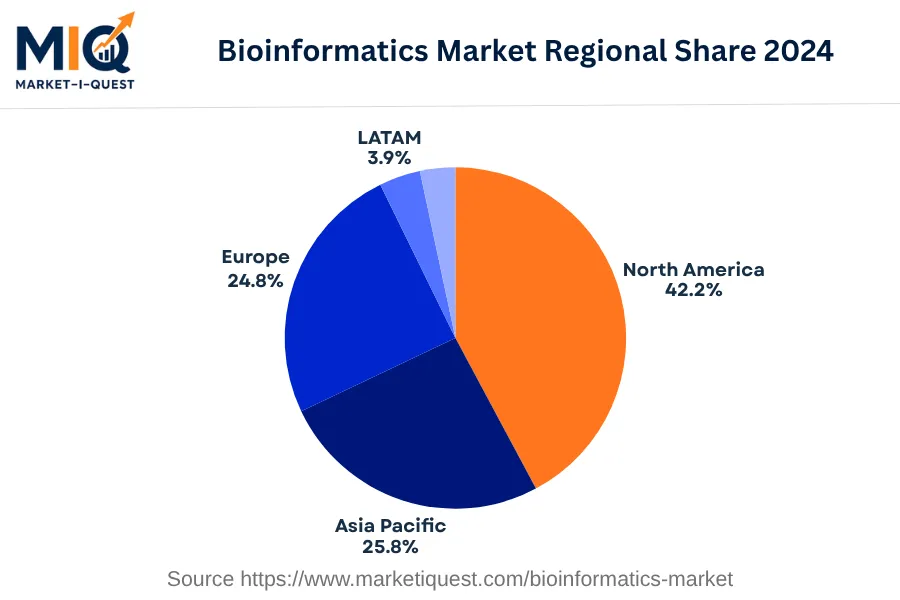
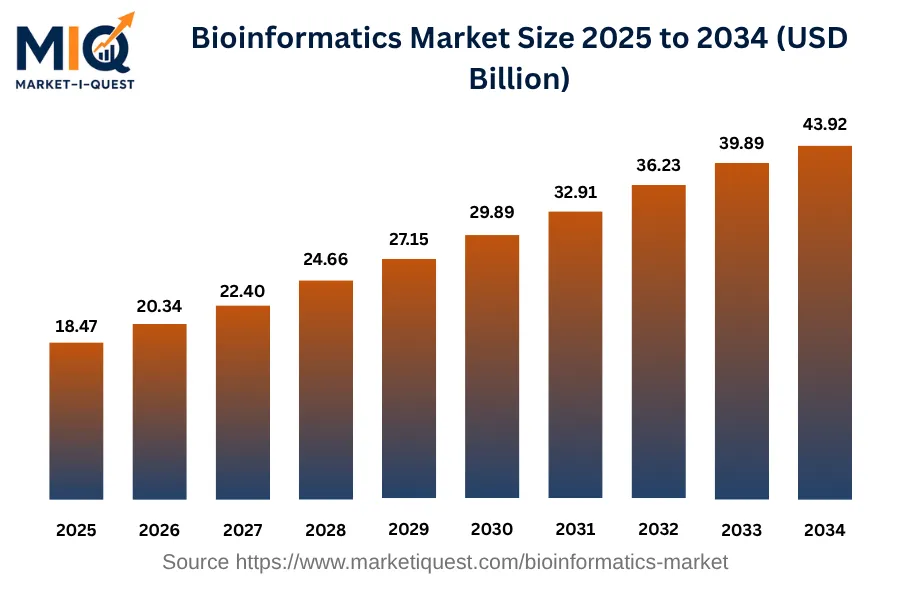
The Bioinformatics Market size was at $18.47 billion in 2025 and is anticipated to rise to $43.92 billion by 2034, growing at a CAGR of 10.1%. This steady growth from $16.78 billion in 2024 indicates an ongoing expansion of the market over a decade. The growth trajectory shows a consistent increase in market value throughout the ten-year period, grounded primarily by the 2025 market value and arriving at the projected 2034 value. The regional distribution of this market in 2024 showed a clear predominance of some regions over others: North America accounted for 42.2% of the market, followed by Asia Pacific with 25.8%. Europe claimed a slightly lesser share with 24.8%. Meanwhile, LATAM and MEA held smaller shares, at 3.9% and 3.3% respectively. These regional shares provide insights into the global spread and acceptance of bioinformatics. However, this data does not suggest any specific regional growth trends over the observed period.

Key Takeaways

  • By Component - Bioinformatics services held the major share accounting for a significant portion in the base year.
  • By Application - Pharmacology led the Bioinformatics market with remarkable contribution in the base year.
  • By End User- Pharmaceutical & Biotechnology Companies leading contributor to the Bioinformatics market in the base year.
bioinformatics-market market size

Key Driving Factors

Prevalence of Chronic Diseases

The prevalence of chronic diseases such as cardiovascular diseases, cancer, and diabetes necessitates the development of new, targeted therapeutic approaches. Bioinformatics plays a critical role here, enabling researchers to understand the genetic and molecular mechanisms underlying these diseases, and thus to identify potential drug targets. For pharmaceutical companies, the analytical power of bioinformatics is indispensable for drug discovery and development. On the clinical side, physicians increasingly rely on genomic information for precision medicine, where treatments are tailored to the individual patient's genetic makeup. Therefore, the need to tackle pervasive chronic diseases is substantially driving the bioinformatics market.

Integration of Artificial Intelligence in Healthcare

The incorporation of artificial intelligence (AI) into healthcare is transforming the field of bioinformatics. AI can analyze massive volumes of data faster and more precisely than human beings, enabling researchers to unearth complex genetic patterns and interactions that would otherwise go unnoticed. This can lead to the discovery of novel biomarkers, which are key in diagnosing diseases early or in predicting disease risk. Besides, AI is being used to streamline the process of drug development, accelerating the journey from biomedical information to valuable therapeutics. AI's growing influence in healthcare represents a considerable driving factor for the bioinformatics market.

Market Evolution by Timeline

2019-2023
During this period, pharma and biotech industries, leading buyers of bioinformatics services, focused on genetic research making North America dominant in market share. Suppliers introduced cloud-based software solutions but integration with existing platforms remained a challenge. US FDA pushed for GxP compliance, influencing software development processes. Subscription-based pricing was the common model with strategic partnerships between tech giants and biotech firms. Data security posed as a significant risk hampering overall expansion.
2024
In 2024, a shift in demand was observed as academic institutions joined the buyer circle in pursuit of personalized medicine research. Asia-Pacific region saw a rise in adoption, driven by India and Japan. Key tech players mediated the integration issue with APIs, while local start-ups struggled. No significant policy shift noted. Pay-per-use model gained momentum, expanding supplier-client base. Yet, capacity building in biostatistics remained a heated concern.
2025-2029
This period saw agrigenomics emerge as the new buyer segment in Europe and Latin America. As AI integrated solutions become prevalent, it addresses scalability restrictions. Regulatory authorities like EMA implemented the 'FAIR' data standards. The tendency towards open-source software affected pricing models and led to partnerships between suppliers and bioinformatics communities. The risk of technology obsolescence was met through regular updates and skill development.
2030-2034
By this time, clinical diagnostics became the key reason for bioinformatics demand with clinics and hospitals as major buyers. The Middle East emerged as a potential market. Advanced algorithms were shipped allowing seamless integrations. ISO introduced standards for AI-powered solutions. Freemium model dominated with add-ons for customization. Undefined IP ownership rules over genetically modified organisms sparked debates and became a potential risk factor.

Future Market Outlook

Future Opportunities

The future of the bioinformatics market appears promising due to ongoing developments in health informatics and regulatory support for personalized medicine initiatives. The U.S. Food and Drug Administration in 2022 released guidelines that encourage the integration of genomic data into clinical settings, promoting personalized medicine solutions. Additionally, collaborations between biotechnology firms and academic institutions are expected to soar, as evidenced by the partnership between Genentech and Stanford University in 2021 focused on biomarker discovery. Regions such as Asia-Pacific, particularly China, are expanding their investments in bioinformatics capabilities; for instance, the Chinese Academy of Sciences established a national bioinformatics center in 2020 to enhance genomic research and applications. Advances in artificial intelligence, as seen in software like DeepVariant developed by Google, are enhancing precision in variant discovery, suggesting a growing market for algorithms that can analyze vast genomic datasets. Moreover, national healthcare strategies, including initiatives from the World Health Organization to bolster genomics research globally, indicate a committed approach towards leveraging bioinformatics for disease prevention and management. This collaborative global framework is likely to lead to tailored healthcare solutions that address specific regional health challenges, integrating bioinformatics into routine clinical practice and opening doors for further innovative applications in diagnostics and treatment.

Segmentation Analysis

By Component

The market is divided into subsegments including Bioinformatics Platforms, Bioinformatics Services, and Bioinformatics Tools & Software. Among these, Bioinformatics Services accounted for the largest revenue share while Bioinformatics Platforms is expected to grow at the fastest CAGR during the forecast period.

Largest Revenue Share

Bioinformatics Services

Market Share Leader

Bioinformatics Services stands as the subsegment that generates the most revenue in the market. This can be attributed to several factors. Foremost, the surge in genomic data has led to increased demand for data analysis and interpretation services. Researchers and pharmaceutical companies find it cost-effective to outsource these services rather than invest in expensive software and skilled personnel. Additionally, bioinformatics services are crucial in personalizing medical treatments, thereby raising their demand in the healthcare sector. Regulations concerning data privacy and the need for efficient data management further boost the requirement for these services. As genome sequencing becomes more common, particularly in developed geographies like North America and Europe, this trend is anticipated to continue. Notably, switching costs are typically low in the bioinformatics services industry, helping maintain a high demand despite the presence of strong competition.

Fastest CAGR

Bioinformatics Platforms

Forecast Period Growth Leader

While generating less revenue than services, Bioinformatics Platforms shows the strongest growth prospects in the bioinformatics market. The growth is largely driven by the advancements in technology, which are making these platforms more accessible and efficient. Additionally, the increasing need for integrated data and the high-throughput of next-generation sequencing (NGS) are propelling their adoption in the market. Partnership among key players in this industry is another significant catalyst for this subsegment’s growth. They are leveraging collaborations to enhance their platforms’ capabilities and make them more reliable and user-friendly. However, high capital expenditure (CAPEX) and the degree of complexity involved in the development of these platforms may hamper growth to some extent. Nevertheless, policies favoring genomic research and the integration of AI in data analysis expect to offset these potential barriers in the near term.

By Application

The market is divided into subsegments including Genomics, Proteomics, Metabolomics, Pharmacology, and others, with Pharmacology holding the largest revenue share, while Genomics is expected to grow at the fastest CAGR during the forecast period.

Largest Revenue Share

Pharmacology

Market Share Leader

In 2024, Pharmacology held the largest revenue share in the Application segment. This prominence is due to the crucial role it plays in drug discovery and development. Moreover, the burgeoning demand for personalized treatment and targeted therapies with greater efficacy and safety profiles directly contribute to the growth of this subsegment. Additionally, the constant technological advancements aimed at accelerating the drug development process are a significant factor propelling revenue growth. This is complemented by the rising prevalence of various diseases worldwide, requiring advanced and fast-acting therapies. Government initiatives to promote research in Pharmacology also add impetus to its growth. Furthermore, the shifting trend towards precision medicine necessitates a comprehensive understanding of Pharmacodynamics and Pharmacokinetics, thereby providing a boost to the Pharmacology subsegment. The growing investment in research and development from both public and private sectors can also be attributed to the significant revenue of this subsegment.

Fastest CAGR

Genomics

Forecast Period Growth Leader

Genomics is projected to experience the fastest CAGR, fueled by the surge in adoption of genomic sequencing for disease diagnosis and precision medicine. The growth drivers for this subsegment include advancements in technology, the decrease in sequencing costs, and the increase in genomic data analysis through bioinformatics platforms. Furthermore, the rise in collaborative initiatives by key players to enhance genomic research is expected to boost the growth of this subsegment. Nevertheless, issues like integration of genomics in clinical practices and interpretation of vast genomic data may pose challenges to the rapid growth. In the near term, data privacy concerns in genomics and regulatory barriers in different regions might affect the CAGR. However, developing policies on data sharing, and the rising emphasis on personalized medicine and genetic research, should likely catalyze the uptake of genomics, securing its fast-paced growth.

By End User

The market is divided into subsegments including Research Institutions, Pharmaceutical & Biotechnology Companies, Healthcare Organizations, and Others. Among these, Pharmaceutical & Biotechnology Companies accounted for the largest revenue share while Research Institutions are expected to grow at the fastest CAGR during the forecast period.

Largest Revenue Share

Pharmaceutical & Biotechnology Companies

Market Share Leader

Pharmaceutical and Biotechnology Companies are known for their significant revenue generation, resulting from their core activities of developing, manufacturing, and marketing of pharmaceuticals and biotech products. With the pursuit of more effective medicines and therapeutic treatments, these companies are significant contributors when it comes to industry revenues. They mostly operate at a global scale which allows them to diversify risk, tap into growing markets especially in emerging economies, and leverage on economies of scale. These companies are backed by well-established and rigorous R&D frameworks, favorable regulation policies, advanced infrastructure, and access to skilled professionals. Moreover, the high pricing of biotech and pharmaceutical products, mainly driven by the cost associated with their development, and the need for potent and effective therapies against various diseases, contribute to the high revenue generation within this segment.

Fastest CAGR

Research Institutions

Forecast Period Growth Leader

Research institutions are poised for the fastest growth rate. These entities are central to the development and innovation of new products or treatments contributing to the overall growth and advancement of the industry. The growth within this sector is primarily driven by increasing global healthcare expenditure, growing emphasis on biomedical research, and the ongoing pursuit for innovative therapeutic methods. Furthermore, intricate collaborations between research institutions and pharmaceutical & biotechnology companies are critical growth catalysts. These partnerships foster the translation of academic research into commercial products, boosting overall market growth. However, it is crucial to monitor the research funding landscape that could pose potential risks to the growth speed. Regulatory hurdles and complexities in research methodologies could also affect the pace of their expansion.

Competitive Analysis

Key Market Players

Manufacturers / OEMs

Thermo Fisher Scientific
US
Illumina Inc.
US
Agilent Technologies
US

Key Suppliers & Raw Materials

Bio-Rad Laboratories Inc.
US
Eurofins Scientific
Luxembourg
QIAGEN
Germany

Distributors, Integrators & Channel Partners

PerkinElmer Inc.
US
Bio-Techne
US
TechData
US

Porter’s Five Forces Analysis

Analysis of the competitive drivers ruling the ever-evolving bioinformatics market landscape.

Supplier Bargaining Power

Medium

Reliant on specialized software and hardware technologies, limiting supplier diversity.

Buyer Bargaining Power

High

Strong buyer power due to varying software solutions and data storage options.

Threat of Substitutes

Low

Unique, scientific, computation-driven applications minimize the threat of substitutes.

Threat of New Entrants

Medium

High investment and expertise barriers, but prospects of profitable returns draw entrants.

Competitive Rivalry

High

Fierce competition due to the rising demand for precision bioinformatics solutions.

Regional Analysis

Geographic market dynamics and growth opportunities across key regions

Global Market Outlook

bioinformatics-market market regional share

North America

In 2024, the North American bioinformatics market is a significant component of the global bioinformatics industry. Three main drivers propel this vibrant sector: technological advancements, increasing demand for bioinformatics solutions in genomics research, and government funding for the life sciences sector. Technological developments in AI and machine learning have catalyzed the expansion of diversified bioinformatics solutions. Increased applications of genomics research in personalized medicine, drug discovery, and agricultural bioinformatics have amplified the demand for efficient data management and interpretation tools. Furthermore, governments in the U.S., Canada, and Mexico have bolstered the market through significant investments in life sciences research.

Several trends have emerged in 2024's bioinformatics landscape. First, there is a noticeable shift among research institutions and pharmaceutical enterprises towards cloud-based bioinformatics solutions for cost-effectiveness and scalability. Second, there is a growing interest in collaborations and strategic partnerships among bioinformatics companies and pharmaceutical firms to speed up drug discovery processes. For instance, the alliance between Genedata and AstraZeneca has proven beneficial. Lastly, there has been a rigorous push towards standardization of bioinformatics software and tools, as seen in the application of Health Level 7 (HL7) standards in genome sequencing data management. This adoption bodes well for the greater integration of bioinformatics in the healthcare sector.

Asia Pacific

In 2024, the Bioinformatics market in the Asia Pacific was characterized by a growing demand for enhanced medical solutions and technological advancement in the sector. The uptake was driven by increasing healthcare expenditure in nations such as China, India, and South Korea, enabling broad adoption of bioinformatics services. Further, regulations like the Digital Healthcare Act in Australia fostered the use of digital platforms in healthcare settings, propelling market momentum. Meanwhile, massive investment inflow into bioinformatics by industry players, notably in China and Japan, boosted the sector's development.

Significant trends in the Bioinformatics market included a shift towards cloud-based solutions in countries like India due to the convenience of remote accessibility. Increasing strategic partnerships and mergers, particularly in the ASEAN market, gained prominence, enabling efficient pooling of resources for optimal results. Furthermore, the intensified focus on personalised medicine in regions like Japan and South Korea pushed the demand for bioinformatics for better diagnosis and treatment. Strict policy enforcement, such as China's Genomic Data Privacy Act, dictated a framework for secure handling of genomic data safeguarding consumer interests. Major customers included healthcare sectors, governmental organizations, and research institutions across the primary markets such as Australia, Japan, China, India, and key ASEAN countries, which utilized bioinformatics for drug discovery, genomic research, predictive modelling, and disease management.
Europe

In the base year 2024, the Bioinformatics market in Europe demonstrated robust growth, driven by a variety of key factors. High demand from the healthcare sector due to the increased relevance of precision medicine, particularly in Germany, the United Kingdom and France, significantly fueled the trend. Regulatory support in these areas, coupled with substantial investments in bioinformatics infrastructure, fostered technology adoption and facilitated supply dynamics. The declining costs of genome sequencing and data analysis further incentivized uptake in these regions.

As an emerging trend, companies have started interweaving artificial intelligence (AI) and machine learning (ML) into bioinformatics platforms. The Nordics, specifically Sweden, stood out for this technological advancement. Moreover, M&A activities spiked, with key enterprises in the UK and Benelux region capitalizing on this trend, aiming to streamline operations and expand offerings. Additionally, stricter policy enforcement regarding data privacy was evident in countries like Italy and Spain. Key customers from sectors including healthcare, pharmaceuticals, and academia formed the bulk of the market demand. These sectors leveraged bioinformatics for personalized treatment, drug discovery, and genomic research. However, the widespread penetration of cloud-based bioinformatics solutions in Central & Eastern Europe, revolutionized data storage and accessibility, revealing a shift towards digital solutions in response to the growing data deluge. Overall, 2024 marked significant shifts and advancements in the European Bioinformatics landscape.

Latin America

In 2024, the Latin American Bioinformatics market displayed significant growth due to heightened healthcare demands and tech adoption. Market drivers included increasing genomics research funded by governments and private entities in countries like Brazil and Mexico, stimulating the demand for efficient bioinformatics services. Moreover, rising chronic disease prevalence in Argentina, Colombia, and Peru necessitated an elevated focus on personalized medicines, which relied heavily on bioinformatics to identify gene-disease correlations. Furthermore, technological advancements and reduced costs promoted by competitive suppliers enabled affordable, high-speed sequencing and data processing capabilities across LATAM nations.

Parallelly, key trends featured shifting customer preferences towards cloud-based bioinformatics solutions for enhanced data accessibility, security, and cost-effectiveness, especially operational in the healthcare and research sectors. Notably, Mexico and Brazil witnessed heightened collaborations between bioinformatics companies and research institutions, fostering a growth-oriented market ecosystem. Simultaneously, patient data privacy regulations, such as the General Data Protection Regulation (GDPR) observed in Chile, enforced strict standards for bioinformatics operations. The increased bioinformatics use in agriculture, particularly in countries like Argentina and Peru, for crop genetic engineering and productivity improvements emphasized sectorial diversity in market adoption. Thus, a holistic focus on genomics research, healthcare demands, technology adoption, and collaborations defined the bioinformatics landscape in the LATAM region in 2024.

Middle East & Africa

In 2024, the bioinformatics market in the Middle East and Africa exhibited a considerable growth dynamic due to various significant drivers and trends. Increasing investment in genomic research, primarily in Saudi Arabia and Israel, fuelled market demand. Healthcare sectors, specifically in the United Arab Emirates and Qatar, adopted advanced bioinformatics technology for better diagnostic and therapeutic solutions. The implementation of supportive government policies in Egypt and South Africa also spurred technological integration in the industry.

Market trends were dominated by the shift towards personal genomics, particularly in nations like Saudi Arabia and Israel with strong healthcare infrastructure. The rising prevalence of genetic diseases in regions like Nigeria and Kenya amplified the need for specialized bioinformatics services, driving a shift in buyer behavior towards genetic testing and genomics. A noticeable trend was the growth in partnerships and M&A, especially in sectors involving government, healthcare, and utilities. In Israel, a substantial number of startups partnered with healthcare facilities to leverage the potential of bioinformatics. Meanwhile, countries including Saudi Arabia and the United Arab Emirates witnessed significant policy enforcement in the realm of data security and privacy, influencing the bioinformatics business environment.

Recent Industry Developments

Latest market innovations, product launches, and strategic initiatives

June 2026

A separate forecast placed the market at USD 38.45 billion in 2026 and USD 118.25 billion by 2034, supported by precision medicine, companion diagnostics, and strategic alliances in pharma and biotech.

February 2026

Bioinformatics market research projected the sector at USD 23.05 billion in 2025, rising to USD 91.95 billion by 2035, driven by genomic research expansion and AI-based biological data analysis.

March 2026

Another market update estimated the bioinformatics market at USD 39.22 billion in 2026 and USD 150.67 billion by 2033, with genomics and bioinformatics platforms leading demand.

Frequently Asked Questions