In-Memory Analytics Market Snapshot

Key Players

  • SAP SE (Germany)
  • Oracle Corporation (United States)
  • Microsoft Corporation (United States)
  • IBM Corporation (United States)
  • Amazon Web Services (United States)
  • Software AG (Germany)
  • Tibco Software (United States)
  • Kognitio Ltd (United Kingdom)
  • Altibase Corporation (South Korea)

Market Size

Base Year 2024
$5.93 Bn
CAGR
21.94%
Forecast 2034
$43.10 Bn

Market Segments

By Organization Size
  • SMEs
  • Large Enterprises
By Application
  • Customer Experience Management
  • Design & Innovation
  • Operational Optimization
  • Marketing Management
  • Real-Time Analysis & Decision Making
  • Others
By Vertical
  • BFSI
  • Retail & E-commerce
  • Government & Defence
  • Healthcare
  • Manufacturing
  • Telcos & ITES
  • Others

Market Dynamics

Drivers
  • Increasing data volume
  • Rapid decision-making requirement
Restraints
  • High implementation costs
  • Limited technical expertise
Opportunities
  • Rising big data trend
  • Increasing demand in real-time data processing

Market Size

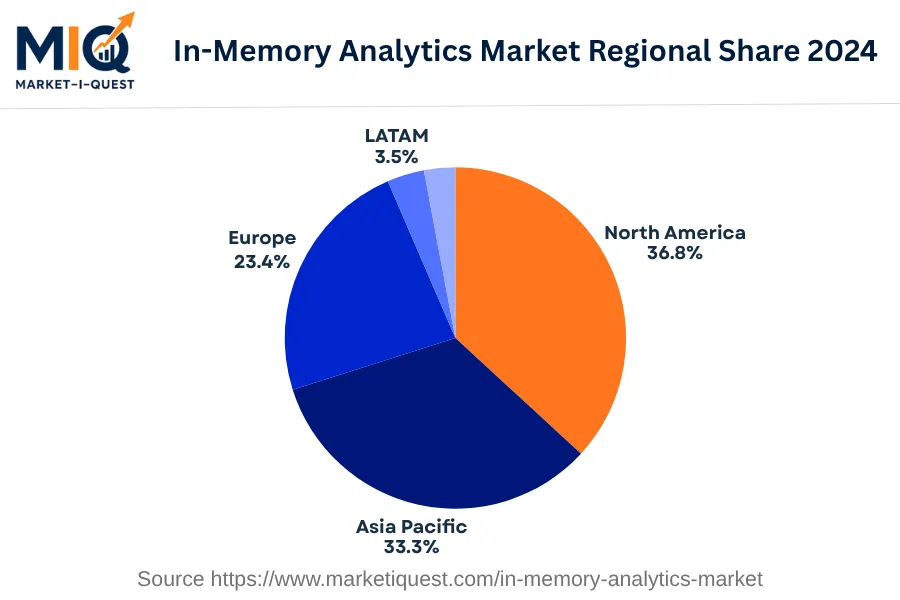
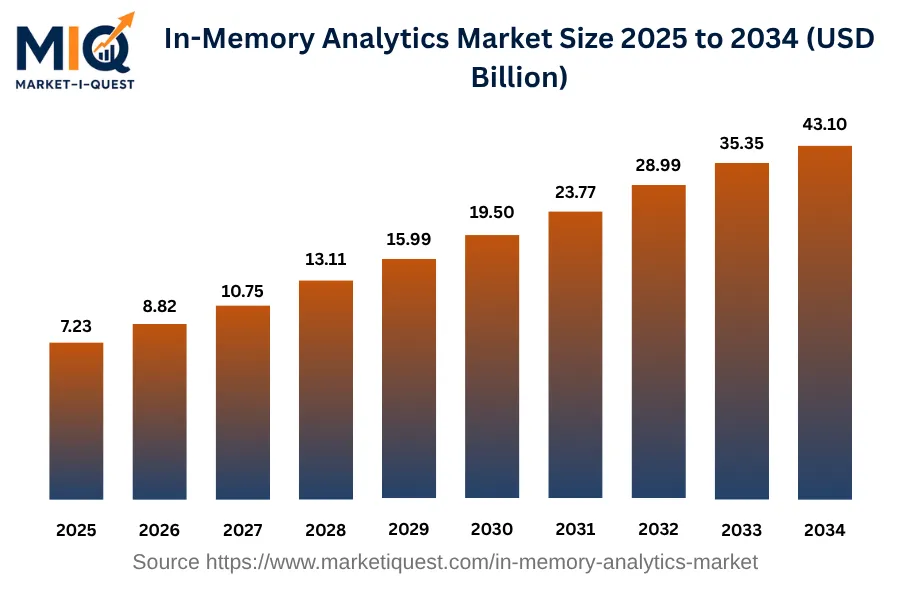
The In-Memory Analytics Market was valued at $7.23 billion in 2025, is expected to grow to $43.10 billion by 2034, at a CAGR of 21.9%. The appreciation in value over these years can be attributed to the increasing demand for self-service business intelligence. Additionally, the need for real-time visualizations of data and faster analytical processing also underpins this growth. Looking at it through a geographical lens, regional shares in 2024 had North America leading with 41.4%, followed by the Asia Pacific at 30.8%. Europe held 21.2% of the market, with Latin America and the Middle East and Africa at 3.1% and 3.6% respectively.

Key Takeaways

  • By Organization Size - Large enterprises dominate this segment owing to their substantial financial resources.
  • By Application - Operational Optimization held the major share accounting for substantial market traction in 2024.
  • By Vertical - Healthcare led the In-Memory Analytics Market in 2024 reflecting strong demand.
in-memory-analytics-market market size

Key Driving Factors

Implementation of Real-time Analysis for Decision Making

Organizations across industries like e-commerce, finance, and health are increasingly applying real-time analysis methods, leading to increased adoption of in-memory analytics. Decision-making processes now more than ever, rely heavily on actionable, real-time data. In-memory analytics tools allow businesses to analyze live data without the restrictions of disk-based storage, thus facilitating immediate insights for proactive decision making. Companies, especially in competitive sectors, leverage this capability to swiftly adapt to changes in market variables and gain a competitive edge.

Upgrading Legacy Systems to Enhance Performance and Efficiency

Companies are moving away from traditional, disk-based database systems and adopting in-memory analytics to increase performance and efficiency. Traditional systems often become bulky and slow, hampering the ability to get analytical results promptly. In contrast, in-memory analytics brings the benefit of processing large volumes of data at a significantly higher speed. This performance enhancement, coupled with the need for industries such as telecommunications and manufacturing to manage and interpret fast-flowing data streams effectively, is driving the migration to in-memory analytics solutions.

Market Evolution by Timeline

2019-2023
Buyers in financial and telecommunication services notably increased demand for In-Memory Analytics (IMA) to expedite customer-related decisions. European businesses led this adoption, owing to regional industrial digitalization policies. Rigorous privacy regulations like GDPR posed constraints on data use, prompting solutions with integrated privacy safeguards. During this period, Oracle Exalytics debuted with claims of real-time decision capabilities, but integration concerns prevailed due to reliance on specific hardware. Subscription-based commercial models dominated, minimizing upfront expenditures. However, unchecked subscription costs became a risk, causing a shift towards pricing models based on usage metrics in latter years.
2024
This year marked the boom of e-commerce and online enterprises exploring IMA to optimize experiences and profits in real-time. Asia-Pacific, particularly China and India, saw demand surge, driven by Internet penetration and a booming digital economy. Major release this year was SAP HANA, promising comprehensive data management and analytics. Despite initial glitches, widespread integrations with complementary technologies like AI and blockchain happened. As for commercial models, revenue sharing agreements occurred where IMA providers received a percentage of profit increases. The major risk was data breaches, which led to rigorous data security standards by businesses and governments alike.
2025-2029
Increased public sector demand for IMA was noted, especially in urban planning and public safety applications in developed economies. There seemed a shortage in supply of custom IMA solutions in this sector. MicroStrategy's HyperIntelligence was well-adopted due to universal integration capabilities with existing systems. As per policy, stringent data residency laws influenced data center locations and service provisions of vendors. Multi-year contract models got popular as organizations sought out strategic partnerships for technological evolution. Cybersecurity remained a risk, with continuous investments in security infrastructure as a typical response.
2030-2034
Healthcare and Life Sciences industries globally increased their IMA adoption for research and patient care optimization purposes. Significant advancements in custom solutions for bio-simulations and patient health-tracking apps were observed. SAS's Visual Analytics became a prominent offering with unique bioinformatics applications. Policy-wise, stringent application-specific privacy regulations influenced IMA adoption in sensitive areas like patient information. We saw tendencies towards value-based pricing by vendors, taking into account customers' achievable profits. Increased scrutiny of bias in AI algorithms using IMA occurred, leading to development of unbiased data training and model building practices.

Future Market Outlook

Future Opportunities

As organizations increasingly depend on data-driven decision-making, future opportunities in the in-memory analytics sector are becoming evident. The ongoing digital transformation across industries, accelerated by the COVID-19 pandemic in 2020, has prompted firms to adopt real-time analytics capabilities, thus highlighting the need for robust in-memory solutions. Leading tech companies such as Microsoft and Oracle are actively enhancing their cloud-based platforms to include in-memory analytics functionalities, indicating where market demand is heading. With regulatory frameworks like ISO 27001 emphasizing data security, there is a growing opportunity for vendors to advance security features within in-memory analytics systems. In 2023, the rise of edge computing will further push the envelope, allowing for real-time analytics closer to data sources, thus making in-memory solutions more relevant. Industries such as manufacturing and retail are already exploring this direction, with case studies illustrating successful applications. In healthcare, initiatives such as the FDA's Real-World Evidence Program launched in 2021, which supports using real-world data for regulatory decisions, represent another fertile ground for in-memory analytics applications. Additionally, partnerships between analytics vendors and software developers to embed in-memory processing directly into enterprise applications are likely to gain traction, reflecting the increasing interconnectedness of technologies that enhances user experience. These dynamics suggest that the in-memory analytics market will continue to evolve in response to real-time data needs, regulatory requirements, and technological advancements.

Segmentation Analysis

By Organization Size

The market is divided into subsegments including SMEs and large enterprises. Large enterprises accounted for the largest revenue share while SMEs are expected to grow at the fastest CAGR during the forecast period.

Largest Revenue Share

Large Enterprises

Market Share Leader

Large enterprises dominate this segment owing to their substantial financial resources, established customer bases, and widespread geographical presence. They are often more capable of sizable upfront investments necessary for sector-specific operations, hence leading to larger revenue. This often leads to procurement of more goods and services, resulting in a greater share of market revenues. They function in multiple countries, gaining access to broader markets, and thus, have a wider distribution network compared to SMEs. Given their size and influence, these companies also have more bargaining power with suppliers, allowing them to negotiate better payment terms, contributing to their financial robustness. Regulatory compliance is also a crucial factor. Large enterprises are often better equipped to navigate complex regulatory landscapes, which can pose challenges for smaller players. Moreover, switching costs for large-scale operations tend to be high, fostering long-term customer relationships and ensuring a steady revenue stream.

Fastest CAGR

SMEs

Forecast Period Growth Leader

The SME segment is projected to witness the fastest growth. As a primary driver, SMEs' nimbleness allows them to adapt quickly to market changes. The rising digital transformation trend among SMEs is another crucial catalyst, as they increasingly invest in modern technologies to stay competitive. The presence of favorable government policies designed to encourage SME growth also acts as a growth propellant. For instance, government-initiated grants, easier access to loans, tax incentives, and support programs push SMEs further along their growth trajectory. It should be noted, however, that SMEs face hurdles such as limited resources, and they may struggle to navigate regulation. Also, these businesses may experience delayed adoption of sector-specific solutions due to cost constraints and lack of skilled personnel. Overcoming these barriers could significantly bolster their growth.

By Application

The market is divided into subsegments including Customer Experience Management, Design & Innovation, Operational Optimization, Marketing Management, Real-Time Analysis & Decision Making, and Others. Operational Optimization accounted for the largest revenue share while Design & Innovation is expected to grow at the fastest CAGR during the forecast period.

Largest Revenue Share

Operational Optimization

Market Share Leader

Operational optimization, considered as the overhaul of business processing and its workflows for embracing simplicity and efficiency, has notably emerged as the major revenue generating subsegment. Companies are prioritizing operational optimization as a strategy to cut costs and improve productivity, particularly in the light of global uncertainties and disruptive trends. Major drivers contributing towards its growth include the rise of AI and machine learning, which are often integrated for process automation, predictive analytics and data-driven decision-making. Furthermore, increasing regulatory pressures, coupled with the surge in demand for streamlined business procedures, are pushing companies to implement operational optimization techniques extensively in their structures. The advent of digital transformation and Industry 4.0 also play crucial roles. Lastly, geographically, developed markets with higher technology adoption rates like North America and Europe are leading contributors to this subsegment's large revenue share.

Fastest CAGR

Design & Innovation

Forecast Period Growth Leader

Despite not earning the highest revenue, Design & Innovation is determined to be the fastest growing subsegment in the market. This is primarily driven by the escalating demand for continuous innovation in products and services, and the realization of design thinking as an effective approach to problem-solving and strategy development. In an increasingly digital world, companies strive to create unique and compelling user experiences to gain competitive advantage, which further bolsters the importance of integrating design and innovation principles. Additionally, advancements in technology, such as connectivity, big data analytics, and AI, are providing new platforms for innovation. Regulatory frameworks encouraging innovation and creative solutions also act as catalysts for growth. At the same time, high initial investments and the challenge of integrating innovative designs into existing systems may pose barriers to adoption. These dynamics signal an upward trajectory for the Design & Innovation subsegment.

By Vertical

The market is divided into subsegments including BFSI, Retail & E-commerce, Government & Defence, Healthcare, Manufacturing, Telcos & ITES, and Others. The Healthcare sector accounted for the largest revenue share while the Retail & E-commerce is expected to grow at the fastest CAGR during the forecast period.

Largest Revenue Share

Healthcare

Market Share Leader

The Healthcare sector leads as the highest revenue subsegment, largely driven by increased government funding and private sector investment. Demand for updated technology and efficient processes within healthcare facilities presents significant revenue opportunities. The proliferation of health data and digital health records has spurred growth and innovation across this sector as organizations look to leverage data for improved patient outcomes. There's a push toward health IT infrastructure development globally, fostering growth in the sector. Technological advancements have also propelled the adoption of digital tools in healthcare, such as telemedicine and remote patient monitoring systems, especially evident in the current pandemic scenario. Purchasing determinants often include return on investment, and the proven ability to improve patient safety and avoid medical errors, thus fueling this segment's growth. The complicated regulatory landscape does pose a challenge, however, continual adherence promotes a competitive market space.

Fastest CAGR

Retail & E-commerce

Forecast Period Growth Leader

The Retail & E-commerce sector is predicted to be the fastest-growing subsegment in the near future. It's driven primarily by the increasing preference for online shopping due to the convenience it provides. The trend of omnichannel retailing, where retailers provide a seamless shopping experience from desktop, mobile, in-store, etc, has been a significant catalyst for growth. Besides, continuous advancements in technology, such as AI, AR/VR, and machine learning, and their integration into the retail ecosystem offer personalized experiences leading to enhanced customer engagement. However, challenges for this segment include maintaining cyber-security and providing a seamless customer experience across all channels. Investments in technologies ensuring secure transactions and improved, intuitive user experience can likely mitigate these challenges.

Competitive Analysis

Key Market Players

Manufacturers / OEMs

SAP SE
Germany
Microsoft Corporation
US
Oracle Corporation
US

Key Suppliers & Raw Materials

Intel Corporation
US
IBM Corporation
US
Micron Technology, Inc.
US

Distributors, Integrators & Channel Partners

Dell Technologies
US
Accenture
Ireland
Capgemini
France

Porter’s Five Forces Analysis

This analysis discerns the competitive dynamics within the In-Memory Analytics Market.

Supplier Bargaining Power

Medium

Availability of various data storage options moderates supplier power.

Buyer Bargaining Power

High

Customers have high bargaining power due to increasing availability of alternatives and low switching costs.

Threat of Substitutes

High

A vast presence of open-source platforms and cloud-based services heightens the threat of substitutes.

Threat of New Entrants

Medium

High initial capital investments and technical expertise requirements pose barriers for new entrants.

Competitive Rivalry

High

Prevalence of prominent players and strong competition in the market signifies high competitive rivalry.

Regional Analysis

Geographic market dynamics and growth opportunities across key regions

Global Market Outlook

in-memory-analytics-market market regional share

North America

In 2024, the In-Memory Analytics Market in North America witnessed exceptional growth and evolution. Key drivers propelling the market include increased demand for advanced analytics solutions across industries, favorable government regulations, heightened investments in data management technologies, burgeoning adoption of cloud-based solutions, and competitive pricing structures. For instance, enterprises in healthcare, manufacturing, and retail sectors exhibited vitally increased adoption of in-memory analytics due to its real-time data processing capabilities that optimize operations. Simultaneously, notable trends underpinning the market transformation include a shift in buyer preference toward automated analytics platforms, the emergence of innovative analytics technologies, dynamic changes in delivery channels, and increasing partnerships and mergers among major market players. Importantly, a growing emphasis on policy enforcement signaled a trend towards the standardization of data analytics.

In the U.S., the retail and enterprise sectors significantly embraced in-memory analytics, motivated by the need for real-time decision making. Similarly, in Canada, industries like healthcare leveraged this technology for swift patient data analysis, pumping the market. The rise in government-led digital initiatives in Mexico also played a crucial role in supplementing the market growth. The collective transformations in these regions underscored the noteworthy development of North America's In-Memory Analytics Market in 2024.

Asia Pacific

In 2024, the In-Memory Analytics Market in Asia Pacific elicited a robust response due to plentiful opportunities for digital transformation. Increased investment from key economic players like China, India, Japan, South Korea, and Australia propelled this growth, driven by a rising need for real-time data processing in sectors such as retail, manufacturing, and utilities. Regulatory pressures in these countries also spurred the adoption of in-memory analytics, as enterprises sought to comply with stringent data management and privacy norms. Significant trends in 2024 centered on the strategic utilization of in-memory analytics tools to enhance user experiences and decision-making processes. Technological shifts highlighted transitions from traditional disk-based storage to memory-centric systems, evident in the expanding digital infrastructure across India and China. Consumer behavior underscored a focus on user-friendly, interactive analytics platforms, triggering an upswing in mobile analytics adoption.

Amongst corporate strategies, the year saw an upsurge in M&A activities, notably in Japan and South Korea, as companies strived for a competitive edge in the evolving technological landscape. Heightened interest from the healthcare and government sectors played a crucial role, as these sectors navigated data management complexities while confronting pandemic-induced challenges. A clear example was Australia's implementation of in-memory analytics in its healthcare services to streamline operations and improve patient care.

Europe

In 2024, the In-Memory Analytics Market in Europe showed strong growth driven by several key factors and trends. Investment in digital transformation, the demand for real-time analytics, and regulatory requirements for data privacy were significant drivers. Enhanced focus on operational efficiency and cost-effectiveness led enterprises across sectors, such as manufacturing, healthcare, and retail, to adopt this technology. Moreover, stringent data protection regulations, such as GDPR, spurred businesses to invest in secure, in-memory analytics solutions to ensure compliance. Emerging trends in 2024 included a shift in buyer behavior, as companies increasingly sought custom, industry-specific solutions. This resulted in increased partnerships and M&A, with tech companies collaborating to provide tailored services.

Simultaneously, the standardization of in-memory analytics tools led to wider adoption, especially in government and utility sectors, which require efficient data management. Furthermore, policy enforcement played a vital role. For instance, data localization laws in Germany and France emphasized the need for robust in-memory analytics, driving market growth in those countries. Also, in Central and Eastern Europe, businesses were keen on adopting advanced technologies, resulting in increased demand for in-memory analytics. Benelux and the Nordics also experienced significant growth due to their mature IT infrastructure and high rate of digital transformation.
Latin America

In 2024, the In-Memory Analytics market in Latin America has seen a dynamic expansion, particularly in countries like Brazil, Mexico, Argentina, Colombia, Chile, and Peru. Key drivers include the increased demand for advanced real-time analytics by enterprises and governments to improve decision making, and the growing investment in advanced technologies across sectors such as healthcare, utilities, manufacturing, and retail. Regulatory changes and technology adoption have ushered in a surge in big data applications, pushing the need for in-memory analytics in this region.

Market trends point to a shift in buyer behavior towards cloud-based in-memory analytics solutions, reflecting a broader move towards cloud computing across various sectors. Product shifts indicate a growing preference for integrated solutions that offer in-memory analytics together with AI and machine learning capabilities. In terms of channel dynamics, there was a rise in partnerships between local and international tech companies in 2024, boosting the availability and accessibility of in-memory analytics solutions in the LATAM market. Lastly, governments' enforcement of data protection policies has positively influenced the in-memory analytics market, compelling companies to invest in secure, efficient data processing solutions and in turn, propelling market growth.

Middle East & Africa

In 2024, the In-Memory Analytics Market in the Middle East and Africa saw robust growth. Driving factors included heightened demand for real-time data processing and analysis in critical sectors such as government, utilities, oil and gas, and telecommunication. Additionally, regional initiatives like Saudi Vision 2030 promoted technology adoption, offering fertile ground for in-memory analytics market expansion. Investment in digital infrastructure, especially in UAE, Qatar, and South Africa, further stimulated market growth. On the supply side, lowered costs of memory devices resulted in favourable pricing dynamics, propelling market penetration.

Trends observed in the market showed significant changes in buyer behavior. There was a notable shift towards preference for in-memory analytics solutions, emanating from a need for faster, data-driven decision making in sectors such as healthcare, manufacturing and financial services. Major telecom players in Egypt and Nigeria forged strategic partnerships for enhanced in-memory analytics capabilities to deal with the growing volume of data. Additionally, a high degree of policy enforcement was witnessed around data security standards, particularly in South Africa and Israel, steering organizations towards adopting advanced in-memory analytics solutions to ensure compliance, which further underpinned trends in the market in 2024.

Recent Industry Developments

Latest market innovations, product launches, and strategic initiatives

May 2026

SAP SE announced an agreement to acquire Dremio, a high-performance data lakehouse platform, to enhance its Business Data Cloud capabilities. The acquisition, subject to regulatory approval, is expected to close in Q3 2026. By integrating Dremio, SAP Business Data Cloud will transition into an Apache Iceberg-native lakehouse, eliminating the need for data movement or format conversion. The platform leverages the SAP HANA Cloud in-memory engine for operational performance. SAP committed to maintaining Dremio's role as a steward of open-source projects like Apache Iceberg, Arrow, and Polaris.

October 2025

MariaDB plc announced a definitive agreement to acquire GridGain Systems, Inc., the pioneer of in-memory computing and the force behind Apache Ignite. The deal combined MariaDB's relational database platform with GridGain's in-memory technology to create "sub-millisecond data infrastructure for the agentic era". Financial terms were not disclosed.

Frequently Asked Questions