
Omnichannel Retail Market Snapshot

Key Players

  • Amazon.com Inc (United States)
  • Walmart Inc (United States)
  • Alibaba Group (China)
  • Zalando SE (Germany)
  • JD.com Inc (China)
  • Shopify Inc (Canada)
  • Marks & Spencer Group Plc (United Kingdom)
  • Nordstrom Inc (United States)
  • eBay Inc (United States)
  • MercadoLibre Inc (Argentina)

Market Size

Base Year 2024
$ 9.63 Bn
CAGR
16.52%
Forecast 2034
$ 44.46 Bn

Market Segments

By Component
Hardware, Software, Services
By Channel
Online, Offline
By Deployment
Cloud, On-Premises
By Enterprise Size
Large Enterprises, Small and Medium Enterprises
By End Use
FMCG, Apparel & Footwear, Consumer Electronics, Hospitality, Others

Market Dynamics

Drivers
  • Increased consumer expectations
  • Technological advancements
Restraints
  • High implementation cost
  • Reluctance to change existing systems
Opportunities
  • Digital technology transformation
  • Emergent economies' consumer bases

Market Size

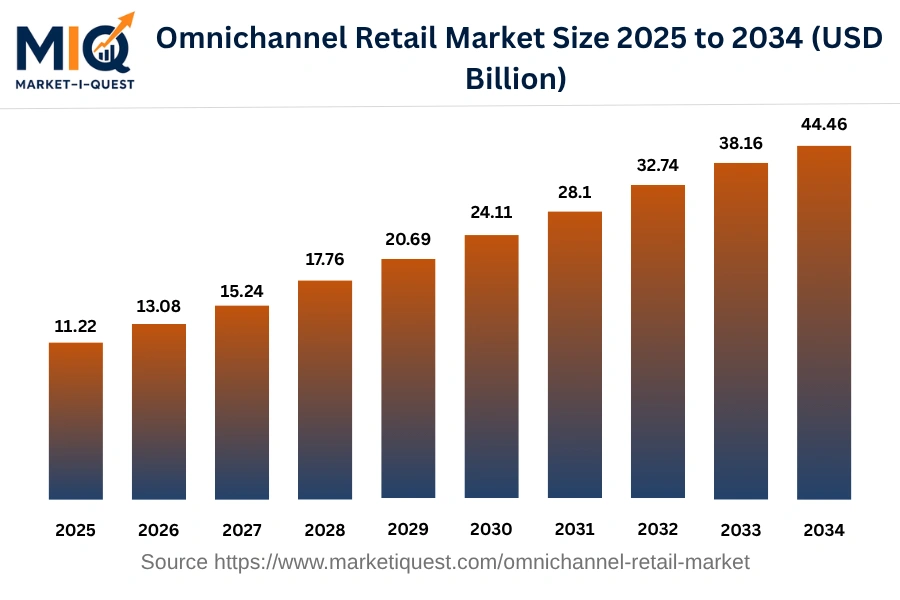
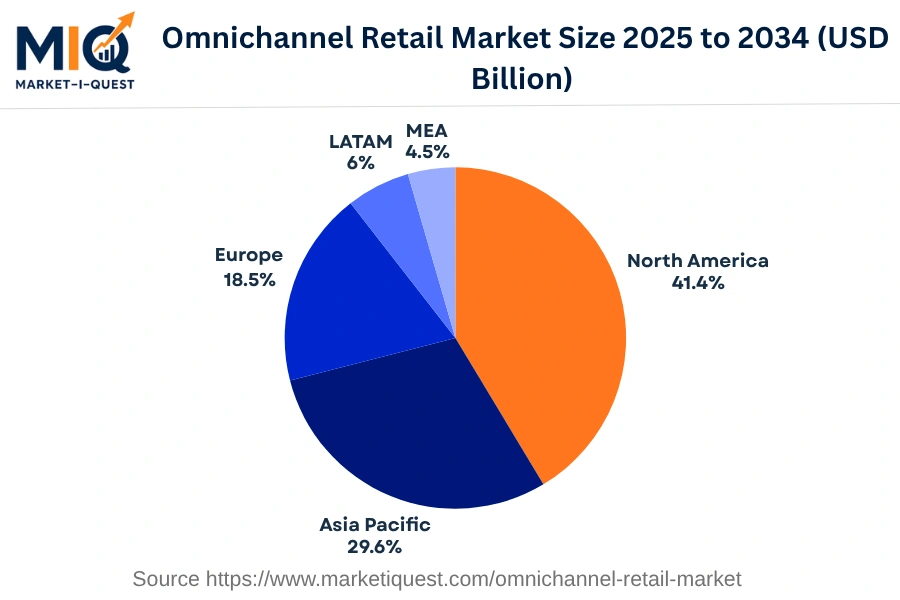
The Omnichannel Retail Market share was valued 11.22 billion USD in 2025. By 2034, the market is projected to reach 44.46 billion with a compound annual rate (CAGR) of 16.5%. The essential factor impacting the growth trajectory was the shift in user shopping preferences which resulted in boosting market value. The period of 2025 to 2034 is seen as the period for expansion in growth, in this period the market grew by 33.24 billion USD with 3.69 billion as an average growth within a year. The regional share in 2024, North America held the largest share at 41.4%, followed by the Asia Pacific at 29.6%. Europe share at 18.5%; whereas, Latin America and the Middle East and Africa accounted for shares at 6.0% and 4.5%.

Key Takeaways

  • By Component - Hardware led the pack accounting for the largest share in the base year.
  • By Channel - Online segment held the majority share in the base year indicating a shift in customer preferences.
  • By Deployment - On Premises solutions expanded at the fastest pace accounting for the highest CAGR during the forecast period.
  • By Enterprise Size - Large Enterprises dominated the market holding the major share in the base year.
  • By End Use - Consumer Electronics led in terms of usage accounting for the leading position in the base year.
omnichannel-retail-market market size

Key Driving Factors

Customer Expectation for Seamless Shopping Experience

The shift in customer expectation acts as essential factor in driving the Omnichannel Retail Market growth. Modern consumers are more used to digital platforms which allows consumers to shop anytime, anywhere. The consumer demand is for a consistent, uninterrupted and flexible shopping experience across multiple channels. Through various platforms such as internet, smartphones or retail stores. The consumer expectations towards retailer are remembering preferences, purchase history and offering personalized recommendations. This type of experiences are efficiently provided by reliable omnichannel strategies with effectively integrating different shopping channels. Unable to meet these expectations can result in customer dissatisfaction and loss of business. Therefore, the need to meet evolving customer expectations is demanding businesses to adopt omnichannel retail strategies.
Retailer's Need for Better Data Integration and Analytics

Another driving factor for the Omnichannel Retail Market growth is the need for an advanced data integration system. Due to the collection of vast amounts of data from multiple sources such as physical stores, e-commerce sites, social media etc. The traditional approach for operating these channels lack the ability to effectively integrate and analyze these data points. An efficient omnichannel strategy allows for integration of data across channels, providing retailers with valuable findings about consumer behavior, preferences and loyalty. Leveraging these insights allows retailers to manage personalized shopping experiences leading towards higher retention rates and increased sales. Therefore, the requirement for improved data analytics through better data integration is driving the adoption of omnichannel retailing.

Market Evolution by Timeline

2019-2023
During this period, major retailers in North America and Europe integrated their distribution channels monitoring investments in logistics integration. Higher adoption of internet and smartphone usage in these regions accelerated towards this shift. Asia saw delayed adoption due to lack of internet access but ‘Singles Day’ event in China showed increased integration towards both digital and physical retail market. Implemented technologies mainly consist of cloud-based retail solutions and targeted advertising systems. A lack of robust technology integration acted as a barrier. Whereas, the adoption of GDPR by EU affected procedures such as handling customer data, forcing changes in online marketing strategies. Most common pricing models were subscription-based or fixed rate. Major risks included data breaches and privacy concern with increased cybersecurity investments.
2024
In 2024, demand for omnichannel retail increased significantly in markets including India, Southeast Asia and Latin America due to the rapid growth towards internet and smartphone adoption. The adoption of AI and machine learning technologies increased personalisation for consumer engagement with creating new efficiencies for supply-chain. Regulatory attention boosted as governments concerns increased towards data privacy with laws similar to the California Consumer Privacy Act appearing globally. Various models such as Pay-per-use pricing models were introduced, but the majority of businesses still used traditional pricing models. Cybersecurity threats remained a concern, driving substantial investments in data security infrastructure.
2025-2029
This period saw an increased adoption of omnichannel retail market within Asia-Pacific with attributing in increased digital infrastructure maturity. Various technological advancements such as augmented reality (AR), voice-enabled shopping and blockchain for visibility in supply-chain. Google's Local Inventory Ads initiative played a major role during this period. During broad adoption of Right to Repair laws market faced several challenges affecting manufacturer exclusive control over repair information. While commercial models, many businesses adopted robust pricing influenced by demand and competition. Data privacy issues and technology integration mismatches were the primary risks encountered.
2030-2034
The integration of offline and online channels became global with Africa being the main exception. Various technologies including Internet of Things (IOT) and 5G been commonly used by retailers and growing use of green tech in logistics and supply chains. Large-scale programs such as Amazon's Virtual Changing Room majorly influenced shopping experiences. With regulation focused privacy become stricter, majorly in Europe with potential GDPR successors, retailers have to adapt the updated standards. Retailers commonly utilized robust pricing models driven by data, leading to increased price competition. Cybersecurity remained a continued risk, along with reducing the increasing carbon footprint of digital technologies.

Future Market Outlook

Future Opportunities

As physical and digital retail continue to work together, various businesses have major omnichannel retail market opportunities for growth by adopting recently used effective strategies. In 2022, Target launched its same-day delivery service driving an increased satisfaction and engagement for the customers in urban areas. Companies are actively analyzing innovative logistics as observed in Amazon’s investment in drone delivery from 2020, which could result in acceleration in order fulfillment and enhance customer service. Also, the shifting expectations of consumer, brands can capitalize on social commerce model significantly popularized by platforms like Instagram and TikTok within the past few years allowing social media to perform direct transactions. The focus on sustainable practices are noticeable with various organizations including Unilever are integrating to reduce their environmental impact by 2025 as a trend that could transform inventory and supply chain management. By considering the 2023 rise for remote works, retailers are likely to integrate their strategies to focus on suburban locations or local stores for attracting customers with shifted shopping behaviors. The current focus on personalization is supported by advanced data analytics which will help retailers for personalizing the offerings with enhancing consumer loyalty. Collaborative partnerships such as the recent collaboration between Shopify and Google Cloud announced in late 2023 shows a rising trend towards creating more integrated platforms that optimizes the consumer experiences.

Segmentation Analysis

By Component

The market is divided into subsegments including Hardware, Software, and Services. Hardware accounted for the largest revenue share, while Services is expected to grow at the fastest CAGR during the forecast period.

Largest Revenue Share

Hardware

Market Share Leader

The Hardware subsegment is currently leading the market revenue due to several factors. Hardware applications are essential without hardware the functionalities of software and services will remain unexpressed. Hardware components are the essential for building blocks of IT structure, creating significant demand in the market. Hardware plays a crucial role for driving high revenue, considering the requirement for regular upgrades and replacements can be up-to-date with technological advancements. The purchasing criteria depend upon the durability, quality, ease-of-integration and cost-effectiveness for these parts. Regions with high economic growth, particularly Asia Pacific and North America, represents as key markets for the hardware subsegment due to the rapid digitalization and technological innovations. Regulatory standards enforcing specific hardware requirements also contribute to the revenue portion. Also, the switching costs for hardware components can be significant, creating a barrier for other subsegments to match its revenue.

Fastest CAGR

Services

Forecast Period Growth Leader

The Services subsegment is forecasted to witness the fastest growth rate in the segment. This can be attributed to the growing requirement for technological support and network services, particularly in industries are evolving towards digital transformation. For instance, the more digitized an organization becomes, the dependence increases on various services for smooth operation. The increasing adoption of cloud computing and Internet of Things (IoT) network are driving growth within the segment. Also, the requirement for services provides increased customization, integration, and maintenance. In particular, post-sale services including customer support and regular system maintenance are essential, especially for companies without a particular IT department. The rise of strategic partnerships particularly for driving innovation and gain large-scale customer represents as a major driver for growth within the sector. Even with growing Omnichannel Retail market opportunities with several risks could include the potential for cyber threats and data breaches.

By Channel

The market is divided into subsegments including online and offline channels. The online subsegment accounted for the largest revenue share in 2024 while the offline subsegment is expected to grow at the fastest CAGR during the forecast period.

Largest Revenue Share

Online

Market Share Leader

In the base year 2024, the online channel emerged as the leading contributor of revenue. This can be attributed to increased expansion of internet and the widespread adoption of e-commerce. The integration of smartphones has made it convenient for consumers to purchase products online, which has increased the growth of this subsegment. The online channel adoption can be credited to the broad availability of product range, competitive pricing, and personalization in customer experiences driven by advanced analytics. Additionally, because of the COVID-19 pandemic, consumers have become more adapted to online shopping, leading to a significant growth in online sales. Developed regions with high internet integration and digital literacy, such as North America and Europe significantly contributes to the revenue. However, increased connectivity and the acceleration of smartphones in developing countries are creating online channels increasingly popular in these regions, contributing to the growth of segment.

Fastest CAGR

Offline

Forecast Period Growth Leader

The offline channel is projected to be the fastest growing subsegment. The main growth driver for the offline channel is the 'touch-and-feel' factor, which is a major purchasing driver for many customers. In certain industries and product categories which require high customer engagement, offline channels will continue to dominate. Also, offline channels leads in providing immediate fulfilment allowing consumers to take the product home immediately. Various personal interaction and trust-related relationships can easily and sustainably developed through offline stores which attracts specific demographic segments. The deployment of technologies such as AR/VR in physical stores to enhance customer experience and strategic partnerships are also driving offline growth. However, high real estate and operational costs can be represented as short-term risks to the offline segment.

By Deployment

The market is divided into subsegments including Cloud and On-Premises deployment. In base year 2024, On-Premises accounted for the largest revenue share while Cloud is expected to grow at the fastest CAGR during the forecast period.

Largest Revenue Share

On-Premises

Market Share Leader

The On-Premises subsegment has emerged as a significant revenue driver in 2024. This can be attributed to a higher level of control provided to the organizations across their data and systems. On-Premises deployment assure companies of the information stored within the physical boundaries of their office premises, thereby reducing external security risks. It also eliminates their dependency on the internet for accessing their data and systems, making operations smoother and reliable. The rising and quick adoption of On-Premises deployment in developing regions is another factor driving the revenue growth. Sector-specific regulations integrating data storage within certain regions have further driven the preference for this model. The key purchasing criteria for this case involves aspects such as security, control, and compliance to local regulations.

Fastest CAGR

Cloud

Forecast Period Growth Leader

The Cloud subsegment is projected to grow at an impressive CAGR. Significant drivers for this growth include reduced infrastructure costs, high-scalability, and easy accessibility from any regional location. These are the advantages that make Cloud deployment is an engaging offering, particularly for small and medium enterprises (SMEs). The growth within digital transformation across industries is further driving the adoption of Cloud solutions. However, it is a requirement to validate certain adoption barriers particularly for data security concerns and regulatory compliance issues especially with cross-border data transfers. Encouragingly tech advancements like encryption and tokenization are optimizing these security concerns and partnerships with local players are addressing regulatory issues. A driver to this growth trajectory is the increasing capital expenditure on IT infrastructure and digital technologies. Near-term risks include interruption in services due to internet connectivity issues and potential data breaches.

By Enterprise Size

The market is divided into subsegments, including Large Enterprises and Small and Medium Enterprises. Large Enterprises accounted for the largest revenue share, while Small and Medium Enterprises are expected to grow at the fastest CAGR during the forecast period.

Largest Revenue Share

Large Enterprises

Market Share Leader

Large Enterprises hold the majority of the market share due to factors such as their numerous resources, market presence and ability to adopt the newest technologies globally. Higher purchasing power allows these enterprises to invest in advanced strategies, innovation and employee training. This usually helps their competitiveness and boosts their market segment. They have the resources with capability to adapt quickly to changing market, making them the key drivers of the market segment. Regular and high volume purchasing contributes significantly to their large revenue. Furthermore, Large Enterprises often benefit from the capacity to validate regulatory fines with meeting compliance requirements due to their vast resources and established systems. Geographically, Large Enterprises tend to have a wide reach and a more diversified customer base.

Fastest CAGR

Small and Medium Enterprises

Forecast Period Growth Leader

Small and Medium Enterprises (SMEs) subsegment is projected to grow with a rapid CAGR due to several driving factors. The increasing global adoption of digitalisation has opened a broader market for SMEs. Many SMEs have proven to be more flexible for adopting technology faster to accelerate their growth with staying competitive. Barriers for SMEs are also reducing due to favorable policies, grants and schemes designed to encourage growth and reinforce their contribution to the economy. Start-up culture and easily accessible capital have also drove the formation and swift expansion of SMEs. However, the subsegment continues to face challenges, particularly surrounding regulatory compliance due to limited resources. Fluctuating economies and uncertain markets can also represents as near-term risks to the growth trajectory of SMEs.

By End Use

The market is divided into subsegments including FMCG, Apparel & Footwear, Consumer Electronics, Hospitality, and others. In the base year of 2024, the Consumer Electronics subsegment accounted for the largest revenue share while the Hospitality industry is predicted to grow at the fastest CAGR during the forecast period.

Largest Revenue Share

Consumer Electronics

Market Share Leader

In 2024, the Consumer Electronics subsegment projected as the largest revenue segment in the market. This could be attributed to several factors such as technological advancements, active consumer trends, and the consistent requirement for innovative products. With the expansion of technology and digital platforms, electronic devices have systematically interconnected with daily lives of consumer. From communication and entertainment the role of electronics remains crucial. The expanding population and growth in middle class, particularly in emerging economies have expanded the consumer base for electronic products. Also, the rise in expandable income has significant contribution in the sales of consumer electronics. Due to continuous updates on existing products and the launch of new innovative gadgets have drove consistent growth. Expanding and efficient global distribution channels both combined with strong dealership networks have fueled easy accessibility and availability of products in remote areas.

Fastest CAGR

Hospitality

Forecast Period Growth Leader

The Hospitality industry is expected to grow at the fastest pace in the coming years. This growth projection is founded on the preparedness of recovery from the recent global health crises and the growing interest for travel and hospitality. The recovery will be boosted by robust measures for prevention of infection, launches of vaccination and regaining consumer confidence. Increasing international tourism due to the easing of travel restrictions combined with the rise in domestic travel are projected in contributing to its accelerated growth. Technological advancements contribute to the faster CAGR with the digital transformation of hospitality services, such as online bookings, virtual tours and touchless check-ins, customer service has become more efficient and convenient creating competitive advantages for providers who adopt these technologies.

Competitive Analysis

Key Market Players

Manufacturers / OEMs

SAP SE
Germany
Oracle Corporation
US
IBM Corporation
US

Key Suppliers & Raw Materials

Cisco Systems, Inc.
US
HP Development Company, L.P.
US
Dell Technologies Inc.
US

Distributors, Integrators & Channel Partners

Adobe Systems Incorporated
US
Microsoft Corporation
US
Cognizant Technology Solutions
US

Porter’s Five Forces Analysis

This analysis uncovers the competitive intensity and attractiveness within the Omnichannel Retail Market.

Supplier Bargaining Power

Medium

Diverse supplier base but major players often have significant bargaining power.

Buyer Bargaining Power

High

Buyers have high switching capability with multiple omnichannel retailers available.

Threat of Substitutes

Medium

Brick-and-mortar and pure e-commerce can be alternatives, although less convenient.

Threat of New Entrants

Medium

Entry requires significant capital, market comprehension, and technological capability.

Competitive Rivalry

High

Intense competition with major players constantly innovating to provide superior customer experience.

Regional Analysis

Geographic market dynamics and growth opportunities across key regions

Global Market Outlook

omnichannel-retail-market market regional share

North America

The North American omnichannel retail market share in 2024, is a combined framework of physical and digital experiences for satisfying the customer needs. The rapid digital transformation due to shift in consumer behaviour also with increased investments in omnichannel strategies and rising adoption of cloud based technologies primarily drove the market. Customers from various region like the U.S. and Canada increasingly preferred purchasing through multiple channels. This shift demanded brands for creating combined trends for both online and in-store. Due to growth in competition delivering speed played a crucial role especially in the U.S. where technological advancements optimized logistics operations escalating the supply dynamics.

In terms of Omnichannel Retail market trends, the region is focused on enhancing the customer engagement, driving the adoption towards various solutions like click-and-collect systems and mobile-based shopping applications. Technological innovations, especially in artificial intelligence (AI) and machine learning (ML) have played a major role in personalizing shopping experiences across sectors such as healthcare and retail, particularly among leading U.S and Canadian enterprises. Meanwhile, in Mexico, partnerships and mergers between eCommerce platforms and physical retailers has shaped the market, allowing channels to expand their reach. QR codes also emerged as a key tool for connecting offline to online within this omnichannel combined, providing customers with easy access to product information and promotions.

Asia Pacific

In 2024, the Omnichannel Retail Market analysis represents Asia Pacific experienced increased growth, driven by increasing interest in regions such as China, India, Japan, South Korea, and key ASEAN markets.
Due to the increasing digital maturity in consumers resulted rising requirement in the regions such as China and India where adoption of advanced technology mainly by middle class segment with increasingly engaging in online shopping activities. While regulatory policies promoted digital payments. New Payments Platform in Australia led the consumer confidence and market growth. Investment from enterprises and increased technology adoption across Asia Pacific, specifically the adoption of AI and data analytics in Japan and South Korea boosted supply capabilities and customer experience.

Emerging Omnichannel Retail market trends included the rising interest in mobile commerce influenced by a shift towards smartphone usage in major markets. The adoption of ‘phygital’(combined physical and digital) shopping experiences are transformed by channel behaviour, observed in the retail strategies of companies in ASEAN markets. Rise in mergers and acquisitions, notably Tencent's acquisition of a share in JD.com, indicating rush towards building omnichannel capacities. The enforcement towards strict data protection and privacy standards across the region, such as the Personal Data Protection Act in Singapore encouraged customers and maintained the integrity of omnichannel platforms. The market growth was prominently registered across sectors including enterprise, retail, healthcare, and manufacturing.

Europe

In 2024, the omnichannel retail market in Europe experienced a substantial growth driven by consumer requirement for smooth shopping experiences and technological advancements. The widespread usage of smartphone boosted the digital literacy throughout the continent. In Germany and United Kingdom the customer interest increased towards around-the-clock access of products. The digital transformation across retail sectors in France and Italy with the regulatory support drove the market growth. Additionally, rising reach of e-commerce across Spain, the Nordics, Benelux and Central & Eastern Europe boosted omnichannel strategies, driving supply chain innovations and competitive models pricing.

Key market trends include a model shift towards customer-related retail strategies, drove by leading retailers in the UK and Germany. Adoption of technologies like AI and data analytics accelerated, transforming inventory management and product recommendation systems throughout sectors. Meanwhile, strategic partnerships were pursued by retailers and technology firms to integrate online with offline, highlighted by the French and Spanish markets. Enforcement of data privacy and security regulations impacted the market and shifted consumer buying behavior and determined retailer operations across countries.

Latin America

In 2024, the Omnichannel Retail Market demand in Latin America represents essential shift towards digital consumer engagement. The market is driven by increasing adoption of internet services and smartphones. Additionally, accelerated by post-pandemic recovery. Regulatory policies such as "Digital Argentina Program" in Argentina and support for digital infrastructure in Mexico with encouraged investments and technology adoption. Local supply chain dynamics in Brazil and Mexico have aligned price reduction and boosting market accessibility.

Changing customer interests indicates a key trend influencing the market with consumers in countries such as Colombia, Peru, and Chile increasingly preferring smooth online-offline retail experiences. The dominance of digitization in retail is shifted towards innovative product and technology. More retailers are integrating engaging technologies like virtual reality to enhance shopping experiences with partnering and M&A activities are expanding among retail, tech and logistics firms to create complete solutions. The enforcement of policies such as General Data Protection Law in Brazil has ensured a secure environment for data-intensive retail operations, reshaping engagement standards and consumer trust.

In 2024, key successors of these developments include sectors such as enterprise, healthcare, and manufacturing but also traditional retail stores that adapt to an omnichannel approach. This development in the LATAM Omnichannel Retail market represents a significant shift in regional consumer engagement dynamics.

Middle East & Africa

In 2024, the Omnichannel Retail market expansion in the Middle East and Africa (MEA) was marked by increased digitalization and customer interests for an enhanced shopping experience. Safety regulations due to the global pandemic shifted towards growth in e-commerce making online-offline integration crucial for retailers within countries like the United Arab Emirates, Saudi Arabia, and South Africa. Investment in technology adoption strengthened with retailers in Egypt, Nigeria, and Kenya developing their digital platforms for uninterrupted omnichannel operation. Innovative supply behaviour was introduced to ensure efficient home deliveries and point-of-transfer pick-ups, affecting pricing structures across the region.

In 2024, online shopping gained consumers trust, driving a shift in buyer behavior across MEA, particularly in markets like Israel and Qatar. Retailers recognized the potential of mobile shopping and prioritized mobile-friendly platforms and applications. Partnerships surged as retailers aligning payment solutions and logistics providers to ensure a smooth omnichannel experience. Policy enforcement around data security became crucial, affecting B2C operations across sectors, majorly in government regulated purchases, telecom and financial services.

Recent Industry Developments

Latest market innovations, product launches, and strategic initiatives

May 2026

French family fashion retailer Gémo integrated Algolia's AI-powered search and retrieval platform to enhance its omnichannel customer experience. The implementation aims to build a more intuitive, seamless search journey for customers across digital touchpoints to handle their massive product catalog efficiently.

April 2025

Meta unveiled new "omnichannel ads" as part of its advertising suite. This new ad format helps brands seamlessly bridge the digital and physical divide by showcasing ads that highlight local product availability and store locations to users most likely to shop in-store.

January 2025

Riskified and Appriss Retail formed a strategic partnership to combat the growing challenges of omnichannel fraud and policy abuse. The collaboration integrates comprehensive data on consumer shopping patterns across the entire buying journey.

Frequently Asked Questions