
Enterprise Application Market Snapshot

Key Players

  • SAP SE (Germany)
  • Oracle Corporation (United States)
  • Microsoft Corporation (United States)
  • IBM Corporation (United States)
  • Salesforce.com Inc. (United States)
  • Workday Inc. (United States)
  • ServiceNow Inc. (United States)
  • Infor Inc. (United States)
  • Adobe Systems Incorporated (United States)
  • Alibaba Cloud (China)

Market Size

Base Year 2024
$315.95 Bn
CAGR
11.24%
Forecast 2034
$916.70 Bn

Market Segments

By Product
  • Customer Relationship Management (CRM)
  • Supply Chain Management (SCM)
  • Business Intelligence (BI)
  • Business Process Management (BPM)
  • Content Management System (CMS)
  • Enterprise Resource Planning (ERP)
  • Others
By Deployment
  • Cloud
  • On-Premise
By End Use
  • IT & Telecom
  • BFSI
  • Retail
  • Government/Public Sector
  • Energy & Utilities
  • Healthcare
  • Others

Market Dynamics

Drivers
  • Rising demand for real-time data access
  • Increasing adoption of cloud-based solutions
Restraints
  • High implementation costs
  • Security and privacy concerns
Opportunities
  • Rising demand for real-time data access
  • Increasing adoption of cloud-based solutions

Market Size

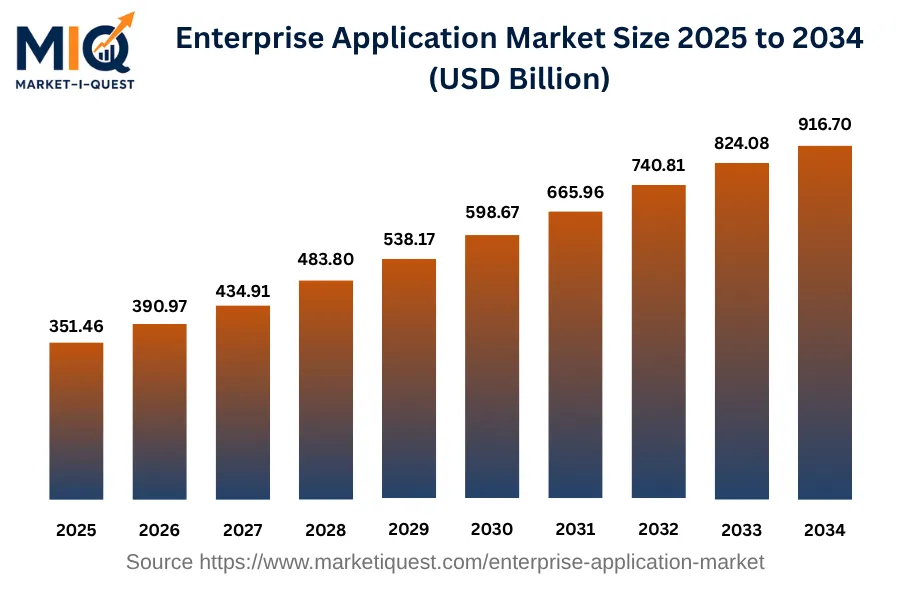
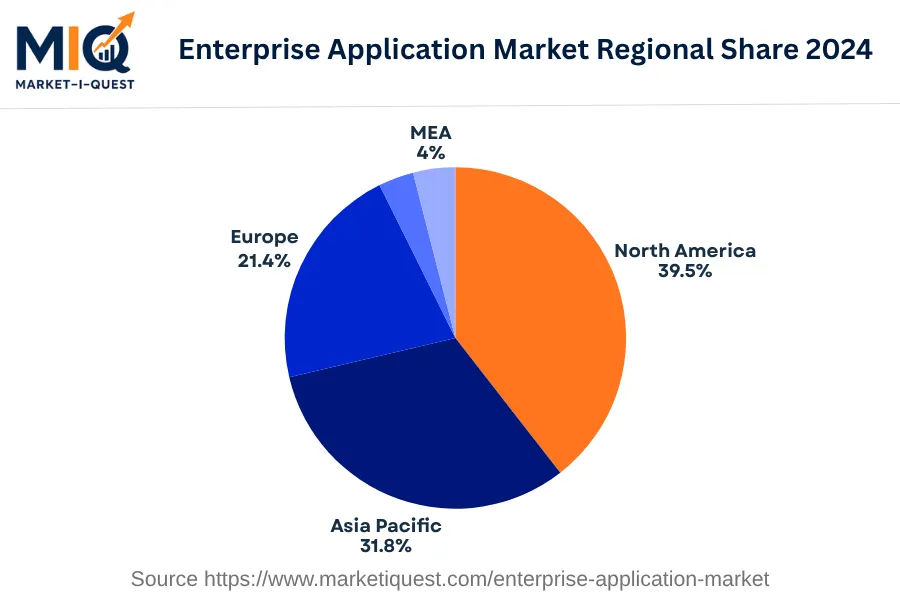
The Enterprise Application Market was valued at $351.46 billion in 2025, a growth from its 2024 value of $315.95 billion. By 2034, the market size is projected to reach approximately $916.70 billion, indicating a Compound Annual Growth Rate (CAGR) of 11.24% between 2025 and 2034. This consistent rise is evident throughout the decade, with the market expanding every year. On a regional scale in 2024, North America accounted for the largest share in the Enterprise Application Market with 39.47%, closely followed by the Asia Pacific region at 31.84%. Europe also demonstrated considerable market presence with 21.36%. Meanwhile, the market shares of Latin America and the Middle East and Africa were much smaller, at 3.34% and 3.99%, respectively.

Key Takeaways

  • By Product - Customer Relationship Management (CRM) segment led the market accounting for a significant market share in 2025.
  • By Deployment - On-Premise held the top position growing at the fastest pace over the forecast period.
  • By End Use - IT & Telecom sector emerged as the leading segment experiencing the highest growth through 2034.
enterprise-application-market market size

Key Driving Factors

Adoption of Cloud-Based Enterprise Applications

A key driving factor for the Enterprise Application Market is the increased adoption of cloud-based enterprise applications among businesses. Cloud computing provides enterprises with scalable, efficient, and affordable access to IT resources, fostering increased adoption. For instance, cloud-based Customer Relationship Management (CRM) or Enterprise Resource Planning (ERP) systems offer improved accessibility, better scalability and lower upfront costs compared to traditional, on-premise solutions. This trend is especially visible in small and medium enterprises (SMEs) which may maintain tighter IT budgets but require flexible, expansion-ready solutions. The shift to remote work due to the COVID-19 pandemic has further stoked demand for cloud-based enterprise applications as they facilitate efficient remote collaboration and resource management.
Regulatory Compliance Requirements

Regulatory compliance requirements have emerged as a prominent driver for the Enterprise Application Market. With regulatory bodies across various industries enforcing stringent rules, businesses need robust enterprise applications to effectively manage and monitor their compliance status. For example, in sectors like healthcare and finance where data security and privacy are of paramount importance, enterprise applications such as Compliance Management Systems or Risk Management Systems are used to ensure adherence to laws like HIPAA or GDPR. These applications aid in identifying potential compliance issues, conduct audits, and maintain comprehensive reports, thus reducing the chances of businesses facing penalties or damages to their reputation due to non-compliance.

Market Evolution by Timeline

2019-2023
In this period, the enterprise application market witnessed a shift towards cloud-based solutions with organizations in North America being the highest adopters. The main driving force behind this were cost benefits achieved through reduced infrastructure investments. Suppliers migrated towards software-as-a-service (SaaS) models, leading to a decline in one-time, upfront licensing cost. Standards like SOC 2 gained prominence for cloud security. Multiple vendor partnerships emerged, allowing businesses to procure integrated software suites instead of single applications. Risks were primarily data security threats, to which industries responded through stringent cybersecurity policies and hybrid cloud strategies.
2024
This year, businesses increasingly focused on mobility and remote workspace solutions, with Europe being a new scope region. Innovation was primarily around providing integrated, on-the-go access to enterprise applications. Mobile-first applications were the norm. Adjusting to these trends, vendors shifted their development practices in line with popular mobile operating systems. Pricing models typically included the purchase of user licenses, with most providers offering discounts based on number of licenses bought. High data usage on mobile devices was a potential risk, yet mitigated by data optimization solutions.
2025-2029
Organizations in Asia intensified their adoption of enterprise applications, driven by digitalization goals in the region. Technology offerings advanced to fulfil requirements in data analytics, AI and Machine Learning tools. Regional policies like the Data Governance Act served as a regulatory guideline for suppliers and corporate users. Vendor-customer partnerships began to lean towards outcome-based models from traditional user-licensing models, prompting greater due diligence in selecting software packages. While suppliers faced challenges in localizing and customizing solutions, they addressed it by developing more adaptive application frameworks.
2030-2034
Automation and cognitive technologies became an integral part of enterprise applications in this timeframe. Large businesses globally embraced automated processes in project management and administrative tasks. Suppliers incorporated AI capabilities into their applications, increasing reliance on open-source tools. Standards like IEEE 7000 series influenced the ethical considerations and transparency in AI usage. A common commercial consideration was the growing importance of offering extended support and maintenance contracts. The primary risk was AI ethics and misuse of data. Response strategies typically included auditing of AI usage and establishing ethical AI guidelines.

Future Market Outlook

Future Opportunities

The current landscape presents numerous opportunities for growth in the enterprise application market, particularly in sectors such as healthcare, manufacturing, and finance. The COVID-19 pandemic accelerated the adoption of telehealth solutions, and companies like Epic Systems and Cerner are poised to meet the rising demand for integrated healthcare applications. As nations such as India continue to emphasize digital health initiatives, the need for tailored enterprise solutions in this field will likely increase. In the manufacturing sector, companies are integrating Internet of Things (IoT) capabilities into enterprise applications to optimize operations. For instance, GE Digital's Predix platform is focused on enhancing asset performance in the industrial sector. Furthermore, regulatory changes, such as the Sarbanes-Oxley Act's emphasis on financial reporting accuracy, create a sustained need for enterprise accounting solutions that ensure compliance and transparency. Additionally, the rise of remote work has increased the demand for collaborative tools, and platforms like Slack and Microsoft Teams are focusing on enterprise integration. With these trends, opportunities for innovative solutions that combine functionalities across various business processes will emerge, allowing organizations to streamline operations and address specific challenges effectively. As the demand for enhanced cybersecurity continues to rise in response to increasing data breaches, companies that specialize in secure enterprise applications will find growing prospects as businesses prioritize data protection.

Segmentation Analysis

By Product

The market is divided into subsegments including Customer Relationship Management (CRM), Supply Chain Management (SCM), Business Intelligence (BI), Business Process Management (BPM), Content Management System (CMS), Enterprise Resource Planning (ERP), and Others with the CRM taking the largest revenue share, while BI is projected to show the fastest growth rate.

Largest Revenue Share

Customer Relationship Management (CRM)

Market Share Leader

CRM systems have garnered the largest revenue share in the product market segment for a myriad of reasons. These systems have become almost vital components of businesses worldwide due to the increasing emphasis on customer retention and satisfaction. CRM assists businesses in managing and analyzing customer interactions and data throughout the customer lifecycle, with the goal of improving business relationships, customer retention, and driving sales growth. Geographically, the adoption of CRM systems is most substantial in the developed markets, like North America and Europe, where enterprises focus intently on customer satisfaction metrics. Another key factor driving CRM sales is the progressively stringent regulatory environment that necessitates efficient data management practices, which CRM systems can streamline. Furthermore, purchasing criteria typically revolve around ease of use, effective integration with other systems, cost-effectiveness, and capability to scale, which many CRM providers typically meet. The inherent switching costs, in terms of time and resources for training and implementation, contribute further to maintaining robust revenue from existing customers.

Fastest CAGR

Business Intelligence (BI)

Forecast Period Growth Leader

Despite commanding a lesser market share than CRM systems, Business Intelligence (BI) applications are expected to exhibit the fastest growth in the coming years. The prime drivers for this surge in growth are related to advancements in technology and policy changes. Modern enterprises handle immense amounts of data that require efficient methods for analysis and interpretation, and BI provides tools and techniques to interpret this data into actionable intelligence. Increased penetration of AI and machine learning technologies in BI tools aids in predictive analysis and decision-making, acting as a catalyst for growth. However, adoption barriers include high initial investments and a lack of skilled personnel for successful implementation. Partnerships and collaborations between BI software vendors and other tech companies are expected to pave the way for innovative features and expanded services. But, the risk remains in terms of data privacy regulations and the constant threat of cyber-attacks, which might impede the rapid growth of this segment.

By Deployment

The market is divided into subsegments including Cloud and On-Premise. In the year 2024, the On-Premise subsegment accounted for the largest revenue share while the Cloud subsegment is expected to grow at the fastest pace during the forecast period.

Largest Revenue Share

On-Premise

Market Share Leader

In the base year 2024, the On-Premise segment emerges as the largest contributor to the revenue, pushed by a multitude of factors. Organizations require an immense amount of data control and security, which is offered by on-premise deployment. It gives complete control over all the data, permits customization and provides high data security which is a critical requirement for enterprises dealing with sensitive information. Furthermore, it eliminates potential risks associated with virtual threats and data breaches. Regulations in various industries demand strict data control guidelines, favoring on-premise deployment. Geographically, developed regions like North America and Europe are witnessing high demand, attributed to their high initial IT infrastructure investments. Moreover, long-term financial commitment, high switching costs, and the need for dedicated IT staff are some additional factors supporting the high revenue share of this segment.

Fastest CAGR

Cloud

Forecast Period Growth Leader

Arguably the most promising subsegment is the Cloud deployment. It is anticipated to exhibit the fastest Compound Annual Growth Rate (CAGR) during the predicted period. A significant factor driving its accelerated growth is the increasing adoption of cloud computing technology across various industries. Not only does it offer cost-effectiveness by eliminating the need for significant upfront investment in IT infrastructure, but it also offers scalability and flexibility in data access. Catalysing this trend is the rapid technological evolution, enabling more robust and secure platforms, supplemented by favorable regulatory policies. However, concerns related to data security in the cloud & adoption barriers in regions with less developed digital infrastructures could pose near-term risks. Collaborative partnerships between cloud service providers & security solution vendors could work towards assuaging these concerns, promoting further growth in this subsegment.

By End Use

The market is divided into subsegments which include IT & Telecom, BFSI, Retail, Government/Public Sector, Energy & Utilities, Healthcare, and Others. In the base year 2024, IT & Telecom generated the largest revenue, while the Healthcare subsegment is anticipated to grow at the fastest CAGR during the forecast period.

Largest Revenue Share

IT & Telecom

Market Share Leader

The IT & Telecom sector stands as the largest revenue-generating subsegment in the year 2024. The demands of dynamic digital transformation, reliance on powerful data storage, processing, and broader communications infrastructure are the key drivers behind the IT & Telecom subsegment's revenue share. Moreover, the immediate requirements like cloud technologies, cybersecurity and 5G deployment are also causing a surge in the revenue. Coupled with the ubiquitous use of smartphones, the necessity for connected solutions globally has fortified the position of IT & Telecom as the leader among other sub-segments. Regions with technology hubs, such as North America and Asia-Pacific, significantly contribute to this revenue due to the presence of key telecom players, tech giants, and a well-established IT infrastructure.

Fastest CAGR

Healthcare

Forecast Period Growth Leader

The Healthcare subsegment is projected to be the fastest-growing during the forecast period. Healthcare's rapid growth is primarily driven by advancements in technologies including telemedicine, AI in diagnostics, robotic surgeries, and digital health records. In addition, the recent COVID-19 pandemic has accelerated the need for advanced and efficient healthcare systems, thereby acting as a catalyst for the segment's growth. Regulatory support such as policies favoring digital health solutions and increased capital expenditure in healthcare technology are also driving the growth. However, barriers to adoption such as data privacy concerns and high costs characterizing this subsegment could pose near-term risks. Therefore, to leverage the projected growth, entities must form strategic partnerships and make wise capital investments in technological advancements.

Competitive Analysis

Key Market Players

Manufacturers / OEMs

SAP
Germany
Oracle
US
Microsoft
US

Key Suppliers & Raw Materials

IBM
US
Zoho Corporation
India
ServiceNow
US

Distributors, Integrators & Channel Partners

Accenture
Ireland
Capgemini
France
Deloitte
UK

Porter’s Five Forces Analysis

The analysis provides insights into the competitive dynamics within the Enterprise Application Market.

Supplier Bargaining Power

Medium

Power is moderate due to the existence of several alternative software and hardware suppliers.

Buyer Bargaining Power

High

Buyers possess high power due to the variety of enterprise solution providers available.

Threat of Substitutes

Low

Substitute threat is low due to the complexity and customization of enterprise solutions.

Threat of New Entrants

Medium

Entry is feasible but tough due to high initial investment and technical expertise required.

Competitive Rivalry

High

Intense rivalry exists among established tech giants and emerging players.

Regional Analysis

Geographic market dynamics and growth opportunities across key regions

Global Market Outlook

enterprise-application-market market regional share

North America

In 2024, the North American Enterprise Application Market was significantly driven by key industry sectors, such as retail, manufacturing, and healthcare. Robust investment in technology adoption served as a major market accelerator, while regulatory changes also played a critical role in the market dynamics. For instance, stringent government mandates around data security in the United States provoked a surge in the demand for secure and compliant enterprise applications. The market in 2024 also witnessed key trends that shaped buyer behavior and tech adoption. Firstly, there was a remarkable shift towards cloud-based enterprise applications, largely attributable to their scalability and cost-efficiency. This trend was particularly significant across enterprises in the U.S. and Canada, boosting the demand for SaaS-based solutions. Beyond this, there was a growing focus on strategic partnerships and M&A activities among key players, aimed at enhancing product offerings and expanding market reach.

Finally, the enforcement of data protection policies like California's Consumer Privacy Act had a significant impact on the Enterprise Application Market. Businesses, in order to comply with such stringent policies, were more inclined towards adopting enterprise applications that meet the prescribed data security standards. This had a notable effect on supply dynamics, with providers focusing more on developing applications that help enterprises meet the regulatory requirements.

Asia Pacific

In 2024, the Enterprise Application Market in the Asia Pacific has seen a period of increased digitization and modernization. The market is primarily driven by the rising demand for streamlined business operations across sectors like manufacturing, retail, and healthcare. China and India are leading with heavy investments in technology adoption, notably cloud computing and AI technologies. Regulatory norms promoting data privacy and cybersecurity, particularly in Australia and Japan, have further boosted the market. Several key trends shape the market dynamics. Firstly, the shift to SaaS models is noticeable, with businesses across sectors prioritizing cost-effectiveness and scalability. Secondly, partnerships and mergers are rampant, driving the integration of different enterprise applications. China's Alibaba and South Korea's Samsung, for example, have been noted for their collaborations with local start-ups. Thirdly, the focus on optimizing user experience has led to a surge in mobile enterprise applications, especially in retail.

In enforcement, Indian government's national digital health blueprint policy bolsters the healthcare sector's uptake of enterprise applications. Similarly, increasing emphasis on smart utilities in ASEAN countries supports market growth. Demand for enterprise applications in these markets therefore reflects an ongoing push towards digitization and enhanced data management across key Asia Pacific economies.

Europe

In 2024, the European Enterprise Application Market was marked by significant shifts in demand, technology adoption, and regulatory influences. Robust corporate investment in enterprise applications was observed, spurred by the drive for business automation, process streamlining, and operational efficiency. Rapid digital transformation across sectors, primarily in manufacturing, retail, healthcare, and government, boosted the market uptake. Revised GDPR regulations enforced sharpened data management strategies, directly influencing adoption of applications geared towards compliance. On the trend front, cloud-based enterprise applications witnessed a surge, with businesses transitioning from traditional software, valuing remote accessibility and real-time updates. Sustainability-focused applications gained traction, reflecting the increased corporate commitment to environmental responsibility. There was a rise in strategic partnerships, as tech companies and end-user corporations sought to create customized application solutions.

Growing expectation for personalized user experiences in countries like the UK and Germany accelerated the shift towards AI and machine learning based applications. A significant branch-out was noted in Italy, Spain, and Central & Eastern Europe, where utility and public sector companies began increasing their investment in enterprise applications. Bucking traditional buy-and-install methods, the preference for subscription-based procurement has grown in the Nordics and Benelux, indicating a shift in buyer behavior. These market conditions in 2024 provided a rigorously dynamic landscape for enterprise applications in Europe.

Latin America

In 2024, the Enterprise Application Market in Latin America demonstrated a robust growth dynamic, stemming from various demand factors, regulatory changes, and technological advancements. Enhanced digital transformation across key sectors like healthcare, manufacturing, retail, and government drove a surge in the adoption of enterprise applications. To streamline operations, industries increasingly demanded applications that offer data-driven insights. Regulations such as the Brazil General Data Protection Law boosted investment in privacy-compliant software solutions. Notably, an upward trend emerged in cloud-based enterprise applications due to their scalability and cost-effectiveness. As a result, more partnerships formed between local software development firms and global cloud service providers. Mergers and acquisitions increased as companies sought to consolidate their market position and broaden their product portfolio. Amid rising cyber threats, security became a pivotal aspect in the selection of enterprise applications, epitomized by a growth in demand for cybersecurity-focused offerings.

In the retail and manufacturing sectors, there was a significant shift towards Enterprise Resource Planning (ERP) and Customer Relationship Management (CRM) systems. The need for efficient public service delivery led to a rise in e-Government applications in countries like Argentina, Colombia, and Peru. Among consumers, a preference for mobile-based applications prevailed. With a tech-hungry demographic and strong market potential, Latin America's enterprise application landscape demonstrated considerable momentum in 2024.

Middle East & Africa

In 2024, the Enterprise Application Market in the Middle East and Africa (MEA) showcased significant dynamism. Its growth was driven by an escalating demand for improved organizational efficiency across various sectors. Saudi Arabia and UAE heavily invested in advanced enterprise applications as part of their digital transformation initiatives, creating a positive ripple in the market. Moreover, broadening internet penetration in countries like Nigeria and Kenya intensified tech adoption, with businesses of all sizes adopting cloud-based applications for agility and cost-effectiveness. The market experienced a shift towards Software-as-a-Service (SaaS), contributed by a growing preference for flexible and scalable software solutions. High-profile mergers and acquisitions, including companies in Israel's tech sector, brought changes in product offerings. Standardization of enterprise applications became prevalent, reflecting policy enforcement for enhanced interoperability and security among businesses.

This market growth manifested noticeably in sectors such as government and oil and gas in countries like Qatar and Saudi Arabia, largely driven by their robust financial resources. Aligned with regional digitalization push, industries including utilities, telecom, and financial services in countries like United Arab Emirates and South Africa were key adopters of these applications. Additionally, despite economic hardships, countries like Egypt found enterprise application adoption critical in healthcare, manufacturing, and retail sectors, making them ardent contributors to the market.

Recent Industry Developments

Latest market innovations, product launches, and strategic initiatives

June 2026

IBM and Google Cloud launched a new global Google Cloud Practice, combining IBM's consulting scale and AI-powered delivery platform with Google Cloud's Gemini Enterprise Agent Platform, cybersecurity, and data capabilities.

January 2026

Zoho launched Zoho ERP, a comprehensive enterprise resource planning platform for Indian small and medium enterprises, addressing high costs, long implementation cycles, and heavy consultant dependence that have slowed ERP adoption among Indian businesses. The platform embeds AI across automation, reporting, audits, workflow creation, and anomaly detection.

Frequently Asked Questions