Implantable Drug Delivery Devices Market Snapshot

Key Players

  • Medtronic (USA)
  • Boston Scientific Corporation (USA)
  • Abbott (USA)
  • Becton
  • Dickinson and Company (USA)
  • Bayer AG (Germany)
  • Novartis International AG (Switzerland)
  • Evonik Industries AG (Germany)
  • Psivida Corp. (USA)
  • Merck & Co. Inc (USA)
  • Biogen Inc. (USA)

Market Size

Base Year 2024
$25.94 Bn
CAGR
7.45%
Forecast 2034
$53.22 Bn

Market Segments

By Product
Contraceptive Implants, Spinal Implants, Brachytherapy Seeds, Drug Eluting Stents, Biodegradable Stents, Intraocular Implants, Infusion Pumps, Others
By Type
Biodegradable, Non-Biodegradable
By Technology
Diffusion, Osmotic, Magnetic, Others
By Application
Contraceptive, Ophthalmology, Cardiovascular, Diabetes, Oncology, Autoimmune Disease, Others

Market Dynamics

Drivers
  • Rising chronic disease prevalence
  • Technological advancements in implantable devices
Restraints
  • High procedure costs
  • Regulatory scrutiny
Opportunities
  • Growing elderly population
  • Advancements in drug delivery technology

Market Size

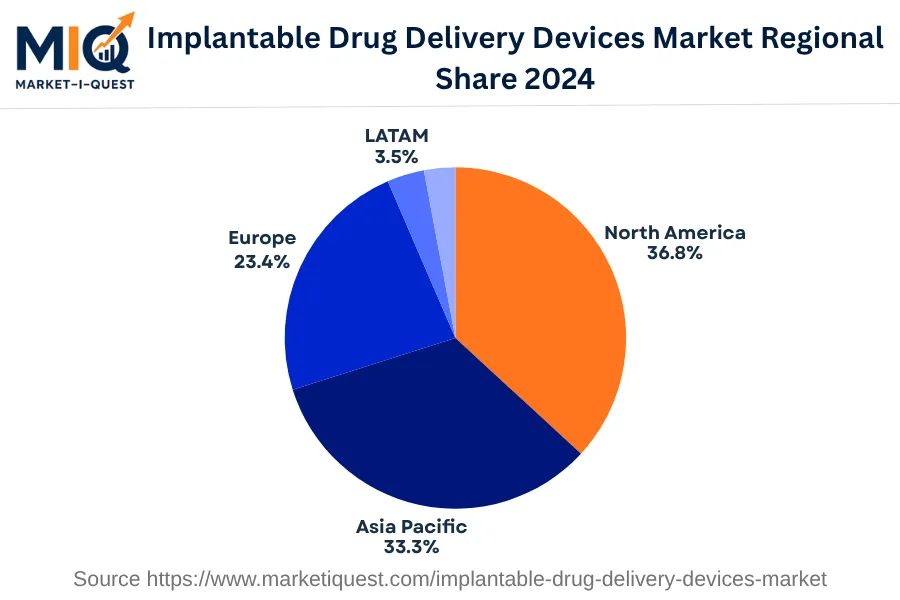
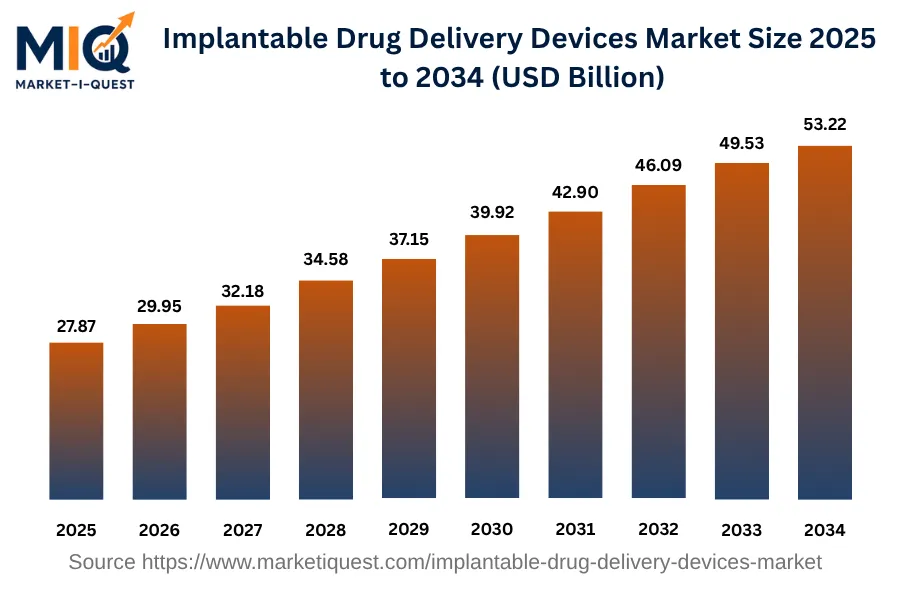
The Implantable Drug Delivery Devices Market was valued at 27.87 billion USD in 2025 and it's projected to grow at a CAGR of 7.45% across the following decade, reaching a size of 53.22 billion USD by 2034. This substantial growth from the starting value of 25.94 billion in 2024 is driven by factors primarily linked to the rapid advancement of medical technology and a rising demand for more efficient, long-term drug delivery systems. Continuous innovations in the field, paired with a steady increase in patient preference for minimally invasive procedures, have boosted the market size over the years, and it continues to expand. In terms of regional market share in 2024, North America takes the lead, accounting for 40.8% of the total. This is followed by the Asia Pacific and Europe regions, which hold 27.7% and 24.2% shares respectively. The remaining 7.2% is nearly evenly split between the Latin America (LATAM) and Middle-East and Africa (MEA) regions, each accounting for 3.6% of the global market.

Key Takeaways

  • By Product - Spinal Implants held the major market share in the given year.
  • By Type - Biodegradable implants led the market in terms of both value and volume.
  • By Technology - Magnetic was identified as the significant subsegment rendering growth.
  • By Application - Oncology was the leading subsegment in the Implantable Drug Delivery Devices Market.
implantable-drug-delivery-devices-market market size

Key Driving Factors

Changing Regulatory Environment

Globally, regulatory authorities like the U.S. Food and Drug Administration (FDA) or the European Medicines Agency (EMA) are continuously updating standards and guidelines associated with implantable drug delivery devices. This evolved regulatory landscape ensures manufacturers are adhering to norms that ensure the safety and efficacy of these devices. For instance, the FDA's Current Good Manufacturing Practice (CGMP) regulations provide the systems to ensure product's safety, and efficacy. To comply with these increasingly stringent regulations, companies are investing in the design, development and manufacturing process of these devices, thereby fueling market growth.

Increasing Prevalence of Chronic Diseases

The rate of chronic illnesses such as diabetes, cancer, cardiovascular diseases, and others is escalating worldwide. These conditions often require long-term medication, and the manageability of treatment regimens via traditional methods can be complex. Implantable drug delivery devices offer a solution by providing controlled, consistent medication release over extended periods, improving patient compliance and treatment outcomes. For example, in the diabetes management, use of implantable insulin pumps is rising, owing to their ability to provide precise and continuous insulin release. This mounting stress of chronic disease management globally is pushing the demand and adoption of implantable drug delivery devices in the market.

Market Evolution by Timeline

2019-2023
In these years, predominant buyers were healthcare providers from North America and Europe, purchasing implantable drug delivery devices to treat chronic diseases. Devices being integrated with biosensors for continuous drug monitoring were shipped. However, poor reimbursement policies in developing countries posed a challenge. U.S. FDA's stringent regulations influenced their adoption. Device manufacturers relied on private funding and pricing was based on product features complexity. Cybersecurity threats posed a significant risk, leading to enhanced device encryption.
2024
In 2024, the demand increased in Asia-Pacific region due to rising diabetic population. New devices with remote tracking capabilities were piloted. However, lack of trained medical professionals was a barrier. EU's new Medical Device Regulations impacted device approval process. Direct-to-consumer sales emerged as a commercial model while patent expiry led to price reduction. Device recall owing to faulty design created risk concerns.
2025-2029
In this period, hospitals in middle-income countries emerged as significant buyers. Devices with AI capabilities for drug dosage prediction were prevalent. However, they faced interoperability challenges. Health Canada's new regulations influenced device safety standards. Prices saw a downward trend due to intense market competition and licensing agreements were common. Product safety issues due to device malfunction were the main risk.
2030-2034
By these years, the market saw increased demand from elderly population demonstrating shifting buyer demographics. Devices with self-adjusting drug delivery mechanism were the norm and were mostly integrated with existing EHR systems. Strict regulatory norms from TGA of Australia shaped the market. Value-based pricing models and strategic partnerships with tech companies were typical. Lack of technology understanding among end-users and doctors constituted a major risk.

Future Market Outlook

Future Opportunities

The implantation of drug delivery devices is poised for growth, especially due to emerging regulatory environments and collaborative efforts in the healthcare sector. In 2021, the FDA implemented the Digital Health Innovation Action Plan, which encourages technology companies to engage with new device concepts that incorporate drug delivery functionalities. Countries like Japan are investing in R&D initiatives through its health ministry, aimed at enhancing drug delivery methods for elderly patients. Furthermore, partnerships between biotech firms and established medical device manufacturers are expected to lead to novel delivery mechanisms; for example, in 2023, Novartis announced a collaboration with a startup to develop microchip-based implantable devices that can release multiple medications at preset times. Telemedicine's rise, accelerated by the pandemic, has created an opportunity for remote monitoring of patients using implantable devices, bringing enhancements to disease management. Collaborations among tech giants, like the ongoing partnership between Google and Sanofi to develop software solutions for diabetes management, represent a strategic response to increasing demand for integrated health solutions. These present-day developments indicate a trajectory toward more personalized and efficient healthcare systems, signaling that the future landscape of implantable drug delivery could see wider adoption and enhanced efficacy in patient care.

Segmentation Analysis

By Product

The market is divided into subsegments including Contraceptive Implants, Spinal Implants, Brachytherapy Seeds, Drug Eluting Stents, Biodegradable Stents, Intraocular Implants, Infusion Pumps, and Others. In 2024, Spinal Implants accounted for the largest revenue share while Biodegradable Stents are expected to grow at the fastest CAGR during the forecast period.

Largest Revenue Share

Spinal Implants

Market Share Leader

Spinal implants securing the largest revenue share can primarily be attributed to the high prevalence of spinal disorders globally, coupled with the increasing ageing population. Spinal disorders like degenerative disc disease, scoliosis, and spondylolisthesis have resulted in a significant rise in demand for spinal implants. These conditions often require surgical intervention, making spinal implants a crucial part of treatment. Additionally, advancements in the materials used for these implants, such as titanium and bioresorbable materials, have improved the performance and longevity of the implants, which have further boosted their market penetration. The frequent product launches by leading manufacturers driven by ongoing research and development is another contributing factor to the segment's revenue. Geographically, developed regions like North America and Europe dominate the spinal implants market due to the high incidence of spinal disorders, better healthcare infrastructure, and wider insurance coverage. However, regulation and supply in these regions are complex yet well-organized, maintaining a steady flow of these implants in the market.

Fastest CAGR

Biodegradable Stents

Forecast Period Growth Leader

Biodegradable stents are projected to register the fastest CAGR in the coming years, fueled by their advanced features and increasing adoption. Unlike traditional metal stents, biodegradable stents dissolve over time that eliminates the need for further surgery for stent removal. The growing understanding and awareness of these benefits among the healthcare community serve as significant growth drivers. Technological advancements are further accelerating the segment's growth, with research and development efforts resulting in improved product performance and durability. Policy support, particularly in developed countries, has facilitated a supportive environment for the uptake of biodegradable stents. In terms of risks, the high cost of these stents and lack of reimbursement policies in developing economies could potentially slow down the market growth. However, ongoing partnerships and collaborations among leading manufacturers and healthcare institutions are expected to overcome such barriers, thereby catalyzing the market's growth.

By Type

The market is divided into two subsegments namely, biodegradable and non-biodegradable. In 2024, the biodegradable subsegment accounted for the largest revenue share while the non-biodegradable subsegment is expected to grow at the fastest CAGR during the forecast period.

Largest Revenue Share

Biodegradable

Market Share Leader

A significant driver of growth in the biodegradable segment is consumer behavior, which is increasingly leaning towards sustainable and environmentally friendly products. Awareness regarding the harmful effects of non-biodegradable products has galvanized a significant proportion of the populace towards this segment. Additionally, several government regulations aimed at reducing the environmental impact of non-biodegradable products have also motivated companies to invest more in the production and marketing of biodegradable alternatives. Also, technological advancements have made it possible to produce high-quality biodegradable product variants that meet and often exceed the performance of their non-biodegradable counterpart, making it an increasingly attractive purchase choice. Major revenue generating geographies include developed regions like Western Europe and North America where sustainability is a significant purchasing criterion.

Fastest CAGR

Non-Biodegradable

Forecast Period Growth Leader

While the non-biodegradable segment may not be the largest revenue earner, it is anticipated to grow at the fastest rate. A primary reason for this is the relatively lower production costs associated with non-biodegradable products, which ensures a wider adoption, particularly in geographies where pricing is a crucial deciding factor. Further, the durability and longer lifespan of non-biodegradable products make them a preferred choice in certain applications. However, potential regulatory challenges and negative environmental impacts could slow this growth. Nevertheless, partnerships and collaborative efforts towards the development of more environmentally friendly non-biodegradable products, coupled with capital investments in technology development, may act as catalysts for sustained growth. Near-term risks include tighter environmental regulations and social backlash, particularly in developed countries.

By Technology

The market is divided into subsegments including Diffusion, Osmotic, Magnetic, and Others. In 2024, the Magnetic segment accounted for the largest revenue share while the Diffusion is projected to exhibit the fastest CAGR during the forecast period.

Largest Revenue Share

Magnetic

Market Share Leader

Magnetic segment dominated the market in terms of revenue in the base year, driven by a variety of factors. Increased demand from sectors such as healthcare, industrial processing, and water treatment has bolstered growth in this segment. The unique advantages offered by magnetic technology, including high precision, reliability and the ability to function in challenging environments, have made it the technology of choice across a variety of applications. Strict regulations in industries such as healthcare and water purification have also created a steady demand for magnetic technology. Furthermore, the availability of advanced magnetic materials and technologies in key geographic markets such as North America and Europe has further expanded their market presence. However, other technologies could challenge the dominance of magnetic segment if they successfully overcome their present hurdles.

Fastest CAGR

Diffusion

Forecast Period Growth Leader

While magnetic technology currently holds the largest market share, the Diffusion segment is projected to register the fastest growth in the coming years. This growth is anticipated to be fueled by ongoing technological advancements and increasing investments in research & development activities. Increasing awareness about the efficiency and effectiveness of diffusion technology in various applications is resulting in its higher adoption. Barriers to the diffusion segment's growth include high initial costs and the need for skilled personnel to operate the technology. However, growing partnerships among key players to leverage shared expertise, combined with governmental policy support in the form of subsidies, are expected to alleviate these barriers and promote market growth. An associated risk in the near term is the ability of diffusion technology to respond to rapid changes in market demand and regulatory environment.

By Application

The market is divided into subsegments including Contraceptive, Ophthalmology, Cardiovascular, Diabetes, Oncology, Autoimmune Disease, and Others. Oncology accounted for the largest revenue share, while Diabetes is expected to grow at the fastest CAGR during the forecast period.

Largest Revenue Share

Oncology

Market Share Leader

In 2024, the Oncology subsegment dominated the revenue share due to rising prevalence of cancer and increasing demand for effective cancer treatment worldwide. The high cost associated with oncology drugs and treatments further propels the substantial revenue, with providers seeing high return on investment. Additionally, advancements in genetic sequencing and personalized medicine are making a significant contribution to the revenue in this sector. The rise of precision oncology in developed markets, where treatments are tailored to individual patients, is driving up costs and as a result revenues. Industry consolidation, the introduction of new drugs, and ongoing clinical trials in immuno-oncology are key influencing factors that are maintaining Oncology's market dominance. However, presenting obstacles to this reign are regulatory pressures, potential lapses in intellectual property protection for blockbuster treatments, and the slow but steady incursion of biosimilar and generic drugs.

Fastest CAGR

Diabetes

Forecast Period Growth Leader

Despite not having the largest revenue share, the Diabetes subsegment is projected to grow at the fastest CAGR. Several key factors contribute to this rapid expansion. First and foremost, there has been a surge in the global prevalence of diabetes due largely to unhealthy dietary patterns and sedentary lifestyles, increasing the demand for diabetes treatment and management solutions. Technological advancements in diabetes devices, including continuous glucose monitors and insulin pumps, are pushing adoption rates higher. The growing preference for non-invasive monitoring devices is a major driver of growth in this subsegment. Furthermore, strategic collaborations and partnerships between leading players to develop and market innovative diabetic care products are boosting the segment growth. A significant risk to this upward trajectory could come from stringent regulatory standards for approval of diabetes devices and potential out-of-pocket costs for patients due to lack of full insurance coverage.

Competitive Analysis

Key Market Players

Manufacturers / OEMs

Medtronic plc
Ireland
Boston Scientific Corporation
US
Abbott Laboratories
US

Key Suppliers & Raw Materials

Solvay SA
Belgium
Evonik Industries AG
Germany
BASF SE
Germany

Distributors, Integrators & Channel Partners

Cardinal Health Inc.
US
McKesson Corporation
US
AmerisourceBergen Corporation
US

Porter’s Five Forces Analysis

This analysis covers the competitive forces impacting the Implantable Drug Delivery Devices Market.

Supplier Bargaining Power

Medium

Specialized component supply chain, with few substitutes and moderate concentration.

Buyer Bargaining Power

Low

Lock-in due to high switching costs and product specificity in healthcare.

Threat of Substitutes

Medium

Emergence of non-invasive drug delivery technologies presents a moderate threat.

Threat of New Entrants

Low

High R&D spend, regulatory hurdles, and intellectual property rights act as barriers.

Competitive Rivalry

High

Intense competition due to continuous innovation, patent expirations, and pricing pressure.

Regional Analysis

Geographic market dynamics and growth opportunities across key regions

Global Market Outlook

implantable-drug-delivery-devices-market market regional share

North America

In 2024, North America's Implantable Drug Delivery Devices market remained a significant contributor to the healthcare sector, with the U.S., Mexico, and Canada as key participants. Diverse demand factors drove the market growth. The increasing incidence of chronic diseases necessitated the usage of these devices, particularly as continuous medication delivery systems. Regulatory support in the form of FDA's approval for certain devices in the U.S., and similar bodies in Canada and Mexico, backed the market momentum. Furthermore, substantial investments in the medical technology sector propelled the adoption of advanced drug delivery devices across the region, with supply dynamics accommodating the growing demand. The pricing of these implantable devices, although varied, remained competitive due to market rivalry.

Market trends offered insights into shifts within the industry. One significant trend was consumers prioritizing non-invasive or minimally invasive implantable devices, influencing manufacturers' production lines. Technological innovation, particularly in biodegradable implants, marked another consequential shift. Given the proprietary nature of these devices, strategic partnerships and mergers emerged as a way of gaining a competitive edge. Lastly, stringent monitoring of policy enforcement, primarily surrounding product safety and efficiency, determined market accessibility. The primary sectors utilizing these devices were healthcare institutions – hospitals, clinics, and research institutes. For patients requiring continuous medication, these devices promised efficient and effective treatment, bolstering the market's growth in North America.

Asia Pacific

In 2024, the Implantable Drug Delivery Devices Market exhibits considerable expansion in the Asia Pacific region. As key drivers, the growing prevalence of chronic diseases in countries like China and India necessitates long-term treatments, thereby escalating the demand for these devices. Concurrently, medical investments in Japan and South Korea have led to technological advancements promoting their adoption in healthcare practices. Additionally, favorable government regulations in Australia endorsing safety and efficacy, coupled with competitive pricing in ASEAN markets, further stimulate supply dynamics.

Noticeable trends in the market include a shift toward advanced biodegradable implants due to rising environmental concerns among buyers. In addition, expansion in the online sales channel has emerged, spurred by the growth of e-commerce in markets like China and India. To catch the wave, many manufacturers form strategic partnerships or undergo M&A to gain a competitive edge. There is also increased enforcement of stringent medical device standards in countries like Japan and Australia for product quality control, impacting market dynamics. These devices find extensive usage in sectors like healthcare and retail, addressing the demand from patients requiring various treatments such as hormone replacement, oncological disorders, cardiovascular ailments, and others.

Europe

In 2024, the implantable drug delivery devices market in Europe witnessed robust growth due to several market drivers. The increasing prevalence of chronic diseases such as diabetes and cardiovascular conditions across key countries like Germany, the United Kingdom, France, Italy, and Spain spurred the demand for these devices. Regulatory support in the form of enhanced patent protection laws and streamlined approval processes for innovative medical devices significantly encouraged market activities. Furthermore, the advancement and rapid adoption of technology aided the proliferation of sophisticated devices with improved drug delivery mechanisms.

Dominating trends during this period included a noticeable shift in buyer behavior within the healthcare sector, with hospitals and clinics favoring smart devices capable of delivering precise dosages to maximize patient comfort and health outcomes. Product innovation became central to the strategies of leading market players, manifesting in devices with extended release periods and customization capabilities. Another key trend was the strategic partnerships and acquisitions formed to facilitate the entry of devices into previously untapped markets in the Nordics, Benelux, and Central & Eastern Europe. Lastly, stricter policy enforcement around the standardization of devices ensured a high level of quality and safety in the market, further boosting trust among end-users, which included medical professionals and patients.

Latin America

In 2024, the Latin American (LATAM) implantable drug delivery devices market showed a prominent increase in growth. An aging population, increased awareness of chronic disease management, technological advancements, and the push for localized treatment options, were primary drivers fueling this growth. The rise in Latin American healthcare expenditure, notably in Brazil, Mexico, Argentina, Colombia, Chile, and Peru, facilitated purchases of these devices, enhancing patient care in hospitals and other healthcare facilities. Industry trends in 2024, included shifting patient preferences towards minimally invasive procedures and the growth of biodegradable implantable drug delivery devices. The advancement of nanotechnology in drug delivery systems was prominently seen across LATAM sectors such as healthcare and manufacturing. Concerning policy enforcement, the Latin American governments have heightened regulations to ensure the safety and effectiveness of these devices. For instance, the Brazilian Health Regulatory Agency (ANVISA) placed rigorous approvals on medical devices driving manufacturers to meet higher standards.

Furthermore, partnerships and mergers were steadfast in 2024, as companies sought to combine resources to enhance research and product development. Notably, acquisitions between LATAM-based medical companies and prominent North American and European firms indicated a trend towards regional expansion. This led to a strengthened market position for these corporations and increased availability of high-tech drug delivery devices across LATAM.

Middle East & Africa

In 2024, the market for Implantable Drug Delivery Devices (IDDDs) showed significant expansion in the Middle East and Africa, primarily driven by growing biomedical investment, regulatory advancements, and the adoption of innovative healthcare technologies. For instance, robust healthcare infrastructure development in the United Arab Emirates and Saudi Arabia, backed by government initiatives, induced a surge in supply and consequently, improved access to IDDDs. In Egypt and Nigeria, demand was catalyzed by the rising prevalence of chronic diseases, underscoring the need for advanced drug delivery systems. South Africa, with its burgeoning pharmaceutical industry, witnessed favorable pricing mechanisms promoting the adoption of such devices.

Consumer behavior notably shifted towards these devices owing to their convenience, reliability, and effectiveness, particularly in the management of chronic ailments. Meanwhile, technological advancements enabled less invasive implantation processes, positively influencing patient acceptance across the region. New alliances among manufacturers, healthcare providers, and governments, as evidenced in Kenya and Israel, propelled the availability and use of IDDDs. Moreover, regulatory enforcement around healthcare quality standards ensured the availability of safe and efficient IDDDs in the market, further boosting their acceptance and utilization in the Middle East and Africa. These factors defined the dynamics and trajectory of the IDDD market in this region in 2024.

Recent Industry Developments

Latest market innovations, product launches, and strategic initiatives

July 2026

Vivani Medical's neurotech subsidiary Cortigent agreed to merge with ClearOne, positioning Cortigent for a Nasdaq listing and allowing Vivani to focus on its implantable drug delivery programs. The deal is expected to close in Q3 2026.

February 2025

Daré Bioscience and Theramex entered a co-development and licensing agreement for Casea S, a first-in-category biodegradable contraceptive implant that releases a contraceptive for 18–24 months before dissolving, eliminating the need for surgical removal. A Phase 1 trial is ongoing.

Frequently Asked Questions