
Drug Eluting Stent Market Snapshot

Key Players

  • Abbott Laboratories (US)
  • Boston Scientific Corporation (US)
  • Medtronic PLC (Ireland)
  • Biotronik SE & Co. KG (Germany)
  • Cook Medical (United States)
  • Terumo Corporation (Japan)
  • B. Braun Melsungen AG (Germany)
  • Lepu Medical (China)
  • Alvimedica (Turkey)

Market Size

Base Year 2024
$8.39 Bn
CAGR
6.53%
Forecast 2034
$15.79 Bn

Market Segments

By Type of Coating
  • Polymer-Based Coating
  • Polymer-Free Coating
By End Use
  • Hospitals
  • Specialty Cardiac/Vascular Centers
  • Ambulatory Surgical Centers (ASCs)

Market Dynamics

Drivers
  • Rising cardiovascular diseases prevalence
  • Technological advances in stent design
Restraints
  • Regulatory compliance hurdles
  • Costly product implementation
Opportunities
  • Rising prevalence of heart diseases
  • Increasing geriatric population

Market Size

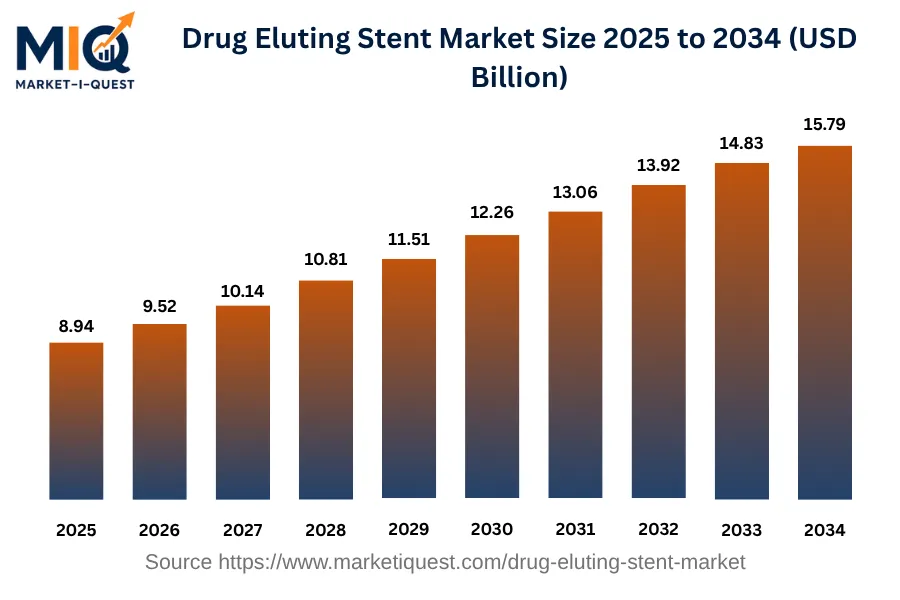
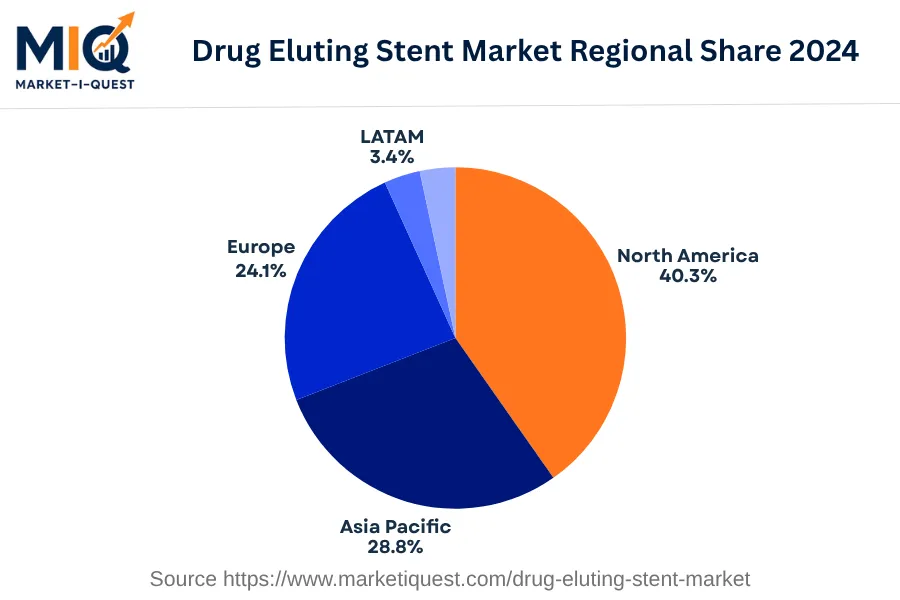
The Drug Eluting Stent Market was valued at 8.39 billion USD in 2024 and is projected to reach 8.94 billion USD by 2025. Over a span of 10 years, by 2034, it is estimated the market will grow substantially to 15.79 billion USD, with a Compound Annual Growth Rate (CAGR) of 6.53%. The market will expand gradually each year due to progress in technology and increased demand for these stents, individuals' rising health consciousness, and escalating chronic illnesses. Furthermore, pharmaceutical advancements in stents have spurred market growth, as the benefits of drug-eluting stents over bare-metal stents are becoming increasingly recognized. The market share was distributed in 2024 as follows: North America had 40.3%, Asia Pacific held 28.8%, Europe accounted for 24.1%, Latin America was 3.4%, and the Middle East and Africa comprised 3.4%.

Key Takeaways

  • By Type of Coating - Polymer-Based Coating led accounting for a substantial share in the base year.
  • By End Use - Hospitals held a dominant position signifying the highest utilization of Drug Eluting Stent.
drug-eluting-stent-market market size

Key Driving Factors

Increased Global Incidence of Coronary Artery Diseases

The rise in global prevalence of coronary artery diseases (CAD) is significantly pushing the demand for drug eluting stents. These heart diseases, often caused by plaque buildup that hardens and narrows the arteries, affect a large population segment worldwide, notably older adults. As the world's population ages, the number of people with CAD continues to increase. Drug eluting stents, which are laced with medication to prevent the artery from closing or re-narrowing post-surgery, represent a preferred intervention approach. They not only address the immediate problem but also minimize the chances of restenosis (re-blockage), thus providing a long-term solution. The rising CAD incidence provides a direct stimulus to adoption and spending in the drug eluting stent market.
Adoption of Minimally Invasive Procedures

The foreseeable future of the drug eluting stent market is being shaped by healthcare providers' growing preference for minimally invasive procedures. This trend is being driven by multiple factors including reduced patient recovery time, lower risk of infections, and lesser post-operation complications. Inserting a drug eluting stent, for instance, does not require major surgery. It is done using a procedure called angioplasty, where a small incision is made in the arm or groin. This procedural shift in addressing heart-related issues is directly pushing the adoption of drug eluting stents. As more and more medical practitioners adopt these less intrusive procedures, the market for drug eluting stents gains momentum and expands its reach.

Market Evolution by Timeline

2019-2023
In this time block, the demand for drug-eluting stents surges primarily amongst patients with coronary artery disease (CAD), particularly in Asia-Pacific regions like China and India, due to their prominent aging populations. Bioabsorbable stents start commercial shipping. However, manufacturing hitches persist due to their advanced nature. Namely, the FDA's stringent rules about safety and efficacy pressurize the industry to enhance their stent technology. Stent manufacturers typically work on partnerships or acquisitions, like Medtronic's acquisition of EPIX Therapeutics, to boost their market presence. The average price of drug-eluting stents slowly drops due to heightened market competition. The most common risk lies in the possibility of long-term complications from substandard stents.
2024
In 2024, the European market records high demand for drug-eluting stents, mainly due to the growing number of percutaneous coronary intervention procedures. New stent technologies, including bifurcation and fenestrated stents, start showing up on the supply front, although they hold a minority market share. Regulatory bodies such as the European Medical Agency demand more rigorous clinical trial data before granting approval, impacting the rate of market uptake. Prices experience minimal fluctuation. The offsetting effect of affordable products from emerging manufacturers and high-priced cutting-edge stents keeps the average cost stable. The key risk in this year is the potential for product recalls due to unexpected device failures, which industry players strive to mitigate by enhancing quality checks.
2025-2029
During these years, North America, particularly the USA, records the highest demand for drug-eluting stents, driven by an uptick in obesity rates leading to a surge in heart diseases. Advances in stent technology, such as drug-filled stents, scale up production, and start gaining widespread adoption. In the context of regulation, new rules by the FDA to enforce more rigorous pre-market testing for re-stenosis impact the supply. As for commercial models, stent manufacturers typically provide package deals where stents come with necessary accessories like catheters. The key risk during these years is the uncertainty around the reimbursement procedure of stents in many insurance policies, often passed on to consumers in elevated prices.
2030-2034
In the final period, demand for drug-eluting stents increases sharply in Middle-Eastern and African countries due to rising cardiovascular disease prevalence. On the supply side, personalized stents based on patient-specific needs are introduced in the market, albeit at an infancy stage. Stricter regulations come into play with the launch of the ISO 25539-2 annex E protocol, which governs the clinical investigation of coronary stents, affecting market dynamics. As to the commercial bits, the rise of e-commerce channels changes procurement models, with wholesalers ordering in bulk online. The main risk lies in the regulatory variances across different countries, leading to difficulties in global product launch.

Future Market Outlook

Future Opportunities

The drug eluting stent market is positioned for growth opportunities driven by technological innovations and evolving patient needs. A key area is the integration of digital health solutions, as demonstrated by Medtronic's initiatives in 2023, which leverage telehealth platforms for remote monitoring of patients post-stent implantation. Additionally, the ongoing development of drug-coated balloons represents a significant opportunity; clinical data presented at the 2023 American College of Cardiology conference highlighted the effectiveness of these devices in specific demographics, particularly for patients with small vessel disease. Another avenue for growth lies in emerging markets, where increased healthcare access is facilitated by government initiatives, such as India's National Health Protection Scheme introduced in 2018, which aims to provide coverage for heart disease treatment. Furthermore, regulatory bodies are expanding the pathways for stent approvals, as seen in the European Commission's 2023 guidelines aimed at expediting the review process for next-generation stents. Collaboration between industry stakeholders offers another promising avenue; for example, the partnership between Siemens Healthineers and local hospitals in Germany to improve stent implantation outcomes could serve as a model for similar initiatives globally. As these factors converge, the drug eluting stent market is poised to adapt rapidly, addressing emerging challenges while enhancing patient care and procedural efficacy.

Segmentation Analysis

By Type of Coating

The market is divided into subsegments including Polymer-Based Coating and Polymer-Free Coating. Among these, Polymer-Based Coating accounted for the largest revenue share while Polymer-Free Coating is expected to grow at the fastest CAGR during the forecast period.

Largest Revenue Share

Polymer-Based Coating

Market Share Leader

Polymer-based coatings have significantly dominated the market share due to its vital advantages which range from corrosion and abrasion resistance to adhesion and durability. These coatings are generally applied across different sectors like automotive, medical devices, industrial equipment, among others, due to their versatility and capability to perform under various conditions. Increased customer demand for products that are durable, cost-effective, and environmentally friendly further propels the use of polymer-based coatings. The mature market in developed regions like North America and Europe, coupled with the rising adoption in emerging markets in Asia, is contributing significantly to its high revenue. However, the specific regulations related to the use of certain polymers and significant switching costs impede the market growth slightly. Notably, the continuous emphasis on R&D activities to yield acceptable environmental profiles and better performance is expected to keep fortifying the market position of this subsegment.

Fastest CAGR

Polymer-Free Coating

Forecast Period Growth Leader

Despite not generating revenue as substantial as polymer-based coatings, polymer-free coatings have presented promising growth potential and are predicted to showcase the fastest CAGR. Rapid technological advancements and the development of innovative materials have leveraged the transition from traditional coating methods to safer and more efficient alternatives like polymer-free coatings. Their enhanced adhesion strength, better surface finish, lower heat conductivity along with the added advantage of being volatile organic compound (VOC) free, denote potential catalysts driving growth. However, the lack of awareness can pose as an adoption barrier, especially in emerging markets. These coatings, in essence, require considerable capex and technical know-how for optimum application which might limit its expansion to a certain extent. Despite the risks, partnerships between manufacturers and end-use industries can potentially accelerate its adoption rate and thus, fuel its growth during the forecast period.

By End Use

The market is divided into subsegments including hospitals, specialty cardiac/vascular centers, and ambulatory surgical centers (ASCs), with hospitals accounting for the largest revenue share, and ambulatory surgical centers expected to grow at the fastest CAGR during the forecast period.

Largest Revenue Share

Hospitals

Market Share Leader

Hospitals hold the dominant market share in 2024 due to several factors. With a wider range of services, established infrastructure, and significant patient inflow, the revenue generation opportunities in the hospital segment are exponentially higher than other segments. Furthermore, the capacity for large-scale operations allows hospitals to benefit from economies of scale, translating into increased profitability. Notably, specialty procedures, including cardiac and vascular operations, often require extended patient stays, increasing per-patient revenue for hospitals. Hospitals also tend to have more comprehensive services, resulting in more procedures under one roof and accruing more revenue. The geographical dispersion of hospitals provides easier patient access, contributing to high patient volumes and steady revenue streams. Given stringent regulatory requirements associated with specialty procedures, hospitals, especially in developed regions, are typically more trusted by the public due to their experience, credibility, and reliability, ensuring a consistent demand inflow further catalyzing the revenue generation.

Fastest CAGR

Ambulatory Surgical Centers (ASCs)

Forecast Period Growth Leader

Ambulatory Surgical Centers (ASCs) are poised to witness the most rapid growth. A shift in patient preference towards minimally invasive procedures and outpatient surgeries drives this growth. With advancements in technology, an increasing number of surgeries are being performed in ASCs, extending beyond the conventionally limited scope. This is facilitated by continual policy support promoting ambulatory care to reduce healthcare costs. Furthermore, increased capital expenditure for infrastructural development and expansion of ASCs is expected to fuel its growth prospects. However, certain aspects of adopting surgical practices in ASCs, such as regulatory compliance, pose a barrier. These centers need to maintain rigorous quality and safety standards often delineated by health authorities. Nonetheless, with expanding private partnerships and investments in healthcare, the ASC subsegment has excellent traction for robust market growth in the near future, albeit associated risks related to patient safety and operational efficiency.

Competitive Analysis

Key Market Players

Manufacturers / OEMs

Abbott
US
Medtronic
Ireland
Boston Scientific Corporation
US

Key Suppliers & Raw Materials

DSM Biomedical
Netherlands
Evonik Industries AG
Germany
BASF
Germany

Distributors, Integrators & Channel Partners

Cardinal Health
US
McKesson Corporation
US
AmerisourceBergen Corporation
US

Porter’s Five Forces Analysis

A comprehensive analysis assessing five major forces in the Drug Eluting Stent market.

Supplier Bargaining Power

Medium

Controlled by a few large manufacturers with specialized materials and technology.

Buyer Bargaining Power

Low

Buyer choices are limited due to stringent government regulations and specificity of products.

Threat of Substitutes

Low

Limited substitutes due to stringent regulations and market specificity.

Threat of New Entrants

Low

Barriers such as high R&D costs, regulatory requirements, and patent protections limit new entrants.

Competitive Rivalry

High

Fierce competition among few established players with similar products driving innovation and price competition.

Regional Analysis

Geographic market dynamics and growth opportunities across key regions

Global Market Outlook

drug-eluting-stent-market market regional share

North America

In 2024, North America's Drug Eluting Stent (DES) Market witnessed significant activity driven by a variety of influential factors. Key drivers involved an increase in demand due to an aging population, ever-growing rates of cardiovascular diseases in the U.S., Mexico, and Canada, and greater investments in medical technology. Furthermore, advances in DES technology and favorable insurance coverage contributed to supply dynamics. The prices of these stents, however, remained a point of contention due to persisting disparities in healthcare provisions across the region.

A conspicuous trend was the heightened preference for bioresorbable vascular scaffolds over conventional stents in the medical community, predominantly in technologically advanced health infrastructures of the U.S and Canada. This shift is attributed to product enhancements that promise shorter healing time and lower risks of restenosis. Strategic partnerships and mergers amongst manufacturers such as Abbott Laboratories and Boston Scientific Corporation played a crucial role in promoting technology adoption and the creation of innovative solutions. Lastly, policy enforcement related to quality assurance and pricing regulation continued to shape the market landscape, maintaining competitiveness while safeguarding consumer interests. Demand across the healthcare sector and retail, both instore and online, dominated purchasing with hospitals, clinics, and pharmacies serving as primary customers.

Asia Pacific

In 2024, the Drug Eluting Stent (DES) market in the Asia Pacific region exhibited dynamic growth with China, India, and Japan leading the demand. The primary drivers for this market included an increasing burden of cardiovascular diseases, propelled by rapid urbanization and lifestyle changes. Investment in healthcare infrastructure, especially in China and India, alongside improved affordability also boosted DES sales. With the adoption of advanced stenting technology, particularly in Japan and South Korea, the market witnessed a surge in supply of these innovative devices. The DES pricing, largely influenced by strict regulatory policies like the National Pharmaceutical Pricing Authority in India, created a cost-effective market environment.

Simultaneously, a shift in buyer behavior towards minimally invasive surgeries amplified the DES market trend. Medical sector collaborations, as seen between Medtronic and China's LifTech, were notable, serving to integrate DES technology rapidly into the existing healthcare systems. Reinforcement of healthcare standards, like Australia's Therapeutic Goods Administration's regulation of devices' safety and performance accelerated DES adoption. With the rise of DES applications, medical settings, such as hospitals and cardiac centers, drove the customer base across the Asia Pacific region. Thus, in 2024, multiple confluences of demand factors, investment, technology adoption, and policy enforcement propelled the DES market, reflecting flexible dynamics across the Asia Pacific region.

Europe

In 2024, the European Drug Eluting Stent market thrived, stimulated by a number of crucial factors. Market drivers included accelerated demand due to increasing prevalence of cardiovascular diseases in countries such as Germany and the United Kingdom. Moreover, favourable reimbursement policies in the Nordics and the Benelux region promoted the usage of these stents. In addition, strong investment in healthcare infrastructure in France, Italy, and Spain facilitated adoption of advanced stent technology.

Significant market trends were observed in consumer preferences and technology advancements. Patients, predominantly in Central and Eastern European countries, gravitated towards drug-deluting stents due to their improved safety and efficacy metrics compared to bare metal stents. Additionally, hospital sectors across the region took note of the growing inclination towards bioabsorbable stents, diversifying their product offerings accordingly. Noteworthy partnerships and mergers and acquisitions occurred, most notably between leading medical device manufacturers and distribution channels, to penetrate untapped markets within Europe. Lastly, enhanced policy enforcement, with standard procedures in stent placement, dictated by the European Society of Cardiology, had a positive influence on the overall market dynamics. The integration of drivers and trends in this market underlined Europe's stepping stone towards a more health-conscious society in 2024.

Latin America

In 2024, the Drug Eluting Stent (DES) market in Latin America demonstrated robust growth, bolstered by several key demand and supply drivers. Countries such as Brazil, Mexico, Argentina, Colombia, Peru and Chile experienced increasing rates of cardiovascular ailments, boosting the demand for DES. Additionally, wider health insurance coverage coupled with government initiatives to improve public hospitals' infrastructure fueled the adoption of advanced cardiovascular treatments. In terms of supply dynamics, investment in healthcare technology by prominent economies like Brazil and Mexico, led to increased availability and accessibility of DES.

The market in 2024 also exhibited distinct trends shaping its landscape. Patient preference for minimally invasive procedures with faster recovery time stimulated DES demand in major healthcare institutions. A clear shift towards technologically advanced products, exemplified by the increased adoption of bio-absorbable stents in Colombia and Argentina's large hospitals, was also evident. Furthermore, partnerships and mergers between local and international medical device manufacturers were increasingly common, enhancing product offerings and competitive dynamics. For instance, a renowned stent manufacturer's collaboration with a leading hospital in Chile boosted the deployment of DES. Key sectors involved in 2024 included healthcare, government and manufacturing. The government took the lead in regulating and improving public health infrastructure, while the manufacturing sector brought in the necessary technology for DES production. For instance, government initiatives in Peru boosted the manufacturing and subsequent availability of DES for local healthcare institutions.

Middle East & Africa

In 2024, the Drug Eluting Stent (DES) market in the Middle East and Africa experienced significant growth due to increased prevalence of cardiovascular diseases, demand for less invasive treatment methods, and advancements in biomedical materials within countries like Saudi Arabia, the United Arab Emirates, Qatar, and South Africa. Drivers in this market included heightened investment in healthcare infrastructure, particularly in areas like South Africa and Saudi Arabia with robust insurance structures. A surge in technology adoption, spurred by government-led initiatives and private sector investments, led to improved DES manufacturing and procedural techniques. Further, regulatory reforms in Egypt and Nigeria streamlined approvals for new DES products and simplified tax structures for imported stents.

Market trends had a marked influence on the DES landscape. A shift towards patient-centric care in countries like Israel increased demand for procedures utilizing DES due to their proven record in reducing post-surgical complications. Partnerships between local hospitals and international healthcare providers allowed for increased access to DES in regions with previously limited availability such as Kenya. In the UAE and Qatar, policy enforcement around medical device quality led to heightened market competitiveness and raised DES standards. Key sectors demanding DES included healthcare facilities, research institutions, and pharmaceutical companies working in the cardiovascular space.

Recent Industry Developments

Latest market innovations, product launches, and strategic initiatives

April 2026

Advanced Bifurcation Systems Inc. (ABS) acquired Svelte Medical Systems, including Svelte's drug-eluting coronary stents portfolio, all associated intellectual property, and comprehensive U.S. and international regulatory approvals. The acquisition positions ABS among a select group of global companies with a complete coronary stent portfolio.

June 2025

Everstone Capital finalized the merger of Translumina Therapeutics and Everlife Holdings in a ₹6,000 crore (approximately $720 million) deal, creating a unified medical equipment powerhouse. Translumina, renowned for its drug-eluting stents developed in collaboration with the German Heart Centre, commands an 18–20% share of India's cardiac stent market.

Frequently Asked Questions