Healthcare Cybersecurity Market Snapshot

Key Players

  • FireEye Inc. (United States)
  • ClearDATA (United States)
  • Cisco Systems Inc.(United States)
  • Atos SE (France)
  • Becton Dickinson and Company (United States)
  • Trend Micro Incorporated (Japan)
  • Proofpoint Inc. (United States)
  • Symantec Corporation (United States)
  • IBM Corporation (United States)
  • Fortinet Inc. (United States)

Market Size

Base Year 2024
$19.64 Bn
CAGR
17.65%
Forecast 2034
$99.78 Bn

Market Segments

By Solution Type
Anti-virus Software, Intrusion Detection System (IDS), Identity & Access Management (IAM), Data Loss Prevention (DLP), Encryption
By Security Type
Network Security, Application Security, Endpoint Security, Cloud Security, IoT Security
By Deployment Mode
On-Premises, Cloud-Based, Hybrid
By End User
Hospitals, Pharmaceutical Companies, Health Insurance Providers, Clinical Laboratories, Research Institutions

Market Dynamics

Drivers
  • Rising digital healthcare adoption
  • Hike in cyber threats
Restraints
  • High implementation costs
  • Lack of cybersecurity awareness
Opportunities
  • Increasing digital healthcare services
  • Rise in cyber attacks

Market Size

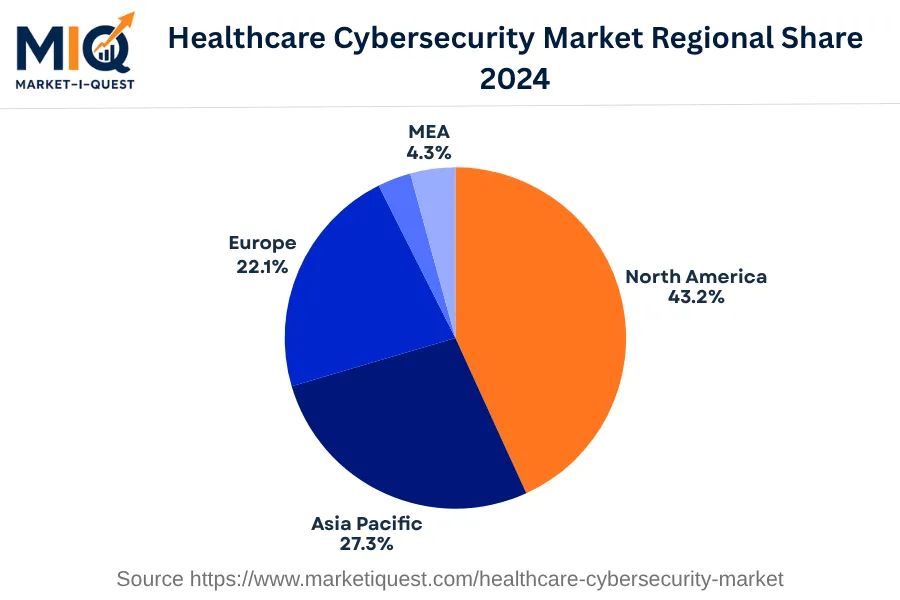
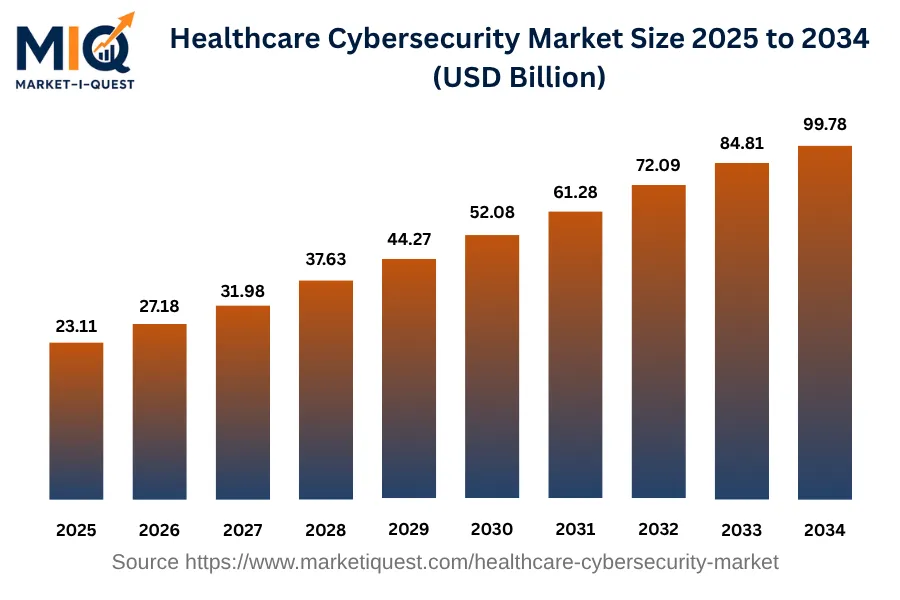
The Healthcare Cybersecurity Market size is projected to grow from USD 23.11 Billion in 2025 to USD 99.78 Billion by the year 2034. This substantial market expansion represents a Compound Annual Growth Rate (CAGR) of 17.65% over the forecast period. The growth journey for the said market is anticipated to start from USD 19.64 Billion in 2024, experiencing a rise to an estimated USD 23.11 Billion by 2025 before eventually reaching the projected size of USD 99.78 Billion by 2034. On the global scale, regional share distribution in 2024 recorded North America holding the largest portion of the market with 43.2%. Asia Pacific followed with 27.3%, Europe with 22.1%, while both LATAM and MEA held smaller portions with 3.2% and 4.3% respectively. Therefore, this data provides a clear roadmap of the Healthcare Cybersecurity Market growth trajectory and regional share distribution.

Key Takeaways

  • By Solution Type - Anti-virus Software held the major share in 2024.
  • By Security Type - IoT Security expanded at a fast pace in the healthcare cybersecurity market from 2025-2034.
  • By Deployment Mode - On-Premises led the market accounting for a significant share in 2024.
  • By End User - Pharmaceutical Companies held a dominant position accounting for a substantial share of the market in 2024.
healthcare-cybersecurity-market market size

Key Driving Factors

Increase in Healthcare Data Breaches

The surge in healthcare data breaches is a primary factor driving the growth of the healthcare cybersecurity market. Despite high-security protocols, health institutions are esteemed targets for hackers due to the sensitive nature of the information they hold. Personal health information, if intruded, can open potential avenues for identity theft and frauds, causing massive fiscal and reputable harm. Presently, each data breach in healthcare is estimated to cost up to several dollars per patient record, leading organizations to prioritize security measures. This consistent concern pushes healthcare providers to invest in advanced cybersecurity solutions, influencing the market expansion.

Adherence to Regulatory Compliance

Regulatory compliances, such as the Health Insurance Portability and Accountability Act (HIPAA) for healthcare organizations in the U.S., play a crucial role. This act mandates the protection of patient records and other related information through appropriate security measures. Failures to adhere can lead to legal penalties, enforcing healthcare entities to maintain robust cybersecurity infrastructure that is compliant with these regulations. As such regulations are growing stronger worldwide, healthcare providers, regardless of their scale, are continuously adopting cybersecurity solutions to protect patient data and ensure regulatory compliance, thus driving market growth.

Market Evolution by Timeline

2019-2023
In North America, healthcare providers increased investment in personal health information protection. Asian hospitals started exploring cybersecurity upgrades, with India and South Korea leading. Interoperability challenges restricted deployment due to inconsistent global cybersecurity standards. The Breach Notification Rule under the U.S. Health Insurance Portability and Accountability Act (HIPAA) pushed adoption. Providers typically used perpetual licensing models and sought cybersecurity vendors with managed services offerings. High solution costs and limited cybersecurity know-how were major constraints, often leading to partial deployments. Consortiums, like the Health Information Sharing and Analysis Center (H-ISAC), promoted best practices.
2024
This year saw European healthcare providers scale cybersecurity solutions due to GDPR implications and increased cyber threats. In the U.S, national standards such as The National Institute of Standards and Technology's Framework influenced adoption. Remote health consultations spiked due to the pandemic, triggering further investments in telehealth cybersecurity. New offerings included Artificial Intelligence-powered threat detection systems. Supply was constrained by integration difficulties with legacy systems. Subscription models became more common. Increased phishing attacks targeting healthcare personnel led providers to invest in staff cybersecurity training.
2025-2029
During these years, cybersecurity solutions saw adoption across most healthcare segments globally, including clinics, hospitals, and research centres. Particular focus areas were to secure mobile health apps and wearable devices. Collaboration around standards such as the Secure Interoperability For Healthcare Data Exchange emerged. Cloud-based cybersecurity solutions, capable of seamless integration with existing systems, fostered the supply side. Value-based pricing models gained acceptance. The primary risk was data breaches due to user errors, and the associated financial penalties. This led to the uptake of integrated security awareness training.
2030-2034
Africa and South America were the final significant geography to broadly adopt healthcare cybersecurity solutions, with donors often funding. Biometric data protection becomes a hot spot. The ISO standard for Health Informatics - Information security management in health using ISO 27799 governed best practices. Supply-side maturity was seen with AI integration, predictive threat models, and custom healthcare sectors cybersecurity solutions. Budget-based pricing models arose, reducing investment constraints. The deployment of Quantum computing technology posed risks of advanced hackings, leading to research in quantum-safe cryptographic solutions.

Future Market Outlook

Future Opportunities

Looking forward, the convergence of healthcare and technology provides multiple opportunities in healthcare cybersecurity. As of 2023, a significant number of healthcare organizations are transitioning to cloud infrastructures, necessitating advanced security protocols tailored for cloud environments. The Federal Risk and Authorization Management Program (FedRAMP) has outlined the standards necessary for securing cloud services in the U.S. federal sector, which healthcare providers can adopt for their cloud compliance. Additionally, the commercialization of 5G technology is set to enhance the capabilities of remote patient monitoring systems, opening opportunities for cybersecurity services that protect fast-transmitting healthcare data. In response to emerging threats, partnerships between technology firms and healthcare providers are increasing. For instance, in 2023, Google Cloud and HCA Healthcare announced a collaboration aimed at improving security and operational efficiency in patient care through data analytics. Furthermore, the implementation of the Cybersecurity Maturity Model Certification (CMMC) is expected to influence how healthcare organizations assess their cybersecurity posture, driving investment in automation and risk management tools. Increased adoption of blockchain technology for secure health records is also becoming a focal point. As regulatory bodies emphasize cyber risk reduction paths, businesses that specialize in cybersecurity solutions tailored for the healthcare sector are likely to experience a growing demand for their services.

Segmentation Analysis

By Solution Type

The market is divided into subsegments including Anti-Virus Software, Intrusion Detection System (IDS), Identity & Access Management (IAM), Data Loss Prevention (DLP), and Encryption. Anti-virus Software accounted for the largest revenue share while Identity & Access Management (IAM) is expected to grow at the fastest CAGR during the forecast period.

Largest Revenue Share

Anti-virus Software

Market Share Leader

Today, the anti-virus software segment leads the market in terms of revenue generation. This can be attributed to several drivers. First, the ever-increasing threats from hackers and cybercriminals have made it imperative for every connected device to be equipped with anti-virus software, driving up demand. Secondly, the increasing digitization coupled with expansion of business operations into the virtual world has made it critical for organizations to protect their databases from malware attacks. Additionally, the trend of work-from-home caused by the COVID-19 pandemic, and enhanced use of IoT devices, has significantly increased thepoints of vulnerability that cybercriminals can exploit, thus, driving the demand for anti-virus software. Geographically, developed regions like North America and Europe, with their high technology adoption rates, dominate consumption. While governments everywhere are introducing stringent regulations related to data protection, they need to ensure a significant increase in the use of anti-virus software, stimulating revenue growth in this subsegment.

Fastest CAGR

Identity & Access Management (IAM)

Forecast Period Growth Leader

The Identity & Access Management (IAM) subsegment is set to experience the fastest CAGR growth. Primarily, the uptick in large-scale security breaches combined with stringent regulatory standards are pushing businesses across verticals to adopt IAM solutions. Technological advancements have made it feasible to integrate IAM solutions with other platforms, simplifying access and increasing operational efficiency. As digital transformation picks up speed, organizations are increasingly focusing on data security and privacy, propelling the adoption of IAM solutions. The scalability offered by cloud-based IAM solutions is attracting small and medium enterprises, thus broadening the consumer base. However, the reluctance of traditional organizations owing to technical limitations and the perceived risk of data migration may slow down the adoption rate. It is anticipated that the growing realization of the importance of IAM in preventing data breaches and enhancing operational efficiency will outweigh these initial hesitations, paving the way for robust growth.

By Security Type

The market is divided into subsegments, including Network Security, Application Security, Endpoint Security, Cloud Security, and IoT Security. As of 2024, Network Security accounted for the largest revenue share, while IoT Security is projected to grow at the fastest rate.

Largest Revenue Share

Network Security

Market Share Leader

Network Security holds the largest market share because it serves as the first line of defense against cyber threats which are becoming increasingly pervasive and sophisticated. Companies of all sizes are investing heavily in network security systems to protect critical infrastructure, customer data, and to comply with strict regulatory rules. This has resulted in a surge of adoption in various sectors, including banking, financial services, healthcare, and retail industries. Network Security is seeing significant growth due to corporate digitization and the permeation of advanced technologies like cloud and 5G. Furthermore, the increasing prevalence of work-from-home culture due to the global pandemic is driving the need for secure remote network access, thus significantly boosting the revenue for the Network Security segment.

Fastest CAGR

IoT Security

Forecast Period Growth Leader

Though IoT Security currently holds a smaller market share it is forecasted to outpace other sectors in growth. The rapid expansion of the IoT marketplace and the proportional surge in security threats are key driving factors. A greater number of connected devices increases the surface for potential attacks, leading to a higher need for security controls. Furthermore, the escalating transfer of data over various networks is promoting the necessity for robust IoT security solutions. Propelled by advancements in AI and machine learning, IoT security capabilities are undergoing considerable improvements which are expected to further catalyze the market's growth. At the same time, stringent regulatory development in the data protection realm act as another major booster. However, lack of awareness and understanding of IoT threats could potentially hinder immediate growth.

By Deployment Mode

The market is divided into subsegments including On-Premises, Cloud-Based, and Hybrid. The On-Premises subsegment accounted for the largest revenue share while Cloud-Based is expected to grow at the fastest CAGR during the forecast period.

Largest Revenue Share

On-Premises

Market Share Leader

The On-Premises subsegment leads in revenue generation due to several factors. The first is control: companies that opt for on-premises deployment are generally looking for tighter control over their data and infrastructure, customizability catering to specific business requirements, and the security brought about by in-house management. This is particularly the case in industries such as finance, healthcare and government where data sensitivity and regulatory concerns steer businesses towards on-premises solutions. Geography also plays a role: businesses located in regions with stable infrastructures often are more likely to opt for on-premises deployment. Moreover, purchasing decisions usually favor on-premises solutions when companies have substantial existing IT infrastructure, especially given the potential switching costs associated with moving to cloud-based or hybrid solutions.

Fastest CAGR

Cloud-Based

Forecast Period Growth Leader

Having taken a secondary position to on-premises solutions in the base year, Cloud-Based solutions are projected to outpace other segments in terms of growth. This subsector will likely benefit from a combination of factors: technological advancements, capital investment, partnerships, and relaxation of regulatory barriers. As the sophistication of cloud technologies increases, they are enabling businesses to move away from the physical restrictions of on-premises solutions. Favorable policies regarding data sovereignty, management and privacy might spur growth too. Further, partnerships between cloud providers and other digital solution providers expand the potential uses of cloud-based deployments, catering to a wider array of business requirements. However, the near-term risks include data security concerns, outage issues, and the uncertainty related to the total cost of ownership.

By End User

The market is divided into subsegments including Hospitals, Pharmaceutical Companies, Health Insurance Providers, Clinical Laboratories, Research Institutions. In the base year of 2024, Pharmaceutical Companies accounted for the largest revenue share while Clinical Laboratories is expected to grow at the fastest CAGR during the forecast period.

Largest Revenue Share

Pharmaceutical Companies

Market Share Leader

Pharmaceutical companies command the lion's share of the revenue pie in this diverse market landscape. Several factors contribute to this lead. First and foremost is their expansion toward more complex and higher-value products, which have been largely driven by advances in science and technology. Also, there has been a rapid increase in the prevalence of chronic diseases globally, which continues to drive the demand for innovative therapeutics. Pharmaceutical Companies are well-positioned to meet these demands, with extensive R&D capabilities and a comprehensive understanding of drug discovery, development, and commercialization. Additionally, these companies benefit from the global regulatory landscape that often prioritizes the drug approval path, resulting in shorter time-to-market. They enjoy strong bargaining power and established relationships with healthcare providers, factors that further solidify their revenue lead. It should also be mentioned that economies of scale, strong branding, and intensive capital investments create significant barriers to entry, making it challenging for potential new entrants to disrupt their market dominance.

Fastest CAGR

Clinical Laboratories

Forecast Period Growth Leader

Clinical laboratories, however, are expected to record the fastest CAGR in the coming years. This projection is mainly attributed to the growing demand for early disease detection, more cost-effective testing processes, and personalized medical solutions across the population spectrum. Clinical laboratories are central in this scenario where precision diagnostics are becoming increasingly critical in medical practice. The accelerated adoption of advanced technologies such as genomics, big data analytics, and artificial intelligence in these laboratories is instrumental in enhancing diagnostic accuracy, efficiency, and cost-effectiveness. Further, collaborations and partnerships with tech companies and digital healthcare platforms can provide access to larger customer bases and enhance service offerings. However, near-term challenges could include regulatory uncertainties and cyber-security risks associated with the increased digitization and interconnectivity. Yet, the overall growth outlook remains strongly positive, backed by the alignment with major healthcare trends and investment in innovation.

Competitive Analysis

Key Market Players

Core Producers for Healthcare Cybersecurity Market

Cisco Systems, Inc.
US
FireEye, Inc.
US
CrowdStrike Holdings, Inc.
US

Key Suppliers & Raw Materials

McAfee, LLC
US
Imperva, Inc.
US
Fortinet, Inc.
US

Distributors, Integrators & Channel Partners

Trend Micro Incorporated
Japan
Palo Alto Networks, Inc.
US
Proofpoint, Inc.
US

Porter’s Five Forces Analysis

Analyzing key drivers affecting the competitive dynamics in the Healthcare Cybersecurity Market.

Supplier Bargaining Power

Medium

Varied cybersecurity solutions providers, with high differentiation leading to moderate power.

Buyer Bargaining Power

High

Numerous buyers, regulatory mandates and potential for scale discounts contribute to high bargaining power.

Threat of Substitutes

Low

Lack of direct substitutes due to the specialized nature of healthcare data and regulatory constraints.

Threat of New Entrants

Medium

Significant investment and technical expertise required but growing market opportunities attract new entrants.

Competitive Rivalry

High

Strong competition due to presence of established tech companies and innovative startups.

Regional Analysis

Geographic market dynamics and growth opportunities across key regions

Global Market Outlook

healthcare-cybersecurity-market market regional share

North America

In 2024, North America's healthcare cybersecurity market was shaped by a landscape of increasing cyber threats targeting the health sector. Vigorous regulatory enforcement, like the U.S. Health Insurance Portability and Accountability Act (HIPAA), drove firms to invest heavily in cybersecurity solutions, prompting technology adoption throughout the healthcare industry. Rapid digitization of health records in the U.S., Canada, and Mexico further intensified demand for strong cybersecurity systems. The shifting supply dynamics accentuated the necessity for robust safeguards against data breaches, reinforcing stringent pricing strategies in the cybersecurity solutions market.

Buyer behavior trends leaned towards comprehensive solutions that assured data security across various digital platforms. Telehealth's rise, triggered by the COVID-19 pandemic, induced a significant shift towards cloud-based cybersecurity products. Increased frequency and sophistication of cyber threats set the stage for strategic collaborations and M&A activities among cybersecurity firms, enhancing the provision of top-tier defense technologies. Regulatory bodies tightened policy enforcement around data privacy and breach notifications, impacting the healthcare cybersecurity product standards. Key customers, including government health agencies, hospitals, and retail pharmacies, adopted advanced cybersecurity software like encryption tools and threat intelligence systems. Enterprises focused on healthcare technologies incorporated stringent cybersecurity measures in their operations, influencing the tech shifts in this market for 2024.

Asia Pacific

In 2024, Asia Pacific’s healthcare cybersecurity market witnessed a crucial phase of investment, regulation enforcement, and technology adoption. High-profile data breaches and increasing use of advanced tech like AI and IoT triggered a surge in demand for cybersecurity measures, with China, Japan, and South Korea spearheading the initiative. Regulatory frameworks like China's Cybersecurity Law pushed healthcare providers to prioritize data security; Australia responded with significant investments in IT infrastructure and cybersecurity providers to counter threats. Market trends echoed this emphasis on security. Asian healthcare firms concentrated on transforming their digital frameworks, shifting from legacy systems to cloud-based solutions. Partnerships and acquisitions became a common strategy, with India's Apollo Hospitals partnering with IBM for a security overhaul – a clear signal of the sector's direction. The choice of cybersecurity solutions also reflected this trend, with preference shifting towards integrated, AI-driven platforms. Policy enforcement saw a rise, with ASEAN countries enforcing standards like General Data Protection Regulation (GDPR) to maintain patient data integrity and privacy.

Key customers in this landscape included large-scale healthcare providers, government-funded institutes, and emerging digital health platforms - sectors that felt the necessity for cybersecurity owing to the sensitive data they handled. Overall, the market in 2024 depicted a robust response to increasing cyber threats, with transitioning trends and regulatory frameworks shaping its direction.

Europe

The European healthcare cybersecurity market experienced significant activity in 2024 primarily due to increased dependency on telemedicine and digital health platforms. Key drivers include the rise in cyber threats targeting healthcare systems, stringent regulations like the GDPR that mandate robust data protection measures, and significant investment in technology solutions by both healthcare providers and governments. High adoption of advanced technologies such as AI for threat detection and prevention also rejuvenated the market. Visible trends in the market comprised the increasing preference of healthcare providers for integrated cybersecurity solutions capable of securing diverse digital platforms. There was a noticeable shift towards cloud-based solutions apt for remote monitoring, owing to the influx of remote medicare due to the pandemic. Market consolidation through M&A was evident as larger cybersecurity companies sought to expand their offerings and reach.

This notable activity was spread across the sectors, with government healthcare agencies, hospitals, and even smaller clinics updating their cybersecurity protocols. In specific geographies, Germany led in terms of investment and regulations, while the UK saw significant partnerships and M&A activities. Central and Eastern Europe observed a considerable increase in the adoption of digital health platforms, pushing their healthcare cybersecurity market advancement.

Latin America

In 2024, the Healthcare Cybersecurity Market in Latin America continued its robust growth, stimulated by unique drivers and trends. Technological adoption was rampant across Brazil, Mexico, Argentina, Colombia, Chile, and Peru. Significant investment in digitizing healthcare records and implementing secure systems, encouraged by regional governments and private corporations, fueled demand for cybersecurity solutions. Importantly, the valuation of personal health information increased, pushing health-related enterprises to prioritize security. Adherence to stringent regulatory mandates, such as the Brazilian General Data Privacy Law (LGPD) and Argentina's Personal Data Protection Law, remained a prime driver of market growth. Demand was robust among hospitals, clinics, insurance firms, and even government health administrations, seeking to secure their digital operations and avoid regulatory fines.

Meanwhile, the dominance of cloud-based solutions in LATAM became more pronounced in 2024. As healthcare providers continued migrating their data to the cloud, this trend fueled demand for cloud-native cybersecurity. Partnerships and M&A activities within the cybersecurity industry also surged, typically involving international technology firms and local cybersecurity startups, particularly in Brazil and Mexico. The persistent threat from cybercriminals targeting the healthcare sector, coupled with more robust policy enforcement, led to an increased emphasis on proactive cybersecurity measures rather than reactive fixes. Lastly, awareness campaigns by the government and cybersecurity providers helped equip more organizations with the knowledge to understand and combat cyber threats.

Middle East & Africa

In 2024, the Healthcare Cybersecurity market in the Middle East and Africa intensified, steered by escalating cyber threats, burgeoning digital healthcare services, and stringent regulations. Heightened digital initiatives in healthcare, such as Saudi Arabia’s Vision 2030, incited flourishing investments, thus enhancing regional technology adoption and strengthening supply dynamics. Additionally, governments' amplified focus on disease surveillance and health data management in countries like the UAE and South Africa propelled demand. A significant trend observed was the increased sensitivity towards patient data confidentiality, shifting hospital system preferences towards more secure, advanced cybersecurity solutions. Notable changes in product technology, especially in Israel, displayed a gravitation towards AI and blockchain for safeguarding healthcare information. There was a distinct proliferation of collaborations, such as that between Nigeria's NITDA and healthcare providers, aiming at optimized cybersecurity measures. A significant increase in regulation enforcement was seen, primarily driven by stringent government policies in countries like Egypt and Qatar.

Accentuated cyber threat awareness influenced buyer behavior across different sectors, including government, healthcare, and financial services. Simultaneously, the preference for specialized cybersecurity service providers became widespread among hospitals and clinics, directly influencing channel dynamics. The Healthcare Cybersecurity market under discussion predominantly served healthcare providers and government entities, emphasizing their growing concern and investment into secure medical data handling.

Recent Industry Developments

Latest market innovations, product launches, and strategic initiatives

July 2026

The U.S. Department of Health and Human Services (HHS) postponed the final HIPAA Security Rule update from May 2026 to July 2027. The proposed rule, originally published in January 2025, aims to strengthen cybersecurity of electronic protected health information by moving away from flexible, "addressable" safeguards toward clearly defined, mandatory technical controls. Key proposed requirements include network segmentation to prevent attackers from moving freely across systems, and mandatory multifactor authentication. The delay gives HIPAA-regulated entities additional time to prepare for implementation.

September 2025

Fortified Health Security, a leading healthcare Managed Security Service Provider (MSSP) recognized by KLAS, acquired Latitude Information Security. The acquisition, finalized on September 29, incorporated Latitude's HITRUST CSF compliance expertise and third-party risk management capabilities into Fortified's platform. The combined entity serves an extensive network of 140 hospital systems, including major organizations like Ascension.

Frequently Asked Questions