Healthcare IT Market Snapshot

Key Players

  • Cerner Corporation (United States)
  • Siemens Healthineers (Germany)
  • McKesson Corporation (United States)
  • Allscripts Healthcare Solutions (United States)
  • Philips Healthcare (Netherlands)
  • Agfa Healthcare (Belgium)
  • Epic Systems Corporation (United States)
  • GE Healthcare (United States)
  • Infermedica (Poland)

Market Size

Base Year 2024
$416.53 Bn
CAGR
15.82%
Forecast 2034
$1809.18 Bn

Market Segments

By Functionality
Administrative Solutions, Clinical Solutions, Financial Solutions
By Deployment Mode
On-Premise, Cloud-Based, Hybrid
By Application
Electronic Health Records (EHR), Telemedicine, Healthcare Analytics, Patient Engagement Solutions, Healthcare Information Exchange (HIE), Others
By End User
Hospitals, Ambulatory Surgical Centers, Clinics, Pharmaceutical Companies, Research Organizations

Market Dynamics

Drivers
  • Rising healthcare expenditure
  • Increasing technological advancements
Restraints
  • High implementation cost
  • Data privacy concerns
Opportunities
  • Telehealth advancements
  • Increasing chronic disease prevalence

Market Size

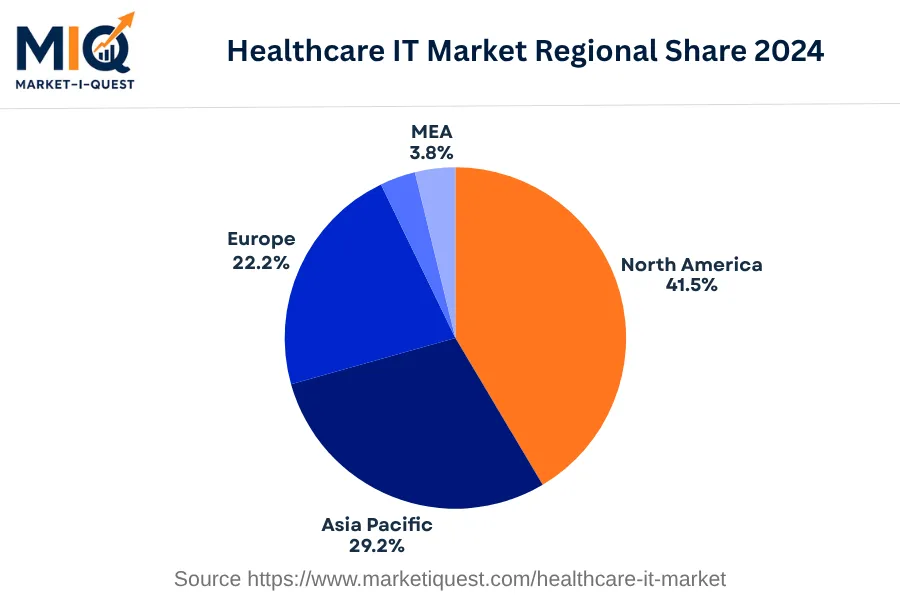
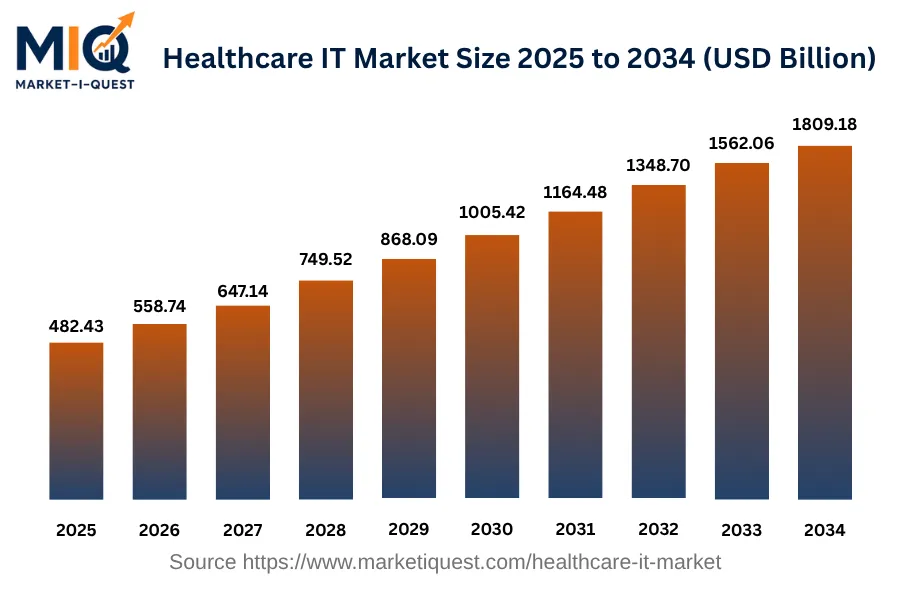
The Healthcare IT Market was sized at $482.43 billion in 2025 and is projected to reach $1,809.18 billion by 2034, growing at a CAGR of 15.82%. The market showed a significant financial leap from $416.53 billion in 2024 to the aforementioned value in 2025, establishing a solid growth path. This consistent growth throughout the decade portrays the advancing trajectory of the Healthcare IT industry, with its ever-increasing market value indicating an escalating demand in related sectors. The regional market distribution in 2024 further provides an insightful perspective, with North America representing the largest share at 41.46%, followed by Asia Pacific at 29.18%, and Europe at 22.18%. Meanwhile, the regions of LATAM and MEA accounted for smaller fractions, securing 3.36% and 3.82% respectively of the global market share.

Key Takeaways

  • By Functionality - Financial Solutions led the sector accounting for a significant share in 2024.
  • By Deployment Mode - On-Premise solutions held the top spot in the base year.
  • By Application - Electronic Health Records(EHR) dominated accounting for a major market share in 2024.
  • By End User - Hospitals stood as the leading segment reflecting a substantial portion of the market in the base year.
healthcare-it-market market size

Key Driving Factors

Implementation of the HITECH Act GDPR

The Health Information Technology for Economic and Clinical Health (HITECH) Act and the General Data Protection Regulation (GDPR) have pivotal roles in the healthcare IT market. The HITECH Act, for instance, promotes the adoption and meaningful use of health information technology, specifically Electronic Health Records (EHR). The law provides financial incentives for providers that demonstrate such use, prompting many to invest in Healthcare IT solutions. GDPR, on the other hand, requires organizations handling EU residents' health data to have proper data security measures in place, leading to increased demand for IT solutions capable of providing this level of protection.

Shift towards value-based care

The transition from a fee-for-service model in healthcare to value-based care has a significant impact on the healthcare IT market. This patient-centric approach relies heavily on data and analytics to improve outcomes and reduce costs. Healthcare providers increasingly turn to IT solutions to collect, analyze, and leverage data to these ends. Are they successful? They can demonstrate better patient outcomes while controlling costs, allowing them to qualify for reimbursement incentives under federal programs like the Medicare Shared Savings Program. These shifts incentivize healthcare providers to further invest in IT solutions.

Market Evolution by Timeline

2019-2023
This period indicated a notable increase in demand for cloud-based technologies, mainly from North American aging population requiring chronic disease management. Electronic Health Records' (EHR) incorporation was on the rise during this period due to the Health Information Technology for Economic and Clinical Health Act advocating for its use. The key challenge during this phase was the data breach risk, causing institutions to implement advanced security systems. Most organizations opted for Subscription as a Service (SaaS), where they paid per user or consumption. However, initial system implementation costs were expensive, hindering some healthcare providers.
2024
In 2024, the demand in the Healthcare IT sector took a significant leap, and a trend towards personalized health management tools was noted, primarily stimulated by European markets. Additionally, telemedicine offerings expanded significantly because of the COVID-19 experiences. In terms of regulations, the General Data Protection Regulation in the EU set stricter controls on data privacy. Stiff price competition led to a prevalence of outcome-based pricing models. Many suppliers, due to the boosted demand, faced production and distribution challenges.
2025-2029
The remote patient monitoring systems saw increased uptake in this period, driven by developed Asian countries focusing on home healthcare. Machine Learning and Artificial Intelligence integration into iT experienced an upward trend, although full-scale implementation was limited by stringent regulatory standards like the HIPAA in the USA. Funding from government initiatives like the Digital Health Implementation Playbook in the U.K. saw SMEs in this sector flourishing. The risk of cyber attacks remained high as technology advanced.
2030-2034
During this period, we see health wearables and IoT devices gaining popularity worldwide, especially in emerging markets. The use of Blockchain technology to secure patient data was a common phenomenon in the IT Healthcare space during this time. However, this technology's integration presented challenges due to its nascent nature. On the pricing front, the trend is moving toward bundled offerings that combine various services for comprehensive care. There's a considerable risk in terms of technology becoming obsolete and being replaced with more innovative solutions, putting pressure on the IT Healthcare suppliers.

Future Market Outlook

Future Opportunities

The accelerating shift towards data interoperability creates substantial future opportunities in the healthcare IT sector. As regulations like the 21st Century Cures Act push for seamless data sharing, healthcare organizations are likely to seek partners in technology solutions that fulfill these compliance requirements. Companies like Allscripts and InterSystems are capitalizing on this trend by developing products specifically aimed at enhancing interoperability among disparate healthcare systems. Furthermore, the telehealth landscape is likely to expand, catalyzed by changes in policies, such as the Centers for Medicare and Medicaid Services extending telehealth payment models established during the COVID-19 pandemic. Such moves are fostering a conducive environment for startups and established companies to innovate in remote patient monitoring and virtual care solutions. Additionally, the rise of value-based care models is prompting healthcare providers to invest in predictive analytics tools that can drive better patient outcomes. Organizations like Optum and IBM Watson Health are already working on solutions that leverage AI and machine learning for predictive health analytics. Given these dynamics, technology providers can also anticipate a growing need for cybersecurity measures, as more patient data is digitized. This environment is likely to drive collaboration between healthcare providers and IT vendors, emphasizing the need for strengthening digital infrastructures to support advanced solutions in patient care and data management on a global scale.

Segmentation Analysis

By Functionality

The market is divided into subsegments including Administrative Solutions, Clinical Solutions, and Financial Solutions. Financial Solutions accounted for the largest revenue share while Administrative Solutions is expected to grow at the fastest CAGR during the forecast period.

Largest Revenue Share

Financial Solutions

Market Share Leader

Financial Solutions emerged as the leading subsegment in the base year, due to a continuous need for financial management across healthcare settings. This derives from the inherent complexities related to monetary practices in the healthcare sector - billing, collections, reimbursement, and revenue cycle management. A range of clients such as physicians, hospitals, and other healthcare service providers are major proponents of these solutions due to their need for effective financial management. Moreover, the increasing regulatory scrutiny over financial transactions in the healthcare sector has accentuated the urgency for financial solutions. This subsegment also benefits from the high switching costs involved, creating a tangible barrier for healthcare providers to transition to new solutions or vendors, thus reinforcing the subsegment's dominance.

Fastest CAGR

Administrative Solutions

Forecast Period Growth Leader

Administrative Solutions is projected to be the fastest-growing subsegment. Two main drivers are propelling this trend - the need for efficiency enhancement and compliance with changing regulatory demands. With healthcare professionals seeking to overhaul archaic administrative procedures to reduce operational overhead and improve patient experiences, the demand for these solutions is on the upswing. Additionally, dynamic policy shifts are prompting organizations to stay abreast with evolving regulatory norms which these solutions conveniently address. Despite the promise of significant growth, adoption barriers remain, namely the need for substantial capital investment and concerns over data protection. Progressively, partnerships between healthcare institutions and technology providers, coupled with ongoing efforts to overcome resistance to technological adoption, are expected to catalyze growth in this subsegment.

By Deployment Mode

The market is divided into subsegments including on-premise, cloud-based, and hybrid deployment modes. In the base year 2024, the on-premise subsegment accounted for the largest revenue share while the cloud-based subsegment is expected to grow at the fastest CAGR during the forecast period.

Largest Revenue Share

On-Premise

Market Share Leader

On-premise deployment has traditionally dominated the market due to its higher control and security features, attributing it for the largest share of market revenue in 2024. Large-enterprise customers prefer on-premise solutions due to strategic emphasis on data control and compliance, particularly in regulated industries such as banking, healthcare and government. These preferential buyer patterns are driven by their larger IT infrastructures and higher capacity to incur upfront costs. Geographically, developed markets with mature IT infrastructure significantly contribute towards the on-premise market size. While on-premise deployment may see a slow growth rate due to overall increased adoption of cloud computing, its strong hold over certain industries and enterprises may continue to generate a significant portion of the market’s revenue.

Fastest CAGR

Cloud-Based

Forecast Period Growth Leader

The cloud-based deployment mode exhibits the fastest growth trajectory in terms of CAGR. This growth is largely due to the increasing adoption of SaaS (Software as a Service) models across all types of businesses. The lower initial investment and flexibility offered by cloud-based solutions benefit a wide customer base, including small and medium-sized enterprises. It’s expected that the trend toward digitization and remote work due to recent global events will likely accelerate the demand for cloud-based solutions. However, data privacy and security remain significant concerns that might slow its adoption rate, particularly in sensitive sectors. Yet, ongoing advancements in cloud technology, like better encryption methods and stringent data protection regulation, could act as catalysts propelling its faster growth.

By Application

The market is divided into subsegments including Electronic Health Records (EHR), Telemedicine, Healthcare Analytics, Patient Engagement Solutions, Healthcare Information Exchange (HIE), and others. Electronic Health Records (EHR) accounted for the largest revenue share while Telemedicine is expected to grow at the fastest CAGR during the forecast period.

Largest Revenue Share

Electronic Health Records (EHR)

Market Share Leader

Electronic Health Records (EHR) leads the industry in terms of revenue generation due to several key drivers. Compliance with regulatory requirements, such as the Health Information Technology for Economic and Clinical Health (HITECH) Act and the Affordable Care Act (ACA), has been a major incentive for healthcare providers to adopt EHRs. The proliferation of digital technology in healthcare, coupled with an increased demand for streamlined workflows among healthcare providers, has also helped. Furthermore, the benefits associated with EHR such as improved patient care, reduction in healthcare costs, increased patient participation, improved care coordination, and better diagnostics and patient outcomes are encouraging its adoption rate. Geography also plays an important role, with the strongest uptake typically seen in developed economies due to better regulatory frameworks, higher spending power, and a stronger focus on healthcare technology.

Fastest CAGR

Telemedicine

Forecast Period Growth Leader

Telemedicine is forecasted to register the most rapid growth over the forecast period. The advent of 5G technology, rising smartphone penetration, and advancements in ICT infrastructure are major catalysts. Higher acceptance of remote consultations, increased realization of cost efficiency, and mobility convenience are the primary drivers. Government initiatives across numerous countries aimed at modernizing health infrastructure and increasing the adoption of telehealth are providing further impetus. However, stringent regulations, lack of proper ICT infrastructure in remote areas, and privacy and security concerns can pose challenges to growth. The COVID-19 pandemic played a major role in boosting telehealth services, and the impacts of it are expected to linger, which might keep the demand high in near future.

By End User

The market is divided into subsegments including Hospitals, Ambulatory Surgical Centers, Clinics, Pharmaceutical Companies, and Research Organizations. In 2024, Hospitals accounted for the largest revenue share while Research Organizations are expected to grow at the fastest CAGR during the forecast period.

Largest Revenue Share

Hospitals

Market Share Leader

Hospitals dominate the market due to a combination of large patient population, extensive healthcare infrastructure, and consistent demand for medical services. Hospitals have frequent, diverse, and high-volume needs making them a significant source of revenue in the market. Additionally, their need to maintain the highest standard of care means they must continually invest in the best available products and treatments. Their size and the complexity of their operations require continual upgrades and replacements, contributing to ongoing demand. Geographies with developed healthcare sectors such as North America and Western Europe contribute significantly to this segment's dominance, as their well-funded hospitals are major consumers of advanced healthcare products and services. Regulatory pressures and patient expectations also drive investment in high-quality health provision, further increasing revenue in this segment. Given their role as core service providers in all health systems, hospitals are likely to continue to represent a significant proportion of the market.

Fastest CAGR

Research Organizations

Forecast Period Growth Leader

Research Organizations are projected to grow at the fastest pace. Research Organizations typically focus on the development and testing of new products and technology, thus being an essential catalyst for market growth. The speed of scientific and technological advances combined with growing recognition of the need for evidence-based practice is likely to drive an increase in the number and scale of projects undertaken by these organizations. Moreover, the growing demand for process improvements and the need to produce comprehensive outcomes have also led to increased investment in research and development, which is further propelling the growth of this segment. Challenges such as the complexity of medical processes and the demand for high-cost investments could affect the growth rate. However, partnerships with manufacturers and policy support for research and development are likely to mitigate these barriers, contributing to this segment's fast growth.

Competitive Analysis

Key Market Players

Manufacturers / OEMs

Microsoft
US
GE Healthcare
US
Siemens Healthineers
Germany

Key Suppliers & Raw Materials

IBM
US
Dell Technologies
US
Intel Corporation
US

Distributors, Integrators & Channel Partners

CDW Healthcare
US
Cerner Corporation
US
Allscripts Healthcare, LLC
US

Porter’s Five Forces Analysis

This analysis inspects the competitiveness and key driving factors within the Healthcare IT Market.

Supplier Bargaining Power

Medium

Power is moderate with dependence on highly specialized providers, but mitigated by numerous vendors.

Buyer Bargaining Power

High

Buyers have high power due to increased awareness, choices and demand for personalised healthcare solutions.

Threat of Substitutes

Low

Low threat due to compliance requirements and the specialized nature of healthcare IT solutions.

Threat of New Entrants

Medium

Entry is medium, needing significant investment in technology, compliance, and trust-building.

Competitive Rivalry

High

High rivalry driven by technological developments, market consolidation and regulatory changes.

Regional Analysis

Geographic market dynamics and growth opportunities across key regions

Global Market Outlook

healthcare-it-market market regional share

North America

The North American Healthcare IT market in 2024 witnessed a significant surge due to various underlying factors. Mandated healthcare policies like Health Information Technology for Economic and Clinical Health (HITECH) Act in the U.S. underpinned new IT adoption among healthcare providers. Additionally, the investment in e-health and m-health tools escalated in response to demand for real-time access to health records and data insights. Driving the market, an increase in the elderly population resulted in amplified demand for healthcare facilities and services, accelerating the need for effective Healthcare IT solutions in Canada. Mexico, acknowledging the growth, implemented changes in healthcare regulations enhancing the IT in public healthcare institutions.

On the trend front, buyer behavior noted a shift towards personalized and user-friendly software interfaces, prompting companies to innovate offerings. Progress was noted in product development, specifically electronic health record systems, showing improved interoperability, data management, and security. Tactical partnerships and M&A's swept across the sector, for example, Microsoft's acquisition of Nuance Communications to expand clinical enterprise capabilities. Government agencies, hospitals, and clinics emerged as the key customers, investing heavily in software applications for clinical decisions, patient monitoring technologies, and telehealth. Notably, retail pharmacies were fast-adopting Healthcare IT systems for digitized patient data management, ensuring an efficient service delivery. In essence, North America's Healthcare IT market in 2024 displayed robust growth, backed by technology adoption, regulatory changes, evolving customer needs, and strategic collaborations.

Asia Pacific

In 2024, the Asia Pacific Healthcare IT Market underwent substantial growth due to a convergence of demand dynamics, regulatory changes, and technology adoption. Rising patient awareness, increased expenditure by healthcare institutions, and higher investment in healthcare technology were key drivers. Regulatory easing in markets including China, India and South Korea further stimulated the market. Technology adoption was paced by Australia and Japan, known for their advanced healthcare systems. Among notable trends, a shift towards integrated healthcare IT solutions dominated, due to their ability to streamline healthcare operations. Proliferating partnerships and M&A activities redefined the competitive landscape, particularly in key ASEAN markets. The enforcement of stringent data security regulations was also a priority, impacting sectors like enterprise and government healthcare departments.

The market also saw a marked preference for cloud-based healthcare IT solutions, fuelled by retail and utility sectors. Moreover, the demand for electronic health record applications increased, with manufacturing companies leading in adoption. China's push for digitization in public healthcare institutions and India's National Digital Health Blueprint were pivotal in shaping the digital landscape. Overall, the Asia Pacific Healthcare IT market displayed robust growth in 2024, shaped by major drivers and specific market trends.

Europe

In 2024, the European Healthcare IT Market experienced significant changes due to various drivers and trends. An essential driver was the growing demand for streamlined healthcare service delivery across Germany, the U.K., France, and Italy, encouraging the adoption of advanced healthcare IT solutions. Regulatory developments also fostered change, notably, the integration of the GDPR standards into the Heathcare IT sector, thereby creating a secure digital environment for patient data. Additionally, heavy investment in IT infrastructure by dominant sectors - enterprise and healthcare, specifically in the Nordics and Benelux, further contributed to the market's evolution. On the market trends front, a notable uptick in strategic partnerships and M&A was observed across Central & Eastern Europe to consolidate resources and boost the Healthcare IT capabilities. An evident shift was noticed towards cloud-based solutions, fueled by the need for remote access to healthcare services and increased interoperability. Furthermore, the implementation of AI and machine learning in healthcare technologies saw a surge, optimizing patient care and operational efficiency.

Overall, the European Healthcare IT Market in 2024 was a dynamic entity, shaped by factors like regulatory changes, sector-specific investments, technology adoption, and strategic collaborations. Each of these factors played a critical role in shaping the market's ecosystem, reflecting the region's commitment to enhancing its healthcare services through IT advancements.

Latin America

In 2024, the LATAM Healthcare IT market experienced a significant advancement, driven primarily by the technology adoption and strategic investments in countries like Brazil, Mexico, Argentina, Colombia, Chile, and Peru. In particular, government regulations promoting digitalization in healthcare systems paved the way for expansive growth across these nations. Increased investment in e-health solutions represented a primary growth driver, as both public and private sectors geared towards strengthening healthcare infrastructure. Brazil and Chile witnessed substantial growth, fuelled by government initiatives for the implementation of electronic health records. Moreover, the growing prevalence of chronic diseases led to escalated demand for remote patient monitoring systems, propelling technology adoption particularly in Mexico and Colombia, with Argentina following suit.

Major trends included the rise in partnerships and M&A activities among health tech firms to fortify their market presence. Telemedicine experienced significant expansion, influenced by a shift in buyer behavior towards digital health platforms, especially in Peru due to the COVID-19 aftermath. Also observed was the policy enforcement by governments to ensure adherence to standards for better data management and interoperability among healthcare IT systems. The enterprise sector, including hospitals and clinics, formed the major customer base. However, integration of IT with healthcare utilities was also a notable trend, indicating a shift of the retail sector towards health tech solutions in a bid to customize patient care.

Middle East & Africa

In 2024, the Healthcare IT market in Middle East and Africa demonstrated significant dynamism, largely propelled by increased government spending on health technology and infrastructure upgrades, particularly in Saudi Arabia, the United Arab Emirates, Qatar, and Israel. Greater adoption of electronic health records (EHRs) across many hospitals in Egypt and South Africa, stimulated by regulatory mandates and financial incentives, was a key driver, as well as advancing digitization efforts in mHealth and telemedicine technologies, notably in Nigeria and Kenya, due to escalating demand for remote healthcare services.

Trends reflective of this evolving market included a shift towards cloud-based solutions in Israel and a strong emphasis on cybersecurity in healthcare IT within the United Arab Emirates. Growing participation from the private sector, evidence by a substantial increase in partnerships and M&A activities across Saudi Arabia and Qatar, also underscored the trend. These trends were catalysed by policies such as the Saudi Vision 2030 and Egypt's Digital Health Strategy which enforced digital transformation in healthcare. The dynamic market was, however, not without challenges. Complexities concerning interoperability and data privacy persist, affecting sectors from government health institutions to financial services dealing with health insurance, in regional economies across the Middle East and Africa.

Recent Industry Developments

Latest market innovations, product launches, and strategic initiatives

May 2026

The European Commission published an implementing regulation setting new procedural requirements for Notified Body assessments in medical device and IVD conformity assessment procedures.

January 2026

The UK and EU authorities advanced major initiatives affecting AI, digital technologies, data governance, and cybersecurity in healthcare. The UK's MHRA proposed pre-market reforms signaling a shift toward more flexible, lifecycle-based oversight with greater emphasis on post-market monitoring and innovation support.

Frequently Asked Questions