Graphene Electronics Market Snapshot

Key Players

  • Graphenea Inc. (United States)
  • XG Sciences (United States)
  • CVD Equipment Corporation (United States)
  • CAmare Inc. (South Korea)
  • Versarien Plc (United Kingdom)
  • 2-DTech (United Kingdom)
  • Samsung Electronics Co. Ltd. (South Korea)
  • Graphene Frontiers (United States)
  • Haydale Graphene Industries (United Kingdom)
  • Aceo (Germany)

Market Size

Base Year 2024
$1.2 Bn
CAGR
34.9%
Forecast 2034
$23.90 Bn

Market Segments

By Product
  • Display
  • Memories
  • Batteries
  • Solar Cell
  • Integrated Circuits and Chips
  • Others
By End Use Industry
  • Consumer Electronics
  • Healthcare
  • Automotive
  • Industrial Robotics
  • Aerospace and Défense
  • Others

Market Dynamics

Drivers
  • Rising demand for flexible electronics
  • Increasing miniaturization of devices
Restraints
  • High production costs
  • Limited commercial viability
Opportunities
  • Emerging wearable technology trends
  • Increased demand for clean energy sources

Market Size

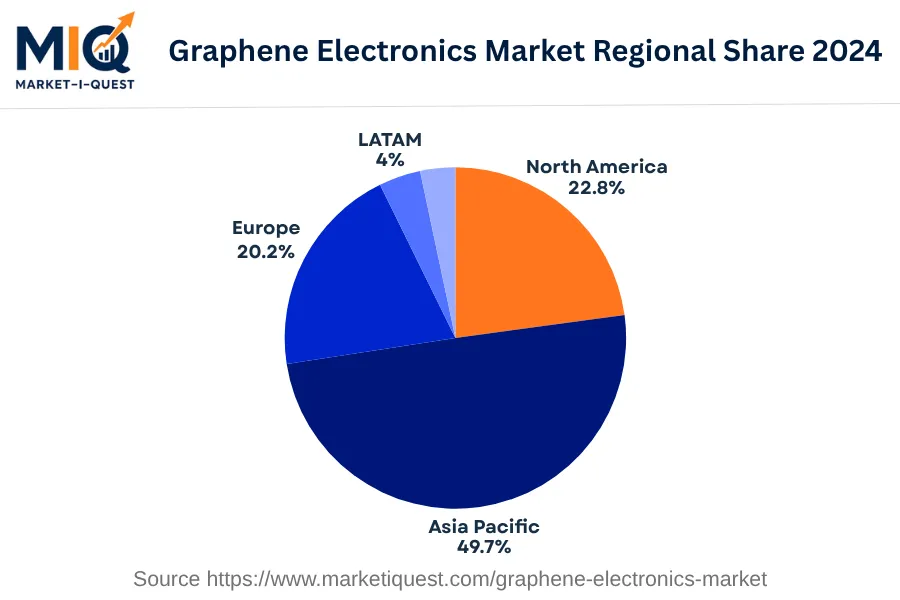
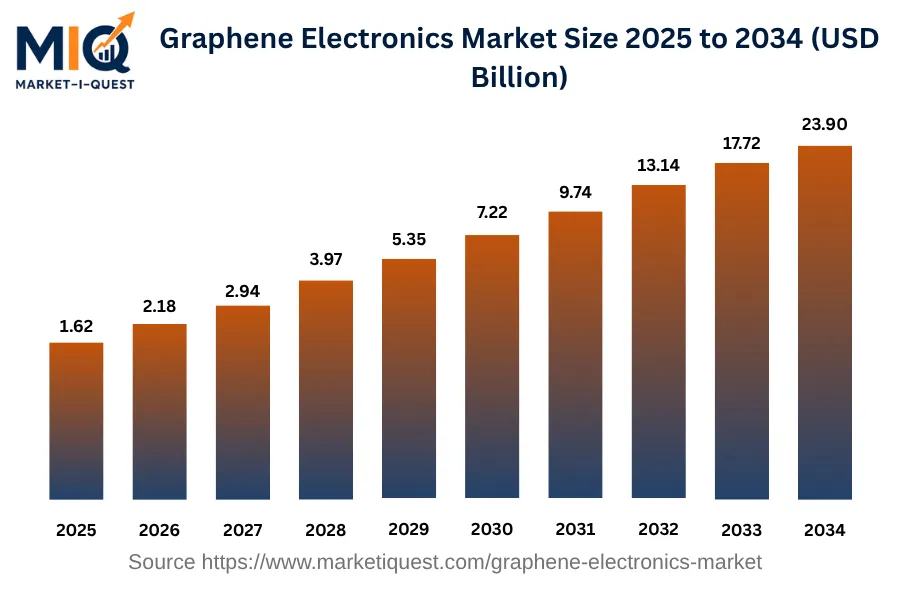
The Graphene Electronics Market in 2025 is worth $1.62 billion, which increases considerably by 2034 to reach $23.90 billion, growing at a CAGR of 34.9%. The market expansion from 2025 to 2034 showcases nearly a 15-fold increase, indicating a high rate of market acceptance for graphene electronics during this period. This growth is primarily influenced by technological advancements and increasing demand for these electronics on a global scale. As of regional share in 2024, Asia Pacific leads with 49.7% of the total market share, followed by North America with 22.8% and Europe with 20.1%. Meanwhile, Latin America contributes 4.0% and Middle East & Africa attributes to 3.3% of the overall market share, respectively.

Key Takeaways

  • By Product - Integrated Circuits and Chips segment held a dominant position in the Graphene Electronics Market.
  • By End Use Industry - Consumer Electronics led the market accounting for a large share in 2024.
graphene-electronics-market market size

Key Driving Factors

Regulatory Support for Clean Technologies

The transition of economies worldwide towards cleaner technologies is a crucial factor driving the Graphene Electronics Market. Regulating bodies across several countries, including the European Union and the United States, emphasize the need for more eco-friendly consumer electronics. Graphene has emerged as a promising solution. Its unique properties mean less material usage and lower energy consumption during production, making it a sustainable choice. This regulatory support for cleaner technologies encourages electronics manufacturers to incorporate graphene into their products. The shift also nudges research institutions and tech firms to further focus on innovating and improving graphene-based components.

Prompted Adoption in Healthcare Sector

The healthcare sector's increasing utilization of graphene electronics is accelerating market growth. Especially in diagnostics, graphene's superior conductivity and biosensing properties make it a desirable material for devices like bioelectric sensors and medical imaging equipment. It allows for enhanced sensitivity and faster response times in diagnostic procedures, consequently improving patient outcomes. Additionally, graphene's flexibility and compatibility with biological systems makes it a promising candidate in developing wearable biomedical devices. Hospitals and laboratories, eager to adopt improved diagnostic and monitoring capabilities, are accelerating the demand for graphene electronics, driving market growth.

Market Evolution by Timeline

2019-2023
In this period, dense clusters of buyers emerged from the automotive and semiconductor sectors attempting to exploit graphene's unique material properties. Specifically, US and Chines are the key regions with strong demand due to their expansive technology and automotive industries respectively. Limited supply of high-quality graphene acts as a constraining factor. Development in purification techniques marked the technology breakthrough which improved graphene integration in semi-conductor devices and batteries. China's introduction of graphene-related material standards like GB/T 30413-2013 outlined the classification and labeling of graphene. Partnerships between multinationals and graphene suppliers, such as Samsung and Graphene Square facilitated graphene's commercial use. High manufacturing cost remained the major obstacle for large scale application of graphene.
2024
By 2024, consumer electronics and energy sectors started adopting graphene-enhanced products. South Korea, Japan, and Germany showed notable demand. Improvements in production technology allowed for the first successful integration of graphene into Li-ion batteries and touch screens. European Commission's Graphene Flagship program sought to bridge the gap between lab-scale manufacturing and commercial-scale production of graphene. Leasing contracts surfaced as a notable commercial model, allowing clients flexible financing and ensuring continuous supply. However, environmental concerns related to graphene manufacturing surfaced, leading to stricter governmental regulations in Europe and US.
2025-2029
During this period, the communications technology sector, particularly 5G technology, showed a remarkable increase in demand for graphene-based components. Greater understanding of graphene's properties coupled with advanced production methods have led to more extensive real-world applications. The continued implementation of manufacturing standards such as ISO/TS 80004-13:2017 by the International Organization for Standardization fostered quality production. Commercial adoption was supported by mark-up pricing, particularly for high-end, graphene-enhanced products. Recycling of graphene material became a key concern in this period due to the increasing volume of graphene waste.
2030-2034
Throughout this period, biotechnology and healthcare sectors emerge as major demand sectors, seeking to leverage graphene's antibacterial properties. Leading regional demands were marked by countries investing heavily in nanotechnology, specifically US and Singapore. On the supply side, graphene biosensors, wearable technology are among the significant achievements. To manage the technological shift, regions followed the examples of prior graphene standards such as ISO/TR 19733:2019; increasing the adoption of uniform industry-standard specifications. Licensing contracts with suppliers became the prevalent commercial model. Sanitation and eco-friendly considerations were the main risks, with healthcare sectors marking practices to mitigate biomedical waste.

Future Market Outlook

Future Opportunities

The future of the graphene electronics market presents a spectrum of opportunities aligned with existing technological trends. In 2023, countries such as South Korea actively promoted public-private partnerships to accelerate the use of graphene in next-generation electronics, setting a precedent for potential collaborative frameworks worldwide. Companies like IBM have been investing resources in developing quantum computing solutions using graphene, driven by its superior characteristics. Furthermore, the demand for more efficient and flexible electronic devices in sectors such as healthcare and wearable technologies is on the rise, evident from recent announcements by firms like Google, showcasing how graphene can enhance device functionality. Research from universities has also focused on the scalability of graphene applications, which will likely attract more investment and innovation in materials science. Frameworks such as the European Battery Alliance have outlined the integration of graphene into energy storage systems, enhancing battery performance significantly as of mid-2023. There are substantial implications for innovations in automotive electronics, where companies like Tesla are exploring graphene-based materials for advanced components. As environmental regulations strengthen globally, a shift toward sustainable electronic solutions using graphene may become a priority, prompting industries to invest in greener technologies. As outlined in various 2022 conferences, these factors will not only open new market segments but will also influence regulatory pathways, allowing stakeholders to navigate the evolving landscape more effectively.

Segmentation Analysis

By Product

The market is divided into subsegments which includes Display, Memories, Batteries, Solar Cell, Integrated Circuits and Chips, and Others, among which Integrated Circuits and Chips accounted for the largest revenue share while Solar Cell is expected to grow at the fastest CAGR during the forecast period.

Largest Revenue Share

Integrated Circuits and Chips

Market Share Leader

The Integrated Circuits and Chips subsegment commands the largest market share in terms of revenue. This can be credited to a multitude of reasons, among which the continuous technological innovation and evolution in the IT industry play the most significant role. The growing demand for faster and efficient computing and mobile devices necessitates an increase in the manufacture of sophisticated integrated circuits and chips. Industry-wide adoption of AI and IoT in sectors such as healthcare, consumer electronics, and automobiles, among others, further accelerates the demand. Increasing miniaturization of electronic devices, coupled with improvements in power efficiency and processing capabilities of chips, also contribute to increased production volumes. Rapid digitalization and the rise of connected devices globally have spurred the growth of this subsegment. Special mention goes to countries in the Asia Pacific region, which due to their vast consumer markets and the presence of multiple manufacturing hubs, make a substantial contribution towards this subsegment's revenue.

Fastest CAGR

Solar Cell

Forecast Period Growth Leader

The Solar Cell subsegment is projected to exhibit the highest growth rate in the future. The escalation can be explained by the growing global movement towards renewable energy to address sustainability concerns and reduce over-dependence on non-renewable and fossil fuel-based power generation. Enhanced efficiency in solar cell technology, innovations in storage systems, and the reduction in cost due to increased production scale have made this form of power significantly appealing. Government initiatives, like policy reforms and subsidies, are boosting the adoption of solar technology in both developed and developing economies. A significant catalyst for growth is the rising investment in the sector, led by private organizations and public-private partnerships. Despite this rapid growth, challenges persist such as grid integration and storage issues that could slow down the momentum if not addressed. Balance of systems costs and dependency on weather are other impediments. However, ongoing research in the field presents a positive outlook for the future.

By End Use Industry

The market is divided into subsegments including Consumer Electronics, Healthcare, Automotive, Industrial Robotics, Aerospace and Defense, and Others. Of these, Consumer Electronics accounted for the largest revenue share, while Aerospace and Defense is expected to grow at the fastest CAGR during the forecast period.

Largest Revenue Share

Consumer Electronics

Market Share Leader

In the base year 2024, the Consumer Electronics segment emerged as a leader in terms of revenue. This substantial market share can be attributed to the pervasiveness of electronic devices in everyday life. The ubiquity of smart devices, from smartphones and tablets to wearables and smart home devices, in combination with sustained consumer demand, continues to fuel the sector's growth. The trend towards IoT-enabled devices and the shift towards smart, connected homes are key drivers. Additionally, emerging markets present vast untapped potential, contributing to the robust revenue outlook. The diversification of consumer electronics products, driven by continued technological innovation, serves to broaden the market reach. Simultaneously, ongoing digitization and increasing consumer spending power underpin strong market performance. It's also worth noting that high purchasing frequency and rapid product replacement cycles contribute to the consistent sales.

Fastest CAGR

Aerospace and Defense

Forecast Period Growth Leader

However, a markedly different trend is projected within the Aerospace and Defense subsegment, which is anticipated to post the fastest growth rate. The dynamic stems from a combination of factors, not the least of which includes the increasing geopolitical tensions and the corresponding surge in defense expenditures. Technological advancements ensuring safety, efficiency, and cost-effectiveness serve as significant growth catalysts. There's also a rising trend toward unmanned systems and the increased use of Artificial Intelligence, Machine Learning, and Robotics. In particular, deep space exploration projects and the commercialization of space travel are potential revenue boosters. However, the high capital requirements and stringent regulations pose near-term barriers to adoption. Succeeding in this market will likely involve developing strategic partnerships, securing government contracts, and maintaining technological superiority.

Competitive Analysis

Key Market Players

Manufacturers / OEMs

IBM
US
Samsung Electronics
South Korea
AMO GmbH
Germany

Key Suppliers & Raw Materials

Graphenea
Spain
Grafoid Inc.
Canada
Sparc Technologies
Australia

Distributors, Integrators & Channel Partners

Haydale Graphene Industries
UK
Versarien plc
UK
ACS Material
US

Porter’s Five Forces Analysis

An analysis of the competitive forces affecting the Graphene Electronics Market.

Supplier Bargaining Power

Medium

Suppliers maintain moderate power due to the complexity and expertise required in graphene production.

Buyer Bargaining Power

High

Buyers have high bargaining power due to the increasing availability of graphene-based products and vendors.

Threat of Substitutes

Low

Threat of substitutes is low as graphene's unique properties make it difficult to replace in many applications.

Threat of New Entrants

Medium

Entry barriers are moderate due to high initial capex, regulatory compliance, and patent-related issues.

Competitive Rivalry

High

Rivalry among competitors is high due to the market's rapid growth and the drive for technological advancement.

Regional Analysis

Geographic market dynamics and growth opportunities across key regions

Global Market Outlook

graphene-electronics-market market regional share

North America

In 2024, the North American Graphene Electronics Market saw a dynamic shift towards technological acceleration and adoption. Several prominent drivers that characterized the year were surges in demand from the electronics industry, amplified by the proliferation of smart devices. Legislative policies favouring clean, sustainable technologies also favored graphene, given its environmentally friendly profile. Investment into R&D was substantial, with companies like IBM and Intel backing comprehensive studies into the applications of graphene.

Noteworthy trends included a shift towards consumer electronics, particularly in segments like smartphones, wearables, and other smart devices. The role of Graphene as a critical component of batteries propelled it to an essential position in the EV market, as manufacturers, notably Tesla, sought to increase energy efficiency. Channel dynamics were influenced by regular strategic partnerships to expedify supply chains and boost collaborative R&D. Standards imposing strict product quality control swayed manufacturers to optimize their processes, ensuring graphene quality.

Various sectors showed keen interest in this market, namely government bodies, manufacturing entities, and the healthcare sector. The U.S. government’s policies to slash carbon emissions led to increased adoption in public utilities, while in healthcare, graphene-based electronics were exploited for diagnostic machines and wearable health devices. In Canada and Mexico, sectors like mining and automobile manufacturing saw mass integration of graphene-based components, fueling the overall market growth in North America.

Asia Pacific

In 2024, the Graphene Electronics Market in Asia Pacific showcased significant growth, fueled by various drivers and trends. High demand for flexible and wearable electronics, particularly in China and South Korea, bolstered the market. Governmental support in India and China toward nanotech research, coupled with substantial investments made, amplified the market status. Additionally, quick technology adoption swiftly replaced silicon-based electronics, notably in Japan and Australia, due to graphene's superior thermal, electrical, and optical properties.

A trend in the market was the shift towards graphene-based photovoltaic cells following policies for energy-conserving electronics in key ASEAN markets. Large-scale manufacturing industries witnessed increased usage of graphene for heat management in semiconductor and IC design processes, driven by the materials exceptional performance at high temperatures.

Escalating acceptance of electronic vehicles, especially in China and India, stimulated demand for graphene applications in battery technology. Partnerships and mergers, predominantly in South Korea and Japan, between graphene manufacturers and end-use industries became increasingly popular to secure raw material supply. Finally, regulatory enforcement in the healthcare sector concerning biosensors' standardization also nudged the market towards graphene-based products across the region. Therefore, a robust blend of market drivers and trends despite the demands and regulations has established a promising future for the Graphene Electronics market in the Asia Pacific region in 2024.

Europe

In 2024, the European Graphene Electronics Market exhibited dynamic growth, propelled by increased government funding and business investments in advanced technology adoption. High demand for flexible, energy-efficient devices, particularly in Germany and the United Kingdom, was a significant market driver, alongside regulatory incentives for green technology in France and Italy. Within Central & Eastern Europe, rising interest in Graphene’s potential for high-performance computing diversified the market supply, as countries positioned themselves at the crossroads of research, business, and manufacturing. Spain and the Nordics saw strong shifts towards Graphene-based photovoltaics, driven by their robust renewable energy sectors.

Key trends re-shaped the buyer landscape and product design. Among businesses and consumers alike, Graphene's high thermal conductivity spurred its use in electronics cooling, especially in data-driven sectors such as enterprise computing and retail. Partnerships between manufacturers, primarily in Benelux countries, emphasized local supply chain sustainability. Increased policy enforcement around e-waste recycling stimulated a shift towards Graphene electronics in the consumer goods sector, particularly in light of Graphene’s inherent recyclability. Meanwhile, rising digital healthcare needs in Germany and the UK spurred interest in Graphene’s potential for bio-integrated devices. The burgeoning market exhibited a nuanced interplay of supply and demand, shaped by diverse regional drivers and trends.

Latin America

In 2024, the Graphene Electronics Market in Latin America entered a crucial expansion phase, guided by innovative technological adoption. The surge in demand for flexible and durable electronics across various sectors like manufacturing, retail, and utilities in Brazil and Mexico primarily drove the market. Regulatory changes enabling more investment in nanotechnology in Argentina and Chile also significantly impacted the market dynamics. Rapid adoption of digital transformation strategies, especially in Colombia's retail sector, led to an increased supply of Graphene-based products.

Changes in buyer behavior were largely influenced by the shift towards sustainable electronics. Companies across the region started prioritizing the development and purchase of products featuring Graphene due to its enhanced properties over traditional materials. Partnerships, like the notable agreement between Peru's leading electronics manufacturer and a major Graphene supplier, fueled this market's growth. Standardization efforts for Graphene-based products gained momentum in Colombia, reflecting the government’s commitment to ensure quality and compatibility. In the healthcare sector in Brazil and Mexico, there was an upsurge in the demand for Graphene-based biosensors due to their high sensitivity and rapid response times. Government entities in Chile and Argentina increased their procurement of Graphene-infused components to support their green technology initiatives. Thus, progressive technology adoption and heightened awareness about Graphene's capabilities shaped the landscape of the Latin American Graphene Electronics Market in 2024.

Middle East & Africa

In 2024, the Graphene Electronics market in the Middle East and Africa demonstrated an escalating growth driven by increased demand, technological advancements and strategic investments. Industry expansion was facilitated by the climbing demand for efficient and sustainable energy solutions in countries like Saudi Arabia and the United Arab Emirates. Regulations favoring renewable energy adoption, particularly in South Africa and Egypt, stimulated market dynamism. Moreover, substantial investments in technology integration particularly in telecom and healthcare sectors, prevalent in Kenya, Nigeria, and Israel, boosted the market's vitality.

The year marked distinctive shifts in buyer behaviors and product preferences, amplifying the market's dynamism. In Saudi Arabia and UAE, an inclination towards smart electronics leveraging graphene technology was prevalent. Rapid expansion of the telecom sector in Qatar and Israel was met with increased graphene electronics adoption for superior connectivity. Adoption was also notable in utilities and manufacturing sectors in South Africa and Egypt, while the financial services sector in Nigeria demonstrated rising interest. With policy enforcement fostering market development, there emerged a favorable environment for mergers and acquisitions, as observed with high-profile partnership deals in the UAE and South Africa. Consequently, the graphene electronics market in the Middle East and Africa showcased a promising trajectory in 2024 owing to favorable market drivers and emerging trends.

Recent Industry Developments

Latest market innovations, product launches, and strategic initiatives

April 2026

This technology spin-off received approval for €211 million in state funding to build a new class of optical hardware. The project uses graphene to help solve data-transfer speed limits inside artificial intelligence computing systems without overheating them.

March 2026

The company secured U.S. Environmental Protection Agency (EPA) approval for its graphene-based thermal coating system. This regulatory clearance allows them to legally sell their heat-dissipating products directly to data centers and electronics manufacturers in the country.

Frequently Asked Questions