
Energy Retrofit Systems Market Snapshot

Key Players

  • AECOM (United States)
  • Daikin Industries Ltd. (Japan)
  • Honeywell International Inc. (United States)
  • Johnson Controls Inc. (Ireland)
  • Orion Energy Systems Inc. (United States)
  • Schneider Electric SE (France)
  • Trane Technologies plc. (Ireland)
  • OSRAM Licht AG (Germany)
  • Philips Lighting Holding B.V. (Netherlands)
  • Siemens AG (Germany)

Market Size

Base Year 2024
$175.4 Bn
CAGR
8.27%
Forecast 2034
$388.25 Bn

Market Segments

By Retrofit Type
  • Building Envelope Retrofits
  • HVAC and Mechanical System Retrofits
  • Lighting Retrofits
  • Others
By Retrofit Depth
  • Shallow Retrofits
  • Medium Retrofits
  • Deep Retrofits
By Building Type
  • Residential Buildings
  • Commercial Buildings
  • Industrial Buildings
  • Public Buildings

Market Dynamics

Drivers
  • Increasing energy efficiency demand
  • Regulatory energy saving obligations
Restraints
  • High installation costs
  • Policy and regulatory uncertainty
Opportunities
  • Increased Energy Efficiency Demand
  • Need for Sustainable Solutions

Market Size

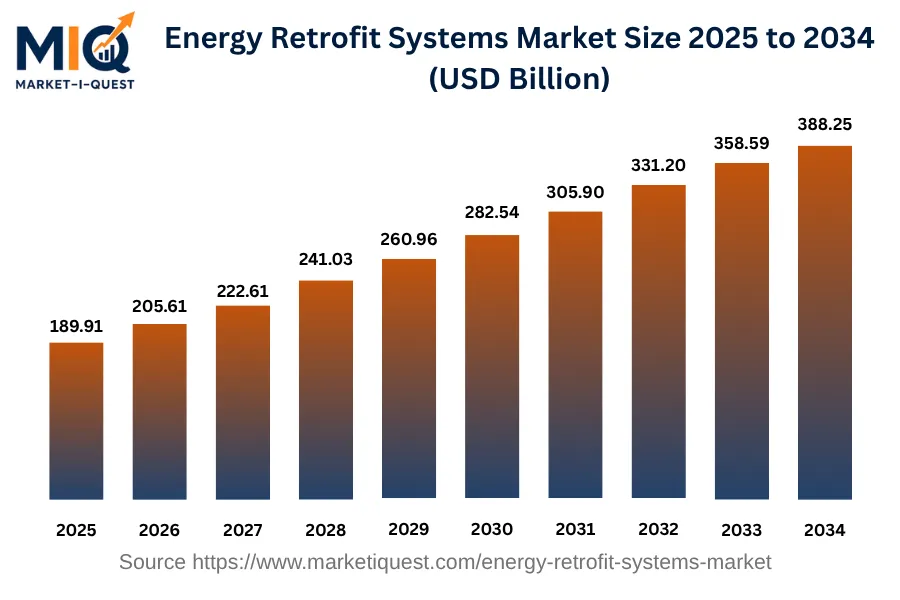
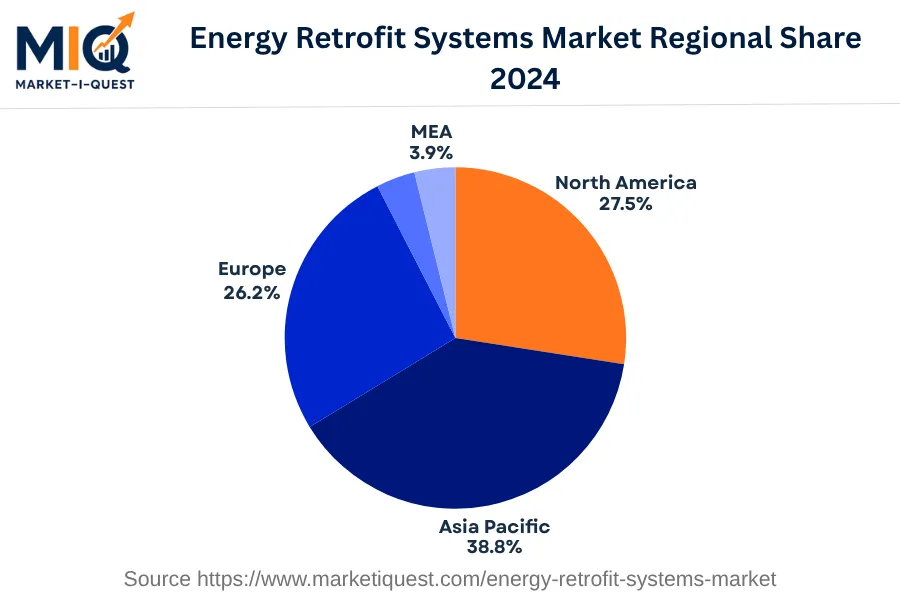
The Energy Retrofit Systems Market, valued at USD 175.4 billion in 2024 is expected to grow to USD 189.91 billion in 2025. By the year 2034, the market size is projected to swell to USD 388.25 billion, demonstrating a compound annual growth rate (CAGR) of 8.27% over this period. This growth is caused by a marked increase in the demand for energy efficiency across various sectors, leading to more institutions adopting innovative means of energy conservation through retrofit systems. The trend is projected to continue well into the forecast period, facilitating steady growth in the market. Also worth noting is the share of each region in the total market value recorded in 2024, where Asia Pacific had the highest at 38.82%, closely followed by North America with 27.46% and Europe with 26.17%. The least contributors were LATAM and MEA regions with 3.68% and 3.87% of the total market value respectively.

Key Takeaways

  • By Retrofit Type - HVAC and Mechanical System Retrofits held the top position accounting for a significant share in 2024.
  • By Retrofit Depth - Deep Retrofits led the market with a high growth rate in the forecast period 2025-2034.
  • By Building Type - Industrial Buildings dominated the Energy Retrofit Systems Market with the largest share in 2024.
energy-retrofit-systems-market market size

Key Driving Factors

Strict Energy Efficiency Standards

In various regions worldwide, governments are setting stringent energy efficiency standards, which are emerging as a significant driver for the energy retrofit systems market. Regulators such as the European Union's Directive on Energy Efficiency and the U.S.'s Corporate Average Fuel Economy standards are requiring reductions in energy consumption. This regulatory pressure pushes businesses and homeowners to revamp their existing buildings and infrastructure by implementing energy retrofit systems. The aim is to reduce overall energy usage and related costs, and to comply with the law. Therefore, the obligation of adhering to these energy efficiency regulations fuels the adoption of energy retrofit systems by both private and public sectors.
Increasing Awareness of Carbon Footprint Reduction

An increasing awareness concerning the environmental impact of carbon footprints has influenced the adoption of energy retrofit systems. Various stakeholders, including consumers, businesses and governments, are pushing for eco-friendliness in order to combat climate change. From small housings to large corporations, there is heightened interest in reducing the carbon dioxide emissions associated with energy use. The use of energy retrofit systems facilitates the reduction of these emissions. Energy retrofit systems can include improvements to building envelopes, the installation of high-efficiency heating and cooling systems, or the implementation of energy-efficient lighting. They not only reduce emissions but often result in utility cost savings, creating a compelling return-on-investment. This growing environmental concern and quest for sustainability is thus driving the energy retrofit systems market.

Market Evolution by Timeline

2019-2023
Over these years, primary buyers of energy retrofit systems were commercial buildings and home users in Europe and North America, attracted by energy savings and carbon footprint reduction. Most systems combined solar panels with energy management software. The integration of these systems encountered challenges owing to their increasing complexity. EU regulations like the Energy Efficiency Directive played a significant role in their adoption. Contract lengths usually ranged from 10 to 25 years, with pricing based on energy savings performance. Partnerships among manufacturers and utility companies became common. Delays in installations due to supply-chain issues posed a major risk.
2024
In 2024, we saw greater demand from emerging Asian markets like India and China, driven by rapid urbanization and government policies aimed at reducing carbon emissions. Advancements were made in energy efficiency technologies like LED lighting and HVAC systems. Standards such as the Indian BEE Star Labeling Program came into play, boosting adoption. The typical business model remained performance-based contracts. A key risk was the high upfront cost for installations, somewhat mitigated by government subsidies and soft loans.
2025-2029
The demand for energy retrofit systems extended to various industrial sectors during this period. Technological advancements led to wider adoption of smart energy management systems. Substantial government funds were used to stimulate markets and offset high installation costs. Regulatory frameworks, such as the China Energy Conservation Program, catalyzed the adoption, and the commercial model evolved with the advent of ESCO. Businesses turned to leasing models to manage the high upfront costs, and issues relating to technology compatibility emerged as risks.
2030-2034
Demand notably spiked from regions implementing strict climate policies, and from industries regulated for their large carbon footprints. Technological progress in IoT-based energy retrofit systems provided novel solutions. Additionally, integration with existing systems matured significantly, reducing user constraints. Policy initiatives, like North America's Green New Deal, promoted low-carbon technologies. The evolving model of Energy-as-a-Service (EaaS) propelled market growth, whereby customers pay for energy services without owning the infrastructure. However, cybersecurity risks surfaced with increased digitalization.

Future Market Outlook

Future Opportunities

Given the regulatory landscape and emerging technologies, numerous opportunities exist in the energy retrofit systems market. As of 2023, regulatory efforts such as California's Title 24 are increasing the emphasis on energy efficiency in buildings, setting stringent performance requirements that encourage property owners to pursue comprehensive retrofitting. This shift creates a heightened demand for retrofit service providers and technology developers capable of offering tailored solutions. Additionally, partnerships between local governments and private firms, such as the initiative launched by the UK government in 2022 to promote energy efficiency upgrades, present avenues for accessing financial incentives and subsidies that can ease the financial burden on homeowners. The growing attention to indoor air quality, especially following the COVID-19 pandemic, has led companies to innovate systems that simultaneously enhance energy efficiency while improving ventilation and air filtration within retrofitted spaces. Furthermore, regions such as Asia-Pacific are experiencing rapid urbanization and subsequent energy demand growth, necessitating retrofitting efforts to improve energy use in existing buildings. Stakeholders in the energy retrofit market may also explore opportunities related to circular economy practices, which involve reusing materials from old buildings in the redesign phase. Overall, proactive engagement with regulatory frameworks and advancements in sustainability can create a robust environment for growth in energy retrofit systems.

Segmentation Analysis

By Retrofit Type

The market is divided into subsegments including Building Envelope Retrofits, HVAC and Mechanical System Retrofits, Lighting Retrofits, and Others. HVAC and Mechanical System Retrofits accounted for the largest revenue share while Lighting Retrofits is expected to grow at the fastest CAGR during the forecast period.

Largest Revenue Share

HVAC and Mechanical System Retrofits

Market Share Leader

HVAC and Mechanical System Retrofits segment dominate the market due to several factors. Firstly, the need to update obsolete systems heavily contributes towards this sub category's dominance. Outdated or inefficient systems are often replaced with modern, energy-saving HVAC and mechanical systems, which offer improved operational efficiency and subsequently, reduced energy costs. Secondly, strict energy and emission regulations have forced companies to retrofit their existing systems to meet these requirements, accelerating market growth in this sub-segment. Thirdly, the sheer size of systems in large commercial and industrial buildings requires ongoing retrofitting, creating a substantial portion of the market. Lastly, geographical factors also play a pivotal role in driving revenue for HVAC and Mechanical System Retrofits. Regions with extreme climates, such as North America and parts of Europe, require functioning HVAC systems for a large part of the year to maintain indoor comfort levels, leading to increased retrofitting activities.

Fastest CAGR

Lighting Retrofits

Forecast Period Growth Leader

Lighting Retrofits is expected to be the fastest-growing subsegment due to a convergence of multiple factors. There is growing regulatory pressure both globally and locally concerning energy usage and carbon emissions, which is compelling businesses to transition to more efficient lighting systems. Moreover, advancements in technology also greatly boost this sub-segment, with the growing availability of energy-efficient LED and smart lighting solutions that are more cost-effective in the long run. Besides, digitization and the Internet of Things (IoT) are making smart lighting an increasingly attractive option. Collaboration between lighting companies and tech companies may further boost this change. However, there are hurdles such as the higher upfront cost of new lighting technology and the inertia of building owners to adapt to new technology. Despite these, the long-term saving potential and growing environmental awareness are expected to drive the growth of this subsegment.

By Retrofit Depth

The Retrofit Depth market is divided into subsegments including Shallow Retrofits, Medium Retrofits, and Deep Retrofits. Among these, Deep Retrofits accounted for the largest revenue share in 2024, while Medium Retrofits are forecasted to grow at the fastest CAGR during the projected period.

Largest Revenue Share

Deep Retrofits

Market Share Leader

Deep retrofits significantly dominate the retrofit market, especially in the base year 2024, due to various factors. Deep retrofits involve comprehensive modification of buildings, which require substantial investment but provide high returns through energy savings. Since the primary driver of the retrofit market is energy efficiency and conservation, deep retrofits directly align with these market needs. Moreover, regulations and policies focusing on carbon footprint reduction and promoting energy efficiency have incentivized deep retrofit projects, further boosting their demand. Building owners strategically undertake deep retrofits for asset value enhancement and reducing operation costs, making it a popular choice despite high upfront costs. Using the context of the industry, we can infer that existing channels for supply and demand, accompanied by the high switching cost, have been guiding factors in making deep retrofits the leading subsegment in terms of revenue.

Fastest CAGR

Medium Retrofits

Forecast Period Growth Leader

While Deep Retrofits takes the lead in terms of generating the most revenue, Medium Retrofits are projected to grow at the fastest rate in the retrofit market. This can be attributed to a blend of factors: these retrofits strike a balance between affordable installation costs and significant improvement in energy efficiency, a selling point for many clients. Moreover, technological advancements along with policy incentives are making medium retrofits more appealing. Medium retrofits are finding growing adoption from customers not ready for high capex of deep retrofits but aiming to obtain substantial energy savings and diminish their carbon footprint. Despite their burgeoning popularity, hindrances such as the still high initial investment and lack of customer awareness of their long-term benefits can pose growth barriers. However, strategic partnerships between implementation agencies, technology providers and policy makers can mitigate these challenges, thereby speeding up adoption.

By Building Type

The market is divided into subsegments including Residential Buildings, Commercial Buildings, Industrial Buildings, and Public Buildings. Industrial Buildings accounted for the largest revenue share while Residential Buildings are expected to grow at the fastest CAGR during the forecast period.

Largest Revenue Share

Industrial Buildings

Market Share Leader

The dominant performance of the Industrial Buildings segment in 2024 is driven by multiple factors. On an overall level, these structures undergo massive construction and restoration due to the continuous industrial advancements that require modern, highly functional, and compliant facilities. Furthermore, their maintenance and refurbishment become imperative over time due to heavy usage and the presence of an industrial environment, ensuring recurrent revenue streams. On a geographical basis, regions with strong industrial bases and fast-growing economies such as Asia-Pacific contribute significantly to the revenue of this segment. Regulatory necessities related to safety and accommodation of complex machinery further necessitate the requirement for industrial buildings. In terms of purchasing criteria, industries prioritize structures that match specific needs, are compliant with all the safety norms, and assure lower overall operational expenses, contributing to the high revenue of this segment.

Fastest CAGR

Residential Buildings

Forecast Period Growth Leader

Residential Buildings expects the highest growth rate primarily driven by increasing urbanization and population growth, requiring robust residential housing infrastructure. Advancements in construction technology and the adoption of green and smart homes have broadened the scope of residential buildings. Government policies in numerous regions, emphasizing affordable housing, are catalyzing segment growth. Partnerships with construction firms and financial institutions provide a boost, enabling developers to offer diversified options to different customer segments. Barriers include higher upfront costs for quality construction, regulatory complexities, and land acquisition difficulties. Near-term risks include changing consumer preferences, swiftly evolving technologies, and potential economic downturns, which could affect the housing market's stability. Yet, the compelling need for housing is expected to prevail and continue to drive growth in the coming years.

Competitive Analysis for Energy Retrofit Systems Market

Key Market Players

Manufacturers / OEMs

ABB Ltd
Switzerland
Ameresco, Inc.
US
Honeywell International Inc.
US

Key Suppliers & Raw Materials

Cree, Inc.
US
Wacker Chemie AG
Germany
Epistar Corp
Taiwan

Distributors, Integrators & Channel Partners

Siemens AG
Germany
General Electric Company
US
Johnson Controls International Plc
Ireland

Porter’s Five Forces Analysis

This analysis outlines the competitive forces in the Energy Retrofit Systems Market.

Supplier Bargaining Power

Medium

Limited number of suppliers can leverage demand but high competition balances it out.

Buyer Bargaining Power

High

Ample choice with minimal switching costs gives buyers high bargaining power.

Threat of Substitutes

Low

The unique benefits of energy retrofit systems limit the scope of potential substitutes.

Threat of New Entrants

Medium

Capital investment and technical knowledge act as barrier but growing demand makes market attractive.

Competitive Rivalry

High

The market is highly competitive with many providers offering similar solutions.

Regional Analysis

Geographic market dynamics and growth opportunities across key regions

Global Market Outlook

energy-retrofit-systems-market market regional share

North America

In 2024, the North American Energy Retrofit Systems Market witnessed substantial growth due to an array of factors. Driving this upturn was increasing energy conservation regulatory measures, specifically in the U.S., which boosted demand for energy-efficient solutions. Investments in retrofit technology from major players like Honeywell and Siemens also played a key role. Furthermore, increased adoption of innovative technological solutions in Canada, emanating from improved supply dynamics and pricing, contributed significantly to market expansion.

Significant trends included a shift in buyer behavior towards green solutions, particularly in the enterprise and healthcare sectors. Also noticeable was the strategic push towards product innovation and tech adoptions, illustrated by a surge in partnerships and mergers among key players to enhance market competitiveness. Policy enforcement proved critical, especially in Mexico, where government incentive programs were enforced to promote energy retrofit systems installation across utilities and manufacturing sectors. However, amidst these strategic developments, channel dynamics were equally important. The rise in favor of online sales channels, marked prominently by U.S. retail sector's increasing engagement in retrofit systems sales, was a noteworthy trend that impacted the market significantly. Overall, the North American Energy Retrofit Systems Market experienced a robust growth phase, spurred by strategic investments, regulatory measures, and shifting consumer preferences.

Asia Pacific

In 2024, the Asia Pacific market for energy retrofit systems saw robust growth potential. Driving forces included escalating energy costs, prompting businesses and households across China, India, Japan, South Korea, and key ASEAN markets to seek energy-efficient solutions. Rigorous standards and policy enforcement like India's Energy Conservation Building Code significantly fueled adoption rates. In China, government investment in particular was instrumental in enhancing technology adoption, while South Korea's rising utility costs encouraged energy retrofit system demand. A noteworthy trend was the increase in partnerships, like the Japan-Australia cooperation on energy and environment technology. The market also encountered a shift in enterprise and manufacturing sectors towards energy retrofit techniques. Buyers were particularly keen on modern technologies, including advanced HVAC systems and LED lighting, which promised long-term savings.

Policy enforcement around energy saving presented itself as a decisive factor that drove changes in buyer behavior, evident in sectors like healthcare and retail. The implementation of strict building codes a motivated trending channel dynamism, significantly giving the retrofit market a stronger hold. However, overall adoption rates were multifaceted, fluctuating with price changes and supply dynamics. Despite the challenges, the base year 2024 marked a decisive shift towards energy-efficient practices in the Asia Pacific region.

Europe

In 2024, Europe's Energy Retrofit Systems Market experienced distinct growth, driven by a multitude of factors. A prominent driver was the demand growth for energy efficiency improvements from sectors like manufacturing, government, and utilities to meet regulatory compliance. The confluence of significant investments in clean energy technology and the adoption of advanced energy retrofit systems further propelled the market's expansion. Markets like the UK and Germany saw increased availability of financing options for energy retrofitting, fostering market growth. Intriguing market trends emerged throughout the year, as customer preferences leaned towards comprehensive retrofits over individual efficiency measures. Technological advancements, such as the introduction of IoT-enabled energy management systems, gained traction in markets including Spain and Italy.

Partnerships notably increased in the Nordics and Benelux region, with large energy service companies entering alliances with technology providers to offer innovative solutions. Another observed trend was the increased policy enforcement, particularly in Central and Eastern Europe, accentuating minimum energy performance standards for buildings. Sectors like healthcare and retail initiated large-scale energy retrofit projects across the European region, further spurring market growth. The aforementioned drivers and trends broadly displayed the increased momentum in the Energy Retrofit Systems Market in Europe for the base year 2024.

Latin America

In 2024, the Energy Retrofit Systems Market in Latin America (LATAM) experienced dynamic fluctuations due to various key drivers and emerging trends. Implementation of stringent regulations aimed at reducing carbon emissions drove a strong demand for energy retrofit systems. A significant increase of investments from Brazil, Mexico, and Colombia stimulated the manufacturing of these systems, while in Argentina, Chile, and Peru, technology adoption was seen as a critical driver, initiated by utilities and government sector that embraced energy optimizing technologies. The fluctuating energy prices across the region induced further adoption of these systems, consequently influencing supply dynamics. On the trends side, energy-conscious behavior among consumers, particularly in retail, became more noticeable. Renewed commitment towards green initiatives was palpable, leading to a considerable shift towards energy-efficient technologies. Channel dynamics were principally altered by digital sales platforms, strengthening their influence in the LATAM market.

The year witnessed strategic partnerships and mergers, particularly in the utilities and manufacturing sectors, aiming for increased adoption of energy retrofit systems. Policy enforcement was significant, with governments, notably in Brazil and Mexico, implementing standards mandating energy efficiency, thereby shaping the regional market landscape. These policies, along with high profile investments in energy retrofit systems, colored the energy scenario in the LATAM region during the base year.

Middle East & Africa

In 2024, the Energy Retrofit Systems market in the Middle East and Africa showcased robust activity due to fluctuating energy demands and increased awareness about energy efficiency. Market drivers included policy initiatives such as Saudi Arabia’s National Energy Efficiency Program and UAE’s Energy Strategy 2050, encouraging energy conservation and sustainability. Investment inflow into the sector, particularly from institutional investors and the government, boosted technology adoption and innovation. Further, strict regulatory measures implemented by Egypt and South Africa to reduce carbon emissions compelled businesses to deploy energy retrofit systems. In Nigeria and Kenya, increased demand was witnessed due to erratic energy supply dynamics. Dominant trends revolved around shifting buyer behavior, with sectors like utilities, telecom, and healthcare incorporating energy retrofit systems to lower operational costs.

Moreover, there was an increasing shift towards the digitization of energy management, especially in Israel. Strategic partnerships and M&As were observed, notably in UAE and Qatar, intensifying market competition and consolidating resources. Lastly, enforcement of international energy standards became a key factor shaping the market. The punctuated pace of technology adoption in this region primarily involved oil and gas, government, and manufacturing sectors, owing to their high-energy consumption patterns and sustainability goals. The focus remained on providing cost-effective and energy-efficient solutions whilst aligning with regional policies and international standards.

Recent Industry Developments

Latest market innovations, product launches, and strategic initiatives

June 2026

California's Energy Commission funded applied research projects through the Equitable Building Decarbonization Program, informing California's transition to an equitable, zero-carbon energy system. California's 2026 solar-plus-storage mandate for new commercial buildings continued to spill over into retrofit scopes.

February 2026

Samsung launched the EHS Mono monobloc heat pump with R290 refrigerant, WiFi connectivity, and easy installation design. The product is specifically positioned for energy retrofits, single-family homes, underfloor heating systems, and low-temperature radiators.

Frequently Asked Questions