
Heat Pump Market Snapshot

Key Players

  • Daikin Industries (Japan)
  • Carrier Global (United States)
  • Mitsubishi Electric (Japan)
  • Trane Technologies (Ireland)
  • Emerson Electric (United States)
  • Johnson Controls (Ireland)
  • Robert Bosch GmbH (Germany)
  • NIBE Industrier (Sweden)
  • Danfoss (Denmark)

Market Size

Base Year 2024
$97.65 Bn
CAGR
10.15%
Forecast 2034
$256.75 Bn

Market Segments

By Type
  • Air Source Heat Pumps
  • Ground Source Heat Pumps
  • Water Source Heat Pumps
  • Hybrid Heat Pumps
By Installation Type
  • New Installation
  • Retrofit
By Application
  • Residential
  • Commercial
  • Industrial

Market Dynamics

Drivers
  • Increasing energy efficiency demand
  • Rising environmental concerns
Restraints
  • High installation costs
  • Limited consumer awareness
Opportunities
  • Increased energy efficiency demand
  • Growing sustainable energy awareness

Market Size

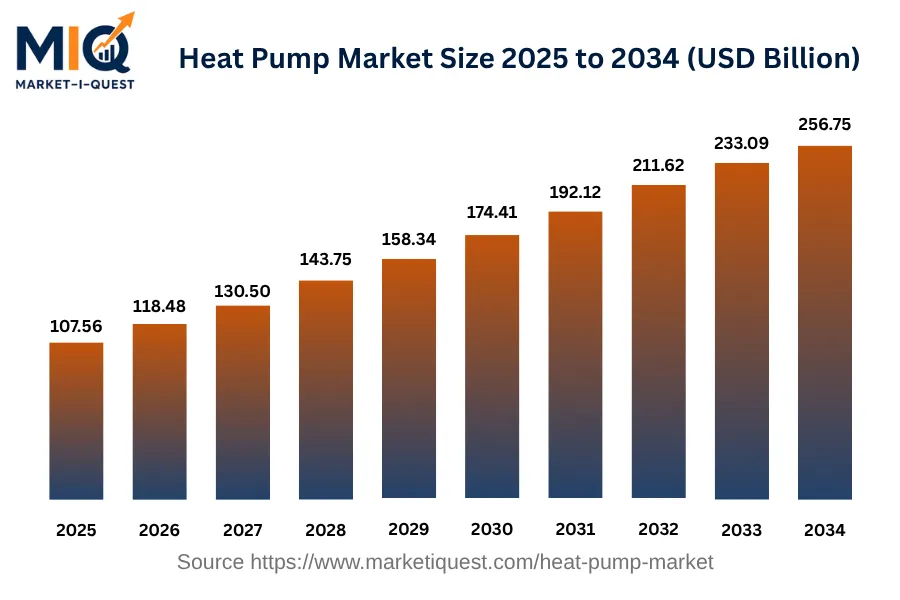
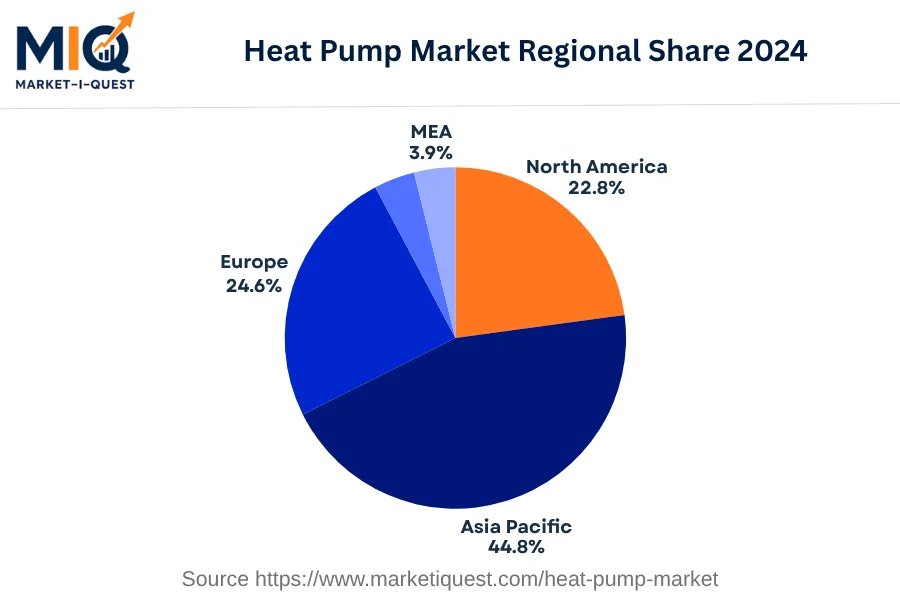
The Heat Pump Market was valued at USD 107.56 billion in 2025 and is projected to reach USD 256.75 billion by 2034, growing considerably at a compound annual growth rate (CAGR) of 10.15%. This substantial increase can be attributed to rising global energy demands and the global shift towards using sustainable energy resources. The increase from USD 97.65 billion in 2024 to USD 107.56 billion in 2025 indicates a promising start to the decade, followed by a steady rise leading up to USD 256.75 billion in 2034, consolidating the market expansion. In 2024, the regional share of the Heat Pump Market was distributed as follows: North America accounted for 22.8%, Europe for 24.6%, Asia Pacific led with 44.76%, while Latin America and Middle East & Africa held smaller shares of 3.86% and 3.91% respectively.

Key Takeaways

  • By Type - Ground Source Heat Pumps held the highest market share in 2024 dominating the Heat Pump Market.
  • By Installation Type - New Installation led the market with a robust growth rate accounting for a significant share.
  • By Application - Residential segment has been identified as the fastest-growing during the forecast period of 2025-2034.
heat-pump-market market size

Key Driving Factors

Stringent Energy Efficiency Regulations

Numerous governments worldwide are stepping up the implementation of stringent energy efficiency regulations, including the European Union's Energy Performance of Buildings Directive and the United States' Energy Policy Act. Both of these regulatory frameworks target reducing energy consumption and emissions from buildings, significantly impacting the heat pump market by compelling companies and homeowners to replace less-efficient heating systems. Although this transition carries a high upfront cost, the savings from lower energy bills and potential for subsidies offset these costs and promote the adoption of energy-efficient technologies such as heat pumps. Companies in the heat pump market are therefore focusing on developing products that comply with these mandates and provide superior energy efficiency.
Adoption by the Construction Industry

The construction industry is a major influencer of the heat pump market, given its role in choices about heating and cooling solutions for new buildings. More construction projects are integrating heat pumps into their designs as part of the growing trend towards 'sustainable buildings.' This trend is particularly evident in commercial developments such as office buildings and hotels, where energy efficiency and carbon footprint reduction are crucial to meet corporate sustainability goals and attract environmentally conscious customers. Developers and architects are discovering that heat pumps, especially ground-source or air-source types, provide an effective, low-carbon response to heating and cooling needs. The commercial construction segment thus promises further growth opportunities for the heat pump market.

Market Evolution by Timeline

2019-2023
During this period, the residential segment had increased demand for heat pumps due to energy efficiency improvements and warmer winters in Europe and North America. What has been shipped was the single-stage heat pumps, with an integration maturity still in the initial stages due to the complexity of system integration. Notably, the United States introduced the Renewable Heat Incentive encouraging wider adoption. Pricing tendencies leaned more towards cost-efficient models as the technology was still considered new in the market. Challenges arose in terms of compatibility with existing heating systems.
2024
In 2024, demand was primarily originating from the commercial segment, with particular interest in the Asia Pacific region due to aggressive urbanization. Multi-stage heat pumps were the majority of supplies, providing a more advanced, energy-efficient solution compared to their predecessors. Government regulations globally started to enforce the use of renewable energy heating, further driving market adoption. The commercial model was typically through direct purchase with warranty services. Understanding the costs and benefits posed a challenge for many buyers.
2025-2029
Heat pump demand reached an all-time high from 2025 to 2029, predominantly from public institutions implementing sustainable practices. Shipment centred around hybrid heat pumps, which offered a synergistic blend of gas and electrical power sources. This period saw the normalization of new integration standards for domestic heating systems, influenced by stringent European Union energy efficiency regulations. Government subsidies became a common commercial model to stimulate market growth. However, a lack of skilled technicians to service these advanced systems became a significant barrier.
2030-2034
Between 2030 to 2034, the demand for heat pumps continued to grow, driven by the industrial sector aiming to reduce carbon footprints globally. The market primarily shipped advanced geothermal heat pumps demonstrating high integration maturity. Climate change policies pushed for more rigorous application standards, elevating market trends towards energy-efficient alternatives. There was a shift towards flexible payment models and financing options as commercial models. Crucially, the need for comprehensive training in handling new heat pump designs emerged as a vital area.

Future Market Outlook

Future Opportunities

Future opportunities within the heat pump market are shaping up in response to ongoing regulatory support and changing consumer behavior. In 2023, the U.K. government announced its plan to phase out gas boilers by 2035, signifying a strategic shift to renewable heating solutions. This regulatory action offers substantial growth potential for heat pump manufacturers, as companies like Vaillant and Bosch position their product lines to meet the rising demand. Furthermore, the expanding focus on electrification pathways influenced by initiatives such as California’s 2022 Clean Heat Program presents large-scale prospects for heat pump adoption in residential and commercial sectors. Collaborative efforts between governments and utility companies, evident in the 2023 partnership between the New York State Energy Research and Development Authority and local municipalities to promote heat pump installations, further bolster market penetration. Additionally, the integration of heat pumps with solar energy systems is gaining traction. Companies like Trane are experimenting with hybrid systems that seamlessly incorporate solar technology. As climate change continues to shape policy and consumer priorities, the heat pump market presents compelling opportunities for advancements. New players entering the industry can leverage supportive frameworks and invest in research to create efficient and sustainable heating solutions. These dynamic changes position heat pumps as a cornerstone of modern energy strategies globally, particularly in regions actively seeking to decarbonize their heating systems.

Segmentation Analysis

By Type

The market is divided into subsegments including Air Source Heat Pumps, Ground Source Heat Pumps, Water Source Heat Pumps, and Hybrid Heat Pumps. Ground Source Heat Pumps accounted for the largest revenue share while Hybrid Heat Pumps are expected to grow at the fastest CAGR during the forecast period.

Largest Revenue Share

Ground Source Heat Pumps

Market Share Leader

Ground Source Heat Pumps (GSHP) have been a dominant segment in the heat pump market due to their efficient and cost-effective sustainability credentials. This dominant status is driven by a range of factors such as higher durability, low maintenance, and considerable efficiency in moderate climates, which have attracted a large proportion of the residential and commercial consumer base. GSHP's have the advantage of leveraging constant ground temperatures to provide heating and cooling, providing more stable operation and higher efficiency than their counterparts. From a geographic perspective, this subsegment is particularly active in regions with moderate climates where the benefits of GSHP's are maximised. Additionally, governments across the globe are increasingly focussed on encouraging the use of sustainable energy sources, often offering incentives that further promote the adoption of sustainable solutions such as GSHP's.

Fastest CAGR

Hybrid Heat Pumps

Forecast Period Growth Leader

While Ground Source Heat Pumps hold the largest revenue share, Hybrid Heat Pumps are poised for the fastest growth during the forecast period. This is primarily due to their adaptive capacity to combine the high-efficiency attributes of heat pump technology with the reliability of traditional heating methods. This allows users to switch between renewable and conventional energy sources depending on their specific needs and external conditions. Additionally, they bring down energy costs and carbon emissions, meeting the increasing demand for energy-efficient and environment-friendly solutions. However, the high upfront cost of installation is one barrier to adoption. Government policy support measures such as subsidies and initiatives promoting sustainable heating solutions can expedite the penetration of hybrid heat pumps into the mainstream market. In the short term, volatile market conditions pose a risk to this fast-paced growth trajectory but longer-term prospects remain robust due primarily to the expected surge in demand for energy-efficient heating solutions.

By Installation Type

The market is divided into subsegments including new installations and retrofits, where new installations accounted for the largest revenue share while retrofits are expected to grow at the fastest CAGR during the forecast period.

Largest Revenue Share

New Installation

Market Share Leader

New installations are accounting for the majority of the market revenue in 2024 due to several factors. This revenue leadership stems from the ongoing economic growth and constant urbanization that increase the demand for new infrastructures, facilities, and residences. Such developments often come hand-in-hand with complex electrical cabling, plumbing, and other installations. As a yet-untapped market, new constructions have significant purchasing potential yet to be unleashed. Also, the installed base is larger by virtue of counting every new building, which tips the scale in favor of new installations. Regulatory changes also play a part, forcing many buildings under construction to incorporate more advanced and efficient systems from the outset, which naturally leads to more new installations. Lastly, new installation buyers rely on well-established direct sales channels from manufacturers, thus reducing potential switching costs.

Fastest CAGR

Retrofit

Forecast Period Growth Leader

On the other hand, the retrofit subsegment is predicted to grow at the fastest CAGR. This can primarily be attributed to the rising consciousness and legislative compulsion toward energy efficiency. As technologies evolve and make systems more efficient, many existing infrastructures have started retrofitting their old systems rather than investing in new constructions. This shift is spurred not only by cost considerations but also due to environmental factors. The decline in installation costs, the increase in energy prices, and the optimization of capex by extending the lifecycle of the existing system are other drivers of the acceleration in the retrofit segment. It is also worth noting that industry-wide partnerships and technological advancements are enabling cost-effective and less disruptive retrofit solutions, further catalyzing this trend. Potential risks include the compatibility of new components with old systems and the slow pace adoption of new technologies.

By Application

The market is divided into subsegments including Residential, Commercial, and Industrial. Among these, the Commercial subsegment accounted for the largest revenue share, while the Residential subsegment is expected to grow at the fastest CAGR during the forecast period.

Largest Revenue Share

Commercial

Market Share Leader

The Commercial sector has traditionally dominated the market, primarily due to the substantial demand from commercial establishments such as offices, malls, and stores. This sector's considerable revenue share can be attributed to the appeal of efficient and advanced systems in commercial buildings looking to decrease operational costs, enhance worker productivity, and align with global sustainability efforts. Commercial buildings usually have higher energy needs compared to Residential and Industrial applications, which drives more substantial market demand. Variables such as economic growth, growth of commercial infrastructures worldwide, and inclination towards the maintenance of environmental standard motivate this sector's market dominance. An ongoing regulatory push for energy efficiency in buildings further strengthens this market position, with many locations mandating better energy usage policies in commercial establishments.

Fastest CAGR

Residential

Forecast Period Growth Leader

Although smaller in terms of revenue when compared to the Commercial sector, the Residential sector presents the fastest growing opportunity. This growth is primarily fueled by the growing awareness and adoption of energy-efficient products among homeowners. Changes in lifestyle and purchasing behaviors, particularly in emerging economies, are driving the uptake of advanced systems and technologies in homes. Numerous government initiatives worldwide are promoting energy efficiency, providing incentives for homeowners to invest in energy-efficient renovations or new builds. Technological advancements, such as the integration of smart home technologies, also serve as significant catalysts in this sector's growth. However, barriers like initial high costs of set-up and slow adoption rate in underdeveloped regions may pose short-term risks.

Competitive Analysis: Heat Pump Market

Key Market Players

Manufacturers / OEMs

Daikin Industries Ltd.
Japan
Danfoss Group
Denmark
Mitsubishi Electric Corporation
Japan

Key Suppliers & Raw Materials

Arkema SA
France
Honeywell International Inc.
US
Chemours Company
US

Distributors, Integrators & Channel Partners

Ingersoll Rand Inc.
Ireland
Johnson Controls International PLC
Ireland
United Technologies Corporation
US

Porter’s Five Forces Analysis

This analysis provides insight into the competitive dynamics within the Heat Pump Market.

Supplier Bargaining Power

Medium

Key components are offered by a balanced spread of suppliers limiting significant pricing power.

Buyer Bargaining Power

High

Buyers have high power due to the availability of multiple brands and technologies.

Threat of Substitutes

Medium

Conventional heating and cooling systems do pose a moderate substitution threat.

Threat of New Entrants

Medium

High entry barriers such as certification and technology development costs moderate entry threats.

Competitive Rivalry

High

Rivalry is high with several established players competing for market share.

Regional Analysis

Geographic market dynamics and growth opportunities across key regions

Global Market Outlook

heat-pump-market market regional share

North America

In 2024, North America's heat pump market witnessed significant growth driven by increased regulatory mandates and investment in sustainable heating technologies. Prominent market drivers included stringent government regulations aimed at reducing carbon emissions, such as the U.S. Department of Energy's revised standards for heat pump efficiency. The clean energy initiatives across the U.S., Canada, and Mexico also spurred investment into energy-efficient heat pump technologies. The implementation of environmentally friendly policies led to a surge in the adoption of heat pump technologies by large enterprises and government agencies. Additionally, competitive pricing strategies and increased supply chain efficiency encouraged market growth.

Key market trends included a shift in buyer behavior towards seeking energy-efficient and eco-friendly solutions, prompting substantial demand in the residential, commercial, and industrial sectors. Technological advancements, particularly AI integration for smarter temperature control, emerged as a significant trend within the market. Partnerships and M&A activities trended among leading market players, aiming to enhance their offerings and expand their customer base. Lastly, stringent standards and enforcement policies for energy-efficient heating systems influenced the heat pump market, bolstering the demand and creating a landscape conducive for growth in North America. This demand was primarily noted in sectors such as utilities, manufacturing, and enterprise businesses.

Asia Pacific

In 2024, the Heat Pump Market in Asia Pacific reached a crucial development phase, driven by energy-efficient policies and high demand for eco-friendly heating solutions. Favorable government initiatives, such as China's "Coal to Electricity" policy and Australia’s Renewable Energy Target Scheme, alongside high investment in technology from major economies, notably Japan and South Korea, underpinned market growth. Accelerated industrialization and urbanization in India and key ASEAN countries led to an uptick in demand, while rapid technological adoption resulted in significant supply dynamics, impacting the heat pump market pricing.

Consumer behavior shifted towards greener alternatives for heating and cooling needs in 2024, evidenced by increased product demand across residential, commercial, and industrial sectors. Aggressive policy enforcement for energy-efficient solutions initiated product shifts, particularly in manufacturing units aiming for carbon neutrality. A surge in digital retail channels influenced buyer preferences and boosted sales. Significant regional partnerships and M&A activities strengthened the market position of industry leaders, encouraging further market penetration. The pervasiveness of standard policies, such as Japan's Top Runner Program and India's Bureau of Energy Efficiency Standards, promoted competitive, yet energy-efficient, heating solutions. Therefore, government policies in tandem with market demands were instrumental in shaping the Asia Pacific heat pump market in 2024.

Europe

In 2024, the heat pump market in Europe experienced substantial growth due to various drivers and trends. An upsurge in energy-efficient home renovations, coupled with stringent EU regulations like the Renewable Energy Directive, drove demand. Investments in renewable energy infrastructure, particularly in Germany, the UK, and France, bolstered this upward trajectory. Meanwhile, rapid technological adoption in the Nordics and Benelux further fueled market growth. A shift in buyer behaviour shaped the market as more consumers sought eco-friendly heating options, catalysed mainly by escalating awareness campaigns regarding climate change. An Industry-wide transition towards eco-designs and energy-efficient models was observed, catering to this growing demand and adhering to EU energy standards. In addition, the heat pump industry in Italy, Spain, and Central & Eastern Europe saw an uptick in strategic partnerships and mergers aimed at strengthening market reach and diversifying product lines.

Major consumers varied across sectors, with the residential sector leading demand due to an increased focus on energy efficiency and cost-saving measures. The manufacturing sector also significantly contributed, given heat pumps’ unique ability to reclaim waste heat, thus aligning with the EU’s aim of industrial energy efficiency. Meanwhile, utilities and government entities increased procurement to meet sustainability targets. In summary, the 2024 European heat pump market was shaped by regulations, investments, technology, eco-conscious trends, and cross-sector demand.

Latin America

In 2024, the Latin American market for heat pumps experienced substantial growth. Significant drivers included increasing environmental awareness stimulating demand for energy-efficient products, stringent government regulations such as Mexico's Energy Transition Law, and burgeoning investments in renewable energy across the region. The upsurge of construction projects in Brazil and Colombia coupled with the adoption of advanced heat pump technologies in Argentina, further shaped the market dynamics. In terms of trends, discernible shifts towards eco-friendly household appliances in countries like Chile and Peru influenced buyer behavior significantly. Technological advancements in the heat pump sector encouraged manufacturers to innovate, pushing the adoption of geothermal heat pumps. Notably, the retail and manufacturing sectors in Brazil and Mexico led this change.

Market trends also revealed dynamic channel strategies and partnerships. Retail giants in Mexico and Argentina expanded their consumer reach through strategic online channels. Moreover, renewed EPC (Engineering, Procurement, and Construction) contracts in Colombia's utility sector fostered collaboration on heat pump installation projects. The LATAM market also observed heightened policy enforcement in 2024, with Argentina and Chile amplifying energy efficiency standards for heat pumps and HVAC systems in general.

Middle East & Africa

In 2024, the Heat Pump Market in the Middle East and Africa underwent steady development due to strapping demand, advantageous regulatory policies, and forward-looking investment. The market's drivers included the increasing demand for heat pumps in key sectors such as oil and gas, utilities, and manufacturing in target countries like Saudi Arabia, UAE, and South Africa, which spurred the growth. Regulatory policies across these countries promoting the use of heat pumps to reduce carbon emissions also encouraged market expansion. Furthermore, significant investments in renewable resources and technology adoption in nations like Israel and Kenya resulted in wider market reach.

Simultaneously, the market was shaped by several trends. There was a noticeable shift in buyer behavior towards energy-efficient products, reflected in high sales of heat pumps. Furthermore, partnerships and M&A activities, such as those observed in the UAE and Qatar, helped strengthen market presence and fuel growth. Advances in product technology, particularly towards remote monitoring and control, influenced market trends as well. Compliance with international standards increased in entities like the Egyptian Government and the Nigerian Telecom sector, which further defined the course of the market. In conclusion, 2024 marked a promising year for the Heat Pump Market in the Middle East and Africa, steered by regional drivers and unique market trends.

Recent Industry Developments

Latest market innovations, product launches, and strategic initiatives

April 2026

The UK’s Clean Heat Market Mechanism (CHMM) second scheme year began, setting low carbon heat targets for heat pump deployment.

September 2025

The U.S. Department of Energy’s rule for consumer central air conditioners and heat pumps became effective, with amendments to appendix M1 mandatory for product testing starting July 7, 2025.

Frequently Asked Questions