Dispersing Agents Market Snapshot

Key Players

  • BASF SE (Germany)
  • Clariant AG (Switzerland)
  • Evonik Industries (Germany)
  • Ashland Global Holdings (United States)
  • Solvay SA (Belgium)
  • Dow Inc. (United States)
  • Croda International Plc (United Kingdom)
  • Elementis Plc (United Kingdom)
  • Akzo Nobel NV (Netherlands)
  • Stepan Company (United States)

Market Size

Base Year 2024
$7.95 Bn
CAGR
5.95%
Forecast 2034
$14.17 Bn

Market Segments

By Structure
  • Anionic
  • Non-Ionic
  • Hydrophilic
  • Amphoteric
  • Others
By End Use
  • Paints
  • Coatings & Inks
  • Adhesives & Sealants
  • Personal Care & Cosmetics
  • Agriculture
  • Construction
  • Household and Industrial/Institutional Cleaning
  • Others

Market Dynamics

Drivers
  • Increasing industrialization
  • Advanced painting technologies
Restraints
  • Regulatory compliance challenges
  • Fluctuating raw material costs
Opportunities
  • Increased demand in construction industry
  • Technological advancements in formulation techniques

Market Size

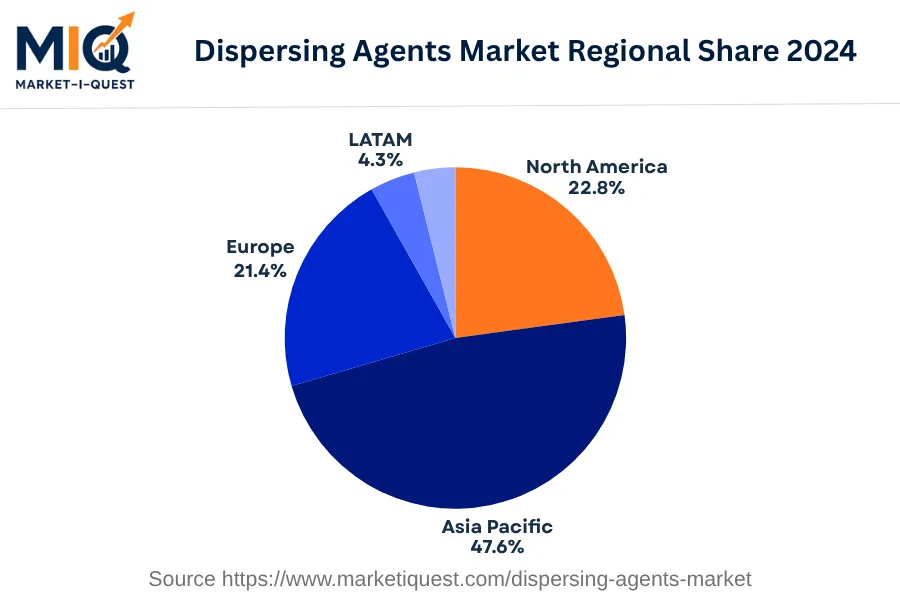
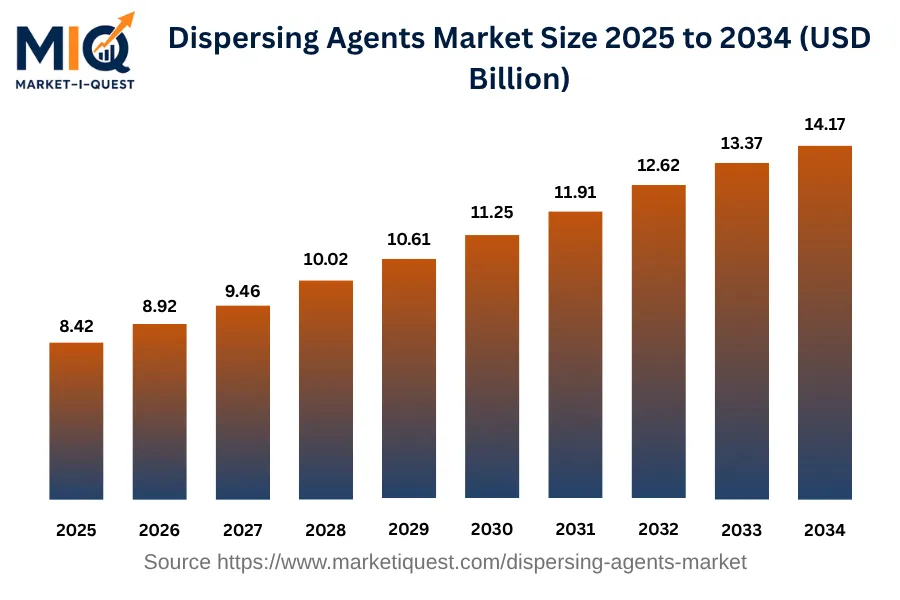
The Dispersing Agents Market size in 2025 is projected to be $8.42 billion, up from $7.95 billion in 2024. By 2034, the market size is expected to grow significantly to reach $14.17 billion, indicating a Compound Annual Growth Rate (CAGR) of 5.9% between 2025 and 2034. The primary drivers of this consistent market growth are gradual consumption increase and ongoing industrial advancements that necessitate the use of dispersing agents. However, the scale and pace of growth fluctuated throughout the aforementioned period. The regional market share mix in 2024 showed the Asia Pacific leading with 47.6%, followed by North America with 22.8%, and Europe accounting for 21.3%. The regions with the least market shares were Latin America and the Middle East and Africa (MEA) with 4.3% and 3.9% respectively.

Key Takeaways

  • By Structure - Anionic accounting for a significant portion of the Dispersing Agents Market.
  • By End Use - Paints Coatings & Inks led the market share in the base year.
dispersing-agents-market market size

Key Driving Factors

Introduction of Eco-friendly Dispersing Agents

As companies across diverse sectors champion environmental responsibility, the move towards green business processes is eminent. A key driver of the dispersing agents market comes from this shift, with the introduction of eco-friendly dispersing agents. These agents are designed to align with the stringent environmental regulations that industries dealing with dispersions are now obliged to adhere to globally. Manufacturers are progressively formulating dispersing agents with a low environmental footprint, and that promise fewer pollution-related risks. Industries preferring these eco-friendly dispersing agents for their products include paints & coatings, pulp & paper, and pharmaceutical industries among others. Hence, the compliance to environmental regulations and the increased consumption by environmentally responsible industries act as catalysts to the growth of the dispersing agents market.

High Performance Demands in End-user Industries

Another non-generic driver for the dispersing agents market is the growing emphasis on improving product performance in end-user industries. Specific sectors like construction, paints & coatings and detergents are increasingly seeking dispersing agents that assure higher efficiency and superior results. In construction, dispersing agents are required to ensure the optimal distribution of particles in concrete mixtures, influencing its strength and longevity. Similarly, paints and coatings industry needs dispersing agents that can guarantee smoother finishes and vibrant colours without clumping. High-performance dispersing agents in detergents results in better cleaning efficiencies. Hence, the need for advanced product performance across these industries is driving the demand for sophisticated dispersing agents, thus shaping the growth of the market.

Market Evolution by Timeline

2019-2023
This period saw a flourishing dispersing agents market predominantly driven by construction and paints & coatings sectors. Asia-Pacific led demand, mainly reflecting construction growth in China and India. Major suppliers included BASF, Clariant, and DowDuPont, with new product introductions showcasing improved stability and efficiency. However, wider integration remained a challenge due to fragmented supply chains. Regulatory frameworks instantiated, like REACH in Europe, started influencing manufacturing practices and pushing eco-friendly products. In the commercial model, contract manufacturing became commonplace as a strategy to reduce overhead costs. However, volatility in raw material prices posed challenges to steady growth.
2024
In 2024, the dispersing agents market experienced a shift. Evolving technologies influenced cleaner production methods, and bio-based dispersing agents gained traction, with companies like Evonik and Arkema leading the way. Additionally, regulations expanded to emerging markets, with analogous to the European REACH regulations implemented in China (China REACH). Amid this context, partnerships between manufacturers and raw material suppliers increased, aiming to secure pricing and supply. Despite technological advancements, unpredictable raw materials prices remained a significant risk.
2025-2029
This period marked further consolidation in the dispersing agents market with growing applications in the pharmaceutical and personal care sectors besides construction and paints & coatings. United States joined Asia-Pacific as a leading demand region with a boom in its pharmaceutical industry. Significant technological advancements in dispersing agents, such as nanotechnology, were now commercialized, although may lack integration in the market. Multiple formulation standards were now being enforced worldwide, with clear preference for environmentally friendly products. Commercially, shift towards strategic alliances to secure supply chain was observed. However, issues with initial product quality and high setup costs formed potential risks.
2030-2034
Supply chain efficiency substantially improved, with better manufacturer-supplier coordination reducing product quality issues. North America and Asia-Pacific remained the leading demand regions for dispersing agents, with steady growth in construction, paints & coatings, pharmaceutical, and personal care sectors. Mega-corporations dominated the manufacturing sector with constant product innovations to remain competitive. Simultaneously, small-scale manufacturers also began to establish a strong presence through niche product offerings. Regulations requiring greener manufacturing processes solidified, creating both compliance challenges and opportunities. The commercial model evolved into long-term contractual agreements, facilitating better pricing negotiations. However, potential regulatory changes dealing with environmental concerns remained a latent risk.

Future Market Outlook

Future Opportunities

Current technological shifts combined with regulatory frameworks present substantial future opportunities within the dispersing agents market. The increasing demand for environmentally friendly products is catalyzed by global sustainability initiatives. In 2023, the International Organization for Standardization (ISO) launched its ISO 14021:2021 standard, aiming to provide clear guidelines for environmental claims, which affects product development across industries, including dispersing agents. Furthermore, developments in nanotechnology show great promise, with companies like DuPont exploring the commercialization of nanoscale dispersants to improve product efficacy. The resurgence of manufacturing in regions like Asia-Pacific, due in part to economies rebounding post-pandemic, is translating to heightened demand for dispersing agents in coatings and textiles. For example, the Indian textile market has been expanding in 2023, leading to increased requirements for dispersing agents that can enhance dye application processes. Additionally, the ongoing transition in the automotive sector towards electric and lightweight vehicles will likely spur demand for specialized dispersing agents that improve the performance of composite materials used in vehicle production. Regulatory pressure in North America continues to push for safer chemical alternatives, indicating a ripe market for manufacturers offering bio-based or biodegradable solutions. Overall, the convergence of sustainable practices, technological innovations, and rising industrial activity in various global regions is paving the way for strategic growth within this sector.

Segmentation Analysis

By Structure

The market structure is segmented into Anionic, Non-Ionic, Hydrophilic, Amphoteric and Others. Of these, Anionic accounts for the largest revenue share while the Hydrophilic segment is projected to have the fastest Compound Annual Growth Rate during the forecast period.

Largest Revenue Share

Anionic

Market Share Leader

In the market, the Anionic segment holds the largest revenue. Several factors contribute to the dominance of this segment in the market. Anionic surfactants display excellent cleaning properties which have brought about their wide adoption in several industries like textiles, oil, personal care, and predominantly in detergents. Their increasing use in these applications can be attributed to their unique characteristics such as wettability, foam-forming ability, and emulsifying properties. This widespread adoption in various industries is a significant driver of demand and consequently, revenue. Geographically, the Anionic segment sees extensive use in both developed and developing markets. Regulation and supply dynamics have largely remained favorable, further aiding growth in revenue. Therefore, it is anticipated that we will see the Anionic segment continue to hold the largest revenue share due to its wide-ranging applications and unique properties.

Fastest CAGR

Hydrophilic

Forecast Period Growth Leader

Although the Anionic segment holds the largest revenue, it is the Hydrophilic segment that is expected to have the fastest growth trajectory. This can be attributed to several factors. Increased awareness and demand for environmentally friendly products are making bio-based Hydrophilic surfactants more popular. They are being seen as an attractive alternative due to their biodegradable and non-toxic properties. This is encouraging manufacturers to invest in research and development efforts to introduce innovative hydrophilic surfactants, which in turn is expected to drive the growth of the segment. Furthermore, strategic partnerships in the market are expected to serve as a catalyst for the growth of this segment. However, high production costs and competitive pricing from synthetic products present near-term risks to the growth trajectory of the Hydrophilic segment. Therefore, while it is assumed that this trend will continue to shape this segment, an upward adjustment in costs may be necessary.

By End Use

The market is further segmented into areas such as Paints, Coatings & Inks, Adhesives & Sealants, Personal Care & Cosmetics, Agriculture, Construction, Household, and Industrial/Institutional Cleaning, and others. The Paints, Coatings & Inks subsegment dominated the market in terms of revenue, while the Personal Care & Cosmetics subsegment is projected to experience the fastest growth.

Largest Revenue Share

Paints, Coatings & Inks

Market Share Leader

The Paints, Coatings & Inks subsegment secured the largest share of the market revenue in 2024. This dominance is primarily driven by the high global demand for durable, cost-effective, and sustainable solutions in the construction and manufacturing industries. Increased urbanization and industrial development, particularly in emerging economies, are significant drivers of this subsegment. Stricter environmental regulations are also encouraging the paint and coating industry to shift towards greener products, fuelling the growth of water-based and other eco-friendly paint and coating products. Innovation and technological advancement have also facilitated the development of high-performing products, further boosting the subsegment's growth. Purchasing criteria often focus on the product's efficiency, durability, versatility, and environmental impact.

Fastest CAGR

Personal Care & Cosmetics

Forecast Period Growth Leader

Though not the largest in terms of revenue, the Personal Care & Cosmetics subsegment is expected to witness the fastest growth. The rise in consumer consciousness about personal grooming and hygiene, particularly amidst the pandemic, is a major catalyst for this growth. Further, increased disposable income, particularly in emerging markets, is enabling more consumers to afford personal care and cosmetic products. Innovations in product formulations and packaging, coupled with aggressive marketing strategies, are further increasing product attractiveness and adoption rates. However, potential near-term risks include stringent regulations on product ingredients and ethical concerns related to animal testing in product development. As the market penetrates more deeply into emerging markets and expands its product offerings, it is expected to overcome these barriers and sustain significant growth.

Competitive Analysis

Key Market Players

Manufacturers / OEMs

BASF SE
Germany
Clariant
Switzerland
Akzo Nobel N.V.
Netherlands

Key Suppliers & Raw Materials

Evonik Industries AG
Germany
Air Products and Chemicals, Inc.
US
Ashland Global Holdings Inc.
US

Distributors, Integrators & Channel Partners

Bowman Inc.
US
Chemical Marketing Associates Inc.
US
Coatex SAS
France

Porter’s Five Forces Analysis

A comprehensive market analysis of the Dispersing Agents Market, highlighting key forces impacting its competitive dynamics.

Supplier Bargaining Power

Medium

Materials predominantly generic, but some specialized input concentration pulls power to suppliers.

Buyer Bargaining Power

Medium

Buyers are numerous but deep technical knowledge limits bargaining power.

Threat of Substitutes

Low

Few substitutions for dispersing agents in major applications like paints and coatings.

Threat of New Entrants

Medium

Financial and technological entry barriers, countered by growing market potential.

Competitive Rivalry

High

Intense competition among key players driven by product differentiation and price sensitivity.

Regional Analysis

Geographic market dynamics and growth opportunities across key regions

Global Market Outlook

dispersing-agents-market market regional share

North America

In 2024, the North American market for dispersing agents saw noteworthy activity, dictated by a multitude of factors. Regulatory changes encouraging more environmentally friendly choices pushed manufacturers towards adopting these substances, particularly in the U.S. where stricter environmental policies were enforced. Investment in research and development witnessed growth in Canada, notably from industry titans seeking more efficient and effective dispersing agents. Availability of raw materials and production capacity influenced supply dynamics across the region, particularly in Mexico, which saw an increase in local manufacturing. Price elasticity also influenced market behavior due to the varying costs of production techniques.

Buyer behavior was characterized by a growing demand in industries such as construction, paints and coatings, pulp and paper, and detergents, driven by the necessity for better product performance. There was also a significant shift towards bio-based and organic dispersing agents - a response to consumer preference and regulatory inclination towards sustainable solutions. E-commerce emerged as a key distribution channel due to its convenience and wide market reach. Furthermore, strategic partnerships and M&A activities were prevalent as enterprises sought to strengthen their positions in this competitive market. Lastly, stricter enforcement of quality standards across all sectors heightened the demand for high-quality dispersing agents.

Asia Pacific

In 2024, the Dispersing Agents market in Asia Pacific exhibited robust expansion, driven by multiple factors. Increasing demand for dispersing agents was observed in the paint, coatings, pharmaceutical, and detergent sectors across China, India, and key ASEAN markets due to urbanization and industrial growth. Heightened environmental regulations, particularly in Japan and Australia, strained the supply dynamics, as manufacturers responded by ramping up production of environmentally-friendly products. Further, technology adoption allowed for streamlined production and efficient distribution, as seen in South Korea's accelerated digital transformation.

Key trends in 2024 included the rise of collaborative partnerships and M&A activities as companies in India, China and ASEAN markets sought competitive edge and expansion. Varying in intensity across countries, this trend was notably chronicled in China's chemical manufacturing sector. Furthermore, an increased emphasis on quality and standard compliance encouraged companies to adapt to stricter government policies such as China’s “Three-year Action Plan for Winning the Blue Sky War”. Lastly, the growth of e-commerce in the region shaped channel dynamics, facilitating efficient product delivery and convenient B2C transactions, especially in retail sectors across Australia, Japan and South Korea. These drivers and trends underpinned a vibrant Dispersing Agents market in the Asia Pacific in 2024.

Europe

In 2024, the European Market for Dispersing Agents experienced a steady demand guided by several drivers and prevailing trends. Significant demand drivers included a surge in construction activities, primarily in Germany, the United Kingdom, France, and Benelux countries, that accelerated the use of dispersing agents in concrete and paints. Increased investment in the pharmaceutical industry, especially in Eastern Europe, meant a higher uptake for dispersing agents in the formulation of drugs, thereby impacting the market positively. Advances in nanotechnology, witnessed predominantly in Italy and Spain, spurred applications for dispersing nanomaterials, driving demand further. Additionally, intensified environmental regulations across Europe curbed the use of VOC-emitting solvents, pushing for eco-friendly dispersing agents.

The market trends predominantly revolved around buyer behavior and policy enforcement. Increased adoption of low-cost, high-performance dispersing agents was evident, influenced by the economical constraints faced by manufacturers in the post-pandemic landscape. A notable uptick in online sales, with manufacturers and buyers favoring digital platforms over traditional sales channels, was another trend. Partnership activities were markedly visible, as central companies joined forces with local firms to extend their product reach. Strict inspection policies were deployed across Europe to enforce the use of eco-friendly dispersing agents conforming to EU standards. Common sectors driving demand included manufacturing, construction, and pharmaceuticals.

Latin America

In 2024, the Latin America Dispersing Agents Market, attributed by advancements in major economies like Brazil, Mexico, Argentina, Colombia, Chile, and Peru, displayed significant growth. Driving this progress were demand factors such as the increased need for high-quality coatings in automotive and infrastructure industries, and regulatory dynamics like strict environmental regulations enhancing the adoption of water-based dispersing agents. Furthermore, investments in research and development by leading companies in Mexico and Argentina propelled technology adoption in dispersing agents market. Brazil's dynamic pricing, favoring water-based agents over solvent-based, also influenced the market.

Among notable trends, consumer behavior shifted towards more environmentally friendly products, maximizing demand for green dispersing agents, primarily in Peru and Chile. Advancements in information technology aided more efficient production processes, evident in Colombia's adoption of nanotechnology in dispersing agents manufacturing. Additionally, increased channels dynamics were observed, with Brazil leading in partnerships and M&A activities to expand production capacities. Policy enforcement, especially in Argentina, guaranteed the implementation of manufacturing standards across the sector.

Key sectors absorbed these trends and drivers, including manufacturing, healthcare and infrastructure. For instance, the healthcare industry in Mexico significantly increased its demand for dispersing agents for its pharmaceutical properties, while Argentina's infrastructure sector favored their use in concrete mixing. Retail industry across LATAM utilized dispersing agents for packaging materials.

Middle East & Africa

In 2024, the Dispersing Agents Market in the Middle East and Africa exhibited substantive dynamics primarily driven by diverse factors. Consumer demand increased in various sectors such as oil and gas, manufacturing and pharmaceuticals, particularly in economies like Saudi Arabia and the United Arab Emirates due to growing infrastructural development and energy requirements. Regulations imposing environmental compliance boosted market growth, as observed in Egypt and Kenya, driving industries towards the use of dispersing agents to reduce pollution and emissions. Technological integration marked a pivotal trend within the market. In Nigeria and South Africa, rapid adoption of advanced production methods optimized efficiency, contributing to market expansion. Israel stood out for its advanced research in nanotechnology, influencing the use of dispersing agents in this field. Price volatility for raw materials remained a consistent trend, influencing supply dynamics across the region.

The shift towards sustainable products influenced buyer behavior, with manufacturers exploring eco-friendly, biodegradable dispersing agents, particularly noticeable in sectors such as utilities and retail. Market consolidation through partnerships provided additional stability, as witnessed in Qatar. As policy enforcement around environmental standards strengthened in these regions, adopting high-quality dispersing agents became a norm across multiple sectors, setting a definitive trend for 2024.

Recent Industry Developments

Latest market innovations, product launches, and strategic initiatives

May 2026

Borchers (a Milliken brand) launched Borchi Gen 0311 at the American Coatings Show, a high-molecular-weight APEO-free and tin-free wetting and dispersing agent developed to simplify pigment dispersion in solvent-borne polyurethane coating systems.

September 2025

Siegwerk announced the acquisition of Allinova, a Dutch specialty chemicals company specializing in the formulation and production of aqueous dispersions, wax emulsions, and polymer dispersants.

Frequently Asked Questions