Wound Closure Devices Market Snapshot

Key Players

  • Ethicon US LLC (United States)
  • B. Braun Melsungen AG (Germany)
  • Medtronic PLC (Ireland)
  • Smith & Nephew PLC (United Kingdom)
  • 3M Company (United States)
  • Integra LifeSciences Corporation (United States)
  • Zimmer Biomet Holdings Inc. (United States)
  • Sutures India Pvt. Ltd. (India)
  • Teleflex Incorporated (United States)
  • Pfizer Inc. (United States)

Market Size

Base Year 2024
$15.94 Bn
CAGR
6.93%
Forecast 2034
$31.15 Bn

Market Segments

By Product Type
Sutures, Staples, Adhesives, Tissue Sealants, Hemostats
By Material
Absorbable, Non-Absorbable, Synthetic, Natural
By Application
General Surgery, Cardiac Surgery, Orthopedic Surgery, Cosmetic Surgery, Trauma Surgery
By End Use
Hospitals, Ambulatory Surgical Centers, Emergency Clinics, Home Care

Market Dynamics

Drivers
  • Growing elderly population
  • Increasing surgical procedures
Restraints
  • Regulatory approval challenges
  • High device prices
Opportunities
  • Rising chronic disease incidence
  • Advancements in surgical procedures

Market Size

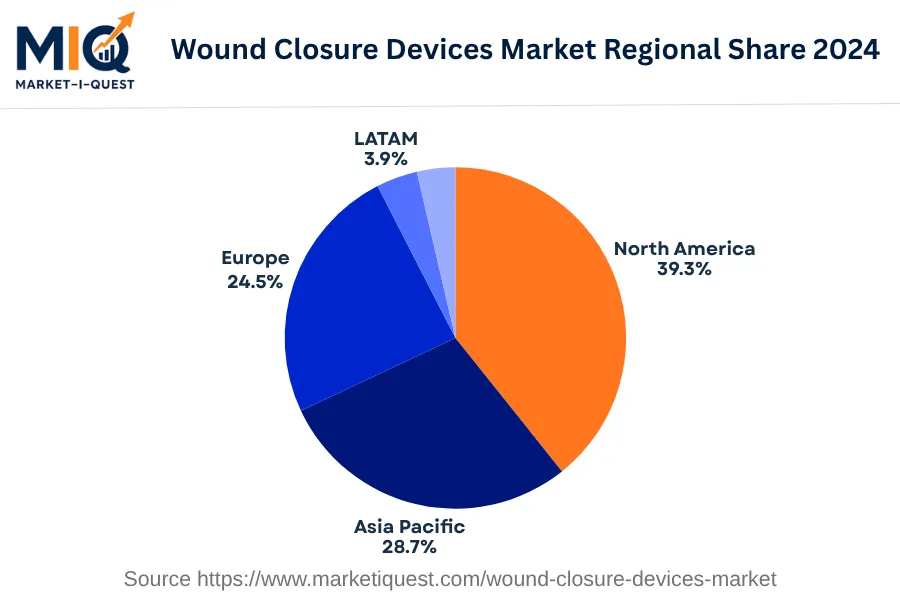
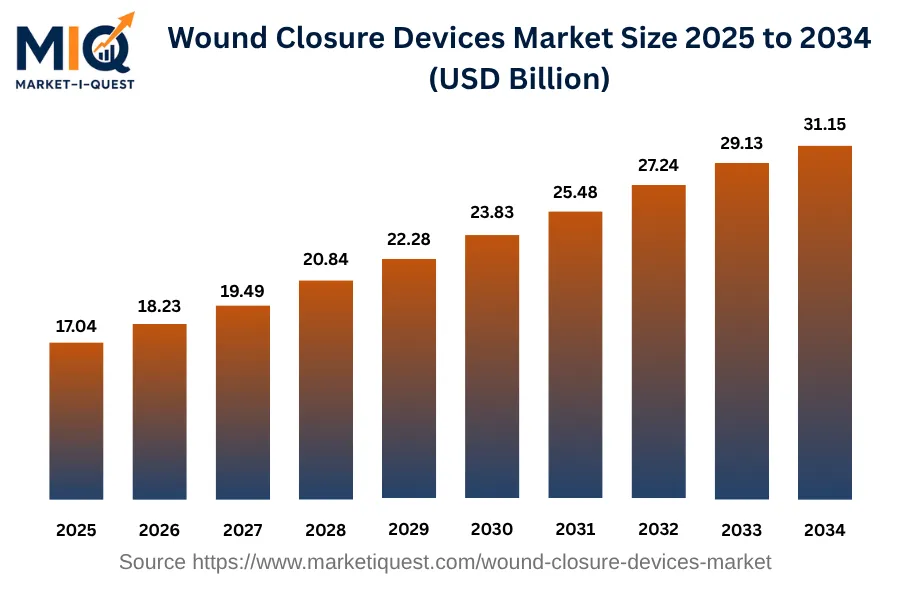
The Wound Closure Devices Market was valued at 17.04 billion USD in 2025 and is projected to reach 31.15 billion USD by 2034, growing at a CAGR of 6.93%. The market experienced a rise in its value from 15.94 billion USD in 2024 to the mentioned value in 2025. Factors fueling growth in the wound closure devices market are increased incidence of wounds, increased spending on health care, and the introduction of advanced wound closure devices. The market spread was distinct across multiple regions in 2024, with North America commanding the largest share at 39.27%, followed by Asia Pacific with 28.73%, and Europe with 24.46%. The remaining regions, Latin America and the Middle East and Africa, accounted for 3.91% and 3.63% respectively.

Key Takeaways

  • By Product Type - Sutures held a dominant position accounting for the highest market share.
  • By Material - Synthetic led the market segment with a significant share.
  • By Application - Cardiac Surgery was the leading segment due to substantial usage.
  • By End Use - Hospitals dominated the market due to high product demand.
wound-closure-devices-market market size

Key Driving Factors

Adoption of Minimally Invasive Surgeries

Providing more precise and less damaging alternatives to traditional surgery techniques, minimally invasive surgeries (MIS) have been gaining traction within the global medical community. Wound closure devices are integral to these procedures as they reduce recovery times and chance of infection post-surgery. They are also adept at handling the small, precise incisions characteristic of MIS, where traditional stitches or staples may prove challenging. This has led to a significant push in adoption from surgeons transitioning towards minimally invasive practices, resulting in an increase in demand within the wound closure devices market.

Pandemic-induced Rise in Telemedicine

The global pandemic has resulted in a significant acceleration of telemedicine adoption across healthcare providers. This changed protocol has created a demand for user-friendly, patient-oriented wound closure devices that can be applied with minimal professional oversight in remote care settings. Wound closure devices often preclude need for a second visit to remove stitches, lessening burden on overworked healthcare systems, and limiting unnecessary exposure during pandemic times. This context has pushed the market to innovate and accommodate devices that cater to telemedicine's requirements, providing a distinct driving factor for the wound closure devices market.

Market Evolution by Timeline

2019-2023
During this period, main buyers were hospitals, private clinics, and trauma centers primarily in North America and Asia Pacific. They adopted wound closure devices for use in surgeries and wound care due to their efficiency and faster recovery rates. Companies like Ethicon Inc., Baxter International and Medtronic PLC produced surgical staples, sutures, hemostats and adhesive strips, which were widely used. A prominent industry challenge was the risk of wound infection post-application of these devices. The US FDA's regulatory framework emphasized the design and sterility of these devices to minimize the risk. Contract manufacturing and partnerships were common commercial practices. This period also experienced pricing pressure due to the competitive landscape and diverse product portfolio availability.
2024
In 2024, the demand for wound closure devices increased from aging populations and patients with lifestyle diseases especially in United States, China and India. Topical agents and sealants saw increased use during this year due to remarkable wound healing properties. However, the production was limited by mandatory clinical trials and safety assessments. In the US, the Affordable Care Act affected the pricing dynamics, due to its provisions on patient care and reimbursements. Manufacturers faced the challenge of aligning their products with the medical device regulation of various countries. Direct sales through websites and e-commerce were the preferred distribution channels.
2025-2029
In this period, the demand for biologic and synthetic wound closure devices had a substantial increase with hospitals and private clinics, mostly in European Union and Asia Pacific driving the purchase. The integration of these devices into the wound care routine was a technological advance, but high procedural costs remained a constraint. Regulatory bodies like European Medicines Agency (EMA) and Center for Devices and Radiological Health (CDRH) kept strict control over the approval and marketing of these devices. The commercial model largely revolved around product differentiation, with price premiums for innovation. Companies ensured product availability through both direct and indirect sales channels.
2030-2034
During this timeframe, the demand for wound closure devices was chiefly driven by the need for advanced wound care solutions. This was especially true in the Middle Eastern and African regions due to the rise in sophisticated healthcare infrastructure. Demand was also fuelled by war-stricken areas due to the frequent incidences of trauma cases. Suppliers faced challenges in keeping up with demand and ensuring the logistical aspects tied to product distribution, especially in war zones. The commercial model was largely dominated by long-term contracts and supply agreements, with price competition being a common feature. Despite advances, a major risk was to maintain the performance quality in terms of wound closure efficiency and risk of postoperative complications.

Future Market Outlook

Future Opportunities

The future landscape of wound closure devices is shaped by current trends in healthcare technologies and patient management. As aging populations increase, particularly in regions like North America and Europe, there will be heightened demand for advanced and efficient wound care solutions. Companies such as Johnson & Johnson are investing in R&D to create adaptive wound care systems that cater to the specific needs of elderly patients. The surge in outpatient surgeries indicates a potential shift towards at-home wound care management, encouraging manufacturers to develop portable and user-friendly devices. Additionally, with rising concerns about antibiotic resistance, there is an impetus for products utilizing antimicrobial materials. In 2023, the World Health Organization highlighted the necessity for innovative approaches to tackle this global health issue, driving research into antimicrobial wound closure technologies. Collaborations between materials scientists and medical professionals are expected to yield new product designs that combine functionality with safety. Countries like Japan are at the forefront of adopting advanced wound care practices and technologies, paving the way for further integrations of robotics and artificial intelligence into surgical procedures. As healthcare moves increasingly toward preventative and personalized care, the wound closure devices market could see promising advancements grounded in current healthcare priorities and demands.

Segmentation Analysis

By Product Type

The market is divided into subsegments including Sutures, Staples, Adhesives, Tissue Sealants, and Hemostats. Among these, Sutures accounted for the largest revenue share while Tissue Sealants is expected to grow at the fastest CAGR during the forecast period.

Largest Revenue Share

Sutures

Market Share Leader

Sutures constitute the most revenue-generating subsegment within the product type category. This prevalence can be attributed to a variety of factors. The use of sutures extends across a wide spectrum of surgical procedures, making them an integral part of the global medical landscape. More recent advances in the design and material of sutures have also augmented their appeal and widened their application scope. Biodegradable sutures, for instance, have gained prominence because of their reduced post-operative risks and overall costs, making them more appealing to the healthcare industry. Furthermore, suture technology has found application in minimally invasive surgeries, providing renewed momentum to this subsegment's growth. The regulatory landscape also favors sutures, considering the well-established guidelines for their usage. The widespread purchasing and distribution channels further enhance their accessibility, ultimately contributing to sutures' high revenue share. It's essential to note that while this subsegment holds a significant revenue share, the landscape's dynamics may change with technological advancements and changing surgical preferences.

Fastest CAGR

Tissue Sealants

Forecast Period Growth Leader

The subsegment projected to grow at the fastest rate during the forecast period is Tissue Sealants. The main driver for this growth is an increasing number of wounds and surgical procedures requiring faster and more efficient healing processes, driving the demand for Tissue Sealants. Further reason includes the advantage of Tissue Sealants over traditional sutures and staples, such as minimizing the risk of contamination and providing a uniform distribution of tension around the wound, thereby reducing scarring and improving aesthetic outcomes. In terms of adoption barriers, product adoption could be impeded by the high cost of sealants and lack of awareness about their benefits. However, with the ongoing advancements in adhesive technologies and consistent efforts to improve medical professional training and awareness campaigns, the adoption barrier is expected to decrease. While the uncertainty regarding the regulation of tissue sealants could pose a near-term risk, partnerships with hospitals and acquiring product approvals could serve as catalysts for growth. However, this is an assumption based on common market trends; the actual growth could vary depending upon diverse market forces.

By Material

The market is divided into subsegments including Absorbable, Non-Absorbable, Synthetic, and Natural materials. In 2024, the Synthetic subsegment reported the largest revenue share, whereas the Absorbable segment is expected to grow at the highest CAGR during the projected period.

Largest Revenue Share

Synthetic

Market Share Leader

The Synthetic category has emerged as the leading revenue generator for 2024. This can be attributed to several factors. First, the synthetic materials' robustness and longevity render them advantageous for long-term applications, contributing to their higher demand. Furthermore, synthetic materials offer a greater level of control and predictability, that results in more precise outcomes thus increasing their acceptability. The prevalent trend of medical device miniaturization also favors synthetic materials due to their ability to maintain structural integrity at microscopic levels. Another dominant factor is the wider geo-spread of manufacturers producing synthetic materials which ensures consistent supply and competitive pricing. Regulatory leniency towards synthetic materials in significant markets like Europe and North America also provides a conducive environment for market expansion. However, it is important to maintain a watch on any potential regulatory shifts.

Fastest CAGR

Absorbable

Forecast Period Growth Leader

Although Absorbable materials did not lead in terms of revenue in 2024, they are projected to register the swiftiest CAGR. This growth is driven by the increasing acceptance of these materials for applications where temporary support is required, as they are bioresorbable and eliminate the need for surgical removal. The growing focus on reducing post-operative complications is also leveraging the adoption of absorbable materials. The advancement in technology is another catalyst speeding up the segment's growth, with companies innovating in bio-engineered absorbable materials for specific medical applications. Partnerships for technological evolution are further aiding in this spirited growth. However, relatively high switching costs from non-absorbable to absorbable materials may represent a hurdle to adoption in the short-term, alongside tighter regulation in comparison to synthetic materials. The prospects of the absorbable materials segment, though, remain buoyant.

By Application

The market is divided into subsegments including General Surgery, Cardiac Surgery, Orthopedic Surgery, Cosmetic Surgery, and Trauma Surgery. In 2024, Cardiac Surgery accounted for the largest revenue share while Cosmetic Surgery is expected to grow at the fastest CAGR during the forecast period.

Largest Revenue Share

Cardiac Surgery

Market Share Leader

Cardiac Surgery emerged as the subsegment with the most revenue in 2024. This is driven by the increasing prevalence of heart-related conditions and diseases across the globe. The every-growing aging population, with a higher susceptibility to cardiac ailments, directly translates into greater demand for cardiac surgeries. Additionally, technological advancements in operative procedures have provided an impetus to this subsegment. Breakthroughs in minimally invasive surgical techniques and enhancements in robotic surgeries have improved success rates, encouraging more patients to opt for these procedures. The market also benefits from well-established healthcare infrastructure and insurance schemes in developed countries. Nevertheless, it is important to consider that the high cost of cardiac surgeries may pose a challenge to markets in developing regions.

Fastest CAGR

Cosmetic Surgery

Forecast Period Growth Leader

Expected to grow at the fastest CAGR during the forecast period is the Cosmetic Surgery subsegment. This growth is fueled by changing societal norms and increasing acceptance of aesthetic procedures. The rising influence of social media and the desire to meet certain beauty standards have amplified the demand for cosmetic surgeries worldwide. Advances in surgical procedures — making them safer and more affordable — have also reduced barriers to adoption. Furthermore, partnerships between cosmetic clinics and financial institutions offering easy payment plans, have made these procedures accessible to a wider population. Potential risks lie in regulatory changes, which might affect the market unpredictably. However, barring any drastic changes, the subsegment is all set for a period of significant growth.

By End Use

The market is divided into subsegments including Hospitals, Ambulatory Surgical Centers, Emergency Clinics, and Home Care, with Hospitals accounting for the largest revenue share while Home Care is projected to grow at the fastest CAGR during the forecast period.

Largest Revenue Share

Hospitals

Market Share Leader

In the healthcare sector, hospitals typically generate the highest proportion of revenue, and this is also true in the context of our analysis. The reasons for this are manifold. For starters, hospitals are the first point of healthcare access for many patients, providing a wide range of services from routine check-ups to critical surgical procedures. Additionally, hospitals have the capital to invest in advanced medical equipment, thereby attracting a large patient base opting for specialized treatments that smaller healthcare providers cannot offer. This extensive service offering and patient volume position hospitals as the highest-grossing segment. Regulatory frameworks also favor hospitals in many regions, securing their position at the forefront of the industry. Furthermore, the continuing trend of hospital consolidation expands their reach and ratchets up their revenue significantly. Purchasing power of hospitals enhances due to their size, permitting the acquisition of high-cost equipment and services, further attracting patients and revenue.

Fastest CAGR

Home Care

Forecast Period Growth Leader

While hospitals bring in the highest revenue today, the Home Care subsegment is projected to show the fastest compounded annual growth rate. Key drivers for this growth include an aging population, an increase in chronic diseases, and a rising preference for receiving care in the comfort of one's own home. The integration of technology in home care, such as telemedicine and remote patient monitoring, is facilitating this shift, making it easier for patients to receive high-quality care at home. Moreover, home care services are generally perceived to be more affordable than hospital care, particularly for long-term care patients. These factors together create an ideal environment for the home care segment's growth. However, barriers to adoption include limited access to technology in remote areas and the resistance from a portion of the elderly population who are not tech-savvy. Overcoming these barriers will be the key to sustaining industry growth.

Competitive Analysis

Key Market Players

Manufacturers / OEMs

Ethicon Inc.
US
B. Braun Melsungen AG
Germany
Medtronic plc
Ireland

Key Suppliers & Raw Materials

Dupont
US
DSM
Netherlands
Evonik Industries AG
Germany

Distributors, Integrators & Channel Partners

Cardinal Health
US
Henry Schein, Inc.
US
McKesson Corporation
US

Porter’s Five Forces Analysis

This analysis provides an overview of the wound closure devices market dynamics from the standpoint of five key forces.

Supplier Bargaining Power

Low

Supplier power is low due to the wide availability of raw materials and manufacturing equipment.

Buyer Bargaining Power

High

Increase in price sensitivity and accessibility to alternatives amplifies buyer bargaining power.

Threat of Substitutes

Medium

Emerging technologies and alternate surgical procedures present a moderate threat

Threat of New Entrants

Medium

Medical device regulations and high R&D cost pose entry barriers, but the profitable market invites new entrants.

Competitive Rivalry

High

The market is highly competitive due to presence of numerous global and regional vendors.

Regional Analysis

Geographic market dynamics and growth opportunities across key regions

Global Market Outlook

wound-closure-devices-market market regional share

North America

In 2024, the North American Wound Closure Devices Market experienced notable growth due to a variety of drivers and trends. Increased investment in healthcare technology, particularly in the United States, facilitated advancements in wound closure devices. The rising prevalence of chronic diseases and surgical procedures across the region galvanized demand for these improved medical tools. Additionally, regulatory bodies like Health Canada and the FDA tightened infection control standards in surgical environments, indirectly boosting the market through enhanced focus on efficient wound closure.

Major trends in 2024 included a shift towards minimally invasive wound closure techniques in healthcare settings across the U.S., Canada, and Mexico. This was notably driven by the patient preference for shorter recovery times and less post-operative complications. Further, technological innovation—exemplified by the adoption of smart sutures capable of monitoring wound healing—transformed the sector. Conjoined with this was a surge in strategic alliances between healthcare providers, medical device manufacturers, and technology firms to expedite product development and market penetration. Finally, enforcement of stringent regulatory standards positively impacted market dynamics, ensuring the provision of high-quality wound closure devices to a range of sectors, including hospitals, outpatient facilities, and trauma centers.

Asia Pacific

In 2024, the Wound Closure Devices Market in Asia Pacific has exhibited vibrant dynamism underpinned by several key drivers. Health sector reforms, increased investment in healthcare infrastructure, rising incidence of chronic conditions and the demand for minimally invasive procedures have bolstered the market. Technological evolution has played a significant role as well, with countries like China, Japan and South Korea taking the lead in the adoption of advanced wound closure devices reflecting their strong inclination towards innovative solutions.

Trends have also shaped the market in a substantive way. Buyers are showing a heightened preference for more advanced and efficient products, propelling companies to innovate. Changes in product preference are vivid in China and Japan, where biologic and absorbable sutures have gained market traction. The burgeoning e-commerce sector, particularly in China and India, is changing channel dynamics. This has led to numerous partnerships with online platforms for maximizing the reach of wound closure devices. China, India, ASEAN and Australia have shown robust policy enforcement aimed at assuring product quality, underlining the preferential shift towards standardized, approved products. In line with these trends, healthcare providers, predominantly hospitals, clinics and ambulatory surgical centers, have been key consumers of these advanced wound closure devices. Their adoption is based on the need for effective wound management, reinforcing the market's vitality in 2024.

Europe

In 2024, the European wound closure devices market experienced a significant surge due to an aging population, technological advancements, and favorable healthcare policies. Rising incidences of chronic wounds in Germany and the UK amplified the demand for advanced closure devices, while increasing investments in healthcare innovation in France and Italy supported supply dynamics. Regulatory authorities in Spain, the Nordics, Benelux, and Central & Eastern Europe continued to ease approval processes, boosting market growth.

Shifts in buyer preference towards minimally invasive surgical procedures fueled the adoption of new-age wound closure devices, with healthcare providers in Germany, France, and the UK leading the trend. The industry saw emerging partnerships, particularly in the UK and Italy, as device makers sought to strengthen their market reach and product development capabilities. There was a clear trend towards sutures equipped with antibacterial properties, most notably in Germany and the Nordics. Adoption of stricter product standardization policies had increased, particularly in Central & Eastern Europe. Shorter hospital stays and efficient wound management were prioritized in the government and healthcare sectors across Europe, aiding the transition to advanced wound closure devices.

Latin America

In 2024, the Latin American Wound Closure Devices Market experienced considerable expansion due to various influential factors. Key drivers included rising healthcare investments across countries like Brazil and Mexico, augmenting the demand for advanced medical devices. The escalating incidence of chronic wounds and surgical procedures in Argentina, Colombia, Chile, and Peru also propelled the market growth. Additionally, steady technology adoption, coupled with favorable regulations encouraging industry advancements in wound care, catalyzed the market expansion.

Notably, new product launches and technological innovations became trending aspects within this market. For instance, bioabsorbable wound closure devices witnessed increased adoption due to benefits like decreased wound complications and less scarring. An increasing inclination towards minimally invasive surgery was also observed, fostering demand for efficient wound closure solutions, especially in urban healthcare facilities across Brazil and Mexico. Adoption of e-commerce channels for medical supplies also emerged as a prominent trend, while the influx of foreign direct investment in healthcare institutions facilitated the acquisition of state-of-the-art wound closure devices. Strategic alliances and mergers between regional and international players were also prominent, enhancing technical capabilities and widening product offerings. From a sector perspective, the market was dominantly driven by hospitals and clinics, followed by standalone wound care centres.

Middle East & Africa

In 2024, the Wound Closure Devices Market in the Middle East and Africa was fueled by several dynamic factors. The demand for improved healthcare services, driven by governments' ongoing investment in healthcare infrastructure, particularly in Saudi Arabia, UAE, and Qatar, provided a strong impetus to the market. Regulatory policies aimed at ensuring patient safety played another significant role in shaping the market. Furthermore, rapid technology adoption in countries like Israel and South Africa accelerated the market's expansion.

Interestingly, buyer behavior reflected increased confidence in advanced wound closure techniques. There was a noticeable shift towards the use of medical adhesives and mechanical stapling devices, moving away from traditional sutures and staples. This was deeply influenced by healthcare providers' growing propensity to adopt technologically advanced medical devices. Meanwhile, in terms of channel dynamics, hospital chains remained the primary end-users, but the emergence of specialty wound care clinics infused growth in the retail segment. A major trend observed in the region was the surge of partnership agreements and M&A activities among the key market participants. Prominent healthcare manufacturers in Israel, South Africa, and Egypt focused on consolidating their market presence through strategic alliances. Concurrently, enforcement of strict quality standards played a crucial role in enhancing the credibility and reliability of these devices in the healthcare sector.

Recent Industry Developments

Latest market innovations, product launches, and strategic initiatives

March 2026

The United States Food and Drug Administration (FDA) implemented a major regulatory overhaul for mechanical wound closure by finalizing the reclassification of internal surgical staplers from Class I to Class II devices. This mandate enforces "Special Controls," making mandatory performance testing and validated labeling for explicit tissue thickness benchmarks a baseline prerequisite for hospital procurement portfolios.

June 2025

Ethicon (Johnson & Johnson) officially launched the ETHICON 4000 Stapler in the United States market. This specialized wound-closure device was engineered with high mechanical staple line integrity to securely approximate thick, complex anatomical tissues while significantly reducing intraoperative bleeding and fluid leaks across high-acuity surgical procedures.

Frequently Asked Questions