Thin Film Battery Market Snapshot

Key Players

  • Cymbet Corporation (United States)
  • Excellatron (United States)
  • Jenax Inc. (South Korea)
  • Blue Spark Technologies (United States)
  • BrightVolt (United States)
  • STMicroelectronics (Switzerland)
  • Samsung SDI Co. Ltd. (South Korea)
  • Flexel LLC (United States)
  • ProLogium Technology Co. Ltd. (Taiwan)
  • Rocket Electric Co. Ltd. (South Korea)

Market Size

Base Year 2024
$0.835 Bn
CAGR
26.45%
Forecast 2034
$8.73 Bn

Market Segments

By Battery Type
  • Thin-Film Lithium-Ion
  • Thin-Film Lithium Polymer
  • Zinc-Based Thin-Film
  • Others
By Deposition Technology
  • Sputtering
  • Chemical Vapor Deposition (CVD)
  • Physical Vapor Deposition (PVD)
  • Thermal Evaporation
  • Others
By Application
  • Wearable Electronics
  • Medical Devices
  • Smart Cards & RFID
  • IoT & Wireless Sensors
  • Consumer Electronics
  • Others

Market Dynamics

Drivers
  • Increasing demand for wearable technology
  • Advancements in nanotechnology
Restraints
  • High production costs
  • Emerging alternative technologies
Opportunities
  • Emerging IoT applications
  • Increasing wearable tech demand

Market Size

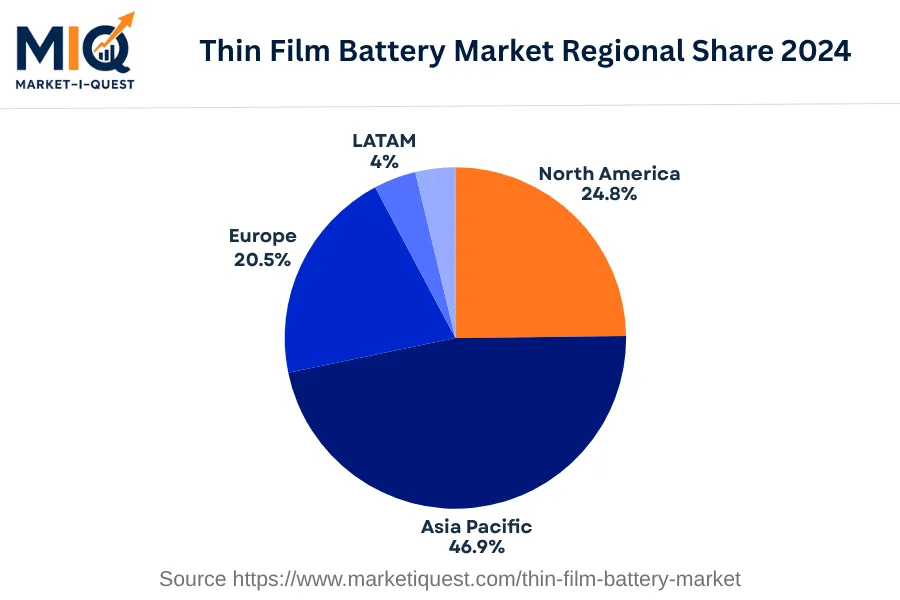
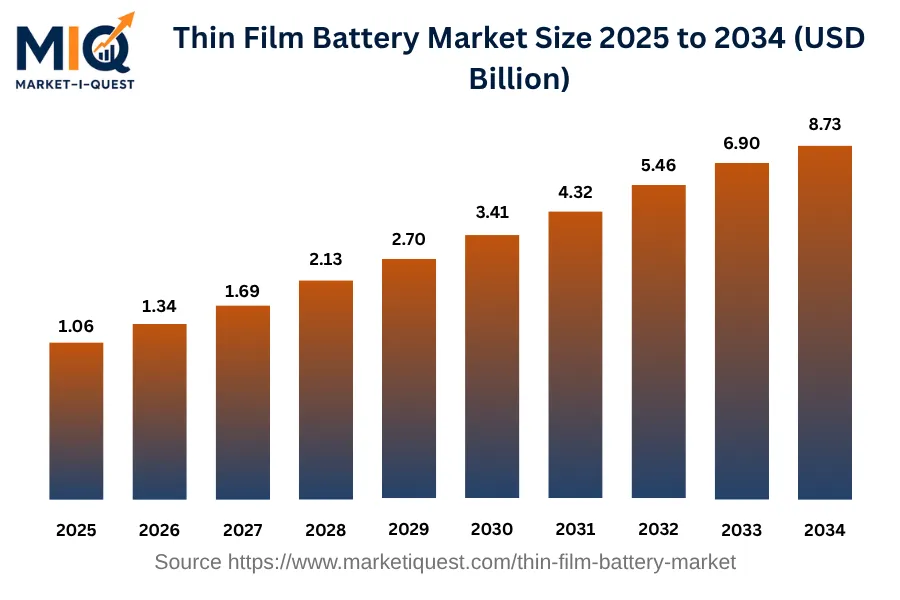
The Thin Film Battery Market was computed at 1.06 billion USD in 2025, up from 0.83 billion USD in 2024. The market is predicted to grow sizably to touch 8.73 billion USD by 2034, advancing at a Compound Annual Growth Rate (CAGR) of 26.45%. The notable increase in market size over this period is due to technological developments alongside increased demand for thin film batteries in numerous applications such as wearable devices. In 2024, the regional distribution of the Thin Film Battery market share was as follows: Asia Pacific led the market with a share of 46.93%, followed by North America and Europe with shares of 24.82% and 20.46% respectively. Latin America and the Middle East & Africa (MEA) held smaller market shares, with 4.01% and 3.78%, respectively.

Key Takeaways

  • By Battery Type - Thin-Film Lithium-Ion accounting for the largest market share in 2024.
  • By Deposition Technology - Chemical Vapor Deposition (CVD) held highest usage accounting for a significant portion in 2024.
  • By Application - Consumer Electronics grew Largest dominating the sector in 2024.
thin-film-battery-market market size

Key Driving Factors

Proliferation of Wearable and IoT Devices

One of the major forces driving the Thin Film Battery Market is the proliferation of wearable devices and the Internet of Things (IoT). As these technologies become more prevalent, they are requiring compact power sources with longer lifespans. Thin-film batteries, with their high energy density, flexibility, and light weight, are an ideal choice for these applications. From fitness trackers to smart watches and IoT sensors, these devices demand reliable, sustainable, and miniaturized power sources that do not compromise the device functionality or design. Thin film batteries tick all these boxes, hence their adoption in this sector fuels their market growth.

Shift towards Clean and Renewable Energy Sources

Another key driver for the Thin Film Battery Market is the global shift towards clean and renewable energy sources. As the world strives to reduce reliance on fossil fuels and mitigate climate change, demand for energy storage solutions that can effectively integrate with renewable solutions is rising. Thin film batteries are one such solution. Their ability to store energy harvested from renewable sources like solar or wind efficiently, thanks to their low self-discharge rate, makes them essential in efforts to transition to green energy. Therefore, this shift is prompting a greater uptake of thin film battery solutions.

Market Evolution by Timeline

2019-2023
During this period, the thin film battery market witnessed an increased interest from consumer electronics and wearable devices sectors, largely in North America and Asia Pacific regions. The demand was driven by battery characteristics like flexibility, custom shapes, and sizes that cater to the evolving design needs. Major players like STMicroelectronics commenced shipments of thin film solid-state batteries. However, the technology faced challenges with integration maturity into complex hardware architectures. Regulations like UL 2054 that governs safety of household and commercial batteries were also applicable here. There was a noticeable trend of tier-based pricing, with customization features held at premium price points. Risks included high production costs and scaling constraints which were mitigated by entering contractual partnerships, and capitalizing on emerging markets.
2024
This particular year saw a specific rise in implementation of thin film batteries in Internet of Things applications. This was predominantly seen in developed European countries experimenting with smart cities and homes concepts. Companies like Samsung SDI co limited, had increased their supply to meet this specific demand. Additionally, UL 1642 standard directed towards lithium batteries made an influence in the market. A standard procurement model, typically, sought extended warranty periods factored into validation contracts. Despite the promising growth, the market faced major risk from the increasing need for larger power capacities in applications, posing problems due to the thin film battery's limited capacity.
2025-2029
During these years, demand for thin film batteries transitioned towards automotive and energy harvesting sectors, specifically in major markets like United States, Japan and China. Success stories of companies like BrightVolt with its patented Thin Film Battery Technology acted as a significant driver. While the technology achieved a higher level of integration maturity, sustainability became a major point of policy considerations, influencing underlying manufacturing practices. Pricing model commonly shifted toward value-based pricing. As a mature technology by now, thin film battery faced risks from newer, potentially disruptive energy storage technologies.
2030-2034
In this span, the deployment of thin film batteries was expected to penetrate into healthcare sector for applications like medical implants, majorly in European regions due to their established healthcare ecosystem. Companies like Cymbet Corporation were typical suppliers. As the technology achieved advanced integration maturity, these devices faced constant scrutiny for various health and safety regulations set by bodies like the FDA. Cost-plus pricing became the prevalent commercial model. The thin film battery market confronted the risk of exhaustive patent landscape making it tough for new entrants which they typically offset by focusing on innovation.

Future Market Outlook

Future Opportunities

The current landscape of the thin film battery sector presents several promising future opportunities shaped by ongoing trends and regulatory actions. The growing demand for environmentally friendly energy storage solutions has encouraged firms to innovate within established frameworks, particularly due to the EU Battery Regulation enacted in early 2023. Companies such as Panasonic are likely to target the electric vehicle sector, realizing that lightweight batteries play a crucial role in efficient energy consumption. Partnerships between technology giants and battery manufacturers are increasingly common, as seen with Google's collaboration with a private firm to enable thin film battery integration in portable devices. Nations such as Germany and Japan are heavily investing in smart grid technology, creating a conducive environment for advancements in energy storage. The rise of Internet of Things (IoT) devices, which require energy sources that can withstand extreme conditions, is placing pressure on manufacturers to develop robust thin film batteries. Moreover, the demand for improved energy density and faster charging capabilities opens the door for companies like LG Chem to enhance product development further. In 2023, the release of the IEC 62619 standard fosters increased safety and reliability in battery technologies, encouraging collaborations focused on regulatory compliance. Consequently, organizations currently engaged in research and innovation are well-positioned to leverage these shifts, creating new applications and expanding market scope in the coming years.

Segmentation Analysis

By Battery Type

The market is divided into subsegments including Thin-Film Lithium-Ion, Thin-Film Lithium Polymer, Zinc-Based Thin-Film and Others. Of these, the Thin-Film Lithium-Ion subsegment accounted for the largest revenue share while the Zinc-Based Thin-Film subsegment is expected to grow at the fastest CAGR during the forecast period.

Largest Revenue Share

Thin-Film Lithium-Ion

Market Share Leader

The Thin-Film Lithium-Ion subsegment has emerged as a major driver of sales within the battery market, underpinned by its comparative advantages such as higher energy density, efficiency, and durability. The rapidly-evolving portable electronics market is a significant consumer of Thin-Film Lithium-Ion batteries due to their lightweight and flexible form factor, minimal self-discharge rate, and the ability to mold into any shape. This is particularly valued in high-demand sectors such as smartphones, laptops, and medical devices. Geographically, high-income markets have increasingly adopted these batteries, while rigorous regulatory standards encourage quality over quantity. Furthermore, sophisticated procurement strategies allow large electronics manufacturers to decrease battery costs, making the product more accessible to consumers. Switching costs are significant due to integration with product designs and mass production scalability, further reinforcing the leading position of the Thin-Film Lithium-Ion subsegment.

Fastest CAGR

Zinc-Based Thin-Film

Forecast Period Growth Leader

The Zinc-Based Thin-Film subsegment, despite commanding a smaller market share, exhibits the most promising growth prospects. This is largely attributable to its incredible potential in less explored markets such as renewable energy storage and electric vehicles, industries projected to have high capex in battery technologies. Zinc-Based Thin-Film batteries offer superior safety, recyclability, and cost-effectiveness, making them ideal for scaling in utility-level energy storage applications. The advent of advanced manufacturing techniques and accessible raw material also catalyzes its growth rate. However, the standardization of these batteries remains a challenge, impeding rapid adoption. Concerted efforts to overcome these technological hitches and formation of strategic partnerships are expected to alleviate this barrier, positioning Zinc-Based Thin-Film batteries for stronger growth in the near future. It is noteworthy that the influx of capital intensive entrants into this subsegment could potentially disrupt the market dynamics.

By Deposition Technology

The deposition technology market comprises various subsegments including Sputtering, Chemical Vapor Deposition (CVD), Physical Vapor Deposition (PVD), Thermal Evaporation, and others. That said, the CVD subsegment accounted for the largest revenue share in 2024, while the Sputtering subsegment is expected to experience the fastest CAGR in the foreseeable future.

Largest Revenue Share

Chemical Vapor Deposition (CVD)

Market Share Leader

Chemical Vapor Deposition dominates the deposition technology market due to its wide application in semiconductors, optics, and solar cells manufacturing. The mass production requirement of these sectors leads to a high demand for CVD equipment, providing a steady revenue stream for the segment. Furthermore, the versatility of CVD in depositing materials on a variety of substrates also contributes to its dominance. Significant advancements in nanotechnology have further increased the adoption of CVD due to its ability to provide high uniformity in thin film layers on a nanoscale. This is particularly relevant in the massively growing electronics industry, which demands precise component manufacturing. It should also be noted that government’s favorable policies towards renewable energy sectors, and stringent regulations on traditional energy sources, are creating a high demand for photovoltaic cells. Inevitably, this is driving up the use of CVD technology because of its critical role in the manufacturing of these cells.

Fastest CAGR

Sputtering

Forecast Period Growth Leader

The Sputtering subsegment, despite not being the current revenue leader, holds a promising outlook with the fastest projected CAGR. The growth momentum behind Sputtering is driven by its wide range of applications in the emerging arenas of microelectronics, display Panels, data storage devices and architectural glass. Furthermore, Sputtering provides high deposition rates and superior step coverage, which has made it a preferred choice over thermal evaporation techniques in certain industries. The rise of wearable tech-markets coupled with the digital revolution has sparked an increased demand for miniaturized products. Manufacturers are thus shifting towards Sputtering technology, given its precise thin film deposition on small components. Consequentially, Sputtering is expected to gain a larger market share in the upcoming years. It must be noted that, while Sputtering has a positive growth outlook, market penetration may face challenges due to high setup costs and low deposition rates as compared to counterparts like CVD. Continuous research and development and room for technological improvements might counteract these challenges.

By Application

The market is divided into subsegments including Wearable Electronics, Medical Devices, Smart Cards & RFID, IoT & Wireless Sensors, Consumer Electronics, and Others. In 2024, Consumer Electronics held the largest revenue share while IoT & Wireless Sensors is expected to grow at the fastest CAGR during the forecast period.

Largest Revenue Share

Consumer Electronics

Market Share Leader

Consumer electronics led the market in 2024, mainly due to the ever-increasing demand for smartphones, smart TVs, home appliances, and other electronic devices. The primary drivers for this segment arise from technological advancements, rising consumer disposable income, and changing lifestyles. The worldwide trend of digitization and IoT integration into consumer electronics also contributes to the growth of this segment. Consumer preferences are shifting towards smart and automated electronic systems, which are driving the demand. Geographically, regions with a high standard of living, particularly North America and Asia Pacific, are significant contributors, due to their high spending power. Regulations, while not directly influencing sales, indirectly propel the market by enforcing energy efficiency and low carbon emission standards. Typically, OEMs and electronics retailers make up the primary distribution channels, and high switching costs lead to brand loyalty.

Fastest CAGR

IoT & Wireless Sensors

Forecast Period Growth Leader

Anticipated to see the highest CAGR during the forecast period, the IoT & Wireless Sensors subsegment is driven largely by the increasing digitization trend, massive growth in data creation, and its need across numerous industries. The advent and adoption of Industry 4.0, automation, and remote controlling in key sectors such as manufacturing, agriculture, and healthcare act as strong growth catalysts. Major growth opportunities also come from prospective policy changes to support digital infrastructure. However, large-scale implementations will involve considerable capital expenditure upfront, and barriers could emerge in the form of privacy concerns, security issues, and technology standardization needs. Partnerships between sensor manufacturers and software providers are likely due to the intrinsic software-hardware dependency here. Near-term risks include market saturation, privacy issues, and vulnerability to cyber attacks.

Competitive Analysis

Key Market Players

Manufacturers / OEMs

Cymbet Corporation
US
Flexel LLC
US
Blue Spark Technologies
US

Key Suppliers & Raw Materials

3M Company
US
Applied Materials
US
Precision Coating
US

Distributors, Integrators & Channel Partners

Imprint Energy
US
Enfucell SoftBattery
Finland
BrightVolt
US

Porter’s Five Forces Analysis

This is an exploration of the competitive factors affecting the Thin Film Battery Market.

Supplier Bargaining Power

Medium

Suppliers’ power is constrained by the availability of alternative material sources.

Buyer Bargaining Power

High

Buyers, majorly tech companies, have numerous thin film battery vendors to choose from.

Threat of Substitutes

Low

Few viable substitutes exist for thin film batteries in compact, low-power devices.

Threat of New Entrants

Medium

High initial investment and expertise requirements could deter new market entrants.

Competitive Rivalry

High

Strong rivalry due to presence of major global corporations and constant technology innovation.

Regional Analysis

Geographic market dynamics and growth opportunities across key regions

Global Market Outlook

thin-film-battery-market market regional share

North America

In 2024, the North American thin film battery market matured, spurred by heightened demand across several industries and technological advancements. Key drivers included a sizable investment in renewable energy, particularly in the U.S., which escalated the demand for efficient energy storage systems. Regulatory measures, namely Canada's Green Energy Act, incentivized the adoption of clean power sources, indirectly propelling the market. Moreover, rapid technological adoption in Mexico expanded the radio-frequency identification market, fueling demand for thin-film batteries.

The market witnessed a shift in buyer behavior, with enterprises prioritizing compact and flexible battery alternatives for wearables and medical devices. A notable trend was the increased adoption within the retail industry, driven by the need for efficient inventory management systems. Health care and utility sectors also seized considerable market shares due to the growing need for reliable, uninterrupted power supply in critical operations. Regarding partnerships, a notable collaboration in 2024 was that of Alphabet's Verily with Johnson & Johnson, aiming to integrate thin-film batteries in surgical devices. The thin-film battery market's growth in North America in 2024 rested largely on regulatory stimuli, technological adoption, investment in energy storage, and shifting consumer preferences across several sectors. Partnerships and mergers further underscored the market's growth trajectory during this period.

Asia Pacific

In 2024, the thin film battery market in Asia Pacific saw robust growth driven by evolving digital infrastructures and technological integrations. Demand was fueled by rapid urbanization, primarily in China, India, and Indonesia, coupled with rising consumption of consumer electronics. Regulatory support, particularly in China, incentivized the adoption of green energy solutions, spurring investment in thin film battery production. Miniaturization of electronic devices, such as wearables and Internet of Things (IoT) gadgets, led to significant advancements in thin film battery technology. South Korea and Japan championed these shifts, thanks to their advanced electronics industries. In India and ASEAN markets, businesses shifted towards thin film batteries in enterprise and healthcare settings for their superior longevity and efficiency.

Concurrently, increased grid instability prompted utilities providers in Australia to explore thin film batteries as an energy storage solution. Moreover, ambitious renewable energy targets in ASEAN led to the integration of thin film batteries in solar panels. Partnerships and M&A activities heightened among thin film battery manufacturers, electronics giants, and digital service providers to capitalize on market potential and streamline supply chains. Meanwhile, stricter standards and policy enforcement were witnessed across the region to promote quality, safety, and sustainability in the thin film battery market.

Europe

In 2024, the European Thin Film Battery Market witnessed significant growth due to various driving factors such as technological advancements, increased investment, and favourable government regulations. Several demand factors played a key role in shaping the market, particularly the progressive adoption of wearable and connected devices in sectors like healthcare, retail, and manufacturing. Technological advancements, notably in Germany and the United Kingdom, also propelled the market with innovative solutions offering better energy storage and efficiency. Additionally, significant investment in research and development, primarily in France and Spain, contributed to market growth. Pricing emerged as a key driver in the market, particularly in Italy and Benelux, where competitive pricing strategies adopted by leading manufacturers resulted in increased market share.

The market also experienced several trends, including a shift towards environment-friendly technology in the Nordics, driven by policy enforcement supporting green energy solutions. Moreover, buyer behaviour showed a marked preference for lightweight, compact batteries, reflecting in product design across the region. Strategic partnerships and mergers and acquisitions were prevalent throughout 2024, notably in Central and Eastern Europe, further solidifying market positioning for key players. Lastly, regulatory developments regarding standards for battery safety and efficiency influenced the market, hinting towards a collective move towards uniformity and quality control.

Latin America

In 2024, the Latin American (LATAM) Thin Film Battery Market displayed robust growth, predominately driven by escalating demand in Brazil, Mexico, Argentina, Colombia, Chile, and Peru. Increasing usage of wearable devices, mainly in the healthcare sector, amplified the need for thin film batteries owing to their longevity and small form factor. Substantial investment in the Internet of Things (IoT) technology across manufacturing and retail sectors powered the adoption of these batteries. Changes in energy policies, aimed at promoting environment-friendly energy sources in LATAM nations, increased supply, further lowering the pricing of these batteries.

Consumer behavior significantly altered in 2024, with a shift towards products that are lightweight yet durable, such as thin film batteries. Technological advancements catalyzed the development of flexible and stretchable electronics, especially in Mexico and Brazil, propelling the market growth. Reshaping channel dynamics, sectors like enterprise and government elevated their dependence on collaborative partnerships with battery manufacturers, leading to multiple mergers and acquisitions. Policy enforcement skewed towards encouraging sustainable energy sources, which had a positive impact on the use of thin film batteries, particularly in utilities and retail. Greater digitalization across sectors facilitated the widespread application of these batteries in areas like wireless sensing and data communication.

Middle East & Africa

In 2024, the Thin Film Battery Market in the Middle East and Africa exhibited significant growth stemming from enhanced technological adoption and regulatory support. Increased demand for wearable devices and IoT technology in markets like Saudi Arabia and United Arab Emirates promoted the expansion of thin film battery. Government policies in countries like Israel and South Africa supporting the adoption of renewable energy resources boosted investment in this sector. Local governments' burgeoning interest in micro-generation, led by Qatar and Kenya, further encouraged market proliferation. A noticeable trend was the shift towards clean and sustainable energy sources. The growing adoption of electric vehicles, particularly in Nigeria, Egypt, and South Africa, increased the need for thin film batteries. In response, manufacturers deepened collaborations, as seen in partnerships between utilities and the telecom industry. Implementation of energy storage standards, such as those by the Saudi Standards, Metrology and Quality Organization, enhanced the market's credibility and reliability.

Key customers spanned across industries such as government, oil and gas, utilities, telecom, healthcare, and retail. Specifically, the healthcare sector in countries like Israel and United Arab Emirates showed a marked preference for thin film batteries due to their use in smart healthcare devices. Similarly, the growth in mobile retail in Saudi Arabia and South Africa further buoyed battery demand.

Recent Industry Developments

Latest market innovations, product launches, and strategic initiatives

June 2026

Swiss battery manufacturer Renata launched the new lithium thin-film battery CP042350, with a thickness of just 0.42 mm and twice the energy density of comparable products on the market. The battery has passed 1,000 bend tests (at a 25 mm bending radius) and is targeted at ultra-thin electronic devices such as smart cards, smart textiles, smart packaging labels, and sensors, with customizable dimensions up to 70×70 mm.

Frequently Asked Questions