Solid State Drive Market Snapshot

Key Players

  • Samsung Electronics (South Korea)
  • Intel Corporation (United States)
  • Western Digital Corporation (United States)
  • Toshiba Corporation (Japan)
  • Micron Technology Inc. (United States)
  • SK Hynix Inc. (South Korea)
  • Kingston Technology Company Inc. (United States)
  • Seagate Technology PLC (Ireland)
  • ADATA Technology Co. Ltd. (Taiwan)
  • Crucial (United States)

Market Size

Base Year 2024
$23.38 Bn
CAGR
16.4%
Forecast 2034
$106.75 Bn

Market Segments

By Type of Interface
Serial Attached SCSI (SAS), SATA, PCI-Express
By Technology
SLC, MLC, TLC, Others
By Storage Capacity
Up to 500 GB, 500 GB - 1 TB, 1T B - 2 TB, Above 2 TB
By Foam Factor
2.5 inch SSD, M.2 SSD, U.2 SSD, E1.S SSD, Other
By End Use
Consumer, Enterprises, Industrial

Market Dynamics

Drivers
  • Increasing data generation
  • Demand for higher performance
Restraints
  • High manufacturing costs
  • Rapid technological obsolescence
Opportunities
  • Rising data center demand
  • Increased consumer electronics sales

Market Size

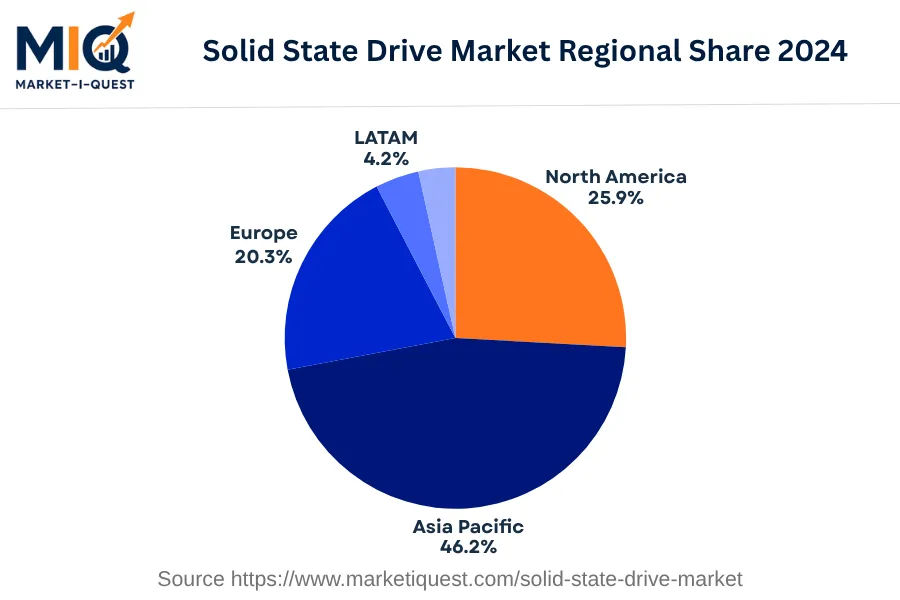
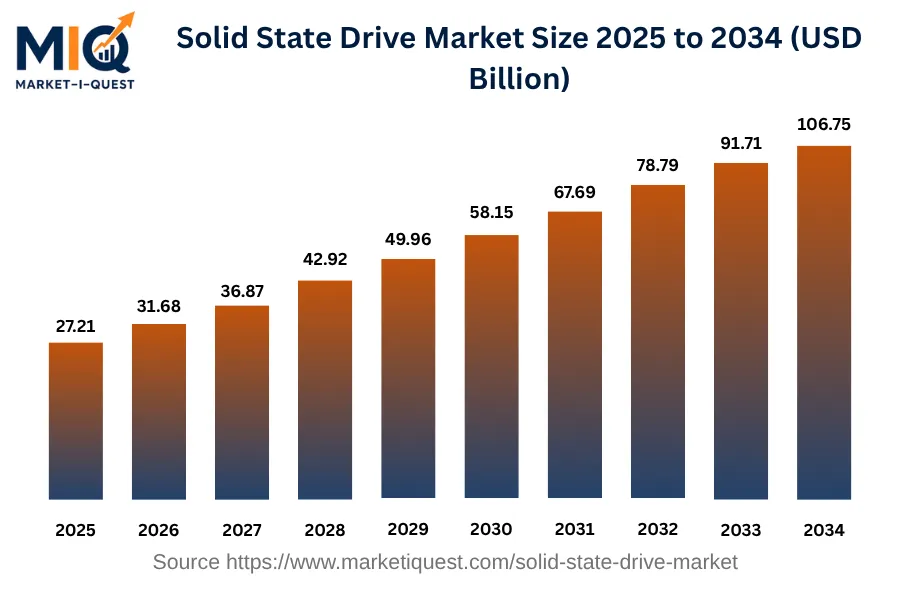
The solid-state drive (SSD) market is projected to increase from USD 27.21 billion in 2025 to USD 106.75 billion by 2034, at a CAGR of 16.4%. This significant escalation over a period of nine years shows a consistent expansion pattern within the SSD industry. The growth is influenced by enhancement of technology and increasing demand for better performing memory storage devices. The year 2024 experienced a market size of USD 23.38 billion, which shows a significant growth in the following year. In terms of regional share, SSD market was distributed across multiple regions in 2024. Asia Pacific held the largest share of 46.2%, followed by North America at 25.9% and Europe at 20.3%.Whereas, LATAM and MEA held 4.2% and 3.5% share of the market respectively.

Key Takeaways

  • By Type of Interface -SATA led in terms of usage accounting for a significant share in 2024.
  • By Technology - MLC emerged as the most preferred holding the major market share in that year.
  • By Storage Capacity - the 500 GB - 1 TB range was prominently used holding a significant proportion in 2024.
  • By Foam Factor - M.2 SSD stood as the leading type accounting for the largest market share.
  • By End Use - Enterprises were the major users holding the dominant share of the Solid State Drive Market in 2024.
solid-state-drive-market market size

Key Driving Factors

Rapid Data Center Expansion

The drive towards digitization in both business and governmental operations has led to rapid growth of data centers globally. These data centers require high-speed and reliable storage solutions, which solid state drives (SSDs) are well-equipped to provide. SSDs' faster data access times and lower power consumption in comparison with traditional hard drives make them favorable choice for data center operators seeking enhanced efficiency and performance. Thus, a single data center switch to SSDs can represent multi-million-dollar investment, making trend of data center expansion a significant driver for solid state drive market.

Increase in Adoption of Cloud-based Services

Cloud services are getting adopted at an remarkable rate across small and medium-sized enterprises (SMEs) globally. These services offer several advantages such as scalability, flexibility and affordability. However, for ensuring seamless service delivery, cloud providers require faster and more dependable data storage and processing solutions. Highlighting significant demand for SSDs due to their improved reliability and speed compared to traditional storage solutions. Moreover, SMEs integrate cloud-based services, with expecting increased demand for solid state drives from cloud service providers, driving growth in the SSD market.

Market Evolution by Timeline

2019-2023
During this period, data centers and consumer electronics were two significant buyer segments for solid state drives (SSDs) due to robust data processing demands and superior performance. Companies shipped nan flash-based SSDs, highlighting maturity in integration with consumer products. Regions such as Asia Pacific had strong supply chains facilitated by tech manufacturing hubs in China and Taiwan. Policies such as Chinese government's Made in China 2025 initiative promoted production and adoption of SSDs. SSD prices generally declined due to high competition. Regular supply contracts influenced while partnerships between PC manufacturers and SSD suppliers were observed, such as HP and Samsung.
2024
In 2024, demand from cloud service providers for data storage became prominent alongside the previous demand sectors. SSD manufacturers introduced 3D NAND technology providing higher storage capacity. China's drive towards being independent in semiconductors significantly influenced the supply dynamics, potentially reducing dependence on foreign NAND chip suppliers. Policy-wise, Road to Zero program by European Union encouraged power efficiency in data centers, preference towards SSD usage. Thus, cost per gigabyte continued to decline making SSDs more viable for mass adoption.
2025-2029
Between 2025-2029, demand from automotive sector for in-vehicle infotainment systems will be significant. This will likely be coupled with consistent demand from data center and consumer electronics sectors. Technological growth will see piloting and shipping of 4D NAND SSDs, offering improved performance over 3D technology. In China, policies will likely aim at boosting domestic semiconductor industry continue to influence market dynamics. SSD pricing will see less fluctuation, indicating market stabilization. Public-Private partnerships like those between car makers and SSD manufacturers emerged, but long-term contracts will remain frequent.
2030-2034
From 2030 to 2034, SSD demand will likely spikes from augmented reality and virtual reality (AR/VR) applications, demanding high-performance drives. The technology is likely to expected maturing with shipment of 5D NAND SSDs. Trends in energy efficiency and self-reliance in semiconductor production from previous years will likely continue shaping market dynamics. By this period, market will likely stabilizes with stable pricing and typical supply contracts. Thus, partnerships might evolve to include AR/VR manufacturers and SSD suppliers.

Future Market Outlook

Future Opportunities

The solid-state drive market offers various opportunities for growth, primarily driven by the constant evolution of use cases and application demands across different sectors. The increasing data bandwidth requirements in artificial intelligence and machine learning projects are creating substantial demand for high-performance SSDs. Companies such as Google and Microsoft are expanding their cloud computing infrastructures, incorporating SSD technology to improve processing speeds and operational efficiency. Notably, sectors such as gaming and virtual reality are relying on SSDs for enhanced user experiences, driven by the release of next-generation gaming consoles such as the PlayStation 5 and the Xbox Series X, both of which feature SSD integration. The automotive industry is exploring opportunities in SSD adoption, with Tesla integrating high-capacity SSDs in their vehicles for data management and updates. The introduction of the PCIe 5.0 standard enabled the way for faster data transfer rates, making SSDs even more attractive for enterprises looking to upgrade their infrastructures. Furthermore, the growing focus on edge computing and IoT (Internet of Things) devices is expected to increase the demand for versatile storage solutions, indicating an opportunity for SSD manufacturers to innovatively serve to diverse market segments. This integration of technological demand across sectors indicates a significant platform for SSD advancements and deployments.

Segmentation Analysis

By Type of Interface

The market is divided into subsegments including Serial Attached SCSI (SAS), SATA, and PCI-Express. In 2024, the SATA subsegment accounted for the largest revenue share, while PCI-Express is expected to grow at the fastest CAGR during the forecast period.

Largest Revenue Share

SATA

Market Share Leader

In 2024, SATA, or Serial ATA, held the largest portion of market revenue in this segment. Due to several reasons SATA supports a range of user-friendly features which are commonly absent in other types of interfaces. The user-friendly design, combined with its cost-effectiveness, is largely engaging to budget-conscious consumers. In addition, SATA drives typically have larger storage capacity and are often used in data-intensive businesses of varying sizes, from smaller-scale start-ups to established multi-national corporations, indicating strong customer base ranging across different regions. Furthermore, regulations and standards of data storage and protection vary across regions, which also influence choice of interface type. Thus, in some regions, the use of SATA is encouraged due to its resilience and compatibility with various devices, widening its customer base and thereby driving up revenue generation.

Fastest CAGR

PCI-Express

Forecast Period Growth Leader

PCI-Express interface subsegment is expected to experience fastest growth in coming years. PCI-Express, or PCIE, provides significant advantages including high-speed performance and increased efficiency making it particularly suitable for heavy-duty applications. With tech advancements and increasing capital expenditure focused towards upgrading existing IT infrastructure, the adoption of PCIe continues to grow. Partnerships with other tech leaders in field of data storage to improve compatibility will likely serve as potential catalysts in its growth. Its high-cost for better performance is driving demand even with significantly higher costs. Trends indicate shift toward higher-performance storage solutions, indicating businesses and individual consumers alike are gradually inclined to hold higher costs for better performance and capabilities.

By Technology

The market is segmented by technology including SLC, MLC, TLC, and others, of which the Multi-Level Cell (MLC) subsegment dominated in terms of revenue, while the Triple-Level Cell (TLC) subsegment is projected to experience the fastest growth in the forthcoming years.

Largest Revenue Share

MLC

Market Share Leader

The Multi-Level Cell (MLC) technology influences the market by technology due to its wide acceptance and application in a range of devices. It provides a balance between cost, performance and reliability that is favorable to customers across several sectors. An MLC's ability to store more information compared to Single-Level Cell (SLC) technology has contributed significantly to its market dominance. In industrial sectors such as retail, healthcare and manufacturing, demand for reliability and high-performance data processing has driven adoption of MLC. Moreover, upgrading regulations requiring high storage capacity, better performance and speed in sectors such as automotive, aviation and governments demand MLC storage solutions. The resulting purchasing criteria, based on speed, durability, reliability and data retention, tends to favor MLC technology. However, prominent distribution channels and minimal switching costs have contributed to MLC's substantial share in the market.

Fastest CAGR

TLC

Forecast Period Growth Leader

The Triple-Level Cell (TLC) technology is expected to grow at the fastest-growth rate during forecast period. This riding trajectory is due to advances in technology and advances in TLC's initial limitations of endurance and data performance. Adoption of TLC is fueled by increasing demand for high-capacity data storage in consumer electronics and enterprise applications. The price per bit of TLC SSDs is decreasing, leading to broader adoption in price-sensitive markets. Policy initiatives promoting technology adoption and investments towards capacity enhancements serve as catalysts for this growth. Whereas, strategic partnerships and collaborations in the industry for technology integration are expected to boost TLC’s demand. Thus, with continuous R&D, TLC is anticipated to continue with its growth momentum.

By Storage Capacity

The market is divided into subsegments including Up to 500 GB, 500 GB - 1 TB, 1 TB - 2 TB, and Above 2 TB. The 500 GB - 1 TB storage capacity subsegment accounted for the largest revenue share, while the Above 2 TB subsegment is expected to grow at the fastest CAGR during the forecast period.

Largest Revenue Share

500 GB - 1 TB

Market Share Leader

In 2024, the 500 GB - 1 TB segment dominated the market in terms of revenue generation, primarily due to its remarkable balance between storage capacity and cost-effectiveness. The widespread consumer behaviors typically drive towards storage solutions that provide adequate space with reduced costs. Businesses and home users alike find that a 500GB - 1 TB range effectively fulfills their day-to-day data storage needs. In regions with pricing sensitivity is a significant factor, such emerging economies, this segment hols substantial market share. Regulatory environments support this segment by encouraging digitalization necessitating moderate storage requirements. Thus, mainstream retail channels predominantly feature products within this capacity range, further fueling its market prominence.

Fastest CAGR

Above 2 TB

Forecast Period Growth Leader

2TB subsegment is expected to grow at fastest compound annual growth rate. This rapid growth is expected to be primarily driven by rising demand for big-data solutions in various sectors, including information technology, healthcare and entertainment. Increasing adoption of data-heavy applications such as cloud computing, AI, machine learning and IoT are driving demand for higher storage capacities. Technology shifts toward 4K/8K video, high-res imaging, VR/AR and next-gen gaming require extensive storage solution. Strategic partnerships, continued technology innovation and gradual reduction in hardware prices promise to lower these barriers in near future.

By Foam Factor

The market is divided into subsegments including 2.5 inch SSD, M.2 SSD, U.2 SSD, E1.S SSD, and Other. M.2 SSD accounted for the largest revenue share while E1.S SSD is expected to grow at the fastest CAGR during the forecast period.

Largest Revenue Share

M.2 SSD

Market Share Leader

The M.2 SSD subsegment is dominating market due to its versatile attributes. It is appreciated by customers for its capability for boosting overall performance of connected device, principally due to high data transfer speed and loading capabilities. Furthermore, M.2 SSDs are compatible with both SATA (Serial Advanced Technology Attachment) and PCIe interfaces. Therefore, these SSDs can display different speeds based on the kind of interface present in host device. This compatibility widens consumer base for M.2 SSDs, driving its remarkable revenue. They are especially popular in densely populated regions such as Asia where budget PCs are common, as customers prioritize performance on budget. Moreover, their compact form factor serves well to range of applications from thin laptops to high-end desktops, giving them an benefit in the market.

Fastest CAGR

E1.S SSD

Forecast Period Growth Leader

The E1.S SSD subsegment is expected to showcase fastest growth rate due to factors such as unique design and superior capabilities explicitly tailored for edge computing and data centers. E1.S SSDs’ form factor and advanced thermal design have initiated new era of opportunities in emerging edge computing market. As IOT continues to grow, demand for more distributed computing and less reliance on centralized data centers calls for better edge storage solutions. Their inherent agile nature fits well into evolving server infrastructure. Moreover, recent industry preference towards green regulations is crucial for manufacturers to enhance their energy efficiency. Thus, long-term benefits and lowered overhead costs will significantly act as catalyst for accelerated growth in future.

By End Use

The market can be divided into subsegments including Consumer, Enterprises, and Industrial. Of these, Enterprises accounted for the largest revenue share, while the Consumer segment is expected to grow at the fastest CAGR during the forecast period.

Largest Revenue Share

Enterprises

Market Share Leader

As bedrock of advanced economies, enterprises pump substantial portion of revenue into the market. Their operations often demand sizeable investments into technology and infrastructure, forming solid revenue streams for this market. By sheer scale, large businesses hold the capacity to drive substantial sales volumes. Furthermore, enterprises often require a bouquet of diverse offerings tailored to their unique needs, which can bring in additional revenue from customization and supplementary services. Along with that, Their global footprint translates into widespread demand across multiple regions, evenly distributing potential risk and aiding overall market growth. Regulatory pressures and thrust towards digital transformation also drive enterprises to invest in these products and services. As a result, the consistently significant purchasing power and expansive reach of enterprises enable this subsegment to maintain the largest revenue chunk as of base year, 2024.

Fastest CAGR

Consumer

Forecast Period Growth Leader

Consumer segment is pegged to be fastest-growing subsegment. It's a blend of the ever-evolving consumer preferences, improvements in disposable incomes, and rapid technological advancements set to catalyze this projected growth. The rise in information access has created a more knowledgeable and demanding consumer base, driving firms in this market segment to innovate continuously. Additionally, shifts in lifestyles and norms, like surge in work-from-home culture, have led to an increased demand for products and services from consumers. Legislative shifts, like data privacy laws, also inspire firms to provide superior customer control and transparency, which can attract a larger consumer base. The barrier to new adoption in this segment is relatively low, as customers often engage on single-purchase basis rather than lengthy contracts. Yet, near-term risks may arise from economic downturns affecting consumer expenditure and potential data security issues.

Competitive Analysis

Key Market Players

Manufacturers / OEMs

Samsung Electronics Co., Ltd.
South Korea
Western Digital Corporation
US
Intel Corporation
US

Key Suppliers & Raw Materials

SK Hynix Inc.
South Korea
Micron Technology, Inc.
US
Toshiba Corporation
Japan

Distributors, Integrators & Channel Partners

CDW Corporation
US
SHI International Corp.
US
Ingram Micro Inc.
US

Porter’s Five Forces Analysis

This analysis examines the competitive pressures influencing the Solid State Drive Market.

Supplier Bargaining Power

Medium

Limited number of manufacturers of NAND flash memory, the key component, yields sizeable influence.

Buyer Bargaining Power

High

Numerous options available result in high buyer power in the SSD market.

Threat of Substitutes

Low

Few viable alternatives to SSD, such as HDDs, which are slower and less durable.

Threat of New Entrants

Medium

High capital investment and technology constraints create a moderate entry barrier.

Competitive Rivalry

High

Strong competition among established players like Samsung, Intel, and Sandisk.

Regional Analysis

Geographic market dynamics and growth opportunities across key regions

Global Market Outlook

solid-state-drive-market market regional share

North America

In 2024, North American Solid-State Drive (SSD) market highlighted growing demand due to technological advancements and evolving consumer behavior. Advancements in cloud computing, data analytics and AI acted as the major drivers. These advancements demanded greater storage capacities and faster data processing speeds, driving the adoption of SSDs in sectors such as enterprise, government, healthcare and manufacturing. Regulations supporting the digitization of records in industries such as healthcare also stimulated the growth of the SSD market.

A trend in consumer behavior towards laptops and gaming systems that provided enhanced speed and efficiency spurred the SSD market. Technological shifts, including shift from Hard Disk Drives (HDD) to SDD in various electronic devices, also characterized the market trends. Increased partnerships in tech sector such as manufacturers partnering with digital solution providers to offer high-performance devices. High levels of adoption of standards such as NVMe (Non-Volatile Memory Express) protocol that increased SSD performance also characterized the market. The SSD market witnessed robust demand from the retail sector, which saw demand for managing large customer databases efficiently. Utility sector exhibited high adoption of SSD technologies to manage and analyze electricity consumption data. Thus, these sector-specific demands further highlighted the expansion and significance of the SSD market in North America.

Asia Pacific

In 2024, Asia-Pacific Solid-State Drive (SSD) market witnessed enhanced activity due to rising demand, technological advancement and regulatory dynamics. Demand expanded continuously from sectors such as enterprise, healthcare and retail driven by their growing demand for data storage. In China and Korea, government policies favoring domestic SSD manufacturing prompted substantial investments, thereby enhancing the supply dynamics. Rapid adoption of 3D NAND technology, especially in Japan and Australia, transformed the storage capacity, contributing to the market growth.

Developments in buyer behavior and product technology developed significant market trends. Notably, customers behavioral shift was prioritizing speed and reliability, particularly in India's burgeoning e-commerce sector. A significant technological shift witnessed transition to SSDs with NVMe protocol providing higher speeds, noted specifically in data-intensive sectors such as healthcare in ASEAN markets. Channel dynamics transformation featured direct-to-consumer sales enhancing in markets such as China. In enterprise sector, SSD use for AI and machine learning applications were frequent trends, particularly in Japan and Korea. Regulatory compliance concerning data privacy remained critical, influencing SSD markets, notably in Australia and key ASEAN markets. Partnerships between SSD manufacturers and tech firms, shaped by policies such as China's 'Made in China 2025', also characterized the market landscape during this year.

Europe

In 2024, European Solid State Drive (SSD) market witnessed a significant rise due to various demand and supply drivers. Growth in data center construction, primarily in Germany, UK and France, increased demands for high-capacity SSDs. Stringent data privacy regulations such as GDPR increased suitability of SSDs over traditional hard drives due to their superior data protection capabilities. This trend was particularly noticeable in healthcare and government sectors across Europe favoring data-intensive operations with enhanced security. Increased focus on R&D investments also boosted SSD technology adoption.

However, shifting consumer preferences towards faster data processing and lower energy consumption shifted demand from Hard Disk Drives (HDDs) to SSDs. This trend was especially noticable in the enterprise sector in Spain, Italy and Benelux regions focusing on operational efficiency. Major SSD manufacturers including Samsung and Kingston initiated strategic partnerships and M&A, boosting their market positions in Central & Eastern Europe and the Nordics. Technology advances in SSDs, such as NVMe technology, provided competitive benefits over HDDs by offering high-speed data transfer. Strict enforcement of e-waste policies by the European Union resulted in SSD's increased uptake due to their longer lifespan and lower environmental footprint than HDDs.

Latin America

In 2024, solid-state drive (SSD) market in Latin America experienced considerable expansion, driven due to rising digital transformation initiatives across various sectors. Significant drivers that contributed in market growth included robust demand for high-speed data processing and storage, especially in Brazil and Mexico, where enterprises are increasingly adopting cloud-based solutions. Government regulations across LATAM favored data localization, driving the demand for advanced storage solutions such as SSDs. Increased investment in Information Technology infrastructure by businesses within regions such as Argentina, Colombia, and Chile expanding SSD market growth.

Among key trends, SSD manufacturers formed strategic partnerships for broadening distribution networks. Brazil's shift towards NVMe technology resulted in higher SSD adoption, while data centers in Mexico experienced an rise in the usage SSDs for reducing access times and energy consumption. Consumer shifts towards lighter, faster personal computing led to increased SSD utilization in devices, especially in Peru. In terms of sectors, adoption was high among enterprise segment, especially among businesses requiring high-performance computing such as financial services, e-commerce, and IT & telecom. The government sector across LATAM also increased their reliance on SSDs for advanced data storage and retrieval, given their increased focus on cybersecurity. Thus, healthcare sector, striving for faster diagnostic procedures and secure patient data storage.
Middle East & Africa

In 2024, the solid state drive (SSD) market in Middle East and Africa highlighted significant growth due to various factors. Demand was driven by increased need for efficient data storage solutions in sectors such as oil and gas, telecom, healthcare and financial services. Regulatory measures for encouraging digital transformation, especially in countries such as Saudi Arabia, United Arab Emirates and South Africa, further boosted the market. The influx of investments into development of advanced technology infrastructure.

Several trends emerged in base year. Shift from traditional hard disk drives (HDDs) to SSDs became noticable, spurred by consumer preference for faster, more reliable storage options. Moreover, rise in partnerships and M&A activities among SSD manufacturers aimed at expanding regional presence, particularly in Nigeria and Kenya, was observed. Finally, stricter policy enforcement on data management and security, as seen in countries like Qatar and Egypt, generated opportunities for SSD adoption. Given the prominence of industries like oil and gas in Middle East and financial services in Africa, these sectors stood out as key customers, further underpinning growth. Overall, the interplay of these drivers and trends in 2024 significantly shaped SSD market in Middle East and Africa.

Recent Industry Developments

Latest market innovations, product launches, and strategic initiatives

March 2026

During the NVIDIA GTC 2026 event, Samsung unveiled PM1763 SSD, a next-generation storage solution utilizing the PCIe 6.0 interface. The drive was specifically designed to integrate with NVIDIA BlueField-4 STX reference architecture to enhance energy efficiency and system performance for heavy AI inference workloads.

March 2026

Kioxia announced development of KIOXIA GP Series, a Super High IOPS SSD engineered directly for NVIDIA Storage-Next architecture. This development essentially allows GPUs to use high-speed flash memory as an expansion to High Bandwidth Memory (HBM), bypassing traditional hardware limits when training massive AI models.

February 2026

Micron achieved a major shipping milestone by entering mass production with the Micron 9650 NVMe SSD, officially world's first PCIe Gen6 data center drive. This fundamentally altered data center I/O architecture by delivering sequential read speeds up to 28,000 MB/s, doubling the bandwidth of existing Gen5 drives to prevent storage bottlenecks during intense AI workloads.

Frequently Asked Questions