Plant Genotyping Equipment Market Snapshot

Key Players

  • Thermo Fisher Scientific Inc. (United States)
  • Illumina Inc. (United States)
  • Agilent Technologies Inc. (United States)
  • QIAGEN NV (Netherlands)
  • Eurofins Scientific (Luxembourg)
  • Takara Bio Inc. (Japan)
  • LGC Limited (United Kingdom)
  • Danaher Corporation (United States)
  • Roche Sequencing Solutions Inc. (Switzerland)
  • Novogene Corporation Ltd. (China)

Market Size

Base Year 2024
$1.37 Bn
CAGR
9.16%
Forecast 2034
$3.29 Bn

Market Segments

By Genotyping Technology
  • SNP Genotyping
  • SSR Genotyping
  • Next-Generation Sequencing
  • DNA Microarrays
By Testing Method
  • Destructive Testing
  • Non-Destructive Testing
By End User
  • Research Institutions
  • Agricultural Biotechnology Companies
  • Government Agencies

Market Dynamics

Drivers
  • Increasing agricultural productivity demand
  • Advancements in biotechnology industry
Restraints
  • High equipment costs
  • Limited skilled personnel
Opportunities
  • Emerging biotech startups
  • Increased plant research funding

Market Size

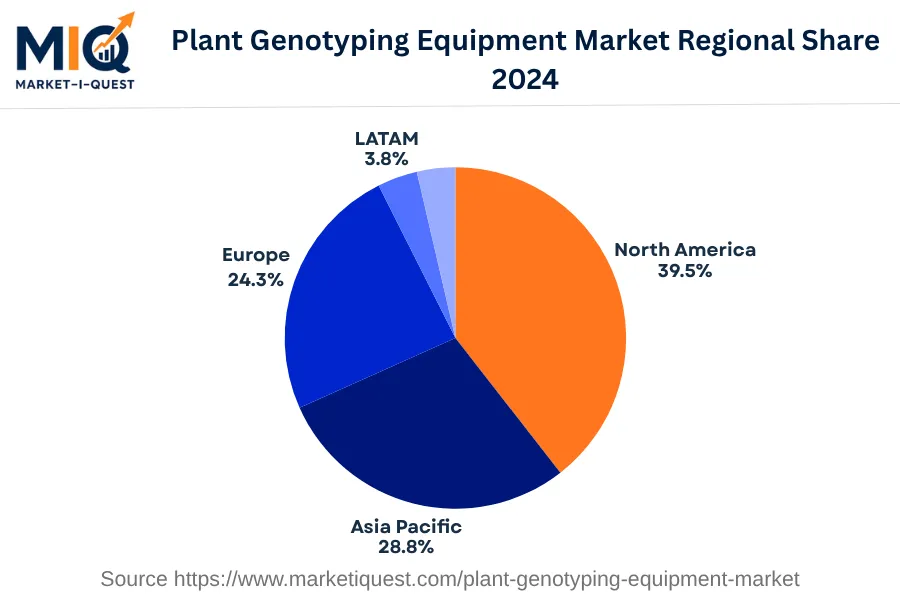
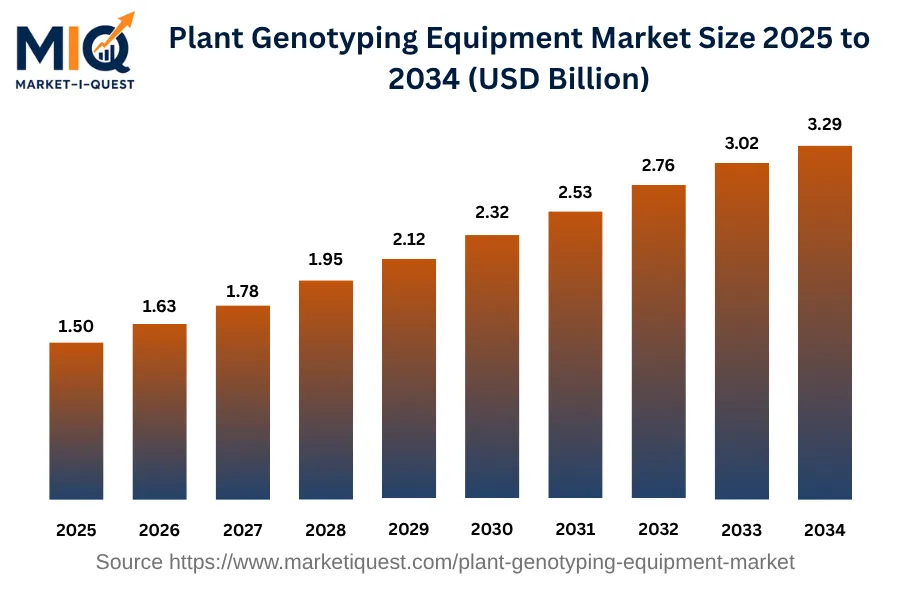
The Plant Genotyping Equipment Market projected a valuation of USD 1.50 Billion in 2025, and by the end of 2034, it is expected to reach USD 3.29 Billion, growing at a compound annual growth rate (CAGR) of 9.16%. This considerable expansion is due to a gradual increase in market size year over year from the value of USD 1.37 Billion recorded in 2024. The continual growth is indicative of a steady rise in the adoption and demand for plant genotyping equipment over the decade. The market trends indicate that North America held the majority share of the market in 2024 with 39.46%, followed by Asia Pacific at 28.84%, Europe at 24.28%, Latin America at 3.79%, and the Middle East and Africa region at 3.63%. The regional distribution of shares signifies the concentrated usage of plant genotyping equipment predominantly in the regions of North America, Asia Pacific, and Europe.

Key Takeaways

  • By Genotyping Technology - DNA Microarrays led the market accounting for a notable position in 2024.
  • By Testing Method - Destructive Testing held a significant market share in 2024.
  • By End User - Research Institutions expanded rapidly emerging as the fastest-growing segment.
plant-genotyping-equipment-market market size

Key Driving Factors

Shift to Precision and Sustainable Agriculture

Farmers and agricultural industries around the world are increasingly adopting precision and sustainable agriculture practices. They are focusing on enhancing crop yield and quality while minimizing the environmental impact. This approach requires equipment that can help identify the genetic makeup of plants to enable faster breeding of high-yield and disease-resistant crops. Plant genotyping equipment serves this exact purpose. It identifies specific markers in plant DNA sequences, offering insights into their potential traits and responses to environmental factors. This shift in agricultural practices is pushing the adoption and spend on plant genotyping equipment.

Increasing Focus on Plant Genomics Research

Universities, research institutions, and biotechnology companies are intensifying their focus on plant genomics research. They aim to understand the genetic makeup of plants, which can lead to breakthroughs in plant breeding and genetic engineering for desired traits. Plant genotyping equipment is a vital tool in this process. It's used to analyze multiple genes at the same time, thereby accelerating the research process. These institutions and companies often have the necessary funding for high-quality research equipment, which further encourages the purchase and use of plant genotyping equipment.

Market Evolution by Timeline

2019-2023
During this period, buyers in the plant genotyping equipment market are principally agri-biotech and plant breeding companies in North America and Western Europe with focus on seeking genotypic information to enhance crop yield. High-throughput plant genotyping technologies like Next Generation Sequencing emerge as reliable options. Limited regulatory influences, but buyer's adherence to International Plant Phenotyping Network (IPPN) standards prevalent. Commercially, manufacturers invoicing on purchase basis, with extended maintenance contracts. Commonly, equipment integration into buyer's existing technological setup demonstrated inconsistent maturity, posing occasional operational challenges. High costs and technical complexities of these equipment are typical supply-side constraints.
2024
In 2024, buyers' demographics widened to include government-backed agricultural bodies in emerging economies like India. Technologies such as microsatellite markers, AFLP, and SNP mark rise in adoption due to accuracy and cost-effectiveness. Buyer's concern for equipment compatibility issues emerged, necessitating suppliers to offer robust integration support. Developed countries implementing mandatory genotyping for germplasm deposition, affecting buyer behavior. Manufacturers started offering flexible pricing models, including leasing options for this equipment. Supply-side, lack of skilled professionals to handle genotyping equipment constituted significant bottleneck.
2025-2029
From 2025 to 2029, developing nations escalated their participation as buyers due to increasing government funding in agricultural genomics. Technologies such as High-Resolution Melting (HRM) and Sequenom MassARRAY show momentum. Suppliers faced challenges around interoperability of equipment with different genotyping technologies. Additional standard adherence, like those under Plant Variety Protection Act by United Plant Savers, surfaced. Commercially, consortium buys and volume contracts established as common procurement models. However, discrepancies in genotyping results due to genetic complexities posed risk to market credibility.
2030-2034
In 2030-2034, diverse buyer base spreading to food-processing industry considering genotypic screening of crops for quality control. Technological maturation anticipated with the rise of integrative genomics tools. New GDPR-like policies concerning genetic data privacy likely to affect market operations. An expected trend towards performance-based pricing models encouraged by buyers. However, maintaining accuracy and reliability of data produced by equipment remained a constant concern for suppliers as false positives/negatives might impede their credibility. Consequently, assurance strategies such as extended warranties and regular calibrations expected to gain momentum.

Future Market Outlook

Future Opportunities

The ongoing advancements in artificial intelligence (AI) and machine learning present significant opportunities for the plant genotyping equipment market. In March 2023, a collaboration between Bayer Crop Science and various AI research institutions was announced to develop predictive models for crop resilience and yield. This focus on AI is further mirrored by developments from companies like 10x Genomics, which introduced single-cell RNA sequencing technology in 2020, driving deeper genetic insights. Furthermore, regulatory bodies such as the European Commission have begun exploring gene-editing frameworks to enable faster integration of genetically modified traits into agricultural practices, slated for discussion in their 2024 guidelines. The increasing demand for drought-resistant and disease-resistant crops drives the need for more precise genetic tools. Strategic partnerships, like the 2022 alliance between Syngenta and the University of California, aim to harness gene-editing technologies to improve crop traits significantly. Additionally, the rise of vertical farming initiatives is creating demand for compact, efficient genotyping solutions that can adapt to diverse growing environments. As businesses aim to meet challenges posed by climate change and food security, they are restructuring their R&D efforts to encompass both traditional and next-generation breeding techniques, thus expanding their market footprint. These developments collectively signify a marked shift towards enhancing agricultural productivity through targeted genetic insights.

Segmentation Analysis

By Genotyping Technology

The market is divided into subsegments including SNP Genotyping, SSR Genotyping, Next-Generation Sequencing, and DNA Microarrays. DNA Microarrays accounted for the largest revenue share while Next-Generation Sequencing is expected to grow at the fastest CAGR during the forecast period.

Largest Revenue Share

DNA Microarrays

Market Share Leader

DNA Microarrays are currently demonstrating the highest revenue generation in the Genotyping Technology market. This can be attributed to the broad utility of this technology in high-throughput and cost-effective genomics research. Microarrays provide the means to simultaneously assess the expression of thousands of genes, which is particularly beneficial in applications such as disease profiling and genetic variant analysis. Additionally, they are widely utilized in clinical diagnostics, offering rapid detection and characterization of viral and bacterial strains. This is especially critical in areas where infectious diseases pose a substantial public health risk. Furthermore, pharmaceutical sectors seeking out genetic markers for drug development and personalized medicine also contribute substantially to the demand for this technology. Favorable regulations, particularly in developed economies, coupled with the steady influx of investments towards genomics-based research, aid in maintaining DNA Microarrays' dominance in the market. However, it should be noted that this analysis is inferred from typical market dynamics and may vary based on industry-specific factors.

Fastest CAGR

Next-Generation Sequencing

Forecast Period Growth Leader

Next-Generation Sequencing (NGS) is projected to be the fastest-growing subsegment within the Genotyping Technology market, bolstered by several factors enabling this proportional growth. Primarily, NGS is gaining preponderance due to its elevated sequencing speed and capability to sequence complex genomes efficiently. An onset of new technology in NGS like third-generation sequencing offering real-time sequencing is likely to spur the growth further. Moreover, the ability to offer high-throughput data results in cost-saving, which is pivotal for research and diagnostic institutes operating on tight budgets. With the ongoing demand for personalized medicine, NGS is becoming indispensable in determining genetic predisposition to diseases and pharmacogenomics. Further, government initiatives worldwide to integrate genomics into clinical care include significant investments in NGS research, accelerating its adoption rates. However, key challenges to its adoption remain, including the need for skilled personnel and high data storage requirements for extensive genomic data. The assumption here is that these factors align with common market performance.

By Testing Method

The market is divided into subsegments including Destructive Testing and Non-Destructive Testing. In 2024, Destructive Testing accounted for the largest revenue share while Non-Destructive Testing is expected to grow at the fastest CAGR during the forecast period.

Largest Revenue Share

Destructive Testing

Market Share Leader

Destructive Testing has the lion's share in the revenues among the testing method subsegments in 2024. Its dominance is primarily driven by its application range, catering to a wider spectrum of industries like manufacturing, construction, aerospace, and automotive, where testing the material's physical properties is crucial. Geo-strategically, emerging markets of the Asia-Pacific region, which are experiencing robust industrial growth, contribute significantly to the demand. Regulatory norms and safety standards across industries mandate Destructive Testing for confirming the intended purpose of products and build quality. Market players prefer this testing method, as results are immediate, leaving less room for speculation and inference. However, the inherent downside of the process is the material wastage which adds to the testing expense, yet the trade-off has been accepted till now.

Fastest CAGR

Non-Destructive Testing

Forecast Period Growth Leader

Non-Destructive Testing, although smaller in revenue scale, is expected to outpace Destructive Testing in growth rate. The shift is instigated by a combination of technological development, commercial considerations, and sustainability needs. Advancements in sensor technology, AI-based image interpretation, micro computed tomography have made possible testing of complex products and materials without destruction or alteration. The cost-effectiveness of this method, its ability to conduct regular monitoring of products and structures, without affecting the ongoing operations, attracts sectors like oil and gas, power industry, infrastructure management, and even heritage preservation. Looking forward, reducing material wastage is an appealing sustainability factor, as businesses worldwide are shifting toward greener practices. However, reliable interpretation of results and lack of skilled analysts remain major hurdles in wide-scale adoption, hence posing risks to the subsegment's growth pace.

By End User

The market is divided into subsegments including Research Institutions, Agricultural Biotechnology Companies, and Government Agencies. In 2024, Agricultural Biotechnology Companies accounted for the largest revenue share while Research Institutions is projected to grow at the fastest CAGR during the forecast period.

Largest Revenue Share

Agricultural Biotechnology Companies

Market Share Leader

Agricultural Biotechnology Companies generate the largest revenue share as they are the key users of market products. As biotechnology develops, the demand for innovative products and solutions in agriculture increases. Problems like population growth, climate change, and the necessity for higher crop yields drive this demand. These companies are largely concerned with improving crop production, developing pest-resistant crops, and augmenting nutritional content. Moreover, as operating in a heavy capital and regulation-intensive sector, these companies have high purchasing power and are less likely to switch suppliers. This explains their predominant share in the revenue. The industry's profitability is also influenced by regulatory policies that encourage sustainable farming practices using biotechnology. Concentrations of these companies in regions with high agricultural output contribute to geography-based sector growth.

Fastest CAGR

Research Institutions

Forecast Period Growth Leader

Though not leading in terms of revenue, Research Institutions are expected to be the fastest-growing subsegment. One growth driver is the increasing investment in biotech research, particularly in areas like genetic engineering and molecular biology. Another catalyst is emerging partnerships between these institutions and companies, intending to fortify R&D capabilities. Institutions also have an advantage with government grants and funding to promote biotech research. However, they face barriers like regulatory scrutiny and ethical dilemmas surrounding certain aspects of biotech research. These hurdles may limit adoption rates in the short term. Despite these challenges, the subsegment's growth is anticipated to remain strong, with rising adoption of the latest biotech applications in academic and clinical studies.

Competitive Analysis

Key Market Players

Manufacturers / OEMs

Thermo Fisher Scientific Inc
US
Illumina Inc
US
QIAGEN N.V.
Netherlands

Key Suppliers & Raw Materials

Agilent Technologies Inc
US
Roche Holdings AG
Switzerland
Bio-Rad Laboratories Inc
US

Distributors, Integrators & Channel Partners

Pacific Biosciences of California, Inc
US
Twist Bioscience
US
BioMarin Pharmaceutical
US

Porter’s Five Forces Analysis

This analysis evaluates the competitiveness and attractiveness of the Plant Genotyping Equipment Market.

Supplier Bargaining Power

Medium

Suppliers have moderate power due to limited manufacturers of advanced genotyping equipment.

Buyer Bargaining Power

High

Buyers have high power due to availability of various equipment options and less switching costs.

Threat of Substitutes

Low

Threat is low due to the specialized nature of the plant genotyping equipment.

Threat of New Entrants

Medium

Entry is challenging due to high capital investments and technical know-how.

Competitive Rivalry

High

Highly competitive due to the presence of several big and small players worldwide.

Regional Analysis

Geographic market dynamics and growth opportunities across key regions

Global Market Outlook

plant-genotyping-equipment-market market regional share

North America

In the base year 2024, the North American Plant Genotyping Equipment market was significantly influenced by various factors. Technological advancements and the growing adoption of high-throughput DNA sequencing played pivotal roles in boosting the market demand. Investment in agricultural research by governmental bodies like the U.S. Department of Agriculture (USDA) increased substantially, leading to improved usage of genotyping equipment for crop improvement programs. In terms of market trends, precision agriculture emerged as a common practice among end-users in the U.S., Canada, and Mexico. This methodology uses plant genotyping equipment to increase crop yield efficiency, reflecting the increased utilization in the agricultural sector. The adoption of intellectual property rights (IPRs) in plant genotyping also influenced the market. Specifically, the U.S. Plant Variety Protection Act (PVPA) has encouraged breeding innovation, indirectly driving demand for genotyping equipment.

The primary sectors driving demand included academic research institutions, government research laboratories, and agricultural biotechnology companies. Among enterprise customers, major agribusiness corporations showed a particular interest in deploying genotyping equipment to develop proprietary seed varieties. Market activities in 2024 also revealed a growing trend of partnerships between biotechnology firms and academic institutions, aimed at accelerating the application of plant genotyping in crop development. This cooperation is likely a response to the surging demand for sustainable food production methods across North America.

Asia Pacific

In 2024, the Plant Genotyping Equipment Market in Asia Pacific witnessed significant activity. Driving this market were factors such as increased demand for advanced plant genotyping equipment in agricultural research centres and significant investments made for innovation in agricultural technology, particularly in China, India, and Australia. Regulations encouraging sustainable farming and the adoption of technologically equipped seed quality control systems by government bodies played a crucial role in stimulating the market.

Changing agricultural trends saw more advanced and accurate equipment being demanded by research institutions and government bodies. Technological advancements in genotyping machines and processes, such as next-generation sequencing systems, were becoming increasingly popular in Japan, South Korea, and key ASEAN markets. The dynamic shift towards digital platforms for marketing and sales distribution channels was a key trend, with more manufacturers leveraging e-commerce to reach a wider consumer base. There was also a noticeable increase in partnerships between equipment manufacturers and research institutions to improve product specifications. Across the region, the primary customers included large-scale agricultural enterprises and government bodies dedicated to agricultural development and research. Other significant sectors included healthcare and pharmaceutical companies using plant genotyping for developing plant-based medical research. Distinct efforts towards enhanced research capabilities in plant genomics were evident across numerous Asia Pacific markets in 2024.

Europe

In 2024, the European market for Plant Genotyping Equipment witnessed substantial activity due to technological innovations and increasing agricultural needs. Drivers of growth included advancements in technology enabling cost-effective plant genotyping, and rising demand for higher agricultural productivity due to European Union regulations encouraging sustainable farming practices. Additionally, substantial investment in research and development activities, especially in Germany and the United Kingdom, bolstered the market development.

Significant trends shaping the market dynamics included a shift from manual to automated genotyping equipment among major research institutions and agricultural enterprises. This move was largely due to enhanced precision and accuracy offered by automation, resulting in improved crop yields. Moreover, increased partnerships between equipment manufacturers and academic institutions, like the University of Cambridge and John Innes Centre, stimulated research activities and, in turn, drove demand. Furthermore, stricter policy enforcement by European governments promoted the adoption of genetically-modified crops, thus stimulating product demand. The key sectors relying on this equipment encompassed agricultural enterprises, government institutions, and research centres. Companies from manufacturing and retail industries also formed a significant customer base, primarily those involved in food production, seeking to ensure crop quality and yield consistency. Particularly in Spain, France, and Italy, renowned for their agricultural prominence, the demand for such equipment was distinctly pronounced.

Latin America

In 2024, Latin America's Plant Genotyping Equipment Market exhibited substantial growth based on various factors. Drivers included robust government support for agricultural research in countries such as Brazil and Mexico, which stimulated demand for plant genotyping equipment. Additionally, agritech advancement in LATAM's nations like Argentina and Colombia implied a higher adoption of innovative genotyping technologies. More so, increasing investments from global plant genotyping manufacturers, conscious of LATAM's significant crop biodiversity and agricultural potential, escalated the equipment supply dynamics.

Simultaneously, the market was influenced by several trends. Buyers leaned towards advanced, high-throughput plant genotyping systems underpinning their efforts towards accelerated plant breeding and crop improvement. Moreover, an observable shift towards smart agriculture, especially within enterprises and government-led institutes in Chile and Peru, necessitated more sophisticated plant genotyping tools. As a repercussion, technology providers' global collaboration intensified, aiming to co-develop and introduce cutting-edge genotyping solutions into the regional market. Lastly, the Latin American governments' regulatory enactments for enhancing crop yield and quality prompted stricter adherence to genotyping standards and related policy execution. This scenario positively impacted sectors ranging from agri-food research, bio-pharmaceutical manufacturing to retail crop production sectors, reinforcing the overall plant genotyping equipment's market proliferation in 2024.

Middle East & Africa

In 2024, the Plant Genotyping Equipment Market in Middle East and Africa was experiencing steady growth due in large part to demand factors and technological adoption. Increased investment in advanced agriculture in countries such as Saudi Arabia, United Arab Emirates, and Israel was driving demand for high precision equipment for plant genotyping. Government regulations promoting sustainable farming practices in South Africa and Kenya, alongside technology adoption bolstered this drive.

The perceived need for enhanced food security significantly influenced the market trend, inducing increased preference for advanced equipment among key sectors such as government and agriculture. Israel’s adoption of high-tech agriculture, such as genotyping of plants propagated the trend. Market players were prioritizing partnerships, particularly in countries like Nigeria and Egypt, aiming to expand their footprint. Strict policy enforcement in Saudi Arabia around technology integration in agricultural practices precipitated a shift towards more technologically advanced plant genotyping. In Qatar, the push for self-sufficiency in food production influenced the adoption of genotyping equipment in the agricultural sector. The market's trajectory was also shaped by South Africa's strong commitment to agricultural R&D, which encouraged further investment in plant genotyping equipment. Towards the end of the base year, the market showed a clear domino effect of these drivers and trends across the region.

Recent Industry Developments

Latest market innovations, product launches, and strategic initiatives

April 2026

The Council of the European Union adopted its position at first reading on a regulation for plants obtained by certain new genomic techniques (NGTs) and their products, amending Regulation (EU) 2017/625.

February 2026

ICARDA inaugurated newly developed facilities of its Food Legume Research Platform in Amlaha, Madhya Pradesh, India, strengthening pulse research through partnerships with the Indian Council of Agricultural Research (ICAR) and national agricultural universities.

Frequently Asked Questions