Network Function Virtualization Market Snapshot

Key Players

  • Cisco Systems (United States)
  • Alcatel-Lucent Enterprise (France)
  • Juniper Networks (United States)
  • Huawei Technologies (China)
  • Ericsson (Sweden)
  • Amdocs (United States)
  • Nokia Corporation (Finland)
  • Oracle Corporation (United States)
  • NEC Corporation (Japan)
  • VMware (United States)

Market Size

Base Year 2024
$35.83 Bn
CAGR
21.87%
Forecast 2034
$258.95 Bn

Market Segments

By Service Type
Consulting Services, Integration Services, Managed Services
By Deployment Model
On-Premises, Cloud-Based, Hybrid
By Application
Telecommunication, Data Analytics, Network Security, Bandwidth Management, Voice Over IP
By End-user
Enterprises, Telecom Service Providers, Government, Others

Market Dynamics

Drivers
  • Increasing demand for cloud services
  • Rapid network infrastructure transformations
Restraints
  • High implementation costs
  • Limited security standards
Opportunities
  • Rapid digital transformation trends
  • Increasing demand for cloud services

Market Size

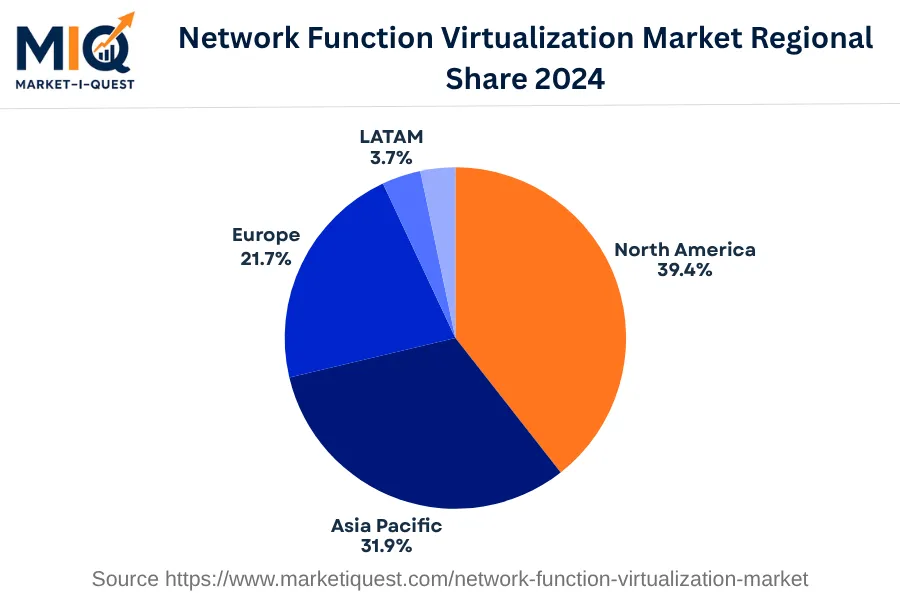
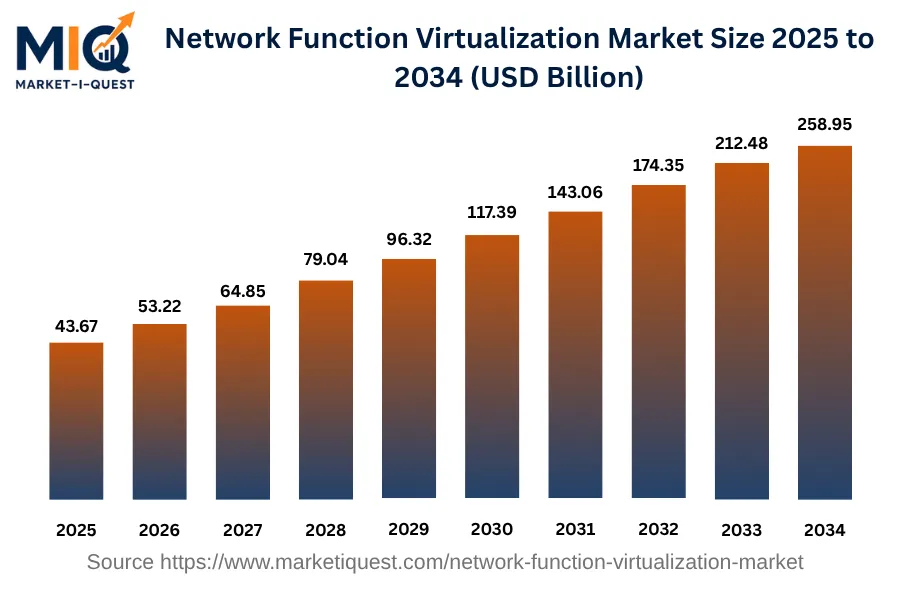
The Network Function Virtualization Market was valued at USD 43.67 billion in 2025 and is expected to grow significantly to reach USD 258.95 billion by 2034, with a compound annual growth rate (CAGR) of 21.9%. Over the nine years from 2025 to 2034, consistent growth is observed. The expansion is primarily due to continual technological advancements and the increasing adoption of virtualization technologies in network services. In geographic terms, regional distribution of market shares in 2024 indicates that North America held the largest share with 39.4%, followed by the Asia Pacific, which accounted for 31.9%. Europe represented 21.7% of the market share, while Latin America and the Middle East Africa comprised 3.7% and 3.3% respectively.

Key Takeaways

  • By Service Type - Consulting Services led the Network Function Virtualization Market in terms of demand in 2024.
  • By Deployment Model - On-Premises solutions held the majority share in 2024.
  • By Application - Data Analytics emerged as the fastest-growing segment with a rising trend expected from 2025 to 2034.
  • By End-user - Enterprises Providers accounted the largest share in 2024 in the Network Function Virtualization Market.
network-function-virtualization-market market size

Key Driving Factors

Shift Towards Cloud-Based Services

The Network Function Virtualization market is being influenced heavily by the global shift of organizations towards cloud-based services. This move is primarily hinged on the need for better storage, accessibility, and processing power amidst growing data generation. Cloud services help companies manage their resources more efficiently, acting as a significant catalyst for the adoption of Network Function Virtualization. By deploying NFV, companies leverage cloud capabilities to reduce the need for physical network components, significantly simplifying network management and reducing maintenance expenses. The platform also aligns with business continuity plans, as it can provide better resilience against disruptions compared to traditional networking methods.

Increased Adoption in Telecommunication Sector

Network Function Virtualization is seeing extensive adoption in the telecommunication sector. The telecommunication industry's evolution, with an emphasis on 5G and IoT (Internet of Things) technologies, necessitates update frequency increases. Traditional network architectures lack the flexibility and scalability to support these rapid changes while maintaining sufficient performance. Conversely, with NFV, telecoms can virtualize network services to swiftly evolve and scale their networks according to demand. The promise of fast and economical scalability along with reduced physical footprint boosts NFV attractiveness for the telecom industry. This supports the expanding and evolving telecommunication networks, driving growth in the NFV market.

Market Evolution by Timeline

2019-2023
In this period, telecommunications operators dominated the buyers segment as they implemented Network Function Virtualization (NFV) to reduce hardware costs and enhance network scalability. While Europe led in regional demand, Asia-Pacific showed promising progress due to China's initiatives towards the commercialization of 5G. Aligned with this growth was the shipment of NFV solutions integrated with machine learning capabilities for predictive maintenance, by suppliers like Ericsson. On the policy front, the European Telecommunications Standards Institute (ETSI) promoted the adoption of NFV through standardization initiatives. Commercially, solutions were typically procured via capital-expenditure models with long-term contracts. The key challenge faced was the complexity of integrating NFV with the existing physical infrastructure.
2024
In 2024, demand for NFV increased in the banking and financial sector due to the need for a reliable, scalable network infrastructure for secure transactions. The US drove this demand due to the large financial corporate presence. On the supply side, Huawei's NFV solution which provided deep integration with legacy systems gained traction while interoperability remained a constraint. Organizations like Open Platform for NFV (OPNFV) continued pushing for global standardization of NFV functionalities. Shift towards pricing models based on operational expenditure was observed because of the predictability this offered. However, concerns arose on ensuring network security in the virtualized environment.
2025-2029
Between 2025 to 2029, emergence of smart cities powered by IoT increased NFV's demand globally. Countries like India and Singapore saw a surge due to their smart city initiatives. NFV suppliers, notably Cisco and Juniper, focused on improving interoperability and automation. The NFV standardization effort was taken up by the 3GPP to bridge the gap between mobile networks and NFV. Subscription-based pricing models became prevalent. Technology providers partnered with cloud facilities to offer NFV as a Service (NFVaaS). The major risk was lack of skilled workforce to operate and manage the virtualized network functions.
2030-2034
The period 2030–2034 saw steady demand from healthcare and manufacturing entities leveraging IoT, where latency and reliability were critical. Countries leading in Industry 4.0, like Germany, created significant demand. Suppliers, including VMWare and Red Hat, offered cloud-native NFV solutions, resulting in easier integration with cloud-enabled services. Regulatory bodies like Federal Communications Commission (FCC) devised guidelines for NFV use to ensure equitable access to network resources. Providers largely adopted a 'Pay-As-You-Go' commercial model, reducing investment risk. The primary risk identified was the high dependency on the network availability and stability, prompting demand for robust backup and disaster recovery solutions.

Future Market Outlook

Future Opportunities

Looking ahead, the network function virtualization landscape presents numerous opportunities as organizations seek to enhance operational efficiencies and adopt agile solutions. Upcoming events, such as the 2024 deployment of 5G standalone networks, are expected to further propel the demand for NFV technologies, particularly in latency-sensitive applications. The partnership between Google Cloud and Telecom Infra Project in 2023 showcases how cloud providers are actively exploring NFV solutions to enhance service delivery models. Additionally, enterprises are increasingly looking toward integrating NFV with edge computing, especially in industries such as automotive and healthcare where real-time data processing is critical. In 2022, the Federal Communications Commission in the United States highlighted the importance of NFV for next-generation wireless infrastructure, indicating strong regulatory backing. Furthermore, private 5G deployment initiatives in sectors such as manufacturing and transportation demonstrate a growing interest among enterprises in leveraging NFV to optimize their networks. The ongoing emergence of AI and Machine Learning technologies in network management offers another facet for innovation, enabling optimized resource allocation and automated decision-making. As 2023 progresses, startups focusing on NFV and software-defined networking stand to capture the interest of investors, fostering a dynamic ecosystem ripe for growth. Thus, the continuous evolution of NFV technology is anticipated to drive significant transformations in how networks are designed and operated globally.

Segmentation Analysis

By Service Type

The market is classified into subsegments namely Consulting Services, Integration Services, and Managed Services. Consulting Services accounted for the largest revenue share while Integration Services is projected to grow at the fastest pace during the forecast period.

Largest Revenue Share

Consulting Services

Market Share Leader

Consulting Services command the leading share in terms of revenue, based on their crucial role in the wider market ecosystem. Consulting professionals provide expert advice and help organizations navigate through the complexity of choosing the right set of services and solutions for their unique needs. With the growing trend of digital transformation and IT services, businesses, regardless of their size and operation, have been showing a significant propensity towards consulting services. The geographic diversity of businesses also adds to the growth of consulting services as it offers international market understanding and cultural experience. In addition, the often stringent and complex regulatory environment across many regions also demands the need for expert consulting services. The procurement of consulting services is largely driven by the desire to improve business efficiency, cost reduction, and gain a competitive edge. The barrier to switching consulting providers is high due to the perceived risk and potential disruption to business operations. Businesses opt for these services through various channels like direct procurement from vendors or through consulting platforms.

Fastest CAGR

Integration Services

Forecast Period Growth Leader

Integration Services are predicted to demonstrate the fastest rate of growth. The primary drivers for this growth include evolving technology landscapes, increasing demand for automated business processes, and the urgency for seamless data flow among disparate business systems. Numerous organizations are adopting integration services to enhance their business efficiency, facilitate real-time decision making, and obtain a holistic view of business data. In an era dominated by the Internet of Things (IoT) and cloud technologies, integration services act as a vital catalyst enabling efficient data and process integration across various platforms and technologies. However, barriers like security concerns and high cost associated with the implementation of these services may inhibit rapid adoption. Despite the challenges, ongoing advancements in technology, favorable government policies encouraging digitalization, and strategic alliances between tech giants and integration service providers are expected to foster the growth of this segment. Though the potential risk of data breaches should be taken into account, the overarching need for seamless business integration is likely to drive the monumental growth of this subsegment.

By Deployment Model

The market is divided into subsegments including On-Premises, Cloud-Based, and Hybrid deployment models. In 2024, the On-Premises model accounted for the largest revenue share while the Cloud-Based segment is expected to grow at the fastest CAGR during the forecast period.

Largest Revenue Share

On-Premises

Market Share Leader

The On-Premises deployment model remains a highly profitable market segment in 2024 due to already established infrastructure and entrenched business practices. Many large enterprise customers, particularly those operating in tightly regulated industries such as healthcare and finance, prefer to have more control over their data and consequently opt for the On-Premises model, where sensitive data is stored in-house. The model's resilience to cyber threats, a growing concern, and the direct control over data management and infrastructure, are proving vital purchasing criteria. High switching costs associated with moving substantial existing on-premises infrastructure to the cloud often creates a hurdle for a quick switch-over, strengthening the revenue stance of this segment. It is also supported by certain geographies with strict data regulation policies that limit the use of foreign cloud service providers, stimulating demand for on-premises solutions.

Fastest CAGR

Cloud-Based

Forecast Period Growth Leader

The Cloud-Based deployment segment is projected to grow at the fastest rate due to the considerable benefits it provides. Cloud technology offers scalability and flexibility, allowing for quicker implementation of new business practices and adjustments of existing operations. It notably reduces server and storage costs, making it an attractive option for startups and small to medium-sized companies. Moreover, periodic enhancements to this technology and the ubiquity of high-speed internet are diminishing the barriers to adoption. The industry will likely see accelerated adoption as significant investments are made in cloud infrastructure, and as cloud providers continue to forge strategic partnerships with various business entities. Near-term risks include potential for data breaches and concerns about data sovereignty in different jurisdictions. However, improved regulatory outlook and stronger encryption methods are expected to overcome these challenges, promoting cloud adoption and driving its rapid growth.

By Application

The Application segment in the market is diversified into Telecommunication, Data Analytics, Network Security, Bandwidth Management, and Voice Over IP. Of these, Telecommunication accounted for the largest revenue share while Data Analytics is predicted to showcase the quickest growth rate during the forecast period.

Largest Revenue Share

Telecommunication

Market Share Leader

In the base year of 2024, Telecommunication dominated the revenue share due to several key factors. Primarily, there has been an exponential increase in the use of internet services around the globe, pressurizing telecommunication providers to enhance their infrastructure, serving both wide area network and local area network. Simultaneously, the subscriber base is growing at a rapid rate with the penetration of 4G and 5G services globally, fueling revenue for telecom services. Moreover, increasing adoption of IoT devices and high demand for reliable and high-speed internet are driving the growth of telecommunication services. Advancements in VoLTE, VoWi-Fi, LTE Broadcast, LTE-U/LAA in wireless technologies have contributed towards the increased revenue. Geographically, the Asia-Pacific region, particularly India and China, substantially contribute to this growth because of their large user-base.

Fastest CAGR

Data Analytics

Forecast Period Growth Leader

Despite not being the largest revenue earning segment, Data Analytics is poised for exceptional growth in the coming years. Countless businesses across all sectors are beginning to leverage data for decision-making processes, marketing strategies, customer acquisition, and more. Advancement in technology, including artificial intelligence and machine learning, are pushing the boundaries of what can be accomplished with data analytics. Policies and regulations that encourage transparency and competition in the digital market are also acting as a catalyst to this growing industry. However, there are near-term risks associated with this rapid growth. Data privacy regulations and the need for secure data handling mechanisms are paramount for maintaining trust and adoption of data analytics. Unless businesses can guarantee the security and privacy of user data, growth could be stifled. Partnerships between data analytics providers and business clients can alleviate this risk, offering more secure, reliable, and efficient data-driven solutions.

By End-user

The market is divided into subsegments including Enterprises, Telecom Service Providers, Government, and Others. In 2024, the Enterprises subsegment accounted for the largest revenue share while the Telecom Service Providers subsegment is expected to grow at the fastest CAGR during the forecast period.

Largest Revenue Share

Enterprises

Market Share Leader

The predominance of the Enterprises subsegment can be attributed to its high demand and purchasing power. A key driver for this is the continuing trend of digital transformation among corporations of various sizes. Companies are investing heavily in tech enhancements to improve operational efficiencies and foster a competitive advantage in their respective industries. Consequently, this leads to increased consumption of the product or service in question across the globe. The purchasing decisions of this subsegment are typically driven by factors such as proven performance, quality, and the ability to provide comprehensive support and integration resources. While headquarters of many large enterprises are based in established markets, these organizations often have branch locations across various emerging markets. This geographical spread contributes to the substantial revenue from this segment, given the extensive and diverse techno-commercial needs of such enterprises. Regulatory standards that encourage or mandate certain technologies or services also continue to be a decisive factor for the lion’s share of Enterprises' revenue.

Fastest CAGR

Telecom Service Providers

Forecast Period Growth Leader

The strong CAGR outlook for the Telecom Service Providers subsegment is influenced by a combination of technological advancements, policy reforms, and strategic alliances. As the world becomes more connected, the demand for sophisticated and reliable communication services rises, providing a fertile landscape for Telecom Service Providers to flourish. Key growth drivers for this subsegment include increased customer demand for high-speed data and the proliferation of smartphones and connected devices. Moreover, progressive policy measures and heavy infrastructural investments in developing markets are removing adoption barriers. However, stringent regulatory compliances, escalating concerns related to data security, and fierce competition might pose a potential threat to its rapid growth. Technological innovations such as 5G, AI, and IoT, along with potential partnerships and collaborations, are expected to catapult this subsegment's growth in the near future.

Competitive Analysis

Key Market Players

Manufacturers / OEMs

Cisco Systems Inc.
US
Nokia Corporation
Finland
Huawei Technologies Co. Ltd.
China

Key Suppliers & Raw Materials

Intel Corporation
US
IBM Corporation
US
AT&T Inc.
US

Distributors, Integrators & Channel Partners

VMware, Inc.
US
Hewlett Packard Enterprise Development LP
US
Citrix Systems, Inc.
US

Porter’s Five Forces Analysis

Analysis of the competitive intensity and attractiveness of the Network Function Virtualization Market.

Supplier Bargaining Power

Medium

Dependent on a limited number of suppliers like Cisco Systems, Huawei Technologies.

Buyer Bargaining Power

High

Buyers are various industries with different functional demands, leading to high bargaining power.

Threat of Substitutes

Low

Unique benefits of NFV reduce the likelihood of finding direct substitutes.

Threat of New Entrants

Medium

Specialist knowledge and initial investment are key barriers to entry.

Competitive Rivalry

High

Dominance of industry leaders increases competitive rivalry.

Regional Analysis

Geographic market dynamics and growth opportunities across key regions

Global Market Outlook

network-function-virtualization-market market regional share

North America

In 2024, the North American Network Function Virtualization (NFV) market exhibited significant dynamism driven by advanced technology adoption and investment in digital infrastructure. Large-scale deployment of 5G networks across the U.S., Canada, and Mexico stimulated demand for NFV solutions, accelerating the shift from hardware to software-based networking. Regulatory support for open-source platforms advanced the market, easing the integration of NFV across telecommunications and utilities industries.

Trends in this market were led by the increasing consumer preference for efficient data handling and speed. The rise of digital banking, online retail, and telehealth services underlined a push for networking solutions that can handle high-traffic loads and secure sensitive information. Enhanced partnerships and strategic mergers were prevalent, with technology giants, such as IBM and Cisco, collaborating with telecommunication companies to facilitate NFV implementation. In the public sector, governments sought to use NFV to streamline their services and improve data management, further promoting the NFV market's viability. On the other hand, the healthcare sector capitalized on NFV's potential to manage patient data efficiently and securely. In the base year 2024, the robust growth of the NFV market in North America reflected the region's adaptation to emerging technologies, regulatory shifts, and evolving consumer demands in various sectors.

Asia Pacific

In 2024, the Network Function Virtualization (NFV) market in Asia Pacific experienced notable growth, steered by several influential drivers and emerging trends. The market's expansion emanated from growing demand for streamlined network operations and reduced expenditure on network infrastructure, notably within key economies including China, India, and Japan. Improved regulations offering data security and increasing technological advances played crucial roles in fueling market performance. For instance, the Chinese government’s Internet Plus strategy encouraged the adoption of NFV technologies, leading to significant investment in the sector.

Trends shaping the NFV market involved shifting buyer behavior towards cloud-based solutions due to lower operational costs, scalability, and rapid deployment. The heightened emphasis on digital transformation in sectors such as manufacturing, healthcare, and retail also instigated technological shifts towards NFV. Notably, partnerships and mergers and acquisitions became prevalent, exemplified by China Mobile and Huawei's collaboration on NFV labs, aiming to accelerate NFV application and industrialization. The increase in policy enforcement further supplemented the rising uptake of NFV, with governments across Asia Pacific promoting standardization to ensure interoperability of network infrastructures, particularly in countries such as South Korea and Australia.

Europe

The network function virtualization (NFV) market in Europe experienced a dynamic 2024, driven by several key factors. Investment in digital transformation strategies spurred the integration of NFV across various sectors such as enterprise, healthcare, and retail. Regulatory standards from the European Union, aimed at improving cloud scalability and interoperability, further boosted the demand for virtualized network infrastructure. Rapid technology adoption, particularly in Central & Eastern Europe and the Benelux region, pivoted towards NFV solutions, increasing the supply dynamics within the market.

Key trends in the NFV market in 2024 included shifts in buyer behavior, indicating a preference for scalable and dynamic cloud solutions in countries such as Germany, France, and the United Kingdom. Technologies enhancing the NFV ecosystem, like orchestration platforms, started gaining prominence in Italy, Spain, and the Nordics. There was also a considerable increase in partnerships and M&A activities among NFV providers and telecom operators, aiming to capitalize on 5G and edge computing capabilities. Enforcement of GDPR policy influenced the development of NFV solutions focused on strong data privacy and security attributes. This widespread market activity in 2024 underscored the strategic importance of network function virtualization in the European digital landscape.

Latin America

In 2024, the Network Function Virtualization (NFV) Market witnessed a significant expansion in Latin America, driven by marked developments in countries like Brazil, Mexico, Argentina, Colombia, Chile, and Peru. A growing demand for advanced network bandwidth management and interoperability across multiple platforms favored market growth. Regulatory reforms in favor of digital transformation and technology adoption, particularly in Brazil’s healthcare and Mexico's manufacturing sector, increased NFV scope. Moreover, higher IT investments in Peru's and Colombia's enterprise sectors boosted NFV supply dynamics.

Conversely, adoption trends highlighted Argentina's retail sector that inclined towards NFV for effective supply chain management, while Chile's utility industry used it for bolstering their digital infrastructure. Larger telecom providers initiated partnerships for consolidating their NFV virtualization capabilities. Argentina and Colombia enforced new policy measures, promoting standards for NFV implementation in government agencies and enterprises. Brazil's telecom firms aimed to enhance services, resulting in increased NFV application. Simultaneously, multiple enterprises in LATAM iterated their network operations through NFV for achieving better agility, efficiency, and lowered costs. These factors contributed towards solidifying NFV market presence in Latin America in 2024. The NFV market of the region, primarily driven by evolving digitalization and investments across key economic sectors, manifested significant expansion in the given year.

Middle East & Africa

In 2024, the Network Function Virtualization (NFV) market witnessed significant growth across the Middle East and Africa. The primary drivers for this expansion were the adoption of telecom cloud services, significant technological investments by key technology providers, and evolving ICT infrastructure. For example, 5G deployment strategies adopted by the government in Saudi Arabia led to substantial investments in NFV, while companies in the UAE saw an increased adoption of NFV in data centers, primarily driven by a necessity for cost-effective network management.

Several trends shaped the NFV market in the region, key among these were strategic partnerships and a marked shift towards digital platforms, particularly in sectors such as telecom and retail. In Egypt, telecom providers partnered with technology providers to upgrade their network infrastructure using NFV technologies. In South Africa, the retail sector exhibited a growing demand for NFV, pushed by the need for efficient network operations to support expansive e-commerce activities. This shift towards virtualized networks was also prominent in financial services across Kenya and Nigeria, where firms leveraged NFV to manage growing digital transactions. In Israel, the healthcare sector invested in NFV for enhanced remote patient care services, indicating the breadth of NFV adoption across different sectors. The cumulative result of these drivers and trends was a robust NFV market across the Middle East and Africa in 2024.

Recent Industry Developments

Latest market innovations, product launches, and strategic initiatives

February 2026

The market has officially moved past the roadmap phase for most telecommunications operators. In 2026, the focus has shifted to deploying AI-driven orchestration layers on top of existing NFV-MANO (Management and Orchestration) and Kubernetes infrastructure. These AI agents are now being used to automate fault detection, predictive capacity scaling, and configuration drift correction, reducing operational expenditure (OPEX) by 20–35% for large-scale operators.

June 2026

With the advancement of 5G Standalone (SA) cores, the industry has seen wider implementation of standardized interfaces that simplify multi-vendor interoperability. Technologies like Cloud-Native Contrail Networking (CN2) have been updated to provide a more seamless "turnkey" management experience, allowing operators to deploy virtualized routers, firewalls, and load balancers across private and public cloud environments with unified policies.

Frequently Asked Questions