Network as a Service Market Snapshot

Key Players

  • Cisco Systems (United States)
  • IBM (United States)
  • AT&T (United States)
  • Vodafone (United Kingdom)
  • Verizon (United States)
  • BT Group (United Kingdom)
  • Telefónica (Spain)
  • NTT Communications (Japan)
  • Orange Business Services (France)

Market Size

Base Year 2024
$19.84 Bn
CAGR
27.43%
Forecast 2034
$224.01 Bn

Market Segments

By Type
LAN, WAN
By Service
WAN Connection, Data Center, Bandwidth on Demand (BoD)
By Component
Infrastructure, Technology Service
By End User
IT & Telecommunication, BFSI, Healthcare, Others

Market Dynamics

Drivers
  • Increasing reliance on cloud computing
  • Advancements in virtualization technology
Restraints
  • High implementation cost
  • Information security concerns
Opportunities
  • Increasing cloud services adoption
  • Emergence of 5G technology

Market Size

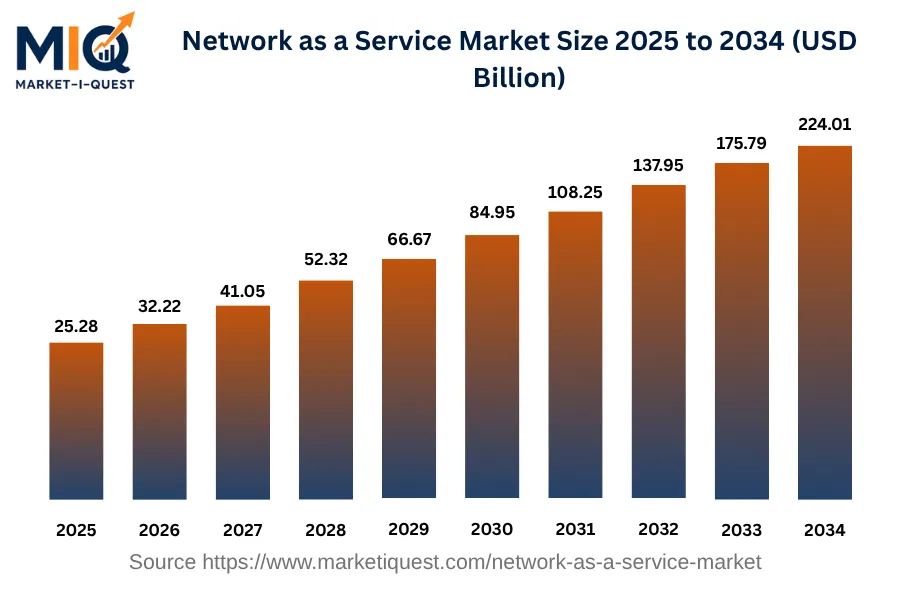
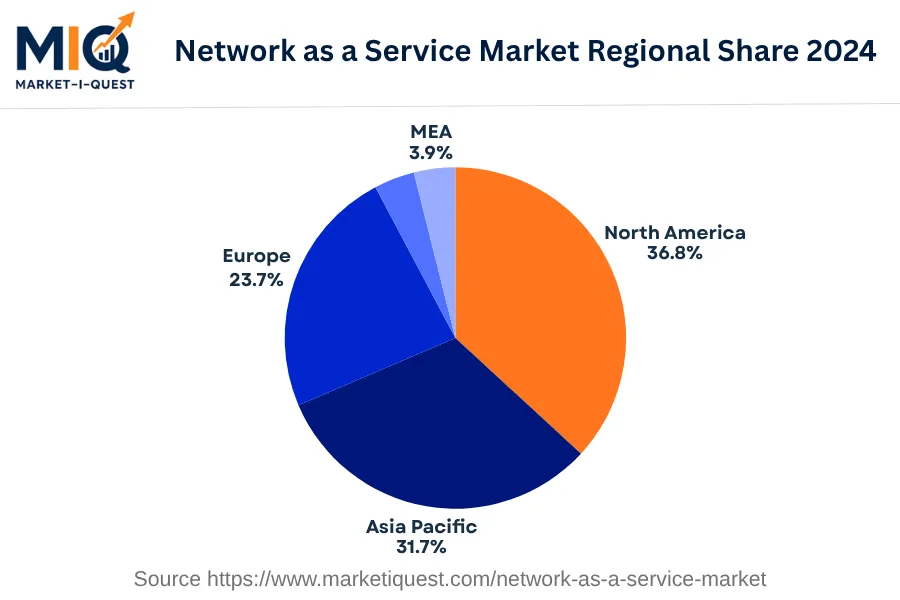
The Network as a Service market stood at USD 25.28 billion in 2025 and is projected to reach USD 224.01 billion by 2034, expanding at a compound annual growth rate (CAGR) of 27.43%. This significant growth can be attributed to advancements in technology necessitating improved network services and the widespread adoption of networking solutions across various industries. Another noteworthy aspect is that the annual market size has consistently increased between those years. For instance, in 2024, the market size was USD 19.84 billion, illustrating a positive growth trajectory. Regional market shares in 2024 depict North America as possessing the largest share at 36.8%, followed closely by Asia Pacific at 31.7%. Europe made up 23.7% of the market, while LATAM and MEA had relatively smaller stakes at 3.8% and 3.9% respectively.

Key Takeaways

  • By Type - LAN led the Network as a Service Market accounting for the major share in 2024.
  • By Service - Bandwidth on Demand (BoD) grew fastest expanding at a notable pace in the forecast period.
  • By Component - Infrastructure held the leading position in the market in 2024.
  • By End User - IT & Telecommunication accounted for the largest market share in 2024.
network-as-a-service-market market size

Key Driving Factors

Compliance with the General Data Protection Regulation (GDPR)

Companies worldwide are striving to stay compliant with privacy regulations such as the European Union's GDPR, thus necessitating secure, efficient data handling and transmission mechanisms. The Network as a Service (NaaS) market is stepping in to satisfy this need. By offering infrastructural services that include traffic management, virtual private networks, and bandwidth provisioning, the NaaS vendors help enterprises to securely handle and process data in line with GDPR requirements. The requirements to ensure data minimization, purpose limitation, and accuracy in data processing are leading to an increased reliance on NaaS solutions. Hence, the drive to remain compliant with GDPR is a significant factor positively impacting the NaaS market.
Implementation of Remote Work Policies

The shift to remote working policies by companies in the face of recent global events has acted as a substantial driving factor for the Network as a Service market. With staff members geographically dispersed, maintaining secure and reliable connections between remote workers and the company's digital resources becomes challenging. As a response, organizations are tapping into the benefits of NaaS offerings, such as secure remote access, scalability, and simplified network management. This move ensures continuity of operations while accommodating the dynamics of a remote workforce. Thus, the adoption of remote work policies is a solid propellant for the growth of the NaaS market.

Market Evolution by Timeline

2019-2023
Telecommunication firms and large enterprises, particularly in North America, were the primary buyers due to high speed internet connectivity demand and hybrid cloud migration. Due to maturing integration and data management abilities, providers like Microsoft, Cisco and IBM gained noticeable traction with SD-WAN services. Afterwards, 5G network was adopted, and various regulations were piloted, including cyber-security rules by Federal Communications Commission (FCC), shedding light on service security. Network subscriptions dominated the commercial model, often based on network size and use-case, with a considerable number of white-label partnerships among established vendors and regional telecommunication companies. Frequent network breaches were the primary risk, tackled mostly through end-to-end encryption.
2024
The demand gradually penetrated Asia Pacific region with China laying down new mandates for 5G deployment, stressing on service reliability. Tech giants such as Google and Amazon highlighted the provision of NaaS over an autonomous network, leveraging machine learning capabilities for network optimization. Meanwhile, European privacy standard GDPR led to amendments in contracts, ending up providing data governance options to customers for credibility. The price wars between the tech giants reduced the per-use costs substantially. The sudden shift to digital medium by businesses amplified DDoS attacks, which were typically addressed through predictive analytical models.
2025-2029
The demand surged from public sector and SMBs globally to cater to digitalization efforts. Ultra-Low Latency Communication (URLLC) under 5G services were shipped by most suppliers, claiming delay-tolerant networks. In light of increasing network complexity, Internet Engineering Task Force (IETF) released policies for network interconnectivity, making it a prominent adoption factor. Despite varying deal structures, lifetime network subscriptions were preferred over the metered models due to foreseeable usage patterns. Limited service coverage was a significant hurdle at this stage, typically handled through edge computing models and investing in network infrastructure.
2030-2034
Demand spanned the education and healthcare sectors, predominantly in emerging markets of Latin America and Middle East. In response to the IoT applications, providers started leveraging AI-driven networking solutions with gathered experience. With 'Net neutrality' reinstated by FCC, providers had to ensure equal treatment of all network traffic. Dynamic pricing based on demand-supply was accepted for under-utilized network resources, making Procurement as a Service (PaaS) a common model. The significant risk revolved around managing the colossal amount of user data while maintaining compliance with changing policies, typically handled through advanced data management standards, often leaning towards federated models.

Future Market Outlook

Future Opportunities

With the expanding ecosystem around NaaS, future opportunities hinge on current technological and regulatory developments. As companies increasingly adopt cloud-native applications and remote working models, the demand for seamless connectivity and adaptive networking services is expected to grow. In 2023, organizations like Cisco announced expansions to their NaaS platforms to meet the needs of digital transformation across numerous sectors. The adoption of multi-cloud strategies by enterprises creates additional avenues for NaaS providers, as flexibility in switching between different cloud services is an emerging priority. Additionally, the strategic partnerships such as that between Telefonica and cloud service providers pave the way for tailored solutions addressing industry-specific requirements. The regulatory push towards enhanced data sovereignty in regions like the European Union presents opportunities for NaaS providers to tailor services that align with local compliance, reinforcing the importance of trust and transparency. Furthermore, the integration of artificial intelligence and machine learning for network optimization, as evidenced by the initiatives from tech giants like Nvidia, will reshape operational efficiencies in NaaS solutions. As enterprises seek agility and responsiveness in their networking solutions, NaaS providers can differentiate themselves through specialized offerings rooted in these technological advancements and regulatory adaptations across various global markets.

Segmentation Analysis

By Type

The market is divided into subsegments including LAN and WAN. LAN accounted for the largest revenue share while WAN is expected to grow at the fastest CAGR during the forecast period.

Largest Revenue Share

LAN

Market Share Leader

LAN or Local Area Networks remain the largest revenue generator among the different types of networks. The market dominance of LAN is primarily due to its wide-scale adoption in businesses of all sizes across various sectors. LANs facilitate efficient communication, data transfer, and sharing of resources within a local geographical area such as an office building or school, which are driving its demand in the market. Furthermore, the expansion of businesses and subsequent increase in the local digital infrastructure is contributing to the LAN market's revenue. The setup of LAN provides a more secure and controlled environment for data management and enhances the operational efficiency of businesses, which drives more companies to implement it. In terms of customers, the business sector, followed by educational institutions, constitute the largest customer segments for LAN. These sectors require high-speed and efficient networks for their daily operations, making LAN an integral part of their infrastructure. Based on this typical industry logic, we can assume that LAN generates the highest revenue.

Fastest CAGR

WAN

Forecast Period Growth Leader

WAN or Wide Area Networks are projected to be the fastest-growing sub-segment. This growth is largely due to the advent of new technologies and increased capital expenditures on communication infrastructure. As businesses expand geographically, the need for secure, reliable, and high-speed networks that can support long-distance communications increases, making WAN an appealing choice. Additionally, the rapid digital transformation process across various industries is triggering the demand for WAN, contributing to its high CAGR. However, significant challenges remain in terms of adoption barriers. The establishment of WAN requires good infrastructure and higher setup costs, which can impede its rapid adoption, especially in regions with inadequate infrastructure. Near-term risks include ever-evolving cybersecurity threats and rapid technological changes which require continuous upgrades. Despite these challenges, strategic partnerships and advancements in technology are likely to catalyze the growth of the WAN segment.

By Service

The market is divided into subsegments including WAN Connection, Data Center, and Bandwidth on Demand (BoD). Data Center accounted for the largest revenue share while the Bandwidth on Demand is expected to grow at the fastest CAGR during the forecast period.

Largest Revenue Share

Data Center

Market Share Leader

The Data Center subsegment has amassed the largest share in the revenue primarily due to its extensive use in the IT sector and beyond. With the transition towards digitalization, the demand for centralized infrastructure to house computer systems and related components has increased significantly, thus, promoting revenue accumulation for the Data Center subsegment. Companies across different sectors seek data center services for data backup, recovery solutions, and server hosting with enhanced security which has boosted demand. Data center providers also serve the additional needs of businesses like disaster recovery, while also providing a safe environment for data storage and management. Technological giants maintain their own data centers, and the growing businesses in developing regions are using data center services, thus, increasing the overall revenue for this subsegment. Regulatory compliance around data security further accelerates the usage of these services by businesses of all sizes.

Fastest CAGR

Bandwidth on Demand (BoD)

Forecast Period Growth Leader

The Bandwidth on Demand (BoD) subsegment is projected to have the fastest Compound Annual Growth Rate (CAGR). This prediction stems from the evolving need for businesses to handle traffic surges and immense data quantities without bandwidth constraints. New-age technologies like cloud computing, IoT, and AI have drastically increased the demand for bandwidth, and BoD services offer an efficient resolution by allowing instant scalability as per demand. Enterprises are expected to migrate towards flexible bandwidth offerings due to the cost-effectiveness and efficiency these services bring. Policymakers are advocating for better internet infrastructure to support the digital economy; thus, making wider bandwidth more available. The increasing focus on real-time, data-driven decision making and the growing adoption of AI and IoT in industries are other key drivers for the anticipated fast growth of BoD. There are barriers are still present though, such as infrastructure costs and understanding the technicalities of BoD, which might slow down the adoption rate but are not likely to halt the fast growth.

By Component

The market is divided into subsegments including Infrastructure and Technology Service. In the year 2024, Infrastructure accounted for the largest revenue share while Technology Service is expected to grow at the fastest CAGR during the forecast period.

Largest Revenue Share

Infrastructure

Market Share Leader

Infrastructure captures the most significant share of the revenue for certain fundamental reasons. Firstly, it forms the backbone of any technological operation or service. No company, irrespective of its operational vertical, can function without secure and robust infrastructure. Whether it's a consumer-facing technology company with a need for vast data centers or a government agency working on sensitive data, the requirement for infrastructure is universal. Additionally, with technological advancements, the need for up-to-date infrastructure is a given, translating into steady revenue streams. Furthermore, in many geographies, regulations necessitate specific infrastructure guidelines, leading to mandatory expenditure on this subsegment. The purchasing criteria rely heavily on reliability, security, and technical capabilities, and switching costs are generally high due to the integrated nature of infrastructure with businesses' overall operations. Lastly, companies tend to purchase directly from trusted manufacturers, bypassing the need for channels or middlemen, ensuring a substantial share goes directly to infrastructure providers.

Fastest CAGR

Technology Service

Forecast Period Growth Leader

Technology Service is predicted to be the fastest-growing subsegment. Key growth drivers include the increasing demand for specialized services, evolving technology landscape, and companies' inclination to outsource technical aspects to focus on core competencies. The adaptation barriers primarily consist of concerns around data security and the quality of service. Nevertheless, catalysts for growth exceed the limitations. Innovative technologies, favorable policies encouraging digital transformation, and large-scale investments in technology integration are fueling the growth of this market. Moreover, strategic partnerships between technology service providers and businesses are on the rise, further accelerating the sector's growth. However, near-term risks include rapid technological shifts requiring constant upskilling and potential data breaches. The growth potential of the Technology Service subsegment thus musn't be undermined, despite Infrastructure's dominant revenue share.

By End User

The market is divided into subsegments including IT & Telecommunication, BFSI, Healthcare, and Others. Among these, IT & Telecommunication accounted for the largest revenue share while the Healthcare is expected to grow at the fastest CAGR during the forecast period.

Largest Revenue Share

IT & Telecommunication

Market Share Leader

The IT & Telecommunication subsegment achieves the highest revenue within the market. This is primarily due to the omnipresence of technological interfaces in our everyday life. As digitalization continues to burgeon, companies from every industry are investing heavily in IT solutions to streamline operations, improve efficiency, and reduce costs. Whether it's customer relationship management tools, cloud storage, or machine learning algorithms, every modern business operation is powered by Information technology. The digitization trend would continue to surge the demand for IT services. Hence, we've seen an uptick in the revenue of the IT & Telecommunication sector. Telecom providers now act as principal gateways for data, voice, and video traffic. Globally, there is growth in policies favoring the expansion of telecommunication services to the users, which amplifies their revenue. Regardless of the economic climate, businesses and consumers continue to rely on the connectivity that telecommunications firms provide.

Fastest CAGR

Healthcare

Forecast Period Growth Leader

The Healthcare segment is anticipated to grow at the fastest CAGR. The health sector is witnessing a leap towards digitalization, as data volumes continue to surge. The adoption of electronic health records, telemedicine, remote patient monitoring, and other digital health tools are transforming healthcare delivery. Besides, investments in health technology have escalated drastically, and regulations increasingly encourage the use of digital health tools, amplifying this growth. The ongoing pandemic has also acted as a catalyst, with virtual care and remote monitoring being normative, thereby accelerating the adoption of digital solutions. However, risks include ongoing concerns about data security and patient privacy, along with segmented healthcare ecosystems and underdeveloped health technology infrastructure in various parts of the world. Nevertheless, the benefits of using digital solutions to drive efficient and effective care are expected to triumph over these barriers.

Competitive Analysis

Key Market Players

Manufacturers / OEMs

Cisco Systems, Inc.
US
Juniper Networks
US
VMware, Inc.
US

Key Suppliers & Raw Materials

Intel Corporation
US
Broadcom Inc.
US
Qualcomm Technologies, Inc.
US

Distributors, Integrators & Channel Partners

IBM Corporation
US
Microsoft Corporation
US
Dell Technologies
US

Porter’s Five Forces Analysis

Evaluating competitive intensity and attractiveness of the Network as a Service Market.

Supplier Bargaining Power

Medium

Suppliers have some influence due to specialized technical expertise and proprietary technologies.

Buyer Bargaining Power

High

An increase in service providers allows customers to switch providers easily, thereby increasing buyer power.

Threat of Substitutes

Low

The unique offerings and superior utility of NaaS solutions limit the threat of substitutes.

Threat of New Entrants

Medium

High initial cost and technical expertise barrier to entry, but potential for high ROI could attract newcomers.

Competitive Rivalry

High

Intense competition due to the presence of multiple vendors offering similar services.

Regional Analysis

Geographic market dynamics and growth opportunities across key regions

Global Market Outlook

network-as-a-service-market market regional share

North America

In 2024, The Network as a Service (NaaS) industry in North America encompassed technologies that allowed businesses to utilize network services over the internet. Increased adoption of cloud-computing across different sectors is a significant driver, as both enterprises and government agencies shift towards cloud migration, recognizing the cost-effectiveness and productivity benefits. Additionally, extensive infrastructure investment in Canada's digital economy has spurred the growth of NaaS providers. Data privacy regulations such as the California Consumer Privacy Act (CCPA) also spurred an increased demand for NaaS as businesses scramble to comply, creating a favorable market environment. An increasing reliance on remote work technology also drove market growth, particularly in the U.S., thanks to the flexibility provided by NaaS solutions facilitating effective distant collaborations.

Trends seen in the market include the acceleration of the services integration process, especially between telecom providers and technology companies. Partnerships and acquisitions were prevalent, exemplified by wide-scale collaborations between NaaS providers and tech bistros. In Mexico, government policy enforcement around digitalization and cybersecurity increased the adoption of NaaS solutions. The shift towards hybrid and multi-cloud environments is another observable trend, with sectors like retail and manufacturing embracing this paradigm change, opting for NaaS solutions that ensure seamless network connectivity and robust security.

Asia Pacific

In 2024, the Network as a Service (NaaS) market in Asia Pacific showed a robust expansion driven by digital transformation across various sectors. Demand surged due to increased reliance on cloud-based solutions, driven by the need for greater operational efficiency in China's manufacturing sector and India's IT services. The adoption of 5G services bolstered market performance, especially in technologically advanced regions such as Japan and South Korea, which prioritized high-speed connectivity. The Australian government's funding for digital infrastructure upgrades further catalyzed this surge.

A noteworthy trend was the heightened preference for virtual network solutions over traditional methods amongst businesses, particularly within Australia's mining and retail sectors alongside India's sprawling SME base. Firms in China and ASEAN markets trended towards collaboration, evidenced by a spate of strategic partnerships and acquisitions aimed at enhanced service delivery and cost optimization. Regulatory bodies across the region, particularly in Japan and South Korea, pushed for stricter network security protocols, leading to increased demand for NaaS providers offering enhanced security features. In essence, the Asia Pacific NaaS market in 2024 surged due to technological advancements, regulatory interventions, increased demand for operational efficiency and security, and the drive towards strategic collaborations.

Europe

In 2024, Europe's Network as a Service (NaaS) market has seen significant momentum, largely fueled by technology adoption, regulatory shifts, and investment dynamics. With the European Union's commitment towards digital transformation, infrastructures and applications have migrated to the cloud, driving demand for robust networks with robust end-to-end IT services. The prevalence of remote work has furthermore fostered NaaS adoption, as organisations seek quick, scalable, and secure network deployment. Sectors like healthcare, finance, and government have led in adoption due to their high data security needs. The market trends in 2024 underscore a lean towards managed services and increased interest in partnerships and mergers in the technology sector. As customer demands become complex, companies are adopting managed NaaS solutions packaged with analytics, cybersecurity, and other dedicated solutions. Large technology companies and telecom operators have capitalized on this trend, solidifying their market position through strategic partnerships and acquisitions.

The regulatory environment also reflects this, with policymakers endorsing open networking standards to foster competition. Examples such as Deutsche Telekom's partnership with Microsoft and BT's acquisition of a cybersecurity firm illustrate the movement towards consolidation in German and UK markets respectively. Meanwhile France, Italy, Spain, the Nordics, Benelux, and Central & Eastern Europe are showing similar patterns, with an increasingly competitive NaaS market landscape.

Latin America

In 2024, the Network as a Service (NaaS) Market in Latin America displays significant growth due to technological adoption and investment influx. Demand factors such as the increasing need for cost-efficient network services drive market expansion, particularly in Brazil and Mexico, where enterprises seek scalable networking solutions. Government regulations promoting digital transformation also propel growth, as seen in Argentina's national digital strategy, encouraging companies to embrace NaaS solutions. Furthermore, the rise in technology investment, typified by Colombia and Chile's spending on information communication technology, fuels the NaaS market.

Trends in 2024 show a marked shift towards cloud-based NaaS solutions, greatly influenced by buyer behavior in sectors primarily composed of enterprise and government entities. For instance, Peru's public sector increasingly adopts NaaS to streamline operations while reducing the burden on its IT departments. Significant partnerships and mergers occur within the market, as providers aim to enhance their offerings and extend reach, analogously to Brazil's Globenet partnering with Microsoft Azure. The escalating requirement for cyber security is also evident, as seen from Mexico's Data Protection Law, putting pressure on companies to maintain highly secure network services. Additionally, IT standard enforcement emerges as vital in ensuring quality and efficiency, exemplified by ITIL practices in the Chilean corporate stratum.

Middle East & Africa

In 2024, the Network as a Service (NaaS) market in the Middle East and Africa witnessed considerable traction due to burgeoning demand for advanced networking solutions and pervasive digitization. Massive technology adoption was seen across industries like government, telecom, healthcare, manufacturing, retail, and financial services, acting as a significant driver. Balanced regulatory frameworks across Saudi Arabia, United Arab Emirates, Qatar, and Israel spurred NaaS investment, while supportive government policies in Egypt, South Africa, Nigeria, and Kenya fueled market growth. However, constrained supply dynamics affected pricing, impacting market equilibrium.

Customers' preference for pay-as-you-go service model and integrated networking solutions shaped the buying behavior trend. The adoption of cloud-based and SDN technologies saw an upswing, altering the technology landscape. Enhanced channel dynamics, as evidenced by increased partnerships and M&A among service providers, influenced market development. For instance, the coalition between telecom giants of South Africa and Nigeria showed the market's consolidation trend. Saudi Arabia's strict policy enforcement around data localization underlined the regional market's standards shifts, while varying degrees of digitization added a layer of complexity to the market. The Middle East and Africa’s NaaS market stood out in 2024 with robust regulatory support, technology adoption, and novel partnership formations.

Recent Industry Developments

Latest market innovations, product launches, and strategic initiatives

June 2026

Axon Networks acquired Greenwave Systems, whose Wavely platform provides a software-defined mobile network core and NaaS orchestration tooling. The acquisition aims to integrate Greenwave's technology into Axon's Maestro platform to deliver a unified OSS/BSS architecture.

April 2025

Comcast Business completed its acquisition of Nitel, a Network-as-a-Service provider, for $1.3 billion in cash. The deal is aimed at helping the telecom expand its networking and cybersecurity capabilities.

Frequently Asked Questions