Natural Oil Polyols Market Snapshot

Key Players

  • BASF SE (Germany)
  • Cargill Inc. (USA)
  • Dow Inc. (USA)
  • Bayer AG (Germany)
  • Johnson Controls (USA)
  • Huntsman Corporation (USA)
  • Soyuz Corporation (Russia)
  • Green Petroleum (India)
  • Emery Oleochemicals (Malaysia)
  • Vithal Castor Polyols (India)

Market Size

Base Year 2024
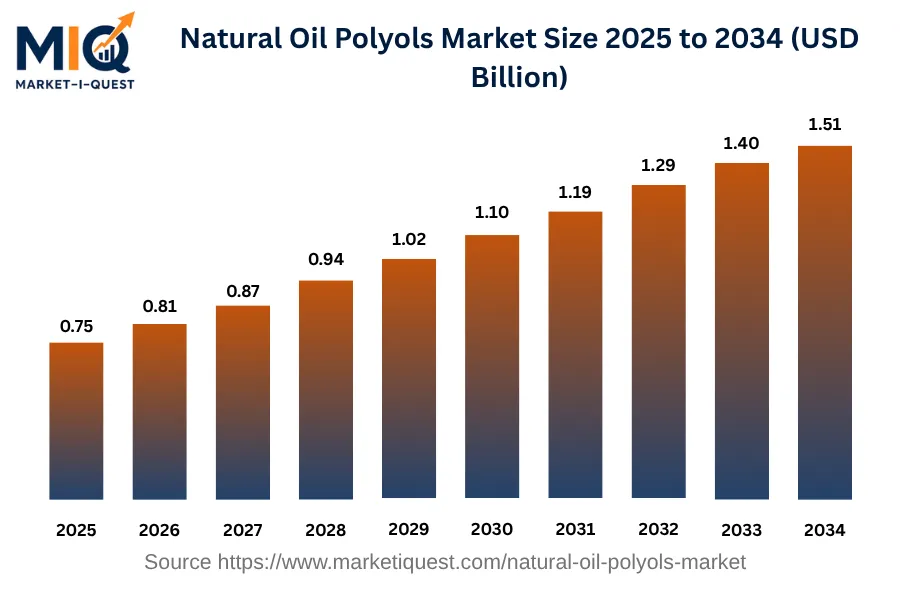
$0.69 Bn
CAGR
8.16%
Forecast 2034
$1.51 Bn

Market Segments

By Type
  • Soybean Oil Polyols
  • Sunflower Oil Polyols
  • Castor Oil Polyols
  • Palm Oil Polyols
  • Other Oil Polyols
By Application
  • Rigid Polyurethane Foam
  • Flexible Polyurethane Foam
  • Polyurethane Elastomers
  • Coatings & Adhesives
  • Other Applications
By End-Use Industry
  • Automotive
  • Building & Construction
  • Furniture
  • Packaging
  • Others

Market Dynamics

Drivers
  • Increased environmental awareness
  • Growth in renewable product demand
Restraints
  • High production cost
  • Limited supply of raw materials
Opportunities
  • Growing environmental concerns
  • Increasing industrial applications

Market Size

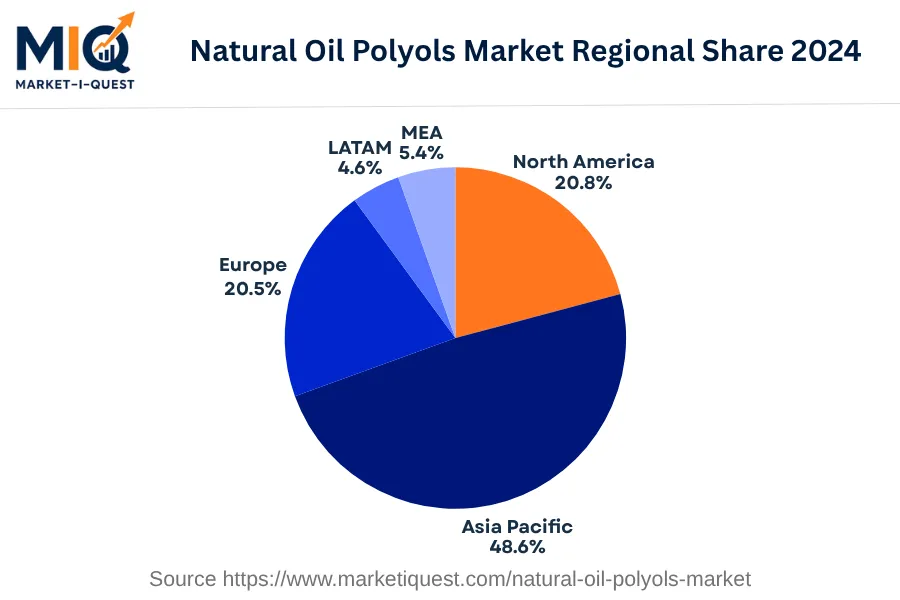
The Natural Oil Polyols market was valued at $0.69 billion in 2024, and it increased to $0.75 billion in 2025. By the end of the year 2034, this market is projected to reach a value of $1.51 billion. From 2025 to 2034, the market is expected to grow at a CAGR of 8.16%. This growth is attributable to an increase in demand for environmentally friendly products, as these polyols are derived from natural oils. Demand for high-performance foams in various end-use industries like the automotive, construction and furniture industry also contributes to the growth of this market. In terms of regional distribution in 2024, the Natural Oil Polyols market was primarily concentrated in the Asia Pacific region, which accounted for 48.6% of the total market share. North America and Europe closely followed with 20.8% and 20.5% respectively. Meanwhile, smaller shares were seen in the LATAM and MEA regions, with 4.6% and 5.4% respectively.

Key Takeaways

  • By Type - Castor Oil Polyols held a notable position in the Natural Oil Polyols Market in 2024.
  • By Application - Rigid Polyurethane Foam led the segment accounting for a major share in 2024.
  • By End Use Industry - Building & Construction had a dominant presence in 2024 with a significant share in the Market.
natural-oil-polyols-market market size

Key Driving Factors

Government Regulations on Synthetic Polyols

Restrictions set by governments around the world against synthetic polyols act as a major driving factor for the Natural Oil Polyols market. Synthetic polyols, prominently used in various manufacturing operations, have been proven harmful to the environment due to their high emission levels. Regulatory bodies like the Environmental Protection Agency in the U.S and the European Environment Agency in EU have established stringent norms and regulations taming the production and use of these synthetic polyols. As a result, manufacturers are pivoting towards eco-friendly alternatives such as natural oil polyols, which are derived from vegetable oils and are biodegradable in nature.

Increased Acceptance in Automobile and Construction Industries

The increased acceptance of natural oil polyols in the automotive and construction industries is another significant driver pushing the market growth. In the automotive industry, natural oil polyols are extensively used in car seats, interiors, insulations due to their high resilience and low volatile organic compound emissions. These attributes are highly sought-after in automobile manufacturing to ensure passenger comfort and safety. Meanwhile, in the construction industry, natural oil polyols are used as insulation materials for buildings due to their high weather resistance, low toxicity and exceptional insulation characteristics. This ensures an eco-friendly construction method and is favored specially in green building projects.

Market Evolution by Timeline

2019-2023
The biggest buyers during this period were in Europe and the Asia-Pacific, driven by environmental concerns and rules biasing towards sustainability. The most common supply type was soybean, canola and sunflower oil polyols. Integrations of such technologies were still only in nascent stages. The EU's bio-based product certification program strongly favored NOPs, further boosting demand. NOPs were mainly sold per tonnage, with long-term contracts prefered due to price stability needs for both sides. Main risk was the reliance on unstable agricultural sector for material supply, causing price volatility.
2024
This year was heavily impacted by the pandemic, causing a dip in most customer categories other than hygiene and medical applications. Production focused on rapeseed and palm oil polyols due to improved manufacturing technologies. Disruptions in the global supply chains brought attention to the need of regional self-sufficiency, leading to diversification of production locations. Tightened environmental norms from the Paris Agreement supported market growth. Pricing saw sudden increase due to downstream factory lockdowns. Producers implemented risk management strategies like buffer stocks.
2025-2029
Buyers increased in North America owing to companies' green initiatives while Asia's demand remained strong. Corn and peanut oil polyols emerged in supply due to region-specific crops advantages. An increase in technological collaboration between crop producers and NOP manufacturers was observed, aiding market maturity. 'BioConcept' project by the EU propelled NOP-driven sustainability. Time-bound contracts became popular with risk-management clauses. Although climate change posed risk to raw material supply, technological advances and diversified crop base mitigated it.
2030-2034
Demand surged globally due to acknowledgment of NOP benefits in lowering carbon footprint, with distinct increase in the automotive sector. Varieties like almond and olive oil polyols were piloted. Advances in NOP processing technologies, and better agronomy practices leveled supply constraints. More countries enforced bio-based product mandates, echoing the EU's positions. Manufacturers started offering flexibility in contract types responding to market dynamics. While large-scale farming challenges persisted, the use of vertical farms for NOP crop cultivation lessened the risk.

Future Market Outlook

Future Opportunities

The natural oil polyols sector is likely to benefit from the increasing regulatory pressure for sustainable and biodegradable materials, particularly in the European Union, which implemented the Green Deal in 2019 aimed at reducing carbon emissions. The 2021 Circular Economy Action Plan further promotes the use of sustainable products and material recycling, providing a conducive environment for companies to invest in bio-based alternatives. Major players, including Huntsman and Reverdia, are expanding their portfolios of natural oil polyols to meet these evolving regulations, indicating growth potential in sectors such as construction and consumer goods. In Asia, particularly in China, the rise of consumer awareness regarding eco-friendly products is driving demand, with companies such as Wanhua Chemical launching new formulations of natural oil polyols tailored for local markets. Furthermore, collaborative initiatives like the Bio-based Industries Joint Undertaking in the EU are projected to create more funding opportunities for research and development in bio-based technologies. The trend toward bioplastic compliance in packaging, catalyzed by legislation like the Single-Use Plastics Directive in 2021, also presents prospects for the integration of natural oil polyols into more sustainable packaging solutions. A 2023 analysis by the International Organization for Standardization highlights growing standards for eco-friendly materials, which could enhance the credibility of natural oil polyol applications. As regulatory landscapes evolve, and companies tap into emerging consumer preferences, the future for natural oil polyols looks promising.

Segmentation Analysis

By Type

The market is divided into subsegments including Soybean Oil Polyols, Sunflower Oil Polyols, Castor Oil Polyols, Palm Oil Polyols, and other Oil Polyols. Castor Oil Polyols accounted for the largest revenue share while Soybean Oil Polyols is expected to grow at the fastest CAGR during the forecast period.

Largest Revenue Share

Castor Oil Polyols

Market Share Leader

Castor oil polyols, derived from a renewable resource, have over the years, registered considerable market appeal, thereby accruing the largest chunk of the market's revenue. This can be attributed to their unique properties including high durability, bio-compatibility, water resistance, and ability to blend well with other polyols to manufacture polyurethanes, making them a preferred choice across various end-use industries such as automotive, construction, and footwear. In simpler terms, the considerable traction of castor oil polyols is a reflection of the indispensable role they play in their industrial application which has increased their demand. Besides, emerging economies in Asia are increasing their focus on sustainability, which has resulted in a surge of interest in bio-based products such as castor oil polyols, driving their sales further.

Fastest CAGR

Soybean Oil Polyols

Forecast Period Growth Leader

While Castor Oil Polyols marks the largest share in terms of revenue, the fastest growing subsegment in the market is the Soybean Oil Polyols. Its rapid growth is credited to its environmental benefits due to the use of renewable resources in its production. Furthermore, the increasing emphasis on environmental sustainability and the trending idea of green chemistry has stimulated greater interest in and use of soy-based products and materials. Additionally, technological advancements and investments in R&D have succeeded in overcoming the initial barriers to adoption, thus promoting its growth. However, the high price of soybeans along with their availability can be a risk that can impede future growth. Nonetheless, partnerships across the value chain and capex in expanding production capacities are anticipated to be key factors in driving growth going forward.

By Application

The market is divided into subsegments including Rigid Polyurethane Foam, Flexible Polyurethane Foam, Polyurethane Elastomers, Coatings & Adhesives, Other Applications. Rigid Polyurethane Foam accounted for the largest revenue share while Polyurethane Elastomers is expected to grow at the fastest CAGR during the forecast period.

Largest Revenue Share

Rigid Polyurethane Foam

Market Share Leader

Rigid Polyurethane Foam took the lead in revenues in 2024 due to its exceptional insulation properties and high demand in applications such as construction and refrigeration. As the world moves towards sustainable development, the construction industry has been seeing a significant demand for energy-efficient infrastructure. Rigid Polyurethane Foam, due to its ability to reduce energy loss, finds extensive use in this field. This foam also witnesses high demand from the refrigeration industry as it offers high thermal resistance, consequently reducing energy consumption. Moreover, regions with harsh climate conditions contribute significantly to demand owing to the thermal insulation properties of Rigid Polyurethane Foam. Further, escalating consumer goods demand has also contributed to this subsegment's revenue growth. To conclude, the key drivers include shifts towards energy-efficient solutions, geographical climates, and the rising consumer goods industry.

Fastest CAGR

Polyurethane Elastomers

Forecast Period Growth Leader

Polyurethane Elastomers is projected to display the fastest growth in the coming years. This subsegment is getting traction due to its increasing applications across sectors such as automotive, industrial, footwear, and medical. Its versatile nature, offering durability, flexibility, and resistance to abrasion and temperature variations, is driving demand in the automotive industry. In the industrial sector, machinery manufacturers source Polyurethane Elastomers for its properties of wear and tear resistance. This subsegment also finds application in the production of comfortable and durable footwear. In the medical field, it's used for manufacturing implants and prosthetics due to its compatibility with body tissues. Technological innovation and investment in R&D are serving as catalysts for the growth of this segment. However, volatile raw material prices and strict environmental regulations might act as a barrier to the growth.

By End-Use Industry

The market is divided into sub-segments including Automotive, Building & Construction, Furniture, Packaging and Others. The Building & Construction subsegment accounted for the largest revenue share while the Automotive subsegment is expected to grow at the fastest CAGR during the forecast period.

Largest Revenue Share

Building & Construction

Market Share Leader

Building and Construction subsegment is leading the market in terms of revenue, primarily because of the continual urbanization, industrialization and infrastructure development across the globe. Increase in residential, commercial, and infrastructure projects has led to a higher consumption of materials and hence, the dominance of this segment. In fact, a key driver for its growth has been the influx of investments in this sector, where both international and government entities have been instrumental. Moreover, the rise in construction activities tends to direct demand for durable, cost and energy-efficient materials, which in turn drives up sales. Additionally, development programs initiated by governments and regulatory bodies to attain infrastructure sustainability further augment the demand in this subsegment. One should also highlight the introduction of innovative construction methods and high-performance materials that bolster the construction industry.

Fastest CAGR

Automotive

Forecast Period Growth Leader

The Automotive subsegment is projected to witness the fastest growth during the forecast period. Significant factors contributing to this growth include advancements in automotive technologies, increase in vehicle production, and rising demand for lightweight materials to achieve fuel efficiencies. Stringent emission norms imposed by regulatory bodies worldwide are pushing automakers to reduce the weight of vehicles, which in turn increases the adoption of new-age materials in the automotive sector. The infusion of capital and research in electric vehicles (EVs) technology is expected to boost the demand further. However, challenges come in the form of high production costs and technical issues related to material handling and assembly. To overcome these hurdles, collaborations and partnerships with raw material providers and investments into technological improvements will be crucial. While the current market outlook seems promising, risks such as fluctuating raw material prices and uncertain economic conditions may affect the subsegment's growth trajectory.

Competitive Analysis: Natural Oil Polyols Market

Key Market Players

Manufacturers / OEMs

BASF SE
Germany
Dow Chemical Company
US
Cargill Inc.
US

Key Suppliers & Raw Materials

Archer Daniels Midland Company
US
Wilmar International Ltd.
Singapore
Louis Dreyfus Company
Netherlands

Distributors, Integrators & Channel Partners

Brenntag North America, Inc.
US
Univar Solutions Inc.
US
Azelis Group
Belgium

Porter’s Five Forces Analysis

This analysis examines the competitive dynamics within the global Natural Oil Polyols market.

Supplier Bargaining Power

Medium

Suppliers hold power due to the necessity of high-quality raw materials, but diverse supply mitigates this.

Buyer Bargaining Power

High

Buyers are powerful due to multiple suppliers and availability of comparative products in the market.

Threat of Substitutes

Medium

While synthetic polyols could be used as substitutes, environmental concerns favor natural oil polyols.

Threat of New Entrants

Low

High upfront cost for plant setup and stringent government regulations form barriers to entry.

Competitive Rivalry

High

Existing firms fiercely compete, driven by innovation in production and sustainability practices.

Regional Analysis

Geographic market dynamics and growth opportunities across key regions

Global Market Outlook

natural-oil-polyols-market market regional share

North America

In the base year 2024, the North American market for Natural Oil Polyols (NOPs) was characterized by a pronounced shift towards environmentally friendly and sustainable products. Primary drivers for this market included increasingly stringent environmental regulations across the U.S., Canada, and Mexico, forcing manufacturers to adopt sustainable and green alternatives such as NOPs. Additionally, the rise in R&D investments aimed at producing superior quality NOPs coupled with technological advancements in manufacturing processes amplified the market's growth. Furthermore, the steady supply of raw materials like soybean oil and castor oil, coupled with competitive pricing strategies, boosted the NOPs market.

The market also saw substantial trends, chiefly led by changing buyer behaviour. Consumers exhibited a preference for products made with NOPs due to an enhanced awareness about environment-friendly choices. There were significant product shifts as manufacturers started integrating NOPs into a wide range of applications such as insulation materials, coatings, and adhesives. Additionally, there was a surge in partnerships and mergers & acquisitions, with organizations intending to expand their sustainable product portfolio. Sectors like manufacturing, retail, and government, turned out to be significant customers for NOPs as they moved towards greener solutions, validating the surge in demand for NOPs in 2024. These factors underpinned an increased acceptance of NOPs across North America throughout the year.

Asia Pacific

In 2024, the Asia Pacific natural oil polyols market experienced robust growth. Driving this market expansion were increasing environmental concerns and shifting industry regulations that favored bio-based products, particularly in China and India. Significant investments made by large corporations such as China's Sinopec in the adoption of the latest polyol technologies boosted supply dynamics. Rising fossil fuel prices also enhanced the competitiveness of natural oil polyol-based products. Market trends were characterized by evolving buyer behavior, particularly a shift towards eco-friendly alternatives due to growing health consciousness among consumers, causing a surge in demand in key sectors like healthcare and manufacturing.

Technological advancements also dictated market trends, with Japan, South Korea, and Australia leading in the development of improved polyol production processes. Enhancements in distribution channels further facilitated seamless supply, especially in major ASEAN markets such as Indonesia and Vietnam. A noticeable trend was the increase in strategic partnerships and mergers among leading players, spurred by China's strengthened policy enforcement on environmental sustainability. Key customer sectors included the construction industry, where polyol-based foams were extensively used for insulation, and the automotive industry that utilized these products for making light-weight car parts. The furniture sector, particularly in India and China, also showed a heightened demand for flexible polyol-based foams.

Europe

In 2024, the European Natural Oil Polyols market showcased a dynamic landscape shaped by increasing consumer demand and evolving regulations. Drivers of the market included a heightened demand for eco-friendly and sustainable products, underpinned by heightened environmental consciousness across countries such as Germany, the United Kingdom, France, Italy, and Spain. Similarly, stringent regulations against synthetic and harmful substances boosted the Natural Oil Polyols market. For instance, stringent environmental policies in the Nordics propelled manufacturers towards more sustainable solutions. The market was also influenced by substantial investments in technology-enhanced production methods, particularly within Benelux nations. Despite mounting supply constraints due to limited availability of agricultural raw materials, overall, the market remained stable due to efficient pricing strategies.

Trends within the market reflected shifts in buyer behavior, such as an increased preference for natural oil polyols in sectors including manufacturing and retail, notably within Central & Eastern Europe. The year also saw an uptick in technological advancements leading to the development of superior quality polyols. Furthermore, the sizable market consolidation, with active M&A activity, underscored the strategic partnerships among the key stakeholders. Lastly, policy enforcement, particularly pertaining to environmental concerns became prominent, further shaping the market dynamics in the base year. For example, tougher emissions standards in countries such as the United Kingdom and France nudged industries towards low-emission substances such natural oil polyols.

Latin America

In 2024, the natural oil polyols (NOP) market in Latin America (LATAM) showed considerable dynamism, influenced by several key drivers and surfacing trends. Drivers included a growing demand for sustainable and eco-friendly products within the rapidly expanding construction and automotive sectors, especially in Brazil and Mexico. Favorable governmental regulations throughout LATAM, such as Argentina's Bio-economy and Eco-design Law, also stimulated market growth by encouraging adoption of bio-based materials. Additionally, substantial investment in renewable technology evolution across Colombia, Chile, and Peru fostered innovative NOP product development.

Concurrent trends revealed strong buyer preference for green goods, driving manufacturers to switch from traditional petroleum polyols to NOPs in furniture, footwear, and other consumer goods production. A prominent trend of partnerships and mergers among LATAM's leading NOP producers, as in the Brazil-based Embrapa and Evonik's collaboration, allowed market players to capitalize on shared expertise and enhanced regional presence. The emergence of stringent environmental policies from government sectors across LATAM implied enforcement of standards favoring NOP usage, impacting various industries, including manufacturing and retail. As such, 2024 marked a transformative period for the LATAM NOP market, where multiple drivers and trends steered it towards increased sustainability, innovation, and consolidation.

Middle East & Africa

In the base year of 2024, the natural oil polyols market in the Middle East and Africa showcased substantial dynamics driven by various factors. Demand heightened particularly in Saudi Arabia and United Arab Emirates owing to aggressive adoption of green and sustainable technologies in construction and automobile sectors. Favorably evolving regulations in Qatar and Kenya promoted eco-friendly materials, boosting the market energies. In Nigeria and Egypt, significant investments in research and development of plant-based polyols buoyed the supply dynamics. An observable trend in buyer behavior across Israel and South Africa displayed a preference for bio-based polyols in furniture manufacturing and insulation applications, driven by an amplifying consciousness towards eco-friendliness.

Advances in technologies catered to this shift as innovations in production processes of natural oil polyols, such as soy and castor oil, demonstrated increased efficiency and cost-effectiveness. An ongoing emergence of strategic partnerships and mergers among key players, like those in the oil and gas sector in Saudi Arabia, signified industry consolidation and offered momentum to the market. Policy enforcement grew more stringent, particularly in sectors such as utilities, automotive, and manufacturing, in nations like United Arab Emirates and Qatar, pushing the industry towards mandatory adoption of natural oil polyols. In conclusion, the natural oil polyols market dynamics in the Middle East and Africa in 2024 were largely propelled by demand, regulatory support, innovation, and evolving buyer trends.

Recent Industry Developments

Latest market innovations, product launches, and strategic initiatives

December 2025

SumiSaujana TCM Chemicals signed an MOU with China-based polyurethane manufacturer CoolisT Group to develop and commercialize bio-based polyols derived from renewable vegetable oils for use in polyurethane foams in furniture and bedding products. Under the MOU, SumiSaujana TCM Chemicals will serve as the technical developer and manufacturer, leading R&D, pilot-scale trials, and certification processes. CoolisT Group is a global leader in bio-based polyurethane application technology with products certified by USDA, EU OK Bio Based, Japan BiomassPla, Germany DIN, and UL.

Frequently Asked Questions