Palm Oil Market Snapshot

Key Players

  • Wilmar International Limited (Singapore)
  • Golden Agri-Resources Ltd (Singapore)
  • IOI Corporation Berhad (Malaysia)
  • Kuala Lumpur Kepong Berhad (Malaysia)
  • Sime Darby Plantation (Malaysia)
  • Mewah Group (Malaysia)
  • Godrej Agrovet Limited (India)
  • Bunge Limited (USA)

Market Size

Base Year 2024
$71.92 Bn
CAGR
4.84%
Forecast 2034
$115.38 Bn

Market Segments

By Type
Crude Palm Oil, Refined Palm Oil, Palm Kernel Oil
By Application
Food Industry, Personal Care Products, Industrial Applications
By Distribution Channel
Direct Sales, Retail, E-commerce
By End Use
Household, Commercial, Food Service

Market Dynamics

Drivers
  • Rising global demand
  • Increasing biofuel production
Restraints
  • Environmental sustainability concerns
  • Fluctuating raw material prices
Opportunities
  • Global demand growth
  • Sustainability initiatives

Market Size

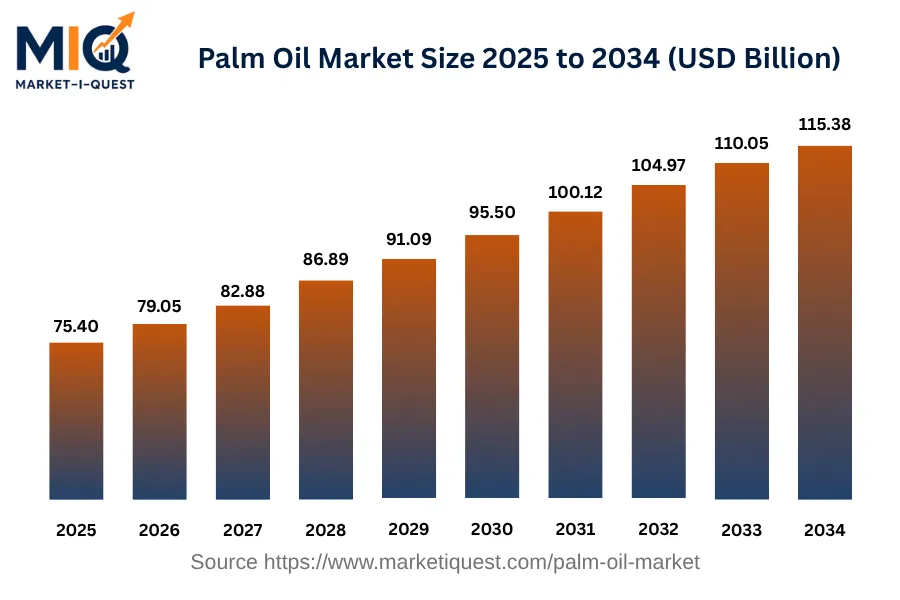
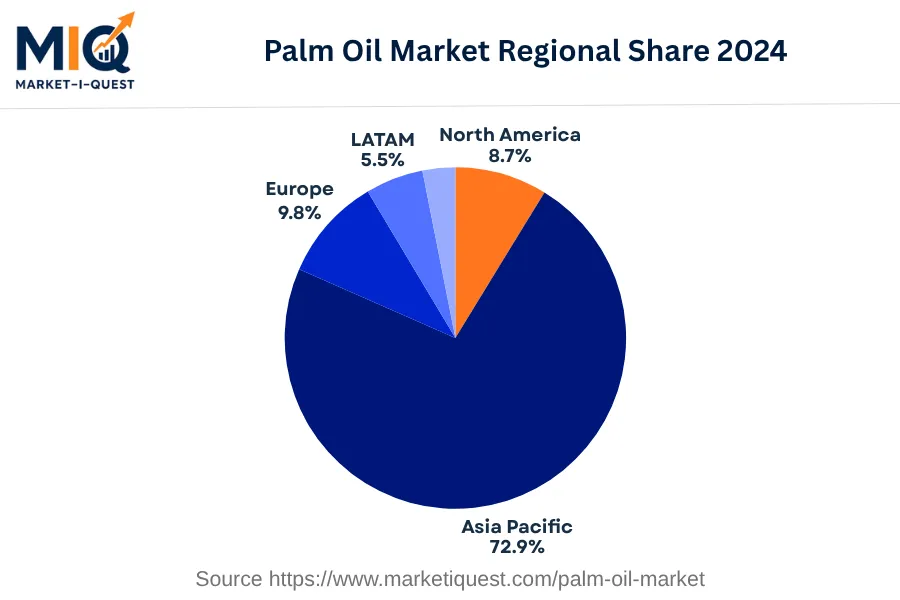
The Palm Oil Market was valued at $75.40 billion in 2025, and by 2034, it is expected to climb to $115.38 billion. Over the nine-year period, the market size is projected to grow at a CAGR of 4.84%. Starting from $71.92 billion in 2024, the initial increase to the 2025 figure was a foreshadowing of the steep upward trajectory that continued into the next decade. The ensuing years witnessed strident advances in the market size, steadily paving the way toward the 2034 estimate. Regional shares of the market also varied with Asia Pacific having the majority at 72.86%. Meanwhile, North America and Europe held a smaller proportion, with 8.74% and 9.82% respectively. The remaining regions, Latin America and the Middle East and Africa, had shares of 5.48% and 3.1% respectively in the global palm oil market.

Key Takeaways

  • By Type - Refined Palm Oil led the market accounting for a significant share in the base year.
  • By Application - Food Industry held the dominant position with a notable portion of the market share in the base period.
  • By Distribution Channel - E-commerce expanded the fastest accounting for a prevalent share in the base year.
  • By End Use - Household segment led the market demonstrating the highest share in the base year.
palm-oil-market market size

Key Driving Factors

Adoption of Sustainable Palm Oil Practices

A critical driver for the palm oil market is the growing international embracement of sustainable palm oil farming practices. Across the globe, food companies, consumer goods manufacturers, and retailers are progressively committing to environmentally friendly and ethically produced palm oil as backlash against deforestation and multitude negative impacts hits the sector. The Roundtable on Sustainable Palm Oil (RSPO) lays out sustainability certification standards. Companies integrate these standards into their supply chains to ensure their suppliers meet the appropriate environmental and social criteria. Consequently, increased adoption of this RSPO certification stimulates demand for sustainable palm oil, in turn propelling the overall palm oil market.
Shift Towards Biofuels in Energy Sector

The palm oil market is also significantly influenced by the energy sector's shift towards biofuels. Governments worldwide are setting ambitious renewable energy targets to combat climate change, stimulating demand for biofuels. Palm oil is a substantial component of many biofuels due to its cost-effective production and high calorie density. For instance, the European Union includes biofuels in its renewable energy directive, contributing to palm oil demand. This policy-driven change in the energy industry indirectly impacts palm oil suppliers, pushing them to increase production to supply the burgeoning biofuels market, which consequently affects growth within the palm oil market.

Market Evolution by Timeline

2019-2023
In this period, the highest Palm Oil buyer demand was from the food and biofuel industry due to Palm Oil's versatility and availability. The top regions in demand were Asia and Europe. On the supply side, Indonesia and Malaysia led with the highest production due to their favourable climate for oil palm cultivation. Integration with technology remained at a basic level, with drone technology being piloted for large-scale plantation surveillance. The adoption of certified sustainable Palm Oil still faced regulatory barriers as RSPO (Roundtable on Sustainable Palm Oil) standards weren't universally accepted. The commercial model was predominately long-term contracts with fixed prices due to the unpredictability of weather conditions. Major risks were deforestation and land exploitation, prompting corporations to increase transparency in their supply chains.
2024
In 2024, Palm Oil demand significantly increased from the cosmetic industry, driven by extensive use in products like soaps and creams. Asian countries remained leading buyers, with a noticeable increase from Africa. Supply was majorly affected by plantation fires in Indonesia resulting in reduced output. Certain areas saw implementation of advanced technology like AI(machine learning) to boost yield and traceability. Regulatory support led to significant adoption of RSPO standards to encourage sustainable practices. Offtake agreements with flexible pricing tendencies were more common, mitigated by emerging partnerships. Agronomic risks associated with Palm Oil cultivation intensified, triggering exploration of sustainable cultivation practices.
2025-2029
In this period, Palm Oil demand shifted towards the renewable energy sector from the traditional food and cosmetic industries, driven by biofuel mandates in countries like US and Brazil. The leading supplier, Indonesia faced constraints in expanding its plantation area due to policy restrictions on deforestation. Certain producers adopted anaerobic digestion technology to turn Palm Oil waste into renewable energy. A hybrid model of RSPO and ISCC (International Sustainability and Carbon Certification) standards was increasingly adopted. With this, dynamic pricing contracts started becoming more routine. On the risk front, the impact on biodiversity and indigenous communities became central to discussions pushing for sustainable practices.
2030-2034
In this period, a significant increase in Palm Oil demand came from pharmaceuticals due to its potential therapeutic effects. Latin America saw a surge in demand due to consumption in processed foods. With limitation on new plantation setups, technology such as precision farming and biotechnology products became a common solution. Most leading markets implemented ISCC Plus certification to ensure socially sustainable Palm Oil production. Take or pay contracts dominated, offering stability to suppliers given long-haul transportation logistics. Fires and pests were major area of risk, leading suppliers to invest in fire management systems and biological control measures to mitigate these threats. A significant policy implementation was the EU regulation to phase out Palm Oil in biofuels by 2030, impacting future export strategies.

Future Market Outlook

Future Opportunities

Opportunities in the palm oil market are expanding as sustainability and transparency become paramount for stakeholders. The ongoing push for environmental responsibility is prompting major retailers to prioritize sustainably sourced palm oil, as seen in 2022, when major grocery chains in the United Kingdom pledged to eliminate unsustainable palm oil from their supply chains. This trend is encouraging upstream producers to adopt better agricultural practices. In this environment, companies that invest in ISO 14001:2015 environmental management systems can better position themselves to meet stringent compliance regulations and consumer demands. The release of the U.S. Department of Agriculture’s guidelines in 2023 for sustainable imports further emphasizes the need for ethical sourcing of palm oil. Furthermore, research and development in alternative oils, such as algae oil, are gaining ground as potential substitutes, indicating a diversification strategy among food manufacturers. Collaborations between technology firms and palm oil producers, such as the partnership between Singapore's Agri-Food & Veterinary Authority and local plantations since 2020, demonstrate a shift toward digital solutions that enhance efficiency and traceability. Additionally, investor interest is growing in mechanisms that promote sustainable plantations, as evidenced by Green Climate Fund’s support for sustainable projects in Indonesia. Overall, the intersection of technology, regulatory frameworks, and market demand creates avenues for innovation and improvement within the palm oil sector.

Segmentation Analysis

By Type

The market is divided into subsegments including Crude Palm Oil, Refined Palm Oil, and Palm Kernel Oil. Refined Palm Oil accounted for the largest revenue share while Crude Palm Oil is expected to grow at the fastest CAGR during the forecast period.

Largest Revenue Share

Refined Palm Oil

Market Share Leader

Refined Palm Oil holds the leading position in terms of revenue generation, due largely to its extensive applications in a wide array of industries, including food and beverage, cosmetics, and biofuels. The refining process of palm oil further extends its usability by removing impurities and enhancing its stability and shelf life. This refinement makes it more appealing to large-scale industrial buyers who prioritize consistency and quality in their raw material inputs. Geographically, demand for refined palm oil has been driven by markets with stringent food safety regulations where refined products are preferred. Moreover, being the most traded vegetable oil in the world, supply channels are well established, allowing easy access to global markets. It's crucial to note that price competitiveness, facilitated by high yield per hectare and low production costs, has been a key driver in enabling refineries to secure a higher market share relative to other subsegments.

Fastest CAGR

Crude Palm Oil

Forecast Period Growth Leader

Crude Palm Oil is anticipated to witness the fastest growth during the forecast period. This is primarily driven by a growing emphasis on sustainable production methods and increasing demand from emerging markets. While crude palm oil is less refined than its counterparts, it has a lower price point and higher nutritional content. Additionally, the processing of crude palm oil is less energy-intensive, making it an environmentally friendly option that takes center stage in many sustainability dialogues. Its adoption will likely be driven by policy changes aiming at reducing carbon footprints and capital investments into sustainable farming methods. On the demand side, the rise of middle-income populations, particularly in Asia and Africa, has boosted the consumption of crude palm oil due to its affordability. However, it's important to also consider challenges including deforestation and regulatory risks posed by some governments' stance on palm oil production. Nevertheless, the incorporation of sustainable practices is expected to mitigate these potential threats and drive the growth in this subsegment.

By Application

The market is divided into subsegments that include the Food Industry, Personal Care Products, and Industrial Applications. In terms of revenue, the Food Industry is leading, however, the fastest-growing subsegment is anticipated to be Personal Care Products.

Largest Revenue Share

Food Industry

Market Share Leader

The Food Industry is expected to have the largest revenue share in 2024. This can be primarily attributed to the constant demand and consumption of food globally. Food being a basic human necessity, its demand is less affected by economic fluctuations than other sectors. Developed markets with high disposable incomes continue to demand higher quantities and better quality food, while developing countries are experiencing increased consumption with improving living standards. Furthermore, innovations in food technology and packaging have led to longer shelf life, and convenience in transportation and consumption, enhancing the industry's revenue potential. Regulatory norms encouraging food safety also support growth in this sector. Moreover, the global food industry is well-diversified and operates through a multitude of channels, from traditional brick-and-mortar stores to online platforms, thus ensuring widespread access to consumers. Hence, the Food Industry dominates in terms of revenue.

Fastest CAGR

Personal Care Products

Forecast Period Growth Leader

While the Food Industry leads in terms of revenue, the sector of Personal Care Products is projected to grow with the fastest CAGR during the forecast period. The growth in the personal care sector is primarily driven by a rising consciousness among consumers about personal health, hygiene, and beauty. Continuous urbanization, an increase in disposable income, and the desire of individuals to maintain youthful appearances are factors contributing to this upward trajectory. The industry has a myriad of products ranging from skin care, hair care, to oral care, and others, catering to varying consumer needs. Technological advancements and innovation in formulations, packaging, and marketing strategies have made products more appealing, enhancing consumer adoption. Furthermore, partnerships with celebrities for product endorsements, and collaborations for co-branded items are tactics adopted by companies to boost sales. However, the industry must watch for any potential regulatory changes concerning product safety and environmental concerns surrounding packaging waste.

By Distribution Channel

The market is divided into subsegments including Direct Sales, Retail, and E-commerce. Retail accounted for the largest revenue share while E-commerce is expected to grow at the fastest CAGR during the forecast period.

Largest Revenue Share

Retail

Market Share Leader

The dominance of the Retail subsegment in terms of generating revenue is propelled by several pivotal factors. A primary driver is the widespread physical presence and the touch-and-feel experience that retail stores provide, allowing customers to interact directly with the product before purchase. This drastically reduces the element of surprise and potential disappointments post-purchase. This coupled with instant availability, discount offerings and easy return policies makes retail shopping a preferred choice for many consumers. The role of retail sales staff plays a vital role in guiding purchase decisions. Geographies with less penetration of internet and e-commerce prop up the retail market. Moreover, the legal and regulatory environment favours retail outlets over Direct Sales, as they often have to navigate complexities such as licensing requirements. Therefore, the assurance of product selection, the instancy of possession, assisted shopping, and region-specific regulatory support are making Retail the largest revenue-generating subsegment.

Fastest CAGR

E-commerce

Forecast Period Growth Leader

While Retail dominates in revenue, E-commerce demonstrates the most potential for rapid growth. Several catalysts drive this growth. Primarily, the continual advancement in technology and the proliferation of internet use facilitate access to ecommerce platforms. This is further complemented by the evolution in payment methods, with digital wallets and fintech solutions providing secure and efficient transaction channels. Partnerships with delivery services further enhance customer experience, contributing to the growing adoption. The Covid-19 pandemic acted as a centrifuge by altering consumer behaviour and encouraging online shopping. However, near-term risks such as data privacy concerns, cybersecurity issues, and the reliance on third-party logistics can pose challenges to this rapid growth. Regardless, the convenience provided by ecommerce – shopping from home, wide product range, effortless return processes, along with tech and policy evolution – serve as key drivers for this fast-paced growth.

By End Use

The market is divided into subsegments including Household, Commercial, and Food Service, with Household accounting for the largest revenue share, while the Food Service subsegment is projected to evolve at the fastest CAGR during the forecast period.

Largest Revenue Share

Household

Market Share Leader

The Household segment captures the largest revenue share in 2024, a position it attained mostly because of the omnipresence of the need it satisfies. Households represent the most ubiquitous and repeated use of the products under consideration, making it a reliable segment for substantial revenue. In addition to the naturally high volume of household consumers in any given market, another contributing factor for this leading position is the low switching costs for consumers within this segment. Household consumers are more likely to experiment with multiple brands and are relatively less constrained by long term contracts or high capital expenditure unlike commercial consumers. The historically leading role of this segment is also enriched by favorable purchasing conditions facilitated by an increasingly digitalized retail industry that has made access to product purchases much more efficient for household users. Additionally, regulatory frameworks globally are generally consumer-friendly, which encourages household consumption.

Fastest CAGR

Food Service

Forecast Period Growth Leader

The Food Service subsegment, while not currently the leader in revenue generation, is forecasted to grow at the quickest pace. The sector is marked by several catalysts that promise high growth rates. First, the recent technological advancements and advent of digitization have significantly lowered the barriers to adoption for food service providers. Furthermore, strategic partnerships between food service establishments and suppliers have streamlined the operating processes, leading to increased efficiency and reduced costs. Although high capital expenditure was traditionally a major barrier, consumer demand for quality and variety in food options is gradually overshadowing the hesitations around capital investments. In the near term, the main risks the segment needs to overcome are the uncertainties in food regulations, considering the fast-evolving nature of the food industry globally. However, considering the current momentum, the Food Service subsegment is expected to surpass these obstacles and emerge as the fastest growing.

Competitive Analysis

Key Market Players

Manufacturers / OEMs

Wilmar International Ltd
Singapore
Sime Darby Berhad
Malaysia
Musim Mas Group
Indonesia

Key Suppliers & Raw Materials

PT Astra Agro Lestari Tbk
Indonesia
IOI Corporation Berhad
Malaysia
PT Bakrie Sumatera Plantations Tbk
Indonesia

Distributors, Integrators & Channel Partners

Cargill
US
Bunge Limited
US
Archer Daniels Midland Company
US

Porter’s Five Forces Analysis

This analysis reflects market dynamics and competition in the Palm Oil Market.

Supplier Bargaining Power

Medium

Limited to countries with suitable climates, providing some power, yet tempered by global pressure for sustainable practices.

Buyer Bargaining Power

High

Many substitutes like soybean, rapeseed oil exist, resulting in high buyer bargaining power.

Threat of Substitutes

High

High availability of alternatives like coconut, corn, or olive oil, including synthetic options, boosts substitute threats.

Threat of New Entrants

Low

High capital expenditure, strict environmental compliance, and need for massive plantations restrict new market entrants.

Competitive Rivalry

High

Rivalry is high among existing companies due to the homogeneous nature of the product and price competition.

Regional Analysis

Geographic market dynamics and growth opportunities across key regions

Global Market Outlook

palm-oil-market market regional share

North America

In 2024, the North American palm oil market experienced significant shifts in demand, regulation, and technology. A growing interest in sustainable consumer products drove an increased demand for certified sustainable palm oil (CSPO). Government regulations, particularly in the US and Canada, emphasized the reduction of trans fats in food products, bolstering the palm oil market due to its trans-fat-free status. Investment in sustainable farming technologies further fueled the growth of the palm oil sector, ensuring adequate supply to meet heightened demand.

Simultaneously, key trends characterized the year. Health-conscious consumer behavior pushed retail sectors in the US, Canada, and Mexico towards the procurement and marketing of CSPO. A technological pivot saw food manufacturers adopting innovative processing techniques, improving the quality of palm oil while reducing production costs. Strategic partnerships among various stakeholders also became prominent, with multiple mergers and acquisitions witnessed among key players in the palm oil sector, aimed at cornering market share.

The influence of these drivers and trends was felt most significantly in sectors such as food and beverage manufacturing, biofuel production, and personal care product manufacturing. Regulatory emphasis on high standards, coupled with consumer interest in sustainable consumption, was especially notable in these sectors, dictating the dynamics of the palm oil market in North America in 2024.

Asia Pacific

In 2024, the Palm Oil Market in Asia Pacific was both diverse and dynamic, with significant attention to environmental sustainability. China, the largest consumer, was driven by huge domestic demand in food, cosmetics, and biofuels sectors, alongside the national regulation which encouraged the use of renewable energy. India, however, focused on pricing and affordability due to population demand and diverse food habits, necessitating substantial palm oil imports from Malaysia and Indonesia. A significant driver for markets in Japan, South Korea and Australia was the promotion of sustainable palm oil production, resulting in heavy investment in RSPO (Roundtable on Sustainable Palm Oil) certified establishments. The growth in demand in ASEAN countries was primarily powered by emerging markets such as Vietnam and the Philippines.

Market trends were largely defined by sustainability and environmental concerns. Buyers increasingly favored RSPO certified palm oil and companies with transparent supply chains, driving mergers and partnerships towards sustainability throughout the region. The adoption of blockchain technology provided traceability, enhancing accountability in markets such as China and Australia, while in India, policy enforcement around healthier edible oil alternatives subtly shifted demand. Increased focus on standards and certification in key sectors, including retail, manufacturing and enterprise, also epitomized 2024’s market trends.

Europe

In 2024, Europe's palm oil market reached a notable level of significance within commercial and domestic sectors. The high demand for palm oil accounted for its dominance, driven by consumer preference for natural products in food manufacturing and cosmetic applications. Regulatory compliance with sustainable sourcing practices intensified as the EU aimed to inhibit deforestation. This stimulated investments in transparent and traceable supply-chain models. Affordable pricing of palm oil due to efficient production techniques further spurred its consumption across European countries.

In trends, consumer preferences gravitated towards certified sustainable palm oil, predominantly in Germany, the UK, and France. Changes in product labelling norms, particularly in Nordic countries, supported this shift. In response, food and beverage sectors initiated partnerships and mergers to meet the public interest in sustainable sourcing. Concurrently, retail industries in Italy, Spain, and Benelux implemented tech-driven tracking of sustainable palm oil trade flow. Enforced in Central & Eastern Europe, policies necessitating rigorous scrutiny of palm oil imports were instrumental in dictating market trends and ensuring compliance with sustainability standards. From government sectors to various industries including healthcare, utilities, and manufacturing, the recognition of sustainable palm oil as a standard was widespread, reflecting Europe's intensified focus on climate-conscious policies in 2024.

Latin America

In 2024, the Palm Oil market in Latin America had seen a considerable dynamism, evident through numerous drivers and trends. Growing demand in industries like food, cosmetics, and biofuels primarily fueled the market. Brazil's biofuel regulation RenovaBio had spurred investment in oil palm cultivation for biofuel production. Parallelly, technology adoption, particularly in precision farming, became prevalent in Argentina and Colombia to increase yields and supply. Yet, price volatility presented challenges across the region.

The year also witnessed transformative trends. Consumer preference for sustainable practices stirred companies towards RSPO-certified palm oil, significantly in Mexico and Chile’s retail sectors. In Brazil, technological advancements led to a shift towards high-yielding hybrid varieties. Vertical integration emerged as a channel dynamic, with large agribusiness engaging directly in oil palm cultivation. Remarkably, policy enforcement in Peru led to stricter deforestation monitoring, reflecting the region's growing environmental consciousness.

Fostering these drivers and trends, sectors such as food processing, cosmetics manufacturing, and energy saw heightened use of palm oil. Brazil’s biofuel industry, Mexico’s retail sector, and Argentina's food industry were amongst the most significant consumers. All this indicates that LATAM’s palm oil market was under a complex interplay of driving forces and evolving trends in 2024.

Middle East & Africa

In 2024, the Palm Oil Market in the Middle East and Africa witnessed steady growth. Demand drivers included rising consumption in processed foods and biofuel industries, especially in emerging economies like Egypt and Nigeria. Aggressive foreign direct investment in Saudi Arabia and Qatar's oil plantation industry facilitated a rise in supply dynamics. Technology adoption in the United Arab Emirates contributed to more efficient plantation management, influencing the market positively. Despite global environmental concerns, regional regulations were lax, further propelling expansion.

Market trends highlighted a shift towards sustainable and certified palm oil products in response to international pressure, particularly from countries like Israel and South Africa. In the Middle East, especially Saudi Arabia and the UAE, buyer behaviour shifted towards products sourced from traceable palm oil supply chains, a trend largely driven by retail giants. Channel dynamics evolved with an increase in online sales, reflecting a tech-conscious customer base. In the base year, significant partnerships were seen between local Middle East processors and African palm oil producers, lowering procurement costs.

This growing enthusiasm captured the interest of myriad sectors such as manufacturing, specifically in the production of goods like soaps and detergents, and the food and beverage industry, for frying and baking applications. Furthermore, the trend of utilizing palm oil as a source of renewable energy attracted the attention of the utility sector.

Recent Industry Developments

Latest market innovations, product launches, and strategic initiatives

March 2026

Indonesia officially scrapped a proposed leap to a B50 mandate (50% palm oil blend) due to technical and export levy funding constraints, opting instead to retain its mandatory B40 biodiesel program. The policy stabilization shifted market focus back toward export availability.

January 2026

Raj Oil Mills Limited launched PALMRAJ, a specialized refined palmolein oil product aimed at expanding consumer retail presence in South Asian markets.

Frequently Asked Questions