
Nanosilver Market Snapshot

Key Players

  • NanoSilver (USA)
  • NanoHorizons (USA)
  • NanoMech (USA)
  • Ames Goldsmith (USA)
  • Advanced Nano Products (South Korea)
  • Nanogist Co. Ltd. (South Korea)
  • Argen Corporation (Japan)
  • Clariant International Ltd. (Switzerland)
  • Cima NanoTech (Israel)
  • NovaCentrix (USA)

Market Size

Base Year 2024
$2.14 Bn
CAGR
9.21%
Forecast 2034
$5.16 Bn

Market Segments

By Product Type
Nanosilver Powder, Colloidal Nanosilver, Nanosilver Ink, Nanosilver Coatings & Films, Nanosilver Fibers
By Particle Size
Below 10 nm, 10–15 nm, 50–100 nm, Above 100 nm
By Shape
Spherical, Rods, Nanowires, Platelets, Clusters
By Application
Antimicrobial Coatings & Medical Devices, Textiles & Apparel, Electronics & Printed Electronics, Water & Wastewater Treatment, Food Packaging, Cosmetics & Personal Care, Catalysts & Chemical Processing, Others

Market Dynamics

Drivers
  • Increasing antibacterial product demand
  • Advancements in nanotechnology
Restraints
  • Environmental safety concerns
  • High production costs
Opportunities
  • Rising antimicrobial applications
  • Increasing healthcare industry needs

Market Size

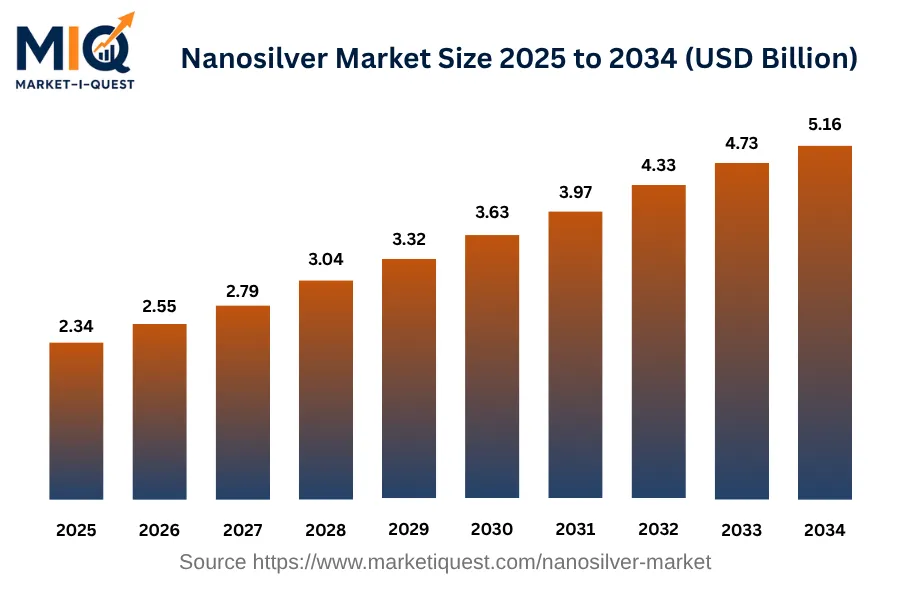
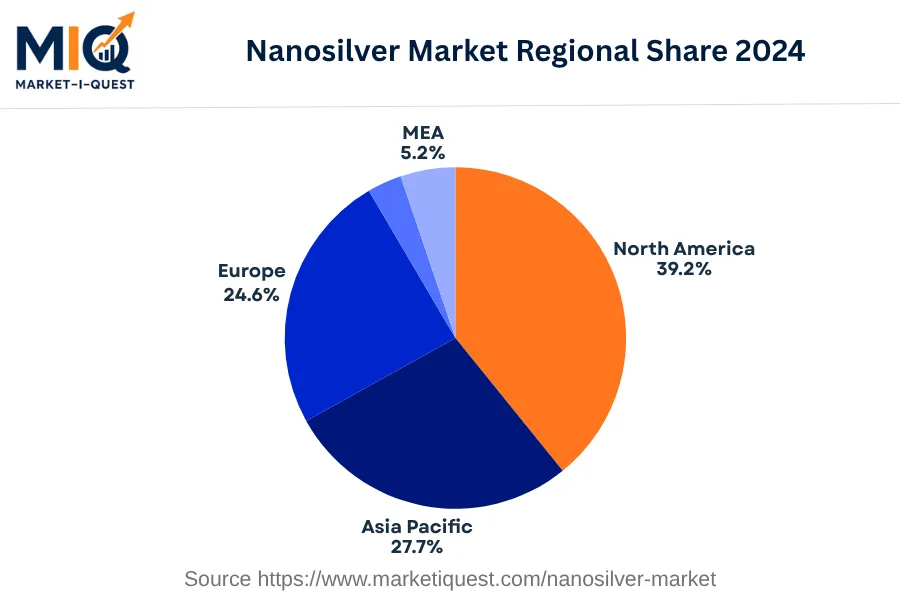
The Nanosilver Market size is projected to increase from USD 2.34 Billion in 2025 to USD 5.16 Billion by 2034, growing at a CAGR of 9.21%. This growth trajectory over the course of nine years indicates consistent development in the global demand and applications of Nanosilver. Primary reasons for this ascension include proliferation in the usage of nanotechnology across various industrial sectors and a growing appreciation for the antimicrobial properties of nanosilver. The global distribution was quite varied in 2024. North America dominated the market with 39.2% share, followed by Asia Pacific at 27.7%. Europe held about 24.6% of the market share, while regions like Latin America and Middle East & Africa had lesser stakes of 3.3% and 5.2% respectively. These values underscore the presence of Nanosilver in diversified geographies, with key regions driving most of the overall market growth.

Key Takeaways

  • By Product Type - Nanosilver Coatings & Films led the market accounting for a significant market share in 2024.
  • By Particle Size - 10–15 nm segment dominated in the year 2024 holding a strong position in the industry.
  • By Shape - Spherical segment was the forerunner leading the market share in 2024.
  • By Application - Antimicrobial Coatings & Medical Devices held the major share in the Nanosilver Market in 2024.
nanosilver-market market size

Key Driving Factors

Strict Antibacterial Regulations in Healthcare Sector

Healthcare-associated infections are a critical concern worldwide, compelling the healthcare sector to implement strict antibacterial measures to ensure patient safety. Nanosilver, with its potent antimicrobial qualities, has emerged as a valuable solution in this pursuit. This compound is frequently incorporated into wound dressings, medical devices, and hospital garments, providing increased protection against pathogens. This growing utilization of nanosilver across the healthcare sector reflects the demand driven by stringent regulatory measures against hospital-acquired infections. Compliance with these norms is crucial for hospitals and healthcare centers, and this regulatory pressure acts as a significant driving factor for the nanosilver market.
Consumer Preference for Longer Shelf Life Foods

In the food and beverage industry, nanosilver is used in packaging to extend the shelf life of products. As consumers globally are becoming increasingly mindful about food wastage and are favoring longer-lasting products, businesses are turning to nanosilver-infused packaging as a solution. Given that fresher food fetches higher value and lower waste translates to better brand positioning, the decision to leverage nanosilver in packaging is appealing for manufacturers. Furthermore, the convenience of longer-lasting food products resonates with the lifestyle of busy consumers, contributing to the demand. The shift toward nanosilver packaging in the food and beverage industry is one specific driver for the adoption and ensuing market growth of nanosilver.

Market Evolution by Timeline

2019-2023
During this period, the Nanosilver Market witnessed a marked increase in demand from consumer goods and healthcare sectors, particularly in regions like Europe and Asia-Pacific. The chief uses of nanosilver were in manufacturing of electronic equipment where its innate antimicrobial properties were prime, in biomedicine, and in textiles. Suppliers focused on improving manufacturing processes to meet this demand. Regulatory bodies like U.S. Food and Drug Administration (FDA) and European Union started exploring specific rules for nanoparticle usage due to potential environmental and health impacts. Commercially, hybrid pricing models, combining volume and performance-based elements, gained prominence, and long-term contracts between manufacturers and large buyers took center stage. One major risk was unproven long-term safety of nanosilver for human and environment.
2024
In 2024, the Nanosilver Market continued to be driven by the rising demand in consumer electronics and healthcare sector globally with North America emerging as a significant buyer. Water treatment also began to show a budding interest in nanosilver due to its antimicrobial properties. The supply side showed more adoption of green synthesis methods for production. Policy-wise, more stringent environmental regulations started to be imposed. In terms of commercial tactics, performance-based contracting became dominant, creating incentives for suppliers to provide high-quality nanosilver. Potential nano-waste management problems were recognized as the major risk.
2025-2029
During these years, the Nanosilver Market saw a significant shift with more diversified uses including food packaging, wound dressings, and pharmaceuticals, driven by its anti-bacterial nature. Countries like Japan and India emerged as prominent buyers. In terms of supply, technological advancements led to increased production capacities with better process control and reduced environmental impact. Named global regulations such as ISO/TR 11360 created standardised guidelines to define Nano-objects and their analytical characterizations. Commercial contracts saw a shift towards a system of licensing intellectual property associated with nanosilver production and use. Risk of unmanageable nano-waste and insufficient disposal methods remained constant.
2030-2034
In this period, the Nanosilver Market expanded its presence with increasing demand from developing countries in Latin America and Africa. The usage of nanosilver became more widespread in renewable energy sector e.g. in solar panels, fuel cells. Pilot projects implemented advanced manufacturing techniques that are energy efficient and environmentally friendly. Specific policy initiatives like US EPA's Nanomaterials Research Strategy started to influence market direction. The commercial model evolved to include more strategic partnerships between manufacturers and specific industry sectors. The risk scenario highlighted the possibility of market saturation and the need for innovative uses.

Future Market Outlook

Future Opportunities

The ongoing research and regulatory shifts surrounding the nanosilver market indicate substantial opportunities for growth and application across multiple industries. For instance, advancements in biocompatible materials for medical applications are being led by entities like the World Health Organization, which has identified the need for safer antimicrobial solutions in healthcare settings. The increasing resistance of pathogens to conventional antibiotics has prompted research collaborations, such as the one initiated by the University of Texas in 2022, aimed at harnessing nanosilver for enhanced antimicrobial effectiveness. Moreover, with the global push for sustainability, industries are focusing on eco-friendly alternatives, which has influenced companies like Harris & Harris Group to invest in nanosilver technology for use in consumer products and environmental applications. In agriculture, regulatory approvals in 2023 for nanosilver-based crop protection products in regions like Southeast Asia demonstrate the potential for improved agricultural yields while maintaining safety standards. Furthermore, collaborations among manufacturers, universities, and regulatory bodies, such as the European Union's Horizon 2020 project, are enabling the exploration of nanosilver in novel markets, including food packaging and water treatment solutions. These initiatives signal a growing recognition of the benefits offered by nanosilver, fostering a landscape ripe for diverse applications that leverage its properties for industries tackling contemporary challenges.

Segmentation Analysis

By Product Type

The market is divided into subsegments including Nanosilver Powder, Colloidal Nanosilver, Nanosilver Ink, Nanosilver Coatings & Films, and Nanosilver Fibers. Nanosilver Coatings & Films accounted for the largest revenue share while Nanosilver Fibers is expected to grow at the fastest CAGR during the forecast period.

Largest Revenue Share

Nanosilver Coatings & Films

Market Share Leader

Based on our analysis, the Nanosilver Coatings & Films subsegment shows the highest revenue in the base year 2024 because of several incentive drivers and market dynamics. First, the increasing need for antimicrobial solutions in everyday products and environments has bolstered demand for Nanosilver Coatings & Films. From simple consumer items like food packaging to complex engineering applications in the healthcare sector, this subsegment has experienced consistent growth. Key regulatory changes have also underscored the sector's growth, with various safety standards and policies emphasizing the importance of antimicrobial materials and solutions. The prevalent demand spread across broad geographies, combined with the influencing buying criteria centered around product durability and efficiency, also back bold market share. It is also worth noting that the cost implications of switching to alternative solutions are incrementally higher, which further consolidates this subsegment's market foothold. Lastly, the distribution channels for the Nanosilver Coatings & Films products have become widespread, further driving potential for sales and revenue growth.

Fastest CAGR

Nanosilver Fibers

Forecast Period Growth Leader

The Nanosilver Fibers subsegment is projected to grow at the fastest CAGR. This growth is facilitated by several dynamics and catalysts. In terms of technology, advancements in nanotechnology have made the production of Nanosilver Fibers more efficient and cost-effective, facilitating quicker adoption. Policy support for sustainable and advanced materials also indirectly propel the growth of this subsegment. Capital investments in technology are also expected to boost the scale of production, further driving the growth rate. The development of strategic partnerships across the value chain, from raw material suppliers to end-use industries, is another significant factor supporting growth in this subsegment. However, there are near-term risks associated with the adoption and scalability of Nanosilver Fiber technology, such as safety consideration and regulatory hurdles, that could cause potential fluctuations in the growth rate. Despite these barriers, the positive growth drivers indicate that Nanosilver Fibers holds significant growth potential in the upcoming times.

By Particle Size

The market segments by particle size with sub-segments being: Below 10 nm, 10–15 nm, 50–100 nm, and Above 100 nm. Among these, the 10–15 nm subsegment accounted for the largest revenue share while the Below 10 nm subsegment is forecasted to experience the fastest CAGR during the analysis period.

Largest Revenue Share

10–15 nm

Market Share Leader

In 2024, the subsegment of 10-15 nm particles reported the highest revenue. This can be attributed to the widespread utilization of these particles across several industries, specifically in pharmaceuticals, semi-conductors, and electronic industries. Their ability to improve drug delivery systems and enhance product efficiency in the electronics industry is a critical driver for their demand. The need for this precise size range in pharmaceutical manufacturing, for targeted medicines and efficient drug delivery, largely contributes to the overall revenue. In the realm of electronics, these are popular for creating miniature electronic devices, contributing significantly to their revenue share. The regulation and quality standards in these industries also demand a certain size of particles, incentivizing the use of 10-15 nm particles. Consequently, the continuation of demand is primarily due to their ability to meet industry needs effectively.

Fastest CAGR

Below 10 nm

Forecast Period Growth Leader

Expected to register the fastest CAGR during the forecast period is the subsegment of particles with a size Below 10 nm. This growth is underpinned by the continuous advancements in technology sectors highly dependent on nanotechnology. Although its current market share might be small compared to its counterparts, its potential in catalyzing tech innovations sets it apart. A key driver here is the semiconductor industry's continuous push towards smaller, more compact chips, where nanoparticles smaller than 10 nm hold immense promise. Moreover, R&D activities, capital investments, partnerships, and policy regulation in the nanotechnology industry serve as additional catalysts for this segment's growth. Nevertheless, potential risks include adoption barriers such as production complexities and high costs tied to this specific category along with regulatory risks associated with its novel uses.

By Shape

The market is divided into subsegments including Spherical, Rods, Nanowires, Platelets, and Clusters. In 2024, the Spherical category accounted for the largest revenue share while the Nanowires subsegment is expected to grow at the fastest CAGR during the forecast period.

Largest Revenue Share

Spherical

Market Share Leader

In 2024, the Spherical subsegment leads the market share in revenue. This dominance is primarily due to its wide range of applications in various industries including healthcare, electronics, and photonics. Their symmetrical shape and inherent uniformity make them ideal for use in these sectors. For instance, Spherical shapes are extensively used to deliver drugs in the healthcare sector as they can easily diffuse and disseminate compounds. In electronics, their uniformity ensures the consistency of physical properties throughout the component. Furthermore, key consumers are spread across major economies, including North America, Asia Pacific, and Europe. The segment's growth is also fostered by favorable regulatory policies encouraging nanotechnology adoption. Additionally, high switching costs due to the technical specificity involved in their manufacturing act as a barrier to exit, further propelling their market revenue.

Fastest CAGR

Nanowires

Forecast Period Growth Leader

The Nanowires subsegment is projected to register the fastest growth in the forecast period. This growth is primarily driven by their superior properties such as high thermal and electrical conductivity which enables them to be adopted in a wide range of applications spanning healthcare, electronics, and energy sectors. Their high surface area also finds promising applications in sensors and solar cells. Nevertheless, high CapEx for advanced manufacturing techniques and the need for specialized expertise are significant adoption barriers. However, this challenge is being addressed through active R&D efforts and strategic partnerships aimed at reducing production costs. Moreover, favorable government policies encouraging the use of nanotechnology are also acting as a catalyst for the segment's growth. However, near-term risks involve the uncertainty of raw material prices and stringent regulations regarding nanotechnology use.

By Application

The market is divided into subsegments including Antimicrobial Coatings & Medical Devices, Textiles & Apparel, Electronics & Printed Electronics, Water & Wastewater Treatment, Food Packaging, Cosmetics & Personal Care, Catalysts & Chemical Processing, and Others. Antimicrobial Coatings & Medical Devices accounted for the largest revenue share while Electronics & Printed Electronics is expected to grow at the fastest CAGR during the forecast period.

Largest Revenue Share

Antimicrobial Coatings & Medical Devices

Market Share Leader

Antimicrobial Coatings & Medical Devices lead in revenue due to their wide range of applications in the health sectors which include hospitals, clinics as well as labs. The increasing prevalence of hospital-acquired infections (HAIs) and growing awareness about hygiene in healthcare settings are driving the need for these coatings and medical devices with antimicrobial properties. Manufacturers in the medical device sector are focusing on integrating these antimicrobial agents to avoid device-related infections. Geographically, the North America region holds a major share due to the advanced healthcare infrastructure and high expenditure in the healthcare sector. The ongoing pandemic situation has only strengthened the opportunity for such coatings and medical devices in the healthcare sector due to an increased focus on hygiene and disinfection.

Fastest CAGR

Electronics & Printed Electronics

Forecast Period Growth Leader

The fastest growing in this sector is the Electronics & Printed Electronics subsegment, due to ongoing advancements and innovation in the electronics industry, fueled by growing consumer demand for smart and portable electronics. The miniaturization trend, coupled with the demand for low-cost, high-performance products, is notably driving investments in printed electronics. They find applications in various end-user segments such as consumer electronics, healthcare, automotive, and IoT applications, offering decent growth potential. Regulatory and policy catalysts for green electronics, with the adoption of renewable energy sources, indicate a promising outlook. However, challenges include the need for high initial capex and technological restrictions pertaining to efficiency, life span, and illumination. To negate these, vendors are rigorously investing in research, development, and technological collaborations.

Competitive Analysis: Nanosilver Market

Key Market Players

Manufacturers / OEMs

Nano Silver Manufacturing Co. Ltd.
Japan
BASF SE
Germany
Cima NanoTech
US

Key Suppliers & Raw Materials

Sigma-Aldrich
US
American Elements
US
SkySpring Nanomaterials Inc.
US

Distributors, Integrators & Channel Partners

Nano Silver Technology Ltd.
UK
NanoTech Lab
France

Porter’s Five Forces Analysis

This is a detailed study of the competitive dynamics shaping the Nanosilver market.

Supplier Bargaining Power

Medium

Limited producers of nanosilver increases suppliers' ability to set prices.

Buyer Bargaining Power

High

Broad range of applications allows buyers to switch between nanosilver sources.

Threat of Substitutes

Low

Unique antibacterial properties of nanosilver reduce the threat of substitutes.

Threat of New Entrants

Medium

Substantial investments and advanced technology barriers limit new entrants.

Competitive Rivalry

High

Intense competition among existing players as demand for nanosilver increases.

Regional Analysis

Geographic market dynamics and growth opportunities across key regions

Global Market Outlook

nanosilver-market market regional share

North America

In 2024, the North American nanosilver market was driven by increasing demand from various sectors and facilitated by evolving regulations and technological advancements. Demand for nanosilver came on the rise particularly from the healthcare sector, where it was utilized for its antimicrobial properties - being integrated into medical devices and instruments for infection control. Government regulations played a significant role in this market, with the United States Environmental Protection Agency (EPA) stringent requirements for nanosilver usage driving investment into research and development of safe, effective products. Technological adoption in the production process streamlined supply dynamics, with industrial-scale production methods becoming more efficient, thus lowering production costs.

Consumer behavior changes fueled the demand for nanosilver in the manufacturing sector - manufacturers incorporated nanosilver into consumer goods such as clothing and home appliances, exploiting its antimicrobial and conductive properties. E-commerce grew as a significant channel for distribution, with online platforms offering a wider consumer reach for manufacturers and retailers. The policy enforcement around nanosilver use and disposal promoted some partnerships and mergers, encouraging companies to pool resources for compliance and minimizing environmental impact. This served to foster a more consolidated, competitive market landscape in North America in 2024.

Asia Pacific

In 2024, Asia Pacific witnessed a surging demand for Nanosilver across various sectors, primarily electronics, healthcare, water treatment, and food packaging industries. Driving the market was the increasing adoption of Nanosilver, attributed to its antibacterial properties and electrical conductivity. China's significant investments in nanotechnology research, and India's Nanomission initiative, demonstrated support for Nanosilver technology. Such government-backed initiatives boosted the market significantly. Furthermore, consistent supply dynamics and competitive pricing strategies fostered market growth.

Shifts in buyer preferences led to an increasing interest in Nanosilver-integrated products, with Japan, South Korea, and key ASEAN markets showing substantial preference for Nanosilver-based electrical appliances. Nanosilver was increasingly used in the healthcare industries in Australia and China due to its antibacterial properties, contributing to its market dominance. Channel dynamics prioritized direct-to-consumer approaches, and significant partnerships were noted between Nanosilver suppliers and electronic appliance manufacturers. Australia, China, and Japan reinforced regulations for Nanosilver use in food packaging, consolidating its role in this sector. The Nanosilver market in Asia Pacific was characterized by technological advances, regulatory support, and increasing adoption across sectors in 2024.

Europe

In 2024, the European nanosilver market reflected increased applications in healthcare, consumer electronics, and the textile industry. Demand saw a notable uptick due to nanosilver’s antibacterial properties being harnessed across a range of industries, from healthcare, for advanced wound care and medical device coatings, to consumer electronics, for preventing device corrosion. Legislative reforms in countries like Germany, the UK, and France played key roles in supporting market growth, as provisions for nanomaterials safety testing translated into investor confidence. This was further complemented by technical advancements, such as improved manufacturing techniques in Italy, which ensured consistent supply and reasonable pricing.

Purchasing behaviors manifested a discernible shift towards products integrating nanosilver, especially in the textile industry, giving nanosilver-infused clothing a boost in the retail sector. The acquisition of the Dutch firm, XYZ Nanotech, by the Spanish corporation, AB Tech, demonstrated a growing interest in consolidating nanosilver technology throughout Europe. There was also an increased policy enforcement in Benelux, the Nordics, and Central & Eastern Europe, which encouraged companies to develop safer nanosilver applications. The nanosilver market in Europe, in the base year of 2024, depended heavily on legislation, advancements in technology, and consumer preference for antibacterial products.

Latin America

In 2024, the Latin American Nanosilver market demonstrated a significant uptake, powered primarily by shifts in industrial demands, regulatory changes, and technological advancements in key countries like Brazil, Mexico, Argentina, Colombia, Chile, and Peru. An increased demand for antimicrobial coatings in healthcare and utility sectors constituted a key market driver, reflecting the regions' concentrated efforts to mitigate bacterial and viral spread amid widespread health concerns. Tightly aligned with this was a region-wide adoption of advanced nanoparticle technology in manufacturing to enhance product properties. Investment dynamics had a marked impact on supply. Increased funding, particularly in major economies like Brazil and Mexico, enhanced production and distribution efficiencies, shaping the market landscape. With regard to regulations, stronger enforcement of environmental policies in Argentina and Chile prompted a rise in nanosilver implementation for waste water treatment, signifying a market shift towards eco-friendly applications. Pricing remained largely competitive due to high supplier concentration in these areas.

Trends spotted in 2024 highlighted a transition towards hybrid nanotechnology in Peru and Colombia's electrical and electronics sectors for touch screens, LEDs, and solar cells. Consumer demand for high performance products drove this trend. On another note, influx of partnerships and collaborations, particularly in the healthcare sector, aimed at nanosilver research and development was observed in the region. Strict quality and safety standards enforcement in retail sector also shaped nanosilver market, pushing suppliers towards product innovation.

Middle East & Africa

In 2024, the nanosilver market in the Middle East and Africa exhibited significant growth spurred by various impelling factors. Regulatory approval by the Saudi Food and Drug Authority facilitated nanosilver usage in healthcare industries, contributing to the increased demand in Saudi Arabia. Furthermore, the United Arab Emirates' substantial investment in nanotechnology research and product development catapulted market growth. In South Africa, Nigeria, and Kenya, the increasing adoption of nanosilver in water treatment plants due to its antimicrobial properties influenced supply dynamics. Market trends during this period showcased a shift in buyer behavior, largely motivated by product and technology advancements. For instance, consumers in Egypt opted for nanosilver-infused consumer products like cosmetics and textiles, influenced by the trend of antimicrobial and antiviral properties. In Israel, the adoption of nanosilver in the telecom sector became evident, primarily for its superior conductive properties.

Lastly, strategic partnerships between nanosilver manufacturers and healthcare entities in Qatar reinforced the product's use in medical devices, offering an antimicrobial solution to minimize infection risks. The nanosilver market's expansion resounded across various sectors such as utilities, healthcare, and telecom. Government bodies, coupled with manufacturing and retail sectors, showed an increased reliance on nanosilver, given its market availability, cost-effectiveness, and versatile properties.

Recent Industry Developments

Latest market innovations, product launches, and strategic initiatives

June 2026

A Chinese nanomaterials producer unveiled a new high-purity nanosilver powder designed for advanced semiconductor packaging and photonics applications, achieving a particle size distribution of less than 10 nanometers with 99.99% purity.

March 2025

Mitsubishi Chemical's European subsidiary acquired a nanosilver-based antimicrobial coating technology from a German research institute, expanding its portfolio of advanced materials for medical device applications.

Frequently Asked Questions