
Medical Polymers Market Snapshot

Key Players

  • Celanese Corporation (US)
  • Evonik Industries AG (Germany)
  • DuPont (US)
  • BASF SE (Germany)
  • Royal DSM (Netherlands)
  • Lubrizol (US)
  • Mitsubishi Chemical Corporation (Japan)
  • Solvay S.A. (Belgium)
  • Victrex Plc (UK)
  • ExxonMobil Corporation (US)

Market Size

Base Year 2024
$23.97 Bn
CAGR
8.18%
Forecast 2034
$52.62 Bn

Market Segments

By Type
  • Fibers & Resins
  • Medical Elastomers
  • Others
By Manufacturing Technology
  • Injection Molding
  • Extrusion Tubing
  • Compression Molding
  • Others
By Application
  • Medical Devices & Equipment
  • Medical Packaging
  • Others

Market Dynamics

Drivers
  • Growing healthcare industry demand
  • Technological advancements in polymer science
Restraints
  • High production costs
  • Regulatory compliance challenges
Opportunities
  • Emerging healthcare sectors
  • Increasing biomedical applications

Market Size

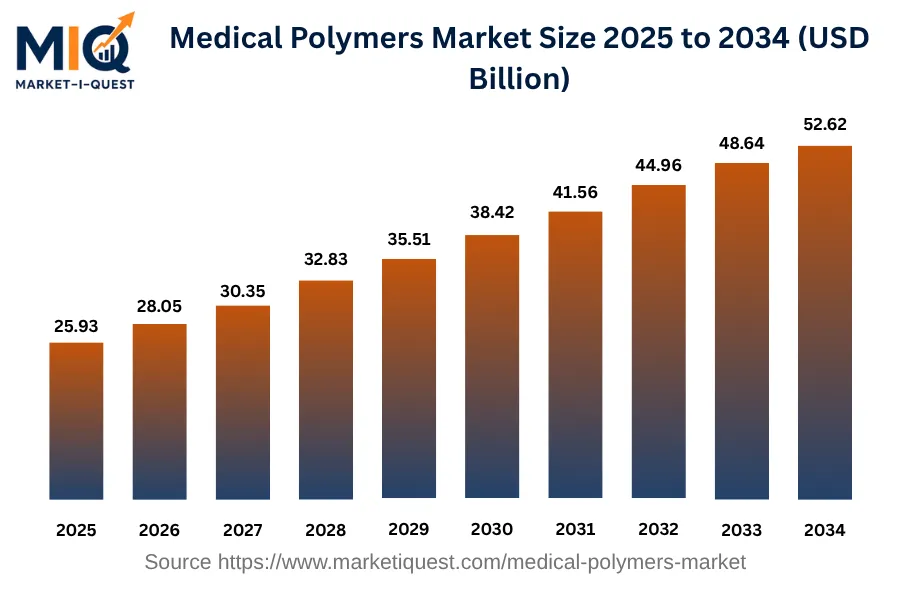
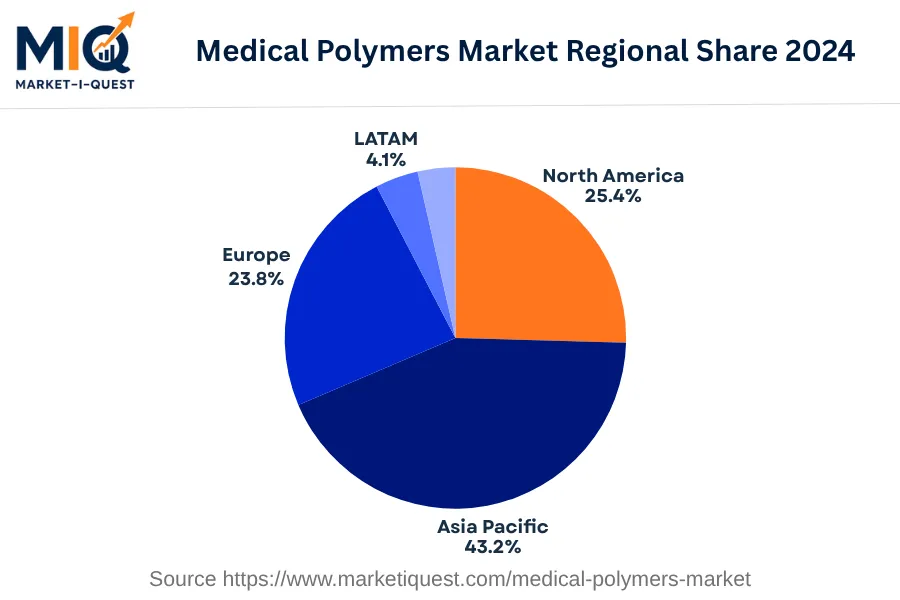
The Medical Polymers Market was worth $25.93 billion in 2025 and is expected to grow to $52.62 billion by 2034, with a CAGR of 8.18%. The growth of the market moving from $23.97 billion in 2024 to $25.93 billion in 2025 signifies a positive trajectory, which is expected to carry on throughout the forecast period. This increase is based on the steady demand for medical polymers in various health and medical applications. The CAGR of 8.18% represents steady, year-on-year growth that is expected to more than double the market value by 2034. On a regional basis in 2024, Asia Pacific had the highest share at 43.16%, followed by North America at 25.43%, Europe at 23.78%, LATAM at 4.07%, and MEA at 3.56%.

Key Takeaways

  • By Type - Medical Elastomers grew fastest expanding its market foothold in 2024.
  • By Manufacturing Technology - Injection Molding held a significant market position in 2024.
  • By Application - Medical Devices & Equipment led the market with its substantial reach in 2024.
medical-polymers-market market size

Key Driving Factors

Regulatory Compliance for Bio-Compatibility

In the medical industry, patient safety and product reliability are paramount, and medical polymers are no exception. Regulatory bodies like the United States Food and Drug Administration (FDA) have stringent requirements for material bio-compatibility, ensuring that medical polymers do not cause medical complications or toxicity when they come into contact with the human body. In this scenario, manufacturers are increasingly trending towards the use of medical-grade polymers that are compliant with such regulations. This includes materials like Polyether ether ketone (PEEK) and Polyethylene (PE), which have seen widespread adoption for implants and prosthetics due to their high bio-compatibility and acceptance by regulatory authorities. So, it is the need for regulatory compliance for bio-compatibility that is enforcing manufacturers to adopt these materials, which, in turn, is pushing the growth of the medical polymers market.
Requirement of Lightweight and Sterilizable Polymer-based Medical Devices

The adoption of lightweight, portable, and sterilizable medical devices is notably influencing the medical polymers market. These attributes are vitally important in a healthcare setting. The light weight ensures easy handling and transportation, while the ability to sterilize the devices safeguards against infection. Polymers like Polycarbonate and Polyvinyl Chloride (PVC) are gaining prominence in the healthcare industry due to their lightweight nature and sterilizability. Furthermore, these polymers are cost-effective and offer high performance, making them suitable for medical device manufacturing. Particularly in an era where healthcare providers are aiming to reduce operational costs and enhance patient safety, the increased use of lightweight and sterilizable medical devices has accelerated. As a consequence, the demand for the medical polymers used in these devices is growing robustly.

Market Evolution by Timeline

2019-2023
This period observed a high demand for medical polymers from pharmaceutical and biotechnology companies for packaging drugs and development of implants. North America had the highest adoption, especially the US due to the proliferation of advanced healthcare facilities. Technologies leveraged were primarily polymer manufacturing and biocompatible polymer coatings. The industry faced regulatory scrutiny from US FDA and European Medicines Agency, which published guidelines for medical-grade polymer usage. Pricing tended to be competitive with long-term contracts being preferred. A significant risk was supply chain disruption due to trade tensions and stricter regulatory control.
2024
In 2024, orthopedic implants emerged as a significant demand area for medical polymers due to an ageing population and increasing prevalence of musculoskeletal conditions. Europe, particularly Germany and France, witnessed increased consumption. Manufacturers were compelled to adhere to ISO 13485:2016 standard for quality management of medical devices. Biodegradable polymers were gaining market acceptance, albeit at a higher price point. Partnership models between polymer manufacturers and medical device companies became more common. The primary risk was environmental concerns over polymer disposal.
2025-2029
During this timeframe, Asia-Pacific region, predominantly China and India, manifested a rise in demand due to growing healthcare infrastructure. Polymers for tissue engineering and wound care became more prevalent. 3D printing technology was increasingly applied for custom device manufacturing. Regulations posed a challenge as implementation of the EU Medical Device Regulations affected the supply. The commercial model evolved towards outcome-based pricing with specific performance criteria. Risk of inconsistent raw material supply due to geopolitical instabilities was identified.
2030-2034
There is an anticipated shift towards using medical polymers for development of smart, biocompatible devices in this period. Regions like Middle-East and Africa are expected to reveal substantial demand due to healthcare development initiatives. Nanotechnology integration into polymer production is likely to become more mature. The medical polymers market will still have to comply with stringent regulatory standards like ISO 10993 for biocompatibility. Price competitiveness combined with value-based contracts might become the norm. The risk of innovation being outpaced by tightening regulation standards, might affect the overall market.

Future Market Outlook

Future Opportunities

The medical polymers market faces compelling opportunities driven by aging populations worldwide, particularly in regions like North America and Europe. The World Health Organization reported in 2023 that the demographic shift towards older individuals is expected to influence demand for medical devices, including those made from advanced polymers. Companies such as 3M and DuPont are already developing polymers specifically designed for applications in orthopedic and cardiovascular devices. These advancements can enhance patient outcomes through better biocompatibility and durability. Additionally, emerging technologies like organ-on-a-chip are stimulating interest in medical polymer applications; in 2022, a project led by Stanford University demonstrated the potential of medical-grade silicone in replicating human organ functions. Furthermore, regulatory bodies like the FDA are updating guidelines to accommodate the rise of digital health solutions, which integrate polymer-based devices for remote patient monitoring. As personalized medicine becomes increasingly routine, a 2023 study conducted by the National Institutes of Health explored the potential of tailored polymer formulations for patient-specific needs. This creates a fertile ground for innovation, allowing small to medium enterprises to enter the market with niche offerings. Consequently, the medical polymers landscape is set to evolve with both established players and newcomers addressing unmet clinical needs through specialized approaches and tailored solutions.

Segmentation Analysis

By Type

The market is divided into subsegments including Fibers & Resins, Medical Elastomers, and Others. Of these, Fibers & Resins accounted for the largest revenue share while Medical Elastomers is expected to grow at the fastest CAGR during the forecast period.

Largest Revenue Share

Fibers & Resins

Market Share Leader

Driving the revenue in the Fibers & Resins subsection of the market is the substance’s versatility and broad application base, especially within the construction and manufacturing sectors. Fibers & Resins have an established market presence which offers strong growth potential due to stable customer bases in these mature industries. The geographical spread of the Fibers & Resins market is vast, penetrating both developed and developing economies around the world that have considerable construction and manufacturing activities. Regulatory authorities have usually supported the use of Fibers & Resins, aiding in its sustained demand. Customers primarily base their purchasing decisions on the product's durability and its impact on the overall product lifecycle. As it is crucial to the structural integrity of many products, the switching costs associated with moving away from Fibers & Resins are fairly high. Furthermore, Fibers & Resins typically reach the market through robust channels, including direct sales for large-scale projects and distributors for smaller products and retail customers.

Fastest CAGR

Medical Elastomers

Forecast Period Growth Leader

Expected to grow at the fastest CAGR during the forecast period, the Medical Elastomers subsegment is being propelled by a number of key factors. Among these is the technological advancement in the healthcare sector leading to the increased use of these materials in a variety of medical applications. While there are substantial capital expenditure required in developing and commercializing Medical Elastomers, strategic partnerships between elastomer manufacturers and medical device companies are becoming more common, dramatically reducing this barrier. Policy shifts favoring the use of advanced materials and medical devices act as another growth catalyst in this market. In the near term, regulatory hurdles and product approval delays could pose some risks to rapid growth. However, with the ongoing innovation in the medical field and a continuous shift towards more effective and efficient healthcare solutions, the Medical Elastomers subsegment is positioned for elevated growth rates.

By Manufacturing Technology

The market is divided into subsegments including Injection Molding, Extrusion Tubing, Compression Molding, and Others. Injection Molding accounted for the largest share in revenue while Extrusion Tubing is expected to grow at the fastest CAGR during the forecast period.

Largest Revenue Share

Injection Molding

Market Share Leader

Injection Molding dominates the manufacturing technology market due to its wide application across sectors such as automotive, medical, consumer goods, and others. It is favored for its short production cycle, high efficiency, flexibility in design, and ability to produce complex and large products. Furthermore, it is relatively cost-efficient when producing parts at high volumes. Compared to other forms of molding, this subsegment requires less post-processing which further reduces production time and costs. Geographically, the Asia-Pacific region contributes significantly to the demand for injection molding, primarily due to the burgeoning automotive and consumer goods sectors in countries like China and India. There are minimal regulations that hinder the market expansion and customers have demonstrated a strong inclination towards suppliers that offer quality and durability, characteristics that are inherent contributions of the injection molding process.

Fastest CAGR

Extrusion Tubing

Forecast Period Growth Leader

Extrusion Tubing is anticipated to exhibit the fastest growth within the manufacturing technologies. It is being embraced due to its key advantage of producing continuous lengths of plastic sections, which are then cut to the specified lengths. This is pivotal particularly in the industries such as construction, automotive, and electronics. One of the significant barriers to adoption being the initial capital expenditure on machinery. However, partnerships, and collaborations tend to offset this challenge to a large extent. The recent advancements in technology have enhanced the capability of extrusion molding in terms of quality of output and reduction in waste, making it an increasingly attractive option for manufacturers. However, near-term risk to this subsegment could be the volatile raw material prices that can impact overall profitability in the sector. Policy level initiatives promoting the use of recyclable materials can act as a catalyst in promoting the adoption of this technology.

By Application

The market is divided into subsegments including Medical Devices & Equipment, Medical Packaging, and Others. Medical Devices & Equipment accounted for the largest revenue share while Others is expected to grow at the fastest CAGR during the forecast period.

Largest Revenue Share

Medical Devices & Equipment

Market Share Leader

Medical Devices & Equipment subsegment leads the market in revenue generation, given the surging demand in preventive care and advancements in healthcare technology. Because they are often essential and have few substitutes, medical devices represent a significant portion of healthcare costs. The demand for these devices is not only driven by population growth but also by the growing demographic of aging populations who often require more medical care. The high switching costs associated with these devices, combined with the specialized knowledge required to design and manufacture them, mean that established players often dominate this market. Regulation also plays a significant role in shaping this market. The stringent guidelines set by regulatory committees force companies to maintain high-quality standards, creating barriers to entry and securing the market share for the existing players. Furthermore, although the devices are often purchased indirectly through healthcare providers, they are also often required to be approved by payers and governments, adding another layer of complexity to the sales channels.

Fastest CAGR

Others

Forecast Period Growth Leader

The 'Others' subsegment is expected to demonstrate the fastest CAGR due to several factors. The general classification of this category allows for the inclusion of various innovative healthcare products and technologies that do not fit neatly into the previous two categories. These may include digital health technologies and telemedicine capabilities, which have surged due to the COVID-19 pandemic. In addition to technology advancements, policy changes and increased investment can also act as catalysts for this group. However, potential adoption barriers may include resistance to technology from older healthcare professionals and patients, lack of widespread technology literacy, and concerns over data security. Short-term risks include economic instability and potential regulatory changes. Despite these risks, the continued growth and adoption of healthcare technology present potential for significant market growth.

Competitive Analysis: Medical Polymers Market

Key Market Players

Manufacturers / OEMs

Celanese Corporation
US
DuPont
US
BASF SE
Germany

Key Suppliers & Raw Materials

Evonik Industries AG
Germany
Honeywell International Inc.
US
DIC Corporation
Japan

Distributors, Integrators & Channel Partners

Covestro AG
Germany
Royal DSM
Netherlands
Solvay SA
Belgium

Porter’s Five Forces Analysis

This analysis examines the competitiveness and strategic options available in the Medical Polymers Market.

Supplier Bargaining Power

Medium

Limited number of suppliers with kapability affecting pricing and supply.

Buyer Bargaining Power

High

Several buyers with varied needs, demanding customized polymer solutions.

Threat of Substitutes

Low

High entry barriers due to specialized knowledge and regulatory constraints mitigate substitution risks.

Threat of New Entrants

Low

High capital expenditures and stringent regulatory standards impede new entries.

Competitive Rivalry

Medium

Existing firms compete aggressively on price, quality, and innovation.

Regional Analysis

Geographic market dynamics and growth opportunities across key regions

Global Market Outlook

medical-polymers-market market regional share

North America

In 2024, North America's medical polymers market played a crucial role in advancing health care outcomes, particularly in the United States, Canada, and Mexico. Driving the market was an increased demand for cutting-edge health technologies including medical implants and prosthetics. Regulatory assistance, such as the United States Food and Drug Administration’s fast-track approval process for new devices, also stimulated growth. Furthermore, ongoing investments in the research and development of innovative polymers, such as biodegradable polymers, amplified the market traction.

Several trends marked 2024 in the medical polymers market. First, a shift towards patient-centred care led to increased use of polymers in drug-delivery methods to enhance therapeutic efficacy. Second, there was a notable rise in partnerships, mergers, and acquisitions among polymer manufacturers, especially in the United States, aiming to gain a competitive edge and strengthen supply dynamics. Third, enforcement of stringent standards by regulatory bodies to ensure safety and efficiency continually reshaped the market landscape. Key sectors leveraging these polymers included healthcare, notably hospitals and diagnostic centres, as well as the enterprise sector, where drug delivery and diagnostic firms proved significant consumers. Overall, 2024 saw a vigorous growth in the North American medical polymers market driven by increasing advancements and applications in healthcare.

Asia Pacific

In 2024, the Medical Polymers market in the Asia Pacific was shaped by evolving medical needs, technological advancements, and increasingly stringent regulations. Key growth drivers included rising healthcare expenditure, particularly in China and India, stimulating demand for high-quality and cost-efficient medical products. The technology adoption throughout Japan and South Korea further accelerated the market, driven by innovations in bio-based and biodegradable polymers. Investments in manufacturing capacity expansion were also notable, especially in India and ASEAN countries, where favorable government policies were facilitating market expansion.

Market trends reflected a shift toward sustainable and recyclable polymers, in response to sweeping environmental policies across the region, particularly in China and Australia. Advances in polymer science had led to development of new, biocompatible materials, adopted enthusiastically by healthcare providers. A surge in partnerships and M&A activities were also visible, notably in Japan and South Korea, to consolidate market presence and expand product portfolios. E-commerce proliferation further influenced the market dynamics, enabling easy availability and affordability of medical polymers. As for sectors, enterprises in medical and pharmaceutical manufacturing were the key consumers of these materials, but usage in tertiary healthcare establishments and utilities were also discernible.

Europe

In 2024, the Medical Polymers Market in Europe proved significant, marked by changing dynamics and varying influences. The underlying drivers included the aging population that increased the demand for medical devices and implants, regulatory pressures that favoured the use of biocompatible polymers, and the extensive investments into polymer research by healthcare institutions. Technology adoption was evident in Germany and the United Kingdom, where medical-grade polymers were widely embraced due to their beneficial properties like longevity and chemical resistance. Moreover, competitive pricing across Europe, particularly in France and Italy, further stimulated market growth.

Trends within the market revolved around buyer preferences with a shift towards biodegradable polymers, evident in Spain and Central Eastern Europe. Furthermore, the healthcare sector in the Nordics and Benelux experienced growing alliances between manufacturers and polymer suppliers, facilitating seamless supply and product innovation. The market also witnessed stricter enforcement of medical standards for polymer use within sectors like dental healthcare and orthopedics. Germany led the policy implementation with its MDR 2017/745, intending to enhance patient safety. Lastly, enhanced e-commerce platforms became a formidable sales channel within the region, offering wider accessibility to polymer-based products. Thus, the interplay of demand factors, market trends, and regulatory context shaped the Medical Polymers Market across Europe in 2024.

Latin America

In 2024, the Latin American market for medical polymers was marked by dynamic growth and expanding opportunities. Driving this progress was the increasing demand for high-quality healthcare services in countries like Brazil, Mexico, Argentina, Colombia, Chile, and Peru, where investment in technology and healthcare infrastructure saw a considerable rise. Furthermore, lenient regulations in these countries encouraged manufacturers to introduce more advanced and diverse polymer-related products in the medical sector.

Trends observed in the base year demonstrated a significant shift towards bio-compatible polymers, mainly due to increasing awareness around public health and safety. Notably, retail and healthcare sectors were heavily investing in lower-cost, high-performance polymers, fostering market growth. Distribution channels also underwent transformation with more partnerships and mergers witnessed among polymer manufacturers and healthcare providers, enhancing market penetration and accessibility. In policy enforcement, strict adherence to healthcare standards and norms significantly influenced the use of medical polymers and dictated market trends to an extent. Simultaneously, manufacturers in sectors such as manufacturing and utilities leveraged technology adoption to enhance the efficiency and durability of their polymer products, promoting market diversity and competitive performance. Consequently, the booming LATAM medical polymers market in this year presented a dynamic landscape navigating towards higher growth accolades.

Middle East & Africa

In 2024, the medical polymers market in the Middle East and Africa displayed robust activity due to various driving factors and emerging trends. Key market drivers included increasing demand for high-performance polymers in healthcare applications, favorable regulations advocating for the use of biodegradable products, and significant investments in medical technology across countries such as Saudi Arabia, United Arab Emirates, Qatar, and Israel. Additionally, the adoption of advanced polymer technologies in these regions was propelled by the supply chain dynamics and competitive pricing strategies.

Notable market trends encompassed shifts in buyer behavior, with healthcare providers prioritizing reliable, cost-effective, and quality polymer products. Advancements in product design and technology, particularly in countries like South Africa, Nigeria and Kenya, also presented key market trends. There was a noticeable increase in partnerships and acquisitions, primarily within the healthcare and manufacturing sectors, helping broaden the reach and application of medical polymers. Furthermore, countries like Egypt witnessed strict policy enforcement for the standardization of these products to guarantee quality and safety. The customer base spanned across several sectors, with dominant shares held by the healthcare, manufacturing, retail and government sectors. Their focus remained on leveraging the benefits of medical polymers, including versatility, durability, and high-sterilization capacity for diverse applications in 2024.

Recent Industry Developments

Latest market innovations, product launches, and strategic initiatives

July 2026

Kimball Electronics acquired European-based medical CDMO Helvoet Polymer Technologies B.V. for €90 million ($103 million), adding facilities in the Netherlands and India specializing in micro-molding, microfluidics, diagnostics, and drug delivery components.

April 2026

LyondellBasell expanded its Purell medical-grade polyolefins portfolio into North America, bringing decades-proven polymers to healthcare manufacturers in the region with full regulatory compliance

Frequently Asked Questions