Marine Propulsion Engines Market Snapshot

Key Players

  • Caterpillar Inc. (United States)
  • Rolls-Royce plc (United Kingdom)
  • MAN Energy Solutions (Germany)
  • Cummins Inc. (United States)
  • Wärtsilä Corporation (Finland)
  • YANMAR Co. Ltd. (Japan)
  • Fairbanks Morse (United States)
  • Hyundai Heavy Industries Co. Ltd. (South Korea)
  • STX Engine (South Korea)
  • Scania AB (Sweden)

Market Size

Base Year 2024
$12.81 Bn
CAGR
5.63%
Forecast 2034
$22.15 Bn

Market Segments

By Engine Type
Diesel, Dual-Fuel, Gas Turbine, Steam Turbine, Electric Propulsion, Other Engine Types
By Ship Type
Container Ship, Tanker, Bulk Carrier, Cruise Ship, Ferry, Offshore Support Vessel, Naval Vessel, Other Ship Types
By Fuel Type
Heavy Fuel Oil (HFO), Marine Diesel Oil (MDO)/Marine Gas Oil (MGO), Liquefied Natural Gas (LNG), Methanol, Ammonia, Hydrogen, Other Fuel Types
By Power Range
Up to 1, 000 kW, 1, 001–5, 000 kW, 5, 001–10, 000 kW, Above 10, 000 kW
By Application
Passenger, Commercial Cargo, Defense

Market Dynamics

Drivers
  • Increasing maritime activities
  • Environmental regulations enforcement
Restraints
  • Stringent emission norms
  • Increased adoption of electric vehicles
Opportunities
  • Renewable energy integration
  • Untapped emerging markets

Market Size

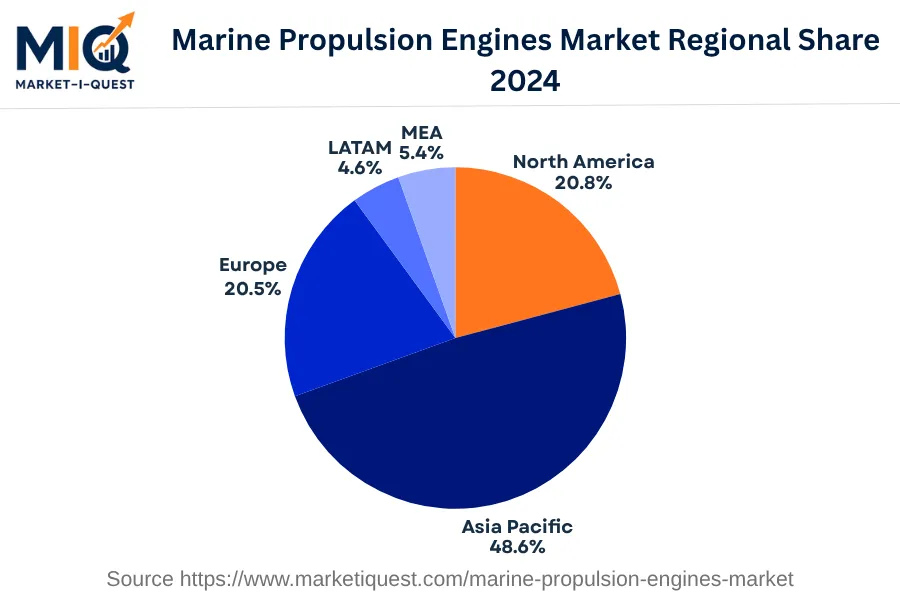
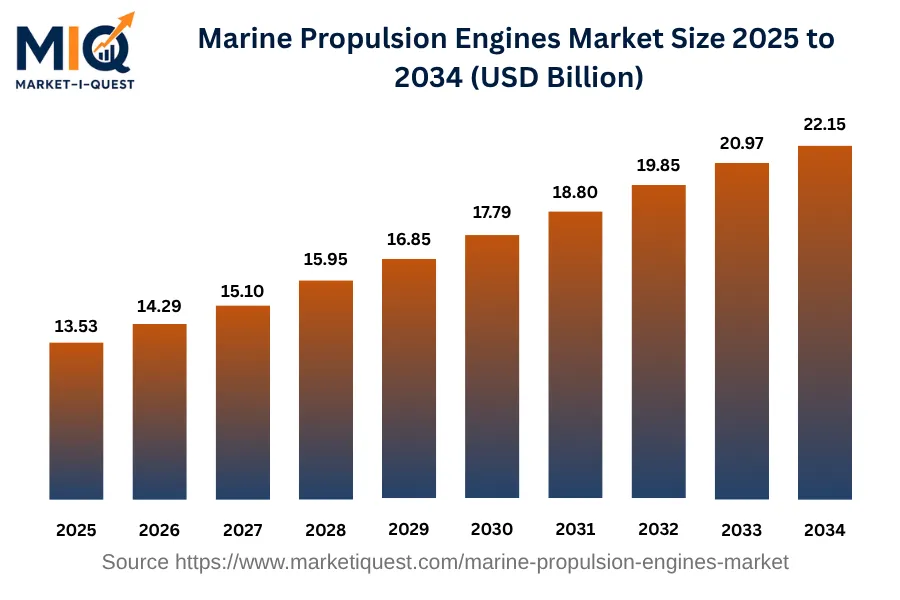
The marine propulsion engines market, which was valued at USD 13.53 billion in 2025, is forecast to reach USD 22.15 billion in 2034, exhibiting a Compound Annual Growth Rate (CAGR) of 5.63%. The growth trajectory shows a steady increase in market value from the base year of 2024, when it was valued at USD 12.81 billion. The expansion can be attributed to technological advancements in engine design, increasing demand for eco-friendly solutions, and broader trends in the maritime transportation industry that require newer and more efficient propulsion systems. As of 2024, the biggest share of the market by region was in the Asia Pacific region, accounting for 48.6% of the total. North America and Europe followed closely, accounting for 20.8% and 20.5% of the market respectively. Meanwhile, the Latin America and Middle East & Africa regions accounted for 4.6% and 5.4% respectively.

Key Takeaways

  • By Engine Type - Diesel held a major share accounting for the top position in the market in the base year.
  • By Ship Type - Bulk Carrier was the leading segment marking a notable position in the market.
  • By Fuel Type - Marine Diesel Oil(MDO)/Marine Gas Oil(MGO) led the market accounting for a substantial market share.
  • By Power Range - Above 10
  • 000 kW segment grew fastest marking a significant expansion in the market.
  • By Application - Passenger was the dominant segment securing a major market share.
marine-propulsion-engines-market market size

Key Driving Factors

Implementation of Stringent Emission Norms

Growing awareness of the environmental impact of conventional propulsion engines, coupled with the enforcement of stricter emission regulations by maritime authorities, is driving changes in the Marine Propulsion Engines Market. International bodies like the International Maritime Organization imposes regulations like the MARPOL Annex VI, aimed at reducing harmful pollutants like sulfur and nitrogen oxides. This puts a requirement on vessel owners to retrofit their existing propulsion systems with cleaner technology or purchase new engines compliant with these norms. Shipbuilding and cruise companies, among others, are therefore demanding innovative, eco-friendly propulsion technologies, compelling engine manufacturers to redesign or adapt their product offerings. This regulatory backdrop is an important driver of the market, pushing both supply and demand.

Rising Preference for LNG-fueled Engines

There is an increasing shift from oil-based to gas-based fuels, particularly, liquefied natural gas (LNG), in the Marine Propulsion Engines Market. The LNG as a marine fuel provides attractive benefits. It's not only more economical than oil-based fuels but also aligns well with the stringent emission regulations cited previously. Vessel owners are acknowledging these benefits and are taking the initiative to either convert their existing oil-fueled engines to LNG-based ones or directly purchase new LNG-fueled engines. This is especially noticeable in sectors like long-haul shipping companies, where fuel costs bear a significant chunk of total operating costs. Consequently, the heightened preference for LNG as a marine fuel is pushing engine manufacturers to create more offerings in this category, thereby driving the market.

Market Evolution by Timeline

2019-2023
During this period, the Marine Propulsion Engines Market witnessed a surge in demand from Asian countries, especially China and South Korea, due to increased shipbuilding activities and an uptick in maritime trade. The dominant engine technology revolves around diesel, with leading suppliers like MAN Energy Solutions and Wärtsilä exerting considerable market influence. Regulatory measures like the International Maritime Organization's (IMO) sulphur cap, implemented in 2020, pushed the industry toward more sustainable solutions. Pilot programs for green propulsion technologies like LNG and biofuel engines cropped up around the world. Typical contracts involved long-term supply agreements, necessitated by the significant investment in engine installation or retrofitting. The primary risk revolved around supply chain disruptions and the ability to adapt to changing fuel requirements.
2024
In 2024, the Marine Propulsion Engines Market started a noticeable shift towards greener technologies, driven mainly by European buyers advocating sustainability. Continued enforcement of emission standards by international agencies gave further push to this trend. This year saw a further increase in hybrid propulsion technologies, combining diesel with electric or LNG fuelled engines. Key suppliers, including Rolls-Royce and Caterpillar, launched various hybrid engine models. A common commercial model was to pair engine procurement with a service agreement, reducing the perceived risk of adopting newer technologies. The primary risk was rooted in the challenge of integrating these propulsion systems into existing vessels.
2025-2029
The Marine Propulsion Engines Market, between 2025 and 2029, likely kept moving towards emission-free propulsion technologies. The increased buyer demand majorly came from North America and Europe, highlighting a commitment to climate goals. Technologies such as fuel cells and battery-electric systems started gaining traction. World-renowned suppliers, including ABB and Siemens, led the pack offering these technologies. Policies such as the EU Green Deal further propelled the adoption of such engines. Resultantly, partnerships between manufacturers and renewable energy providers became more common. However, it is typical that high upfront costs and uncertain ROI posed challenges to wider acceptance.
2030-2034
In the 2030-2034 time frame, the Marine Propulsion Engines Market is anticipated to be driven by near-zero emission standards enforced globally leading to innovative programmings such as 'Carbon-free by 2050'. Demand was expected from various segments, from cargo carriers to cruise liners, on a global level. The technology space will likely feature hydrogen fuel cells and advanced electric propulsion engines as two major contenders. Asian suppliers such as Hyundai and Doosan were likely to emerge as significant players in this evolving market scenario. As a response to the risk of outdated infrastructure, new ship designs are expected to be created integrating the new engine technologies from the ground up.

Future Market Outlook

Future Opportunities

Given the current technological momentum, significant opportunities are emerging within the marine propulsion engines market. The recent adoption of regulations such as the European Union's Fit for 55 package indicates impending legislative frameworks supporting low-emission technologies by 2025. Companies that invest in research and development for hydrogen fuel cells, as seen with Hyundai's launch of the first hydrogen-powered cargo vessel in 2023, are poised to gain a competitive edge. There is also potential for partnerships focused on hybrid solutions, as seen in the collaboration between ABB and the U.S. Coast Guard to enhance energy efficiency in maritime operations. Furthermore, increasing demand for retrofitting existing vessels with eco-friendly propulsion systems aligns with growing sustainability initiatives from industry bodies like the Clean Shipping Coalition. Moreover, the trend of digitization is presenting opportunities in predictive maintenance and real-time monitoring systems, which can be seen in the roll-out of IoT solutions by Siemens AG for maritime applications. As maritime stakeholders increasingly prioritize compliance with environmental regulations, investments in cleaner and more efficient propulsion technologies will be essential, allowing companies to not only meet but exceed current standards, thereby creating a more sustainable future for the marine industry.

Segmentation Analysis

By Engine Type

The market is divided into subsegments including Diesel, Dual-Fuel, Gas Turbine, Steam Turbine, Electric Propulsion, and Other Engine Types. Diesel accounted for the largest revenue share, while Electric Propulsion is expected to grow at the fastest CAGR during the forecast period.

Largest Revenue Share

Diesel

Market Share Leader

The Diesel subsegment leads the engine type market in terms of revenue, and this leadership position can be attributed to a number of factors. Diesel engines are known for their fuel efficiency, high torque, and durability, which make them a preferred choice in various applications including commercial vehicles, heavy-duty machinery, and maritime transport. They have a proven track record in operation across heavy-duty sectors, leading to a greater installed base and market dominance. Regulatory framework and supply changes have little effect on the preference for diesel engines due to their robustness and ability to work in harsh conditions. In terms of purchasing criteria, diesel engines are favored for their reliability and cost-effectiveness over time, despite higher upfront costs compared to some alternatives. Furthermore, switching costs, including the need for new infrastructure, new equipment, and operator training, make transitions from diesel more challenging. Finally, the widespread availability of diesel fuel and servicing capabilities via extensive sales channels also contributes to diesel engines keeping the largest revenue share among engine types, despite environmental concerns.

Fastest CAGR

Electric Propulsion

Forecast Period Growth Leader

While Diesel engines dominate the current landscape, Electric Propulsion engines are poised to grow at the fastest rate. This is driven by a confluence of factors including technological advancements, policy impetus, capital investment and emergent partnerships in the industry. Technological breakthroughs in battery density, charging infrastructure and energy management systems have enabled a higher level of efficiency in electric propulsion systems, breaking down initial adoption barriers. Policy-wise, the global push towards reducing greenhouse gas emissions has led governments to incentivize the use of electric engines. With significant investments pouring in, the electric propulsion segment is benefitting from increased manufacturing scale and declining component costs. A final influential element is the formation of partnerships between technologists and manufacturers. This amalgamation aids in overcoming technical challenges and accelerates the development of commercial solutions. However, potential near-term risks, such as changes in policy direction or further economic disruptions due to global events, can impact the growth trajectory of this rapidly advancing subsegment.

By Ship Type

The market is divided into subsegments including Container Ship, Tanker, Bulk Carrier, Cruise Ship, Ferry, Offshore Support Vessel, Naval Vessel, and Other Ship Types. The Bulk Carrier subsegment accounted for the largest revenue share while the Offshore Support Vessel subsegment is expected to grow at the fastest CAGR during the forecast period.

Largest Revenue Share

Bulk Carrier

Market Share Leader

Bulk carriers, as a shipping subsegment, represent the largest revenue contributor in 2024. This status is primarily driven by the sheer volume of dry bulk commodities transported globally, including coal, iron ore, and grains. Bulk shipping is deeply embedded in various industrial supply chains, making the global demand resilient and steady. Geographically, major dry bulk trade routes involve countries with massive commodity production like Australia, Brazil, and several other emerging countries, which further consolidate the revenue position of bulk carriers. Regulation doesn't seem to present significant hurdles for this subsegment considering that it operates under globally agreed maritime laws. The purchasing decisions in this segment are primarily determined by vessel efficiency, carrying capacity, and operating costs. Switching costs are substantial due to heavy capital investment in the fleet by shipping companies, thereby retaining the revenue within the subsegment. Bulk carriers usually reach their customers through brokers, ship owners, and operators.

Fastest CAGR

Offshore Support Vessel

Forecast Period Growth Leader

The Offshore Support Vessel (OSV) subsegment is projected to have the fastest CAGR outlook. This growth can be mainly attributed to increasing deep-sea explorations and offshore wind energy projects. The need for maintenance, supply, and personnel transportation services in offshore oil operations present robust demand for OSV. Advancements in technology have enabled these vessels to perform complex operations, boosting their demand. Another catalyst for growth is the increasing partnerships between oil companies and offshore support vessel providers to ensure efficient operations. An important risk, however, is the cyclical nature of the oil and gas industry, which could impact demand. As the push for sustainability intensifies, regulatory changes promoting offshore renewable energy infrastructure could further propel the subsegment growth. However, high capital expenditure may pose an adoption barrier for new entrants. Market participants could mitigate near-term risks by expanding their presence in emerging markets where offshore activities are growing.

By Fuel Type

The market segment includes various fuel types such as Heavy Fuel Oil (HFO), Marine Diesel Oil(MDO)/Marine Gas Oil(MGO), Liquefied Natural Gas (LNG), Methanol, Ammonia, Hydrogen, and Other Fuel Types. As of the base year 2024, Marine Diesel Oil(MDO)/Marine Gas Oil(MGO) accounted for the largest revenue share, while Liquefied Natural Gas (LNG) is expected to grow at the fastest CAGR during the forecast period.

Largest Revenue Share

Marine Diesel Oil(MDO)/Marine Gas Oil(MGO)

Market Share Leader

Marine Diesel Oil/Marine Gas Oil (MDO/MGO) occupy the dominating position in the market in terms of revenue generation, as these are among the most commonly used fuel types in the marine industry. Key reasons driving MDO/MGO's market dominance include its widespread availability, relatively low cost, and compatible implementation in a vast array of marine engines. Additionally, these fuels prove more beneficial considering the tightening environmental regulations, as they emit lower levels of sulphur compared to heavy fuel oil. The international maritime sector, which represents a significant chunk of global trade, predominantly prefer these fuels due to their efficient combustion and caloric value properties. Furthermore, geographically, major market territories like Asia-Pacific and Europe have continued to fuel the demand, primarily driven by its wide acceptance in commercial, cargo, and passenger vessels.

Fastest CAGR

Liquefied Natural Gas (LNG)

Forecast Period Growth Leader

Liquefied Natural Gas (LNG) is projected to experience the fastest growth rate over the coming years. This can be attributed to the growing global trend of environmental sustainability and stricter emission controls imposed by regulatory bodies. LNG is a cleaner burning fuel and has become a popular choice for many shipping companies seeking to comply with changing emission regulations established by the International Maritime Organization (IMO). Nevertheless, the up-front costs related to engine modifications and infrastructure to use LNG can be significant, though they get offset with the long-term benefits of reduced emissions. While the higher initial expenditure and infrastructural challenges can act as barriers to adoption, partnerships among vessel operators, engine manufacturers, and fuel suppliers are addressing these issues. Additionally, technological advancements and government policies supporting green fuels are likely to bolster the growth of LNG in the near future. However, it is important to keep an eye on developments in the supply chain and potential market risks.

By Power Range

The market is divided into subsegments including 'Up to 1,000 kW,' '1,001–5,000 kW,' '5,001–10,000 kW,' 'Above 10,000 kW.' Of these, the '1,001–5,000 kW' subsegment accounted for the largest revenue share, while the 'Above 10,000 kW' subsegment is expected to grow at the fastest CAGR during the forecast period.

Largest Revenue Share

1,001–5,000 kW

Market Share Leader

The 1,001–5,000 kW subsegment dominates the market revenue due to its versatile utility across various industries. These power range products find widespread use in small to medium enterprises (SMEs), manufacturing units, hospitals, and data centers. The capability of these models to adequately cater to both peak and off-peak requirements, without a significant reduction in efficiency, enhances their acceptance among end-users. With stringent energy efficiency regulations globally, businesses lean towards this power range, delivering an optimal balance of cost-efficiency and performance. Switching to a higher range is often associated with higher costs, leading to a continued preference for this segment. The broad customer base and ongoing global industrialization trends contribute to the subsegment's significant revenue generation.

Fastest CAGR

Above 10,000 kW

Forecast Period Growth Leader

The 'Above 10,000 kW' subsegment is predicted to exhibit the fastest growth, driven by expanding industrialization in developing economies and increasing demand for heavy-duty applications. These units are prominently utilized in large-scale industries, such as metal processing, large data centers, and power plants, all of which require consistent high-power output. As technology advances, the adoption barriers related to high initial investment and maintenance costs are expected to diminish. Moreover, the ongoing trend of digitization and the rise of cloud-based services necessitates robust power systems, indirectly fueling the growth of this segment. However, this segment's growth may be partially offset by high regulatory scrutiny and tight emission norms, which require manufacturers to invest further in R&D to develop compliant products.

By Application

The market is divided into subsegments including Passenger, Commercial Cargo, and Defense. The Passenger subsegment accounted for the largest revenue share while the Commercial Cargo subsegment is expected to grow at the fastest CAGR during the forecast period.

Largest Revenue Share

Passenger

Market Share Leader

The Passenger subsegment commands the largest share of the revenue in the base year 2024. This major revenue share is primarily driven by the high frequency of passenger travel globally, coupled with the constant demand for improved and efficient service delivery. The growth drivers and purchasing patterns in the Passenger segment are significantly impacted by factors such as evolving customer expectations for convenience, safety regulations, and the growth of middle-class populations in emerging markets. These socio-economic groups are increasingly inclined towards air travel, providing a steady consumer base. In addition, government regulations in developing economies have led to increased domestic air travel, further contributing to the overall growth. Air travel companies leverage multiple channels for ticket distribution, including online platforms that attract more customers due to efficiency, conveniently reinforcing the dominance of this subsegment.

Fastest CAGR

Commercial Cargo

Forecast Period Growth Leader

Commercial Cargo is projected to be the fastest growing subsegment in the forecast period. The growth in this sector is driven by an increasing demand for time-bound and efficient delivery of goods. Additionally, the robust growth of the e-commerce sector is acting as a key catalyst in driving the demand for faster and efficient freight transportation. Partnerships with e-commerce giants are anticipated to provide impetus to the growth of this subsegment. However, a major barrier to the adoption of cargo services is the high capital expenditure associated with air freight. Furthermore, volatile fuel prices and stringent regulations related to cargo security pose near-term risks. Nevertheless, technologically advanced cargo aircrafts to handle large volumes and efficient fuel consumption are likely to promote future adoption and growth.

Competitive Analysis: Marine Propulsion Engines Market

Key Market Players

Manufacturers / OEMs

MAN Energy Solutions
Germany
Caterpillar Inc.
US
Rolls-Royce Power Systems AG
Germany

Key Suppliers & Raw Materials

Bosch Rexroth
Germany
Nippon Piston Ring Co., Ltd.
Japan
Federal-Mogul Corporation
US

Distributors, Integrators & Channel Partners

Cpower
France
Marine Propulsion & Power Systems
US
Power House AB
Sweden

Porter’s Five Forces Analysis

This analysis offers strategic insights into the competitive dynamics influencing the Marine Propulsion Engines Market.

Supplier Bargaining Power

Medium

Suppliers have moderate influence due to proprietary technology and high capital investments.

Buyer Bargaining Power

High

Many alternative options and low switching costs provide buyers with high power.

Threat of Substitutes

Low

Unique purpose of marine propulsion engines limits threat of viable substitutes.

Threat of New Entrants

Low

High technical competency requirements and significant regulatory barriers deter new entrants.

Competitive Rivalry

High

The market is well-served by several mature competitors with well-established customer relations.

Regional Analysis

Geographic market dynamics and growth opportunities across key regions

Global Market Outlook

marine-propulsion-engines-market market regional share

North America

In 2024, the North American marine propulsion engines market navigated a unique landscape driven by a push for sustainable propulsion solutions and heightened regulatory standards. Increased environmental awareness stimulated demand for cleaner, more efficient propulsion solutions among commercial, naval, and leisure sectors in the U.S., Canada, and Mexico. Government regulations, primarily the U.S. Environmental Protection Agency's Tier 4 standards, acted as a catalyst, urging manufacturers to reduce marine engine emissions. Investments in technological innovation fostered the adoption of hybrid and electric propulsion engines, aligning both the market and products with a direction toward decarbonization. Supply side dynamics were also affected; the surge in raw material prices put manufacturers in cost-pressure situations, subtly steering the market pricing structure.

Shifting buyer preferences were notable, with a gravitating interest in environmentally friendlier alternatives such as hybrid, electric, or biofuel powers. Similarly, the emergence of AI and IoT in marine propulsion systems was a distinguishable trend, offering improved fuel efficiency and predictive maintenance. Channel dynamics witnessed tweaks, with direct-to-customer sales gaining momentum due to digital integration. Furthermore, the market saw key collaborations, notably partnerships focused on joint development of propulsion technologies. Policy enforcement operated heavily towards the sustainability end of the spectrum in all three countries, reinforcing the impetus for innovation and pushing industry standards toward environmental compatibility.

Asia Pacific

In 2024, the Asia Pacific Marine Propulsion Engines Market witnessed significant dynamism. Key drivers included the increasingly stringent marine pollution regulations by governmental bodies in India and China, promoting the adoption of cleaner and more efficient engines. The expansion of Asia Pacific's maritime transport, particularly in countries like Australia, Japan, and South Korea, amplified demand for robust propulsion systems, enhancing market growth. Furthermore, substantial investments in advanced technology by key players operating in ASEAN markets contributed to increased supply dynamics. Market trends featured a noticeable shift in buyer behavior, with maritime operators prioritizing fuel-efficient and environmentally friendly propulsion engines, reflecting the impact of the global green movement. Additionally, many manufacturers in China and Japan began concentrating on technological innovations, incorporating hybrid systems and remote control capabilities to gain competitive advantage.

Mergers and acquisitions were common, specifically in India and South Korea, transforming channel dynamics and consolidating the market further. Enforcement of international emission standards by Asian governments initiated industry-wide changes with the rise of LNG and hybrid propulsion systems. Clients ranged from enterprise-level marine transport corporations to government-operated sea vessels, all seeking propulsion engines that comply with sustainability regulations while providing high performance. Noteworthy market shifts were rampant, offering room for potential growth and transformation in Asia Pacific's marine propulsion engine sphere.

Europe

In 2024, the European marine propulsion engines market saw significant developments influenced by various drivers and trends. Demand for marine propulsion engines rose due to increased maritime trade activities, particularly in Germany and the United Kingdom. With Germany leading as the largest manufacturing country in Europe, its rapid technological adoption notably drove market growth. Additionally, strict emission regulations in key regions, such as the Nordics, dictated a shift towards more environmentally friendly engines, including electric and hybrid propulsion systems. Trends within the market revealed a shift in buyer behavior towards more sustainable solutions. The UK and France, for instance, saw increased demand for renewable energy engines in marine transportation. Meanwhile, Italy and Spain endorsed government policies promoting the adoption of efficient propulsion systems. Another trend was the strategic partnerships and mergers among key players aiming to improve product portfolios and expand market reach.

Strong commitment to enforcing the sulfur cap regulation among the Benelux and Central & Eastern Europe countries notably stirred market dynamics. The primary customer sectors were enterprise and manufacturing, featuring maritime enterprises and shipbuilding manufacturers across Europe. In summary, the European marine propulsion engines market in 2024 was chiefly driven by growing demand from key sectors, rigid environmental regulations, technological advancement, strategic market collaborations, and government policies favoring sustainability.

Latin America

In 2024, the Latin American marine propulsion engines market exhibited robust growth fueled by increasing shipbuilding activities, particularly in Brazil, Mexico, Argentina, and Chile. Drivers for this uptick included aggressive investment in shipbuilding and maritime infrastructure by Latin American countries. Argentina's adoption of cutting-edge propulsion technology significantly stimulated market growth. Lastly, the supply dynamics spearheaded by Columbia's robust local manufacturing sector and competitive pricing strategies offered by Peruvian manufacturers also cheetahed the market's growth.

Significant trends observed in the market included a shift towards environmentally friendly propulsion systems due to strict enforcement of marine pollution regulations in several countries, particularly Brazil and Mexico. Enterprises were observed to progressively favor electric and hybrid propulsion technologies over traditional diesel engines. The COVID-19 pandemic served as a catalyst for the adoption of digital sales channels, leading to a shift in business strategies towards digital marketing and online sales. Partner alliances and Mergers & Acquisitions (M&A) activity, driven by companies such as Transmecanica Ltda and Bercovich, were prominent trends. Compliance with the International Maritime Organization's (IMO) emission standards became the norm across the major shipping operators in the region, impacting engine design and fuel choices.

Middle East & Africa

In 2024, the Marine Propulsion Engines Market in the Middle East and Africa exhibited robust dynamics driven by increasing investments in maritime infrastructures, evolving regulations, and an escalating demand for efficient and eco-friendly propulsion technologies. Shipping industry investment was incentivized by significant government backing in Saudi Arabia and United Arab Emirates, resulting in an upsurge in the demand for advanced marine propulsion engines in these states. Stringent emission norms and the resulting necessity for cleaner engines boosted the adoption of hybrid and electric propulsion systems, particularly in South Africa, Israel, and Kenya, where green initiatives were prioritized.

Consumer preference shifted significantly towards technologically advanced, fuel-efficient, and low-emission engines primarily due to environmental concerns and cost-effectiveness. A noticeable trend was the growing inclination towards LNG-fueled engines, primarily driven by the oil and gas sector in Qatar and Nigeria. This shift was facilitated by significant partnerships and mergers in the region, like that of the UAE's ADNOC with numerous global marine engine manufacturers. The implementation and enforcement of energy efficiency standards, especially the MARPOL Annex VI, were strictly observed in Egypt and other participating nations. These stronger norms dictated the market direction, leading customers from various sectors, including government, utilities, and manufacturing, towards environmentally friendly propulsion engines.

Recent Industry Developments

Latest market innovations, product launches, and strategic initiatives

July 2026

Kongsberg Maritime agreed to acquire Swedish propulsion specialist Berg Propulsion. Berg, which employs around 400 people and has an installed base of about 4,000 vessels, generated approximately €160 million in revenue in 2025. The acquisition strengthens Kongsberg's propulsion portfolio and expands its exposure to volume vessel segments including general cargo ships and product tankers. Berg will operate as a separate brand within Kongsberg Maritime's Propulsion & Handling division.

December 2025

Hanwha Engine signed a $197 million agreement to acquire Norwegian electric propulsion specialist SEAM from private equity firm Longship. The acquisition combines Hanwha's dual-fuel engine technology with SEAM's electric propulsion and power automation systems. SEAM holds a 40% share of the Norwegian electric vessel market. The deal was finalised in April 2026.

Frequently Asked Questions