Diesel Engine Market Snapshot

Key Players

  • Caterpillar Inc. (United States)
  • Cummins Inc. (United States)
  • MAN SE (Germany)
  • Volvo Group (Sweden)
  • Detroit Diesel Corporation (United States)
  • Isuzu Motors Ltd. (Japan)
  • MTU Friedrichshafen (Germany)
  • Yanmar Co. Ltd. (Japan)
  • Kohler Co. (United States)
  • Perkins Engines Company Limited (United Kingdom)

Market Size

Base Year 2024
$228.53 Bn
CAGR
3.4%
Forecast 2034
$309.03 Bn

Market Segments

By Power Rating
  • 0.5-1 MW
  • 1-2 MW
  • 2-4 MW
  • Above 4 MW
By End User
  • Automotive
  • Non-Automotive

Market Dynamics

Drivers
  • Increasing environmental regulations
  • Rising industrialization levels
Restraints
  • Stringent Emission Regulations
  • Rising Electrification in Vehicles
Opportunities
  • Increasing environmental concerns
  • Growing industrialization in emerging economies

Market Size

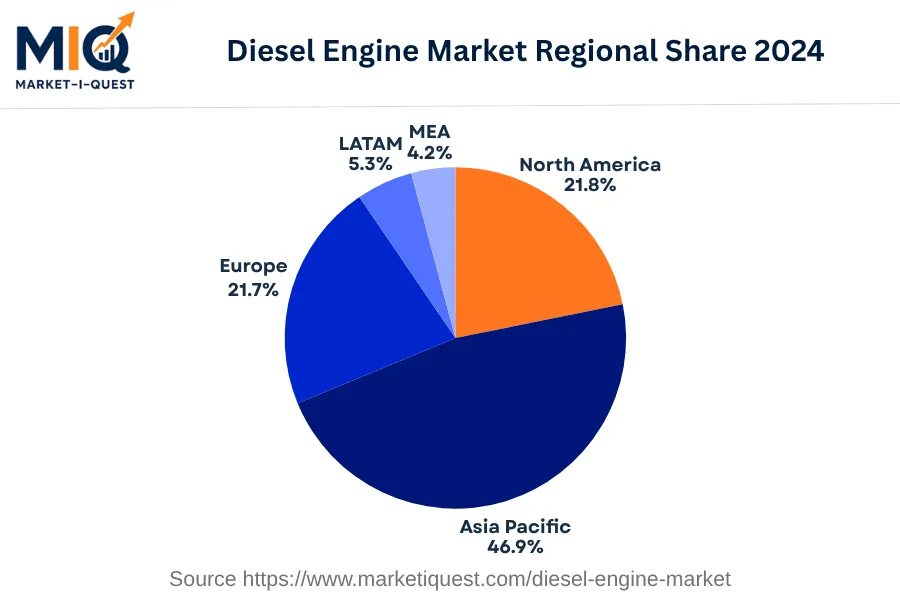
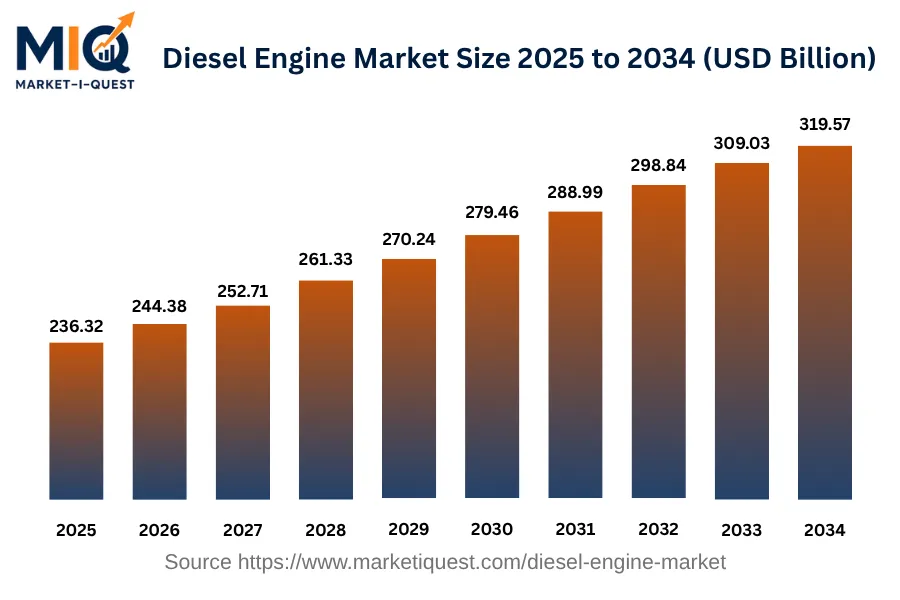
The Diesel Engine Market size is projected to rise from USD 236.32 billion in 2025 to USD 319.57 billion by 2034, with a CAGR of 3.41%. The market will continue to show steady growth, climbing from its 2024 level of USD 228.53 billion. This consistent expansion is due to the increasing requirement for diesel engines in various industries as they offer better fuel efficiency compared to other engines. Moreover, the continuous advancements and technological evolution in diesel engines may also contribute to the market size increment. On a regional basis, during 2024, Asia Pacific had the highest share at 46.93%, followed closely by North America and Europe with shares of 21.84% and 21.72% respectively. Meanwhile, LATAM accounted for 5.34% of the market share and MEA contributed 4.17%.

Key Takeaways

  • By Power Rating - 1-2 MW subsegment led the Diesel Engine Market accounting for a substantial share in the base year.
  • By End User - Automotive segment emerged as the leader accounting for a significant market percentage.
diesel-engine-market market size

Key Driving Factors

Implementation of High BS-VI Emission Standards

Several key markets, including the European Union and India, have adopted stringent BS-VI Emission Standards. These standards lower the acceptable levels of harmful pollutants a diesel engine can emit, necessitating manufacturers to upgrade their technologies. A direct consequence of this is a significant push for research and development in the Diesel Engine Market. Manufacturers are striving to innovate high-efficiency, low-emission diesel engines that will comply with these rigid norms while maintaining power and performance. This regulatory intervention therefore indirectly propels the diesel engine market.

Expansion of Commercial Shipping Activities

Around the globe, there has been a substantial increase in maritime commercial activities. Diesel engines, recognized for their fuel efficiency and power, are widely used in shipping vessels. Higher trade volumes lead to a higher number of cargo ships on the water, which consequently increases the need for reliable and efficient diesel engines. This boom in shipping and trade introduces a direct causal mechanism propelling the growth of the diesel engine market. Manufacturers must therefore meet this increasing demand by scaling production, iterating designs and ensuring the reliability of their engines for marine commercial usage.

Market Evolution by Timeline

2019-2023
This period saw China and India as major buyers due to the growth in commercial vehicles and infrastructure needs. Euro 6 on-road emissions standard drove technological advancements to meet these cleaner standards in Europe, while Tier 4 standards applied for non-road diesel engines in the US. Suppliers faced challenges to meet these rigorous emission standards without compromising engine performance, and high R&D investments were typical. Diesel prices, though fluctuating, remained relatively low. Key risks during this time included increasing public scrutiny on air pollution issues, prompting governments and companies toward more eco-friendly alternatives.
2024
In 2024, electrification began impacting the diesel engine market. The demand for diesel engines in passenger cars witnessed a significant fall, notably in Europe due to the rising popularity of electric vehicles (EVs). Technological development continued around emissions containment, but the pace slowed due to increasing EV adoption. Several cities initiated diesel bans, disrupting the market dynamic and shifting focus to other engine technologies. Commercial models had to adapt, experiencing a transition towards leasing of engines to offset initial purchase costs. There was a growing introduction of bio-diesel alternatives, reducing dependency on petroleum diesel.
2025-2029
This phase showed a stronger shift to EVs and alternative fuels, affecting market demand in urban areas and developed countries, though rural and off-road applications kept a certain level of diesel engine demand. Companies started testing hydrogen fuel cells and electric powertrains for heavy-duty vehicles. However, these technologies were not mature, resulting in continued preference for diesel in this segment. Policies like suburb diesel bans spread in more cities across Europe and Asia. Leasing contracts gained popularity, and suppliers had to ensure compliance with increasingly stringent environmental standards, which led to higher manufacturing costs.
2030-2034
A number of countries planned to ban internal combustion engines entirely, impacting the diesel engine market significantly. However, industries including shipping, construction, and agriculture remained as consistent buyers due to a lack of feasible alternatives. Diesel-hybrid technologies and fuels with lower carbon footprints were developed to comply with strict climate and pollution regulations. Challenges included significant R&D costs for low-emission technologies, while low-sulphur diesel fuel provided a stop-gap solution. Commercial trends included an increase in partnership-based models, with companies collaborating to address technological challenges together and mitigate risk.

Future Market Outlook

Future Opportunities

The ongoing transformation within the diesel engine market signals diverse future opportunities built on current technological and regulatory frameworks. As countries, such as Germany and France, implement stricter emissions regulations, there is a growing incentive for companies to develop cleaner diesel technologies. A notable example is transitioning to renewable diesel, which has gained traction in the U.S. as a cleaner alternative, supported by favorable tax incentives and increasing consumer demand for eco-friendly options. In 2023, the U.S. Environmental Protection Agency proposed further revisions to the biodiesel and renewable diesel programs, providing additional impetus for innovation in diesel technologies. This presents a significant market opportunity for manufacturers specializing in biodiesel production, such as Renewable Energy Group. Moreover, collaborations between companies, including the partnership between MAN Energy Solutions and Wärtsilä, are aimed at enhancing diesel engine efficiency and sustainability in marine applications. As digital connectivity and automation gain prominence, opportunities for smart diesel engines equipped with IoT capabilities will expand, allowing real-time data analytics for optimized performance and reduced downtime. Automotive manufacturers can capitalize on this trend by integrating advanced telemetry systems that monitor engine health and emissions. Overall, the convergence of regulatory compliance and technological advancements offers a clear path for companies to revamp their diesel engine offerings to meet future demands while maintaining competitiveness.

Segmentation Analysis

By Power Rating

The market is divided into subsegments including 0.5-1 MW, 1-2 MW, 2-4 MW, and Above 4 MW. The 1-2 MW subsegment accounted for the largest revenue share while the Above 4 MW subsegment is expected to grow at the fastest CAGR during the forecast period.

Largest Revenue Share

1-2 MW

Market Share Leader

The 1-2 MW subsegment dominates the revenue charts in this market due to several factors. Firstly, the products in this range are cost-efficient while still offering sufficient power for most industrial applications. This makes them highly attractive to medium-to-large scale businesses looking at reducing capital expenditure without compromising their operations. Additionally, these units find wide traction across a plethora of regions, especially in developing countries, where most of the industries prefer this range for its balance between power and cost. In terms of regulation, the 1-2 MW range benefits from fewer restrictions and favourable policies, further enhancing its appeal. Its customer base is vast and spans several sectors including manufacturing, IT, logistics among others. These machines also score highly on purchasing criteria like durability, maintenance costs and energy efficiency. Lower switching costs and widespread channels of distribution also facilitate its market dominance. It’s important to note that these trends might vary across different geographies.

Fastest CAGR

Above 4 MW

Forecast Period Growth Leader

While the Above 4 MW segment might not boast of the largest revenue share, it is expected to grow at the fastest CAGR in the forecast period. This growth can be attributed to the increasing demand for high-power applications in larger industries and infrastructural projects. The advance in technology and the reduction in price of higher-capacity units have eased initial adoption barriers and increased the appeal of these units. Governments across various countries are introducing favorable policies and tax incentives to promote the adoption of more efficient and cleaner power, giving a considerable push to this segment. However, it’s important to anticipate near-term risks such as possible changes in energy regulations or the impact of global economic conditions on capital expenditure by large industries. Expensive switching costs may initially be a hindrance, but long-term benefits such as increased efficiency and lower operating costs could offset these drawbacks.

By End User

The market is divided into subsegments including Automotive and Non-Automotive. In 2024, the Automotive subsegment held the largest revenue share, while Non-Automotive subsegment is expected to grow at the fastest CAGR during the forecast period.

Largest Revenue Share

Automotive

Market Share Leader

The Automotive subsegment commanded the largest share of the end-user market in 2024 primarily due to the ever-increasing global automobile production and sales. The driving factors behind this are the maturing automotive markets in developing nations, growing disposable incomes, and the rising demand for technologically advanced vehicles. The automotive industry's growth trajectory was also influenced by supportive government policies such as incentives for electric vehicles and substantial investments in infrastructural improvements like road networks. Additionally, strict emissions regulations and fuel efficiency standards propelled the demand for advanced automotive components and thus boosted this market segment. Other factors, such as increasing urbanization rate and growing consumer spending on vehicle purchase due to improved economic conditions, have significantly contributed to the Automotive subsegment's leading position.

Fastest CAGR

Non-Automotive

Forecast Period Growth Leader

The Non-Automotive subsegment is predicted to burgeon at the highest rate due to several growth-inducing factors. Emerging technological innovations and the rising need for efficient and sustainable methods across various industries, such as construction, agriculture, and manufacturing are some major catalysts for its growth. The uptake of advanced technologies for process optimization has equally ramped up, further propelling this subsegment's growth. At the same time, improved business conditions post-pandemic, coupled with the initiation of capital projects across many industries, have led to increased investment in non-automotive machinery and equipment. However, risks include regulatory challenges and potential economic slowdown that could dampen investment in new technologies. Nevertheless, the benefits provided by these advancements are expected to outweigh the potential hurdles in the near future.

Competitive Analysis - Diesel Engine Market

Key Market Players

Manufacturers / OEMs

Caterpillar Inc.
US
Cummins Inc.
US
MAN SE
Germany

Key Suppliers & Raw Materials

Bosch GmbH
Germany
Denso Corporation
Japan
Continental AG
Germany

Distributors, Integrators & Channel Partners

Penske Corporation
US
W.W. Williams
US
RYOBI Limited
Japan

Porter’s Five Forces Analysis

This analysis examines the competitive dynamics in the global diesel engine market by focusing on five key forces.

Supplier Bargaining Power

Medium

Certain raw material providers hold power, but competitive supplier market mitigates effects.

Buyer Bargaining Power

High

With numerous suppliers and product standardization, buyers have a high bargaining position.

Threat of Substitutes

Medium

Electric engines pose substitute threat despite high switching costs and integration challenges.

Threat of New Entrants

Low

High capital requirements and stringent regulatory barriers limit new entrants.

Competitive Rivalry

High

Intense rivalry driven by key giants like Cummins, Bosch and Caterpillar.

Regional Analysis

Geographic market dynamics and growth opportunities across key regions

Global Market Outlook

diesel-engine-market market regional share

North America

In 2024, the North American diesel engine market was distinguished by resilience and diverse application across sectors. Regulatory authorities' stringent emission standards commanded adaptations in engine manufacturing, contributing to some of the year's technological advancements. Investment in advanced engine technology, particularly in the U.S., resulted in diesel engines with improved fuel efficiency and reduced emissions. Mexico's manufacturing sector significantly increased demand, propelling the regional market dynamic.

Trends in the diesel engine market reflected changing consumer behavior and technological shifts. The transition from traditional to smart diesel engines gained pace with the push from government policy enforcement for cleaner and greener technology proliferation in the region. Advanced integration was a significant trend, with companies partnering for technology sharing. For instance, the agreement between Volvo and Daimler focused on fuel-cell technology.

The prominent sectors contributing to diesel engine adoption in 2024 were logistics, construction, and manufacturing, reflecting heavy machinery and vehicle use. Despite electric vehicles’ increasing popularity, businesses and government entities still preferred diesel engines for heavy-duty applications. Enterprises in Canada's mining sector significantly contributed to diesel engine use owing to the industry's extensive operations. Diesel's cost-effectiveness compared to alternatives further sustained the market demand from the retail sector in North America.

Asia Pacific

In 2024, the Diesel Engine Market in Asia Pacific witnessed notable dynamics driven by regulatory changes, rising demand, technology adoption, and evolving supply structures. Stringent emission standards led by China’s Blue Sky Protection Campaign and India's BS6 norms spurred mass adoption of cleaner, advanced diesel engines. Robust industrialization in ASEAN markets, particularly in Thailand and Indonesia, amplified the demand for heavy-duty diesel engines in sectors such as construction, mining, and manufacturing. Enhanced fuel efficiency and reliability brought through technological advancements further improved diesel engine adoption rates.

Pertaining to trends, the buyers in Japan and South Korea demonstrated strong preference for eco-friendly bio-diesel engines, pushing manufacturers to innovate and modify their offerings. In China, the increased popularity of online sales channels led to significant changes in distribution dynamics. Across Asia Pacific, widespread adoption of Industry 4.0 principles fostered numerous partnerships and M&A activities within the market, particularly aimed at technological integration and broadening the product range. Regulatory rigidity was noticeable, with governments intensifying enforcement of emission standards and incentivizing environment-friendly technologies. These profound shifts in the diesel engine market were most prominent in sectors such as transport, utilities, and manufacturing, with players seeking efficient energy solutions that comply with local and international environmental standards.

Europe

In 2024, the Diesel Engine Market in Europe faced several unique drivers and trends. Strict emission regulations enforced by the European Union (EU), such as the Euro 6 standards, dictated manufacturers' focus towards more efficient and cleaner engines. Increased investment in research and development (R&D) by manufacturers like Volkswagen and BMW enabled advancements in diesel engine technology. The rise of hybrid and electric vehicles reduced the demand for diesel engines, creating competitive pricing dynamics in countries like the UK and Germany.

Trending behaviors included a shift by automotive consumers towards vehicles with a lower environmental impact, specifically in Germany, prompting auto manufacturers to invest in cleaner diesel technologies or alternative fuel solutions. This also led to strategic partnerships and acquisitions, such as Volvo partnering with Daimler to develop fuel cell systems. In the sector of construction and agriculture, especially in France and Italy, high-performance diesel engines remained popular. However, a decline in diesel engine sales was observed in the passenger cars segment due to the emergence of electric cars and policy enforcement by the EU to reduce carbon footprint. In the shipping sector, particularly in the Nordics, diesel engines dominated, driven by diesel’s superior energy density and reliability on long voyages. Across the Benelux region and Central & Eastern Europe, diesel remained a primary choice for heavy-duty commercial vehicles due to its robustness and high-torque performance.

Latin America

In 2024, the Diesel Engine Market in Latin America demonstrated significant growth fueled by various factors. Increased demand, driven by the flourishing commercial vehicle sector, primarily in Brazil, Mexico, and Argentina, put direct pressure on production and subsequently on prices. Stringent emission standards imposed by governments, particularly in Chile and Colombia, stimulated the adoption of cutting-edge diesel engine technology. Additionally, heavy investments made in the manufacturing and mining sectors across Peru and Mexico kick-started the supply dynamics.

Consumer behavior, influenced by the adherence to environmental norms and regulations, trended towards more technologically advanced and fuel-efficient diesel engines. The shift towards products that complied with emission standards was evident across sectors like utilities, manufacturing, and retail. Larger enterprises in the region were found showing an increased preference for Original Equipment Manufacturer (OEM) partnerships, leading to a boom in M&A activity, particularly in the Brazilian and Mexican markets. Another significant trend was the enforcement of Euro VI and Proconve P8 emission standards across several Latin American countries, which had a direct effect on product designs and buyer preferences. Lastly, a drift towards online sales channels, redefining the way manufacturers, distributors, and customers interacted, was observed, indicative of the region's changing retail dynamics.

Middle East & Africa

In 2024, the Diesel Engine Market in the Middle East and Africa remained influenced by various industry-specific drivers and trends. Key drivers included stringent emission regulations in Israel and South Africa, increased foreign investments in Saudi Arabia and UAE in line with Vision 2030 and UAE Vision 2021 respectively, as well as robust technology adoption in telecom and utility sectors across Qatar and Egypt.

Market supply dynamics saw Nigeria and Kenya leveraging local manufacturing capabilities, and spikes in diesel pricing impacted consumer behavior, particularly in retail and financial services sectors.

A notable trend was the accelerated shift toward energy-efficient diesel engines due to policy enforcement in the healthcare and government sectors, primarily in UAE and South Africa. This influenced buying behavior, further enhanced by the narrowing price-performance gap with gasoline engines.

Partnerships and M&A activities, especially within the oil and gas sector in Saudi Arabia and Qatar, were characteristic of an increasingly consolidated market. Demand for diesel engines furthermore spiked in tech-savvy sectors such as utilities and telecom, especially for power backup solutions, with Egypt and Israel leading the charts.

Standardization efforts across the region, for instance, the adoption of Euro VI emission standards, were key markers of markets' maturity and commitment to environmental sustainability in the base year.

Recent Industry Developments

Latest market innovations, product launches, and strategic initiatives

June 2026

These organizations launched the Marine Diesel MD 3.0 at the Seawork trade show. This is a compact, lightweight diesel engine built specifically with built-in remote control systems to power autonomous, uncrewed boats without human intervention.

August 2025

Caterpillar launched a new 1.5-megawatt diesel generator set. This development focused on providing heavy-duty backup power in a significantly smaller physical package, targeting industrial facilities and data centers where physical space is highly restricted.

Frequently Asked Questions