Hydrocarbon Solvents Market Snapshot

Key Players

  • ExxonMobil Corporation (United States)
  • Royal Dutch Shell (Netherlands)
  • Chevron Phillips Chemical Company (United States)
  • China Petroleum & Chemical Corporation (China)
  • Total SA (France)
  • BASF SE (Germany)
  • BP Plc (United Kingdom)
  • Petroliam Nasional Berhad (Malaysia)
  • Idemitsu Kosan Co. Ltd. (Japan)
  • Reliance Industries Limited (India)

Market Size

Base Year 2024
$6.48 Bn
CAGR
4.7%
Forecast 2034
$10.26 Bn

Market Segments

By Type
  • Aliphatic Naphtha
  • Mineral Sprit
  • Heptane
  • Hexane
  • Aromatic
By Application
  • Paints & Coatings
  • Cleaning & Degreasing
  • Adhesives
  • Aerosols
  • Rubber & Polymer
  • Printing Inks
  • Pharmaceuticals
  • Agriculture Chemicals
  • Others

Market Dynamics

Drivers
  • Growing industrialization
  • Increasing demand in pharmaceuticals
Restraints
  • Regulatory environment restrictions
  • Fluctuating raw materials prices
Opportunities
  • Increased industrialization globally
  • Environmentally friendly solvent demand

Market Size

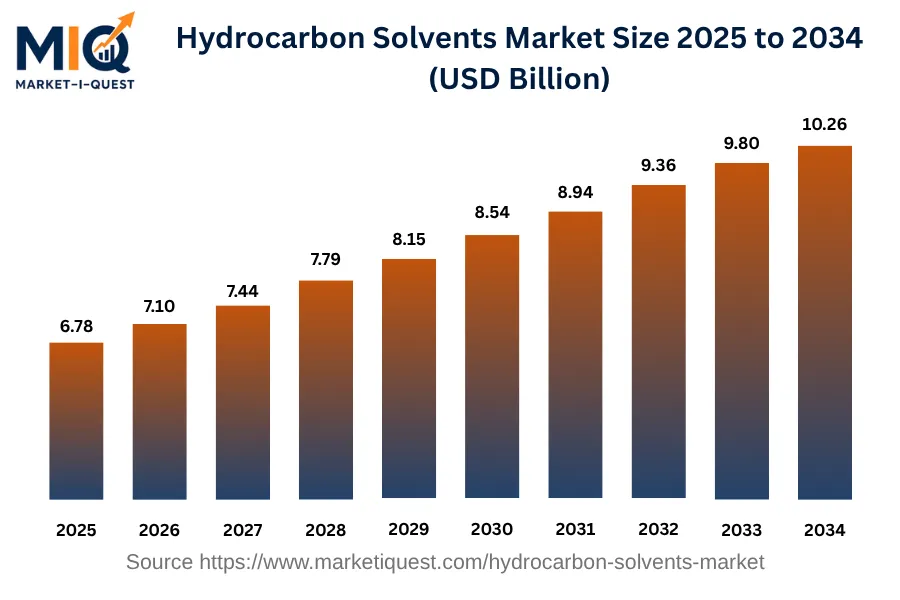
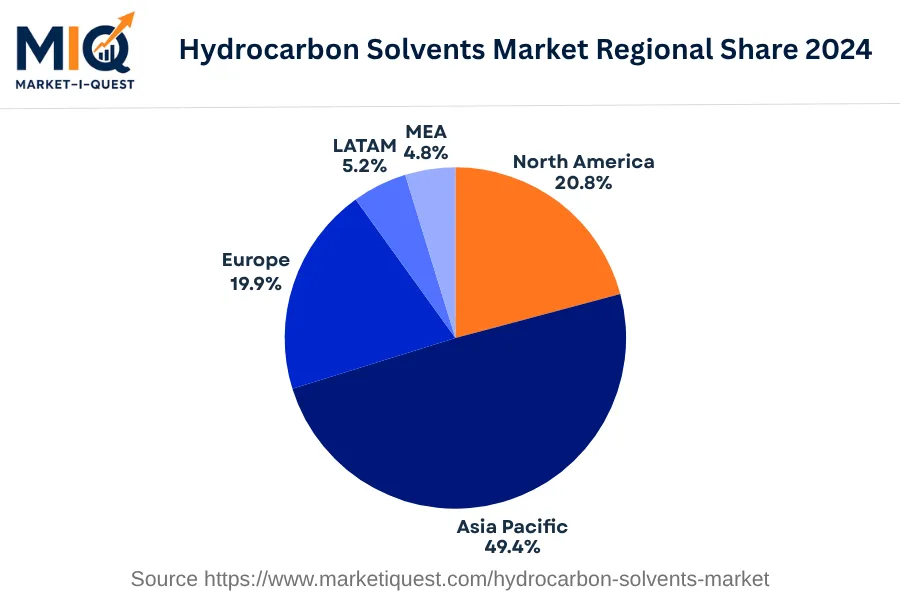
The Hydrocarbon Solvents Market valued USD 6.78 billion in 2025 with the projection to reach USD 10.26 billion in 2034, with a CAGR of 4.7%. The market experienced steady growth from the value of 2025 at USD 6.78 billion, leading up to its 2034 projected value. This growth in the market is observed majorly due to increased usage across various industries, including paints and coatings, cleaning and degreasing and others applications. Moreover, the growing demand for hydrocarbon solvents in the pharmaceutical industry has been a significant contributor to the overall growth of the market. Whereas, the regional share breakdown in 2024, Asia Pacific accounted for 49.4% of the market, the highest among all regions. North America and Europe followed, holding 20.8% and 19.9% respectively, while LATAM and MEA held smaller percentages of 5.2% and 4.8% respectively.

Key Takeaways

  • By Type - Hexane led the market taking a significant chunk of the share in 2024.
  • By application - Pharmaceuticals held the prime position with most market share in 2024.
hydrocarbon-solvents-market market size

Key Driving Factors

Increased usage in Pharmaceutical Industries

Hydrocarbon solvents, particularly in their high-purity form, have found significant application in the pharmaceutical sector. They are primarily used in drug formulation, extraction processes and as cleaning agents. However, with their unique properties, such as low toxicity, compatibility with other chemicals and affordability, make them a favorable choice. Furthermore, the ongoing growth of the pharmaceutical industry, especially in developing countries, is providing a substantial market for these solvents. Various pharmaceutical companies are heavily investing in research and development activities, subsequently increasing the demand for hydrocarbon solvents.
Enhanced environmental regulations for Paints and Coatings Industry

Hydrocarbon solvents are essential components in the paints and coatings industry. They are utilized to dissolve, disperse and adjust viscosity in paint and coatings products. Recent environmental regulations, most notably the Air Pollution Control Act in the US and the European Union's REACH (Registration, Evaluation, Authorisation, and Restriction of Chemicals), have drove this industry towards using safer, low-VOC (volatile organic compounds) hydrocarbon solvents. These restrictions have increased the market demand for hydrocarbon solvents which are significantly lower in VOCs compared with other traditional solvents.

Market Evolution by Timeline

2019-2023
In this period Asia Pacific, particularly China and India, obtained a substantial quantity of hydrocarbon solvents, mainly for usage in paints and coatings. Manufacturers majorly focused on developing significantly less harmful variations of these solvents. The market was regulated by VOC emissions standards such as 'Directive 2004/42/EC' in European Union. Pricing was primarily contract-based and partnerships were witnessed with downstream users such as paint manufacturers.
2024
North America highlighted a significant demand for hydrocarbon solvents in the construction industry following urbanization trends. This allowed for the pilot integration of renewable and bio-based hydrocarbon solvents by major suppliers. Regulatory policies focused on the possible health and environmental risks, directing pricing towards green alternatives. Partnership patterns shifted to sustainability-focused organizations, with supply risks associated with scaled manufacturing for bio-based alternatives.
2025-2029
Latin America is expected to witness increased usage of hydrocarbon solvents in agricultural applications, particularly in pesticides. Bio-based hydrocarbon solvents will likely reach a mature level of integration and facing constraints around biodiesel supply. Regulations, such as 'EU Ecolabel for Indoor Paints and Varnishes', will likely drive for green solvents. Contracts are projected to become integrated to 'green' benchmarks, leading to collaborations with innovators of eco-friendly technologies. However, risks related to reliance on consistent bio feedstock supplies will be present.
2030-2034
Demand for hydrocarbon solvents in cleaning products and adhesives are expected to surge in Europe. The supply side will likely witness the introduction of hydrocarbon solvents derived from waste plastic. Whereas, the 'REACH' regulation are projected to become instrumental in defining solvent standards. Market prices will likely trend upwards due to the adoption of new technologies. New partnerships are expected in the forecasted period in waste management for ensuring feedstock supply, with the risk associated with changes in waste generation and collection policies.

Future Market Outlook

Future Opportunities

Future opportunities in the hydrocarbon solvents market are being shaped by regulatory environments and the increasing demand for sustainable products. The ongoing shift towards more stringent sustainability frameworks, such as the aforementioned EU Green Deal, is motivating companies in the sector for pursuing eco-friendly solvent alternatives. Major suppliers such as Dow Chemical are investing in research to create bio-derived solvents that comply to these regulations while offering performance consistency with traditional hydrocarbons. In North America, as several states adopt stricter VOC regulations, sourcing and production methods are anticipated to diversify and opening new markets for suppliers that specialize in compliant formulations. Simultaneously, the shift in automotive sector towards electric vehicles is creating opportunities for solvent manufacturers for developing specialized cleaning and degreasing solutions for EV components. Partnerships between solvent providers and automotive manufacturers, such as LG Chem's collaboration with General Motors, highlights the shifting landscape. Moreover, the increasing interest in green chemistry methodologies indicates further avenues for growth, with educational institutions such as MIT leading initiatives on sustainable solvent development. Moreover, a surge in research focused on solvents for pharmaceuticals highlights the ongoing evolution toward health-conscious formulation methodologies, indicating that future market opportunities will likely center around compliance, innovation, and strategic collaborations.

Segmentation Analysis

By Type

The market is divided into subsegments including Aliphatic Naphtha, Mineral Sprit, Heptane, Hexane, and Aromatic. Hexane accounted for the largest revenue share while Aromatic is expected to grow at the fastest CAGR during the forecast period.

Largest Revenue Share

Hexane

Market Share Leader

Hexane has emerged as the subsegment with the highest revenue share within this market. The key factors driving the demand for Hexane are its various applications in the extraction process of edible oils from seeds and vegetables. Hexane's relatively low cost and high efficiency have made it the preferred choice of consumers across various industries. Geographically, demand from growing economies with large-scale industries has also contributed significantly in the revenue growth of the subsegment. Moreover, the presence of established distribution channels ensures consistent supply of Hexane to end users.

Fastest CAGR

Aromatic

Forecast Period Growth Leader

Aromatic naphtha is expected to grow at the fastest rate within the forecasted period. However, the wide usage in the manufacturing of paints, rubber, and chemicals, driving its demand in large-scale industries. Further, its unique properties of providing excellent solvency with a high flash point, low toxicity and high stability making it a preferable choice for industries seeking safer and more effective alternatives. Technological advancements and increased R&D initiatives in developing aromatic derivatives are likely to serve as significant growth drivers. Adopting strategies such as partnerships can reduce some of these challenges and ensure efficient utilization of resources.

By Application

The market is divided into subsegments including Paints & Coatings, Cleaning & Degreasing, Adhesives, Aerosols, Rubber & Polymer, Printing Inks, Pharmaceuticals, Agriculture Chemicals, and Others. Among these, the Pharmaceuticals subsegment had the largest revenue share in 2024 base year, whereas the Agriculture Chemicals subsegment is believed to be growing at the fastest rate.

Largest Revenue Share

Pharmaceuticals

Market Share Leader

Pharmaceuticals segment holds the largest market share primarily because of the ever growing global pharmaceutical industry and the need to meet exacting standards. The demand for pharmaceuticals has been rising consistently majorly due to a surge in chronic and infectious diseases, increasing population and advancements in medicines. The production and delivery of pharmaceutical products demand precision and purity. This several factors significantly contributes to the highest revenue generation in this segment. Thus, switching costs also become considerably high which limits market competition, contributing to the large revenue share.

Fastest CAGR

Agriculture Chemicals

Forecast Period Growth Leader

The Agriculture Chemicals segment is expected to be the fastest-growing due to multiple factors. With steadily rising global population trends indicate a significant rise in the demand for agricultural produce. This increasing demand acts as a driver for the growth of agriculture chemicals for maximizing the yield. Whereas, the advent of green chemistry and its adoption in the chemical industry serves as a key growth driver. This will lead to the development of more eco-friendly agriculture chemicals which is in line with global environmental policies. Also, partnerships and collaborations between manufacturers and agricultural firms are being actively explored, aiming for developing more effective and sustainable products. Despite these, the outlook continues to be robust, promising faster growth compared to its counterparts.

Competitive Analysis for Hydrocarbon Solvents Market

Key Market Players

Manufacturers / OEMs

ExxonMobil Corporation
US
Royal Dutch Shell
Netherlands
BASF SE
Germany

Key Suppliers & Raw Materials

Sinopec Corporation
China
British Petroleum
UK
Nynas AB
Sweden

Distributors, Integrators & Channel Partners

Pon Pure Chemicals Group
India
Univar Solutions Inc.
US
Nexeo Solutions, Inc.
US

Porter’s Five Forces Analysis

This analysis scrutinizes the competitive situation and trends within the Hydrocarbon Solvents market.

Supplier Bargaining Power

Medium

Suppliers' power is somewhat moderated by the availability of numerous raw material providers.

Buyer Bargaining Power

High

Buyers exert strong power due to a wide array of substitute products and competitive pricing.

Threat of Substitutes

High

Threat is high because of the availability of alternate green and bio solvents.

Threat of New Entrants

Medium

Barriers like stringent regulations and high setup costs limit, but don't eliminate, entry threats.

Competitive Rivalry

High

Intense rivalry due to presence of numerous global and regional players.

Regional Analysis

Geographic market dynamics and growth opportunities across key regions

Global Market Outlook

hydrocarbon-solvents-market market regional share

North America

In 2024, North America's market highlighted significant strength driven by various factors. Regulatory initiatives such as Canada's Chemical Management Plan fueled industry adaptation, driving demand for greener hydrocarbon solvents. Innovative technology adoption, especially in the United States, with advanced formulation techniques boosting solvent efficiency. Investments in the petroleum sector, such as Pemex's explorations in Mexico, influenced the availability of raw materials and pricing.

However, buyer preference shifted toward low-aromatic and biodegradable solvents, primarily driven by environmental awareness and stringent regulations. In the technology realm, a notable adoption of green and bio-solvents and promotion of waste reduction measures. In terms of sector interaction, considerable partnerships and mergers occurred, especially in the manufacturing and retail sectors. Customers across diverse sectors, including paints and coatings, pharmaceuticals and automotive industries, highlighted significant demand for hydrocarbon solvents. Government agencies and environmental bodies sustained policy enforcement, imposing strict regulations on solvent emissions and utilization, further driving demand for eco-friendly products.

Asia Pacific

In 2024, the market in Asia Pacific was notably factor-driven with a blend of regulatory impacts, demand surges and technological adoptions. Demand was significantly increased by the robust consumer goods manufacturing sectors in key markets such as China and India. Meanwhile, countries such as Japan, South Korea and Australia witnessed the introduction of stringent regulations addressing to solvent emissions, enforcingcleaner production methods and influencing the market dynamics. Investment in advanced technologies to optimize solvent production, particularly in the critical ASEAN markets.

A growing preference for bio-based solvents witnessed across sectors from manufacturing to enterprise-level consumption. The utilities sector in India and China specifically shifted towards these environment-friendly alternatives. In response to the changing market, there were several strategic alignments partnerships and mergers were formed, especially in China and key ASEAN markets. Simultaneously, stricter enforcement of environmental policies had manufacturers complying to prescribed emission standards.

Europe

In 2024, the market in Europe showed robust activity due to various drivers and notable trends. Increased demand came from industries such as manufacturing and retail, driven by a growing demand for organic solvents and a shift towards bio-solvents. Additionally, investments into technology adoption accelerated the production of cost-effective hydrocarbon solvents, such as Aliphatic and Aromatic solvents. Regulations enforcing lower VOC emissions caused about a review of solvent-based formulations, notably in Germany and the United Kingdom, which subsequently increased the demand for low aromatic and de-aromatized hydrocarbon solvents. Meanwhile, in France and Italy, stringent environmental regulations ushered in higher demand for eco-friendly and safer solvents, driving producers to innovate and develop low-toxicity products.

Market trends highlighted a consumer shift towards eco-friendly solvents, particularly in the Nordics and Benelux, where green label certifications for exceeding environmental standards have become increasingly frequent. The shift saw a rise in partnerships and mergers between solvent manufacturers and green tech firms. Moreover, central and Eastern Europe witnessed a surge in online channels, accommodating larger portfolios of hydrocarbon solvents. The enforcement of solvent emission directives, such as the European Union's VOC Directive, led to further innovation in the market, supporting manufacturing sectors for achieving sustainability targets by embracing safer solvents.

Latin America

In 2024, Latin America's market experienced a significant shift due to various factors affecting demand and supply dynamics. Increased urbanization, specifically in countries such as Brazil and Mexico, triggered robust demand for solvents in the construction and paints & coatings industry. Whereas, in Argentina, regulatory monitoring, such as REACH legislation caused a surge in demand for eco-friendly and bio-based solvents. Technology adoption also influenced the market in LATAM region, where Colombia's oil refineries expanded their production capabilities, and Chile promoted industrial growth by incentivizing investment in solvent production.

Consumer behavior began to favor environmentally-friendly products, resulting in a shift towards bio-based solvents across retail sectors. LATAM saw a shift in product preferences, with hydrocarbon solvents used in pharmaceutical and cosmetic industries due to their superior cleaning and dissolving capabilities. Channel dynamics evolved as well, with digital platforms becoming a prominent route for trade in Peru's solvent industry. This led to the formation of partnerships to secure supply chain continuity. Stricter enforcement of environmental policies by government across LATAM resulted in manufacturers opting for safer, low-VOC solvents, shifting the entire market landscape in 2024.

Middle East & Africa

In 2024, the Hydrocarbon Solvents market in the Middle East and Africa highlighted a notable vitality due to several influential factors. Key drivers included growing demand from the oil and gas industry, particularly in countries such as Saudi Arabia and the UAE, due to extensive exploration and production activities. South Africa’s industrialisation initiatives also increased demand, while Nigeria’s growing paint and coatings industry fed increased consumption. Technology adoption was a visible trend, with Kenya and Egypt utilizing high purity solvents in emerging tech-driven sectors such as telecommunications.

Pricing played a significant role in market dynamics. In Qatar, the lower costs of hydrocarbon solvents compared to other organic solvents stoked significant uptake. Key trends included increased buyer preference for greener alternatives across healthcare and manufacturing sectors—envirocare trends in these sectors were enforced through stringent regional policies. Israel’s medical equipment manufacturing sector portrayed a shift towards lighter, cleaner solvents to comply with such regulations. Partnerships and M&A were seen in UAE, where local players allied with international brands to access advanced solvents tech. Lastly, standards enforcement was clear across all sectors, with governments emphasizing compliance with health, safety, and environmental policies.

Recent Industry Developments

Latest market innovations, product launches, and strategic initiatives

June 2026

Major industry players, including ExxonMobil and Shell, have accelerated the shift toward "low-aromatic" and "high-purity" aliphatic solvent grades. This strategic pivot is a direct response to tightening global VOC (Volatile Organic Compound) regulations, which are forcing manufacturers to replace traditional, high-toxicity aromatic solvents with paraffins (C6-C8) that offer similar performance with significantly lower environmental and health risks.

January 2026

Building on the U.S. Environmental Protection Agency (EPA) mandates from late 2024, regulatory bodies in North America and Europe have further tightened emission standards for architectural finishes, capping VOC limits at 50 g/L for flat paints. This regulatory environment is effectively commoditizing traditional high-VOC hydrocarbon solvents and forcing companies to invest heavily in reformulated, low-emission solvent blends or risk non-compliance penalties and production halts.

Frequently Asked Questions