Aersol Market Snapshot

Key Players

  • AkzoNobel (Netherlands)
  • Ball Corporation (United States)
  • Henkel AG & Co. (Germany)
  • Proctor and Gamble (United States)
  • Reckitt Benckiser Group (United Kingdom)
  • SC Johnson (United States)
  • Thymes LLC (United States)
  • Unilever (United Kingdom)
  • Avon Products Inc (United Kingdom)
  • Coster Tecnologie Speciali S.p.A. (Italy)

Market Size

Base Year 2024
$95.84 Bn
CAGR
5.85%
Forecast 2034
$169.22 Bn

Market Segments

By Type
  • Aerosol Spray
  • Aerosol Foam
  • Aerosol Gel
By Propellant Type
  • Hydrocarbon
  • Compressed Gas
  • Dimethyl Ether
  • Hydrofluorocarbons
By End Use
  • Commercial
  • Residential
  • Institutional

Market Dynamics

Drivers
  • Rapid industrial growth
  • Rising consumer awareness
Restraints
  • Stringent environmental regulations
  • Consumer health concerns
Opportunities
  • Emerging economies' demand growth
  • Environment-friendly aerosol alternatives

Market Size

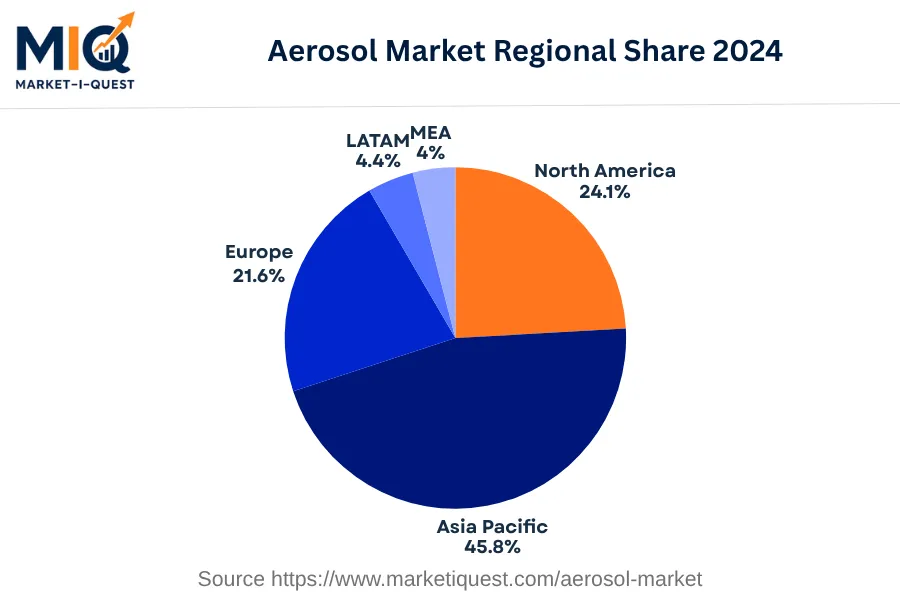
The Aerosol Market size stood at 101.45 billion USD in 2025 and expanded at a compound annual growth rate (CAGR) of 5.85% to reach 169.22 billion USD by 2034. This upward trajectory indicates continuous growth over this nine-year period. A variety of factors fueled the market's expansion. Among the contributing factors were technological advancements, increasing popularity and awareness of aerosol products, and growing applications in various sectors such as personal care, automotive, medical, and paints. On a regional level in 2024, the aerosol market was most heavily concentrated in the Asia Pacific, which constituted 45.8% of the share. North America followed with a 24.1% share, Europe with 21.6%, while Latin America and the Middle East and Africa had a much smaller presence with 4.4% and 4.0% respectively.

Key Takeaways

  • By Type - Aerosol Spray held the majority stake with a prominent market presence in the base year.
  • By Propellant Type - Hydrocarbon led accounting for a substantial share in the base year.
  • By End Use - Commercial segment emerged dominating the market in the base year.
aerosol-market market size

Key Driving Factors

Impact of Sustainable Packaging Regulations

The growth of the aerosol market in many regions is highly influenced by environmental regulations aimed at promoting sustainable packaging. These include EU Directive 94/62/EC in Europe and Resource Conservation and Recovery Act (RCRA) in the United States, which necessitate the use of more environmentally friendly and easily recyclable materials. As most aerosol containers are made of metal, which is recyclable, the industry benefits from these legislative tendencies. Manufacturers are also increasingly investing in product innovation to meet these rigid regulations and consumer preference towards eco-friendly products, which is further driving the Aerosol market.

Changing Consumer Preferences towards Easy-to-Use Products

Modern consumers are increasingly drawn to convenience and ease-of-use in their products, a major selling point for aerosols. Aerosols are widely used in industries such as personal care, household, automotive and industrial applications which allows consumers to utilize products such as paints, cleaners, and deodorants in an easy, ready-to-use format. The trend is particularly strong within the personal care industry, where the demand for convenient and fast-acting products like dry shampoos and antiperspirants is on the rise. This increasing preference to easy-to-use products among consumers propels the growth of the Aerosol market.

Market Evolution by Timeline

2019-2023
During this period, Aerosol usage had vast applications globally, predominantly seen in Paints and Coating industries. For instance, in 2019, the majority of buyers were coming from Asia-Pacific with the automotive industry leading the demand. In terms of technology, Aluminum aerosol cans were mainstream due to their easier recycling process and cost effectiveness. Some constraints were present around the harmful environmental impact of propellants used in aerosols. As for regulation, several countries started adopting more rigid aerosol standards, like Brazil implementing INMETRO's mandatory regulations. In terms of commercial model, long-term contracts with network distribution providers was a common practice, for securing stable supply. Inflation was a risk faced by the production side causing cost hikes.
2024
In 2024, Personal Care industry increasingly began using aerosols, especially in North America and Europe for deodorants and hair sprays. The market integration of Bag-on-Valve (BoV) technology was a significant development offering product-preserving benefits. On the other hand, the constraint of CFCs causing ozone depletion was addressed through Montreal Protocol standards for aerosols, leading to transition to environment-friendly propellants. Prices were generally stable with occasional increases due to raw materials price fluctuation. A significant risk was non-compliance to regulations such as the Hazardous Materials Transportation Act resulted in fines.
2025-2029
In this time period, aerosols used in medical applications surged, notably in Latin America. Technologically, compressed air became a common propellant due to no propellant-product mixing. However, costs associated with machinery upgrades posed a constraint for many companies. The ISO13485 for medical aerosols was put in place, setting a universally recognized standard for quality and safety. The predominant commercial model continued to be long-term contracts that were typically renegotiated every five years. As for risks, inconsistent supply of raw materials began impacting production schedules.
2030-2034
Come 2030 to 2034, demand from emerging economies in Africa for personal care aerosols increased notably. Technological advancements led to the usage of bio-based and water-based aerosols to curb environmental impact. The main constraint for these technologies was the higher pricing. For regulation, the UN's Sustainable Development Goals advocated for more eco-friendly forms of packaging influencing the aerosol sector. The commercial model begun to shift towards the usage of e-commerce platforms for selling directly to end consumers. However, budding regulatory laws pertaining packaging waste imposed risks on the industry.

Future Market Outlook

Future Opportunities

Future opportunities in the aerosol market are expected to arise from ongoing advancements in technology and shifts in consumer preferences. The increased regulatory emphasis on sustainability, particularly the push for low-impact aerosols, suggests that manufacturers will need to explore alternative formulations. Companies like Colgate-Palmolive have already begun investing in research to create aerosol products that utilize plant-based ingredients, indicating a trend towards integrating biodegradable components. Furthermore, the development of advanced delivery systems, such as microencapsulation and targeted aerosol distribution, is expected to enhance product effectiveness and attract consumer interest. In 2022, the emergence of market entrants focusing on eco-friendly personal care aerosols showcased a consumer shift towards responsible purchasing. Additionally, regulatory trends in places like California, where Proposition 65 mandates labeling for potentially harmful ingredients, are cultivating an environment where transparency and safety are paramount. Adoption of intelligent aerosol systems, capable of monitoring and optimizing spray patterns for efficiency, is likely to be explored further, as manufacturers look to differentiate their offerings. The international push towards biodegradable and recyclable aerosol containers, as seen with recent initiatives by the Global Plastics Alliance, also represents a significant opportunity for innovation. With consumer awareness around environmental issues on the rise, companies that align their products with these values may find ample opportunities for growth and relevance in the global aerosol market.

Segmentation Analysis

By Type

The market is divided into subsegments including Aerosol Spray, Aerosol Foam, and Aerosol Gel. Aerosol Spray accounted for the largest revenue share while Aerosol Gel is expected to grow at the fastest CAGR during the forecast period.

Largest Revenue Share

Aerosol Spray

Market Share Leader

The Aerosol Spray subsegment currently leads the market in terms of revenue. Its dominance can be attributed to its widespread use across various industries and consumer products. Market players do indeed cater to a wide array of applications including household cleaning products, air fresheners, insecticides, paint sprays, and personal care products, such as deodorants and hair sprays. Its penetration into these diverse applications is driven by its easy and convenient use, portability, and effectiveness. One must take into consideration that geographically, developed markets like North America and Europe hold a significant share due to higher purchasing power and extensive use of aerosol-based consumer products. Regulatory factors also play a crucial role. Many countries have regulations that promote the use of aerosol sprays in preference to other delivery mechanisms due to their lower environmental impact, thereby boosting their sales. Switching costs are relatively high for consumers and manufacturers alike as this would involve not only a change in product formulation but also in packaging, manufacturing, and distribution strategies.

Fastest CAGR

Aerosol Gel

Forecast Period Growth Leader

Even though aerosol gel currently does not lead the market in terms of revenue, it is expected to grow at the fastest rate during the forecast period. The primary driver behind this projected growth is the burgeoning interest in personal care and grooming products where aerosol gels, such as hair styling gels and shaving gels, are gaining popularity. There's also increased adoption of innovative aerosol gel applications in areas such as sun care and body care which is expected to drive further growth. The investment in product formulation and packaging innovation, as well as strategic partnerships with key retail channels, are pivotal catalysts propelling the segment's fast growth. However, market entrants should be aware of potential barriers including consumer perception of aerosol gels' environmental impact as well a relatively high unit cost compared to alternative formats. The issue of VOC emissions associated with aerosol products too could pose a significant near-term risk.

By Propellant Type

The market is divided into subsegments including Hydrocarbon, Compressed Gas, Dimethyl Ether, and Hydrofluorocarbons. In 2024, the Hydrocarbon segment accounted for the largest revenue share while the Dimethyl Ether segment is expected to grow at the fastest CAGR during the forecast period.

Largest Revenue Share

Hydrocarbon

Market Share Leader

In the base year 2024, the Hydrocarbon segment led in revenue generation. This dominance stems from widely-established usage of hydrocarbons as fuel in a variety of applications including power generation, transportation, heating, and in industrial processes. The consistency and reliability of the supply chain for this propellant type further solidifies its leading position. Hydrocarbons also present lower production costs compared to other propellant types, making them the preferred choice for manufacturers and consumers alike. Geographically, demand is concentrated in regions with mature industrial and domestic fuel consumption markets, such as North America and Europe. Although regulatory challenges due to environmental concerns are present, switching costs and widespread adoption make the hydrocarbon segment a hard competitor to dislodge.

Fastest CAGR

Dimethyl Ether

Forecast Period Growth Leader

While Hydrocarbon leads in revenue, Dimethyl Ether is poised for the fastest growth in the forecast period. Dimethyl Ether's potential as a clean, alternative fuel to traditional hydrocarbons is its leading growth driver. It is producing less harmful emissions and poses fewer environmental risks, making it appealing to environmentally conscious organizations and governing bodies. Technological advancements and a focus on sustainable green chemistry are catalyzing the adoption of this propellant. Furthermore, capital investments in research and development of eco-friendly alternatives are expected to further stimulate its growth. However, barriers such as higher production costs, lack of infrastructure, and regulatory uncertainties exist, impacting its adoption rate. Despite these challenges, partnerships and strategic collaborations aimed to improve production efficiency and affordability are expected to expedite the growth of this segment.

By End Use

The market is divided into subsegments including Commercial, Residential, and Institutional with the commercial subsegment accounting for the largest revenue share while the residential subsegment is expected to grow at the fastest CAGR during the forecast period.

Largest Revenue Share

Commercial

Market Share Leader

The commercial subsegment tops revenue generation in 2024 backed by several driving factors. First, businesses, whether they are corporate offices or retail stores, often invest significantly in products and services to improve their operations and offerings. Consequently, this creates higher demand and increased spending, driving revenue growth. Specific industries such as real estate, hospitality, and e-commerce have significantly contributed to the upsurge in demand. Second, geographically, developed regions with strong business infrastructures record higher sales, influencing the global market trend significantly. Regulatory policies have not significantly hindered the commercial sector, keeping most transactions regulated and making for easy entry and exit in the market. With regard to purchasing criteria, pricing, quality, brand reputation, and supplier relationship management play a substantial role in driving revenue. Moreover, the size of companies, which is typically larger in the commercial segment, leads to high-volume transactions and contracts, which further fuel revenue growth.

Fastest CAGR

Residential

Forecast Period Growth Leader

The residential subsegment is forecasted to experience the highest CAGR. While the commercial sector dominates in terms of revenue, several catalysts drive the rapid growth of the residential segment. Technological innovation streamlines processes and encourages adoption in the residential market. For instance, smart homes and automation have spurred demand for new, innovative products and services. Furthermore, policies supporting home ownership and improvement have also catalyzed growth in this subsegment. Residential investments are frequently invigorated by partnerships between manufacturers, service providers, and finance companies offering attractive payment options making products and services more accessible. Merger and acquisition activities among such companies also spur growth. Near-term risks may include economic downturns or changes in policy that make home ownership or improvements more costly. However, the overall outlook remains strong given the persistent demand for residential goods and services and the growing emphasis on smart home technologies.

Competitive Analysis: Aerosol Market

Key Market Players

Manufacturers / OEMS

Proctor & Gamble
US
Unilever
UK
L'Oréal
France

Key Suppliers & Raw Materials

Reckitt Benckiser
UK
Sherwin-Williams
US
PPG Industries
US

Distributors, Integrators & Channel Partners

Ball Corporation
US
Rieke Packaging Systems
US
BWAY Corporation
US

Porter’s Five Forces Analysis

This analysis addresses the competitive environment and relative powers within the Aerosol market.

Supplier Bargaining Power

Medium

Varied chemical suppliers but specialized components and gases can limit negotiation power.

Buyer Bargaining Power

Medium

Many buyers with different demands make bulk purchasing less predictable, giving them some negotiation power.

Threat of Substitutes

Low

Fewer alternatives in certain aerosol applications like medicinal inhalants or environmental testing.

Threat of New Entrants

Medium

The need for significant capital expenditure and regulatory compliance present barriers to entry.

Competitive Rivalry

High

Acceleration in product innovation and varying pricing strategies enhance competitive rivalry.

Regional Analysis

Geographic market dynamics and growth opportunities across key regions

Global Market Outlook

aerosol-market market regional share

North America

In 2024, North America's aerosol market centered largely on the sectors of personal care, automotive and industrial applications. Heightened demand was driven by technological advancements such as VOC-reduced aerosols and eco-friendly materials, which complied with the ever-tightening regulations regarding environmental conservation and user safety. Moreover, rising consumer awareness of the health benefits linked to using aerosols, particularly in the personal care sector, factored into market growth.

The market trend showed a tilt towards sustainable packaging strategies, directly influenced by North America's stringent environmental rules. Consumer behavior also steered towards eco-friendly aerosol products, particularly in the U.S. and Canada, affirming the region's commitment to sustainable consumption. Technological shifts were evident in sectors like automotive, where moisture-displacing aerosols gained popularity due to their ability to prevent rust and corrosion. Widespread adoption of aerosol-based products in the healthcare sector became a standout trend, spurred by their convenience and efficiency. Despite this, market challenges existed such as high set-up costs and required compliance with various safety standards, which impacted smaller manufacturers. The market saw increased collaboration within the industry. Key market players engaged in partnerships and mergers with the aim of pooling resources and expanding their product range, especially in Canada and the U.S. which further stimulated the competitive landscape. This led to elevated standards and enforcement of policies, thereby diversifying and strengthening North America's aerosol market in 2024.

Asia Pacific

In 2024, the Asia Pacific aerosol market experienced dynamic growth driven by varied factors. Increasing urbanization and lifestyle changes in emerging economies like China and India, fueled a rising demand for personal care products like deodorants and hair sprays enabling significant market expansion. In Japan and South Korea, stringent regulations incentivized firms to deploy environmentally-friendly propellant alternatives in aerosol manufacturing. Technological innovation, particularly in Australia, boosted market growth with the introduction of smart aerosol dispensers in healthcare and retail sectors.

The predominant trend witnessed was a shift in buyer behavior towards natural and organic aerosol products primarily in China and Australia, underpinned by increased consumer awareness about health and environment. The ASEAN region experienced an upsurge in partnerships and M&A activities among major players aiming to enhance their market penetration. Channel dynamics saw e-commerce emerge as a pivotal platform for aerosol sales, particularly in India and South Korea, where online retail flourished. In terms of policy enforcement, regulatory bodies in Japan and Korea adopted stricter norms regarding aerosol can standards, thereby affecting market operations. Lastly, the manufacturing sector, specifically in China, witnessed expedited aerosol adoption for spray painting and coatings underlining a notable sectoral trend in the base year.

Europe

In 2024, Europe's aerosol market was characterized by a robust demand for aerosols in diverse sectors. On the drivers' side, heightened consumer awareness regarding personal hygiene post-pandemic increased the buying of aerosol-based sanitizers and deodorants, particularly in countries like Germany, UK, and France. Similarly, environmental regulations, such as the EU's Aerosol Dispensers Directive, necessitated companies to adopt more eco-friendly solutions impacting the supply dynamics. High investment in innovative aerosol technologies was observed in the Nordics and Benelux, leading to an expansion of product offerings in the market. Digital printing on aerosols emerged as a trend that enhanced the visual aesthetics of the product, boosting sales in Spain and Italy. The rise in online purchasing, driven by retail lockdowns, changed the channel dynamics with essential partnerships between aerosol manufacturers and e-commerce platforms, especially in Central and Eastern Europe. Additionally, the enforcement of EU's REACH regulation fostered product safety and transparency by obliging companies to mention ingredients on aerosol cans, primarily impacting sectors like pharmaceuticals, cosmetics, and food & beverage. On the customer side, substantial demand was observed from sectors including retail, healthcare, and personal care. For instance, aerosol-based disinfectants witnessed high use in hospitals across all these countries due to persistent health concerns.

Latin America

In 2024, the Latin American aerosol market experienced buoyant growth driven by distinct demand factors and regional dynamics across Brazil, Mexico, Argentina, Colombia, Chile, and Peru. Consumer preference for convenient and easy-to-use products, especially in personal care and household segments, spurred demand. Further, regulatory provisions promoting eco-friendly product design, such as Mexico's General Law for the Prevention and Integral Management of Wastes, stirred innovation across aerosol manufacturing. Investments in technology adoption for efficient production also enhanced the supply side, notably the transition to Bag-on-Valve technology in Argentina's aerosol sector.

Amid these drivers, several market trends unfolded. Buyer behavior inclined toward sustainable aerosols with reduced propellants, underpinning a product innovation shift company-wide. For instance, Brazilian firms launched water-based aerosols, broadening the product market. The rise of e-commerce in Peru and Chile altered channel dynamics, supporting direct-to-consumer sales of aerosols. Partnerships, such as those endorsing recycling endeavors, gained traction, with market leaders like Unilever engaging in waste management agreements in Colombia. The imposition of stringent environmental standards resonated in policy enforcement, compelling manufacturing firms to adopt aerosol cans with lower global warming potential. Thus, these factors aligned to shape the aerosol market in Latin America in 2024.


Middle East & Africa

In 2024, the Aerosol Market in the Middle East and Africa was characterized by a steady growth, with key nations including Saudi Arabia, UAE, Egypt, and South Africa leading in terms of both demand and supply. Major drivers included the surge in demand from industries like healthcare, manufacturing, and retail, propelled by rising economies such as Nigeria and Kenya. Enhanced regulations promoting eco-friendly aerosols in nations like Israel also contributed to market expansion. Increased investment in technology adoption materialized in countries like Qatar, aiding product quality enhancement and thus, raising purchaser interest. Furthermore, competitive pricing strategies adopted by suppliers primarily in UAE and Saudi Arabia helped maintain market vitality.

In terms of trends, buyer preference started shifting towards more environmentally conscious products in response to policies encouraging cleaner manufacturing practices. Significant product innovation was observed across the region, particularly in healthcare and retail sectors. There was a notable increase in M&A activities, especially among UAE-based companies aiming to broaden their market presence and diversify their aerosol offerings. Additionally, more robust policy enforcement was witnessed across the region, particularly in South Africa and Egypt, aiming to regulate both the production and application of aerosols in various sectors. Partnerships between aerosol manufacturers and users like oil and gas companies in Saudi Arabia were also a key trend, serving to directly link supply and demand.

Recent Industry Developments

Latest market innovations, product launches, and strategic initiatives

June 2026

Personal care brand Native rolled out an entirely reformulated range of propellant-free deodorant sprays. The eco-conscious product line utilizes innovative mechanical dispensing systems that dry instantly on the skin without leaving a white residue, eliminating the need for volatile organic compounds (VOCs).

Frequently Asked Questions