Gene Amplification Technologies Market Snapshot

Key Players

  • Thermo Fisher Scientific Inc. (US)
  • Bio-Rad Laboratories Inc. (US)
  • Agilent Technologies Inc. (US)
  • QIAGEN N.V. (Netherlands)
  • F. Hoffmann-La Roche Ltd. (Switzerland)
  • Illumina Inc. (US)
  • PerkinElmer Inc. (US)
  • Takara Bio Inc. (Japan)
  • Promega Corporation (US)
  • GE Healthcare (UK)

Market Size

Base Year 2024
$28.74 Bn
CAGR
7.2%
Forecast 2034
$57.60 Bn

Market Segments

By Technology
  • Polymerase Chain Reaction (PCR)
  • Real-Time PCR
  • Digital PCR
  • Loop-Mediated Isothermal Amplification (LAMP)
  • Helicase-Dependent Amplification (HDA)
By Application
  • Diagnostics
  • Research and Development
  • Forensic Science
  • Drug Discovery and Development
  • Agriculture and Food Safety
  • Others

Market Dynamics

Drivers
  • Increasing incidence of genetic disorders
  • Rapid technological advancements in gene amplification
Restraints
  • High equipment costs
  • Stringent regulatory hurdles
Opportunities
  • Expanding genetic research
  • Increasing healthcare investments

Market Size

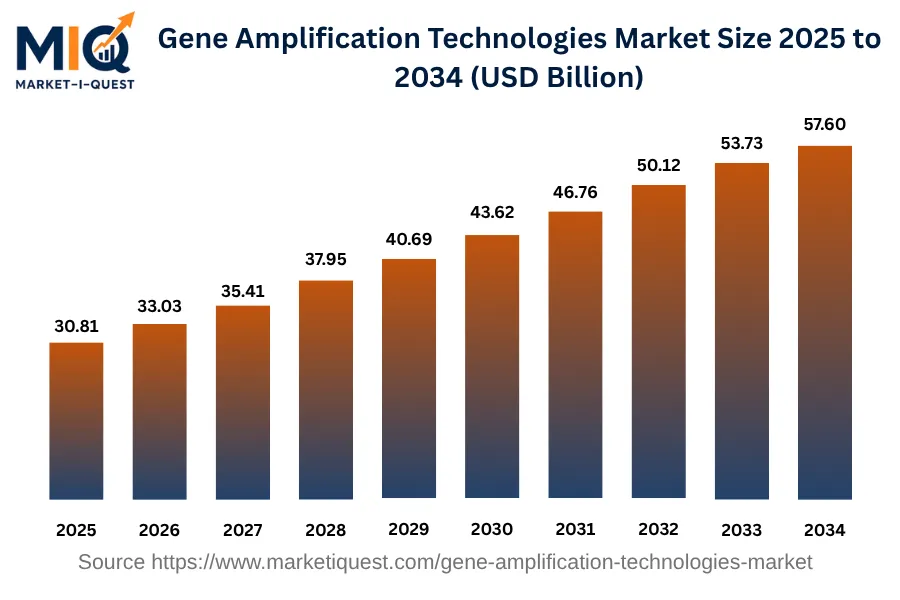
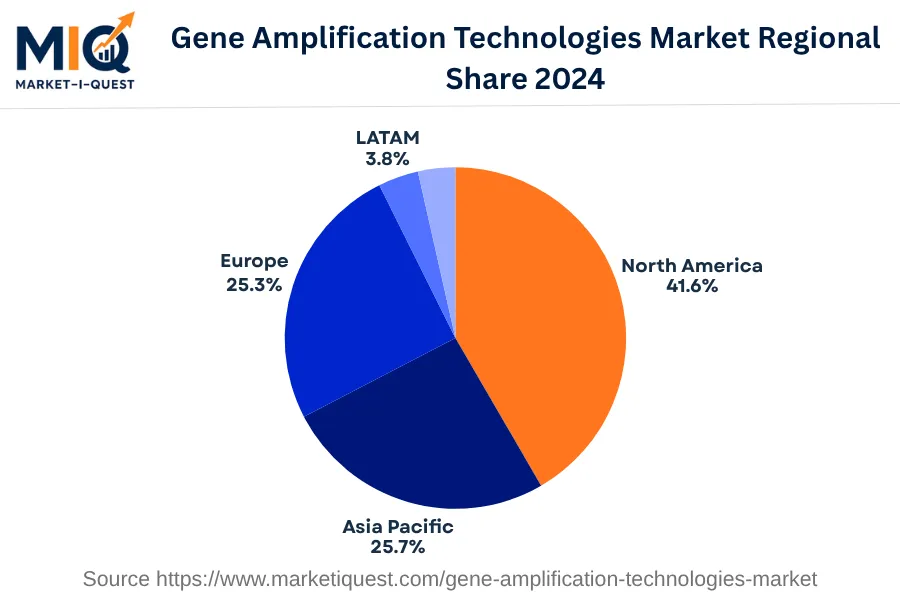
The Gene Amplification Technologies Market is projected to expand from a size of $30.81 billion in 2025 to $57.60 billion in 2034, reflecting a CAGR of 7.2%. This represents an increase from the market's valuation of $28.74 billion in 2024. The considerable growth in this market over a span of 9 years from 2025 to 2034 can be attributed to advancements in gene amplication methodologies and raise in implementation of these technologies across various sectors. On the regional front, North America held the largest share of the market in 2024 with 41.6%, followed by Asia Pacific with 25.7%, and Europe with 25.3%. The remaining market share in 2024 was divided between Latin America (3.8%) and the Middle East and Africa (MEA) (3.5%).

Key Takeaways

  • By Technology - Loop-Mediated Isothermal Amplification (LAMP) is the fastest growing segment indicating the increasing need for accurate rapid and cost-effective genetic analysis.
  • By Application - Diagnostics expanded considerably showcasing the demand for precise gene amplification techniques in the field.
gene-amplification-technologies-market market size

Key Driving Factors

Place of Precision Medicine in Modern Healthcare

The concept of precision medicine, which tailors treatment plans to an individual's genetic makeup, is gaining popularity. This rise can be attributed to the proliferation of knowledge and awareness of genetic diseases amongst healthcare stakeholders. Gene amplification technologies are intrinsic tools in the identification and understanding of genetic anomalies in patients, thus helping in the production of precision or personalized medication. Notably, increasing implementation of precision medicine procedures by healthcare providers is an influential driver for the expansion of gene amplification technologies market. With more healthcare providers turning to this approach, the usage of gene-amplification tools will likely experience substantial growth.
Policies Pushing for Genomic Research

Increasingly, governing bodies globally are recognizing the potential of genomic medicine in preventing and treating diseases, and are subsequently implementing policies that encourage genomic research. Grants and subsidies from government and healthcare organizations, for instance, offer strong financial support for research in genetic engineering and gene therapy. Consequently, this stimulates increased demand for gene amplification technologies that aid in such research. The market for these technologies also receives an indirect boost from regulations that mandate gene mapping before certain pharmaceutical drugs are approved for production. As these policies become standard practice, the gene amplification technologies market is expected to see substantial growth.

Market Evolution by Timeline

2019-2023
During this period, gene amplification technologies started showing substantial application in pharmaceutical and genetic disorder sectors primarily in developed regions like North America and Europe. Technological advancement that shipped during these years includes Digital PCR, extensively used for early detection of diseases. Regulatory environment was dominated by initiatives like the 21st Century Cures Act in the USA, promoting the deployment of innovative personalized medicine technologies. The dominant commercial model observed was patent-licensing agreements, with partnerships between manufacturers and research institutions. Yet, pricing was a significant barrier, with the high cost of most technologies limiting adoption. Risk factors include a bottleneck in the supply chain due to a scarcity of reagents and trained personnel.
2024
In 2024, bioengineering companies largely utilized gene amplification technology to tweak their products, while academic institutions commonly used the technology for research purposes. The technology was also integrated in the healthcare sector in countries such as Germany and Japan for genetic disorder identifications. There was, however, a slowdown in technological breakthroughs due to funding constraints. Government initiatives such as the Genomic Health programme in the UK drove adoption rates up. Collaboration between biotechnology firms and genomic research institutions was the prominent commercial pattern. Supply-side risks were due to limited production capabilities.
2025-2029
Demand from the clinical diagnostics sector may increase significantly during this period, with broader adoption across regions such as South Asia driven by the need to detect genetic disorders. Next-generation sequencing (NGS) technologies could see wider deployment, supporting personalized medicine approaches. However, concerns about the maturity and seamless integration of these technologies may persist. Policies such as Australia's National Health Genomics Policy Framework will likely encourage usage. Fixed-pricing contracts could remain common, although their fairness may face scrutiny given the substantial investment required for implementation. Strict intellectual property protections could also create barriers for new market entrants, potentially limiting competition.
2030-2034
During this period, demand may expand globally, with South America and Africa potentially experiencing greater adoption driven by rising awareness of genetic disorders. Loop-mediated isothermal amplification (LAMP) technology could enable wider access to rapid diagnostic testing in remote areas, although challenges related to technology standardization may persist. Global health initiatives, such as the WHO's Genomics Resource Centre, may positively influence policy development and adoption. Underestimated cost factors could encourage a shift from fixed pricing toward volume-based pricing models. Meanwhile, ethical concerns regarding the potential misuse of gene amplification technologies may remain a barrier to broader adoption, prompting industry stakeholders to develop and implement codes of conduct.

Future Market Outlook

Future Opportunities

The current landscape of gene amplification technologies presents numerous opportunities for growth across various sectors. Countries like the United States and Germany are heavily investing in biotechnology research, with initiatives from organizations like the National Institutes of Health and the European Molecular Biology Organization aiming to support advanced molecular diagnostics. The collaboration between biotechnology firms and academic institutions fosters innovation, exemplified by partnerships such as the one established between Illumina and the University of California, San Diego for genomics research. As precision medicine gains traction, organizations are increasingly integrating gene amplification technologies into their pipelines, particularly in developing targeted therapies for conditions like cancer. The deployment of CRISPR-Cas9 gene editing technologies in diagnostics, observed in projects launched further illustrates the potential intersection of amplification and editing tools. Moreover, emerging markets in Asia Pacific and Latin America are prioritizing genetic testing infrastructure, creating considerable demand for reliable amplification solutions. The rise of consumer-driven genomics companies such as 23andMe and AncestryDNA, indicates a shift towards personal genomic information, amplifying the need for user-friendly amplification technologies. As regulatory frameworks continue to evolve, these advancements will likely usher in a new era of accessible and advanced gene amplification solutions across global healthcare landscapes.

Segmentation Analysis

By Technology

The market is divided into subsegments including Polymerase Chain Reaction (PCR), Real-Time PCR, Digital PCR, Loop-Mediated Isothermal Amplification (LAMP), and Helicase-Dependent Amplification (HDA). Of these, Real-Time PCR accounts for the largest revenue share, while Loop-Mediated Isothermal Amplification is projected to experience the fastest CAGR during the forecast period.

Largest Revenue Share

Real-Time PCR

Market Share Leader

Real-Time PCR has garnered a pivotal role in the field of technology, being widely deployed for a multitude of applications, which has cemented its place as the segment with the largest revenue. This subsegment owes its top ranking partly to its high sensitivity and specificity, along with its capacity to provide real-time analysis. Its role in diagnosing infectious diseases is well acknowledged, with robust usage in medical and healthcare facilities globally. This has only been exacerbated by the present-health situation, as there is a growing need to rapidly and accurately test for various pathogens, including COVID-19. The prevalence of chronic and infectious diseases worldwide also bolsters demand for Real-Time PCR. Additionally, geographic regions with more advanced healthcare infrastructure, especially North America and Europe, are key contributors to the Real-Time PCR revenue due to their wider adoption of this technology.

Fastest CAGR

Loop-Mediated Isothermal Amplification (LAMP)

Forecast Period Growth Leader

Loop-Mediated Isothermal Amplification (LAMP) holds significant potential as it is expected to grow at the fastest CAGR in the forecast period. The projected growth pivotally hinges on LAMP’s highly selective amplification process, which is faster and less resource-intensive than traditional PCR methods, making it an enticing alternative for resource-limited settings and point-of-care testing. However, its adoption is not without roadblocks, predominantly being the scepticism around its relative newness and adequate training required for its effective use. The technology is making headway via strategic partnerships, with numerous biotech companies investing in the research and development of LAMP-based technologies. The possibility of real-time monitoring for a range of pathogens stands as a powerful catalyst for growth, although ongoing concerns about the accuracy and standardization are likely to present near-term obstacles.

By Application

The market is divided into subsegments including Diagnostics, Research and Development, Forensic Science, Drug Discovery and Development, Agriculture and Food Safety, and Others. In 2024, the Diagnostics subsegment accounted for the largest revenue share while the Agriculture and Food Safety subsegment is expected to grow at the fastest CAGR during the forecast period.

Largest Revenue Share

Diagnostics

Market Share Leader

Diagnostics has emerged as the subsegment with the most revenue due to several key factors. These include an increasing awareness of preventive healthcare, a rise in the chronic and infectious disease incidents, and ageing populations worldwide. The subsegment is also bolstered by technological advancements in diagnostic methods, leading to more sensitive, accurate, and quick tests for disease identification. Added to this is the necessity for diagnostics in patient care management to inform treatment decisions. Regulatory changes that encourage health screenings and diagnostics to avoid future complications also drive this subsegment's growth. With evolving healthcare infrastructures and the ramping up of investments in healthcare across developing economies, the Diagnostics subsegment further broadens its market share.

Fastest CAGR

Agriculture and Food Safety

Forecast Period Growth Leader

Agriculture and Food Safety subsegment is projected to expand most rapidly. The primary drivers of this growth trend are greater emphasis on food safety regulations, increasing awareness of foodborne diseases, the global challenges of food security, and an acceleration in the introduction of genetically modified organisms (GMO). Integration of new technologies like genomics and bioinformatics in agricultural and food safety research also act as catalysts for this market growth. However, there are some adoption barriers, such as the high costs associated with advanced safety testing procedures, and the need for international standards for GMO testing. It's noteworthy, though, that collaborations between industry players and government bodies, along with continuous technology innovations, are facilitating the overcoming of these challenges and contributing to this subsegment's robust growth rate.

Competitive Analysis

Key Market Players

Manufacturers / OEMs

Thermo Fisher Scientific Inc.
US
Bio-Rad Laboratories Inc.
US
QIAGEN N.V.
Netherlands

Key Suppliers & Raw Materials

Roche Diagnostics
Switzerland
Agilent Technologies
US
PerkinElmer Inc.
US

Distributors, Integrators & Channel Partners

Abbott Laboratories
US
Danaher Corporation
US
DiaSorin S.p.A
Italy

Porter’s Five Forces Analysis

A comprehensive analysis of the competitive dynamics in the Gene Amplification Technologies market.

Supplier Bargaining Power

Medium

Moderate power due to supply chain complexity and reliance on specialty chemicals in process.

Buyer Bargaining Power

Low

Buyers lack alternatives due to unique capabilities of gene amplification technologies.

Threat of Substitutes

Low

Specified functionality reduces the threat of substitute products.

Threat of New Entrants

High

Rapid technological advancements could see potential new entrants with innovative solutions.

Competitive Rivalry

High

Rivalry is intense due to ongoing innovation and fight for market share.

Regional Analysis

Geographic market dynamics and growth opportunities across key regions

Global Market Outlook

gene-amplification-technologies-market market regional share

North America

In 2024, North America's Gene Amplification Technologies Market observed significant activity. Drivers included heightened investment in biotechnological research mostly in the U.S., dictated by the necessity for improved precision in disease diagnosis. New federal regulations across all three countries spurred adoption by mandating advancements in genetic testing quality. Furthermore, robust supply dynamics supported by scalable technology infrastructures facilitated broader accessibility at competitive prices.

Shifts in buyer behavior underscored key market trends, as healthcare providers and research institutions increasingly leaned towards advanced PCR methodologies for rapid, accurate testing. Technological pivot towards digital PCR, known for its precision and sensitivity in detecting genetic variances, was ubiquitous across the region. Changes in channel dynamics were evident in the market, with an evolving reliance on partnerships between biotechnological and pharmaceutical companies, which aimed at fast-tracking product development and approvals. A surge in M&A activities also indicated industry consolidation. Finally, increased policy enforcement, particularly around the use of gene amplification in clinical trials and patient diagnostics, pointed towards a need for high-quality, standardized techniques in diverse sectors. Stricter control measures became common in relation to genetic testing in contexts ranging from cancer research to prenatal screening, impacting sectors such as healthcare, research institutions, and diagnostic centers.

Asia Pacific

In 2024, the Gene Amplification Technologies Market was highly dynamic with significant healthcare prospects in the Asia Pacific region, particularly in China, India, Japan, South Korea, Australia and key ASEAN markets. Increased technological adoption and investments were driven by rising chronic disease incidences and growing demand for personalized medicine in these regions, particularly in China and India. Regulatory frameworks, especially in Japan and South Korea, mandated genomics research and application, wit h government initiatives focused on enhancing gene therapy.

Customer behavior shifted in 2024 towards more reliable and efficient genomic data interpretation, prompting a shift in technology from conventional gene amplification products to more efficient ones. There was a substantial increase in collaboration and partnerships, like between China's BGI Genomics and India's Medgenome, due to rising demand for large-scale genomic sequencing in healthcare centers and research facilities. Policymakers enforced stricter data privacy norms due to the sensitive nature of genetic data. Sectors especially impacted were healthcare and pharmaceutical industry, with more pharmaceutical companies investing in gene amplification technologies to develop targeted therapies. Research institutions in Australia and key ASEAN markets also utilized these technologies extensively for population genetics research.

Europe

In 2024, the Gene Amplification Technologies Market in Europe has been characterized by increased demand, technological advancements, and subsequent investments. High prevalence of genetic diseases and significant investments in healthcare research in countries like Germany, the United Kingdom, and France catalyzed the demand for advanced gene amplification technologies. Regulations promoting precision diagnostics, prevalent in Italy and Spain, pushed labs and diagnostics centers to adopt these technologies. Additionally, competitive pricing strategies from suppliers in Benelux and the Nordics spurred market expansion.

The European market saw a notable trend towards automated gene amplification systems, driven by a need for high throughput and accuracy in sectors such as healthcare and enterprise. As sequencing technologies became more simplified and optimized, there was a shift towards ready-to-use and point-of-care diagnostics, particularly within the UK and Germany. Mergers and acquisitions were common, especially in Central and Eastern Europe, enabling market consolidation and increased service range. The increased enforcement of GDPR policies tightened data privacy measures within the field, impacting storage and processing practices of genetic data across all sectors. Lastly, there was a surge in partnerships between biotech firms and academic institutions, elevating gene amplification research and technological innovation throughout the region.

Latin America

In 2024, the LATAM gene amplification technologies market witnessed substantial growth largely driven by the health sector's increased demands, technological advancements, and regulatory catalysts. The implementation of precision medicine programs in Brazil and Mexico, coupled with Argentina's focused investment in biotechnology, stimulated the demand for gene amplification solutions in diagnosing genetic conditions and cancer. Colombia's increased adoption of next-generation sequencing technologies compelled providers to amplify genetic materials for sufficient analysis, fueling market growth. In Chile and Peru, the demand for personalized therapies underpinning genetic testing led to a market expansion.

The market exhibited significant trends shaping its dynamics. A shift to digital polymerase chain reaction from traditional methods characterized buyer behavior in Brazil and Mexico, given its accuracy in detecting genetic materials. Patients' increased awareness and acceptability of genetic testing in Argentina and Colombia translated to mounting pressure on healthcare providers to adopt advanced gene amplification technologies. Regulatory bodies in Chile ensured strict adherence to genetic testing policy, fostering standardization. The emphasis on partnerships in Peru became pronounced, with government and private healthcare providers collaborating with gene amplification technology vendors to enhance diagnostic capabilities. The surge in M&A activities among major biotechnology firms further solidified the market's robust stature.

Middle East & Africa

In 2024, the Gene Amplification Technologies Market in the Middle East and Africa evidenced significant progress driven by various factors and marked by distinct trends. High prevalence of genetic disorders and infectious diseases in countries such as Saudi Arabia, South Africa, and Nigeria increased demand for efficient diagnostics, driving market growth. Regulatory support such as Egypt's policy for promotion of precision medicine also facilitated technology adoption. Moreover, substantial investment in healthcare infrastructure in the United Arab Emirates and Qatar further encouraged the supply of gene amplification technologies.

Regarding trends, buyer behavior significantly shifted towards non-invasive gene amplification technology due to its convenience and reliability. For instance, in sectors like healthcare and genetic research, practitioners increasingly favored techniques such as Polymerase Chain Reaction(PCR). Development of strategic partnerships, especially between technology providers and healthcare institutions, fostered market expansion in regions like Kenya and Israel. Notably, these technologies found use in a variety of sectors. Beyond healthcare and research, industries like agriculture and livestock in these regions also integrated gene amplification technologies for improved outcomes, demonstrating the broadening scope of this market in 2024.

Recent Industry Developments

Latest market innovations, product launches, and strategic initiatives

June 2025

Eli Lilly and Company made a major move in the genetic medicine sector by acquiring Verve Therapeutics for up to $1.3 billion. The acquisition significantly bolsters Lilly’s capabilities in pioneering single-dose gene editing and amplification technologies. By taking control of Verve's high-efficiency platform, Lilly intends to accelerate the clinical rollout of permanent, single-course therapies for cardiovascular diseases.

October 2025

Thermo Fisher Scientific announced a major research and development partnership with AstraZeneca BioVentureHub. The alliance integrates Thermo Fisher's advanced molecular genomics and chromatography platforms with AstraZeneca's biomedical pipelines. It focuses on optimizing workflows for high-sensitivity gene amplification and expression analysis to accelerate precision oncology drug discovery.

Frequently Asked Questions