
Enterprise Firewall Market Snapshot

Key Players

  • Cisco Systems Inc. (US)
  • Palo Alto Networks Inc. (US)
  • Fortinet Inc. (United States)
  • Check Point Software Technologies Ltd. (Israel)
  • Juniper Networks Inc. (US)
  • Barracuda Networks Inc. (US)
  • Huawei Technologies Co. Ltd. (China)
  • Sophos Group plc (United Kingdom)
  • Symantec Corporation (US)
  • Trend Micro Incorporated (Japan)

Market Size

Base Year 2024
$13.28 Bn
CAGR
11.37%
Forecast 2034
$38.98 Bn

Market Segments

By Firewall Type
Next-Generation Firewall, Unified Threat Management (UTM), Cloud-Based Firewall
By Deployment Model
Cloud-Based, On-Premises, Hybrid
By Security Features
Intrusion Detection and Prevention, Web Filtering, Anti-Malware, Virtual Private Network (VPN), Distributed Denial of Service (DDoS) Protection
By Industry
Information Technology, Financial Services, Manufacturing, Retail, Healthcare, Others

Market Dynamics

Drivers
  • Rising cybersecurity threats
  • Increased adoption of BYOD policies
Restraints
  • High Implementation Cost
  • Complex Management Structure
Opportunities
  • Increasing cybersecurity threats
  • Cloud network adoption

Market Size

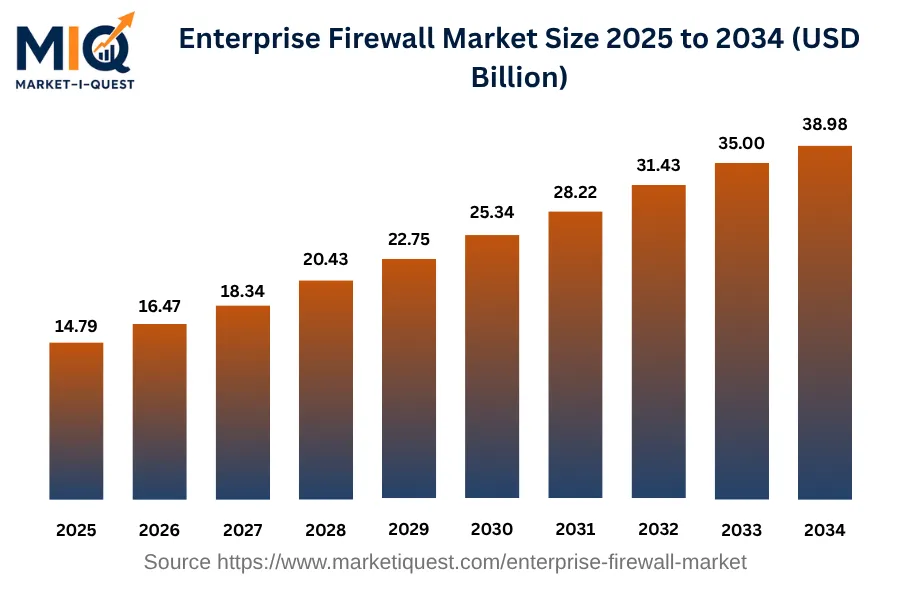
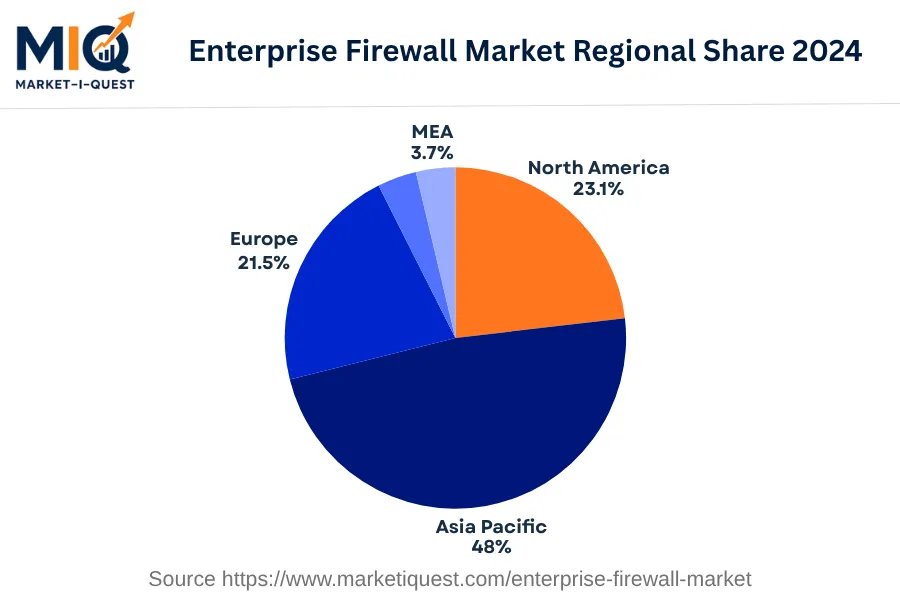
The Enterprise Firewall Market size stood at USD 13.28 billion in 2024 and scaled to USD 14.79 billion in 2025. By 2034, it is projected to reach USD 38.98 billion, marking an upward trajectory with a compound annual growth rate (CAGR) of 11.37 percent. This steady growth path was clearly evident during the decade under consideration. In 2024, the market's regional share was dispersed according to the following breakdown: North America accounted for 23.14 percent, Asia Pacific for 47.96 percent, Europe for 21.47 percent, Latin America for 3.71 percent, and the Middle East and Africa for 3.72 percent of the total market share. These values provide a clear snapshot of the Enterprise Firewall Market, demonstrating both its current status and future potential.

Key Takeaways

  • By Firewall Type - Unified Threat Management (UTM) held the leading position in market dominance.
  • By Deployment Model - Cloud-Based systems emerged as the fastest-growing segment.
  • By Security Features - Anti-Malware accounted for the major share of the market.
  • By Industry - Financial Services sector had the largest market share.
enterprise-firewall-market market size

Key Driving Factors

Stringent Compliance Regulations

As cyber threats continually evolve, so do regulations aimed at protecting consumers and ensuring data privacy and integrity. For instance, businesses are increasingly required to comply with stringent standards such as the General Data Protection Regulation (GDPR) in Europe, and the California Consumer Privacy Act (CCPA) in the U.S., which involves securing data through reliable methods like enterprise firewalls. Failure to comply with such regulations can result in hefty fines and reputational damage, pushing companies to beef up their cyber security measures. These necessary compliance efforts act as a driving force for the adoption of enterprise firewall solutions, specifically within sectors like finance and healthcare where secure data management is highly regulated.
Adoption of Multi-cloud Strategies

Many organizations are adopting multi-cloud strategies for their infrastructure needs. Each additional cloud platform added to an organization's infrastructure expands its attack surface, creating opportunities for breaches. As a result, companies need to ensure consistent, secure access to critical data and systems across all platforms, which is where enterprise firewalls come into play. The proliferation of cloud-based solutions and the broader trend towards digital transformation in the business sector are leading to a greater need for enterprise firewalls. These firewalls protect against potential vulnerabilities presented by multi-cloud architectures, making them crucial components of a robust cybersecurity strategy.

Market Evolution by Timeline

2019-2023
During this period, large enterprises, particularly in the banking, healthcare and retail sectors, were primary buyers of firewall solutions, reflecting demand from North America and Europe, mainly driven by increasing cybersecurity threats. Vendors like Cisco, Fortinet, and Palo Alto Networks led the supply, introducing advanced threat intelligence and integrating features like intrusion prevention. Pricing usually entailed annual or multi-year licenses with premium support services. Regulatory compliance, including GDPR and California Consumer Privacy Act, significantly influenced adoption. However, integration challenges with existing IT systems were a common risk, typically addressed by vendor support.
2024
2024 witnessed a shift in demand with significant growth from SMEs. This was likely due to the increased digitization of their operations and rising cyber-threats in the Asia-Pacific region. Suppliers like Check Point Software highlighted cloud-based firewalls, catering to remote workforces. Pricing trends leaned towards subscription models with flexible terms. Region-specific standards, such as China's Cybersecurity Law, influenced purchases. Implementation difficulties, due to lack of in-house expertise, was a key risk, often mitigated by managed security services.
2025-2029
Demand during 2025–2029 increasingly came from public sector organizations, due to cybersecurity concerns in public infrastructure, particularly in emerging markets. Providers like Huawei extended firewall capabilities with Artificial Intelligence to detect and prevent sophisticated threats. Still, vendor lock-in posed a challenge, which encouraged the adoption of open-source firewalls, influencing pricing, with many clients opting for free versions supported by community forums. Mandatory adherence to NIST Cybersecurity Framework in U.S. among other policies affected purchases. Mitigating the risk of cyberattacks became a crucial priority, often addressed with frequent system updates and patching.
2030-2034
The period of 2030–2034 sees a surge in demand from industries adopting IoT, like manufacturing and logistics, particularly in South America and Middle East regions. Market leaders like Juniper Networks have adapted to the trend, shipping firewalls designed for IoT protection. Firewall as a Service (FWaaS) gained traction, changing pricing dynamics towards pay-as-you-go models. While international standards governing IoT security shaped adoption, lack of skills in managing sophisticated firewall systems remained a risk, typically overcome by leveraging AI-enabled automated systems for the task.

Future Market Outlook

Future Opportunities

The trends observed in the enterprise firewall market signal numerous opportunities for growth and development. With 5G technology becoming widespread by 2024, organizations will require firewalls capable of managing higher data throughput and lower latency connections. This need creates a prime opportunity for innovation in firewall solutions that can handle the complexities introduced by IoT devices. In 2023, the implementation of the Cybersecurity Maturity Model Certification (CMMC) by the U.S. Department of Defense further highlights the growing need for robust cybersecurity measures, including sophisticated firewall capabilities. Local companies and global enterprises aiming to secure sensitive data will increasingly integrate compliance-driven firewall solutions into their infrastructure. Additionally, partnerships among firewall vendors, like the collaboration between Cisco and Microsoft announced in early 2023, can strengthen capabilities by combining software solutions with secure networking. This move towards interoperable security solutions can bolster enterprise defenses against sophisticated cyberattacks. The expansion of the cloud environment offers a unique avenue; cloud-native firewalls are gaining traction as businesses transition to multi-cloud strategies. As a result, the demand for firewalls that can seamlessly operate in diverse cloud settings is expected to surge. Overall, the evolution of network security requirements presents a fertile ground for innovation and expansion in enterprise firewall technologies.

Segmentation Analysis

By Firewall Type

The market is divided into subsegments including Next-Generation Firewall, Unified Threat Management (UTM), and Cloud-Based Firewall, out of which the UTM accounted for the largest revenue share while the Cloud-Based Firewall is expected to grow at the fastest CAGR during the forecast period.

Largest Revenue Share

Unified Threat Management (UTM)

Market Share Leader

Unified Threat Management (UTM) leads today's market with the largest revenue share and there are several factors contributing to this. UTM has the advantage of integrating multiple security features into one appliance thus providing simplified security management, which has become an enticing offering for small and medium enterprises that may not have robust IT teams. This factor, coupled with the increased adoption of BYOD (Bring Your Own Device) culture in corporations, significantly drives the demand for UTM solutions as they can provide comprehensive security against a diverse range of threats. Additionally, the regulatory landscape has also indirectly fueled the UTM market growth, particularly in sectors such as finance, healthcare, and governmental bodies where data security is of paramount importance. The stringent regulatory policies demand high levels of security measures to be implemented, which complements the comprehensive protection provided by UTM solutions.

Fastest CAGR

Cloud-Based Firewall

Forecast Period Growth Leader

The fastest growing subsegment, Cloud-Based Firewall, is set to revolutionize the market in coming years. The catalysts for this rapid growth are primarily the growing recognition of the many benefits that cloud-based solutions provide in general – cost efficiency, scalability, and remote accessibility being to name a few. As companies increasingly migrate data and operations to the cloud, the demand for corresponding cloud-based security measures is anticipated to surge. In effect, technological advancements in virtualization and the growing acceptance of public cloud services among enterprises can facilitate growth in this subsegment. However, hesitation regarding data security on the cloud and the presence of regulatory constrictions can potentially slow down the growth. Despite potential barriers, the increasing capital expenditure aimed towards enhancing cybersecurity infrastructure is expected to sustain the momentum of growth in this subsegment.

By Deployment Model

The market is divided into subsegments including Cloud-Based, On-Premises, and Hybrid. In 2024, the On-Premises model accounted for the largest revenue share while the Cloud-Based model is projected to grow at the fastest CAGR during the forecast period.

Largest Revenue Share

On-Premises

Market Share Leader

The On-Premises deployment model continues to rake in the most revenue, driven primarily by organizations' need for stringent data security and complete control over sensitive data. In 2024, industries with high security requirements such as banks, healthcare institutions, government bodies opted for On-Premises deployment due to data sovereignty laws and regulatory compliance, contributing to its large revenue share. These systems offer robustness, reliability, flexibility, and a high level of control, making them a preferred choice for organizations with complex operations and sufficient IT workforce. Many enterprises have legacy systems installed, resulting in high switching costs, further enabling the On-Premises model to maintain its lead. Limitations of bandwidth and internet instability in various geographies also account for the popularity of on-premises solutions.

Fastest CAGR

Cloud-Based

Forecast Period Growth Leader

On the contrary, the Cloud-Based model is expected to grow rapidly during the forecast period. Its fast-paced growth can be attributed to numerous factors including reduced cost of ownership, scalable infrastructure, automated updates, and quick deployment. Large investments in data center infrastructure and partnerships between software providers and cloud service providers are acting as catalysts for cloud model adoption. Policies promoting digital transformation and SMEs gravitating towards cost-effective, secure and scalable options are propelling its rapid growth. However, challenges persist in the form of data security concerns, latency issues, and regulatory compliance, especially in key sectors like finance and healthcare, that may hamper its optimal growth in the short term.

By Security Features

The market is divided into subsegments including Intrusion Detection and Prevention, Web Filtering, Anti-Malware, Virtual Private Network (VPN), and Distributed Denial of Service (DDoS) Protection. The Anti-Malware sub-segment accounted for the largest revenue share while the VPN is expected to grow at the fastest CAGR during the forecast period.

Largest Revenue Share

Anti-Malware

Market Share Leader

Anti-Malware software drives the largest revenue in the security features market mainly due to the proliferation of malware activities worldwide. Cyber-attacks rising due to increasing internet penetration and digitalization of industries boost the demand for anti-malware software. Corporations, regardless of size, are investing heavily in cyber defense to protect sensitive data from potential threats, thus fueling the revenue growth. Furthermore, regulatory bodies imposing stringent regulations and norms related to data security are also propelling organizations to adopt advanced security solutions. Anti-Malware solutions' utility across a wide range of sectors like banks, organizations, and governments for securing their systems from various types of malicious software such as viruses, worms, ransomware, and spyware provides an extensive customer base and contributes to its leading revenue share.

Fastest CAGR

Virtual Private Network (VPN)

Forecast Period Growth Leader

Virtual Private Network (VPN) is projected to record the fastest growth owing to the rising demand for remote access to secure and private networks. Many factors spur the growth such as the increasing mobile workforce, improving internet connectivity, and growing necessity for data privacy in digital communication. While VPN applications effectively secure online activities, they were previously considered a niche product. However, the rapid surge in remote working and distance learning setups due to the COVID-19 pandemic led to a dramatic spike in VPN adoption, and this trend is likely to continue even post-pandemic. That being said, barriers like lack of understanding about VPN technology and the availability of free or cheaper alternatives might slightly slow down the adoption rate. Nonetheless, due to growing cyber-security threats, the VPN segment is set for a fast growth trajectory in the foreseeable future.

By Industry

The market is divided into subsegments including Information Technology, Financial Services, Manufacturing, Retail, Healthcare, and Others. Financial Services accounted for the largest revenue share while Information Technology is expected to grow at the fastest CAGR during the forecast period.

Largest Revenue Share

Financial Services

Market Share Leader

The Financial Services industry leads in revenue generation in 2024 due to numerous key factors. Firstly, this industry's growth is bolstered by a robust demand for a broad spectrum of services such as loans, insurance, and asset management, among other things. Furthermore, the industry benefits from the technological advancements allowing the creation of innovative products and services for customers, contributing significantly to the industry revenue. Geographically, developed economies with a higher number of financially healthy participants contribute largely to the revenue. Regulatory factors also play a critical role: banks are increasingly required to maintain solid capital reserves, ensuring a strong market for financial advisory services and risk management. Lastly, intense competition in this industry prompts businesses to increase efficiency and innovate which ultimately results in higher overall industry revenue.

Fastest CAGR

Information Technology

Forecast Period Growth Leader

The Information Technology (IT) subsegment is projected to be the fastest-growing sector within these market structures. This prediction is driven by various factors. The primary catalyst being the ongoing digital transformation across all sectors, forcing businesses to adopt the latest technological advancements or risk losing competitiveness. New technologies such as artificial intelligence and machine learning, cloud computing, data analytics, and cybersecurity, continue to present significant growth opportunities. Regulatory policies encouraging digital infrastructure also contribute to the industry's growth. However, high capital expenditure (capex) and partnerships needed for research and development present considerable barriers to adoption. Moreover, near-term risks such as data privacy compromises and cyber threats can slow down growth. Despite these challenges, the prospects for long-term growth remain promising due to the industry's pivotal role in business modernization.

Competitive Analysis

Key Market Players

Manufacturers / OEMs

Cisco Systems
US
Fortinet
US
Palo Alto Networks
US

Key Suppliers & Raw Materials

Intel Corporation
US
Broadcom
US
Marvell Technology Group
US

Distributors, Integrators & Channel Partners

Tech Data Corporation
US
Ingram Micro
US
Synnex Corporation
US

Porter’s Five Forces Analysis

This analysis evaluates the competitive intensity and attractiveness of the Enterprise Firewall Market.

Supplier Bargaining Power

Medium

Limited number of hardware and OS providers influences firewall design and pricing.

Buyer Bargaining Power

High

Big enterprises and organizations dictate terms due to their substantial size and buying power.

Threat of Substitutes

Low

Dearth of viable substitute products, given the high need for advanced network security solutions.

Threat of New Entrants

Medium

High initial investment and technical expertise constraints minimize new market entrants.

Competitive Rivalry

High

An intense competition among current players, driven by the ongoing technological advancements.

Regional Analysis

Geographic market dynamics and growth opportunities across key regions

Global Market Outlook

enterprise-firewall-market market regional share

North America

In 2024, North America’s enterprise firewall market experienced substantial growth, driven by demand factors, regulatory environments, technological adoption, investment strategies, and supply dynamics. A surge in cyber threats demanded sophisticated data protection measures from enterprises, governments, healthcare sectors, utilities, and retail industries. Additionally, stringent data protection regulations such as the California Consumer Privacy Act fomented widespread firewall adoption. Major advancements in artificial intelligence and machine learning led to increased investment, escalating the adoption of next-generation firewalls. A robust supply chain, coupled with the escalating demand, led to competitive pricing models, further driving the market.

Trends were driven by shifts in buyer behavior, evolving technology, partnership dynamics, and enforcement policies. An increase in remote work necessitated advanced security solutions, accelerating firewall acceptance. Evolution in firewall technology, such as Unified Threat Management (UTM), was widely adopted for its comprehensive protection. Strategic partnerships and acquisitions, like Cisco's acquisition of Duo Security, bolstered firewall advancements. Strict enforcement of data security standards influenced organizations' firewall adoption, particularly in healthcare and manufacturing sectors. Thus, heightened demand for secure network infrastructure amplified growth in the enterprise firewall market in 2024.

Asia Pacific

In 2024, the Enterprise Firewall Market in the Asia Pacific region saw notable advancements and change. China's stringent cyber regulations drove robust sales across various sectors, while in India, rapid digitalization pushed demand upward. Japan and South Korea saw increased investment in firewall technology, improving both supply and pricing dynamics. Australia and key ASEAN markets such as Singapore and Malaysia grew due to enhanced cybersecurity measures and widespread technology adoption. Several trends marked the landscape. The rising incidents of cyberattacks led businesses to rethink their security, especially in manufacturing and retail sectors, sparking interest in more advanced and integrated firewall solutions.

The acceleration of cloud services in China and Japan saw a shift towards adopting firewall products that protect both on-premise and off-premise environments. There was a notable rise in partnerships and M&A activities between international and local security brands, particularly in India and Australia, serving to diversify product offerings. Policies endorsing stricter enforcement of security standards in sectors such as government, healthcare, and utilities also played a critical role in shaping market trends. For instance, in South Korea, the implementation of the Personal Information Protection Act compelled many enterprises to invest heavily in improving their firewalls. In summary, the Enterprise Firewall Market in the Asia Pacific region in 2024 delivered strong vitality, stimulated by policy, partnerships, and an urgent demand for robust security solutions.

Europe

In 2024, the enterprise firewall market in Europe saw heightened interplay between technological advancements, regulations, and market needs. Regional cybersecurity directives drove demand, with Germany and the United Kingdom leading in the adoption of advanced firewall technologies, closely followed by France, Italy, and Spain. A surge in investment across stable economies such as the Nordics and Benelux region bolstered the supply dynamics while real-time threat intelligence and AI integration became key factors shaping pricing strategies. Trends witnessed in this year highlighted a significant shift in buyer behavior, primarily in sectors such as government, healthcare, utilities, manufacturing, and retail, leaning towards solutions offering advanced threat protection and data privacy compliance.

Central & Eastern Europe, while lagging behind in adoption, showed increased enterprises' interest in unified threat management firewall systems, turbocharging market competition. Furthermore, partnerships and M&A activity grew increasingly prevalent, as firms aimed for joint innovation and cost-efficient solutions. The emphasis on standards compliance underlined these developments, with policy enforcement like the General Data Protection Regulation (GDPR) and Network Information Systems (NIS) directive acting as key decision-making factors. This pointed towards a harmonized approach to cybersecurity across Europe, indicating a maturing firewall market responding effectively to evolving enterprise needs and regulatory norms.

Latin America

In 2024, the Limited Access Terminal Mover (LATAM) enterprise firewall market experienced remarkable activity, influenced by an array of factors. Substantial growth drivers included heightened cyber threats and data breaches which propelled a surge in demand for advanced firewall solutions by enterprises, government institutions, and healthcare sector. Also, escalating adoption of cloud-based solutions further intensified firewall demand in the region. In Brazil and Mexico, regulatory updates warranting enhanced data protection measures led enterprises to invest in top-grade firewall systems. Besides, the proliferation of 5G technology across Argentina and Chile stimulated the need for robust firewalls, given the increased internet speed and risk of cyberattacks.

Trends shaping LATAM's firewall market included a shift in buyer preferences; customers increasingly opted for integrated firewall solutions with real-time threat intelligence capabilities. Channel dynamics also evolved, with the digital sales channel gaining prominence due to pandemic-induced remote work culture. Amid firm policy enforcement, Colombia saw several strategic partnerships and M&A activities. This was to meet the government's cybersecurity requirements, leading to the strengthening of firewall service offerings. Significant sectors playing a pivotal role included manufacturing and retail. They sought advanced firewalls to protect their wide network coverage and vast data reserves. Driven by respective internal and external factors, these nations displayed substantial demand for enterprise firewall solutions, shaping the LATAM's firewall market dynamics in 2024.

Middle East & Africa

In 2024, the Middle East and Africa's enterprise firewall market exhibited robust growth across diverse sectors. Driving factors included increasingly stringent governmental regulations for data security in nations such as Saudi Arabia and the United Arab Emirates. In Nigeria and Kenya, increasing investments in digital infrastructure widened the adoption of sophisticated firewall technologies, while in Israel, supply dynamics such as competitive pricing strategies of key players influenced market growth. Trends in the enterprise firewall market reflected evolving technology landscapes and market dynamics. The rapid shift towards cloud-based services was evident, with sectors such as telecom, healthcare, and financial services in South Africa and Egypt opting for firewall-as-a-service. In the manufacturing and retail sectors of Qatar, the implementation of next-generation firewalls for their integrated security solutions became commonplace.

High-profile partnerships and M&A activities, such as those seen in the UAE's oil and gas sector, further shaped the market while stricter policy enforcement was observed across all sectors, ensuring stringent compliance to data protection norms. Demand across the region continued to be driven by the need for robust cybersecurity measures in crucial sectors, with the enterprise firewall market in the Middle East and Africa becoming an essential part of a comprehensive approach to secure digital practices and data privacy.

Recent Industry Developments

Latest market innovations, product launches, and strategic initiatives

June 2026

Dell launched the SonicWALL SuperMassive 9000 Series Next-Generation Firewall (NGFW), built from the ground up for enterprise networks with multi-gigabit throughput, near-zero latency, and full inspection of SSL-encrypted traffic using patented Reassembly-Free Deep Packet Inspection (RFDPI) technology.

February 2025

Sophos Group partnered with Pax8 to offer a comprehensive cybersecurity portfolio to Pax8's network of managed service providers (MSPs), including Sophos Managed Detection and Response, Endpoint Protection, and Firewalls.

Frequently Asked Questions