DNA and Gene Chip Market Snapshot

Key Players

  • Affymetrix Inc. (US)
  • Agilent Technologies (US)
  • Illumina Inc. (US)
  • Thermo Fisher Scientific Inc. (US)
  • PerkinElmer Inc. (US)
  • Bio-Rad Laboratories Inc. (US)
  • F. Hoffmann-La Roche Ltd (Switzerland)
  • MacroGenics Inc. (South Korea)
  • Arrayit Corporation (US)
  • Biometrix Technology Inc (China)

Market Size

Base Year 2024
$14.83 Bn
CAGR
9.74%
Forecast 2034
$37.57 Bn

Market Segments

By Type
  • Oligonucleotide DNA Microarrays
  • Complementary DNA Microarrays
  • BAC Clone Chips
  • Others
By Product
  • Consumables
  • Instrumentation
By Application
  • Cancer Diagnosis & Treatment
  • Gene Expression
  • Genotyping
  • Genomics
  • Drug Discovery
  • Agricultural Biotechnology
  • Others

Market Dynamics

Drivers
  • Rapid advancements in genomics
  • Increasing prevalence of cancer
Restraints
  • High cost of implementation
  • Lack of skilled professionals
Opportunities
  • Increasing healthcare investments
  • Rapid advancements in genomics

Market Size

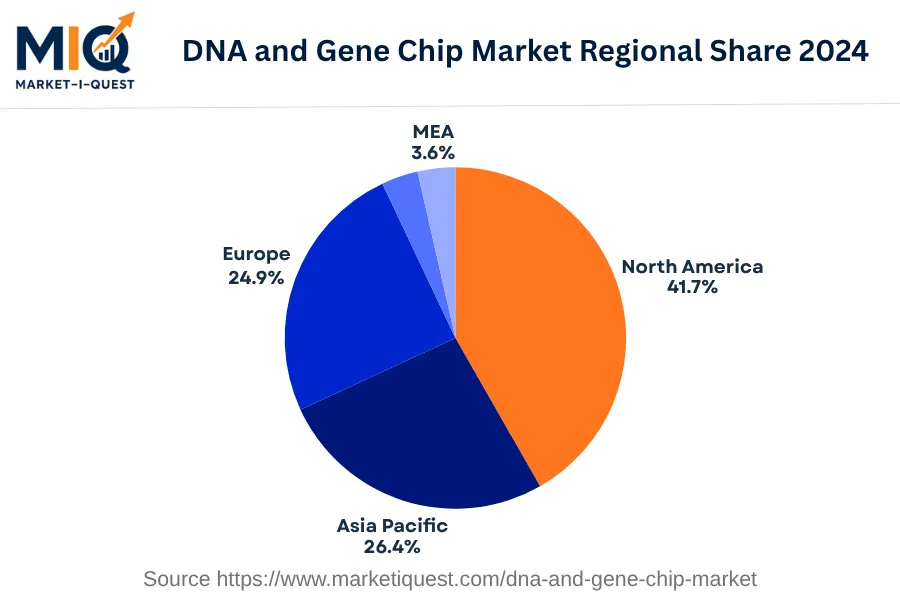
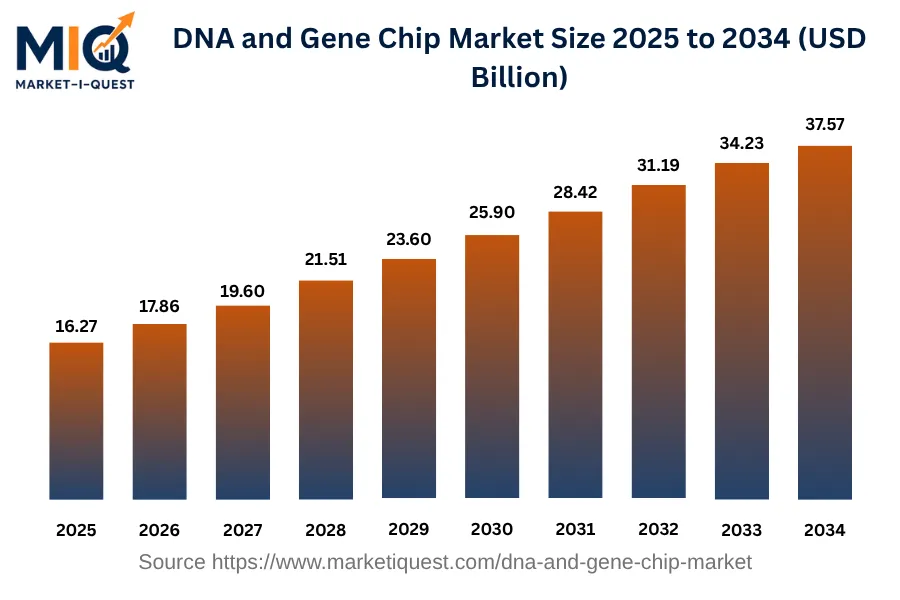
The DNA and Gene Chip Market, valued at $16.27 billion in 2025, is projected to expand further, reaching a market size of $37.57 billion by 2034. This market growth signifies a CAGR of 9.74% over the forecasted period from 2025 to 2034. The consistent rise in the market size, year on year, stems from increasing reliance on DNA and gene-chip technology in medical research and diagnostics. It is critical to note the regional contributions to the market in 2024, indicating the market spread across that period. North America held the majority share, accounting for 41.7% of the global market. Asia Pacific followed next, contributing 26.4%, while Europe nearly matched the Asia Pacific's stake, holding 24.9% of the market share. Meanwhile, both Latin America and the Middle East and Africa each constituted less than 4% of the global market in 2024, at 3.5% and 3.6% respectively.

Key Takeaways

  • By Type - Oligonucleotide DNA Microarrays led the sector in 2024 accounting for a significant industry share.
  • By Product - Consumables held the dominant position in market.
  • By Application - Cancer Diagnosis & Treatment led accounting for a substantial market share Market in 2024.
dna-and-gene-chip-market market size

Key Driving Factors

Increasing Incidence of Genetic Disorders

The DNA and Gene Chip market is experiencing substantial growth due to the increasing occurrence of genetic disorders. As these disorders, such as Down syndrome, cystic fibrosis, are caused by abnormalities in an individual's genome, DNA and gene chips are used for understanding, diagnose and develop treatments for them. They do this by identifying inconsistencies and mutations within the genetic data. The demand for DNA and gene chips is therefore driven by the demand from healthcare providers, research institutions and pharmaceutical companies to tackle these diseases effectively. This growing need to manage and treat genetic conditions therefore propels the market forward.

Shift Towards Personalized Medicine

Personalized medicine's rise is another major factor driving the DNA and Gene Chip market. This approach tailors medical treatment to the individual characteristics, needs, and preferences of each patient. Personalized medicine largely relies on the patient's genetic information to provide the most effective treatment, and DNA and gene chips play a critical role in supplying this data. Particularly in oncology, where a tumor's genomic profile can guide therapy choices, these chips are essential. The demand amplifies among pharmaceutical companies focused on drug discovery and development to suit patients' unique genetic make-up. This shift towards personalized medicine, therefore, presents a powerful factor influencing DNA and gene chip market expansion.

Market Evolution by Timeline

2019-2023
In this period, academic research institutions formed a significant chunk of buyers for DNA and gene chips, with primary usage in genetic research, particularly human genome projects. Chinese manufacturers, including CapitalBio and Agilent Technologies, dominated supply. However, old data printing technology was still prevalent, leading to higher error rates. The US FDA issued regulations for quality control in chip manufacturing. Pricing based on chip complexity had become standard. Buyers commonly showed preference for volume-based long-term contracts with suppliers.
2024
In 2024, usage of DNA and gene chips expanded into the clinical diagnostics sector, increasing demand. American companies like Affymetrix and Illumina, started shipping next-generation sequencing (NGS) integrated chips, improving accuracy but also driving up costs. Owing to an EU-wide policy initiative favoring personalized medicine, there was a marked rise in the adoption of these chips in Europe. The surging costs prompted a shift towards per-test pricing models in commercial contracts.
2025-2029
Demand from the agriculture industry might surface in this period, will likely be supported by the demand for improved crop varieties. BiochipInk might make progress in the supply scene, launching chips with inkjet DNA synthesis. The FDA approval process for gene chips will likely become increasingly streamlined with updated guidelines. A trend towards license-based pricing models might be seen as companies will start offering proprietary software for chip analyses. A typical risk during this time might be a novel genetic modification regulations in several countries, posing a barrier to agricultural applications of these chips.
2030-2034
In this span, forensic labs are expected to be newly identified buyer segment, using DNA chips for comprehensive genetic profiling. Suppliers, predominantly from USA and Israel, will likely introduce portable lab-on-a-chip devices, indicating the maturity of on-field testing capabilities. Lois Law, a global data privacy regulation impacting different regions, mandated strict user consent for gene profiling, slowing expansion. Usage-based pricing models might be witnessed as these chips will be incorporated into portable testing kits. Data privacy regulations polymorphism presented major risks to the sector, making compliance a requisite.

Future Market Outlook

Future Opportunities

The future of the DNA and gene chip market is poised for growth as advancements continue unfolding due to ongoing research and regulatory support. Regulatory guidance, such as FDA proposal for streamlined pathways for medical devices based on genetic information, indicates a welcoming environment for innovative applications in healthcare diagnostics. Several research institutions in the United States initiated pilot programs that leverage gene chips for identifying cancer mutations, highlighting the expanding diagnostic capabilities in oncology. Collaborative partnerships, such as alliance between Thermo Fisher Scientific and the Broad Institute, focus on harnessing gene editing technologies which enhances the scope of gene chip usage in therapeutic areas. Beyond diagnostics, increasing awareness of genetic predispositions and preventive healthcare suggests upcoming applications for personal genomics, further enhancing market avenues. The establishment of data-sharing frameworks, particularly within the Global Alliance for Genomics and Health, encourages global collaboration and data access that can unlock additional research avenues. Furthermore, advancements in artificial intelligence are being integrated into genetic analysis workflows, as seen with companies investing in machine learning models. This integration may lead to improved data interpretation capabilities and individualized treatments.

Segmentation Analysis

By Type

The market is divided into subsegments including Oligonucleotide DNA Microarrays, Complementary DNA Microarrays, BAC Clone Chips, and Others. Oligonucleotide DNA Microarrays accounted for the largest revenue share while Complementary DNA Microarrays is expected to grow at the fastest CAGR during the forecast period.

Largest Revenue Share

Oligonucleotide DNA Microarrays

Market Share Leader

In the base year 2024, the Oligonucleotide DNA Microarrays segment led the market in terms of revenue. This can be attributed to their broad array of applications in the biotech industry, especially in gene expression profiling, mutation analysis, genotyping, and measuring DNA sequence affinity. Additionally, the flexibility in designing these arrays to target any sequence of interest makes them a preferred choice among researchers. Other key drivers include their ability to analyze a larger number of genes in a single experiment and high-throughput capability. There’s a strong demand in regions with a high concentration of research institutes and biotech companies, for instance, North America and Europe. Technological advancements and the introduction of new products have added to the growth.

Fastest CAGR

Complementary DNA Microarrays

Forecast Period Growth Leader

The Complementary DNA (cDNA) Microarrays segment, though not at the forefront in terms of revenue, is expected to exhibit the fastest CAGR during the forecast period. The primary growth drivers for this segment include the increasing demand for cDNA microarrays in gene expression analysis and comparative genomics. The simplicity of the technology involved in the production of cDNA microarrays as compared to its counterparts is also playing a significant role in driving growth. Being less complex, they offer easier scalability and lower switching costs, encouraging more laboratories and research institutions to opt for cDNA over others. This subsegment is likely to witness substantial growth in the coming years.

By Product

The market, categorized by product, offers distinct subsegments including Consumables and Instrumentation. Within this structure, Consumables accounted for the largest revenue share, while Instrumentation is expected to grow at the fastest CAGR during the forecast period.

Largest Revenue Share

Consumables

Market Share Leader

In 2024, Consumables emerged as the most revenue-generating subsegment. The significant share is mainly attributed to the recurrent need for these products across numerous industries. Consumables including filtration products, reagents, and other laboratory necessities are ubiquitously required in biotechnology, pharmaceutical, and clinical entities. Their consistent demand results in a sustained revenue flow. Additionally, the growth in healthcare and life science sectors, particularly in developing regions, further augments the consumption of such consumables. Rapid industrialization and an increasing number of research institutions are enhancing the demand for sophisticated and higher-grade consumables, hence increasing the revenue stream. However, the subsegment is also dictated by regulations regarding safety and quality standards of consumables which assure their reliability and establish their market value.

Fastest CAGR

Instrumentation

Forecast Period Growth Leader

Instrumentation is projected to manifest the fastest growth in terms of CAGR. The subsegment's growth can be credited to the escalating adoption of advanced technology and the advent of automated systems. The rise in demand for process automation across several industries like healthcare, pharmaceuticals, and research laboratories, due to its efficiency, accuracy, and reduced human error, is propelling the instrumentation market. This trend is likely to hold in the near future as organizations continue to invest in automation, upgrading existing equipment, and value the benefits automation brings to their operations. Furthermore, growth may be fostered by partnerships within the industry concerning technology exchange or synergistic collaborations. This mix of potential high-reward growth alongside certain risks can make the Instrumentation subsegment an entity of interest for market participants.

By Application

The market application is divided into subsegments including Cancer Diagnosis & Treatment, Gene Expression, Genotyping, Genomics, Drug Discovery, Agricultural Biotechnology, and Others. In the base year 2024, the Cancer Diagnosis & Treatment subsegment accounted for the largest revenue share, while the Genomics subsegment is expected to grow at the fastest CAGR during the forecast period.

Largest Revenue Share

Cancer Diagnosis & Treatment

Market Share Leader

Cancer Diagnosis & Treatment sub-segment accounted for the largest share in revenue in the base year. This dominion is driven by the rising prevalence of various forms of cancer worldwide, an aging population, and increased health care spending on cancer diagnosis and treatment. Advances in genomic sequencing technologies have made it possible to identify cancer-related genetic mutations, contributing significantly to the development of personalized cancer treatments, thereby boosting revenue in this segment. The demand for these technologies is particularly high in developed regions such as North America and Europe, where investment in healthcare infrastructure is robust. Plus, the increased regulatory focus on early diagnosis and preventative healthcare is fueling the growth in the Cancer Diagnosis & Treatment segment.

Fastest CAGR

Genomics

Forecast Period Growth Leader

The segment of Genomics is projected to grow at the highest CAGR. Major growth factors include unprecedented advancements in genomic research coupled with IT integration. The overall demand for genomic-based personalized medicine is increasing which is further supported by reduction in sequencing costs, advancement in data analytics solutions, and increasing global strategic initiatives towards genomics. Technological catalysts, such as Next-Generation Sequencing (NGS) and CRISPR, are enabling precision medicine and the study of rare diseases, which, in turn, is anticipated to fuel market growth. Immediate risks involve data privacy and standardization in genomics research.

Competitive Analysis

Key Market Players

Manufacturers / OEMs

Affymetrix Inc.
US
Agilent Technologies
US
Illumina Inc.
US

Key Suppliers & Raw Materials

Roche NimbleGen
Switzerland
Microarrays Inc.
US
Arrayit Corporation
US

Distributors, Integrators & Channel Partners

Biocompare, Inc.
US
SciGene Corporation
US
PerkinElmer Inc.
US

Porter’s Five Forces Analysis

This analysis evaluates the competitive intensity and attractiveness of the DNA and Gene Chip Market.

Supplier Bargaining Power

Medium

Concentration of suppliers and high production complexity increase their bargaining power.

Buyer Bargaining Power

High

Many suppliers and advancements in technology give the buyer a lot of bargaining power.

Threat of Substitutes

Low

Due to the specialized nature of the chips, there are few close substitutes.

Threat of New Entrants

Low

High entry barriers due to the need for technological expertise and capital investment limit new entrants.

Competitive Rivalry

High

Large number of existing competitors and aggressive strategies employed further intensify market rivalry.

Regional Analysis

Geographic market dynamics and growth opportunities across key regions

Global Market Outlook

dna-and-gene-chip-market market regional share

North America

In 2024, the North American DNA and Gene Chip market was influenced by various drivers and shaped by distinct trends. Demand was largely driven by the healthcare sector, especially in the United States due to rising genetic disorders and increased adoption of personalized medicine. The establishment of robust healthcare infrastructure in Canada and Mexico also played a significant role in propelling the market. Regulatory guidelines such as FDA’s ‘Design Control Guidance for Medical Device Manufacturers’ motivated manufacturers to comply and design gene chips with precision, leading to quality assurance and market growth. Additionally, significant investments in R&D activities related to genomics favored technology adoption and innovation.

Trends observed in the market included the continual shift towards miniaturized microarrays, largely favored by research institutions for cost-effectiveness and convenience. A surge in strategic collaborations and M&A, such as Illumina's acquisition of Edico Genome, illustrated an effective market penetration strategy. Furthermore, the implementation of strict policy enforcement aimed at ensuring the safety and efficacy of gene chips played a crucial role in validating market trends. Lastly, the increased use of gene chips in the fight against genetic diseases and the consequent rise in predictive diagnosis positively impacted buyer behavior, thereby shaping the market landscape in 2024.

Asia Pacific

In 2024, the DNA and Gene Chip market in the Asia Pacific region presented a notable position in biotechnology sectors, particularly in China, India, Japan, Australia, and key ASEAN markets. Significant drivers included rising investments in genomics research, stringent government regulations mandating the use of gene chips in clinical labs and accelerated adoption of gene technology in early diagnosis and treatment of life-threatening diseases. China's governmental encouragement for sector investments and India's booming IT sector were specific catalysts for market growth.

Trends identified a shift in buying behavior, with increasing preference for high-density gene chip products, especially in advanced healthcare facilities in Japan and South Korea. There was a surge in strategic partnerships, exemplified by collaborations between gene chip manufacturers and pharmaceutical giants in these key markets, aimed at customizing products for specific diagnostic applications. Australia's stringent product standards ensured high-quality gene chips, prompting increased trust and utilization among the healthcare and research sectors. Advanced policy enforcement, particularly in China, mirrored a clear commitment to embedding gene technology for effective disease management. The gene chip market consequently witnessed intensified demand from consumer segments including healthcare, pharmaceuticals, and academic research institutions.

Europe

In 2024, the European DNA and Gene Chip Market thrived due to various factors and trends. Several drivers were fundamental to its growth. Increased investment from healthcare and pharmaceutical industries, fueled by a surge in genetic disorders and advancements in genetic research, largely contributed to demand. Stricter government regulations on genetic testing laboratories spurred the need for quality chip solutions. Also, the adoption of automation tools in genomics gained traction and impacted supply dynamics. Pricing revolutions, including cost reduction in gene sequencing, further expanded the market reach.

Trends reshaping the market were just as significant. The increasing preference of customers, particularly in the healthcare and pharmaceutical sectors, for personalized medicine was evident. There were sweeping changes in product development, with companies steering towards microarray technology. A shift towards direct-to-consumer channels was observed, particularly in the UK, Germany, and Nordic regions. Significant partnerships and M&A activities, such as Thermo Fisher Scientific's acquisition of Affymetrix, influenced the industry landscape. New standards and policy enforcement were also crucial, including the enforcement of the European Union’s General Data Protection Regulation protecting genomic data privacy. The DNA and Gene chip market, particularly in countries like Germany, the UK, France, Italy, Spain, the Nordics, Benelux, and Central & Eastern Europe, observed remarkable shifts and growth in 2024.

Latin America

In 2024, the Latin American DNA and Gene Chip market exhibited a robust dynamic driven by technological progress, growing healthcare needs, and precise policy measures. Demand was fueled largely by increasing government investment in life sciences and biotechnology, improved healthcare infrastructure, and an expanding genetic research community in countries like Brazil, Argentina, Mexico, Colombia, Chile, and Peru. Moreover, the adoption of advanced genomics techniques and predesigned gene chip product availability fueled market expansion.

Market trends pointed towards an increasing deployment of DNA and gene chips in cancer diagnosis, drug discovery, and personalized medicine across the healthcare sectors of these regions. Therapeutic advancements in genetic diseases have skyrocketed, witnessed by the rise in pharmaceutical and biotechnological firms investing in DNA array technology adoption for drug development and diagnosis. Furthermore, the implementation of technology partnership agreements among leading market players was prevailing for capitalizing on regional growth opportunities. However, regulatory policies played a substantial role in shaping market trends. Stringent regulatory procedures and the necessity for rigorous clinical evidence to approve new biotechnology enhanced the reliability of market offerings. Notably, within sectors such as government healthcare systems, pharma enterprises, and academic research institutions, DNA and gene chip applications became indispensable components in LATAM's genetic investigation and disease control efforts.

Middle East & Africa

In 2024, the DNA and gene chip market in the Middle East and Africa held a considerable market share in the biotechnology sphere. It was largely driven by the increased demand for personalized medicine and diagnostics in countries like Saudi Arabia, United Arab Emirates, Egypt, and Israel. Favorable government policies towards biotechnology research and strict adherence to genomic-based clinical trials across the region also influenced the market. Moreover, significant investments from healthcare and pharmaceutical stakeholders into gene-related technologies fostered growth, especially in South Africa and Nigeria.

One of the noticeable trends was the rising adoption of DNA sequencing for early disease detection and treatment in countries like Kenya and Qatar, while Israel led in terms of technological advancements in genomics. There was also an increased significance of partnerships among biotechnology companies for capacity expansion and market penetration. For instance, mergers and acquisitions were common in Saudi Arabia's healthcare and pharmaceutical sectors. Furthermore, governments across the region enforced policies to promote gene chip technologies, contributing to the burgeoning market. Overall, the DNA and gene chip market in the Middle East and Africa had a significant influence on the larger healthcare, pharmaceutical, and biotech sectors in 2024.

Recent Industry Developments

Latest market innovations, product launches, and strategic initiatives

March 2026

Analytik Jena partnered with Illumina to provide a turnkey automated sample preparation solution for Illumina's Infinium® XT BeadChip, enabling ultra-high throughput genotyping scaling from several hundred thousand to 1 million samples per year.

January 2025

SOLVD Health received FDA PMA Supplement Approval for its INFINITI High Throughput System (HTS) to be used with AvertD, expanding the regulatory-cleared applications of its microarray analysis platform.

Frequently Asked Questions