Display Driver Integrated Circuit Market Snapshot

Key Players

  • Samsung Electronics Co. (South Korea)
  • Novatek Microelectronics Corp. (Taiwan)
  • Himax Technologies Inc. (Taiwan)
  • Silicon Works Co. Ltd. (South Korea)
  • Fitipower Integrated Technology Inc (Taiwan)
  • Solomon Systech Limited (Hong Kong)
  • Dialog Semiconductor (UK)
  • Ilitek (Ilitek Semiconductor Co. Ltd) (Taiwan)

Market Size

Base Year 2024
$10.94 Bn
CAGR
7.38%
Forecast 2034
$22.30 Bn

Market Segments

By Resolution
Full HD (1920×1080), Quad HD (2560×1440), 4K UHD (3840×2160), 8K UHD (7680×4320)
By Refresh Rate
60 Hz, 120 Hz, 144 Hz, 240 Hz
By Panel Technology
LCD, OLED, Mini LED, Micro LED
By Application
Smartphones, Tablets, Laptops, Monitors, Televisions, Others

Market Dynamics

Drivers
  • Rising demand for OLED displays
  • Increasing smart device adoption
Restraints
  • High production cost
  • Advanced alternative technologies
Opportunities
  • Rising popularity of high-resolution mobile devices
  • Increasing demand for OLED screens

Market Size

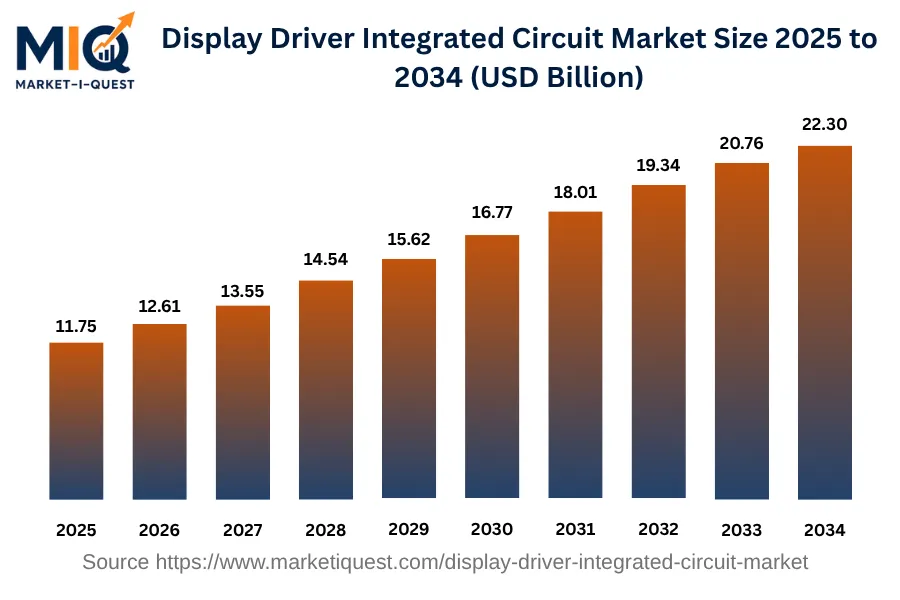
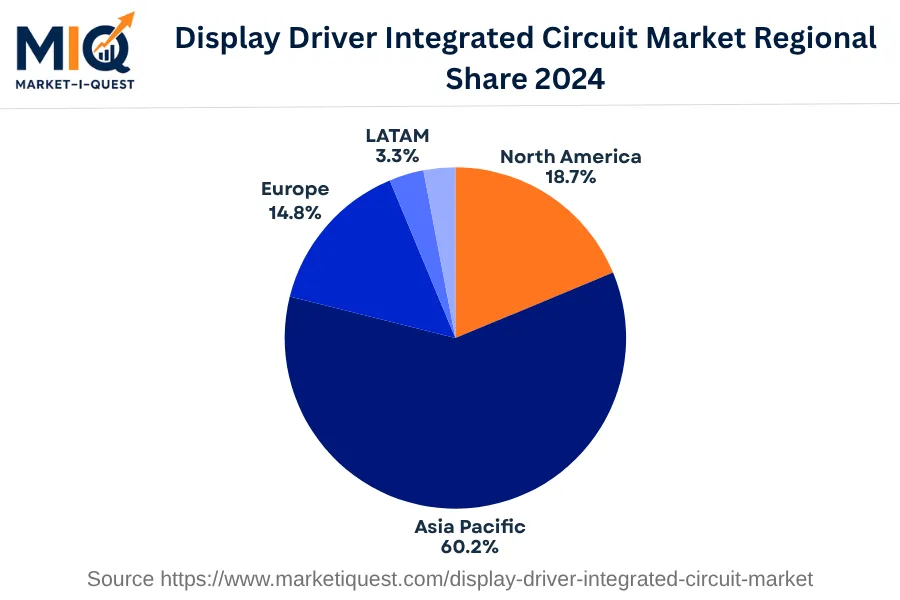
The Display Driver Integrated Circuit Market had a size of 11.75 billion USD in 2025, and it is forecast to reach 22.30 billion USD by 2034, with a compound annual growth rate (CAGR) of 7.38%. Beginning in 2024 with a market size of 10.94 billion USD, there was a growth instance to 11.75 billion USD in 2025. The market then persistently expanded over the years to reach 22.30 billion USD in 2034. The Market growth is explained by a continuous increase in demand for these circuits due to their high efficiency and low power consumption feature, making them a preferred choice in various technology-based applications. Regarding regional shares in 2024, Asia Pacific had the lion's share at 60.2%, followed by North America at 18.7%, Europe 14.8%, LATAM 3.3%, and MEA standing at 3.01%. The geographical distribution highlights the predominance of the market in the Asia Pacific region.

Key Takeaways

  • By Resolution - Full HD (1920×1080) held the major share in the Display Driver Integrated Circuit Market in 2024.
  • By Refresh Rate - 120 Hz led the market accounting for a notable share in 2024.
  • By Panel Technology - LCD held the leading position in the Display Driver Integrated Circuit Market in 2024.
  • By Application - Tablets grew the fastest accounting for a significant share in 2024.
display-driver-integrated-circuit-market market size

Key Driving Factors

Shift towards High Definition (HD) Resolution Display

One major driver pushing the display driver integrated circuit market forward is the escalated shift towards high definition (HD) resolution displays. Various industries, including television, smartphone, and gaming, are increasingly adopting high definition (HD) and Ultra HD displays. These high-resolution displays necessitate sophisticated display driver integrated circuit (DDICs) for functioning optimally, creating a surge in demand. Larger, higher-resolution displays require advanced DDICs to manage the complex pixel control, resulting in enhanced image clarity and color accuracy. Furthermore, consumer expectations for high quality visuals result in manufacturers integrating advanced DDIC technology into their products for market differentiation and customer satisfaction.
Emergence of the Fast-Charging Technology

The emergence of fast-charging technology in the electronics sector is another significant driver. With increased usage of electronic devices, battery lifespan and charging speed have become critical areas of concern. As such, fast-charging technology has emerged as an innovation for maintaining device longevity. Display Driver Integrated Circuits (DDICs) play an essential role in this technology by managing the power supply to the display, regulating battery use to optimize performance. With growing prevalence of fast-charging technology across devices like smartphones, laptops, and electric cars, the demand for DDICs, specifically tailored for efficient power management, has amplified. This demand pushes the technological innovation and growth in the DDIC market.

Market Evolution by Timeline

2019-2023
During this phase, the adoption of display driver integrated circuits (DDICs) increased significantly in the automobile industry, particularly in Asia-Pacific regions such as China and South Korea. Suppliers launched innovative solutions designed for HD displays used in high-end vehicles. However, they faced some challenges in the integration of DDIC technology, primarily due to compatibility issues and high manufacturing cost. Regulatory standards like ISO 26262 for functional safety influenced the design and implementation of these components. It was common for bilateral contracts and long-term agreements to be established between manufacturers and suppliers, often to mutually manage price volatility. Risks of counterfeit and substandard products being introduced to the market were noted, leading companies to enhance focus on quality control and brand protection.
2024
The year witnessed a move towards higher resolution screens in the consumer electronics segment, such as television and smartphones, further driving the need for advanced DDICs. This led to an increase in the complexity of chip design, challenging the technology providers to maintain consistent product quality. The United States and European nations also showed interest in implementing environment-friendly regulations like RoHS (Restriction of Hazardous Substances) which impacted the production process of DDICs. Vendors adopted a competitive pricing policy in this increasingly crowded market. Additionally, the risk of technological outdating led manufacturers to invest heavily in R&D for future-proof solutions.
2025-2029
The rise of OLED and foldable screens in the smartphone industry in regions including East Asia and North America created new opportunities for DDIC manufacturers. Technological advancements led to the entry of chips with advanced display interfaces compatible with micro-LED and OLED displays. No notable policy or regulation change occurred that affected the existing commercial model, which was still centered around long-term contracts. However, the demand for application-specific chips raised concerns about price inflation, inciting suppliers to explore cost-effective manufacturing processes. The risk of supply-demand imbalance became apparent as the market grew rapidly.
2030-2034
The DDIC market experienced growing demand from virtual reality and augmented reality applications in sectors like gaming, healthcare, and defence, with North America leading the adoption. The development of energy-efficient DDICs gained momentum, driven by stringent environmental standards like Energy Star. The commercial model shifted towards competitive bidding for securing contracts, impacting the pricing dynamics in the DDIC market. Suppliers also started offering comprehensive solutions, including software support, to differentiate themselves. As DDIC technology became integral to a vast array of applications, the risk of cybersecurity threats emerged, highlighting the need for robust security measures.

Future Market Outlook

Future Opportunities

As the demand for advanced display technologies rises, future opportunities in the DDIC market appear promising. The ongoing proliferation of automotive displays presents a significant avenue for growth, driven by the increasing adoption of digital cockpit solutions by major automakers like Tesla and BMW as of 2023. Furthermore, the expansion of virtual reality (VR) and augmented reality (AR) applications highlights another potential area, with companies like Meta and Qualcomm investing heavily in these technologies to enhance user engagement and visualization experiences. The emergence of 5G technology facilitates faster data transmission, subsequently creating demand for more sophisticated DDICs that can handle high-definition content seamlessly. Emerging markets, particularly in Asia-Pacific regions such as India and Southeast Asia, reflect opportunities due to rising consumer electronics penetration and increasing disposable incomes. Government initiatives promoting local manufacturing, such as India's Production Linked Incentive Scheme, could also provide context for enhanced production capabilities. Additionally, the integration of health monitoring applications within wearable devices is expanding, leading companies such as Garmin and Fitbit to seek advanced DDIC solutions for improved display functionalities. Thus, focused investment in the evolving technologies and strategic partnerships within sectors aligned with display innovations can cultivate substantial opportunities in the global DDIC market moving forward.

Segmentation Analysis

By Resolution

The market is divided into subsegments including Full HD (1920×1080), Quad HD (2560×1440), 4K UHD (3840×2160), and 8K UHD (7680×4320). The Full HD subsegment accounted for the largest revenue share while the 8K UHD is expected to grow at the fastest CAGR during the forecast period.

Largest Revenue Share

Full HD (1920×1080)

Market Share Leader

The Full HD (1920×1080) resolution subsegment leads the market in revenue generation primarily due to its widespread adoption and affordability. Full HD continues to be the standard resolution for a vast range of digital devices, such as televisions, laptops, and smartphones. Its vast user-base ensures a steady flow of revenue for manufacturers and service providers. The resolution provides an optimal balance between display quality and cost-effectiveness, making it a popular choice among consumers, particularly in geographies with lower purchasing power. Moreover, Full HD content is widely available, further solidifying its position in the market. Low switching costs associated with Full HD further encourage user loyalty. Thus, driven by its affordability, widespread availability, and the vast user-base, the Full HD subsegment is able to secure the largest share of revenue.

Fastest CAGR

8K UHD (7680×4320)

Forecast Period Growth Leader

The 8K UHD (7680×4320) resolution subsegment is expected to witness the fastest growth rate. This subsegment is emerging as the new frontier in display technology, offering the highest grade of picture clarity currently available. The segment's growth is fueled by technological advancements and increased consumer demand for higher quality displays. However, the widespread adoption of 8K UHD faces barriers such as the high prices of devices and a limited availability of true 8K content. However, partnerships among tech giants and manufacturers, and increased capex in technological innovations will likely mitigate these barriers and drive the segment's growth. Nevertheless, near-term risks include rapid technological evolution, which may render current 8K technologies obsolete, and potential market saturation in the high-end consumer electronics segment. It is assumed that despite these challenges, the 8K UHD segment will grow at the most robust CAGR due to its superior display quality and ongoing technological advancements.

By Refresh Rate

The market is divided into subsegments including 60 Hz, 120 Hz, 144 Hz, and 240 Hz refresh rates. 120 Hz segment accounted for the largest revenue share while the 240 Hz subsegment is expected to grow at the fastest compound annual growth rate (CAGR) during the forecast period.

Largest Revenue Share

120 Hz

Market Share Leader

The 120 Hz segment stands as the revenue leader for the base year 2024. This can be attributed to the balance it strikes between advanced performance and affordability. High-refresh-rate displays, such as those running at 120 Hz, render more frames per second. This results in smoother motion perception and lower input lag, greatly benefiting video game players and professionals involved in video editing, 3D modeling, and graphic design. Versatility is another driver, with 120 Hz displays commonly found in TVs, monitors, gaming consoles, and even smartphones. This wide range of applications increase unit sales and therefore revenue. Customers, both corporate and individual, primarily in North America, Europe, and Asia, driven by the rise of remote work and e-sports, are the major contributors to this segment. Regulatory environment and supply chain issues have minimal effect on this segment.

Fastest CAGR

240 Hz

Forecast Period Growth Leader

While the 120 Hz segment dominates the current market, the 240 Hz segment is projected to grow fastest in the following years. Although high cost is a hurdle to rapid adoption of 240 Hz technology, shrinking manufacturing costs and the rise of a more affluent consumer base are expected to drive growth. The increasing prevalence of competitive e-sports, which highly value the extreme fluidity that 240 Hz monitors provide, is a strong growth driver. Upcoming technologies and collaborations between monitor manufacturers and game developers to optimize software for high refresh rates will further fuel this growth. However, such extreme refresh rates have minimal impact outside of high-end gaming, representing a potential barrier to wider adoption. Investors should be aware of the risks associated with technological advancements that may exceed 240 Hz refresh rates and potentially disrupt the market.

By Panel Technology

The market is divided into subsegments including LCD, OLED, Mini LED, and Micro LED. In 2024, LCD accounted for the largest revenue share while Mini LED is expected to grow at the fastest CAGR during the forecast period.

Largest Revenue Share

LCD

Market Share Leader

LCD, or Liquid Crystal Displays, remain the dominant subsegment in this sector, primarily due to its widespread application in both consumer electronic and industrial devices. LCDs provide a solid balance of cost-effectiveness, energy efficiency, and visual quality, thereby making it a preferred choice for manufacturers across multiple industries. The ubiquity of LCD technology in television sets, smartphones, and laptops contributes significantly to its undeterred market dominance. Moreover, LCD displays are also extensively used in automotive, aviation, medical, and other sectors. The overall purchasing criteria, which swings in favor of LCDs, include factors like color accuracy, lifespan, viewing angles, and notably, cost. In addition, high switching costs involved in transitioning production lines to developing technologies such as Mini LED or Micro LED have further fortified the revenue share of LCDs in 2024.

Fastest CAGR

Mini LED

Forecast Period Growth Leader

Mini LED is poised to grow at the fastest CAGR in the forecast period. This growth is primarily driven by the technology's significant advancements over its alternatives. Mini LEDs offer a higher contrast ratio and improved brightness compared to regular LEDs, leading to an improved visual experience for consumers. Its growth potential is substantial in premium televisions and flagship smartphones where manufacturers seek differentiation through enhanced display performance. However, the high capital expenditure required for developing and integrating Mini LED technology is a significant adoption barrier. Partnerships with chip manufacturers, policy support for next-generation display technologies, and increased investment in capacity enhancement would support the adoption growth of this technology. But its high cost might pose a near-term risk in adoption, especially in price-sensitive markets.

By Application

The market is divided into subsegments including Smartphones, Tablets, Laptops, Monitors, Televisions, and Others. Of these, Smartphones accounted for the largest revenue share while Tablets is expected to grow at the fastest CAGR during the forecast period.

Largest Revenue Share

Smartphones

Market Share Leader

Smartphones dominate the market segment due to their fundamental role in our everyday life. In 2024, the reliance on smartphones for communication, work, education, entertainment, and other applications has augmented their market share. The expansion of 5G technology has given a significant boost to the smartphone market. This new tech has not only increased speed and efficiency but also brought about innovative features that have driven consumer demand. Additionally, geographic regions, particularly Asia, have seen a surge in smartphone adoption, due to a growing middle class with increased disposable income. Legislation has played a role, too. Regulations, particularly entailing data security, have demanded higher-end smartphones ensuring secure transactions, thereby driving the premium smartphone market further. The purchasing criteria considers brand, cost, technology, durability, and design deciding the market shares among brands while high switching costs have ensured customer loyalty.

Fastest CAGR

Tablets

Forecast Period Growth Leader

The subsegment poised for the fastest growth in the market is tablets. Despite a slow start, tablets have quickly caught up with evolving technology and customer needs. Adaptive form factors and versatile use-cases make them particularly attractive for consumers and professionals alike. Rising digital literacy, coupled with reducing prices due to economies of scale, are expected to be the main catalysts for their adoption. Additionally, key partnerships between tablet manufacturers and educational institutions for digital learning, especially in the post-pandemic era of online education, has spiked demand. A major roadblock for this growth could be the high investment involved in the latest tablet models which may deter cost-sensitive consumers. However, a policy push for digital education and capital expenditure in the corporate world to accommodate the 'work-from-home' modality are expected to overcome this hurdle.

Competitive Analysis

Key Market Players

Manufacturers / OEMs

Samsung Electronics Co., Ltd
South Korea
Novatek Microelectronics Corp.
Taiwan
Synaptics Incorporated
US

Key Suppliers & Raw Materials

TEL NEXX, Inc.
US
Siltronic AG
Germany
Sumco Corporation
Japan

Distributors, Integrators & Channel Partners

WPG Holdings
Taiwan
Avnet, Inc.
US
Future Electronics Inc.
Canada

Porter’s Five Forces Analysis

This analysis examines the competitive structure and intensity of the Display Driver Integrated Circuit Market.

Supplier Bargaining Power

Low

Supplier bargaining power is low due to the high number of raw material providers.

Buyer Bargaining Power

High

High volume purchases from smartphone manufacturers increases buyer bargaining power.

Threat of Substitutes

Medium

Potential for substitutes is medium as technological disruption introduces alternative display technologies.

Threat of New Entrants

Low

High entry barriers due to significant R&D investments and regulatory compliance limit new competitors.

Competitive Rivalry

Medium

Competition is medium with a few dominant players but the market is growing steadily.

Regional Analysis

Geographic market dynamics and growth opportunities across key regions

Global Market Outlook

display-driver-integrated-circuit-market market regional share

North America

In 2024, the Display Driver Integrated Circuit (DDIC) market in North America took on increased significance due to developments in the technology and electronics sectors. The drivers shaping this market included a surge in demand for high-resolution display panels, considerable investment in research and development by semiconductor companies, and increasing adoption of 8K technology in the entertainment industry. Stringent regulations concerning electronic waste also prompted companies to create display driver integrated circuits with longer lifespans and higher durability.

Trends shaping this market space entailed rising consumer preference for smart and connected electronic devices, a shift towards OLED displays for better color accuracy and contrast, and increase in partnerships between semiconductor and electronics manufacturing companies to leverage combined expertise. For example, numerous technology conglomerates initiated collaborations with semiconductor firms to integrate advanced DDICs into their products, changing the dynamics in the retail sector. Rapid digitization in healthcare also contributed to an increased demand for high-resolution displays powered by sophisticated DDICs. Meanwhile, in the enterprise sector, the demand grew for high-performance display devices for various applications such as remote working and virtual meetings, fueling the North American DDIC market.

Asia Pacific

In 2024, the Display Driver Integrated Circuit (DDIC) market in the Asia Pacific held a significant share in the global landscape, driven by rapid technological adoption and high demand from consumer electronics manufacturers. Regulatory policies promoting local manufacturing, particularly in China and India, triggered increased investments, bolstering the market position. Shifting supply dynamics, with South Korea and Japan's emphasis on high-quality DDIC production, further stimulated market growth. Additionally, a decline in raw material prices positively affected DDIC pricing in the base year.

Trends in 2024 accentuated a surge in buyer preference for high-resolution display devices, influencing the DDIC market. The adoption of advanced DDIC technologies like AMOLED in smartphones and smart TV manufacturing, primarily by Chinese and South Korean manufacturers, marked a significant product shift. Channel dynamics highlighted the predominance of online platforms, driven by Australia and key ASEAN markets' growing digital economies. The increased incidence of partnerships amongst technology providers, particularly in Japan, sought to boost production capacities and reinforce market stature. Regulatory authorities in significant markets, including China and India, stressed strict adherence to quality standards, minimizing counterfeit product influence. Across Asia Pacific, the majority DDIC demand came from consumer electronics, automotive, industrial, and healthcare sectors.

Europe

In 2024, Europe’s Display Driver Integrated Circuit (DDIC) market registered notable growth, majorly fuelled by technological advancements and rising demand for consumer electronics. Demand factors including high usage of touch-based devices in Germany and the United Kingdom, and increased investments in France and Benelux in IoT-based solutions stimulated the market expansion. Positive regulatory structures in Spain and Central & Eastern Europe further propelled DDICs' acceptance, making them an integral component in gadgets such as smartphones, televisions, and laptops. The market trends leaned more towards consumer behavior, with a preference shift observed towards OLED and AMOLED displays, especially in Italy and the Nordics. Partnerships and M&As prominently occurred between major stakeholders to tap the potential of the growing market. An example is the agreement between semiconductor giant, Intel and UK-based ARM Holdings to offer innovative DDIC solutions.

Key sectors seen adopting these chips were manufacturing, healthcare, and utilities across Europe due to enhanced visual performance and power efficiency. With retailers focusing on providing high-quality display devices, the retail sector also boosted the DDIC market. Moreover, the policy enforcement of energy-efficient electronic products by European governments endorsed the usage of these highly efficient display driver integrated circuits, ensuring their significant market presence in 2024.

Latin America

In 2024, the Display Driver Integrated Circuit (DDIC) market in Latin America (LATAM) demonstrated a surge in interest in electronic components to support booming digital markets. Several factors drove this growth. Brazil and Mexico's investment in digital technologies such as IoT and AI increased, requiring high-performance display drivers. Strict regulations around energy use in Argentina and Chile, particularly in manufacturing and utilities, influenced the demand for energy-efficient DDICs. Above all, a price drop in display driver components triggered by supply dynamics within the region played a key role in accelerating market demand.

Buyer behavior in LATAM has shifted towards a demand for higher resolution displays, benefiting the sales of DDICs. A remarkable trend observed in 2024 was the adoption of mobile and automotive technology in Brazil, Mexico, and Colombia, increasing the demand for DDICs. Retailers and manufacturers, in particular, became more reliant on touch and display interface technology. Concurrently, partnerships and mergers within the tech industry in LATAM suggested a strategic focus on enhancing digital interfaces, with a prevalent uptake of the Video Electronics Standards Association's display standard. Overall, 2024 marked significant transformation in the LATAM DDIC market propelled by technological advancements and strategic partnerships across various sectors.

Middle East & Africa

In 2024, the Display Driver Integrated Circuit Market in the Middle East and Africa region exhibited considerable growth. This expansion was spurred by increasing demand for high-end display panels in sectors such as telecom, government, and manufacturing, specifically in countries like Saudi Arabia, United Arab Emirates, and Israel. Regulations also played a vital role, with governments investing heavily in technology adoption to boost infrastructure, particularly in South Africa and Egypt. Moreover, cost-effective supply dynamics, coupled with competitive pricing, intensified the market's growth trajectory.

Market trends in 2024 saw a shift in buyers' behavior, leaning towards advanced product offerings with improved technology, significantly seen in the telecom sector across the UAE and Saudi Arabia. This product evolution was amplified by key partnerships and M&A activities, particularly in Israel’s technology hub. Standards set by the regulatory authorities further propelled adherence to regulatory compliance, evident in the healthcare sector in South Africa and Egypt. Lastly, policy enforcement, especially in Nigeria and Qatar, played a crucial role in shaping this market, leading to robust growth in the retail and financial services sectors in these countries. In all, 2024 was a significant year for the Display Driver Integrated Circuit Market across the Middle East and Africa region.

Recent Industry Developments

Latest market innovations, product launches, and strategic initiatives

July 2025

Infineon Technologies launched a new family of automotive-grade display driver ICs designed for large-format panels, delivering higher brightness and lower power consumption to address demand in infotainment and digital cockpit applications.

Frequently Asked Questions