Dental Laboratories Market Snapshot

Key Players

  • Dentsply Sirona (United States)
  • Danaher Corporation (United States)
  • 3M (United States)
  • Zimmer Biomet (United States)
  • Ivoclar Vivadent AG (Liechtenstein)
  • Shofu Inc. (Japan)
  • VITA Zahnfabrik (Germany)
  • GC Corporation (Japan)
  • Planmeca Oy (Finland)
  • Digital Dental Lab (Australia)

Market Size

Base Year 2024
$23.65 Bn
CAGR
6.4%
Forecast 2034
$43.98 Bn

Market Segments

By Product Type
  • Crowns
  • Bridges
  • Dentures
  • Orthodontic Appliances
  • Implants
  • Others
By Laboratory Type
  • Full-service Dental Laboratories
  • Commercial Dental Laboratories
  • Specialty Dental Laboratories
By End User
  • Dental Clinics
  • Hospitals
  • Others

Market Dynamics

Drivers
  • Rising dental disorders
  • Advancements in dental lab technology
Restraints
  • High equipment costs
  • Lack of skilled technicians
Opportunities
  • Technological advancements in dental procedures
  • Increasing geriatric population

Market Size

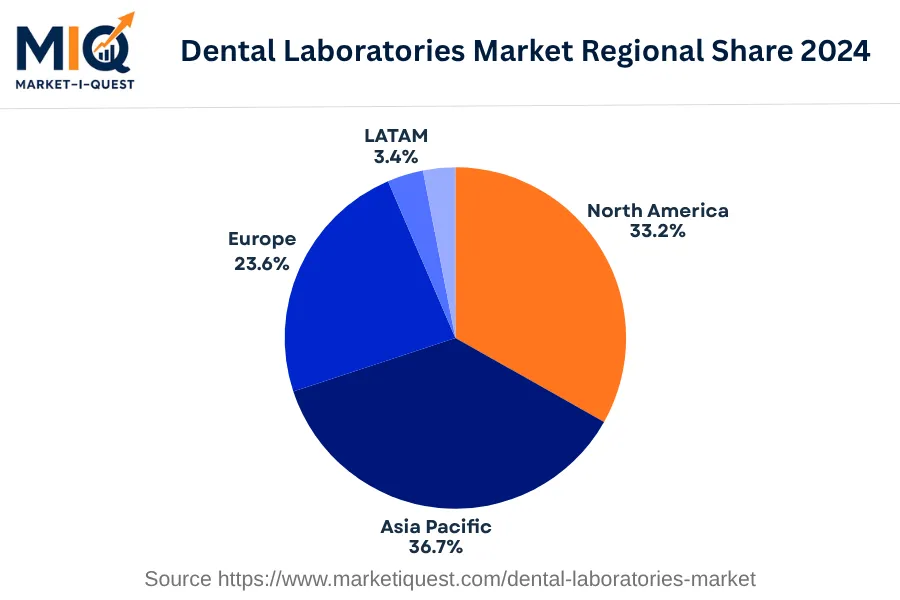
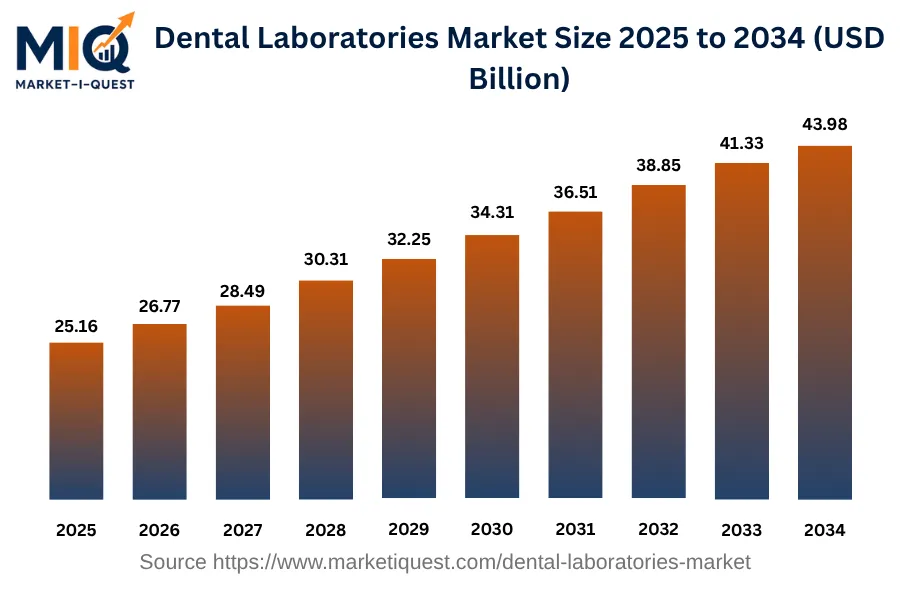
The Dental Laboratories Market size in 2025 is forecasted at $25.16 billion, up from $23.65 billion in 2024. The market continues to grow reaching $43.98 billion by 2034. Between 2025 and 2034, the market experiences a CAGR of 6.4%. Several factors contribute to this growth. Firstly, there is increased demand for cosmetic dentistry and dental implants driving expansion in this sector. Secondly, advancements in dental laboratory technologies play a crucial role in propelling the market growth over this period. In 2024, the market share was distributed among several regions. North America held 33.2% of the market, Asia Pacific led with 36.7%, Europe held 23.6%, whereas the remaining regions of Latin America and the Middle East & Africa held smaller shares, 3.4% and 3.05% respectively.

Key Takeaways

  • By Product Type - Implants led the segment accounting for a substantial market share in 2024.
  • By Laboratory Type - Full-service Dental Laboratories led the segment.
  • By End User - Dental Clinics held the highest share representing a prominent position in the year 2024.
dental-laboratories-market market size

Key Driving Factors

Impact of CAD/CAM Technology in Prosthetics Production

The increased adoption of Computer-Aided Design and Computer-Aided Manufacturing (CAD/CAM) systems in dental laboratories is a key driver for the dental laboratories market. These systems are increasingly being used to create frameworks for dental restorations such as crowns, bridges, and veneers. They are highly valued for their accuracy, speed, and ability to streamline production processes, which can significantly reduce turnaround times. Dental professionals appreciate the predictable and consistent quality of restorations made using CAD/CAM, leading to customer satisfaction and repeat business. More dental laboratories globally are integrating CAD/CAM into their workflows, due to these potential efficiency and quality improvements.

Enforcement of Strict Regulatory Standards

The strict regulatory standards set by authorities such as The Federal Drug Administration (FDA) and European Medicines Agency (EMA) are pushing dental laboratories to leverage high-grade materials and adopt technologically advanced production processes. For instance, the FDA mandates dental laboratories to maintain detailed documentation of device history records, including the materials used and all stages of the production process. To adhere to these regulations, dental laboratories are investing in advanced equipment and software, driving demand in the dental laboratories market. Non-compliance risks penalties, loss of business, or even closure. Hence, the stringent regulatory landscape is a significant factor propelling growth in this market.

Market Evolution by Timeline

2019-2023
In this period, demand from ageing populations in developed regions including North America and Europe raised inputs for dental lab products - teeth implants, bridges, dentures. The adoption of CAD/CAM and 3D printing technology improved efficiency and precision in the production process. Suppliers faced constraints due to the lack of skilled personnel for operating this emerging technology. Regulations like the EU Medical Devices Regulation (MDR) required dental labs to ensure product quality and safety. Time-and-material based pricing was mostly used, with some contracts offering discounts for bulk orders. Major risks arose from the misuse of the newly adopted technology, requiring training and standard operation protocols.
2024
In 2024, market demand from developed regions remained high, with the Asia-Pacific region showing an upward trend due to increasing dental health awareness. The dental labs market faced supply hurdles as the COVID-19 pandemic caused interruptions in production due to staff shortages and disrupted supply chains. On the technology front, the improved integration of CAD/CAM technology with 3D printing proved beneficial to manufacturers. Loopholes in regularity compliance became apparent as the EU MDR was strictly enforced. The pricing model remained majorly unchanged despite fluctuations emanating from pandemic-induced disruptions. The biggest challenge came from the increasing competitive pressures and the scaling up required to meet growing market demand.
2025-2029
Rapid urbanisation and associated lifestyle changes in developing countries are expected to surge the market demand in this period. Additionally, growing dental tourism particularly in countries like India and Thailand may also contribute to the increase. The suppliers, might struggle with technology integration, facing challenges with phantom processes that affected operational efficiency in their output. As a response to these challenges, the revised version of the EU MDR will likely be launched to guide the industry better. The lab-based pricing model are expected to introduce during this time to mitigate costs within the dental laboratories.
2030-2034
Despite the growing demand, there will likely be the decline in the number of dental labs especially in North America due to consolidation and merging of labs. On the technological front, Artificial Intelligence (AI) might be increasingly adopted for automation and to improve the precision of outputs. However, AI may introduce challenges in terms of complex operations and data management. The Federal Drug Administration (FDA), will likely launch strict regulations for AI implementation in dental labs. Concerning the commercial model, the value-based pricing might be introduced, giving priority to quality over quantity. One major risk will likely be the unpredictability of AI algorithms, thus requiring robust reviewing and testing frameworks.

Future Market Outlook

Future Opportunities

The future opportunities in the dental laboratories market stem from the increasing demand for personalized dental solutions. A survey by the International Dental Federation highlighted that 70% of patients prefer customized dental services. This consumer preference is pushing dental labs to adopt advanced technologies such as AI and machine learning, leading to more accurate diagnoses and treatment planning. Partnerships between dental labs and technology firms are expected to grow, as evidenced by the collaboration between Sirona Dental Systems and various AI startups to enhance digital imaging systems. Countries like Germany are investing in continuous education for dental technicians to better navigate these technological integrations. Moreover, the ongoing digitization of health records, supported by regulations like GDPR in Europe, will facilitate better data sharing between dental labs and healthcare providers. This will streamline communication and lead to better patient outcomes. Furthermore, biodegradable materials for dental appliances are gaining attention, driven by increasing environmental consciousness. Research initiatives led by universities in the United States are exploring sustainable materials for crowns and bridges, indicating a shift towards eco-friendly practices.

Segmentation Analysis

By Product Type

The market is divided into subsegments including Crowns, Bridges, Dentures, Orthodontic Appliances, Implants, and Others. Implants accounted for the largest revenue share while Orthodontic Appliances is expected to grow at the fastest CAGR during the forecast period.

Largest Revenue Share

Implants

Market Share Leader

Implants have been preceding the Dental products market in terms of revenue, primarily due to the associated advantages that outweigh their contemporaries. Implants offer permanency, durability, and high success rate, appealing to an increasing demographic. These restorative applications have received preference over dentures and bridges because they offer longevity coupled with stability. Moreover, they have been favored due to a greater emphasis on aesthetics in the dental industry. The rise in the geriatric population, a leading consumer of implants globally, has also fueled the market's revenue share. They are increasingly opting for implants to avoid difficulties with speech or eating. Advancements in technology make this process less invasive, enhancing their acceptance among a wider user base. Regions with high disposable income like North America and Europe have shown a greater demand for implants, boosting the market further. The competitive landscape has also encouraged manufacturers to invest more in R&D, leading to better quality products available at competitive prices, further driving revenue growth.

Fastest CAGR

Orthodontic Appliances

Forecast Period Growth Leader

The Orthodontic Appliances subsegment has been demonstrating the fastest growth concerning CAGR in the dental products market. The growth can be primarily attributed to an increased focus on oral health and appearance, which has reshaped market dynamics, leading to skyrocketing demands for Orthodontic Appliances. An exponential rise in the awareness of early orthodontic treatment across the globe has been a significant catalyst in this subsegment's continual growth. Society, specifically in developed regions, is increasingly gravitating towards improving aesthetics, which influences potential customers, especially among the youth, to rectify misaligned teeth. Technological advancements in Orthodontic Appliances include invisible aligners that have encouraged an uptick in adoption rates among adults, who were previously hesitant due to the stigma attached to traditional braces.

By Laboratory Type

The dental laboratories market is divided into subsegments including Full-service Dental Laboratories, Commercial Dental Laboratories, and Specialty Dental Laboratories. In 2024, Full-service Dental Laboratories accounted for the largest revenue share while Commercial Dental Laboratories are expected to grow at the fastest CAGR during the forecast period.

Largest Revenue Share

Full-service Dental Laboratories

Market Share Leader

Full-service Dental Laboratories is holding largest revenue share of the segment. These laboratories offer a comprehensive range of services from simple fillings to complex prosthetics, appealing to a wide variety of clientele. Dentists tend to favor full-service labs for the convenience of being able to send all of their lab work to a single entity, thus, enhancing the overall workflow efficiency. Plus, these labs can leverage their broad-scale capabilities to achieve better economies of scale, allowing them to price competitively, attracting cost-conscious customers. Geographically, their presence is widespread due to their ability to cater to a comprehensive dental needs spectrum. Moreover, full-service labs are well-equipped to stay compliant with the stringent regulatory standards for different dental solutions, giving them added credibility.

Fastest CAGR

Commercial Dental Laboratories

Forecast Period Growth Leader

Commercial dental laboratories are set to become the fastest-growing subsegment, due to operate on larger scales and have robust operational infrastructure, . Leveraging the benefits of volume efficiency, these labs can provide cost-efficient solutions, which is a critical purchasing criterion for many dental practices, especially in cost-sensitive markets. Furthermore, commercial labs are usually faster at adopting new technologies due to their larger resources and strategic partnerships, thus promoting innovation and efficiency in their service offerings. Although these labs face challenges like higher capital expenditure and adoption barriers in certain regions, the overall trend towards consolidation, potential for technological upgrades, and ability to cater to cost-sensitive clients are strong growth drivers.

By End User

The market’s end users are segmented into Dental Clinics, Hospitals, and Others. Dental Clinics is the subsegment with the biggest revenue share. In contrast, Others is predicted to experience the fastest growth during the forecast period.

Largest Revenue Share

Dental Clinics

Market Share Leader

Dental clinics are driving the market revenue in 2024. Utilizing a multitude of key services and products, dental clinics consistently display high purchasing activity. These establishments serve as the first line of oral care, offering preventative and restorative procedures to a vast range of patients. Their central role in consumer healthcare allows them to maintain consistent demand for products and services. The high patient inflow results in a higher frequency of equipment usage, leading to more frequent replacement or upgrade cycles. Furthermore, improved dental clinic infrastructure, especially in developed countries, contributes to higher expenditure levels on medical supplies, technology, and advanced dental equipment. The clinic market is also aided by various regulatory compliances favoring clinic establishments and operations. However, it is assumed that the dominance of dental clinics can vary based on regional healthcare structures and access to oral healthcare.

Fastest CAGR

Others

Forecast Period Growth Leader

The 'Others' subsegment, potentially including standalone practitioners, specialty clinics, and telemedicine platforms, is expected to grow at the most significant rate. The expansion of this segment is driven by the rise of individual practitioners who are appealing to patients through personalized, direct-to-consumer offerings. Moreover, the continuous evolution of telemedicine has been a pillar for growth, providing remote oral care services, such as consultations and follow-ups. It lowers the entry barrier for consumers seeking oral healthcare services, especially in geographically isolated areas. This development is supported by innovative partnerships between traditional care providers and technology firms, increased investment in digital health platforms, and evolving patient preferences for healthcare delivery.

Competitive Analysis

Key Market Players

Manufacturers / OEMs

Dentsply Sirona
US
Danaher Corporation
US
Zimmer Biomet
US

Key Suppliers & Raw Materials

Ivoclar Vivadent
Liechtenstein
VITA Zahnfabrik
Germany
Wieland Dental
Germany

Distributors, Integrators & Channel Partners

Burkhart Dental Supply
US
Henry Schein, Inc.
US
Patterson Dental Supply, Inc.
US

Porter’s Five Forces Analysis

This analysis assesses the competitive landscape and market dynamics of the Dental Laboratories Market.

Supplier Bargaining Power

Medium

Dependent on specific inputs and technologies, hence suppliers have moderate influence.

Buyer Bargaining Power

High

Numerous suppliers are available, leading to strong price competitiveness.

Threat of Substitutes

Low

Highly specialized and professional service, substitutes are rare.

Threat of New Entrants

Medium

Considerable capital costs, ongoing tech advancements and regulation represent moderate barriers.

Competitive Rivalry

High

Due to increasing number of international and local companies.

Regional Analysis

Geographic market dynamics and growth opportunities across key regions

Global Market Outlook

dental-laboratories-market market regional share

North America

In 2024, the Dental Laboratories Market in North America primarily revolved around serving the dental healthcare needs of regional populations across the United States, Canada, and Mexico. The prominent drivers influencing this sector included mounting demand for dental prosthetics, federal regulations favoring dental health maintenance, and the infusion of advanced technology into dental practices. Rising oral health awareness among consumers substantially increased the demand for dental prosthetics, while government regulations promoted preventive dental health practices across all age brackets. The adoption of new-age dental equipment further revolutionized market dynamics.

Key trends observed in this market constituted changes in buyer behavior, technological shifts, and increasing collaborations within the sector. With growing education about dental health, consumer preference shifted toward preventive and restorative dental care, thereby altering purchase patterns. Technological advancements, such as the advent of 3D printed dental prosthetics and digital scanners, streamlined procedures, catalyzed efficiency, and improved service quality. Additionally, partnerships and mergers became prevalent, being seen as effective strategies to expand market presence and strengthen service portfolios in the face of stiff competition. The market also witnessed robust enforcement of quality assurance standards and policies to ensure patient safety and satisfaction.

Asia Pacific

In 2024, the Dental Laboratories Market in Asia Pacific displayed significant dynamism, driven by various factors and trends. High prevalence of oral diseases in countries like China and India, combined with an aging population in Japan and Australia, stimulated demand for dental prosthetics and other laboratory services. Implementation of beneficial healthcare policies from governments across the region, such as India's Ayushman Bharat, further encouraged market expansion. Significant investments in advanced technologies, like CAD/CAM, enhanced production efficiency and precision in dental laboratories, primarily in technologically progressive markets such as South Korea and Japan.

Interestingly, a clear consumer preference towards private healthcare providers was observed across key ASEAN markets due to perceived quality assurance and better service provision. This shift necessitated dental laboratories to form strategic partnerships with private hospitals and dental clinics. In terms of technology adoption, 3D printing for dental prosthetics became a disruptive innovation, with enterprises and healthcare providers showing greater acceptance, especially in Australia. Policy enforcement for certified production and quality assurance standards gained momentum, encouraging market transparency and fostering customer trust. Ultimately, the Dental Laboratories Market in Asia Pacific was shaped by the technological advancements, policy benefits and patient-centric approach in 2024.

Europe

In 2024, the Dental Laboratories Market in Europe exhibited a dynamic commercial landscape. Significant drivers included robust investment, fostered by insurance reimbursement policies in countries such as Germany and France, boosting demand for dental prosthetics. The United Kingdom's rigorous regulations on dental product standards also stimulated quality improvements and technological adoption across the industry. Simultaneously, low pricing strategies in Central and Eastern Europe triggered a supply surge, aiding EU market expansion. Trends pointed to marked shifts in buyer behavior, as consumers in Italy and Spain leaned towards custom dental prosthetics, influencing a technology swing towards CAD/CAM systems in laboratories. Partnership deals and M&A activities flourished, especially in the Nordics and Benelux, reshaping channel dynamics.

Meanwhile, enforcement of the EU Medical Device Regulation established unified standards, prompting transparency in the dental laboratories market. The sector noticeably impacted dental healthcare services and retail enterprises, as consumer interest unexpectedly travelled from conventional dentistry towards specialized dental laboratory products in several countries, including the UK, Germany, and Benelux. Hence, the Dental Laboratories Market in Europe in 2024 illustrates a thriving setup driven by smart regulations, innovations, cost-effective strategies, and a perceptible shift in consumer behavior.

Latin America

In 2024, the Dental Laboratories market in Latin America demonstrated notable dynamism driven by population growth, evolving healthcare demands, and increasing technological adoption. Rapid urbanization, particularly in Brazil, Mexico, Argentina, Columbia, Chile, and Peru, coupled with the disposable income growth in these countries spurred a higher demand for advanced dental care. Increased government regulations catalyzed the sector’s growth, as authorities actively promoted high quality medical and dental care, while dental companies and laboratories increased investments in state-of-the-art equipment and technologies. The wider adoption of digital dentistry technologies such as CAD/CAM systems, also impacted the market positively, enhancing efficiency and precision in dental diagnoses and treatments.

Dominant trends in the dental industry included consumer preference for cosmetic dentistry, primarily in urban areas, influenced by an advancing consumer culture valuing aesthetics. Furthermore, an increasing prevalence of dental disorders and dental health consciousness also drove the demand for sophisticated dental solutions. A shift towards online marketing and digital communication channels was observed, as dental laboratories sought to penetrate deeper into the market through remotely accessible digital platforms. Increase in strategic partnerships and mergers were noticed among key players seeking to expand their operations and consolidate market presence. Despite the COVID-19 related restrictions, enhanced protocols and policy enforcement helped maintain steady operations, reinforcing confidence and stability in the Dental Laboratories market.
Middle East & Africa

In 2024, the Dental Laboratories Market in the Middle East and Africa experienced robust growth due to diverse drivers. Government initiatives endorsing oral health played a monumental role, particularly in Saudi Arabia, United Arab Emirates and Qatar. Technology adoption such as computer-assisted design and computer-assisted manufacturing (CAD/CAM) systems stimulated market growth, essentially in countries like South Africa, Nigeria and Egypt where investment in health-tech was prominent. The competition in supply dynamics, particularly in Kenya and Israel enhanced the market's growth, coupled with competitive pricing strategies.

The observed trends within this period amplified the resultant effects of these drivers. Patients' preference for cosmetic dentistry and advanced dental procedures proliferated; this was noticeable among UAE, South Africa and Egypt's middle-class population. Increased partnerships, as seen in Qatar with international dental laboratories, also contributed to technology and knowledge sharing. Digitalization increase in dental laboratory procedures highlighted the year, with CAD/CAM systems adoption amassing popularity. The policy enforcement for quality assurance, especially in Kenya and Nigeria, shaped the industry's standards. In summation, government policies, technological adoption, robust competition and digital advancements were the driving forces in the Dental Laboratories Market in the Middle East and Africa in 2024.

Recent Industry Developments

Latest market innovations, product launches, and strategic initiatives

September 2025

SprintRay, a prominent provider of dental 3D printing ecosystems, completed the acquisition of the EnvisionTEC (ETEC) dental product portfolio from Desktop Health. The deal integrated EnvisionTEC's advanced stereolithography intellectual property, inventory, and materials portfolio directly into SprintRay's manufacturing supply chain for commercial dental laboratories.

July 2025

Leixir Dental Laboratory Group entered into a major multi-year strategic partnership with the North American Dental Group (NADG). Under this agreement, Leixir became the primary laboratory service provider for NADG's network of over 200 affiliated dental practices and 400 clinical providers.

Frequently Asked Questions