Dental Implants Market Snapshot

Key Players

  • Straumann Group (Switzerland)
  • Dentsply Sirona (US)
  • Zimmer Biomet (US)
  • Osstem Implant (South Korea)
  • Danaher Corporation (US)
  • AVINENT Implant System (Spain)
  • BioHorizons (US)

Market Size

Base Year 2024
$7.94 Bn
CAGR
6.94%
Forecast 2034
$15.53 Bn

Market Segments

By Product
  • Titanium Dental Implants
  • Zirconium Dental Implants
By Procedure
  • Root-form Dental Implants
  • Plate-form Dental Implants
By End User
  • Hospitals
  • Ambulatory Surgical Centers
  • Dental Clinics

Market Dynamics

Drivers
  • Rising dental health consciousness
  • Aging global population
Restraints
  • High treatment costs
  • Limited insurance coverage
Opportunities
  • Aging global population
  • Increasing dental diseases

Market Size

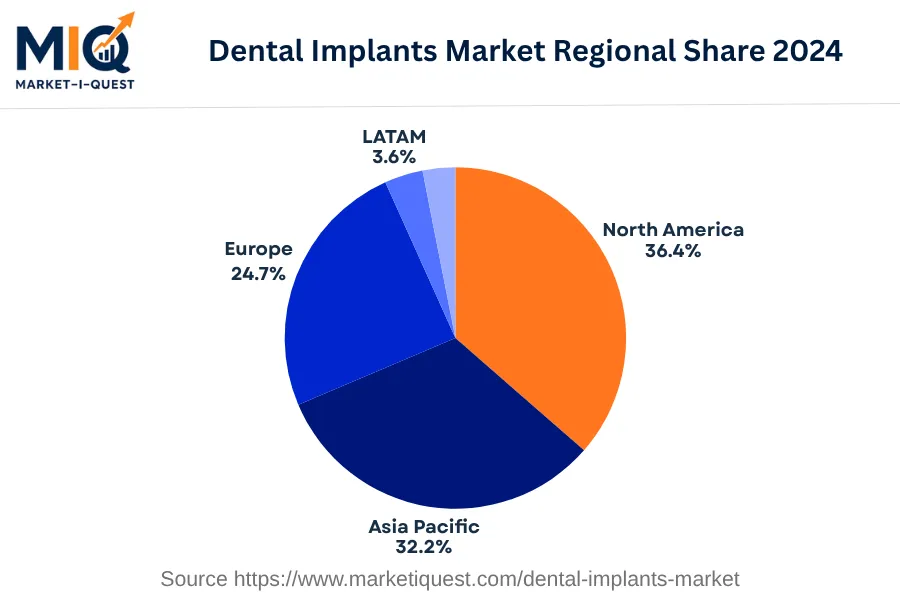
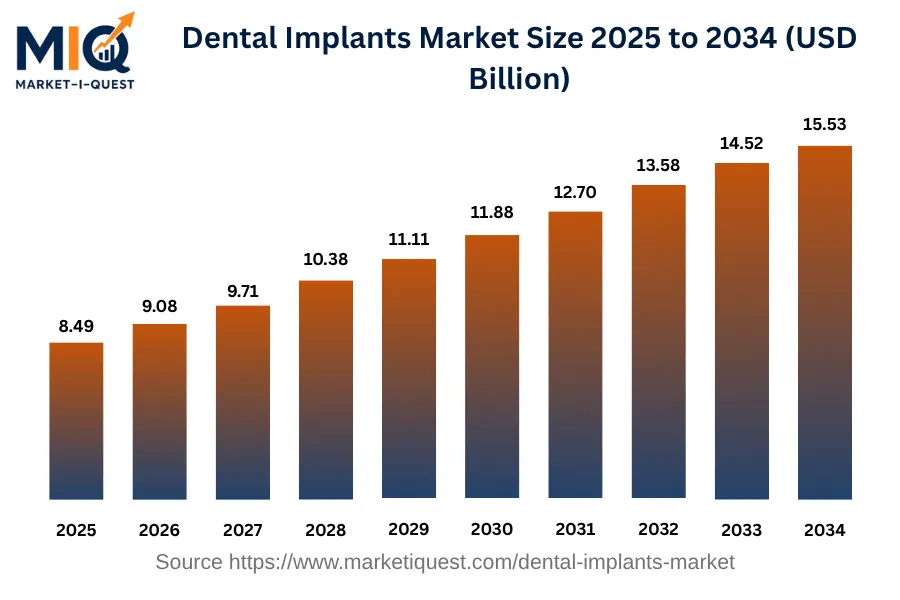
The Dental Implants Market was sized at $8.49 billion in 2025, and it is projected to grow to $15.53 billion by 2034, with a compound annual growth rate (CAGR) of 6.94%. This growth trajectory begins at a market size of $7.94 billion in 2024, and after crossing the $8.49 billion mark in 2025, it continues its upward journey towards 2034. The growth in the upcoming years is expected to be steady, exhibiting a CAGR of 6.94%. The reasons for this growth are not included in the available data. As for the regional distribution of market share in 2024, North America had the largest share at 36.4%, followed closely by the Asia Pacific at 32.2%. Europe commanded 24.7% of the market, whereas LATAM and MEA had comparatively lesser shares at 3.6% and 3.1%, respectively. The regional shares were not subject to change as per the provided information up to the year 2034.

Key Takeaways

  • By Product - Titanium Dental Implants held a significant share.
  • By Procedure - Root-form Dental Implants led the market by holding significant market share.
  • By End User - Hospitals accounted for the majority market share.
dental-implants-market market size

Key Driving Factors

Increasing Prevalence of Periodontal Diseases

The dental implants market is significantly driven by the escalating prevalence of periodontal diseases worldwide. With age, the risk of developing such diseases increases and leads to tooth loss. According to the Centers for Disease Control and Prevention, around half of the adults aged 30 years and above are diagnosed with periodontal disease. This predicament necessitates restoration procedures, which increasingly involve dental implants due to their high success rates and durability. The acceptability and preference for these implants by patients and dental professionals alike fuel the growth of the dental implants market.

Advancements in 3D Imaging and CAD/CAM Adoption

In the recent times, the dental implants market is witnessing growth due to the innovative advancements in 3D imaging technology and the high adoption of Computer-Aided Design and Computer-Aided Manufacturing (CAD/CAM) systems. These technological enhancements provide precision in the planning and placement of dental implants, which significantly reduces complications and healing time. In turn this improves the overall success rate of the procedure. The capability to provide a more accurate diagnosis and treatment planning has driven many dental clinics and laboratories to invest in these technologies. Hence, the continued adoption of 3D imaging and CAD/CAM systems is significantly propelling the dental implants market.

Market Evolution by Timeline

2019-2023
Between 2019 and 2023, the dental implants market was largely driven by the aging populations in countries like the United States and Japan. The enhanced focus on aesthetic appeal triggered demand for advanced dental implant solutions. Major suppliers included Straumann, Dentsply Sirona, and Zimmer Biomet. They provided titanium and zirconia based implants, and the latter material demonstrated growing adoption due to hypoallergenic properties and aesthetic appeal. Regulatory factors like ISO 13485 influenced the market dynamics, pushing manufacturers to maintain comprehensive quality management systems. Typical pricing models remained product-centric with tiered pricing based on material and design complexity. One considerable risk pertained to the limited insurance coverage for dental implants, affecting demand among price-sensitive patients.
2024
In 2024, the dental implants market experienced an increased uptake owing to increased dental tourism in countries like Hungary, India, and Thailand. Patients typically sought more affordable care, driving the market in these regions. Companies such as Envista and Medtronic entered the market, leading to increased competitiveness and curtailing monopoly. The Food and Drug Administration in the US implemented stricter standards that manufacturers had to meet, such as the Unique Device Identification (UDI) program for traceability of medical devices. Localized partnerships for distribution emerged as a prevalent commercial model. One risk that surfaced was the lack of skilled dental professionals to cater to the growing demand.
2025-2029
During the 2025–2029 period, the dental implants market saw the influence of digitalization strategies. Patient-specific implants produced using CAD/CAM technologies emerged as a trend in regions like Europe and North America. Companies including Align Technology and Institut Straumann AG took center stage with their CAD/CAM systems. Regulations around data privacy, including the European General Data Protection Regulation (GDPR), impacted how digital health data was stored. Contracts commonly turned into subscription models for software used in implants design over these years. The potential risk of cybersecurity attacks on these digital health data presented a new challenge in this period.
2030-2034
Between 2030 and 2034, personalized dental implants leveraging 3D printing technology were the prime market focus, driven notably by digitally-native millennials. Companies like BEGO and 3D Systems front-lined this innovation, transforming supply dynamics. Regulatory emphasis on device safety and environmental impact triggered the development of bioresorbable implants. Dental provider partnerships with 3D printing service providers became common, allowing them to deliver swift and personalized services. Pricing models leaned towards pay-per-print, making 3D printed implants more accessible. As biocompatibility tests of printers' material evolved, bioresorbable implants faced the risk of rejection or allergic reactions causing market apprehends.

Future Market Outlook

Future Opportunities

The dental implants market is poised for significant expansion, driven by a growing aging population necessitating dental solutions. In 2020, the World Health Organization reported that approximately 1.5 billion people were aged 60 or older, highlighting the increasing need for restorative dental procedures. As a result, companies are investing in research and development to enhance implant technologies catering to diverse patient needs. In 2023, research from the International Congress of Oral Implantologists revealed a rising preference for immediate loading implants, which allow for quicker rehabilitation, aligning with patient demands for expedited treatment timelines. Furthermore, the integration of artificial intelligence in treatment planning is being explored, as seen in collaborations between software firms and dental practitioners to optimize implant placement. As tele-dentistry gains momentum, particularly post-2020, it presents an opportunity for remote consultations, allowing practitioners to assess candidacy for implants remotely. Notably, several countries, including the United States and Germany, are reviewing regulations to streamline the approval process for new dental technologies, potentially facilitating faster market entry for innovative products. Additionally, emerging markets in Southeast Asia and Latin America are seeing improved healthcare infrastructure, creating a growing market for dental implants as oral health awareness increases. These factors collectively indicate a favorable landscape for companies looking to develop new products and services within the dental implants sector.

Segmentation Analysis

By Product

The market is divided into subsegments including Titanium Dental Implants and Zirconium Dental Implants. Titanium Dental Implants accounted for the largest revenue share while Zirconium Dental Implants is expected to grow at the fastest CAGR during the forecast period.

Largest Revenue Share

Titanium Dental Implants

Market Share Leader

Titanium Dental Implants is the subsegment with the most revenue owing to several factors. A prominent factor driving this segment is its longevity and durability that appeals to a significant customer base seeking long-term results. Titanium is a material known for its excellent biocompatibility and strength, thereby making it the number one choice for dental implants. Furthermore, its ability to osseointegrate effectively with the bone structure ensures successful outcomes for placement procedures. Additionally, dentists and dental surgeons favor this material due to its easy handling and customization options. Geographically, the adoption of Titanium Dental Implants is widespread following its approval by the regulatory authority across many regions. They are the standard in the industry, and many insurance providers offer generous coverage for titanium implants making them accessible for patients. However, it's worth noting that the high upfront costs associated with titanium implants can be a barrier for certain price-sensitive markets.

Fastest CAGR

Zirconium Dental Implants

Forecast Period Growth Leader

Zirconium Dental Implants, on the other hand, are projected to exhibit the fastest growth rate over the forecast period. A surge in demand for metal-free options has placed the spotlight on zirconium as a fitting substitute. Zirconium implants are known for their natural tooth-like color, which is aesthetically pleasing and appealing to patients seeking a more natural look. The increased uptake can also be attributed to advances in dental technologies and the associated advantages such as better strength compared to other ceramic materials, and lower plaque affinity. There is also an emerging consumer consciousness about the potential allergic reactions to metals, pushing the preference towards metal-free alternatives like those made of zirconium. That being said, the higher costs of Zirconium Implants, issues related to cracking, and the requirement for advanced skill sets for implant placement may act as barriers to their adoption rate. But with potential advancements and partnerships aiming to resolve these issues, the growth outlook stays positive.

By Procedure

The market is divided into subsegments including Root-form Dental Implants and Plate-form Dental Implants. Root-form Dental Implants accounted for the largest revenue share while Plate-form Dental Implants are expected to grow at the fastest CAGR during the forecast period.

Largest Revenue Share

Root-form Dental Implants

Market Share Leader

Root-Form Dental Implants, characterized by their screw-like shape analogous to a tooth's root, have dominated the market due to their superior success rate, stability, and versatility. They have a wide range of sizes and lengths, allowing for a versatile application in various bone types and structures. Additionally, being a time-tested and extensively researched implant option, they have a high acceptance rate among dental professionals. Geographic regions with higher disposable income and advanced healthcare facilities, such as North America and Western Europe, contribute significantly to this subsegment's revenue, due to the prevalence of aesthetic dentistry and cure for edentulism. Regulatory approvals and reliability of these implants further drive their demand. However, the high costs associated with these implants, along with the required surgical proficiency, might limit their adoption in cost-sensitive markets or among novice practitioners.

Fastest CAGR

Plate-form Dental Implants

Forecast Period Growth Leader

While the Plate-form Dental Implants account for a smaller market share currently, they are projected to witness the fastest growth. The unique design of plate-form or blade-form implants makes them ideally suited for narrow, shallow bone structures which can't accommodate the larger root-form implants. This makes them a preferred choice in challenging surgical scenarios. Rapid advancements in this technology, combined with strategic partnerships with dental colleges for training programs, are enhancing their adoption by dentists. From a bottleneck perspective, the initial cost of adopting new technology and the steep learning curve can serve as barriers. However, with continuous improvements in design, material, and procedure simplifications, these hurdles are expected to mitigate, paving the way for a significant adoption of plate-form implants in the coming years.

By End User

The market is divided into subsegments including Hospitals, Ambulatory Surgical Centers, and Dental Clinics among which Hospitals accounted for the largest revenue share while Ambulatory Surgical Centers are expected to grow at the fastest CAGR during the forecast period.

Largest Revenue Share

Hospitals

Market Share Leader

Hospitals are the subsegment contributing the most to the revenue share, as they serve as the primary point of care for various health-related issues. They possess the necessary infrastructure and skilled manpower to cater to a large volume of patients. Hospitals also have departments dedicated to various specialties, which leads to a viable market for a broad spectrum of medical and surgical devices. Furthermore, with hospitals being the primary recipients of healthcare funding from both private and government sources, they have the financial capacity to invest in the advanced technologies. This has resulted in them being the largest end-user segment in terms of revenue. The segments contribution is also heightened by the fact that in critical medical situations, hospitals become the most sought after healthcare institution due to the availability of comprehensive medical care.

Fastest CAGR

Ambulatory Surgical Centers

Forecast Period Growth Leader

Ambulatory Surgical Centers are expected to witness the fastest growth, given their increasing popularity for minor surgical procedures. Substantial advancements in medical technology have allowed numerous procedures to be performed outside hospital settings at these centers, saving time and costs. By providing an effective and efficient environment for surgical procedures, these centers are increasingly being preferred over hospital outpatient departments. Moreover, the increasing prevalence of chronic diseases that require surgical interventions also support the growth of this subsegment. However, there could be potential risks such as changes in regulations and policies affecting the overall operations of these centers. The potential for high growth might therefore be leveraged through strategic partnerships and consolidations to maintain competitive positioning.

Competitive Analysis

Key Market Players

Manufacturers / OEMs

Straumann
Switzerland
Dentsply Sirona
US
Zimmer Biomet
US

Key Suppliers & Raw Materials

Johnson & Johnson
US
3M
US
Danaher Corporation
US

Distributors, Integrators & Channel Partners

Henry Schein, Inc.
US
Patterson Companies, Inc.
US
Benco Dental Supply Company
US

Porter’s Five Forces Analysis

A summary of the competitive forces shaping the Dental Implants Market.

Supplier Bargaining Power

Medium

Strong industry standards but diverse sources of dental implant materials.

Buyer Bargaining Power

Low

High switching costs and lack of alternative treatments reduce buyer power.

Threat of Substitutes

Low

Few viable substitutes exist for dental implants in severe cases.

Threat of New Entrants

Medium

Technological advancements lower barriers, but regulatory compliances present challenges.

Competitive Rivalry

High

Large market players dominate with strong brand loyalty and advanced technologies.

Regional Analysis

Geographic market dynamics and growth opportunities across key regions

Global Market Outlook

dental-implants-market market regional share

North America

In 2024, the North American dental implants market showcased robust growth, underpinned by rising dental issues, technological advancements, and a growing elderly population.

Drivers stimulating this growth consisted of improved dental health awareness, accelerating demand for cosmetic dentistry, and an increase in oral diseases and conditions in the United States, Canada, and Mexico. Investment in research and development led to technological innovations, such as nanostructured titanium implants, enhancing market growth. A shift towards digitization in dental implant procedures rendered more precise and efficient solutions, catering to the evolving demands of customers and healthcare professionals. Pricing dynamics also played a role, with the prevalent trend of low-cost dental implants facilitating market expansion in economically strained sectors.

Trends in the market were reflective of changes in both customer behavior and technology. An evident shift towards minimally invasive surgical procedures marked a pivotal transformation in buyer behavior. Technology-wise, the rise of CAD/CAM systems and 3D printing for customized implants shaped the market significantly. A notable trend in policy enforcement was evident in efforts to standardize dental implant procedures across healthcare establishments. Additionally, strategic partnerships and M&A activities, primarily in the U.S., significantly catalyzed the market's growth trajectory. Meanwhile, rising health insurance penetration, particularly in the U.S., rendered substantial impetus to the uptake of dental implants.

Asia Pacific

In 2024, the Asia Pacific dental implants market witnessed significant growth largely driven by a robust increase in geriatric population, rising dental tourism, and increasing focus on aesthetics. China led the market driven by the soaring elderly population prone to tooth loss and a high prevalence of oral diseases. Simultaneously, India experienced impressive growth due to affordable dental services, fuelled by the burgeoning dental tourism sector.

High investments in R&D for advanced dental implants, particularly in Japan and South Korea propelled market growth. There was a noticeable trend of adoption of CAD/CAM technology in Australia, enhancing preciseness in dental implant procedures. ASEAN countries focused on regulatory changes to assure implant quality, legitimizing certain implant standards.

Consumer preferences were increasingly leaning towards less intrusive procedures and long-lasting solutions, including implants. In Japan and South Korea, a trend of partnerships between local and international implant manufacturers was obvious, aiming to cater to this growing demand more effectively. Enforcement of strict standards by government bodies, particularly in Australia, influenced the overall market trends, pushing for high-quality dental implant production.

The primary customer base was the healthcare sector, comprising dental clinics and hospitals, fueled by both public and private healthcare systems. Meanwhile, strong government support in countries like China and India propelled demand from government healthcare services, driving overall growth in the Asia-Pacific region.

Europe

In 2024, the dental implants market in Europe demonstrated significant dynamism. Key demand drivers included an aging population with improved longevity, heightened awareness of oral health, and increased accessibility to dental care services particularly in countries like Germany, the United Kingdom, and France. Advances in technology and an environment that fostered investment also dynamically shaped the market. Particularly in Germany, the adoption of digital dentistry tools such as 3D printing and CAD/CAM systems supported an efficient and precise process in dental implantology.

Shifting trends emphasised a clear consumer preference for ceramic implants due to their biocompatibility, aesthetic appeal, and durability. In the United Kingdom and France, distribution networks leaned towards dental clinics, as that channel facilitated to streamline the adoption of dental implants. Also, there was an observed increase in partnerships and M&A activities in the region, noticeably between manufacturers and dental clinics. These collaborations encouraged strategic growth and expansion across Europe. Furthermore, notable standard enforcement was recognized in relation to the EU Medical Devices Regulation (MDR) that set stricter safety and quality requirements on dental implants, thereby ensuring product authenticity in the market. Thus, with the combination of demand drivers and shifting trends, the European dental implant market appeared poised for steady growth in 2024.

Latin America

In 2024, the Dental Implants Market in Latin America (LATAM) experienced substantial growth due to several key drivers and emerging trends. Increased awareness regarding oral health boosted demand for dental implants, while accelerated investment in healthcare technology facilitated broader access to implant treatment. High prevalence of dental illnesses in countries like Mexico and Brazil further amplified the demand. On the supply side, advancements in CAD/CAM technology improved production efficiency and quality of dental implants, affecting pricing positively.

Simultaneously, changes in buyer's behavior showed an increasing preference for premium, aesthetically appealing implants, prompting manufacturers to innovate product designs. Tech-enabled services like virtual consultations became prevalent, affecting channel dynamics as well. In Brazil, partnerships between local dental clinics and global implant manufacturers flourished, allowing for enhanced treatment accessibility. Regulatory bodies in Mexico and Argentina tightened quality control, resulting in a rise of certified dental implants in the market.

The improved consumer purchasing power in urban areas in countries like Chile and Colombia resulted in an increasing number of people opting for dental implants in lieu of traditional bridges and dentures. Moreover, public dental healthcare sector in Peru increasingly included dental implants in their coverage, contributing significantly to the market growth. Across LATAM, the retail sector also influenced the uptick in demand for dental implants, primarily through online stores.

Middle East & Africa

In 2024, the dental implants market in the Middle East and Africa experienced significant growth dynamics. Driving factors included the rising prevalence of oral disorders, such as tooth decay and periodontal diseases, in key countries like Saudi Arabia, UAE, South Africa, and Israel. Increased healthcare investments by governments like Saudi Arabia and UAE enhanced accessibility to dental implant procedures. Adoption of advanced technology in dental surgeries, especially in Israel and UAE, also boosted supply dynamics.

In terms of trends, consumer behavior saw a shift towards preferring dental implants over traditional dentures due to their longer longevity and aesthetic benefits. Technologically, the adoption of CAD/CAM systems for better precision in dental implant surgeries gained momentum in countries like South Africa and Saudi Arabia. Channel dynamics echoed a rise in dental tourism, with countries like Egypt and Israel emerging as preferred destinations for affordable and advanced dental care. Strategic collaborations between major implant manufacturers and local distributors surfaced as a key strategy for market penetration.

Key sectors involved were healthcare, with remarkable contributions from governments and private players. Hospitals and dental clinics were the main customers, with a rising trend observed in the private sector due to increasing per capita healthcare expenditure and insurance coverage in countries like South Africa, UAE, and Israel. Demand from the elderly population and affluent segments also influenced market dynamics.

Recent Industry Developments

Latest market innovations, product launches, and strategic initiatives

March 2026

The Straumann Group, a global leader in premium implantology, announced an official strategic partnership with the world-renowned Malo Clinic network. The alliance focuses on co-developing and driving advanced digital workflows for complex full-arch dental rehabilitations, leveraging Straumann’s digital guided surgery suites across Malo’s global clinical branches.

April 2025

ZimVie officially launched the Immediate Molar Implant System in the United States market. This specialized system introduces engineered surgical instrumentation specifically designed to streamline alveolar site preparation directly following a molar extraction, reducing the overall time required for predictable immediate-load implant placement.

February 2025

Global medical technology manufacturer Medtronic acquired key nanosurface technology assets and related intellectual property from Nanovis. This acquisition included specialized titanium nanosurface tech and biologic fixation intellectual property (including rights to Sites Medical's OsteoSync titanium infrastructure), which are engineered to enhance early-stage bone integration in orthopedic and endosteal dental implants.

Frequently Asked Questions