
Dental Equipment Market Snapshot

Key Players

  • Dentsply Sirona (United States)
  • Danaher Corporation (United States)
  • Planmeca Oy (Finland)
  • Ivoclar Vivadent AG (Liechtenstein)
  • 3Shape A/S (Denmark)
  • GC Corporation (Japan)
  • Carestream Dental LLC (United States)
  • Henry Schein Inc. (United States)
  • Straumann Group (Switzerland)
  • DentalEZ Inc. (United States)

Market Size

Base Year 2024
$8.49 Bn
CAGR
3.86%
Forecast 2034
$12.40 Bn

Market Segments

By Equipment Type
  • Dental Radiology Equipment
  • Dental Chairs
  • Handpieces
  • Dental Lasers
  • Sterilization Equipment
By Distribution Channel
  • Direct Sales
  • Online Sales
  • Distributors
By Application
  • Orthodontics
  • Endodontics
  • Periodontics
  • Cosmetic Dentistry

Market Dynamics

Drivers
  • Rising dental disorders prevalence
  • Technological advancements in equipment
Restraints
  • High equipment costs
  • Regulatory compliance issues
Opportunities
  • Emerging countries' dental industry growth
  • Advancements in dental device technology

Market Size

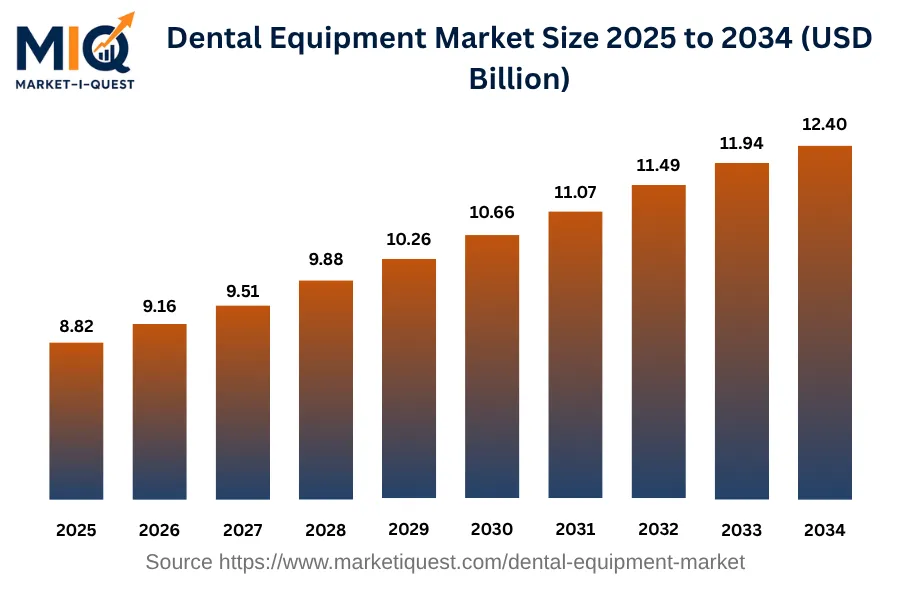
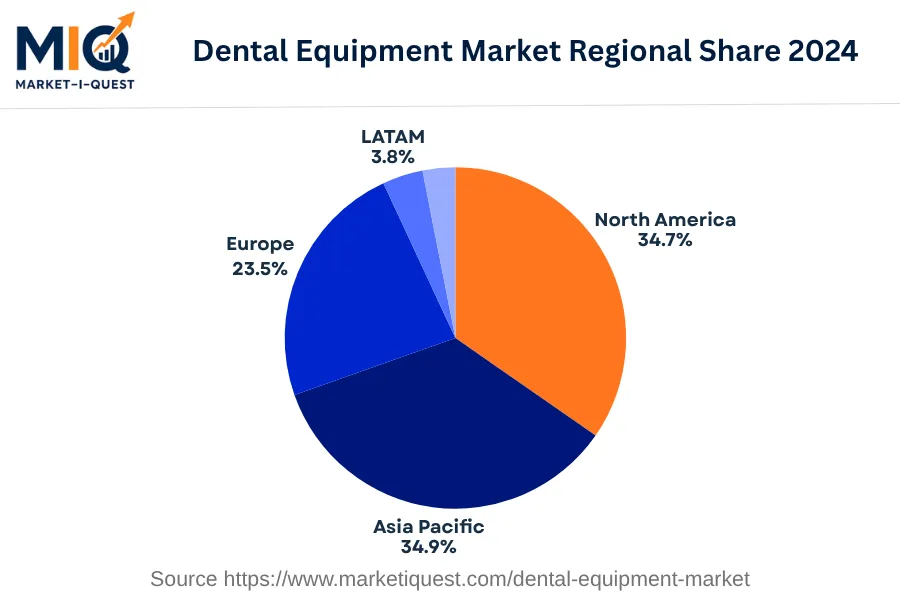
The Dental Equipment Market, sized at $8.82 billion in 2025, is projected to grow to $12.40 billion in 2034 with a CAGR of 3.9%. From 2025 to 2034, the market grows almost steadily with increased demand and new product innovations. This ten-year period shows an overall increase of $3.58 billion, marking consistent growth in the dental equipment industry. The regional share distribution in 2024 underlines North America with a 34.7% market share, closely followed by the Asia Pacific region, holding 34.9%. Europe, with a 23.5% share, is third in line. The stakes are comparatively lower in LATAM and MEA, carrying the percentages of 3.8% and 3.1% respectively. These numbers illuminate the global spread of the Dental Equipment Market demand and penetration.

Key Takeaways

  • By Equipment Type - Dental Radiology Equipment led the market with a dominant position in the base year.
  • By Distribution Channels - Online Sales held the lion's share in the Dental Equipment Market.
  • By Application - Orthodontics emerged as the leading subsegment in the given period.
dental-equipment-market market size

Key Driving Factors

Increased Demand for Aesthetic Dentistry

Aesthetic dentistry focuses on improving the appearance of teeth and gums. As societies globally place more emphasis on personal appearance and presentation, individuals are becoming more fascinated by picture-perfect smiles depicted in various media platforms. Due to this popularity, there's been a sizeable jump in the number of people seeking cosmetic dental procedures in recent years. This clientele shift has exerted significant pressures on dental clinics and hospitals to modernize and invest in high-quality dental equipment. Professional dental care providers are looking to meet clients' sky-high expectations by offering the latest and most performed cosmetic dental procedures such as teeth whitening, veneers, or dental implants, thereby stimulating further growth and expansion of the dental equipment market.
Emphasis on Regular Preventive Dental Check-ups

Public health officials and dental care providers are championing the value of regular preventive dental check-ups with greater vigor than before. They argue that routine check-ups can help diagnose oral health issues early, making them easier and less costly to treat, and can also contribute to improved overall health. Educational campaigns, initiatives by healthcare organizations, and public service messages reinforcing these points have led to increased preventive dental visits. This rising awareness is expected to stimulate the purchase of dental equipment as dental practices strive to accommodate the growing number of patients seeking preventive oral health care. This trend is a potent force projecting the dental equipment market towards a trajectory of sustained growth.

Market Evolution by Timeline

2019-2023
From 2019 to 2023, primary buyers of dental equipment included private practices and larger healthcare groups in Europe and North America. The trend is influenced by increasing awareness of oral healthcare. Supply-wise, major dental players concentrate on upscale CAD/CAM systems. However, their integration into regular workflows posed challenges for many dental clinics. Regulatory-wise, the EU's Medical Device Regulation (MDR) of 2020 has led to stricter standards. Commercial model was leaning towards bundled purchase contracts including servicing options to offset initial investment costs. Major risks included insufficient trained operators and high initial costs, mitigated by easier financing options and training sessions by suppliers.
2024
The year 2024 was characterized by laser dentistry becoming more popular in North America and Western Europe, driven by its precision and less invasive nature. Companies like Biolase were a main player in this trend. In addition to the standard variety of dental equipment, suppliers introduced more of such equipment to their sortiment. There were concerns about the FDA's rigorous evaluation process for medical lasers, although their approval could be a stamp of reliability. Pricing of laser dental equipment remained high, acting as a barrier to widespread adoption. Partnerships between manufacturers and educational institutions were common, providing training to future practitioners to mitigate lack of technical skills.
2025-2029
During 2025-2029, Asian countries, led by India and China, were the key buyers in the dental equipment market. This demand was mainly due to rising middle-class population and expanding healthcare infrastructure. Supply side observed increased production of in-office milling units. However, there were issues with integrating these units in smaller clinics. In terms of policy, the enforcement of new regulations for Dental Material Biocompatibility in China in 2026 impacted market dynamics. The prevalent commercial strategy was offering capital finance options to help clinics afford new technologies. Difficulty in managing and maintaining the new equipment remained a significant risk, tackled by suppliers by offering extended warranties and services.
2030-2034
By 2030-2034, Africa began to emerge as a market for dental equipment, driven by improved healthcare funding. Suppliers were having difficulties meeting demand for lower-end equipment, while the supply of high-tech products like Cone Beam Computed Tomography (CBCT) devices grew. Regulatory influences included the African Continental Free Trade Area (AfCFTA) implemented in 2031, which eased import and export procedures between African nations. Leasing arrangements were becoming a common commercial model due to increased purchase cost. The major risk was lack of trained professionals, addressed by various capacity-building programs initiated by governments and international organizations.

Future Market Outlook

Future Opportunities

Future opportunities in the dental equipment market can be closely associated with the ongoing trend of digitization and patient-centric approaches within the industry. The rise in demand for minimally invasive procedures, observed in the European market since 2021, creates openings for companies focused on developing advanced dental tools like lasers and digital scanners. These technologies not only facilitate accurate diagnoses but also provide quicker treatment alternatives, attracting more patients. Moreover, partnerships between dental manufacturers and technology firms are becoming common, exemplified by the collaboration between Align Technology and 3Shape in 2023 to enhance digital workflow solutions for orthodontic practices. Regulatory shifts, especially around electronic healthcare records integration in the United States, further support the move toward connected dental practices, thereby increasing the need for compatible dental equipment. Furthermore, the growing interest in preventive care and aesthetics is sparking research into new materials and treatment modalities. The increased focus on dental hygiene and wellness, underscored by dental health campaigns in various countries, paves the way for equipment advancements aimed at early intervention and preventive measures. These trends indicate that companies committed to innovation and aligned with regulatory changes will likely find new growth avenues in the evolving dental landscape.

Segmentation Analysis

By Equipment Type

The market is divided into subsegments including Dental Radiology Equipment, Dental Chairs, Handpieces, Dental Lasers, and Sterilization Equipment. Dental Radiology Equipment accounted for the largest revenue share while Dental Lasers is expected to grow at the fastest CAGR during the forecast period.

Largest Revenue Share

Dental Radiology Equipment

Market Share Leader

Dental radiology equipment comprises a majority market share owing to its essential role in dental diagnosis and treatments. Tools like cone-beam computed tomography (CBCT), panoramic and cephalometric, and intraoral x-ray devices form a critical part of this subsegment and are widely utilized throughout the dental industry. The high prevalence of oral diseases, increased aging population, and the growing emphasis on dental cosmetic procedures support the consistent demand for these products. Besides these, strict regulation and high-quality requirement standards also contribute to the high purchasing patterns for these equipment, driving their prices and hence revenue. Additionally, the move towards digitization in healthcare has led dental professionals to adopt digital radiology equipment, which offers advantages such as greater imaging precision, faster processing, and improved patient comfort. This insertion of advanced technology into this subsegment escalates its value and relevance in the dental industry, making it the subsegment with the largest revenue share.

Fastest CAGR

Dental Lasers

Forecast Period Growth Leader

Despite its modest share currently, the Dental Lasers subsegment portrays a high potential for rapid growth. Dental lasers are used for a variety of procedures including gum reshaping, cavity removal, and teeth whitening among others. Not only do these lasers improve the precision and efficiency of treatments, they also enhance patient experiences by reducing pain and healing time. Technological advancements and continuing R&D investments in laser technology are catalyzing its acceptance and use in dentistry. Yet, the high initial expenditure of laser devices may be a barrier to adoption, particularly for small and medium-sized practices. However, the prospect of performing more procedures in-office, reducing referrals out, and charging premium prices because of the improved patient experience may offset these initial costs. The swift rise in cosmetic dental procedures worldwide is another impetus for this subsegment growth. However, regulatory roadblocks and slower adoption due to legacy equipment may put short-term brakes on the expansion speed of this subsegment.

By Distribution Channel

The market is divided into subsegments including Direct Sales, Online Sales, and Distributors. Online Sales accounted for the largest revenue share while Direct Sales is expected to grow at the fastest CAGR during the forecast period.

Largest Revenue Share

Online Sales

Market Share Leader

The Online Sales subsegment holds a significant portion of the market. It is driven primarily by the growing digitalization and the rising penetration of the internet globally. With consumers more accustomed to online shopping, an ease of transaction, hassle-free return policies, and better pricing competitively, online sales continue to grow. Additionally, the platform provides a wider geographical reach than the traditional sales channels, which has played a crucial role in its growth. Notably, online platforms also allow for personalized marketing strategies based on customer behavior data. This advantage, combined with the convenience offered to customers and the ability to compare prices across providers, has propelled the online sales subsegment to the top of the revenue list in the market.

Fastest CAGR

Direct Sales

Forecast Period Growth Leader

The Direct Sales subsegment, while not the largest revenue generator currently, is projected to have the fastest growth rate. This can be attributed to several key factors. Direct sales allow for greater control over pricing strategy and let businesses build closer relationships with their customers, leading to increased customer loyalty. They can customize the sales process to the specific needs and preferences of each client, giving them a significant advantage over other channels. Moreover, the implementation of technologies like AI and CRM in direct sales has been a game-changer, reducing operational costs and improving efficiency. However, it is essential to note that while the growth rate is promising, there are barriers to adoption. The main challenge lies in training the sales force to be adaptable in an increasingly digital market. Nevertheless, with the right strategies, these challenges can be overcome, leveraging direct sales to maximum advantage.

By Application

The market is divided into subsegments including Orthodontics, Endodontics, Periodontics, and Cosmetic Dentistry. Orthodontics accounted for the largest revenue share while Cosmetic Dentistry is expected to grow at the fastest CAGR during the forecast period.

Largest Revenue Share

Orthodontics

Market Share Leader

Orthodontics leads the revenue share in the application segment. This dominance can be attributed primarily to the prevalent malocclusion and jaw disorders among the global population. As orthodontic treatments are often critical necessities rather than elective procedures, a consistent demand is maintained. With increasing awareness about dental health and the role of aesthetics in improved self-esteem, people across all socio-economic strata are willing to undertake orthodontic procedures. Moreover, advances in orthodontic technologies such as clear aligners are propelling the market further. These appliances provide cosmetic advantages over traditional wire and bracket braces, bolstering their adoption particularly among adults. This trend is observed globally, across developed and developing countries. Regulatory bodies in many regions support orthodontic treatments as essential healthcare needs, further influencing market dynamics. The purchasing decision is often driven by the quality of care, accessibility, and cost, with dental insurance playing a key role in developed nations.

Fastest CAGR

Cosmetic Dentistry

Forecast Period Growth Leader

Cosmetic Dentistry is expected to be the fastest growing subsegment. This growth can primarily be driven by rising consumer focus on dental aesthetics and improvements in cosmetic dental procedures. Advanced technologies like 3D imaging and digital smile design are making cosmetic dental procedures more precise and predictable, fostering greater patient trust and uptake. An increasing number of partnerships between dental clinics and beauty spas indicate a growing trend of 'smile makeovers' as part of overall beauty regimens. There is significant investment in developing minimally invasive, pain-free cosmetic dentistry procedures, breaking down another barrier for potential adopters. However, there might be near-term risks associated with varying regulatory outlooks on such treatments globally, painstaking insurance reimbursement processes, and the high out-of-pocket expense for consumers. Patients value benefits versus risks and costs implications, which will be the key factor for adoption of these cosmetic dental procedures.

Competitive Analysis

Key Market Players

Manufacturers / OEMs

Danaher Corporation
US
Dentsply Sirona
US
Planmeca Group
Finland

Key Suppliers & Raw Materials

Ivoclar Vivadent
Liechtenstein
VITA Zahnfabrik
Germany
Coltene Group
Switzerland

Distributors, Integrators & Channel Partners

Henry Schein
US
Patterson Dental
US
Benco Dental
US

Porter’s Five Forces Analysis

This is an analysis of the dental equipment market using Porter's Five Forces framework.

Supplier Bargaining Power

Medium

Relatively few suppliers compete, but many dental equipment OEMs source independently.

Buyer Bargaining Power

High

Large number of clinics and hospitals drive high competition and thus higher bargaining power.

Threat of Substitutes

Low

Lack of professional alternatives to reliable dental equipment limits threat of substitutes.

Threat of New Entrants

Medium

High capital investment and regulatory barriers somewhat limit new entrants.

Competitive Rivalry

High

Intense competition due to demand for innovation and product differentiation in dental equipment market.

Regional Analysis

Geographic market dynamics and growth opportunities across key regions

Global Market Outlook

dental-equipment-market market regional share

North America

In 2024, the North American Dental Equipment Market was shaped by both technological advancements and changing consumer needs. The driving factors in this market were manifold. Firstly, the rising prevalence of dental disorders spurred demand. Enhanced insurance coverage for dental procedures, endorsed by the Affordable Care Act in the United States, also boosted the market. High capital investment by key players in the dental industry was noted, particularly in Canada’s robust healthcare sector. Furthermore, the market saw a significant uptake of advanced technologies, such as CAD/CAM systems, which improved the efficiency of dental procedures. Nevertheless, supply was somewhat constrained by the high costs of specialized dental equipment in the United States.

Concurrent trends in 2024 included a marked shift in consumer preferences towards cosmetic dentistry, especially in urban regions of Mexico and the U.S. Meanwhile, the growing utilization of digital and software-based dental systems underlined the technology shift in this market. A noteworthy trend in channel dynamics was the increased partnering of dental clinics with equipment manufacturers, an alliance that enhanced service delivery. Furthermore, stringent policy enforcement around hygiene and sterilization requirements of dental equipment played a crucial role in market trends. This was particularly evident among state healthcare departments, independent practitioners, and dental hospitals, which constituted major customers in this market.

Asia Pacific

In 2024, the Asia Pacific dental equipment market evidenced noticeable expansion due to comprehensive factors. The prime drivers included increasing dental disease prevalence and growing geriatric population, particularly in nations such as China and India. Additionally, Asia Pacific nations such as Japan and South Korea showed impressive uptake of advanced technologies in dental procedures, whilst increased healthcare investments from public and private sectors invigorated market growth. On the trend front, a shift towards digitization in dental practices emerged marked in largely developed markets such as Australia. The adoption of CAD/CAM systems for designing and creating dental prosthetics rose, enhancing productivity and accuracy. Equally noteworthy was the trend in e-commerce, with more dental equipment being purchased online due to ease of comparison and convenience. Increased M&A activities among prominent players bolstered resource integration and advanced market expansion, with growing policy enforcement to maintain product quality ensuring safe and effective dental devices.

Key customers included healthcare institutions such as hospitals and dental clinics. Adoption across government organizations was observed, too, with a push for improved dental care in public health initiatives. Manufacturing enterprises also emerged as major customers, leveraging advanced dental equipment to create a vast variety of dental prosthetics. In summary, the Asia Pacific dental equipment market in 2024 witnessed significant development, instigated by compelling needs, innovations, investments, and regulatory enforcements.

Europe

In 2024, the European dental equipment market experienced substantial growth with increased prosperity in Germany, the UK, France, Italy, Spain, the Nordics, Benelux, and Central & Eastern Europe. Stimulated demand arose from an aging population necessitating increased dental care, and enhanced healthcare infrastructure investments. Updates in EU regulations for medical devices also played a significant role by encouraging market participants to innovate and align with contemporaneous standards. Rapid technological adoption especially in CAD/CAM systems further fortified market robustness, while pricing adjustments sought to strike a balance between affordability and profitability.

Underlying trends highlighted a pivot towards digital technology compelling a shift in buyer behavior. Traditional dental instruments gradually gave way to advanced equipment such as digital X-rays and imaging technologies for precise diagnostics and efficient treatment. Integrated practice management software also gained popularity, suggesting an emergence of tech-savvy dental practices. A notable surge in partnerships and mergers & acquisitions established it as a preferred strategy for market consolidation and shared technological advances. Policy enforcements and stringent standards by the European Union bolstered market quality and reliability, fostering consumer confidence. Major customers encompassed healthcare providers, particularly private dental clinics, enterprise-level dental chains, and government health institutions, attracted by newer technologies and patient-centric approaches.

Latin America

In 2024, the Dental Equipment Market exhibited robust performance in Latin America, reflecting the region's increasing commitment to oral health and technological advancement. Several factors were driving this growth. For instance, increased government initiatives in nations like Brazil and Mexico enhanced public awareness about oral hygiene, sparking demand. Also, rising investments in the medical sector from Argentina and Chile resulted in the procurement of sophisticated dental equipment. Further, the technology adoption in Colombia and Peru intensified, marked by the rise in digital imaging systems and CAD/CAM systems, indicating improved supply dynamics. Yet, pricing was a significant hindrance with high-end equipment being expensive.

Turning to trends, the dental equipment market saw changes at multiple levels. The consumer behavior tilted towards preventive dentistry, resulting in an upsurge in demand for dental radiology equipment in healthcare establishments. Additionally, the advent of 3D imaging technology reshaped the dental diagnostics sector across the region. Among channel dynamics, distributors formed strategic alliances to expand their geographic reach, most notably in Brazil and Mexico. The market also witnessed increased standards and policy enforcement, most notably in Argentina and Chile, where regulations favoring quality dental services were stringently imposed. Thus, LATAM's Dental Equipment Market was dynamically evolving in 2024, steered by multiple demand-supply factors and changing trends.

Middle East & Africa

In 2024, the Dental Equipment Market in the Middle East and Africa experienced significant fluctuation due to various drivers and trends. Key drivers included a surge in dental diseases, an expanding elder population, and stringent regulatory norms. For instance, escalating incidences of oral inflammation and periodontal diseases across Saudi Arabia and United Arab Emirates fuelled demand for dental equipment. In addition, investments from multinational corporations into private healthcare sectors of Nigeria and South Africa propelled the demand for technologically advanced equipment to enhance oral health services.

Simultaneously, several trends became apparent in 2024. The emphasis on aesthetic appeal in countries like Israel and Qatar spurred the popularity of cosmetic dentistry, influencing the requisite for innovative dental tools. E-commerce for dental equipment, especially in Egypt, emerged as a key distribution channel due to conveniences like quick deliveries and easy return policies. Notably, partnerships and mergers became commonplace, intended to expand offerings and target a diversified client base, with key focus areas involving necessities for dental hospitals and laboratories. In all these dynamics, the government and healthcare sectors played a key role, influencing policies and striving for the enhancement of oral healthcare standards across the region.

Recent Industry Developments

Latest market innovations, product launches, and strategic initiatives

June 2026

Mitsui Chemicals announced the $900 million full acquisition of Ultradent Products, marking the largest acquisition in the company's history and positioning its combined Kulzer-Ultradent dental business as a global top-two player in dental materials.

July 2025

3D Systems announced full commercial release of its NextDent Jetted Denture Solution for the U.S. market, featuring a first-to-market monolithic, multi-material denture 3D printing workflow with up to 300% efficiency improvement.

Frequently Asked Questions