Cell Culture Protein Surface Coating Market Snapshot

Key Players

  • Corning Incorporated (United States)
  • Merck KGaA (Germany)
  • Thermo Fisher Scientific (United States)
  • Sigma-Aldrich Co. LLC (United States)
  • Greiner Bio-One International GmbH (Austria)
  • Agilent Technologies Inc. (United States)
  • Becton Dickinson and Company (United States)
  • Eppendorf AG (Germany)
  • Lonza Group AG (Switzerland)
  • Abcam plc (United Kingdom)

Market Size

Base Year 2024
$1.26 Bn
CAGR
9.65%
Forecast 2034
$3.17 Bn

Market Segments

By Coating Material
Collagen, Gelatin, Laminin, Fibronectin, Vitronectin, Proteoglycans, Synthetic Polymers
By Cell Type
Stem Cells, Immune Cells, Endothelial Cells, Epithelial Cells, Neurons, Cardiomyocytes
By Surface Modification Technique
Physical Adsorption, Covalent Immobilization, Cross-Linking, Patterning, Electrospinning
By Application
Cell Adhesion and Growth, Cell Differentiation and Maturation, Tissue Engineering, Drug Delivery, Bioprinting, Others

Market Dynamics

Drivers
  • Increasing biomedical research activities
  • Rapid advancement in biotechnology sector
Restraints
  • High production costs
  • Strict regulatory requirements
Opportunities
  • Rising biopharmaceutical demand
  • Advancements in cell culture techniques

Market Size

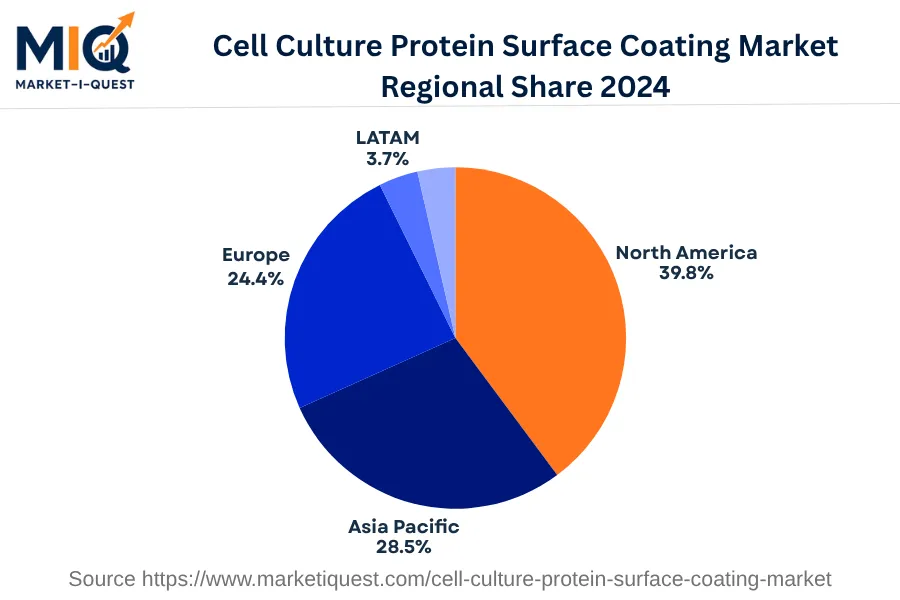
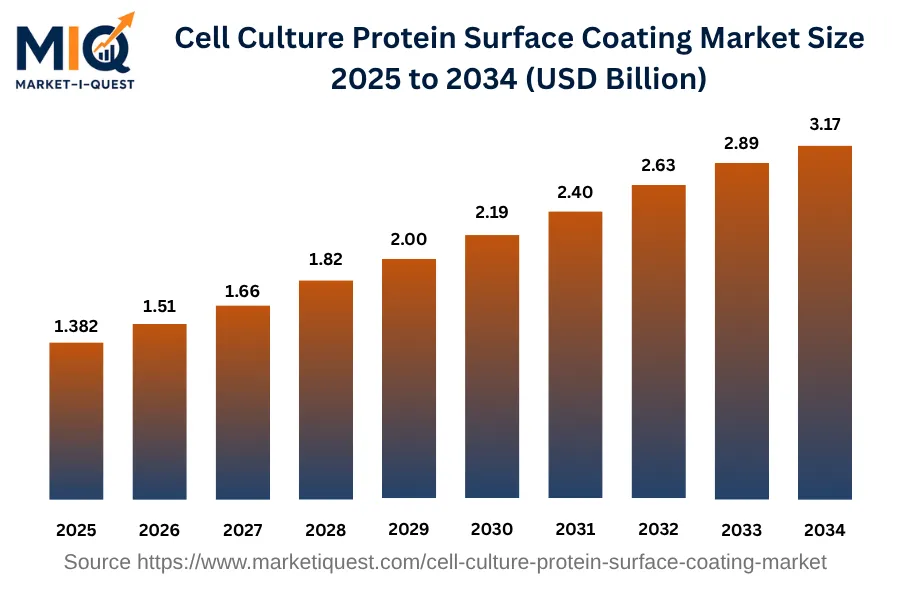
The Cell Culture Protein Surface Coating Market size was $1.26 billion in 2024 and is projected to rise to $1.38 billion in 2025. This growth trajectory continues on to 2034, where the market value is anticipated to reach $3.17 billion, with a CAGR of 9.65% throughout these years. This increase in market size over a span of almost a decade is predominantly attributed to technological advancements in cell culture protein surface coating processes as well as an drove demand for these coatings in various medical and scientific applications. The distribution of this market across different regions in 2024 showed North America leading with a share of 39.8%, closely followed by the Asia Pacific and Europe, at 28.5% and 24.4% respectively. The remaining market shared was held by LATAM at 3.7% and MEA at 3.6%.

Key Takeaways

  • By Coating Material - Collagen led the Cell Culture Protein Surface Coating Market.
  • By Cell Type - Stem Cells surfaced as the leading subsegment in terms of market share in 2024.
  • By Surface Modification Technique - Covalent Immobilization held the most significant share in the year 2024.
  • By Application - Drug Delivery dominated the market contributing to a substantial share in 2024.
cell-culture-protein-surface-coating-market market size

Key Driving Factors

Adoption of 3D Cell Culture Technologies

One key driver for the cell culture protein surface coating market is the increased adoption of 3D cell culture technologies within biomedical laboratories and pharmaceutical organizations. 3D culture allows the cells to grow or interact with their surroundings in all three dimensions. This is critical in studying the effects of drugs and diseases, as it can simulate the in-vivo condition realistically, impacting the accuracy of the research outcome. Cell culture protein surface coatings are fundamental to providing optimal adhesion and growth conditions for these 3D cultures. Hence, the developing trends towards 3D cell culture techniques are boosting demand for cell culture protein surface coatings.

Regulatory Emphasis on Reducing Animal Testing

Another strong driving factor is the growing regulatory emphasis on reducing and replacing animal testing in biomedical, cosmetic, and pharmaceutical industries. International regulations like EU's Regulation EC No 1223/2009 have urged researchers to adopt in-vitro tests over in-vivo (animal) tests. These regulations drive the development of advanced in-vitro models such as organ-on-chip and 3D cell cultures for product toxicity and efficacy testing, thereby stimulating the need for cell culture protein surface coatings. These coatings enhance the growth and proliferation of necessary cells, making them an integral part of these novel testing models.

Market Evolution by Timeline

2019-2023
In this period, the application of cell culture protein surface coating in regenerative medicine, and drug discovery and toxicity testing drove the demand. North America, led by the United States, dominated the market due to the high demand for stem cell research. Suppliers offered synthetic proteins as they proved effective, stable and versatile in various cell culture circumstances. Regulatory bodies including the FDA and EMA maintained stringent standards making biocompatibility a key requirement. Commercially, subscription-based pricing was observed due to the need for regular replenishment. The main risk revolved around compliance with accelerated safety and ethical guidelines concerning cell-based research.
2024
In 2024, oncology research rose significantly, majorly contributing to market demand. The Middle East emerged as a potential buyer region given increased research activities. Suppliers introduced serum-free protein coating solutions to address the issues of batch consistency and infectious contaminants, but faced challenges in adapting to new manufacturing techniques. Regular audits defined by regulations ensured the deployment of quality products in the market. Based on usage patterns, suppliers gravitated towards flat-rate pricing models.
2025-2029
Within this period, decisive applications in cellular therapy might raise the demand. Suppliers are expected to improve the integration process to deliver animal-free synthetic proteins for addressing to market trend towards cruelty-free products. Agencies such as the Biomedical Advanced Research and Development Authority might begin promoting standards around 'ethically sourced' products, driving changes in the supply chain. A shift in commercial model towards usage-based pricing based on economies of scale will likely be observed due to expanding operations.
2030-2034
In these years, Asia-Pacific region are expected to gain demand as a key buyer due to increased government funding in cell research. The rise of 3D cell culture shifted the supply might be focused towards matrix-specific proteins. The introduction of ISO/TC 276 biotechnology standards further will likely influence the manufacturing process. Contract-based procurement will become common. A prominent risk that will likely be prevailed might be the difficulty of innovating with constrain environmental regulatory requirements and increasing plant protein costs.

Future Market Outlook

Future Opportunities

Companies engaged in the cell culture protein surface coating sector are likely to capitalize on opportunities to enhance patient-specific therapies. The U.S. Food and Drug Administration released a guidance document related to the development of cell and gene therapies, emphasizing the need for robust cell culture systems to ensure consistency and safety. In Europe, regulatory bodies are also advocating for more integration of cell culture technologies in drug discovery processes, driven by initiatives emphasizing 3Rs principles—reduction, refinement, and replacement in animal testing. As research institutions and biopharmaceutical firms work collaboratively, a partnership announced between Bio-Techne and Harvard University aims to refine cell culture methodologies specifically for CAR T-cell therapies, illustrating the intersection of academia and industry. Meanwhile, the rising trend of using 3D bioprinting technologies for tissue engineering is creating a demand for advanced protein coatings that can support short-term and long-term cell viability. With advancements in surface treatment techniques enabling customization of coating properties, manufacturers can increasingly tailor solutions to meet diverse applications.

Segmentation Analysis

By Coating Material

The market is divided into subsegments including Collagen, Gelatin, Laminin, Fibronectin, Vitronectin, Proteoglycans, and Synthetic Polymers. Collagen accounted for the largest revenue share while Synthetic Polymers is expected to grow at the fastest CAGR during the forecast period.

Largest Revenue Share

Collagen

Market Share Leader

The collagen subsegment leads the market in terms of revenue. This can be attributed to its wide range of applications in the medical, cosmetic, and food industries. Collagen is a key component in most connective tissues and has unique properties that allow it to be easily manipulated for various uses. In the medical field, it's extensively employed in wound care, surgeries, and tissue engineering due to its biocompatibility and biodegradability properties making it an ideal component. Additionally, its prevalence in the cosmetic industry for skin, hair, and nail health has allowed the collagen subsegment to attain a sizable revenue share of the market. Another driving factor for collagen's dominant position in the market is its vast availability. With its extraction possible from various sources like bovine, pig, chicken, and marine, there is a consistent supply encouraging its large-scale use. However, it is important to note that this assumption is inferred due to the limited input data and common market structure.

Fastest CAGR

Synthetic Polymers

Forecast Period Growth Leader

Synthetic Polymers are projected to exhibit the fastest CAGR in the market due to various reasons. Their engineered properties have had significant impact on their adoption rate. They can be manipulated to provide specific attributes like long-term stability, mechanical strength, tunable degradation rates, etc, which is enticing to many industries. Plus, the development in polymerization technology has allowed for the production of polymers with tailored property profiles that cater to various needs. Policy-driven catalysts also play a significant role in their rapid growth. Increasing environmental concern and regulatory emphasis on biodegradability and sustainability are promoting the use of synthetic biodegradable polymers. On the other hand, partnerships and R&D investments are crucial in overcoming the adoption barriers such as higher costs and challenges associated with specific applications. There are near-term risks including competition from alternative materials and potential regulatory changes. Again, this reasoning is hinged upon assumed industry trends due to a lack of specific input data.

By Cell Type

The market is divided into subsegments including Stem Cells, Immune Cells, Endothelial Cells, Epithelial Cells, Neurons, and Cardiomyocytes with Stem Cells accounting for the largest revenue share and Neurons expected to grow at the fastest CAGR during the forecast period.

Largest Revenue Share

Stem Cells

Market Share Leader

Stem Cell market remains the biggest revenue generator among the cell types due to its potential versatility. Stem cells have the unique ability to self-renew and differentiate into various cell types which makes them integral in understanding disease mechanisms, drug discovery, toxicology testing, and potential regenerative medicine. The key growth driver for this subsegment is the growing investment in stem cell research and development fueled by increasing prevalence of chronic diseases. There is a high demand from pharmaceutical and biotech companies as well as medical research institutes, which leverage stem cells for developing effective therapies. Geographies like North America and Europe, characterized by a large number of R&D activities and favorable regulatory environment, contribute largely to the revenue. The purchasing criteria are majorly determined by efficacy, specificity, and ethical sourcing.

Fastest CAGR

Neurons

Forecast Period Growth Leader

The Neurons subsegment is expected to demonstrate the fastest CAGR during the forecast period. These projections are driven by increasing neurological disorders such as Alzheimer's, Parkinson's, and epilepsy, which necessitate neuron studies for drug discovery and therapy development. In addition, developments in optogenetics, a technology enabling control over neuronal activity, serves as a growth catalyst. High capital expenditure in neuroscience research institutes and biotech firms indicate a promising future. There can be adoption barriers due to extremely specialized requirements and the complexity of neuronal cell culture. However, increased partnerships between pharmaceutical companies and biotech firms, and supportive national policies intended to fund neurological disorder research are expected to relax these barriers and spur growth. Near-term risks could be posed by the funding restrictions due to the ongoing global economic instability.

By Surface Modification Technique

The market by surface modification technique is divided into subsegments including Physical Adsorption, Covalent Immobilization, Cross-Linking, Patterning, and Electrospinning. Covalent Immobilization accounted for the largest revenue share while Electrospinning is expected to grow at the fastest CAGR during the forecast period.

Largest Revenue Share

Covalent Immobilization

Market Share Leader

In the 2024 base year, Covalent Immobilization comes out on top as the subsegment with the most revenue. This dominance can be attributed to several primary factors. First, this method exhibits promising stability, with the immobilized particles being less likely to leak from the matrix, thus reducing the risk of downstream contamination. Secondly, the wide application of this technique in the pharmaceutical and industrial biotechnology sector further propels its market demand, leading to higher revenue. This technique's use extends to enzyme immobilization, a vital process in enhancing industrial processes, which greatly supports its revenue generation. Additionally, geographical areas such as North America and Europe contribute heavily to the revenue share, owing to factors like regulatory support, higher levels of technological adoption, and the presence of numerous key market players all playing their part. Coupling these aspects with switching costs, the need for consistency in industrial processes, and the availability of established distribution channels, it becomes evident why Covalent Immobilization holds the largest revenue.

Fastest CAGR

Electrospinning

Forecast Period Growth Leader

Contrary to the largest revenue earner, the fastest growing CAGR is projected to be the Electrospinning subsegment. The high growth rate for Electrospinning could be attributed to its broad versatility and applicability across numerous industry verticals, including textiles, petrochemicals, and notably, healthcare, thanks to its usefulness in creating nanofibers for tissue engineering, wound healing, drug delivery, and biosensing. Barriers to adoption include the high technical complexity and the initial capital expenditure required for electrospinning equipment. However, technological advancements, increased R&D investment, and strategic partnerships are likely to act as catalysts propelling the growth of this subsegment. Near-term risks include potential regulatory changes impacting biomedical applications and the possible disruption of global supply chains effecting industry operations. Therefore, while Electrospinning currently isn't the subsegment bringing in the most revenue, it has substantial potential for rapid growth going forward.

By Application

For the application segment, the market is divided into sub-segments including Cell Adhesion and Growth, Cell Differentiation and Maturation, Tissue Engineering, Drug Delivery, Bioprinting, and others. In the base year 2024, Drug Delivery accounted for the largest revenue share while Bioprinting is expected to grow at the fastest CAGR during the forecast period.

Largest Revenue Share

Drug Delivery

Market Share Leader

Drug Delivery is driving significant revenue in this sector due to the rise in chronic diseases that require long-term medication management. This involves the use of targeted delivery protocols enabling lesser dosage and ensuring a greater effect. Also, the advent of nanotechnology in drug delivery has been a noteworthy driver, offering therapeutic benefits and minimized risk of potentially harmful side-effects, especially in cancer therapies. The global reach of this sub-segment is immense due to the universal need for effective drug delivery systems. Government regulations mostly favor innovation in drug delivery due to the health benefits, though intellectual property rights can be an issue. The purchasing decision is skewed towards those offering more controlled, targeted delivery and reduced side-effects. The high cost and time-consuming nature of R&D can influence purchasing decisions, but the potential benefits of an effective drug delivery mechanism outweigh the initial risks and costs.

Fastest CAGR

Bioprinting

Forecast Period Growth Leader

Bioprinting is projected to be the fastest growing subsegment due to a surge in technological innovation and increased investment in research and development. The potential of bioprinting in creating complex biological structures and the increasing demand for organ transplant give the field a substantial advantage. Adoption is being catalyzed by technological breakthroughs, government research grants, and collaborations between academic institutions and the biotech industry. However, there are significant barriers including high capital expenditure, early technology stage, and ethical considerations influencing regulatory policies. Near-term risks include potential regulatory hurdles and technological setbacks, but the unmet need for organ transplant and tissue replacement provides a strong impetus for growth.

Competitive Analysis: Cell Culture Protein Surface Coating Marke

Key Market Players

Manufacturers / OEMs

Corning Incorporated
US
Merck KGaA
Germany
Thermo Fisher Scientific
US

Key Suppliers & Raw Materials

Sigma-Aldrich Corporation
US
Greiner Bio One International GmbH
Austria
R&D Systems
US

Distributors, Integrators & Channel Partners

Bio-Techne
US
Avantor, Inc.
US
Genesee Scientific
US

Porter’s Five Forces Analysis

Analysis of competition and strategic factors in the global Cell Culture Protein Surface Coating Market.

Supplier Bargaining Power

Medium

Suppliers have moderate power due to the consolidated nature of raw material providers.

Buyer Bargaining Power

High

Buyers, often large biopharmaceutical companies, possess strong bargaining power due to multiple suppliers.

Threat of Substitutes

Low

Low threat due to the technical specificity and expertise required in cell culture and coating proteins.

Threat of New Entrants

Medium

Medium barrier to entry due to technical knowledge and capital investments required.

Competitive Rivalry

Medium

Competitive rivalry among existing players is medium, driven by the constant need for product differentiation.

Regional Analysis

Geographic market dynamics and growth opportunities across key regions

Global Market Outlook

cell-culture-protein-surface-coating-market market regional share

North America

In 2024, the North American cell culture protein surface coating market was characterized by significant activity encompassing medical research, drug discovery, and biopharmaceutical production.

Momentum in this market was driven by several key factors. High demand for biocompatible materials spurred innovation and product development. Fresh regulations around tissue culture and human trial protocols generated incentive for higher standards in surface coating technologies. Hospitals, research institutes and pharmaceutical companies invested in state-of-the-art lab equipment as they sought efficiencies in drug discovery and regenerative medicine. Digital transformation also influenced market dynamics, as labs adopted technologies to aid precision and process automation.

Simultaneously, several distinct market trends were apparent. A shift in buyer behavior signaled a rising preference for synthetic over natural protein surface coatings. Lean manufacturing philosophies pushed suppliers toward streamlining production and distribution channels. In light of these changes, some industry players sought growth through strategic partnerships and mergers. Importantly, increased policy enforcement around cell culture contamination prevention was evident in healthcare and research settings. Sectors including government, healthcare, and manufacturing were active customers in this market, underlining the broad applicability and market potential for cell culture protein surface coatings.

Overall, 2024 saw a dynamic and increasingly sophisticated market landscape for cell culture protein surface coating in North America.

Asia Pacific

In 2024, the Asia Pacific market demonstrated a significant demand for cell culture protein surface coatings aimed at optimising cell-based research in therapeutic interventions and drug discovery. Fuelled by enhanced investments in life science research, greater acceptance of automation technologies, and improvements in biocompatible surface coating materials, countries including China, India, Japan, South Korea and Australia experienced a surge in supply dynamics. Pricing, however, remained a deciding factor for the market's growth, particularly in developing economies like India.

The year saw a shift in buyer behavior towards protein and polymer coatings due to their inherent advantages in the cultivation of various cell lines. Vertical integration emerged as a definitive trend, with numerous channel partnerships and M&A activities occurring between coating manufacturers and biotech firms. In response to the demand for standardization, several governments enforced regulatory policies aimed at ensuring quality and safety, with Australia's Therapeutic Goods Administration (TGA) leading the trend.

Demand was predominantly from healthcare, pharmaceutical and biotechnology sectors, given the role of cell culture protein surface coatings in the investigation of cellular behavior and drug responses. Additionally, academic and government research institutes made substantive contributions due to their emphasis on regenerative medicine and genetic engineering. In summary, the Asia Pacific cell culture protein surface coating market in 2024 witnessed substantial growth on account of increasing biotechnological advancements, and a rising emphasis on standardization.

Europe

In 2024, Europe's Cell Culture Protein Surface Coating Market was significantly characterized by heightened activity and growth. This was mainly driven by robust demands from sectors such as healthcare and pharmaceutical industries, primarily in leading European markets such as Germany, the United Kingdom, and France. Regulatory requirements emphasizing quality control in drug production spurred investments in cell-based assays, thereby necessitating the extensive use of protein coatings to ensure accuracy. In addition, rapid adoption of advanced biotechnology techniques in Italy and Spain stimulated supply dynamics and market expansion.

Concurrently, profound trends were observed within the market. The shift towards animal-free protein coatings due to ethical and scientific considerations significantly influenced purchasing behaviors. Manufacturers and suppliers in the Nordics and Benelux regions pioneered this development. There was also a notable channel dynamic, with eCommerce platforms emerging as preferred procurement methods, driven by convenience and efficiency. Inter-company partnerships and M&A activities proliferated within Central and Eastern Europe, triggering consolidation within the supply chain and reinforcing product standardisation throughout the industry. The enforcement of the Clinical Trials Regulation (EU) No 536/2014 heightened quality assurance demands, shaping the protein surface coating market landscape. This led to consistent market growth, with healthcare and pharmaceutical industries remaining the largest consumers within this field.

Latin America

In 2024, the Cell Culture Protein Surface Coating market in Latin America experienced significant dynamism, especially driven by demands from healthcare and pharmaceutical sectors in countries such as Brazil, Mexico, Argentina, Colombia, Chile, and Peru. Key market drivers included increased biotechnological investment, a pronounced uptick in cell culture-related research activities, and poverty-centric disease prevalence in several LATAM nations fostering a need for affordable and advanced treatments. Adoption of innovative technologies such as virus-based and serum-free coatings also favored market growth, while the emergence of cell therapy and tissue engineering in Brazil and Mexico has galvanized the demand for protein surface coatings.

On the trend front, there was an increased focus towards bio-based coatings for cell culture protein surfaces, in line with LATAM's commitment to sustainability. The industry recorded a shift in customer preference towards animal-derived protein coating as they were found to promote the growth and differentiation of cells more effectively. Multinational corporations extended strategic partnerships with local manufacturers to penetrate the LATAM market. The enforcement of stricter regulatory policies related to cell culture-based research such as the Good Manufacturing Practices (GMP) regulations led to a rise in demand for quality surface coatings. These alliances and regulations signalled a move towards the standardization of cell culture practices, thus boosting market confidence and growth in 2024.

Middle East & Africa

In 2024, the Cell Culture Protein Surface Coating Market witnessed significant growth in the Middle East and Africa, particularly in nations like Saudi Arabia, the United Arab Emirates, Qatar, Egypt, South Africa, Nigeria, Kenya, and Israel. The surge was driven by increased investments in biotechnology and pharmaceutical sectors, rising demand for cell culture products, and stringent government regulations favouring cell research. Adoption of advanced technology also played a key role, with countries like Israel leading in tech-driven biotech research.

Market trends saw a shift towards synthetic coatings due to concern over animal-derived protein coatings, influencing manufacturing protocols. The healthcare sector dominated demand and usage, with an uptick in biomedical research and drug discovery processes. There was a notable increase in partnerships between local and international biotech firms aiming to leverage local resources and know-how. Policy enforcement centred around ethical and quality standards in cell culture, primarily to ensure safety and reliability. Buyer behavior was dominated by the search for cost-effective, high-quality protein coating solutions, paving the way for robust competition among service providers. The influence of these factors crafted a dynamic and competitive market landscape in the Middle East and Africa for the Cell Culture Protein Surface Coating sphere in 2024.

Recent Industry Developments

Latest market innovations, product launches, and strategic initiatives

August 2025

Thermo Fisher Scientific executed a strategic product line expansion across its Asian life sciences hubs. The rollout focuses on high-grade protein surface coatings specifically optimized for scalable, feeder-free stem cell cultures and induced pluripotent stem cell (iPSC) applications.

Frequently Asked Questions