Gelatin Market Snapshot

Key Players

  • Gelita AG (Germany)
  • Rousselot SAS (France)
  • Weishardt Group (France)
  • Nitta Gelatin Inc. (Japan)
  • PB Gelatins (Belgium)
  • Junca Gelatins SL (Spain)
  • Sterling Biotech Ltd (India)
  • Gelnex (Brazil)
  • Lapi Gelatine S.p.a. (Italy)
  • Italgelatine S.p.A. (Italy)

Market Size

Base Year 2024
$4.85 Bn
CAGR
6.38%
Forecast 2034
$9.00 Bn

Market Segments

By Type
  • Type A
  • Type B
By Source
  • Swine Skin
  • Bovine Skin
  • Animal Bones
  • Others
By Application
  • Food & Beverage
  • Pharmaceuticals & Nutraceuticals
  • Personal Care
  • Others

Market Dynamics

Drivers
  • Rising health awareness
  • Increasing meat consumption
Restraints
  • Strict vegan/vegetarian consumer base
  • Increasing gelatin substitutes availability
Opportunities
  • Increased vegan population
  • Healthcare industry growth

Market Size

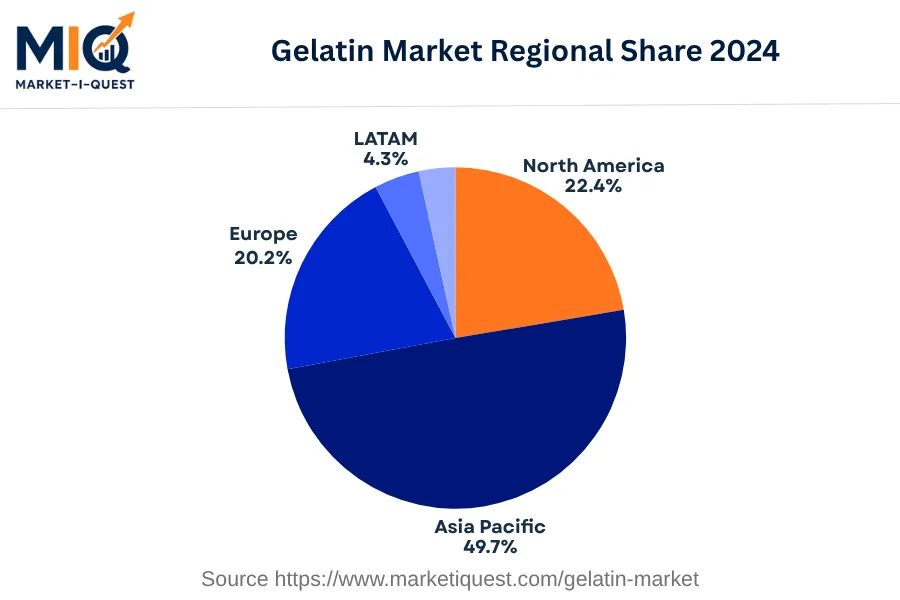
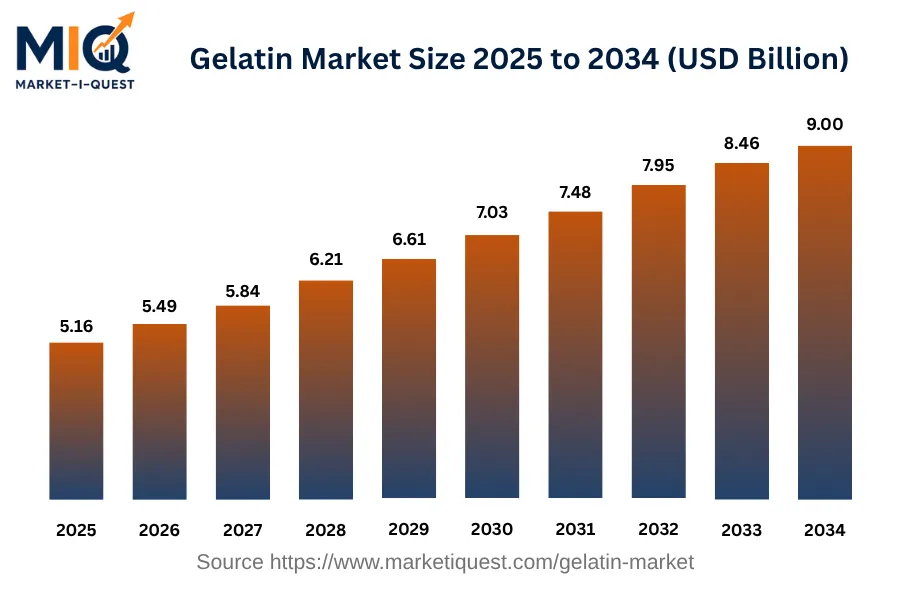
The Gelatin Market, valued at 5.16 billion USD in 2025, has been projected to grow at a CAGR of 6.38% and reach 9.00 billion USD by 2034. This growth can be attributed to an increase in the adoption of gelatin across various industries during the forecast period. Starting from 4.85 billion USD in 2024, the market size rose accordingly in the subsequent years along the calculated CAGR path. The gelatin market is regionally segmented and shares in 2024 highlighted significant discrepancies. Asia Pacific possessed the largest share with 49.72%, followed by North America and Europe with 22.36% and 20.18% respectively. Less significant shares were noted in Latin America and the Middle East and Africa, with values of 4.28% and 3.46% respectively.

Key Takeaways

  • By Type - Type A led the market accounting for a significant market share in the base year.
  • By Source - Swine Skin emerged as the market leader in the base period.
  • By Application segment - Pharmaceuticals & Nutraceuticals held the highest market share during the base year.
gelatin-market market size

Key Driving Factors

Increasing Preference for Convenient and Portable Food Options

The gelatin market is influenced directly by the consumer-led shift towards ready-to-eat, portable food options. This drive originates from dynamic lifestyle changes, specifically in urban settings, where consumers have less time to prepare meals. Innovations from manufacturers targeting these consumers include gelatin-based snacks like protein bars enhanced with gelatin, jelly desserts, and yogurts. Gelatin as an ingredient provides these products with texture and consistency, alongside health benefits such as improved digestion and joint health. Notably, the trend is not limited to urban centers or developed countries but is becoming widespread, causing an impact on the demand for gelatin globally.

Regulatory Shifts towards Clean-Label Ingredients

Regulatory changes focused on food transparency are also influencing the dynamics of the gelatin market. Consumers are increasingly interested in understanding the components of their food and favor ingredients they recognize and trust. Responding to this trend, food regulatory bodies globally are emphasizing transparency, leading manufacturers to reformulate their products with clean-label ingredients. As a natural protein derived from animal sources, gelatin matches this demand. Its use is being extended into products such as candies, marshmallows, and ice creams that were traditionally made with synthetic ingredients, catalyzing an upsurge in the use and market demand for gelatin.

Market Evolution by Timeline

2019-2023
Key buyers of gelatin in this period were predominant industries such as food and beverage, pharmaceutical, health supplements, and photography. Growing consumer awareness about the benefits of gelatin, predominantly in regions like North America and Europe, drove the demand significantly. However, plant-based alternatives started to gain attention due to the increasing preference for vegetarian and vegan diets. Supply side was burdened with sourcing issues of raw materials. Environmentally conscious policies in the European Union and United States restricted the use of chemicals in gelatin production. Pricing had a mild increase, and partnerships were typically between gelatin manufacturers and end-user industries. Anticipated risks during this period were scarcity of raw material and ambiguity over regulatory policies.
2024
In 2024, gelatin demand mostly sprouted from developing regions like South-East Asia, driven by the growth in the cosmetic industry and increased consumption of dietary supplements. However, demand for bovine-sourced gelatin trips due to religious beliefs in these regions. Technology-wise, efforts were underway to pilot new methods for efficient production of gelatin, aimed at reducing the environmental impact. Standards like Halal and Kosher certifications carried significant influence over the gelatin market. Commercially, long-term contracts were popular, with pricing trends showing minor escalation. The risk was majorly tied to unfavorable foreign trade policies and currency fluctuation.
2025-2029
Countries like India and China showed escalated demand for gelatin during this period. Key driving sectors were nutraceuticals and cosmetics, followed by the packaged food industry. Fish sourced gelatin saw a surge in preference, owing to its religious acceptance and hypoallergenic properties. Technological advancements resulted in a highly optimized production process. Sustainability standards exerted notable influence over procurement decisions. Commercial models still favored long-term contracts with an incline in cost due to supply-demand dynamics. Theft of proprietary technology presented a pronounced risk during this timeline.
2030-2034
By this period, gelatin market witnessed a high demand from the older population across the globe requiring health supplements. Gelatin use in 3D bioprinting applications marked an innovative turn. On the supply side, technologies started incorporating AI and Machine Learning for demand forecasting and optimizing supply chain. Regulations, like eco-label certifications, played a key role in final purchase decision. Wholesale partnerships dominated the market with flexible pricing strategies. Critical risks involved were potential disruptions in supply chain and technological glitches in advanced production processes.

Future Market Outlook

Future Opportunities

As consumer preferences evolve, the gelatin market presents multiple future opportunities shaped by current trends and regulations. In 2024, the implementation of stricter regulations on food safety by the Food and Drug Administration in the United States is expected to create demand for gelatin products adhering to higher quality standards. With the advent of health-conscious consumers, companies like Ewald-Gelatin GmbH have started developing gelatin fortified with functional ingredients such as collagen and probiotics, responding to trends documented in various industry reports from 2023. The growing popularity of gelatin-based wellness products illustrates an opportunity for brands to increase market presence by diversifying their product offerings. Furthermore, the notable rise in the vegan diet, highlighted by the Vegan Society’s annual report in 2022, opens avenues for the development of plant-based gelatin alternatives within the food sector. Regions such as North America, where awareness about dietary supplements is rising, present substantial opportunities for companies to engage in niche markets focused on health benefits. Similarly, health guidelines issued by the World Health Organization in 2023 advocating for increased protein intake can lead to expanded applications of gelatin in nutritional products. Overall, these shifts indicate a robust potential for growth in various segments of the gelatin market driven by immediate consumer demand and regulatory landscapes.

Segmentation Analysis

By Type

The market is divided into subsegments including Type A and Type B. Type A accounted for the largest revenue share while Type B is expected to grow at the fastest CAGR during the forecast period.

Largest Revenue Share

Type A

Market Share Leader

The dominance of Type A in revenue share is primarily driven by its broad customer base and extensive applications. Its core customer groups are derived from multiple industries owing to the pareto principle, which stipulates that about 80% of the sales come from 20% of the clients. Geographically speaking, Type A has a significant presence in developed markets where demand consistency, aided by regulatory stability, better product understanding, and purchasing power, fuels its revenue generation. In terms of procurement, purchasers generally prefer Type A due to its reliability, technical specifications, and performance outcomes, offering it a competitive advantage. The stiff switching cost for clients also fortifies the type A's market position as customers hesitate to shift to alternatives considering the potential risks and transition expenses. Distributionally, a robust channel network marked by strategic partnerships enables Type A to maintain a steady supply stream contributing to its revenue durability.

Fastest CAGR

Type B

Forecast Period Growth Leader

Type B, although not present in a larger volume compared to Type A, is expected to witness the fastest growth. This projection is primarily driven by numerous catalysts including technological advancements, policy support, strategic collaborations, along with capital investments in the sector. The emergence of innovative technologies and expanding R&D efforts in this segment will dramatically enhance the performance competency of Type B, thereby propelling its acceptance rate. An increasingly favorable regulatory framework, combined with government incentives, could give an impetus to Type B's market penetration. Greater emphasis on strategic partnerships and alliances also stimulates its market development by facilitating resource sharing and reducing operational costs. Furthermore, the rise in capital expenditure indicates growth prospects by fostering capacity expansion and upgrading. However, potential adoption barriers such as initial high costs, lack of awareness, and transitioning complexities could pose short-term growth risks.

By Source

The market is divided into subsegments including Swine Skin, Bovine Skin, Animal Bones, and Others. Bovine Skin accounted for the largest revenue share while Swine Skin is expected to grow at the fastest CAGR during the forecast period.

Largest Revenue Share

Bovine Skin

Market Share Leader

In the 2024 base year, Bovine Skin emerged as the market segment with the highest revenue, stemming mainly from its multifaceted uses and extensive application across industries. The prime driver here is the high worldwide demand for bovine skin to manufacture leather goods such as footwear, bags, furniture coverings, and the auto industry's upholstery needs. It also benefits from its superiority over synthetic substitutes in terms of quality, texture, and durability. The developed nations leading the demand, backed by burgeoning purchasing power and the consumers' inclination towards high-quality, sustainable materials. Bovine Skin is also popular in the food industry as gelatin and for medical uses like sutures, adding to its market share. But regulatory & supply factors like livestock farming conditions and animal rights also shape this segment's performance.

Fastest CAGR

Swine Skin

Forecast Period Growth Leader

While Bovine Skin holds the largest revenue, Swine Skin is projected to exhibit the fastest growth rate. Market indications point towards an increase in the acceptance and demand for swine skin as a more affordable and widely available option. Principally, the growth catalyst in this context is cost-effectiveness, along with technology advancements which can improve and standardize the processing quality. Adoption barriers involve concern for high fat content and lower leather quality; however, techniques to remove excess fat content and retain quality are making headway. Further, new partnerships with retailers and manufacturers keen on utilizing cost-effective materials can potentially drive the subsegment's growth. Risks include stringent quality control and regulations about pig farming and slaughter, plus disease outbreaks affecting supply, hence requiring close industry monitoring.

By Application

The market is divided into subsegments including Food & Beverage, Pharmaceuticals & Nutraceuticals, Personal Care, and Others. Pharmaceuticals & Nutraceuticals accounted for the largest revenue share while Personal Care is expected to grow at the fastest CAGR during the forecast period.

Largest Revenue Share

Pharmaceuticals & Nutraceuticals

Market Share Leader

Pharmaceuticals & Nutraceuticals segment leads the market currently due to escalating consumer health awareness, a rapidly aging global population, and an increased expenditure on healthcare. These factors drive the demand for pharmaceuticals and nutraceuticals, consequently enhancing their market revenue. Moreover, regulatory frameworks in many countries support pharmaceutical and nutraceutical industries by providing easier pathways for new product approvals. The buyer's criteria typically revolve around the effectiveness, safety, and price of the product, pushing manufacturers to invest in research and development, leading to increased revenue. In addition, the direct channel distribution through digital pharmacy platforms has played a key role in reaching a diverse customer base, thereby contributing directly to the substantial revenue generation of this subsegment.

Fastest CAGR

Personal Care

Forecast Period Growth Leader

The Personal Care sector is anticipated to experience the fastest growth rate. Predominant growth drivers include technological advancements, evolving consumer lifestyle and increased health consciousness, which is triggering the demand for more organic and nature-based skincare products. Additionally, the growing consumer propensity towards improved aesthetic appeal and anti-aging products, supplemented by increased disposable income, amplify the growth potential for this segment. Despite the promising outlook, there exists adoption barriers correlated with high costs, potential adverse effects and skepticism towards product authenticity. Yet, strategic partnerships between manufacturers and suppliers, combined with substantial capital investments in marketing and branding initiatives, are anticipated to lessen these barriers and boost the overall market growth. Relevant risks on the horizon include regulatory uncertainties and intense competition among players which could potentially dampen the short-term market momentum.

Competitive Analysis

Key Market Players

Manufacturers / OEMs

GELITA AG
Germany
Darling Ingredients Inc.
US
PB Gelatins GmbH
Germany

Key Suppliers & Raw Materials

Tessenderlo Group
Belgium
Foodchem International Corporation
China
Holista CollTech Ltd
Australia

Distributors, Integrators & Channel Partners

Nitta Gelatin Inc.
Japan
Italgelatine S.p.A.
Italy
Advanced BioMatrix, Inc
US

Porter’s Five Forces Analysis

Comprehensive analysis demonstrating the competitive intensity and attractiveness of the global Gelatin Market

Supplier Bargaining Power

Medium

Limited suppliers and growing demand endow suppliers with moderate bargaining power.

Buyer Bargaining Power

Low

High product differentiation and brand loyalty lower the bargaining power of buyers.

Threat of Substitutes

High

The availability of plant-based gelatin substitutes increases the threat level.

Threat of New Entrants

Low

High entry barriers such as stringent regulations and high production costs deter newcomers.

Competitive Rivalry

High

Intense competition among global and regional players, innovation and price wars enhance competitive rivalry.

Regional Analysis

Geographic market dynamics and growth opportunities across key regions

Global Market Outlook

gelatin-market market regional share

North America

In 2024, the North American Gelatin Market witnessed significant growth, driven by factors predominantly in the United States, Canada, and Mexico. The demand for gelatin surged due to a rise in health awareness and the growing trend of functional food products. Strict food and beverage regulations in the U.S and Canada, necessitating the use of safer ingredients, amplifed the market. Enhanced technology adoption in gelatin production and supply dynamics also served as critical growth drivers. Key trends observed included a shift towards plant-based alternatives, impacting traditional gelatin consumption. Online sales escalated as eCommerce became a vital channel for businesses to reach their consumers, further facilitating market growth.

Significant mergers and acquisitions in the market, especially in the U.S, played a substantial role in shaping the overall industry dynamics. The enforcement of new food safety standards and policies also influenced the unfolding market trends. The food & beverage industry remained key to the high demand for gelatin, followed by the pharmaceutical industry which embraced gelatin capsules due to their many advantages. Retail sector growth in Canada, influenced by an augmented demand for confectionery products and the low-fat content of gelatin, was another important customer for this market. Lastly, the nutraceutical sector emerged as a significant customer due to the widespread use of gelatin in dietary supplements.

Asia Pacific

In the base year 2024, the Gelatin Market in the Asia Pacific demonstrated significant dynamism. Drivers include robust demand in food and beverage industries, notably in China and India, for products such as yogurts, desserts, and protein bars which utilize gelatin as a gelling agent. Moreover, supportive regulations promoting the use of natural ingredients have further fueled the market, particularly in Japan and South Korea. The increase in halal-certified investments in Malaysia and Indonesia also played a crucial role in shaping the region's gelatin market. Trending in this sector was the accelerated adoption of pharmaceutical-grade gelatin in healthcare applications, like hard and soft capsules, led by Australia's stringent pharmaceutical standards.

eCommerce emerged as a significant distribution channel, particularly in China and South Korea, owing to the increasing penetration of internet and smartphones. Additionally, several partnerships and mergers among key players such as Sigma-Aldrich and Nitta Gelatin India were observed, aimed at gaining a competitive edge. Lastly, the enforcement of the China Food and Drug Administration’s stringent policy on using edible gelatin in food products intensified the market competition, signaling the government's active role in this sector. Overall, the 2024 gelatin market in the Asia Pacific was stimulated by a combination of demand dynamics, regulatory frameworks, technology adoption, and intense competitive alliances.

Europe

In 2024, the gelatin market in Europe exhibited robust dynamics, driven by varied factors across key nations. Consumer consciousness for health and nutrition, especially in the United Kingdom, Germany, and France, escalated demand for gelatin—a key ingredient in nutritional supplements. This shift towards healthier diets was fortified by government initiatives like Germany's National Action Plan on Nutrition and France's National Nutrition Health Program. Conversely, strict EU regulations on the sourcing and processing of raw materials, such as Regulation (EC) No 853/2004, presented challenges while reinforcing quality standards in the supply chain. Meanwhile, innovative extraction techniques gained adoption in countries like Italy and Spain, boosting production efficiencies.

A key trend in the market was the shift towards bovine gelatin, observed predominantly in Central & Eastern Europe, owing to rising concerns regarding BSE in porcine sources. Retail channels in this region also amplified their promotion of gelatin-based products, further fueling this change. This movement was observed alongside an uptick in M&A activity within the market, with companies like Nordics-based Rousselot expanding their reach. The evolving dietary preferences in sectors like healthcare and food manufacturing, coupled with the implementation of stringent policies, shaped the movements within the Europe gelatin market this year. These dynamics presented a complex yet thriving industry landscape in 2024.

Latin America

In 2024, the Latin American gelatin market experienced dynamic growth fueled by diverse factors. Demanding sectors such as pharmaceuticals and food & beverages pushed for increased usage. Brazil, Mexico, and Argentina led with heightened consumption, underpinned by stringent food safety regulations and significant healthcare investments. Technology adoption in processing units boosted production capacities in Colombia and Chile, enabling market expansion. Trends were dictated by changing consumer behavior and industrial shifts. Buyers increasingly leaned towards gelatinous products for health benefits, driving manufacturers to advance production technology. A notable shift occurred towards the use of fish gelatin, primarily in Mexico and Argentina, due to rising concerns over BSE and sustainability.

Change in channel dynamics resulted from courier service proliferation, expanding delivery reach to untapped areas in Peru.In Brazil, an enlarged consumer base contributed to the retail sector's influence on market movements. Mergers and acquisitions solidified market leaders' positions, essential for maneuvering the competitive landscape. Strict policy enforcement in healthcare, due to gelatin's integral role in capsule production, further stimulated the market. Overall, Latin America's gelatin market in 2024 witnessed an intricate play of supply-demand dynamics, accelerated technology adoption, stringent regulatory environment, and evolving buyer behavior.

Middle East & Africa

In 2024, the gelatin market in the Middle East and Africa showcased notable growth dynamics. Robust demand drivers included a surge in usage in pharmaceuticals, primarily in Saudi Arabia and United Arab Emirates due to a growing health-conscious population and increasing per capita expenditure on medicine. Technological adoption of advanced hydrolysis processes, especially in Israel and South Africa, resulted in cost-effective production, acting as a catalyst. Nigeria’s regulatory environment encouraging halal-grade gelatin production boosted the market. Market trends revealed a shift towards vegetarian gelatin alternatives, influenced by lifestyle trends in Kenya and Egypt. The emergent pattern of using gelatin in cosmetics due to its skin benefits was witnessed especially in Qatar and United Arab Emirates retail sector.

Partnerships between local gelatin manufacturers and foreign companies for technological transfer, as in the case of Saudi Arabian companies, spurred market growth. A majority of the demand stemmed from three primary sectors: pharmaceuticals, food & beverages, and cosmetics, with pharmaceuticals leading the consumption charts. There was increased gelatin use in utility services for water treatment in South Africa. The trend of using gelatin-enriched food products in the retail sector was prominently visible in markets such as Nigeria and Kenya. There was a noticeable dynamic shift towards more sustainably sourced gelatin, driven by policy enforcement specifically in countries like Israel.

Recent Industry Developments

Latest market innovations, product launches, and strategic initiatives

January 2026

Türkiye implemented new import conditions for gelatin and collagen intended for human consumption, requiring imports from EU member states registered in the TRACES NT system.

December 2025

Capnest Health Care Private Limited entered into a business transfer agreement to acquire an Empty Hard Gelatin Capsule unit at Bhatoli from Nectar Lifesciences Limited for approximately INR 200 million (~$2.4 million), with expected completion between December 2025 and April 2026.

Frequently Asked Questions