Cell Culture Market Snapshot

Key Players

  • Thermo Fisher Scientific (US)
  • Merck KGaA (Germany)
  • GE Healthcare (US)
  • Sartorius AG (Germany)
  • Corning Incorporated (US)
  • Danaher Corporation (US)
  • Lonza Group Ltd (Switzerland)
  • Becton Dickinson and Company (US)
  • Agilent Technologies (US)
  • Shanghai iCell Biotechnology (China)

Market Size

Base Year 2024
$30.85 Bn
CAGR
10.38%
Forecast 2034
$82.82 Bn

Market Segments

By Product
  • Consumables
  • Instruments
By Application
  • Biopharmaceutical Production
  • Drug Development
  • Tissue Culture & Engineering
  • Cell & Gene Therapy
  • Toxicity Testing
  • Others

Market Dynamics

Drivers
  • Rising biopharmaceutical development
  • Increasing chronic disease prevalence
Restraints
  • High equipment cost
  • Strict regulatory frameworks
Opportunities
  • Emerging biopharmaceutical industries
  • Increased stem cell research

Market Size

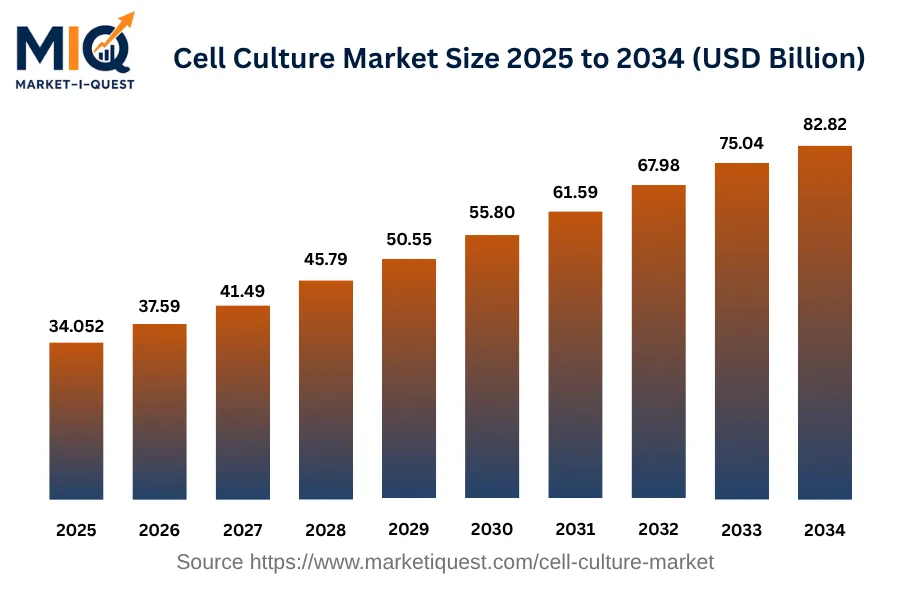
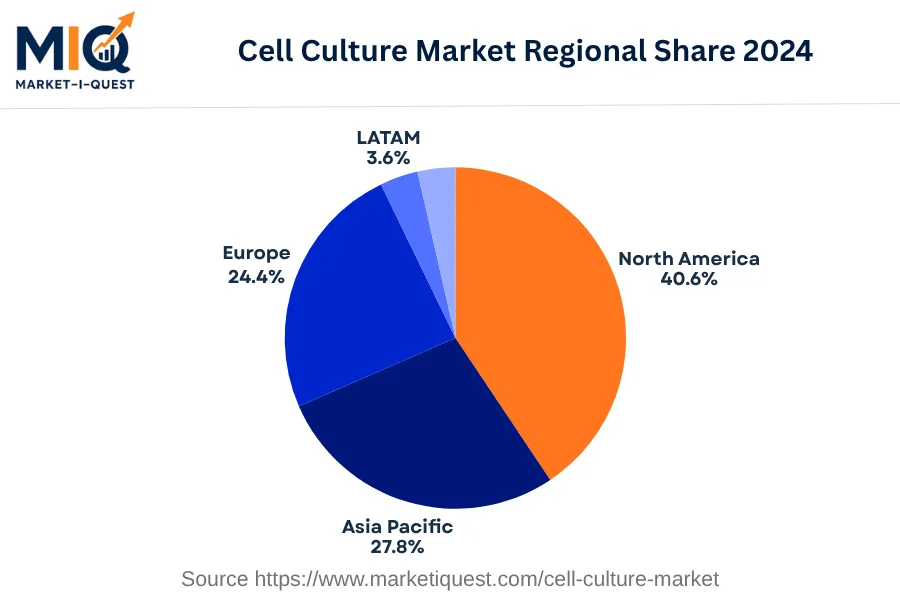
The Cell Culture Market size stood at $34.05 billion in 2025, exhibited a Compound Annual Growth Rate (CAGR) of 10.4% and is projected to reach $82.82 billion by 2034. This continuous growth pattern can be traced through a series of distinct increments across the decade; from the market size of $30.85 billion in 2024. The fundamental reasons attributed to this expansion include enhancements in biopharmaceutical manufacturing, growing demand for single-use technologies, and the rapid adoption of advanced cell culture techniques. Region-wise, North America led the market with a share of 40.6% in 2024. This was followed by Asia Pacific and Europe, which accounted for 27.8% and 24.4% of the total share respectively. Meanwhile, the combined share of the Latin America (LATAM) and the Middle East and Africa (MEA) regions stood at 7.2%.

Key Takeaways

  • By Product - Consumables held the dominant position accounting for the majority share in 2024.
  • By Application - Biopharmaceutical Production led the market representing the lion's share in 2024.
cell-culture-market market size

Key Driving Factors

Adoption of 3D Cell Culture Systems

The adoption of 3D cell culture systems over traditional 2D cell culture models is a powerful driver of growth in the cell culture market. 3D cell culture offers a more realistic and dynamic simulation of in vivo conditions, which scientists can use for advanced drug discovery research, disease modeling, and regenerative medicine. Pharma and biotech companies are increasingly employing 3D models for drug toxicity testing before in vivo trials, lending a significant boost to the cell culture market. With superior predictability and enhanced survival rates of the cells, 3D cell culture systems naturally hold an edge over their 2D counterparts. Ultimately, the switch to these systems by research and development entities is carving out a key growth trajectory for the market.
Regulatory Encouragement of Alternatives to Animal Testing

Another significant driver for the cell culture market is the regulatory emphasis on reducing and replacing animal testing. Influential directives like the European Union's Directive 2010/63/EU on the protection of animals used for scientific purposes have initiated the shift towards alternatives to animal testing for drug development and safety regulations. As a result, more healthcare and cosmetic industry players are turning to cell culture techniques as a humane, ethical, and scientifically advanced alternative. The in vitro cell cultures provide an adequate platform for testing the effectiveness and safety of new drugs without involving animals, which is aligning with the global trend towards cruelty-free methods. This regulatory stance is therefore catalyzing the expansion of the cell culture market.

Market Evolution by Timeline

2019-2023
In this period, key buyers of cell cultures were pharmaceuticals, biotech firms, and academic research centers primarily in United States, Europe, and parts of Asia Pacific regions. The demand largely centered around drug discovery, toxicity testing, and cell biology studies. Advancements were seen in bioreactors technology, with single-use bioreactors becoming popular due to reduced cross-contamination risks. However, strict and country-specific animal welfare regulations disrupted global supply chains. The cost-plus pricing model was generally followed, but the high cost of cell culture reagents posed challenges. Key players often formed strategic alliances to share expertise and expand globally. Contamination of cultures was a primary risk, typically mitigated by strict quality assurance protocols.
2024
In 2024, growing healthcare sectors in emerging countries like India and China further increased global demand for cell cultures. Vaccines production saw increased usage of cell cultures, thus expanding buyer types to include vaccine manufacturers. Production efficiency of cell culture was improved by automation technology, though high technology costs became a barrier for many small-sized firms. The regulatory landscape remained complex, but harmonization initiatives like International Conference on Harmonisation (ICH) addressed some issues. Per-service billing emerged as a pricing model in this period. Lack of skilled labor became a significant risk, addressed by several firms through partnerships with academic institutes.
2025-2029
Over this time frame, the buyers remained similar but usage for regenerative medicine and stem cell applications spiked significantly. Bioprinting technologies for complex cell culture started appearing, but wide-scale integration was hampered due to technical complexities and high costs. Regulatory agencies started implementing the 'QbD' (Quality by Design) during this period, leading to better quality control in cell culture production. The cost pressure led to more bundled pricing models, where complete cell culture system components were sold together. The escalated competition to capture new markets heightened risks of intellectual property right (IPR) issues, prompting companies to invest more in securing their assets.
2030-2034
In this period, individual researchers also became buyers, thanks to DIY cell culture kits innovation. Cell culture usage diversified further, including into personalized medicine and organ regeneration. 3D cell culture systems, while more mature, remained high-cost and technically complex. 'Good Manufacturing Practices' (GMP) standards became increasingly enforced to ensure quality. Subscription-based pricing was introduced by many suppliers who also offered technical support services. Threats to bio-security were identified as a novel risk, leading to the implementation of increased security measures in cell culture labs. The period saw a balance between demand and supply largely due to the evolution of both cell culture technologies and market conditions.

Future Market Outlook

Future Opportunities

Opportunities in the cell culture market are expanding due to rising research in regenerative medicine and personalized therapies. In 2023, several U.S. universities, such as Stanford and MIT, launched collaborative research programs focusing on stem cell culture for tissue engineering, illuminating substantial avenues for development. Regulatory support is provided by organizations like the FDA, which is emphasizing the approval of cell-based therapies and their applications, particularly in oncology. Partnerships, such as the collaboration between CellSignaling Technology and Harvard University, are exploring advanced cell culture models to facilitate drug discovery processes. The push for environmentally sustainable practices is prompting manufacturers to explore biodegradable materials in cell culture plastics, spurred by recent findings published in the Journal of Biomaterials in 2022 that highlight the environmental impact of traditional plastics. Moreover, the introduction of organ-on-a-chip technology by companies like Emulate Inc., released in 2021, is gaining traction as a viable alternative to conventional cell culture systems. Additionally, the rise in the popularity of personalized medicine is supported by increasing investments in precision health initiatives, notably the 2022 launch of the All of Us Research Program in the U.S. The significant focus on personalized treatment approaches across European countries, reinforced by the European Commission's health strategy released in 2022, anticipates a continued expansion in customized cell culture solutions.

Segmentation Analysis

By Product

The market is divided into subsegments including Consumables and Instruments. Consumables accounted for the largest revenue share while Instruments is expected to grow at the fastest CAGR during the forecast period.

Largest Revenue Share

Consumables

Market Share Leader

The consumables subsegment leads the market today due to a variety of factors. Firstly, the recurring need for these products is high, as they are usually intended for single use, creating steady customer demand. Their diverse range further contributes to their high revenue generation. This includes everything from reagents, kits, plates, tubes, to other laboratory disposable items. Hospitals and diagnostic labs form a significant portion of their customer base as they continuously require consumables for their ongoing operations. Meanwhile, research institutions also contribute significantly to product demand for varied research projects. Geographically, developed regions show a higher consumption rate due to the well-equipped and regularly functioning laboratories, thereby making a higher revenue contribution. Furthermore, regulations that maintain strict standards for laboratory procedures also drive the demand for consumables. They outline the conditions for sterile, single-use items, significantly contributing to this subsegment. Lastly, the purchasing criteria largely revolve around the product's effectiveness, sterility, and cost, which manufacturers carefully keep in account.

Fastest CAGR

Instruments

Forecast Period Growth Leader

Despite not leading in terms of revenue, the Instruments subsegment is expected to grow at the fastest CAGR. This growth is driven by advancements in technology and the increasingly complex requirements of modern diagnostic and research procedures. Instruments are integral to conducting precise tests and measurements, and changes in related policies often necessitate either upgrading or replacing older instruments with newer models. Research institutions, diagnostic labs, and healthcare facilities invest heavily in durable, innovative instruments, influencing the growth prospects of this subsegment. Barriers to adoption primarily revolve around high initial capital expenditure, maintenance cost, and the need for proper training to handle these instruments. However, strategic partnerships between manufacturers and research facilities, along with favorable government funding for research and development activities, act as catalysts, promoting the adoption of novel instruments. The primary risks associated with this subsegment are related to the product's lifecycle, the pace of technological advancements, and market competition.

By Application

By application, the market is divided into subsegments including Biopharmaceutical Production, Drug Development, Tissue Culture & Engineering, Cell & Gene Therapy, Toxicity Testing, and Others. Biopharmaceutical Production accounted for the largest revenue share while Cell & Gene Therapy is expected to grow at the fastest CAGR during the forecast period.

Largest Revenue Share

Biopharmaceutical Production

Market Share Leader

Biopharmaceutical production continues to lead the market due to the established infrastructure, technological advancements, and high demand for these products. It involves the manufacturing of biological products which typically require more rigorous processes and testing standards compared to traditional pharmaceuticals, thereby increasing profitability. The market dynamics are also heavily influenced by regulatory guidance, stringent requirements, and complex production mechanisms which further increase the revenue generated by this subsegment. Additionally, the constant need for innovation in biopharmaceuticals to cater to patient needs, requires significant investment in both R&D and manufacturing capacity, thereby raising revenue. Another significant factor driving its revenue growth is the increasing prevalence of chronic diseases, fueling the need for efficient and effective drugs. Geographically, the high prevalence of disease in developed countries, along with their robust health infrastructure, significantly contributes to this subsegment's revenue share.

Fastest CAGR

Cell & Gene Therapy

Forecast Period Growth Leader

The subsegment of Cell & Gene Therapy is expected to grow at the fastest CAGR. This growth is primarily driven by exponential advancements in genetic engineering and cellular technology, the escalating prevalence of genetic disorders, and the concerted push from policy makers to facilitate quick adoption of these therapies. Moreover, the surge in collaborations and partnerships between pharmaceutical companies and biotech firms contributes to the quicker development and approval of cell and gene-based therapies. Barriers such as high therapy costs and regulatory complexities pose significant challenges, yet industry-wide initiatives to streamline manufacturing processes and implement patient access schemes are mitigating their impact. Nevertheless, near-term risks, such as the ethical considerations associated with gene editing and the rigorous clinical trial processes, have the potential to slightly inhibit growth. Regardless, the potential of these therapies to offer curative solutions propels their adoption despite these challenges.

Cell Culture Market Competitive Analysis

Key Market Players

Manufacturers/OEMs

Thermo Fisher Scientific Inc.
US
Corning Incorporated
US
Sigma-Aldrich Co. LLC
US

Key Suppliers & Raw Materials

Pan Biotech
Germany
Merck KGaA
Germany
Avantor, Inc.
US

Distributors, Integrators & Channel Partners

Lonza Group Ltd
Switzerland
Bio-Techne
US
STEMCELL Technologies Inc.
Canada

Porter’s Five Forces Analysis

An investigation into the competitive intensity and attractiveness of the cell culture market.

Supplier Bargaining Power

Medium

Controlled by suppliers of culture mediums, and advanced technology equipment.

Buyer Bargaining Power

High

Driven by high number of buyers and availability of alternative products.

Threat of Substitutes

Medium

Presence of alternatives like tissue engineering and 3D cell culture techniques.

Threat of New Entrants

Low

High entry barriers due to stringent regulations and need for specialized knowledge.

Competitive Rivalry

High

Numerous key market players with intense competition and high demand.

Regional Analysis

Geographic market dynamics and growth opportunities across key regions

Global Market Outlook

cell-culture-market market regional share

North America

In 2024, the North American cell culture market demonstrated significant activity across the United States, Canada, and Mexico, fueled by several key drivers and trends. A high demand for biopharmaceuticals and advancements in cell-based research were among the primary drivers in the market. The increased adoption of personalized medicine in the U.S healthcare sector further buoyed this growth. Notably, rising government and private investment in cell culture-related research, particularly in Canada, also acted as a catalyst to the market.

Concurrent trends in the market included a marked shift towards 3D cell culture techniques, driven by the quest for more accurate biological models in research institutions. Partnership activities and mergers and acquisitions were rife, especially in the U.S., as enterprises sought to bolster their product portfolios and market presence. The enforcement of stricter quality standards and policies by regulatory bodies across North America also shaped the market dynamics, urging firms to conform to best practices.

The market saw heightened engagement from the enterprise segment, particularly biotechnology companies and contract research organizations. In the healthcare sector, demand was prominent from hospitals and research institutes for drug development and toxicity testing. As such, the cell culture market in North America was underpinned by robust drivers and significant trends in 2024.

Asia Pacific

In the base year 2024, the Cell Culture Market in the Asia Pacific experienced robust growth due to several factors. Demand increased significantly, driven by adoptions in the healthcare sector and government-backed initiatives. Regulatory bodies in China and India fostered a conducive environment for R&D investments, thereby boosting the market. Furthermore, the adoption of advanced culture techniques in Japan and South Korea impacted market expansion positively.

Pertaining to trends, buyer behavior shifted towards products promising higher efficiency, forcing firms to innovate continually. Technological advancements, particularly in stem cell and cancer research, became significant influences in the market across all major geographies. In the Asia Pacific region, there was an observable rise in partnerships and M&As, as companies sought to enhance their portfolio and market hold. In China, stricter regulatory standards were enforced to maintain product quality and safety.

Key customers included enterprises and healthcare institutions heavily reliant on cell culture for research, product development, and application in medical treatments. Markets in countries like India and Australia witnessed governmental patronage in the form of funding and supportive policies. Overall, the cell culture market in the Asia Pacific in 2024 reflected significant growth and transformation, driven by an increasing demand for advanced healthcare solutions and the impetus of government support.

Europe

In 2024, the European Cell Culture Market underscored the significance of cell-based research in diverse sectors. The driving factors included regulatory enforcement for cell-based assays in pharmacokinetics and drug toxicity studies, propelling demand particularly in the biopharmaceutical sector. Investments into stem cell therapeutics and microbiome research flourished, with notable contributions from Germany, the United Kingdom, and France. In tandem, advancements in three-dimensional (3D) cell culture technology gained traction, especially in Central & Eastern Europe, enhancing the efficiency of tissue and organ studies.

Biotrends reflected the strategic shifts across the market. A reliance on animal models lessened as researchers leaned towards cell culture due to ethical considerations and precision. Next, the adoption of 3D cell cultures over traditional 2D cultures intensified, driven by their capability to mimic in vivo conditions more closely. Industrial collaborations to maximize innovations in this sphere were marked, an example being partnerships between biotechnology firms and research institutions across the Nordics and Benelux. Increasingly stringent standardization and quality control in cell culture preparation and usage surfaced as a regulatory trend from EU authorities to ensure accuracy and reproducibility of results. Lastly, the market saw a surge in demand from sectors encompassing healthcare, pharmaceuticals, and academic institutions, reinforcing the pivotal role of cell cultures in these domains.

Latin America

In 2024, the LATAM Cell Culture Market exhibited strong growth driven by increasing sector-specific demands and advancements in technology. Biopharmaceutical companies led market demand due to rising biomedical research investments particularly in nations like Brazil and Mexico. Higher adoption of technologies such as 3D cell culture significantly accelerated market expansion, as seen in Argentina. Furthermore, favorable government policies including healthcare expenditure allocation bolstered cell culture utilization, predominantly in Colombia & Chile.

Major trends in the base year included a shift in buyer behavior towards advanced cell culture methodologies, primarily in biotech firms and research institutions. Brazil and Argentina saw a marked increase in partnerships and M&A activities, aiming to enhance product portfolios and market presence. This was coupled with an evolving emphasis on stringent quality recall procedures, as manifested in national policies like Mexico's Norma Oficial Mexicana. This ensured adherence to international cell culture standards, thus indirectly tipping market scales.

In terms of customer segmentation, healthcare facilities, academic and research institutes, pharmaceutical industries and biotech companies were key contributors to market growth. Brazil led in pharmaceutical industry contribution while research activities in Mexico offered significant growth prospects. Thus, compelling government support, technology adoption, and evolving market dynamics converged to bolster the LATAM Cell Culture Market in 2024.

Middle East & Africa

In 2024, the Cell Culture Market in the Middle East and Africa exhibited remarkable dynamism due to multiple drivers powering growth. Technological adoption was a key driver, with countries like South Africa and Israel adopting advanced cell culture techniques in the healthcare and research sectors. The robust investment by Saudi Arabia and the United Arab Emirates in life sciences also contributed significantly to the market's expansion. Regulatory changes, including the harmonization of cell culture standards across the region, introduced by organizations like the African Union, further propelled the market's development.

Different trends were also observed in 2024. A considerable shift towards 3D cell culture helped the pharmaceutical and healthcare sectors innovate in drug development and personalized medicine, primarily in Egypt and Nigeria. In Israel, a hub for medical research, partnerships, and M&A activities surged with global life science companies. Markets in countries like Qatar oriented themselves towards serum-free and chemically defined media adhering to the rising standards in production efficiency and reproducibility. Lastly, demand in the retail sector increased, notably in Kenya, which witnessed a rising customer awareness about the health benefits of cell-based meat and dairy products, pushing the segment towards cellular agriculture.

Recent Industry Developments

Latest market innovations, product launches, and strategic initiatives

July 2026

GC Cell (affiliate of GC Biopharma) formed a Korea CGT value chain alliance, uniting specialists across the cell and gene therapy industry to accelerate development-to-manufacturing timelines and strengthen competitiveness in the CGT sector.

January 2026

DKSH signed a distribution agreement with Xcell Therapeutics to market and distribute CellCor chemically defined media in India, strengthening access to advanced bioprocessing solutions in India's rapidly expanding biotechnology and cell therapy market.

Frequently Asked Questions