Brushless DC Motors Market Snapshot

Key Players

  • Nidec Corporation (Japan)
  • ABB Ltd. (Switzerland)
  • Maxon Motor AG (Switzerland)
  • Ametek Inc. (USA)
  • Johnson Electric Holdings Limited (Hong Kong)
  • Allied Motion Technologies Inc. (USA)
  • Portescap (USA)
  • ANAHEIM Automation (USA)
  • TRINAMIC Motion Control GmbH & Co. KG (Germany)
  • Oriental Motor Co. Ltd. (Japan)

Market Size

Base Year 2024
$23.58 Bn
CAGR
7.8%
Forecast 2034
$49.97 Bn

Market Segments

By Type
  • Inner Rotor
  • Outer Rotor
By Speed
  • Less than 500 RPM
  • 501-2000 RPM
  • 2001-10000 RPM
  • More than 10000 RPM
By End-use Industry
  • Automotive
  • Consumer Electronics
  • Manufacturing
  • Healthcare
  • Others

Market Dynamics

Drivers
  • Increasing automation in industries
  • Enhanced motor efficiency demand
Restraints
  • High manufacturing costs
  • Technological complexities
Opportunities
  • Increased demand in automotive industry
  • Emergence of highly efficient variants

Market Size

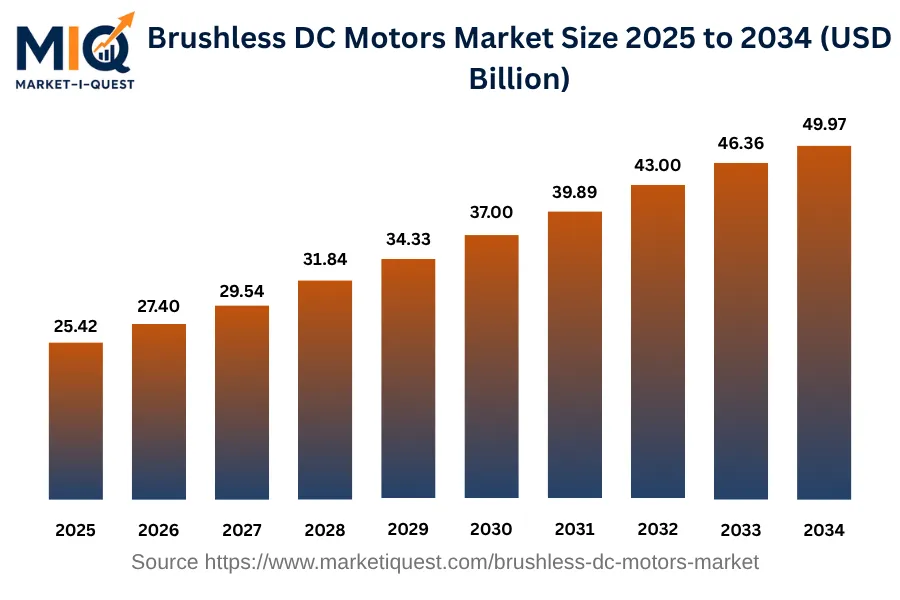
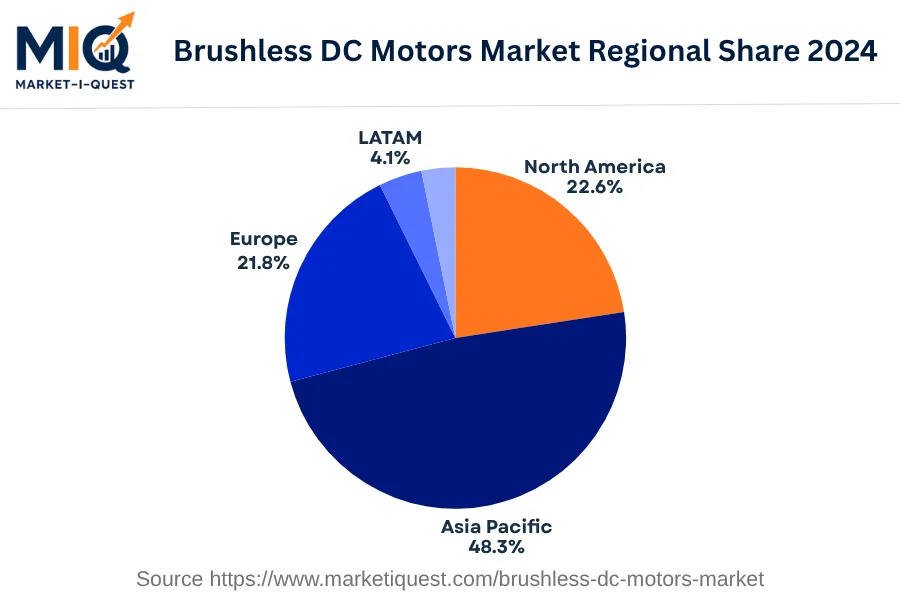
The Brushless DC Motors market size valued at 25.42 billion USD in 2025, is projected to grow at 49.97 billion USD by 2034, with a CAGR of 7.8%. This substantial increase 23.58 billion USD in 2024 showing consistent demand and revenues for brushless DC motors over the decade. Growth in this market is driven by factors like technological advancements and increased adoption of these motors across a wide range of applications due to capabilities like high efficiency and durability. The regional share in Brushless DC Motors market in 2024 was distributed with Asia Pacific leading at 48.3%, followed by North America at 22.6%, Europe 21.8%, Latin America 4.1%, Middle East & Africa at 3.2% respectively.

Key Takeaways

  • By Type - Inner Rotor led in the Brushless DC Motors Market accounting for a crucial share in 2024.
  • By Speed - 501-2000 RPM showcased the quickest growth expanding fastest in the forecast period.
  • By End-use - Automotive sector held a strong lead accounting for the largest industry usage in 2024.
brushless-dc-motors-market market size

Key Driving Factors

Rise in Electric Vehicle Production

One of the major factors for growth of Brushless DC Motors Market is the surging production of electric vehicles globally. Brushless DC motors are a key component of electric vehicles, precisely used in propulsion system due to their high efficiency and lower maintenance requirements in comparison with brushed motors. With increasing focus of manufacturers towards automotive sectors on switching to electric mobility due to stringent emission standards, like the Euro 6 norms the need for brushless DC motors is spiking. Consequently, boom in electric vehicle (EV) production is driving growth of Brushless DC Motors Market.

Adoption in Industrial Automation

Another significant driver for Brushless DC Motors Market is the increased adoption in industrial automation. Various Industries particularly in sectors like manufacturing and logistics are optimizing automation for enhancing the productivity and reduce operational costs. Notably, brushless DC motors are widely used in automated equipment, robotic systems and conveyor belts due to benefits like high torque, compact size, long lifespan and better speed control. The shift towards industrial automation, thus, increases the need for brushless DC motors, influencing market dynamics.

Market Evolution by Timeline

2019-2023
During this period, demand for brushless DC motors mainly driven due to automotive, medical, and industrial automation sectors with higher usage in North America and Asia. Manufacturers innovatively integrated signal processing and power electronics. In terms of policy, European Union implemented Ecodesign regulations imposing efficiency standards on electric motors, driving manufacturers for innovation. Dominating purchasing model like direct sale contracts between supplier and buyer, while price showed increased relatively due to the complex manufacturing process.
2024
In 2024, significant interest in energy-efficient systems in residential sector led to increased demand for brushless DC motors. Drug delivery and surgical robotics drove increase in medical sector, particularly in Western Europe. Suppliers introduced enhanced IOT technologies to improve motor performance. The US updated energy efficiency standards for electric motors according to the Energy Policy Act. Typically, suppliers offered discounts on bulk purchases, encouraging large-scale acquisitions.
2025-2029
Within this period brushless DC motors adoption significantly increased in aerospace industry with substantial growth in Middle East and Africa. Whereas, in technology sector, suppliers launched motors with integrated AI for predictive maintenance with procurement of advanced electronic components. In China, the Ministry of Industry and Information Technology implemented a national standard GB/T for motors energy performance classification. Commercially, leasing agreements emerged as a frequent transaction model to reduce high purchase prices.
2030-2034
In this period, brushless DC motors demand characterized by renewable energy applications, especially in Latin America. Suppliers started releasing wireless connected motors for real-time monitoring. Adapting to regulations, the Indian Bureau of Energy Efficiency highlighted new mandatory motor efficiency standards. A noticeable procurement model repeated maintenance subscriptions included with the initial purchase to expanded motors life-span. There was an increase in trade of rare earth minerals, which was typically addressed through international consensus arrangements.

Future Market Outlook

Future Opportunities

Future opportunities for brushless DC motor market are indicating the ongoing trends of electrification across multiple sectors. In 2021, General Motors announced a significant investment in electric vehicle technology, showing increased demand for brushless DC motors for future models. Similarly, the electric aviation industry is emerging rapidly with companies like Joby Aviation constantly testing prototypes of electric aircraft that rely on this motor technology. Whereas, in robotics sector advancements in artificial intelligence are driving demand for precision control in robotic systems subsequently creating demand for high-torque brushless DC motors capable of meeting stringent performance standards. Policy initiatives like U.S. government's commitment for reducing carbon emissions by 50% by 2030 highlights major shift towards cleaner technologies, resulting in an increased focus on electric propulsion systems utilizing brushless DC motors. Furthermore, growth of renewable energy projects, like wind and solar farms, highlights necessity for reliable motor solutions in various applications from energy storage to active cooling systems. Companies expanding their R&D initiatives, like Mitsubishi Electric focusing on optimizing motor designs to serve these emerging applications. Thus, industries adapting to stricter environmental regulations and consumer preferences for sustainable solutions, brushless DC motors is expected to play a critical role in meeting these demands while adopting technological development.

Segmentation Analysis

By Type

The market is divided into subsegments including Inner Rotor and Outer Rotor. Inner Rotor accounted for the largest revenue share while Outer Rotor is expected to grow at the fastest CAGR during the forecast period.

Largest Revenue Share

Inner Rotor

Market Share Leader

The Inner Rotor sector has consistently leading the subsegment, driven due to its crucial role in diverse applications. Its dominance can be attributed to high efficiency and benefits offered by inner rotor designs. The increase interest is due their narrow size, cheaper price and ability to spin rapidly than outer rotors. Geographic factors contribute to this trend. Countries with well-established electronic and automotive industries like USA, Germany, Japan and China, with integrating enhanced efficiency and capacity, driving demand for the inner rotor. Regulation and supply effects, specifically favorable government policies promoting energy efficiency and reductions in greenhouse gas emissions, including the demand. The purchasing criteria largely revolve around performance, price and quality, elements where inner rotor excels. Thus, customers have long-term contracts with manufacturers, which in turn increases switching costs and strengthens market position of the inner rotor.

Fastest CAGR

Outer Rotor

Forecast Period Growth Leader

Outer Rotor subsegment is projected to experience the highest rate of growth in future. Its growth is mainly driven by shift in technological advancements and an appetite for innovation. Outer rotor’s growth potential indicated due to robust design and high torque production at low speeds, with gaining popularity in specialized application areas like e-bikes and HVAC systems. Partnerships and collaborations between rotor manufacturers and innovative start-ups have accelerated the adoption of outer rotors. Capital expenditure in research and development and policies favoring reduced carbon emissions serve as drivers of the growth. Thus, capitalizing on the higher torque utility of outer rotors can present a sizeable growth opportunity in the market segment.

By Speed

The market is divided into subsegments including Less than 500 RPM, 501-2000 RPM, 2001-10000 RPM and More than 10000 RPM. Of these, the 501-2000 RPM segment accounted for the largest revenue share while the More than 10000 RPM segment is expected to grow at the fastest CAGR during the forecast period.

Largest Revenue Share

501-2000 RPM

Market Share Leader

The 501-2000 RPM subsegment leads segment primarily due to its extensive utility across multiple industries. It is a highly versatile sector wherein machinery and equipment of this speed range are found to be optimally efficient for many processing and manufacturing tasks. Purchasing criteria predominantly revolve around factors like power consumption, service coverage and speed, making 501-2000 RPM range favored by many enterprises. Furthermore, high demand from emerging markets where various industries are still in their growing phase contributes to extensive revenue of this segment. Regulatory standards also favor this speed range, further boosting its growth. Thus, this segment's dominance is highlighted by a well-established supply chain that ensures device availability and robust distribution channels provide customer accessibility.

Fastest CAGR

More than 10000 RPM

Forecast Period Growth Leader

The More than 10000 RPM subsegment is forecasted to grow at fastest CAGR. Its growth is highlighted by technological advancements and increasing demand for high-speed operations in various sectors like aviation, automotive and IT hardware. Policy dynamics favoring energy-efficient machinery serving as driver for growth, promoting innovation in high-speed machinery with lower energy footprint. Additionally, partnerships and strategic alliances focusing on capitalizing and improving high-speed machine technologies are expected to drive growth. Thus, subsegment is rapidly changing technology landscape.

By End-use Industry

The market is divided into subsegments including Automotive, Consumer Electronics, Manufacturing, Healthcare, and Others. The Automotive subsegment accounted for the largest revenue share while the Healthcare subsegment is projected to grow at the fastest CAGR during the forecast period.

Largest Revenue Share

Automotive

Market Share Leader

In base year 2024, Automotive subsegment records highest revenue. The auto industry's technological advancements have drove this growth. With integration on digitization, AI and automation drives demand for solutions that can streamline and transform automotive processes. Whereas rise in electric vehicles or EVs increases demand, where automation plays vital role in battery management and advanced driver-assistance systems. More cars on road also imply rising need for maintenance, repairs and replacement of parts, contributing towards revenue. Regulatory landscape supporting growth, with many jurisdictions requiring certain digital and automated components for safety. Geographically, key markets like U.S., Europe and Japan, with emerging markets like China and India are key drivers due to their immense automotive user base and manufacturing capabilities.

Fastest CAGR

Healthcare

Forecast Period Growth Leader

Healthcare subsegment is expected to exhibit fastest CAGR. The growth is driven by increased focus on digital health technologies, especially due to global pandemic. Increasing investments in telemedicine, AI-based diagnostic tools and robotic-assisted surgery are majorly driving this trend. Meanwhile, aging populations in many countries are forcing healthcare providers to seek more efficient ways to deliver care and manage resources. Advent of personalized medicine, IOT in healthcare and drives value-based care acts as catalysts for growth. The ability successfully to address these issues through regulation and technological improvements will largely decide pace of growth. Thus, partnerships between healthcare providers and tech companies are crucial.

Competitive Analysis Brushless DC Motors Market

Key Market Players

Manufacturers / OEMs

ABB
Switzerland
Johnson Electric
Hong Kong
Arc Systems
US

Key Suppliers & Raw Materials

Electrocraft
US
Allied Motion
US
Maxon Motors
Switzerland

Distributors, Integrators & Channel Partners

Moog Inc.
US
Schneider Electric
France
Nidec Corporation
Japan

Porter’s Five Forces Analysis

This assessment evaluates market dynamics and competition levels influencing the Brushless DC Motors market.

Supplier Bargaining Power

Medium

Limited suppliers with specialized components elevate their negotiation powers.

Buyer Bargaining Power

High

OEMs and industrial sectors can exert purchasing power due to multiple suppliers.

Threat of Substitutes

Low

Few efficient substitutes exist for brushless DC motors, limiting threat levels.

Threat of New Entrants

Medium

Capital and technology intensity create barriers to entry, but opportunities exist for well-funded entrants.

Competitive Rivalry

High

The market hosts intense competition among established manufacturers and innovating newcomers.

Regional Analysis

Geographic market dynamics and growth opportunities across key regions

Global Market Outlook

brushless-dc-motors-market market regional share

North America

In 2024, North American market for Brushless DC Motors distinguished by a strong integration of energy efficiency and automation. With diverse drivers of this market. Increased demand for electric vehicles spurred growth, particularly in U.S., due to stringent vehicle emission standards drove manufacturers to transition to BLDCs. In Canada, major focus on renewable energy led to increased investment in BLDCs due to superior efficiency and controllability of market. In Mexico, adoption of Industry 4.0's intelligent manufacturing technologies necessitated use of BLDCs for their precision control attributes.

Notably, market witnessed several trends in 2024. End-users in industrial automation sector showed a strong preference for brushless motors, valuing their high speed and torque capabilities. This trend was particularly witnessed in manufacturing sector. Within technology sector, enterprises shifted toward smart BLDCs equipped with IOT, offering better responsiveness and predictability. Distribution channel dynamics also shifted with predominant reliance on direct sales from manufacturers to end-users diminishing to create a path for increased online sales. In terms of partnerships and M&A, notable actions indicated a rise in market dominance, especially in U.S., as players sought to diversify their portfolios and enhance technological capabilities. Regulatory pressures highlighted stricter energy efficiency standards and stricter enforcement of these standards, particularly in Canada.

Asia Pacific

In 2024, Brushless DC Motors Market in Asia Pacific was characterized by diverse market dynamics across China, India, Japan, South Korea, Australia and key ASEAN markets. Expansion of applications in industries like manufacturing, automation and consumer electronics was seen as a key driver of market growth. In terms of regulation demand for energy-efficient systems in regions like China and Japan drove market proliferation. Innovation investments, particularly in China and South Korea, further facilitated technology adoption.

Simultaneously, product shifts towards compact, high-efficiency motors indicating shifting buyer behavior. While manufacturers in Japan and Australia consolidated distribution channels to streamline supply and delivery. The market also witnessed notable partnerships, specifically, between Indian manufacturers and their ASEAN markets to meet rising demand in these regions. Regulations enforcing international efficiency norms set by International Electrotechnical Commission driving further market trends.

Sectors primarily driving use of Brushless DC Motors included utilities and manufacturing in China and Japan due to their high industrialization rates. Retail sector in developing economies like India and ASEAN markets saw an growth in demand, advancing market growth in these regions. Thus, market in 2024 was a mix of regulatory influences, technological advancements and shifting consumer preferences.

Europe

In 2024, the European brushless DC motors market highlights significant growth driven by several key factors. Increased demand for energy-efficient motors in manufacturing industries of Germany, Italy and United Kingdom drove the growth. Reinforced regulations, particularly in Nordics and Benelux for reducing carbon emissions and energy consumption have accelerated the adoption of the technology. Further, growth within investments majorly from France and Central & Eastern Europe in developing high-performance brushless DC motors enhanced the market dynamics.

In terms of trends, shift towards adoption of brushless DC motors in electric vehicles has been significant across France and United Kingdom. Advances in wireless communication technology have incorporated IOT capabilities in motors which were witnessed in Spain and Italy. Through partnerships and M&As, companies in Germany and United Kingdom are driven towards standardization in production of brushless DC motors. Whereas, healthcare sector, primarily in Benelux and Nordics, brushless DC motors are increasingly used in medical devices due to their precise control capabilities. With increasing adoption of stringent policy enforcement related to energy efficiency in enterprise and government sectors across Europe played significant role in shaping market landscape.

Latin America

In 2024, the Brushless DC Motors Market in Latin America has enhanced competition with Brazil, Mexico, Argentina, Colombia, Chile and Peru being most promising markets. Drivers for market are characterized by increased demand for energy-efficient motors, primarily in manufacturing and utility sectors, due to strict energy regulations. Significant investments by stakeholders have allowed for introduction of new technologies and innovative motor designs improving performance and durability. Supply dynamics have shifted due to expansion in local production capabilities, leading to advantageous pricing strategies.

Trends in the market indicates a shift towards Industry 4.0 and IoT applications adoption, contributing to increase in demand for high-performance motors. With increasingly, alliances being formed between manufacturers and technology companies to design smart brushless DC motors. With noticeable shifts in consumer behavior with preference for eco-friendly products resulting in regulatory bodies enforcing stricter sustainability standards. Key customers of brushless DC motors include enterprises in manufacturing sector, government projects focusing on infrastructure development and utilities implementing smart grid solutions. High demand is driven by new technologies and regulations thus, shifting consumer behaviors and alliances among industries.

Middle East & Africa

In 2024, Brushless DC Motors market within Middle East and Africa indicated enhanced dynamics due to reduction of fossil fuels and engagement of energy-efficient systems. Key market drivers included increased demand for energy savings. Whereas, in Saudi Arabia, increasingly implemented brushless DC motors in HVAC systems to reduce excessive usage of energy. Regulatory policies, especially in nations like Nigeria and South Africa adopted market growth by implementing clean energy adoption. Increased investments in technology by countries like United Arab Emirates and Israel accelerated market expansion. Along with these, Supply dynamics made an impact as international players penetrated African markets.

Market trends showed shift towards green energy with Kenyan government using brushless DC motors for minimizing carbon footprint. Shift in buyer behavior became evident as individuals and corporates in nations including Qatar and Egypt shifted towards energy-efficient technologies. With growing strategic partnership, particularly in healthcare and manufacturing sectors, promoting adoption of these motors. Energy policies enforcing use of energy-efficient systems, exemplified by strict regulations in Israel's utilities sector. Thus, growth was observed in sectors like government, oil and gas, utilities, telecom, healthcare, manufacturing, retail and financial services due to growing focus on energy optimization.

Recent Industry Developments

Latest market innovations, product launches, and strategic initiatives

March 2026

The company launched Energion Elevate, a new line of brushless motors designed specifically to improve energy efficiency for home appliances in domestic market.

February 2026

The organization released highly compact motor controller designed to fit directly inside moving joints of humanoid robots. This development saves physical space while providing the necessary power for robotic movement.

January 2026

The company introduced its first stainless steel brushless motor. This product was built to resist rust and withstand heavy washing, making it suitable for strict hygiene environments like food production facilities and medical labs.

Frequently Asked Questions