
Industrial Automation Market Snapshot

Key Players

  • Siemens AG (Germany)
  • Rockwell Automation Inc. (USA)
  • ABB Ltd. (Switzerland)
  • Schneider Electric SE (France)
  • Emerson Electric Co. (USA)
  • FANUC Corporation (Japan)
  • Mitsubishi Electric Corporation (Japan)
  • Yaskawa Electric Corporation (Japan)
  • Honeywell International Inc. (USA)
  • KUKA AG (Germany)

Market Size

Base Year 2024
$187.65 Bn
CAGR
10.45%
Forecast 2034
$507.00 Bn

Market Segments

By Component
Hardware, Software, Services
By Deployment Mode
On-Premise, Cloud-Based, Hybrid
By Application
Manufacturing Operations, Quality Control, Inventory Management, Packaging & Processing, Predictive Maintenance
By Industry Vertical
Energy & Utilities, Pharmaceuticals, Automotive, Electronics & Semiconductors, Food & Beverage, Chemicals, Aerospace & Defense, Oil & Gas, Others

Market Dynamics

Drivers
  • Growing industrial sector
  • Technological advancements
Restraints
  • High implementation cost
  • Complex installation process
Opportunities
  • Emerging IoT technologies
  • Increasing demand for digitization

Market Size

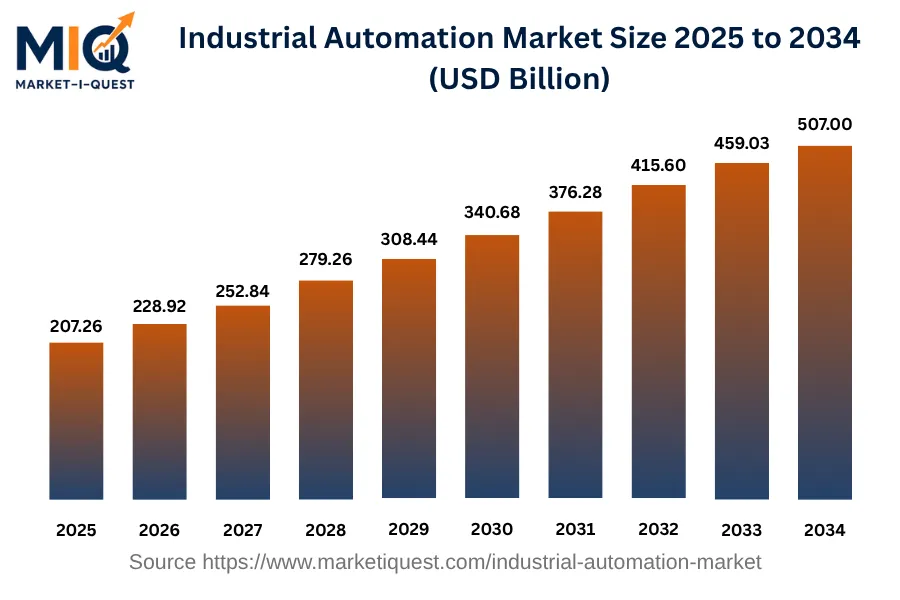
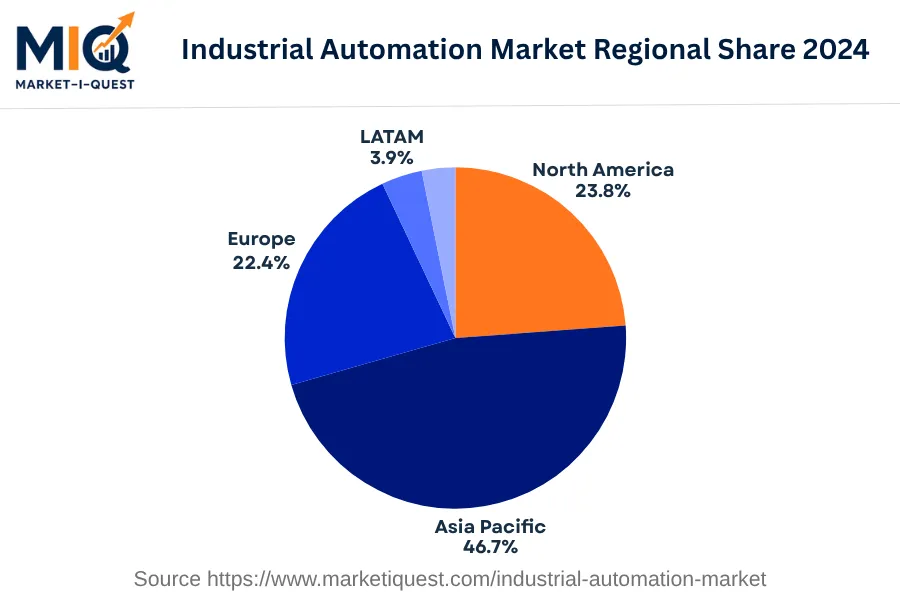
The Industrial Automation Market was valued at $207.26 billion in 2025, and it is projected to grow to $506.99 billion by 2034, demonstrating a compound annual growth rate (CAGR) of 10.45%. This indicates a robust increase in the Industrial Automation Market throughout this period. The primary cause for the enlargement of the market size can be attributed to the constant advances and developments in technology, leading to enhanced and more efficient industrial automation solutions being introduced to the market. Another contributing factor is the rising need among various industries to improve productivity and streamline operations, driving the demand and consequently the growth of the industrial automation market. When observing the market distribution in 2024, the Asia Pacific region held the largest share at 46.7%, followed by North America at 23.8%, and Europe at 22.4%. The remaining market share was distributed between Latin America at 3.9% and the Middle East and Africa at 3.2%.

Key Takeaways

  • By Component - Hardware accounted for the largest market share.
  • By Deployment Mode - On-Premise segment held the leading position in the market largely due to its trustworthy security in 2024.
  • By Application - Inventory Management dominated the market in 2024 largely owing to its critical role in mass production.
  • By Industry Vertical - Electronics & Semiconductors accounted for the largest market share in 2024.
industrial-automation-market market size

Key Driving Factors

Implementation of Industry 4.0 and IIoT

The adoption of concepts related to Industry 4.0 and the Industrial Internet of Things (IIoT) are key drivers within the industrial automation market. Industry 4.0 is a term that refers to the integration of information technology with operational technology to optimize production processes. Meanwhile, IIoT involves embedding sensors and software in physical assets to enhance connectivity, data sharing, predictive maintenance, and automation of industrial processes. Many industries are shifting towards these approaches as they promise to significantly improve efficiency, reduce downtime, lower costs, and result in more flexible production capabilities. This shift is driving a surge in demand for automation technologies, such as advanced robotics and AI-driven systems, to support intelligent manufacturing and supply chain operations. Adoption is particularly strong within sectors such as automotive, electronics, and pharmaceuticals, where precision, repeatability, and high throughput are critical.
Stringent Workplace Safety Regulations

The reinforcement of workplace safety policies and regulations is another influential driver for the industrial automation market. Governments worldwide are becoming stricter about workers' safety in hazardous environments like manufacturing units, chemical plants, and oil & gas refineries. In response, numerous organizations and businesses are employing automated systems to limit direct human involvement, thereby reducing safety risks and improving compliance with regulations such as the U.S. Occupational Safety and Health Administration (OSHA) standards. Moreover, industrial automation systems can help organizations adhere to product quality standards required by regulatory bodies. Thus, compliance to various safety and quality regulations propels business entities to invest in industrial automation, contributing to market growth.

Market Evolution by Timeline

2019-2023
This period saw the early adoption of Industrial Automation in sectors such as Automotive and Pharmaceuticals. The primary reason for this includes increased efficiency and reduction in human errors. The adoption is specifically high in regions like North America and Asia-Pacific because these regions house the majority of global manufacturing units. The key tech supplied during this period included Machine Learning and AI integrated systems, which were still in their early development stages, facing constraints like high setup cost. Regulatory standards encouraging automation, such as ISO 9000 in Europe, helped businesses transition. Commercial models mostly consisted of lump-sum payments. High customizability caused a variation in pricing. Risk factors mainly included job displacement and the fear of complex technology.
2024
In 2024, the adoption of Industrial Automation saw a moderate rise especially in industries like Food and Beverage, Electronics, and Oil and Gas. This adoption, particularly observed in MENA region, aimed at cost reduction and reducing time-to-market. Technologies like Robotics Process Automation and Cloud Computing became widespread. Mesh network standards, such as Zigbee, helped in forming reliable connectivity among devices. Usually, businesses preferred leasing automation equipment to mitigate the high initial setup cost. Factory workers' resistance against job displacement rendered as the main risk factor for the adoption of automation.
2025-2029
The appetite for Industrial Automation became substantial during this period. Driven by demands from large scale manufacturing sectors, it saw a massive uptake in Europe and North America. Unlike the previous years, IoT and Big Data greatly influenced the tech in this phase. However, these technologies also faced challenges regarding data privacy and security. Government regulations like the General Data Protection Regulation (GDPR) in Europe played a major role in their safe adoption. The prevalent commercial model embraced a subscription-based service for software. Risk factors included cyber threats, leading to an increased demand for cybersecurity in industrial automation.
2030-2034
With advancement in technology, industries like logistics, healthcare, and agriculture widely adopted Industrial Automation. Countries in Africa and South America also began investing in such technologies aiming to increase productivity. Technology-wise, embedded systems, and cognitive computing dominated the scene. Standards like IEC 61850 (for Power systems management) had a noticeable influence on tech adoption. The companies, continuing with a subscription-based model for software services, moved from equipment leasing to equipment-as-a-service model. Manufacturing job displacement still remained a major risk.

Future Market Outlook

Future Opportunities

Future opportunities within the industrial automation market are closely linked to advancements in technology and evolving regulatory environments. The push towards sustainability is being emphasized by new regulations like the European Union's Green Deal launched in 2019, which mandates reductions in industrial emissions. Companies such as Schneider Electric and Honeywell are responding with automation solutions that not only enhance efficiency but also promote energy savings and carbon reduction. The growing emphasis on workforce reskilling is creating opportunities for training service providers as existing workers adapt to new technologies, with programs being rolled out in regions such as North America and Europe. The rise of digital twins, which mirror physical assets in a virtual environment, is enabling manufacturers to enhance product quality and reduce defects. Furthermore, as supply chains become increasingly complex, there is a higher demand for intelligent automation systems capable of agile responses to market changes. By 2023, partnerships like the one between Siemens and Microsoft are focusing on integrating cloud technologies that enable greater data analytics and decision-making in real-time. These numerous trends highlight the industrial automation sector's potential for growth through a convergence of technology solutions, regulatory support, and shifting market needs ensuring efficiency and sustainability for the future.

Segmentation Analysis

By Component

The market is divided into subsegments including hardware, software, and services, with hardware accounting for the largest revenue share, while software is expected to grow at the fastest CAGR during the forecast period.

Largest Revenue Share

Hardware

Market Share Leader

The hardware subsegment leads today primarily due to its indispensable role in both consumer and enterprise sectors. Hardware forms the backbone of any technological infrastructure, hence driving the high revenue in this subsegment. Consumers are continually upgrading their devices, while companies update their infrastructures to support new technologies and improved efficiencies. Geographic regions with rapid economic growth are contributing to the hardware demand as they build their technological capabilities. In addition, regulations surrounding cybersecurity push firms to keep their hardware updated to prevent breaches, further driving the demand. The criteria for purchasing hardware often come down to quality, durability, and brand reputation, thereby strengthening the position of established hardware manufacturers. Switching costs from one hardware brand to another could be high due to compatibility issues, encouraging brand loyalty and ensuring a robust revenue stream. Both direct channels, like brand stores, and indirect channels, such as ecommerce and retail stores, effectively contribute to the hardware sales.

Fastest CAGR

Software

Forecast Period Growth Leader

Software, as a subsegment, demonstrates the fastest growth largely driven by technological advancements and digital transformation trends across industries globally. The fundamental catalysts accelerating the growth of the software sector include cloud computing, artificial intelligence, machine learning, and the need for data analytics. These developments push businesses towards more agile, scalable, and cost-effective software solutions. Significant capital investment in software development and strategic partnerships within the sector also fuel this growth. However, barriers to adoption remain in the form of initial setup costs, skill gaps, and potential security concerns. Recent policies aiding digital transformation and data privacy regulations also contribute towards advanced and secure software development. Despite promising growth, potential risks include rapid technological obsolescence and intense competition, especially from open-source alternatives. The coming years will likely witness higher software adoption across multiple sectors, driven by need-based bespoke solutions, business process automation demands, and the quest for competitive advantages.

By Deployment Mode

The market is divided into subsegments including On-Premise, Cloud-Based, and Hybrid deployment modes. In 2024, On-Premise accounted for the largest revenue share while Cloud-Based is expected to grow at the fastest CAGR during the forecast period.

Largest Revenue Share

On-Premise

Market Share Leader

On-Premise deployment remains the predominant choice amongst various enterprises and organizations in 2024, contributing to the majority of the revenue share. This can be attributed to a range of factors. Firstly, On-Premise solutions offer enhanced control over data and systems to companies. They have the physical servers in-house, resulting in direct control and management of the data. Enterprises can tailor security measures directly to their specific needs, which is vital in sectors with stringent regulations, such as finance and healthcare. Furthermore, organizations opting for On-Premise deployments typically have significant investments in existing infrastructure and are thus less inclined to switch to cloud-based options. Such sunk costs, in the form of hardware and trained personnel, make the transition financially less attractive. Lastly, even though the trend of digitization and cloud adoption is widespread, some geographical regions still prefer On-Premise due to connectivity and data sovereignty issues.

Fastest CAGR

Cloud-Based

Forecast Period Growth Leader

Despite generating lesser revenue compared to the On-Premise segment, the Cloud-Based deployment mode reflects the highest growth potential. The growth trajectory of this sector is driven by the maturing digital ecosystem and businesses' shift towards more flexible, scalable solutions. It allows businesses to reduce their capital expenses as they need not invest in extensive hardware infrastructure. Cloud-based services also provide ease of access to data across various geographical locations, thus catering to the needs of a more global and mobile workforce. The growing partnerships between businesses and cloud service providers, coupled with policy initiatives promoting digitalization, further stimulate this sector's fast-paced growth. However, probable near-term risks include potential cybersecurity threats and data privacy concerns, as well as adoption barriers in regions lacking robust internet infrastructure. It is imperative for firms in this rapidly expanding sector to account for such potential challenges as they strategize their growth and expansion plans.

By Application

The market is divided into subsegments including Manufacturing Operations, Quality Control, Inventory Management, Packaging & Processing, and Predictive Maintenance. In 2024, the Inventory Management subsegment accounted for the largest revenue share while Predictive Maintenance is expected to grow at the fastest CAGR during the forecast period.

Largest Revenue Share

Inventory Management

Market Share Leader

Inventory Management as a subsegment contributes the highest revenue, based mainly on the significant demand for efficient and optimized resource management across industries. Inventory plays a fundamental role in manufacturing and retail businesses, acting as a bridge between production and customer satisfactions. Inventory management systems enable businesses to have the right goods in the right quantity at the right time, reducing the risk of stockouts or overstocking. These systems provide critical insights into sales trends and customer behaviour, aiding in demand forecasting. With the prevalence of e-commerce and omnichannel retailing, integrated, real-time inventory management is all the more necessary for businesses to efficiently fulfill orders, improve customer service, and ultimately increase their profit margins. Considering these factors, it's a logical assumption that the Inventory Management would be the subsegment with the most significant revenue share in 2024.

Fastest CAGR

Predictive Maintenance

Forecast Period Growth Leader

On the other hand, Predictive Maintenance is expected to be the fastest-growing subsegment. Predictive Maintenance, driven by the advent of Industry 4.0 and the increasing integration of IoT and AI in industrial operations, implies a powerful predictive approach to preventing equipment downtime and enhancing operational efficiency. The need to reduce operational costs, increase equipment lifespan, and prevent catastrophic failures heightens the demand for Predictive Maintenance solutions. Policy initiatives supporting industrial automation and digitization also act as significant catalysts for growth. However, risks associated with the initial high Capex, the need for skilled resources, and data security and privacy concerns could potentially slow down the subsegment's expected rapid growth. Despite these risks, the pressing need for efficiency and cost reduction is projected to fuel the CAGR of the Predictive Maintenance subsegment.

By Industry Vertical

The market is divided into subsegments including Energy & Utilities, Pharmaceuticals, Automotive, Electronics & Semiconductors, Food & Beverage, Chemicals, Aerospace & Defense, Oil & Gas, and Others. Electronics & Semiconductors account for the largest revenue share while the Pharmaceuticals segment is expected to grow at the fastest CAGR during the forecast period.

Largest Revenue Share

Electronics & Semiconductors

Market Share Leader

The Electronics & Semiconductors segment maintains its lead primarily due to constant innovation and high demand for consumer electronics and enterprise hardware in both developed and emerging markets. Firstly, the acceleration of digital transformation across various sectors, including healthcare, education, and transportation, has fueled demand for semiconductors across different applications. Further to that, there's been a rise in the demand for semiconductor components as emerging tech trends such as AI, IoT, and 5G drive up consumption. Additionally, this segment significantly benefits from economies of scale and scope in manufacturing, packaging, delivery and service channels. Lastly, the uptick in high-end devices, major adoption switch towards smart devices, and the increase in internet traffic due to remote working are also supporting the growth of this industry vertical. Therefore, based on these factors, Electronics & Semiconductors represent the largest cash-generating segment.

Fastest CAGR

Pharmaceuticals

Forecast Period Growth Leader

Pharmaceuticals is the fastest-growing subsegment, given the sustained investment in research and development, leading to the discovery of new drugs and treatments for a multitude of diseases. One key driver is the growing global concerns related to health as an aging population and prevalence of chronic diseases require advanced and efficient pharmaceutical products. The policy of governments worldwide to support the local pharmaceutical industry through sponsorships and tax incentives is also playing a major role in fostering growth in this segment. Technology adoption and partnerships have led to the development of personalized medicine which, although at infancy, promises strong future growth. However, in the short term, high R&D costs, regulatory hurdles and patent cliffs pose risks to growth. Despite these challenges, the pharmaceutical segment, with its constant innovation and research successes, is expected to grow at the fastest pace in the forecast period.

Competitive Analysis

Key Market Players

Manufacturers / OEMs

Siemens AG
Germany
Rockwell Automation
US
ABB Ltd.
Switzerland

Key Suppliers & Raw Materials

Honeywell International
US
Te Connectivity Ltd.
Switzerland
Eaton Corporation Plc
Ireland

Distributors, Integrators & Channel Partners

Bosch Rexroth AG
Germany
Mitsubishi Electric Corporation
Japan
Schneider Electric
France

Porter’s Five Forces Analysis

This is an analysis of the competitive forces shaping the Industrial Automation Market.

Supplier Bargaining Power

Medium

Power is moderated by the availability of multiple automation hardware and software suppliers.

Buyer Bargaining Power

Low

Large industrial purchasers often have long-term contracts, reducing their supply-chain flexibility.

Threat of Substitutes

High

Emerging technologies like AI, IoT and machine learning can substitute traditional industrial automation systems.

Threat of New Entrants

Medium

Significant capital requirements and regulatory complexity limit, but do not prohibit, market entrance.

Competitive Rivalry

High

Competition is intense with several multinational corporations and rapid technological advancements.

Regional Analysis

Geographic market dynamics and growth opportunities across key regions

Global Market Outlook

industrial-automation-market market regional share

North America

In 2024, the North American industrial automation market is defined by its growing digitization and the increasing need for operational efficiency among industries. Driving forces behind this context include high demand for robotics in manufacturing sectors in the United States and Mexico, propelling the necessity of automation tools. In Canada, stringent government regulations concerning workers' safety have accelerated the shift towards machinery automation. Extensive investment in AI and IoT technologies by enterprises, particularly in the United States, has paved the way for intelligent automation. Moreover, factors impacting supply dynamics include the decreasing prices of automation devices, making them more accessible to various industries.

Market trends underline shifts in buyer behaviour toward increased adoption of wireless communication and cloud computing across industrial verticals such as utilities, manufacturing, and government sectors. Tech advancements like machine learning and AI have initiated partnerships and M&A activities notably between tech giants and manufacturing firms. Enhanced enforcement of Industrial Internet of Thing (IIoT) standards also steers the market trajectory. Use cases expand from small scale industries to large enterprises, most noticeably in healthcare, where automation is leveraged for precision-driven tasks under strict regulatory compliances and in retail, for efficient inventory management. In essence, Industrial automation in 2024 in North America manifests as a maturing ecosystem of increased cooperation between human and machine towards optimized industry processes.

Asia Pacific

In 2024, the industrial automation market in the Asia Pacific was dynamic and robust due to several driving factors. Rapid urbanization in India and China necessitated efficient manufacturing processes, propelling demand for automation. Japan’s strict industrial safety regulations catalyzed technological adoption in sectors like manufacturing and utilities, while South Korea’s substantial investment in digital transformation projects fortified the industrial automation infrastructure. Lastly, the competitive pricing provided by key ASEAN manufacturers fueled supply dynamics in the region.

Among trends, cognitive automation was gaining traction in markets such as Japan and Australia, prompting channel dynamics shifts towards specialized vendors. Besides, enterprise-level adoption of advanced robotics saw a sharp rise in China and India driven by a focus on quality assurance and productivity improvement. Intense M&A activities, underscored by notable deals like Nidec's acquisition of Mitsubishi's industrial automation business, steered the competitive landscape in Japan and the ASEAN region. The implementation of China’s ‘Made in China 2025’ policy prompted many manufactures to increase industrial automation, pushing the market's growth. Furthermore, the rising utility of IoT in South Korea's healthcare sector demonstrated the broader applicability of automation solutions. Cumulatively, these drivers and trends stimulated the industrial automation market across several sectors in the Asia Pacific during 2024.

Europe

In 2024, Europe's industrial automation market experienced substantial growth driven by key economic factors, regulatory parameters and advances in technology. Upsurge in demand was mainly echoing in sectors like manufacturing, healthcare, utilities and retail, backed by continuous push for efficiency and cost-cutting. Investments in Industry 4.0, particularly in Germany, were a major driver with factories adopting smart and automated solutions on a large scale. Simultaneously, UK's stringent regulations for workforce safety urged industries towards automation. In France and Benelux, desire to strengthen competitiveness fueled adoption of AI-aided automation systems.

The diversification of collaborations spurred leading shifts, such as Airbus and Siemens enhancing their assembly lines through robots and machine learning. An intended outcome of the European Green Deal policy, automation aided in reducing carbon footprint in industries, proving consequential in Central and Eastern Europe. Consumer behavior altered noticeably, favoring brands utilizing automated, transparent, and green supply chains-- particularly visible in Spain’s retail sector. Contactless, automated services became the norm in Italy's hospitality industry due to pandemic-instigated safety regulations. Automation-as-a-service gained popularity in the Nordics, aligning with their affinity for tech solutions. Aggressive M&A activities were prominent, reshaping the automation landscape with international tech firms investing heavily, specifically in UK and Germany. Overall, 2024 marked a pivotal point for Europe's industrial automation, catalyzing transformation across various industry sectors.

Latin America

In the base year 2024, the industrial automation market in Latin America observed a noticeable push due to several drivers. Regulatory policies, such as Mexico's Industry 4.0 Initiative, stimulated the adoption of automation technology by incentivizing investments. The escalating demand for efficiency and productivity in manufacturing sectors, particularly in Brazil and Argentina, considerably fueled the growth of the market. Concurrently, the declining price of automation components led to an increased supply, especially from major players such as Emerson and Siemens.

Several key trends emerged in parallel. The burgeoning e-commerce sector, predominantly in Brazil and Mexico, drove demands for automated warehouse solutions, enhancing operational efficiency. Advances in robotics and AI indirectly led to innovations in automation systems, particularly in manufacturing industries in Argentina, influencing buyer preferences. Intriguingly, a substantial shift was noted towards 'Industrial Internet of Things' (IIoT) solutions, most prominently in Chile and Peru, transforming traditional manufacturing practices. M&A activities were observed among key industrial automation providers, aiming to harness respective technological capabilities, a distinguishable practice in Colombia's robust agricultural sector. In conclusion, 2024 witnessed intrinsic changes in LATAM's industrial automation landscape due to evolving regulations, tech adoption, and novel market trends.

Middle East & Africa

In 2024, the Industrial Automation Market in the Middle East and Africa experienced significant growth due to various drivers and trends. Increased investments in the oil and gas sector coupled with government regulations in Saudi Arabia and the United Arab Emirates spurred demand for automation services. Technological advancements and adoption, particularly in South Africa and Israel, enhanced supply dynamics in the region. The prominence of digital transformation strategies, specifically in Nigeria and Kenya's telecom and financial services sectors, ignited a shift in buyer behavior towards automation products and tech-driven solutions. Innovative partnerships in Egypt's healthcare sector, and policy enforcement aimed at efficiency in the utilities sector in Qatar, marked a shifting trend towards automation standards. Pricing played a significant role in the region, increasing accessibility and demand among smaller businesses in the manufacturing and retail industries. Additionally, the shift towards data-centric operations across various sectors contributed to the market’s growth in 2024. By leaps and bounds, market factors drove substantial growth in automation across Middle East and Africa's industrial landscape.

Recent Industry Developments

Latest market innovations, product launches, and strategic initiatives

June 2026

Aaronn Electronic and Advantech jointly introduced an industrial hardware architecture designed for safety-critical robotics. The platform enables local processing of sensor data, eliminating the need for cloud-based round-trips and thereby reducing latency in autonomous on-site industrial systems.

May 2026

AMETEK announced an agreement to acquire Indicor Instrumentation for $5 billion. The acquisition adds a portfolio of mission-critical industrial and scientific instrumentation to AMETEK’s business, specifically targeting sectors that generate recurring revenue through aftermarket support and consumables.

Frequently Asked Questions