Home Energy Management Systems Market Snapshot

Key Players

  • General Electric Company (United States)
  • Schneider Electric SE (France)
  • Honeywell International Inc. (United States)
  • Siemens AG (Germany)
  • ABB Ltd. (Switzerland)
  • Cisco Systems Inc. (United States)
  • Johnson Controls Inc. (Ireland)
  • Lutron Electronics Co. Inc. (United States)
  • Control4 Corporation (United States)
  • Eaton Corporation plc (Ireland)

Market Size

Base Year 2024
$ 4.31 Bn
CAGR
14.86%
Forecast 2034
$ 18.37 Bn

Market Segments

By Component
Hardware, Software, Services
By System
Lighting Controls, Thermostats, Self-Monitoring Systems, Advanced Central Controllers, Intelligent HVAC Controllers
By Technology
Wired, Wireless, Hybrid
By Deployment
On-premises, Cloud
By Application
New Construction, Retrofit

Market Dynamics

Drivers
  • Increasing energy cost concerns
  • Advancements in IoT technology
Restraints
  • High Installation Costs
  • Lack of Consumer Awareness
Opportunities
  • Rising energy conservation awareness
  • Smart grid development

Market Size

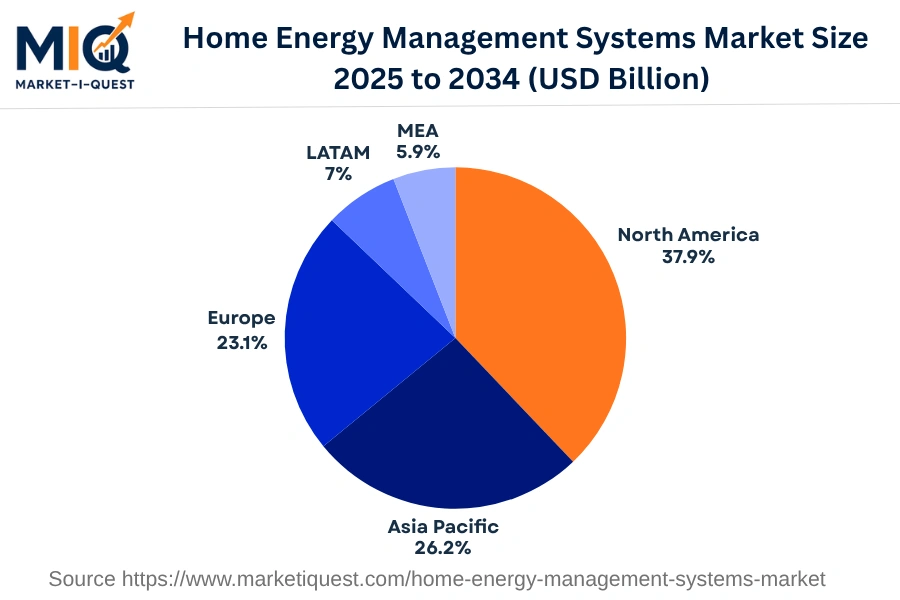
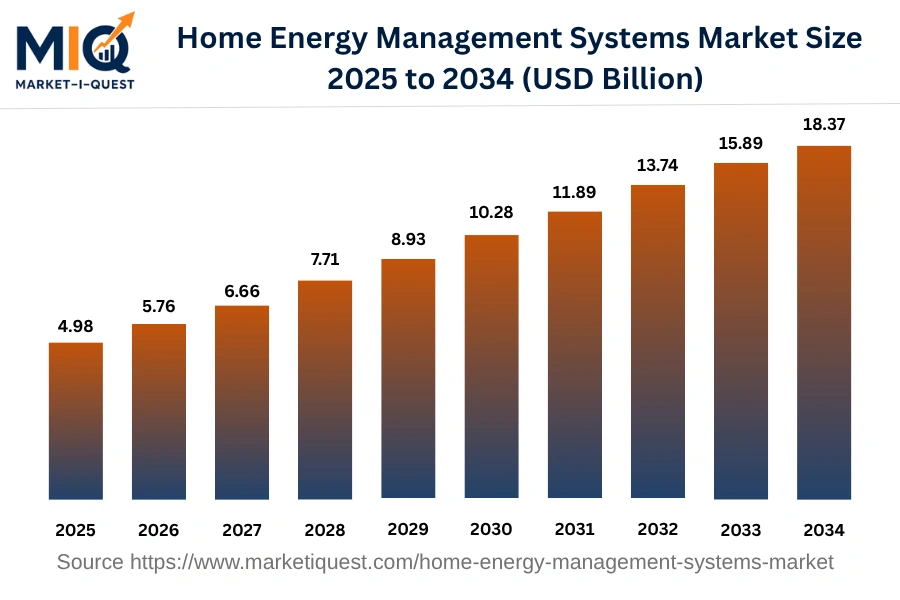
The Home Energy Management Systems Market share is worth $4.31 billion in 2024 with a rapid increase in the growth to $4.98 billion in following year. Over the decade surge is projected to reach $18.37 billion in 2034 with a CAGR of 14.86%. The consistency in growth is attributed to the sudden awareness and demand for efficient energy consumption with reducing in the wastage of energy from households worldwide. Also the market is expanding due to innovations through advanced technologies in energy management systems. In 2024, the global market shares were divided as follows: North America possessed the largest share (37.9%), followed by Asia Pacific (26.2%), Europe (23.1%), Latin America (7.0%), and Middle East & Africa (5.9%).

Key Takeaways

  • By Component - Hardware held the leading position in the home energy management systems market in 2024.
  • By System - Lighting Controls was the fastest-growing segment in the year 2024.
  • By Technology - Wired solutions accounted for the largest share of the market in 2024.
  • By Deployment - On-premises systems led the market with a notable dominance in 2024.
  • By Application - New Construction subsegment expanded the fastest in 2024.
home-energy-management-systems-market market size

Key Driving Factors

Legislation Aimed at Carbon Reduction Drives the Market

Globally within several regions various governments are introducing precise legislation with target for reducing carbon emission. These guidelines require residents for the regulation of their energy usage leading the rise in adoption of Home Energy Management Systems (HEMS). For instance the EU's Energy Efficiency Directive and the UK's adoption of 'Powering our Net Zero Future' with mandating substantial reduction in national carbon emissions. The major driving forces are these political moves, leading residents are seeking various solutions such as HEMS for meeting new laws and avoid penalties.

Integration with Smart Home Devices Propels the Market Growth

The ongoing surge in popularity of smart home devices is influencing the home energy management systems market demand. The rise in household consumers integrating Internet of Things (IoT) into their homes for increased convenience and efficiency with various devices such as Amazon Alexa and Google Nest. The integration of HEMS with popular smart home devices has enhanced their popularity with allowing residents for monitoring and managing their energy usage from a central device. This trend of smart home device integration is a specific driver for the acceleration in the adoption of HEMS.

Market Evolution by Timeline

2019-2023
During this period, interested buyers mainly consisted of homeowners in urban regions, with attributes of energy-consciousness and financial means, especially in European countries like Germany and Netherlands. Suppliers like Tado, and Qivicon started integrating systems with smart home platforms like Apple HomeKit or Google Home. However, suppliers faced constraints in making systems user-friendly to average consumer. In the policy space, EU's 'Clean Energy for all Europeans' package acted as a guide for wider adaptation. A typical commercial model was direct selling from manufacturers to end users, with subscription-based services for cloud-based energy management. Risks included high initial investment costs for consumers, counteracted by energy savings in the long-term.
2024
In this year, interest spread to broad residential market and small and medium sized businesses, driven by increasingly tangible cost saving opportunities. Diverse players from energy providers to tech companies entered the space influencing competitive pricing dynamics. Regulatory initiatives like California's Title 24 building energy efficiency standards began impacting market adoption positively. Introduction of Demand Response (DR) programs enabled energy companies to control their customer's energy consumption during peak load periods, allowing cost-sharing models. However, ensuring system interoperability emerged as a critical challenge.
2025-2029
In the period of 2025-2029 various effective consumer strategies for engagement and adoption among a broader group of consumer, widening the reach to various regions including Asia and Australia. Companies such as Google and Honeywell are leading the market by integrating machine learning algorithms for predictive controls allowing efficient usage of energy. Regulatory standards such as International Electrotechnical Commission (IEC) 62933 for grid connectivity of energy storage promotes influences the behavior and home energy management systems market opportunities drivers. Emergence of new business models including utility-owned program models where utilities provide hardware, installation, and services for customers. Risks include potential cyber threats to user data, which companies mitigate through stringent security protocols.
2030-2034
By this period, it's typical to expect homeowners across all demographics actively engaging with HEMS for reasons such as cost and energy savings along with environmental concerns. Integration of HEMS with other smart home applications becomes a standard feature, with issues of system complexity largely resolved. Building codes and standards would likely mandate the inclusion of basic HEMS as a part of energy conservation measures. Companies pivot towards a business model which involves leasing the HEMS to consumers for a monthly fee. Possible risks include obsolescence of technology or the inability of systems to handle large amounts of data from various household devices.

Future Market Outlook

Future Opportunities

The evolving landscape of Home Energy Management Systems presents substantial opportunities driven by current technological and regulatory shifts. As municipalities and governments globally prioritize energy efficiency and sustainability, the 2021 European Union Climate Law sets ambitious targets for reducing greenhouse gas emissions. This legislative framework encourages households to adopt advanced HEMS technologies that help lower their carbon footprints. Partnerships between technology firms and energy utilities, like the collaboration between Schneider Electric and leading energy companies in 2023, aim to promote enhanced energy management solutions tailored for residential consumers. Furthermore, the continued rollout of smart grids, particularly in regions such as Japan, provides invaluable data that can be leveraged to optimize HEMS. Initiatives involving community solar projects have also gained traction, as evidenced by pilot programs in New York and Massachusetts that support local renewable energy generation. As electric vehicle adoption accelerates, companies like ChargePoint are recognizing the integration of EV charging management in HEMS to optimize energy use based on availability and pricing. Moreover, data privacy considerations, highlighted by new regulations in 2023, will create opportunities for companies that prioritize user control and transparency in energy usage data. These factors collectively create an environment ripe for innovation and growth in HEMS, adapting to the growing demands for energy efficiency and sustainability.

Segmentation Analysis

By Component

The market is divided into subsegments including Hardware, Software, and Services. Hardware accounted for the largest revenue share while Software is expected to grow at the fastest CAGR during the forecast period.

Largest Revenue Share

Hardware

Market Share Leader

The hardware subsegment accounted for the largest revenue share in 2024. Hardware is a fundamental component of any tech-based solution forming the basis for all operations. It includes a wide variety of products like servers, storage, and networking devices. These devices play an indispensable role in data processing, management, and storage, which are of paramount value to any organization today. Furthermore, advancements in technology constantly offer new hardware upgrades, resulting in regular flow of purchases. Regulations also support the immense growth of this sector, with various norms mandating certain standards of equipment, which refreshes the buying cycles in regular intervals. As per industry norms, quality and performance are key purchasing criteria for hardware, wherein switching costs are high due to the integral nature of these components. Distribution channels are also wide and varied, spanning from direct manufacturer sales to various eCommerce platforms. Geographical spread plays a crucial role too, with countries running large-scale businesses contributing majorly to the revenue shares, due to increased dependency on considerable hardware deployments.

Fastest CAGR

Software

Forecast Period Growth Leader

The software subsegment is fastest growing during the forecasted period. The growth drivers for this subsegment include growing adoption across businesses trying to digitally transform their operations. The rapid advancements in technologies such as artificial intelligence, machine learning, and blockchain are complemented by the flexible nature of software, making it a critical component of modern businesses. Key barriers facing this subsegment may include a lack of technical skills within organizations and the inherent complexity associated with developing and managing bespoke software solutions. Nevertheless, the software segment is expected to overcome these barriers due to the increasing need for automation and efficiency. Tech investment, influential policies promoting digitalization, and strategic partnerships are all acting as catalysts for its growth. Near-term risks include the effects of a volatile global economy, geopolitical tensions, and stringent regulations around data privacy and security. Despite these, the software sector is poised for rapid growth.

By System

The market is divided into subsegments including Lighting Controls, Thermostats, Self-Monitoring Systems, Advanced Central Controllers, and Intelligent HVAC Controllers. In the year 2024, Advanced Central Controllers accounted for the largest revenue share while Self-Monitoring Systems are expected to grow at the fastest CAGR during the forecast period.

Largest Revenue Share

Advanced Central Controllers

Market Share Leader

Advanced Central Controllers are leading the market in terms of revenue in 2024. This is largely due to the heavy reliance and increasing adoption in both residential and commercial sectors. In a world where automation and digitalization are priority, businesses are fast integrating central controllers into their systems to manage and monitor activities within their operations. The ability of advanced central controllers to control and manage numerous systems and applications makes them a highly sought after technology. Additionally, as more industries incorporate IoT into their operations, the need for central controllers is becoming increasingly apparent. These drivers, coupled with high purchasing power in developed regions like North America and Europe, are further bolstering the uptake of advanced central controllers. The strict energy efficiency standards in many countries also favor the adoption of advanced central controllers which optimally regulate and control energy usage within systems.

Fastest CAGR

Self-Monitoring Systems

Forecast Period Growth Leader

Self-Monitoring Systems is the fastest growing subsegment in the forecast period. This growth is accredited to the increasing demand for security solutions amidst rising burglaries and theft rates around the world. Technological advancements have facilitated the development of easy-to-install and user-friendly self-monitoring systems that can alert homeowners of potential threats or intrusion. The capability of these systems to connect with smartphones has further simplified access to real-time information related to home security, thereby promoting its adoption among customers. Near-term risks to this growth might include potential data privacy concerns and a substantial initial investment required, which may deter budget-sensitive consumers. However, with growing partnerships between tech-companies and security solution providers along with ongoing advancements in AI, the market for self-monitoring systems looks set for robust growth.

By Technology

The market is divided into subsegments including Wired, Wireless, and Hybrid technologies. In the base year of 2024, the Wired technology subsegment held the largest revenue share, while the Wireless technology subsegment is expected to grow at the fastest CAGR during the forecast period.

Largest Revenue Share

Wired

Market Share Leader

In 2024, the Wired technology subsegment accounted for the largest slice of the Home Energy Management Systems market share. This can be attributed to widespread adoption of wired technology across several industries. Its dominance in terms of revenue contribution are also tied to several key factors such as reliability, speed, and secure data transmission. These attributes make wired technology a preferred choice in sectors like healthcare, government, and enterprise where handling of sensitive information is involved. The infrastructure costs of wired networks are high, but once installed, these systems typically deliver faster and more reliable internet services than their wireless counterparts. This reliability, along with high transmission speeds, makes wired solutions quite attractive to customers, resulting in its large revenue share.

Fastest CAGR

Wireless

Forecast Period Growth Leader

Wireless technology stands as the fastest growing subsegment in the market during the forecast period. This growth is primarily driven by the increasing consumer inclination towards smart devices and IoT-based products. Adoption of wireless technology enables end-users to leverage enhanced flexibility while accessing internet services, making it the preferred choice in sectors such as residential, hospitality and retail. Additionally, advancements in 5G technology as well as government policies promoting wireless infrastructure also act as key catalysts. However, they face adoption barriers such as security concerns and inconsistent connectivity which need to be addressed to maintain their growth trajectory. In spite of these challenges, the subsegment’s growth potential remains significant thanks to continuous technological improvements in wireless connectivity.

By Deployment

The market is divided into subsegments including On-premises and Cloud. In 2024, the On-premises subsegment accounted for the largest revenue share while the Cloud subsegment is expected to grow at the fastest CAGR during the forecast period.

Largest Revenue Share

On-premises

Market Share Leader

The On-premises subsegment is dominating the market revenue primarily due to its extensive adoption in legacy business systems across industries. Businesses have historically favored on-premises solutions, seeing them as more secure and giving them greater control over their data and systems. Security has been a significant concern for many industries, especially for industries like finance and healthcare, where data breaches could lead to severe penalties under regulations. Additionally, these industries have significant investments in on-premises solutions, creating high switching costs to other deployment modes. The ability to customize on-premises solutions to suit the unique needs of each organization is another crucial factor favoring their market dominance. Furthermore, on-premises solutions do not require continuous internet connectivity, making them ideal for regions with unreliable internet connections. All these factors contribute to the high revenue of the on-premises deployment model.

Fastest CAGR

Cloud

Forecast Period Growth Leader

The Cloud subsegment is the fastest-growing, primarily driven by the flexible scalability, economical nature, and easy compatibility of cloud-based solutions. As digital transformations become more common across industries, cloud services offer attractive opportunities for businesses to optimize their operations. Moving towards cloud-as-a-service models reduces capital expenditure and shifts it to operational cost, improving financial efficiency. Also, as data regulations evolve, cloud service providers are increasingly offering solutions that meet varying regulatory needs across geographies, further driving their adoption. Moreover, partnerships between cloud service providers and technology service providers have also boosted the proliferation of cloud solutions. Thus, as per the home energy management systems market analysis, the aforementioned factors are driving the market.

By Application

The market is divided into subsegments including New Construction and Retrofit. In the base year of 2024, Retrofit accounted for the largest revenue share while New Construction is projected to grow at the fastest compounded annual growth rate during the forecast period.

Largest Revenue Share

Retrofit

Market Share Leader

Retrofit held the largest revenue share in the base year 2024 due to several factors. As a segment, Retrofit solutions are heavily allocated in multiple areas where existing buildings and structures are prevalent and require significant energy efficiency updates to correspond with modern standards. The gravitational pull towards sustainability has influenced property owners leaning towards retrofitting solutions for durability, energy savings, and eventually, cost-effectiveness. Furthermore, demographic factors and urbanization in emerging and developed economies led to the increasing demand for Retrofit technology or services in the residential and commercial sectors. The tightening regulations related to energy consumption and greenhouse gas emissions along with the incentive for buildings to obtain green certification additionally boost this segment.

Fastest CAGR

New Construction

Forecast Period Growth Leader

Among the segmented applications, New Construction is expected for the fastest growth. during the forecast period. This acceleration is driven by several energies, including rising investments in infrastructure projects, technological advancements, and government initiatives encouraging new constructions with low environmental impacts. A significant factor for this growth is the trend of incorporating energy-efficient designs and systems in the early stages of construction, which proves to be more affordable and efficient in the long run compared to retrofitting older buildings. Additionally, increased emphasis on sustainable and green construction practices by regulatory bodies speed up the growth of this segment. However, the subsegment faces potential hurdles such as increasing costs and the complex process of construction permits, which may hinder this rapid growth. Nevertheless, with the growing importance of energy-efficient buildings and the advent of smart homes, the New Construction segment drives the home energy management systems market trends.

Competitive Analysis

Key Market Players

The Home Energy Management Systems is competitive, with a mix of large established companies and smaller regional players. Most companies focus on improving their products/services, keeping prices attractive, and strengthening relationships with key customers. They also use partnerships, acquisitions, and new launches to expand their presence in existing and new markets. Overall, players compete on quality, reliability, and value, and competition is expected to remain strong over the forecast period.

Manufacturers / OEMs

Honeywell International Inc.
US
Schneider Electric SE
France
Siemens AG
Germany

Key Suppliers & Raw Materials

General Electric
US
ABB Ltd.
Switzerland
Eaton Corporation
Ireland

Distributors, Integrators & Channel Partners

Cisco Systems, Inc.
US
Johnson Controls
US
Panasonic Corporation
Japan

Porter’s Five Forces Analysis

This analysis speaks to the competitive forces impacting the home energy management systems market.

Supplier Bargaining Power

Medium

Hardware and software providers have moderate power with potential for vertical integration.

Buyer Bargaining Power

High

Buyers have high power due to the availability of different system providers and leveling technology prices.

Threat of Substitutes

Low

Low threat due to lack of alternative technologies that manage home energy as efficiently.

Threat of New Entrants

Medium

Technology advancements and reducing costs present moderate barriers to entry.

Competitive Rivalry

High

Intense competition among well-established brands and upcoming innovators looking to carve market share.

Regional Analysis

Geographic market dynamics and growth opportunities across key regions

Global Market Outlook

home-energy-management-systems-market market regional share

North America

In 2024, North America's Home Energy Management Systems (HEMS) Market growth was characterized by intensified adoption driven by increasing energy costs and a surge in environmental consciousness among homeowners. A key driver of this surge was the prevalence of government regulation, particularly in the U.S. and Canada, emphasizing energy efficiency and the reduction of carbon footprint. Likewise, substantial investments in the energy sector served as an accelerant, with an emphasis on smarter, interconnected technology that allows homeowners to monitor and control their energy usage efficiently. Supply dynamics also contributed, as production advancements lowered manufacturing costs bringing HEMS devices within reach of a broader market segment.

The emergence of Internet of Things (IoT) technologies proved a significant trend, with smart appliances and home automation systems seamlessly integrated into HEMS becoming commonplace in household energy management. Increasingly, customers were opting for cloud-based Home Energy Management Systems trend that offered convenient remote access. It was also observed that manufacturers sought partnerships and strategic acquisitions to enhance technological capabilities and extend market reach. Moreover, stricter enforcement of energy efficiency standards by the government played an influential role in shaping the market.

Asia Pacific

In 2024, the Asia Pacific Home Energy Management Systems (HEMS) market trends experienced significant transformation due to various driving factors. Increased consumer awareness on energy conservation and supportive government policies, such as China's Energy Conservation Law and Japan's Top Runner Program, boosted Home Energy Management Systems market demand. High levels of investment in smart grid infrastructure projects played a vital role in creating a productive environment for HEMS adoption, particularly in advanced markets like South Korea and Australia. Moreover, advancements in Internet of Things (IoT) technology adopted in India and key ASEAN markets led to an improvement in HEMS supply dynamics.

Tendentially, buyers shifted their preferences towards cloud-based HEMS owing to their real-time energy consumption monitoring feature. Partnerships and Mergers and Acquisitions, especially in China and Japan, restructured the Home Energy Management Systems market expansion, and a prominent example is Panasonic's strategic alliance with Schneider Electric. Governments were seen enforcing policies that set new standard requirements for HEMS, compelling manufacturers to develop compliant systems. The residential sector emerged as the dominant customer segment, followed by utilities and the retail sector. These trends further promoted the commercialization of intelligent energy management solutions across the Asia Pacific region.

Europe

In 2024, the European Home Energy Management Systems (HEMS) market expansion was significantly shaped by increased consumer demand, regulatory pushes, and technological advancements. Increasing consumer awareness of energy conservation, along with incentives from utilities and energy suppliers, propelled market growth. Notably, the United Kingdom and Germany saw high adoption rates due to government policies such as the UK's Renewable Heat Incentive (RHI) encouraging investment in energy-efficient technologies.

In terms of trends, digitalisation was prominent, with the emergence of smart home-based systems integrated with utilities and service providers becoming more apparent. For instance, the partnership of British Gas with Hive furthered the roll-out of smart meters across UK households, revolutionising energy management at home. In Italy and Spain, increased solar energy installations signified the rise in renewable energy use, prompting more investments in HEMS that can better control and manage renewable energy.

The centrality of IoT and AI-based solutions in HEMS was also notable across several sectors including housing, hospitality, and utilities. These sectors specifically witnessed significant activity in the Home Energy Management Systems market demand in key European economies like France, the Nordics and Central & Eastern Europe in response to new standards and policy enforcement focusing on energy efficiency and reduction in carbon emissions.

Latin America

In 2024, the home energy management systems (HEMS) market opportunities in Latin America advanced concretely, driven by various factors. Regulations around energy consumption and efforts towards decarbonization amplified demand for efficient energy solutions in Brazil and Mexico. Increased investment in smart grid technology, predominantly in Argentina and Colombia, further promoted the adoption of HEMS. The rapid urbanization in these countries and growing middle-class population in Chile and Peru induced the demand for smart homes, promoting HEMS.

Simultaneously, changing consumer behavior towards environmental sustainability transformed the market landscape. Rapid adoption of green technology and IoT propagation induced the need for remote-controlled devices and energy-efficient appliances. In Brazil alone, adoption of solar power systems increased, reflecting the shift in consumer behavior. Channel dynamics also evolved, with utilities and energy services companies (ESCOs) partnering to provide integrated home energy management solutions. In Mexico and Argentina, rigorous enforcement of energy efficiency policies led to adoption of HEMS across sectors, with significant uptick in residential, government, and retail segments. These alliances and adherence to energy policies fueled the Home Energy Management Systems market growth throughout the LATAM region in 2024.

Middle East & Africa

In 2024, the home energy management systems (HEMS) market in the Middle East and Africa demonstrated prominent growth. Growth catalysts included evolving government regulations supporting energy-efficient practices, rising environmental consciousness, and rapid tech adoption across Saudi Arabia, United Arab Emirates, Qatar, Egypt, South Africa, Nigeria, Kenya, and Israel. Enhanced investment in energy management solutions from sectors like telecom, oil and gas, manufacturing, and financial services boosted the home energy management systems market demand.

The home energy management systems market trends in 2024 indicated an increased preference among consumers for smart and automated energy solutions, driven by growing urbanization and digital literacy. Technological advancements led to user-friendly interfaces for real-time monitoring and controlling of energy use, thereby increasing acceptance of HEMS. The year also witnessed significant partnerships between utility providers and tech companies for more integrated and comprehensive energy management solutions. Increased enforcement of energy efficiency standards and policies by government bodies further shaped the market. The rise of solar energy in regions like South Africa and Kenya led to tailored HEMS solutions for solar-powered homes, indicating a shifting market focus. Overall, the market in the Middle East and Africa in 2024 witnessed both tangible growth in demand due to changing environments and consumer behavior, and a shift towards more innovative and customized solutions.

Recent Industry Developments

Latest market innovations, product launches, and strategic initiatives

April 2026

Elsevier review provides an academic, technical baseline that highlights industry adoption of AI/ML for forecasting and control and the growing emphasis on grid‑facing services from residential HEMS.

May 2025

BB’s launch targeted installers and homeowners in Europe first and positioned HEMS as part of a full-stack electrification play to reduce energy bills and support grid rules.

Frequently Asked Questions