
Basalt Fiber Market Snapshot

Key Players

  • Kamenny Vek (Russia)
  • Basaltex (Belgium)
  • Sudaglass Fiber Technology (United States)
  • Technobasalt Invest LLC (Ukraine)
  • Mafic SA (Luxembourg)
  • Zhejiang GBF Basalt Fiber Co. Ltd (China)
  • Incotelogy GmbH (Germany)
  • Isomatex (Belgium)
  • Isobasalt (Romania)
  • Basalt Fiber Tech (Australia)

Market Size

Base Year 2024
$0.427 Bn
CAGR
11.86%
Forecast 2034
$1.31 Bn

Market Segments

By Form
  • Continuous Fiber
  • Chopped Fiber
  • Woven Fabric
  • Non-Woven Fabric
By Product Type
  • Basalt Fiber Roving
  • Basalt Fiber Yarn
  • Basalt Fiber Fabric
  • Basalt Fiber Composite
  • Basalt Fiber Reinforcement
By End-Use Industry
  • Construction
  • Automotive
  • Energy
  • Defense
  • Others

Market Dynamics

Drivers
  • Increasing demand in construction industry
  • Environmental sustainability benefits
Restraints
  • High production cost
  • Limited product awareness
Opportunities
  • Rising demand in construction
  • Emerging automotive applications

Market Size

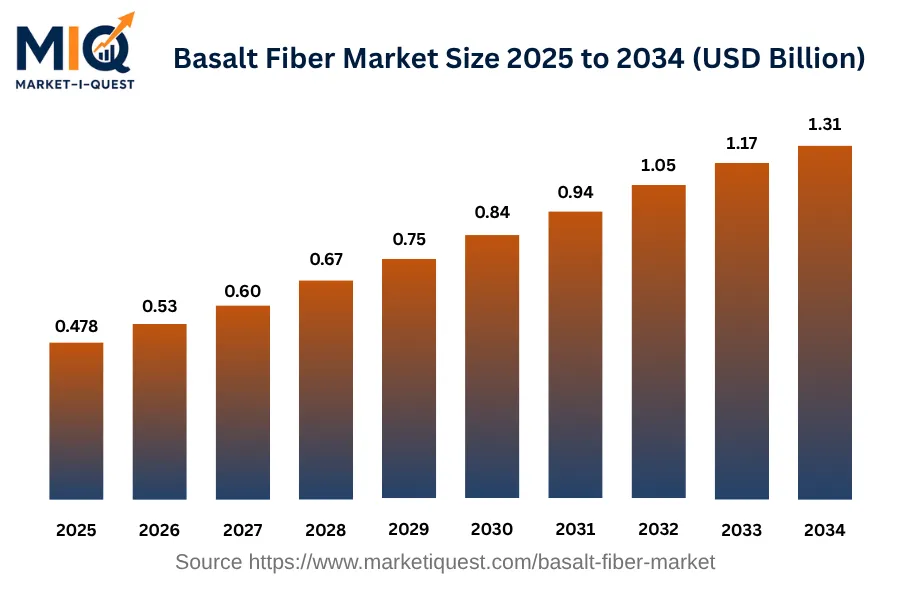
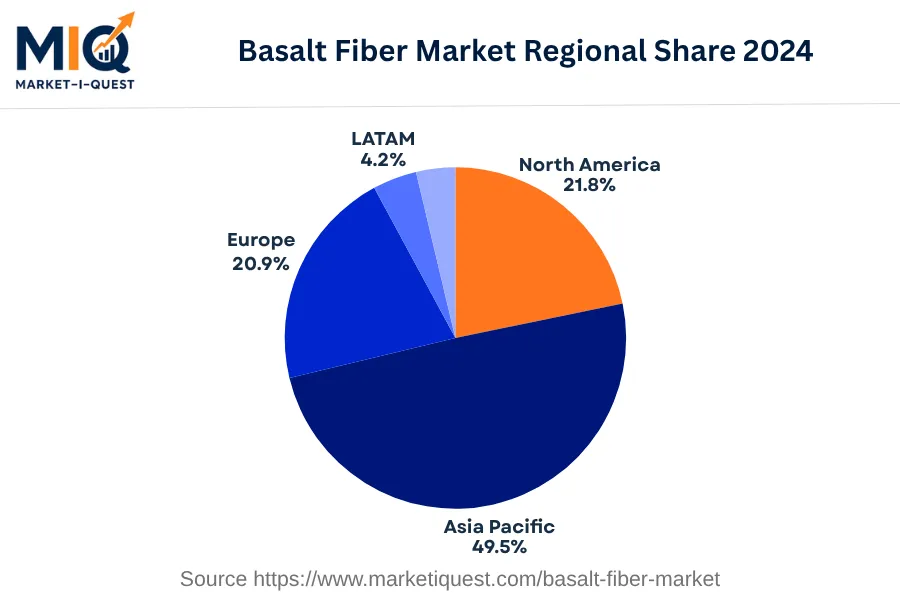
The Basalt Fiber Market was valued at $0.43 billion in 2024 and is expected to increase to $0.48 billion in 2025. By 2034, the market size is forecasted to reach $1.31 billion, achieving a compound annual growth rate (CAGR) of 11.9% over the course of nine years. This suggests that the market will nearly triple in size from 2025 to 2034. As for regional contributions to market value in 2024, the Asia Pacific leads the way with 49.5% of the market share, closely followed by North America at 21.8% and Europe at 20.9%. Latin America and the Middle East and Africa hold a smaller share, with 4.2% and 3.7% respectively. This displays the present regional distribution of the Basalt Fiber Market, favoring the Asia Pacific region but with significant contributions from North America and Europe. While the regions with the smallest shares of the market are Latin America and the Middle East and Africa.

Key Takeaways

  • By Form - Continuous Fiber held a dominant position in the Basalt Fiber Market.
  • By Product Type - Basalt Fiber Fabric was the leading segment.
  • By End-Use Industry - Construction was the most prominent subsegment.
basalt-fiber-market market size

Key Driving Factors

Environmental Regulations and Green Building Initiatives

The increasing global emphasis on implementing environmental regulations and sustainable practices plays a major role in driving the basalt fiber market. Governments and organizations worldwide are propagating the application of green materials that are eco-friendly and recyclable in the construction industry. Basalt fiber, being naturally resistant and non-hazardous, fits well within this framework. This material is increasingly becoming popular among builders and architects due to its high insulation properties and superior strength. Furthermore, basalt fiber can be reused and recycled, thereby reducing waste and helping in conserving the environment. The Paris Agreement on climate change and legislative shifts toward green building standards like LEED, are undergirding demand for this sustainable material and fueling the growth of the worldwide basalt fiber market.
Rapid Infrastructure Development in Developing Economies

The rapid pace of infrastructure development in emerging economies like China, India, and Brazil gives impetus to the basalt fiber market. Governments in these nations are investing heavily in public infrastructure projects including highways, bridges, and buildings. The goal is to deal with quick urbanization, developing population, and the subsequent demand for upgraded facilities. Basalt fiber, with its high durability, resistance to corrosive elements, and effective insulation, is an ideal material for such construction projects. For instance, the 'Belt and Road Initiative' by China and 'Smart City Project' by India, have paved the way for an increased demand for basalt fibers, significantly impacting the market dynamics.

Market Evolution by Timeline

2019-2023
During this period, automotive and construction sectors predominantly drove the demand for Basalt fibers, due to its superior mechanical and thermal properties. Regions like Europe and North America led consumption because of rigorous safety regulations. Manufacturers like Mafic moved from R&D phase to production, integrating basalt fibers into composite materials. The supply was constrained by infrastructure needed for high-quality basalt fiber production. Lack of recognized standards limited broader adoption. In terms of commercial model, pricing evolved to reflect cost-plus basis, due to increased production costs. Lock-in contracts between manufacturers and construction companies were common. Major risk was public scepticism fuelled by unfamiliarity with the material.
2024
In 2024, additional use cases were explored in electronic device shielding and acoustic insulation. Rising environmental awareness increased demand from eco-friendly building projects. Europe set a new production standard for the basalt fiber industry (EU Standard EN 13168). Despite expansion of production facilities, supply was still capped due to technical knowledge requirements. Introduction of standards allowed for more widespread adoption. Prices remained stable, despite renewed scrutiny of mining impacts. Renewable energy initiatives prompted partnerships with basalt fiber manufacturers. Dependency on basalt mining remained a significant risk.
2025-2029
The period saw diversification of basalt fiber applications, including protective clothing and ballistic protection, especially in the Asia-Pacific region. Innovative technologies allowing efficient extraction and processing of basalt fibers decreased manufacturing costs. Constraints remained related to availability of raw materials and energy costs. Changes to EU Standard EN 13168 drove technology advancements. Subscription-based contracts emerged between manufacturers and major industry clientele. Declining basalt reserves became a focus, though advancements in synthetic alternatives offered a probable solution.
2030-2034
The basalt fiber market matured, with demand getting stronger from Asian markets and usage in new sectors like aerospace and defense. Breakthroughs in basalt fiber synthesis technology altered the supply scenario, with countries like India and China playing a significant role. Maturity and standardization of the product led to a shift in the commercial model, favoring long-term contracts. Technology became the key price determinant. The scarcity of basalt, a major raw material, upended the market, leading to exploration of alternative raw materials.

Future Market Outlook

Future Opportunities

As the demand for sustainable construction materials rises, basalt fiber presents significant future opportunities, particularly in Europe and North America. The European Union's commitment to achieving net-zero carbon emissions by 2050 is driving sectors such as construction to adopt materials like basalt fiber, which offers advantages over traditional materials. Companies including JRLON in the USA have already started to explore innovative applications of basalt fibers in infrastructure projects under new sustainability guidelines. Moreover, the increased awareness of the longevity and resistance to corrosion of basalt fibers can attract sectors such as civil engineering and marine applications. In 2023, a consortium of how the U.S. Department of Transportation initiated pilot projects to incorporate basalt fiber-reinforced composites into bridge construction showcases government support for these materials. Likewise, research spearheaded by universities across Canada and the UK is focusing on enhancing the mechanical properties of basalt fibers for diverse applications. The rise of electric vehicles will likely necessitate continuous advancements in lightweight materials, making basalt fibers a prospective alternative. This shift aligns with ongoing projects initiated by major automotive firms, including Ford, aimed at integrating sustainable materials into their manufacturing processes, further highlighting the impending growth opportunities in the basalt fiber market.

Segmentation Analysis

By Form

The market is divided into subsegments including Continuous Fiber, Chopped Fiber, Woven Fabric, and Non-Woven Fabric. Continuous Fiber accounted for the largest revenue share while Non-Woven Fabric is expected to grow at the fastest CAGR during the forecast period.

Largest Revenue Share

Continuous Fiber

Market Share Leader

Continuous Fiber leads the market by revenue due to its extensive applications across various industries such as automotive, aerospace, and electronic goods manufacturing. The high structural strength of Continuous Fiber materials, coupled with their excellent thermal stability and low thermal expansion coefficient, makes them highly desirable for these industries. Certain regulatory mandates also favor the use of Continuous Fiber, driving its adoption in markets with stringent safety and performance standards. Its purchasing is often facilitated through direct supplier relationships or through specialized distributors, set up as a response to the specific product characteristics and purchasing requirements. Switching costs can be quite high as alterations to production processes and infrastructure may be required when changing the fiber type, providing a further barrier to shift away from Continuous Fiber. This sub-segment's dominance in high-value industries effectively translates to a larger revenue share.

Fastest CAGR

Non-Woven Fabric

Forecast Period Growth Leader

Non-Woven Fabric is expected to witness the fastest growth due to a variety of factors. Their potential applications are broadening due to technological advancements, enabling them to penetrate novel sectors such as medical textiles and geotextiles. Policy initiatives promoting sustainability and environmentally-friendly materials may facilitate more rapid adoption of Non-Woven Fabrics given their recyclability and reduced carbon footprint. Partnerships between manufacturers and companies in these new sectors could function as significant catalysts for growth. However, near-term risks include material cost fluctuations and potential supply chain disruptions. Despite these potential headwinds, this sub-segment's versatile properties and increasing uptake in new industries make it the fastest growing within this market segment.

By Product Type

The market is divided into subsegments such as Basalt Fiber Roving, Basalt Fiber Yarn, Basalt Fiber Fabric, Basalt Fiber Composite, and Basalt Fiber Reinforcement. Basalt Fiber Fabric accounted for the largest revenue share while Basalt Fiber Composite is expected to grow at the fastest CAGR during the forecast period.

Largest Revenue Share

Basalt Fiber Fabric

Market Share Leader

In 2024, Basalt Fiber Fabric emerged as the top revenue-generating subsegment in the Basalt Fiber market. Its dominance can be attributed to various factors. Firstly, it caters to a diverse set of industries including automobile, construction, and marine, where it's lauded for its advanced properties - high strength, resistance to heat, and durability. Its versatility allows it to be used in strengthening and insulating materials, significantly driving its demand. Additionally, an increase in urbanization leading to the growth in construction projects has fueled consumption of basalt fibers in the creation of high-quality fabric. Regulatory focus towards eco-friendly building materials incentivizes the use of basalt fibers, contributing to its growth. Lastly, its wider accessibility and mature supply chains across major geographical markets additionally bolster its leading position in terms of revenue.

Fastest CAGR

Basalt Fiber Composite

Forecast Period Growth Leader

While Basalt Fiber Composite may not lead in present-day revenue, it's projected to witness the fastest growth in the foreseeable future. This projection is rooted in the evolving demand dynamics in the basalt fiber market. Composite materials made from basalt fibers are increasingly relevant in industries such as aerospace, defense, and sporting goods where high puncture resistance, light-weight, and durability are key. Moreover, advancements in composite technology and wider recognition of the material's benefits are acting as catalysts for its adoption. Potential barriers could be the costs and technical integration, which are expected to be offset in the near term as market stabilization processes occur and production methods evolve. Partnership across supply chains, increasing Basalt Fiber Composite adoption in newer markets, and the capital investment in fiber-based composite manufacturing will be key to the quicker growth of this subsegment.

By End-Use Industry

The end-use industry market is divided into subsegments including Construction, Automotive, Energy, Defense, and Others. The Construction subsegment accounted for the largest revenue share, while the Energy subsegment is projected to grow at the fastest CAGR during the forecast period.

Largest Revenue Share

Construction

Market Share Leader

In the base year 2024, the Construction subsegment leads the industry in revenue share. This dominance can largely be attributed to the sustained growth of construction activities worldwide, particularly in emerging economies. There's a constant push for infrastructural developments and real estate projects which fuels consistent demand for products and services within this subsegment. Moreover, construction projects necessitate a wide range of products, leading to increased customer-base and diverse revenue streams. Evolving regulations towards eco-friendly construction materials and techniques also drive substantial replacement demand. Customer preference continues to lean towards companies that can offer high quality, affordable, and sustainable solutions. This relatively low purchasing and switching cost allows a much wider adoption across the customer spectrum in both developed and developing regions. Because of its direct relationship with human settlement and its subsequent growth, the construction industry typically encounters a steady and reliable distribution channel with a low risk of disturbance.

Fastest CAGR

Energy

Forecast Period Growth Leader

Whereas Construction may lead in terms of current revenue, the Energy subsegment is expected to experience the fastest growth in the coming years. Global concerns around climate change and the shifting paradigms around conventional energy systems have set the stage for this promising subsegment. Technological breakthroughs in renewable energy generation, storage and distribution are primary catalysts driving rapid growth. Government policies and initiatives that promote cleaner energy solutions play a significant role in adoption. There's observed increase in capital investments aiming to leverage this transition towards sustainable energy, indicating bright business prospects. However, it should be noted that regulatory barriers and high initial capital expenditure could potentially slow down the pace of adoption. Yet, the strategic partnerships between public and private entities are expected to address such barriers, smoothing the path for accelerated growth.

Competitive Analysis

Key Market Players

Manufacturers / OEMs

Kamenny Vek
Russia
Zhejiang GBF Basalt Fiber Co., Ltd
China
Mafic SA
Belgium

Key Suppliers & Raw Materials

Technobasalt-Invest LLC
Ukraine
Basaltex NV
Belgium
Isomatex SA
Belgium

Distributors, Integrators & Channel Partners

Incotelogy GmbH
Germany
Basalt.Fiber World
Netherlands
BASALT.PRO
Russia

Porter’s Five Forces Analysis

A study of the competitive forces and appeal in the Basalt Fiber Market.

Supplier Bargaining Power

Medium

Suppliers possess medium power due to diverse sources and limited raw material requirements.

Buyer Bargaining Power

High

Buyers exhibit high bargaining power owing to the availability of multiple suppliers and low switching costs.

Threat of Substitutes

Low

Threat of substitutes is low due to the unique properties and applications of basalt fibers.

Threat of New Entrants

Medium

Medium entry barriers exist due to the significant capital and technological requirements.

Competitive Rivalry

High

High competitive rivalry is observed due to the presence of many local and international companies.

Regional Analysis

Geographic market dynamics and growth opportunities across key regions

Global Market Outlook

basalt-fiber-market market regional share

North America

In 2024, the North American basalt fiber market showed a competitive upward curve, bolstered by a shift towards sustainable and resilient construction materials. This shift was largely driven by government regulations which endorsed the use of environment-friendly, high-strength materials in infrastructure projects across the United States, Canada, and Mexico. Significant investments in research and development to harness basalt fiber's heat resistance, tensile strength, and electrical insulative properties further amplified market dynamics. Additionally, the automotive sector's adoption of basalt fiber for weight-reduction and fuel-efficiency goals supported the market's growth.

Trends in the market illumined an increased buyer preference for basalt fiber in applications ranging from roadway overlays to wind energy systems. Partnerships—like that of the auto-giant Ford with basalt fiber manufacturer Mafic—exemplified strategic moves to leverage the lightweight, corrosion-resistant properties of these fibers. Particularly in the manufacturing sector, shifts towards basalt fiber were noticeable due to its sound insulation qualities. Enforced guidelines such as U.S. Federal Highway Administration's Buy America Act catalyzed local consumption of basalt fiber, impelling producers to balance supply and price in response to market demands. Thus, the North American basalt fiber market in 2024 was invigorated by driving forces and trends rooted in sustainable practices, technological innovation, and policy regulation.

Asia Pacific

In 2024, the Asia Pacific basalt fiber market experienced a significant uptick, influenced by demand factors, government regulations, and innovative technologies. Rapid urbanization in countries such as China, India, and ASEAN nations stimulated a surge in the demand for durable and lightweight construction materials, increasing the adoption of basalt fibers. In particular, China's 'New-Type Urbanization Plan' drove the construction sector, impacting basalt fiber utilization. Moreover, numerous governments' regulatory policies encouraged the use of eco-friendly materials, strengthening the market.

Key trends shaping the basalt fiber landscape included shifts in buyer behavior and advancements in technology. The increase in infrastructural projects and an uptick in the manufacturing sector, especially in Japan and South Korea, saw firms prioritizing basalt fiber for economic and resilience benefits. In technological aspects, India's automotive industry leaned significantly towards basalt fiber-reinforced polymer composites due to their superior mechanical properties. Furthermore, notable partnerships, such as those within the automotive industry in Australia, echoed the shift towards basalt fiber application.

The importance of basalt fiber was visibly felt across various sectors, including enterprises and manufacturing industries. Illustrating policy enforcement, governments across the region endorsed numerous environmental regulations that boosted basalt fiber utilization. Consequently, the basalt fiber market in the Asia Pacific showed remarkable adaptation in 2024.

Europe

In 2024, the European basalt fiber market exhibited dynamic growth due to several driving factors. Stimulated demand from the construction and automotive industries propelled the market, with notable spikes in Germany and Italy, resulting from legislative commitments to strengthen green building norms and sustainable auto-manufacturing. Changing regulations in the United Kingdom and France, promoting the use of non-hazardous, recyclable materials in manufacturing, have enlarged basalt fiber market share. Additionally, increased investment in infrastructure projects throughout the Nordics led to high regional adoption. Elevated global crude oil prices made basalt fibers a cost-effective alternative to traditional glass fibers, further bolstering its demand in Spain and the Benelux region.

Trends in 2024 evidenced a shift in consumer preferences toward environmentally friendly products, pushing manufactures to invest in basalt fiber production. Technological advancement in fiber production techniques gained momentum in Central & Eastern Europe, advancing product quality and manufacturing efficiency. New partnerships and mergers within the market, as seen in Germany and the United Kingdom, underscored strategic maneuvers aimed at market expansion and consolidation. Increasing policy enforcement for reduced carbon emission among the manufacturing sector, seen vividly in France, Italy and Spain, triggered a switch to basalt fibers from traditional materials. In sum, 2024 was a pivotal year for the European basalt fiber market, driven by various demand factors, regulatory changes, and market trends.

Latin America

In 2024, the basalt fiber market in Latin America was characterized by increasing demand and technological advancements.
Driving factors included the growing construction and automotive industries, particularly in Brazil and Mexico. Regulations favoring environment-friendly and energy-efficient materials significantly boosted the demand for basalt fibers, and increased investment in infrastructure development in Argentina, Colombia, Chile, and Peru also fueled market growth. Additionally, the adoption of modern technologies in fiber production improved supply dynamics, contributing to lower prices.

Major trends in the basalt fiber market included a shift towards sustainable and durable materials, along with an emphasis on cost efficiency. Consumers increasingly favored basalt fibers over traditional materials such as glass or carbon fiber, inspired by their superior durability and environmental benefits. The expansion of e-commerce platforms presented new distribution channels, and partnerships between local producers and international companies reinforced the market strength. Strict enforcement of building codes and automobile manufacturing regulations stimulated further growth in the use of basalt fibers. Key sectors driving consumption included the construction industry, automotive manufacturing, and utility sector, due to the material's heat and sound insulation capabilities. All in all, the basalt fiber market in Latin America in 2024 was defined by robust growth and evolving consumer preferences.

Middle East & Africa

In 2024, the Basalt Fiber Market in the Middle East and Africa witnessed substantial activities. Market drivers included robust demand from the construction sector in countries like Saudi Arabia and UAE, where infrastructure projects were predominant. Additionally, favorable government regulations in Qatar and Israel stimulated market development, while private sector investment in Egypt and Nigeria enhanced market penetration. Technological adoption was evident in South Africa's manufacturing industry, utilizing Basalt Fiber's unique thermal resistance properties.

Key market trends in the base year highlighted a shift in buyer behavior, with increased preference for eco-friendly products boosting Basalt Fiber's significance given its renewable nature. Technology advancements in Kenya's utilities sector marked a vital trend, with the use of Basalt Fiber in reinforcing power transmission lines. A notable trend was the prevalence of partnerships in Israel between government bodies and manufacturers to explore innovative basalt fiber applications. Egypt's automotive industry enforced stringent fiber standards, driving a preference shift towards high-quality basalt fibers.

Basalt Fiber was widely utilized across several sectors, particularly construction and manufacturing in Saudi Arabia and UAE. Kenya's utilities sector adopted the product for its superior strength, while Israel's government projects incorporated it amid collaborations with manufacturers. Nigeria's booming oil and gas sector saw basalt fiber's role in pipeline reinforcement, bridging a critical supply need in the nation.

Recent Industry Developments

Latest market innovations, product launches, and strategic initiatives

April 2026

Materials research published by the American Chemical Society and international research teams confirmed the practical deployment of next-generation, self-healing basalt fiber-reinforced composites. The structural technology embeds micro-capsules within the epoxy matrix to autonomously seal structural micro-cracks in heavy infrastructure materials.

May 2025

Academic and industrial material researchers successfully developed an advanced, copper-deposited continuous basalt fiber fabric. The technical modification yields a conductive material targeted for high-efficiency electrochemical carbon dioxide reduction systems.

Frequently Asked Questions