Glass Fiber Market Snapshot

Key Players

  • Owens Corning (US)
  • PPG Industries Inc (US)
  • Nippon Electric Glass Co. Ltd. (Japan)
  • 3B-The Fibreglass Company (Belgium)
  • Compagnie De Saint-Gobain (France)
  • China Jushi Co. Ltd. (China)
  • Taiwan Glass Industry Corp. (Taiwan)
  • Korea Glass Fiber Co. Ltd. (South Korea)

Market Size

Base Year 2024
$15.62 Bn
CAGR
6.75%
Forecast 2034
$30.02 Bn

Market Segments

By Type
  • E-Glass
  • A-Glass
  • C-Glass
  • S-Glass
  • T-Glass
  • AR-Glass
  • D-Glass
By Printing Process
  • Tape
  • Cloth
  • Rope
By Application
  • Composites
  • Insulation

Market Dynamics

Drivers
  • Increasing construction activities
  • Advancements in technology
Restraints
  • High production costs
  • Environmental concerns
Opportunities
  • Increasing construction activities
  • Advancements in technology

Market Size

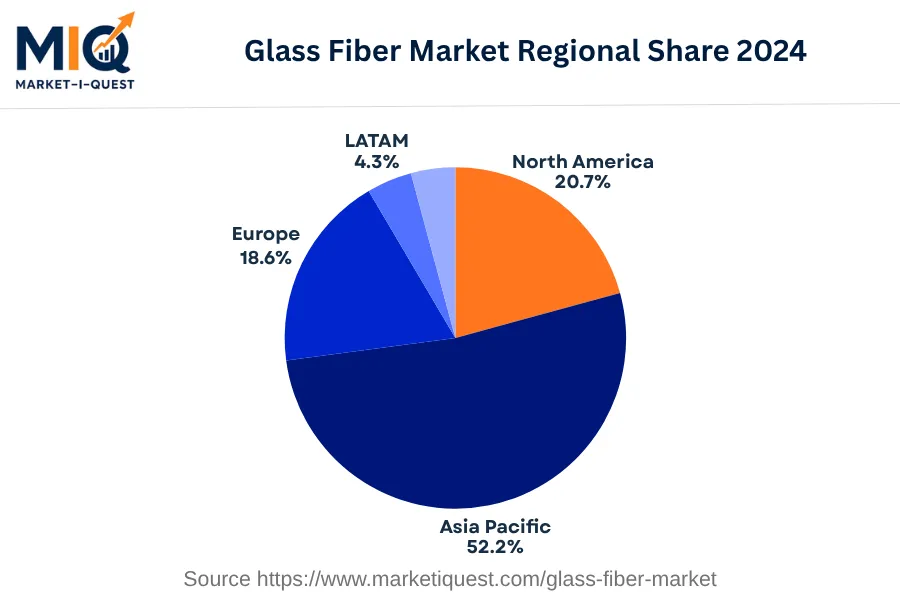
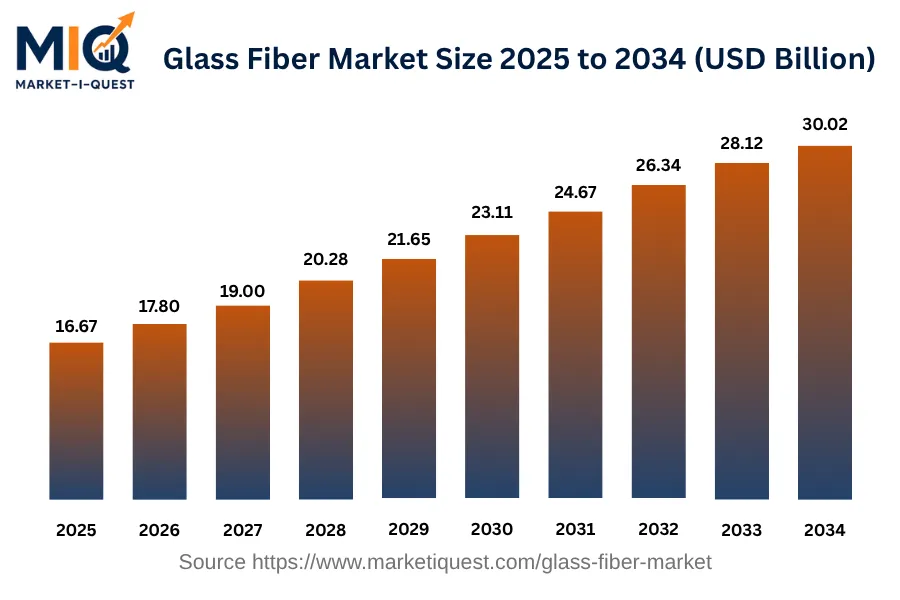
The Glass Fiber Market, initially worth 16.67 billion USD in 2025, is forecast to expand to 30.02 billion USD by 2034, experiencing a CAGR of 6.75%. This growth path indicates that the Glass Fiber Market is projected to almost double in size over approximately a decade. Favorable conditions such as technological advancements, rising consumption, and rigorous demand are the primary reasons contributing to this growth. Exploring the market share regionally in 2024 provides insights into the distribution of the expansion. Asia Pacific accounted for the most significant portion, almost 52.2% of the total share, followed by North America and Europe, with 20.7% and 18.6% respectively. Meanwhile, LATAM and MEA held the smallest shares, each comprising around 4.2% of the market.

Key Takeaways

  • By Type - E-Glass led the market translating to the highest share in 2024.
  • By Printing Process - Cloth held the top spot accounting for the majority share in 2024.
  • By Application - Composites emerged as the leading segment in 2024.
glass-fiber-market market size

Key Driving Factors

Strict Enforcement of Environmental Regulations

Stringent environmental rules are playing a vital role in shaping the glass fiber market. Manufacturers are compelled to comply with regulations such as those enforced by the Environmental Protection Agency (EPA) and similar international bodies. These regulations demand reduction in greenhouse gas emissions and greater responsibility towards waste management. Glass fiber, known for its recyclable nature and lower carbon footprint compared to traditional materials, is hence emerging as a preferred choice for manufacturers across sectors, adding to the momentum in the glass fiber market. This trend is more prevalent in developed nations owing to their strict regulatory environment, directly translating into an increase in usage and production of glass fiber.

Surge in Construction and Infrastructure Projects

The surge in global infrastructure and construction activities is another major driver fueling the glass fiber market. As urbanization progresses, especially in emerging economies, the demand for durable and cost-effective materials increases. Glass fiber emerged as a choice since it offers superior strength, insulation properties and resistance to corrosion. It's widely utilized in construction for reinforcing concrete, insulation, and cladding for its longevity and resistance against extreme weather conditions. Further, glass fibers are being increasingly incorporated in road construction as a reinforcement material, adding longevity to the road structure and bringing down maintenance costs. These practical implementations in different construction activities are boosting the market prospects for glass fiber.

Market Evolution by Timeline

2019-2023
During 2019-2023, the most prominent buyers of glass fiber were automotive and construction industries predominantly in North America and Asia-Pacific regions due to the materials' high strength and light-weight characteristics. The main supply was from China, contributing approximately one-third of the global total. The technology was mature with a relatively stable integration process throughout these years. The ISO 2078 standard highly regulated the dimension of the glass fiber which influenced the production and market. The commercial model was mainly long-term supply contracts with fixed price agreements due to the stable demand. The major risk in this period was trade tensions between the US and China which led to higher tariffs, affecting both import and export price in the global glass fiber market.
2024
In 2024, the automotive sector continued to be a powerful user of glass fibers, particularly in Europe where pursuit for eco-friendly alternative materials surged. The primary supply of glass fiber still rested in China, although they began to face competition from European producers. In terms of regulations, European Union's stringent recycling and environmental standards became more influential. Commercially, flexible pricing models were becoming norm as suppliers diversified production. Risks associated with this period were emerging competitors from Europe and the uncertainty of trade agreements which impacted the global supply chain.
2025-2029
Between 2025 and 2029, the demand for glass fiber expanded to electronics and renewable energy sectors due to its versatility and durability, notably in the US and Europe. Advances in production technology put the US and European producers on par with Chinese suppliers. Regulations sustained focus on environmental standards, prompting cleaner production methods. Commercially, the trend was towards bundled procurement with supply-chain services, enabling greater economies of scale. Risks during this period included supply chain disruptions caused by raw material price volatility and strict regulatory compliances.
2030-2034
In 2030-2034, the demand for glass fiber extended towards the aerospace industry, specifically in countries with a strong presence in the sector like the US and France. Technological integration matured so 3D printing started to take off in producing these materials. Mandatory ISO 2078 and EN 14014:2018 standards prompted manufacturers to improve production methods. Commercial model saw more strategic partnerships between suppliers and their customer businesses to secure steady demand. Key risks included potential overcapacity and anticipating sudden shifts in technology due to rapid development of 3D printing techniques.

Future Market Outlook

Future Opportunities

The glass fiber market is poised for expansion due to evolving consumer expectations and advancements in production capabilities. The demand for strong yet lightweight materials is evident in the aerospace and renewable energy sectors, as seen in Boeing's use of glass fiber composites in the 787 Dreamliner, which has been operational since 2011. Countries like Germany are also prioritizing the integration of glass fiber in wind turbine installations to enhance performance and durability, in line with the EU’s 2023 Green Deal. Additionally, emerging markets in Asia, particularly in India, are witnessing increased infrastructure investments, leading to a rising demand for glass fiber products in construction applications. Companies such as Jushi Group have already made strides in expanding their operations in these markets to capture this growth. Furthermore, the recent push towards zero-waste manufacturing processes by environmental agencies opens opportunities for glass fiber recycling initiatives, which are gaining traction globally. Initiatives to address waste in the United States, such as the National Recycling Strategy introduced by the EPA in early 2022, signal a shift towards a circular economy. As a response, manufacturers are beginning to explore and invest in closed-loop systems to utilize production waste creatively. These factors suggest that the future landscape of the glass fiber market will be shaped increasingly by sustainability and innovation in production methods.

Segmentation Analysis

By Type

The market is divided into subsegments including E-Glass, A-Glass, C-Glass, S-Glass, T-Glass, AR-Glass, and D-Glass. E-Glass accounted for the largest revenue share while AR-Glass is expected to grow rapidly during the forecast period.

Largest Revenue Share

E-Glass

Market Share Leader

The E-Glass subsegment leads the market in terms of revenue generation based on a combination of resiliency, higher performance, and widespread applicability. E-Glass is preferred due to its excellent mechanical properties, unique electrical insulation, and cost-effective nature. It's commonly utilized in various industries, including automotive, aerospace, and electrical, due to its superior strength and ability to resist heat, good insulating properties, and light weight. Moreover, the rise in consumer electronics demand across different geographic regions enhances its market footprint. Its cost-effectiveness compared to its peers makes it the preferred choice among the customer segment primarily focused on budget constraints. Furthermore, an established supply chain facilitates and fosters its wider distribution and adoption. This inference assumes that the E-Glass continues to be the most sought-after type based on its intrinsic properties and cost-effectiveness, leading to higher revenue generation.

Fastest CAGR

AR-Glass

Forecast Period Growth Leader

AR-Glass stands out as the subsegment with the fastest CAGR outlook. Despite it not taking the lead in terms of revenue, the growth of AR-Glass is driven by its unique features, such as increased durability and resistant properties. The high alkali resistance offered by AR-Glass is a catalyst for its increasing demand in the construction industry, where it plays a crucial role in reinforcing cement. Moreover, the shift towards sustainability and green building materials has significantly increased the adoption rate of AR-Glass. Despite these growth drivers, challenges like higher switching costs and lack of awareness about the benefits of AR-Glass can act as barriers to its adoption. However, strategic partnerships and awareness campaigns focusing on the benefits of AR-Glass can serve to mitigate this risk. This growth forecast assumes that the upward trajectory of the construction industry continues, and the awareness about AR-Glass benefits spreads further.

By Printing Process

Divided into subsegments including Tape, Cloth, and Rope, the Printing Process market had Cloth-based products accounting for the largest revenue share, while Rope is expected to grow at the fastest CAGR during the forecast period.

Largest Revenue Share

Cloth

Market Share Leader

Cloth-based products hold the majority of the revenue in the printing process market due to their immense versatility and broad application scope. They are fundamental elements in industries such as apparels, home decor, and commercial spaces - areas where high quality prints on fabrics are in constant demand. The rise of e-commerce platforms and online shopping trends has facilitated easy availability of cloth-based printed products, thus driving sales and revenue. From a geographic perspective, emerging economies are showing a higher inclination towards locally crafted and printed textiles, stimulating demand in the cloth segment. Moreover, advancements in technologies are facilitating easier, faster, and more efficient cloth printing processes, further driving the market. The combination of innovation in printing techniques and steady consumer demand makes Cloth the most revenue-generating subsegment in the printing process market.

Fastest CAGR

Rope

Forecast Period Growth Leader

Although starting from a smaller base, the Rope subsegment is predicted to exhibit the fastest growth compared to the other subsegments in the printing process market. The reason lies in the rapidly growing applications of rope in a variety of industries such as construction, shipping, sports, and fashion accessories. Rope printing, while niche, has become essential in these industries for reasons spanning from branding to function identification. Adopting digitized rope printing techniques has vast potential for offering personalization and customization, contributing to the expected high growth. However, market adoption could be held back by initial high capital investment and the need for specialized equipment. To overcome these challenges, collaboration among manufacturers, suppliers and end users could prove crucial. In light of these circumstances, the conduct of business partnerships and the commitment of capital expenditure to boost production scalability will be determinant for the subsegment's outlook.

By Application

The market by application is segmented into Composites and Insulation. In 2024, Composites commanded the largest revenue share while Insulation is expected to exhibit the fastest growth.

Largest Revenue Share

Composites

Market Share Leader

Composites has led the market in terms of revenue in 2024. This occurrence can be attributed to the heightened demand from end-use industries such as automotive, aerospace & defense along with wind energy. These sectors have increasingly harnessed composite materials due to its superior properties like high strength-to-weight ratio, corrosion resistance, durability, and high-temperature resistance. Further, advances in manufacturing technologies have reduced the cost of composites, contributing to their dominance. Geographically, regions such as North America and Europe have seen a robust usage of composites in their various industries, contributing to the revenue share. Add to that regulatory policies supporting the use of composite materials for environmental sustainability have catalyzed its market dominance. It's also worth noting that end-users have exhibited a low switching tendency due to the high relation between composites and product quality.

Fastest CAGR

Insulation

Forecast Period Growth Leader

The Insulation segment is projected to grow at a swift rate. The growth of this segment can be traced back to an increase in construction and infrastructural activities across developing nations. Insulation materials, being critical in energy conservation in buildings, are being heavily adopted. Additionally, strict regulatory frameworks and policies encouraging energy-efficient structures are also serving as major catalysts for increased market penetration of insulation products. Furthermore, technological advancements in insulation material, which have improved performance and cost-effectiveness, are further stimulating adoption. However, market growth may be curtailed by factors such as high initial capital investment and challenges related to recyclability and waste management of insulation materials.

Competitive Analysis

Key Market Players

Manufacturers / OEMs

Owens Corning
US
Jushi Group Co., Ltd
China
Saint-Gobain Vetrotex
France

Key Suppliers & Raw Materials

PPG Industries, Inc.
US
Nippon Sheet Glass Co., Ltd
Japan
Momentive Performance Materials Inc.
US

Distributors, Integrators & Channel Partners

Mulford Plastics
Australia
Technical Fibre Products Limited
UK
Loxim Industries Ltd
India

Porter’s Five Forces Analysis

A comprehensive review of the competitive dynamics within the Glass Fiber Market.

Supplier Bargaining Power

Medium

Suppliers gain power from unique production processes and specialized material needs.

Buyer Bargaining Power

High

Glass fiber users have multiple suppliers to choose from, enhancing their bargaining power.

Threat of Substitutes

Low

Few materials match glass fiber's performance and affordability, making substitutes less threatening.

Threat of New Entrants

Medium

Established brands and high capital requirements pose hurdles to new entrants.

Competitive Rivalry

High

Intense competition exists among several entrenched manufacturers of glass fiber.

Regional Analysis

Geographic market dynamics and growth opportunities across key regions

Global Market Outlook

glass-fiber-market market regional share

North America

In 2024, the North American glass fiber market exhibited active growth driven by diverse factors. Increased demand in the construction and automotive sectors was pivotal, as rising urbanization in the United States, Mexico, and Canada spurred rapid infrastructure development and heightened vehicle production. Changes in regulatory measures on environmental safety also prompted manufacturers to use lightweight, energy-efficient materials like glass fiber in their products. Technological advancements such as the adoption of E-glass and S-glass types invigorated the market, with private investments stimulating further innovation. Nevertheless, supply dynamics were influenced by material scarcity and volatile pricing, necessitating strategic resource management.

Simultaneously, noticeable trends shaped the market landscape in 2024. Purchasing behaviors evolved as buyers sought high-strength, corrosion-resistant products, prompting shifts towards specialized glass fibers in manufacturing and retail. Industry players leveraged e-commerce platforms for wider reach and customer engagement against traditional channels. Notable partnerships and mergers occurred, fueling competitive rivalry and innovation. Improvements in production standards and stricter policy enforcement underscored quality and environmental responsibility. In the defense sector particularly, an uptick in glass fiber usage was noted – driven by its high strength-to-weight ratio. Thus, in 2024, the intertwined dynamics of demand, regulation, innovation, and competition stimulated significant evolution in the North American glass fiber market.

Asia Pacific

In 2024, the Asia Pacific Glass Fiber Market revealed a strong tenure of growth, stimulated primarily by escalating demand in industries such as automotive, construction, and wind energy. Curtailed environmental regulations coupled with the shifting focus towards lightweight, robust, and eco-friendly materials intensified its growth throughout the principal markets of China, India, Japan, South Korea, Australia, and key ASEAN countries. Enhanced investments in infrastructure development, notably in India and China, stirred demand. Concurrently, advances in technology and the adoption of automated systems and robotics in manufacturing has expedited production and enhanced supply dynamics.

Market trends chiefly centered on buyer preference for sustainable products, leading to a shift towards bio-based glass fibers. In China and Japan, integrated production facilities emerged as a dominant trend to offer cost-effective solutions. A surge in partnerships and mergers & acquisitions was also evident, with companies aiming to expand their footprint, mostly in India and Australia. The statutory enforcement of safety standards across sectors drove the demand for fire-resistant glass fibers in industries such as construction and electrical & electronics. Moreover, the Asia Pacific region displayed a tendency towards advanced glass fiber products, exemplified by China's implementation of a policy mandating the use of thermoplastic composites in automotive and aerospace industries.

Europe

In 2024, the European glass fiber market experienced a period of remarkable dynamism, shaped by multiple demand and supply-side factors. Increased investment in infrastructure and renewable energy projects, particularly wind energy, spurred demand for glass fiber composites. Rigorous enforcement of environmental regulations, such as the EU’s circular economy action plan, intensified the shift towards the use of sustainable materials like glass fiber in construction and automotive sectors. Technological innovation, specifically high-speed fiberglass production processes, further aided the market expansion.

Buyer behavior demonstrated a strong preference for lightweight, durable materials in Germany and Benelux nations, driving manufacturers to incorporate more glass fiber in their products. Shifting channel dynamics saw traditional physical distributors losing ground to digital platforms, particularly in the United Kingdom and Nordics, expediting glass fiber sales across borders. There were numerous partnerships among glass fiber producers and research institutions in France and Italy, underpinning the growth of advanced glass fiber variants aligned with stringent industrial standards. Moreover, clear policy enforcement by authorities in Central & Eastern Europe mandated the use of energy-efficient materials, such as glass fiber in utilities and manufacturing sectors. As a result, the market in 2024 demonstrated robust growth opportunities and innovation across all sectors.

Latin America

In 2024, the Latin American Glass Fiber Market witnessed substantial shifts influenced by various drivers and trends. Key drivers included increasing demand in the automotive sector, especially in Mexico and Brazil, where glass fibers are extensively used due to their high strength and lightweight nature. Enhanced public infrastructure investments in Argentina, Chile, and Colombia triggered demand for glass fibers in the construction sector. Advances in technology opened new applications for glass fiber in renewable energy, particularly wind turbines in regions like Peru that prioritize green energy.

Emerging trends affecting the market landscape involved changing buyer behaviors, with companies emphasizing cost-efficiency and quality, leading to increased demand for high-performance glass fibers. In technology, significant developments took place in the manufacturing of bio-based glass fibers, reducing ecological impacts and aligning with the region's sustainability policies. A shift in channel dynamics occurred as digital platforms became popular purchasing venues, supported by increasing internet penetration in LATAM. Partnership and M&A activity were prominent, with companies strategically aligning to expand production capacities and broaden reach. Lastly, enforcement of stringent environmental regulations saw a surge, particularly in Brazil and Mexico, influencing manufacturers to adhere strictly to eco-friendly practices.

Middle East & Africa

In 2024, the Glass Fiber Market in the Middle East and Africa depicted significant growth, primarily driven by demand from the construction and automotive sectors. Key market drivers included rapid urbanization in countries like Saudi Arabia, Kenya, and Nigeria, propelling construction sector activities and boosting the demand for glass fiber reinforcements. The shift towards lightweight vehicles in UAE and South Africa created a higher demand for glass fiber in the automotive industry. Additionally, favorable government policies in Egypt and Israel encouraged the domestic manufacturing of glass fibers, further fueling the market's expansion.

Key trends shaping the market included sustainability, with customers increasingly preferring eco-friendly glass fibers. Many producers, particularly in Saudi Arabia and Qatar, adopted environment-friendly production processes. Technological advancements were witnessed, with countries like Israel and UAE incorporating robotics and AI in glass fiber production. Companies responded to these shifts by forming strategic partnerships to enhance technological capacities. For instance, several manufacturers collaborated with tech firms to facilitate production automation. Additionally, standard-enforcement became prevalent, with nations like South Africa and Egypt imposing stricter quality and safety standards on glass fiber products to protect end consumers. Overall, 2024 saw a robust Glass Fiber Market due to increased demand and technological innovations.

Recent Industry Developments

Latest market innovations, product launches, and strategic initiatives

April 2026

China's State Council Gazette published Decree No. 119 of the State Administration for Market Regulation, finalizing the revised "Measures for Quality Supervision and Management of Fiber Products".

December 2025

China's State Administration for Market Regulation issued Decree No. 119, revising the "Measures for Quality Supervision and Management of Fiber Products," effective July 1, 2026. The revised measures implement key supervision for infant fiber products, student uniforms, underwear, and wadding fiber products.

Frequently Asked Questions