Ballistic Protection Market Snapshot

Key Players

  • BAE Systems (United Kingdom)
  • DuPont (United States)
  • Honeywell International Inc. (United States)
  • Teijin Aramid BV (Netherlands)
  • Dynema BV (Netherlands)
  • 3M Company (United States)
  • Survitec Group Ltd (United Kingdom)
  • MSA Safety Inc. (United States)
  • Protech Armor Systems (United States)
  • ArmorSource LLC (United States)

Market Size

Base Year 2024
$14.97 Bn
CAGR
6.38%
Forecast 2034
$27.79 Bn

Market Segments

By Product
Personal Protective Equipment, Ballistic Blocks, Ballistic Containers and Portable Shelters, Hull & Body, Ballistic Barrier Systems, Weapon Stations & Optronics, Cockpit Ballistic Protection, Fuel Drop Tanks & Ammunition Storage, Ballistic Floors, Pilot S
By Platform
Land, Airborne, Marine
By Technology
Hard Armor, Soft Armor
By Threat Level
Level II & Level IIA, Level III & Level IIIA, Level IV & Above
By Application
Military, Homeland Security, Private and Commercial

Market Dynamics

Drivers
  • Rising global security threats
  • Advancements in protective materials
Restraints
  • Stringent regulatory norms
  • High production costs
Opportunities
  • Rising security concerns globally
  • Advanced material development

Market Size

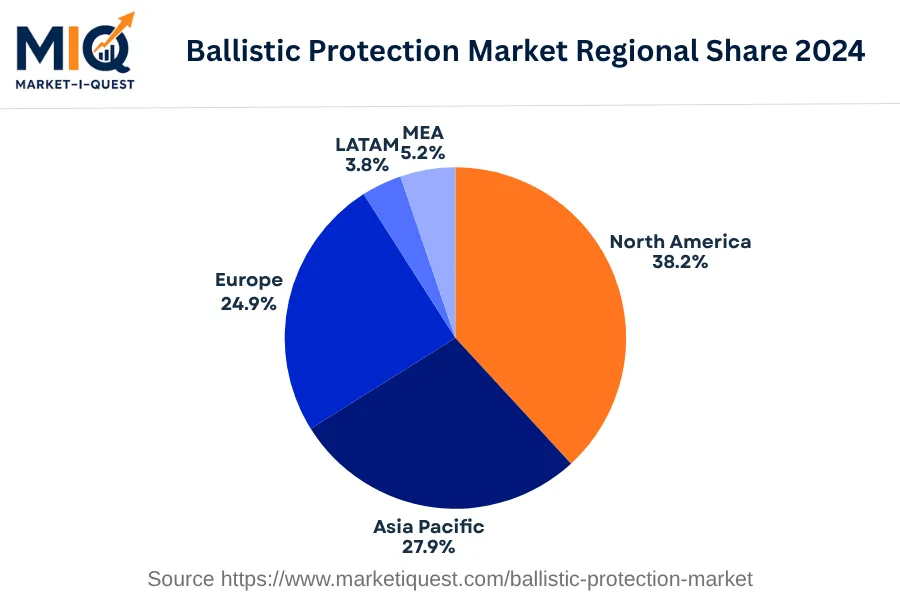
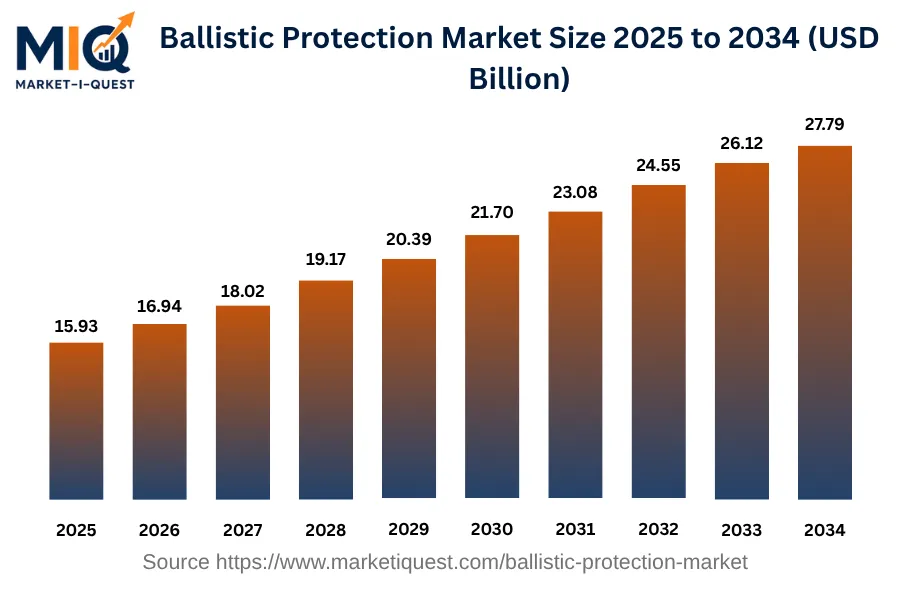
The Ballistic Protection Market size was $15.93 billion in 2025, and it is projected to reach $27.79 billion in 2034, yielding a compound annual growth rate (CAGR) of 6.38%. This substantial increase nearly doubles the market size within a decade. The growth over the period can be attributed to an upward trajectory from a value of $14.97 billion in 2024 to $27.79 billion in 2034. On a regional basis in 2024, North America held the largest share of the market at 38.16%, followed by Asia Pacific at 27.94%. Europe held 24.86% of the market share, while the remaining regions, Latin America and Middle East and Africa, held 3.82% and 5.22% respectively.

Key Takeaways

  • By Product - Hull & Body held a leading position in terms of demand and utility.
  • By Platform - Land-based ballistic protection systems had the predominant stake considering the wide range applications.
  • By Technology - Soft Armor units accounted for substantial interests because of their superior protection levels.
  • By Threat Level - Level III & Level IIIA was the most sought after due to their capability to withstand high-velocity threats.
  • By Application - Military applications dominated given the consistently high demand for advanced ballistic protection.
ballistic-protection-market market size

Key Driving Factors

Enforcement of Military Modernization Programs

Multiple nations, notably the United States, Russia, and prominent countries in the Middle East, have been vigorously working on their military modernization programs. These programs aim for a significant upgrade in their military capability, which involves replacing old armor systems with sophisticated ballistic protection. The upgraded armor provides stronger protection, aiding soldiers in hostile twin threats of warfare and domestic security operations. As more nations follow suit to match the increasing global threat levels, the demand for high-performance ballistic protection gears in the military sector amplifies, driving growth in the ballistic protection market.

Heightened Security Concerns In Private Sector

In recent years, the landscape of threats to corporate and private entities has been shifting and intensifying. The rising threat of terrorism and the increased focus on personnel security have contributed to the increased procurement of ballistic protection solutions by private security agencies and corporate organizations. Ballistic protection gear is increasingly seen as essential for safeguarding important personnel, including VIPs and top executives who are under a higher risk of attack. The necessity to ensure the safety and security of such individuals has been driving significant spend and adoption of sophisticated ballistic protection in the private sector.

Market Evolution by Timeline

2019-2023
During this period, buyers from the defense sector, particularly in countries like the USA and UK, are seen purchasing ballistic protection equipment due to growing security concerns. The main supplies, like bulletproof vests, helmets, and shields came primarily from manufacturers like BAE Systems and DuPont. Technologically, the ability to integrate these products into existing military gear was at a moderate level of maturity. Within this term, NATO standards continued to influence product adoption among NATO members. Pricing leaned towards a per-unit cost basis with long term supply contracts being dominant. On the downside, a key risk involved supply chain disruptions due to international conflicts greatly affecting its operations.
2024
The ballistic protection market experienced an increase in purchasers, especially from law enforcement agencies across the globe and private security firms in conflict-prone regions. Meanwhile, technological innovations from suppliers like 3M and Armorsource commenced pilot run for lightweight, yet strong, ballistic body armor. Also, the adoption of Mil-Spec standards influenced the industry practices in the US. The commercial model leaned more towards multi-year contracts due to predictable demand. Key risk involved regulations around the export of military technology, causing hindrance to market expansion.
2025-2029
In this timeframe, there were rising purchases in the Asian market, particularly India and China, for military and law enforcement use. On the supply side, innovations in nanotechnology and smart fabrics from companies like Honeywell and Teijin offered an improved level of ballistic protection. The ISO standards became more influential in the European market during this period. Incremental pricing, based on features and adaptations, was more common in contracts. At this stage, the risk came from fluctuating global policies concerning peacekeeping missions that directly impacted the demand.
2030-2034
Through these years, demand from private consumers for personal protection became apparent, particularly in areas with high crime rates. Suppliers like Rheinmetall and Heracles Research Corporation piloted self-healing and adaptive protection gear. Technological integration with Internet of Things (IoT) showcased notable advancements. The implementation of the EN 1063 standard highly influenced product qualities and the Ballistic Protection Act governed market practices in the US. Lower costs driven by technology advancements characterized this period's commercial model. The major risk encountered was the uncertainty over the misuse of personal protection equipment.

Future Market Outlook

Future Opportunities

There are several avenues for growth in the ballistic protection market, particularly stemming from ongoing geopolitical tensions and the evolving landscape of warfare. For instance, in 2022, NATO renewed its focus on enhancing troop armor in response to increased threats along Eastern European borders, which is expected to boost demand for advanced protective gear. Additionally, the ongoing counter-terrorism initiatives in regions like the Middle East create a sustained need for upgraded ballistic protection for personnel deployed in conflict zones. The rising use of drones and unmanned aerial vehicles has prompted interest in protective solutions that can defend against aerial threats; companies like Bell Helicopter announced in 2023 partnerships with armor manufacturers to develop drone-based protection systems. On the civilian side, law enforcement agencies are increasingly adopting body armor, spurred by legislative actions aimed at improving officer safety in countries such as Canada, which implemented new guidelines in 2022 for mandatory body armor for police officers. Moreover, the integration of artificial intelligence into ballistic systems could enhance threat detection capabilities, as seen in research conducted by various tech startups in the United States in 2023. This convergence of security needs across military, law enforcement, and civilian sectors positions the ballistic protection market for significant evolution in the coming years.

Segmentation Analysis

By Product

The market is divided into subsegments such as Personal Protective Equipment, Ballistic Blocks, Ballistic Containers and Portable Shelters, Hull & Body, Ballistic Barrier Systems, Weapon Stations & Optronics, Cockpit Ballistic Protection, Fuel Drop Tanks & Ammunition Storage, Ballistic Floors, Pilot Seat Protection, Ballistic Doors, Engine Protection, Ballistic Windows, and others. Among these, Hull & Body holds the largest revenue share while the Personal Protective Equipment sector is anticipated to grow at the fastest CAGR during the forecast period.

Largest Revenue Share

Hull & Body

Market Share Leader

The Hull & Body subsegment represents the largest share of revenue in the market, and this could be ascribed to several factors. Foremost among them is the escalating demand for advanced hull & body protective gear for military purposes, primarily serviced by countries with significant defense budgets such as the United States, Russia, and China. Hull & Body products are indispensable to providing optimum security for various armored vehicles, warships, and aircraft. The evolving nature of warfare has also necessitated the improvement in the quality of hull & body protection, spurring increased investments in R&D and technological advancements. Furthermore, the strict regulations worldwide from defense organizations to ensure the utmost safety of personnel have driven demand even higher. Nonetheless, it's the elevated switching costs that have cemented Hull & Body as the market leader in terms of revenue.

Fastest CAGR

Personal Protective Equipment

Forecast Period Growth Leader

The Personal Protective Equipment subsegment is projected to grow at the quickest pace for a myriad of reasons. Firstly, there's an expanding consciousness and concern for individual safety globally, noted particularly in conflict-prone regions. This awareness skyrockets the demand for personal protective equipment prompting the industry's growth. Secondly, advancements in technology have played a significant part, with insulated clothing, protective foot and headgear, shields, and even bulletproof vests now superior to previous models, increasing consumer appeal. Furthermore, decreasing costs due to mass production and economies of scale have made Personal Protective Equipment more accessible. Government regulations mandating the use of personal safety equipment in multiple sectors, including construction and law enforcement, also stimulate its demand. However, potential pitfalls to growth might include the high initial capital expenditure required by manufacturers to maintain quality standards and the potential health risks associated with prolonged usage of some Personal Protective Equipment products.

By Platform

The market is segmented into various platforms including Land, Airborne, and Marine. While the Land segment accounted for the largest revenue share in the base year 2024, the Airborne platform is projected to grow at the fastest CAGR during the forecast period.

Largest Revenue Share

Land

Market Share Leader

The Land platform garnered the highest revenue in 2024 owing to variety of factors. Firstly, the proliferation of land-based solutions is driven by a need for better connectivity and data management in various sectors including defense, transportation, agriculture, etc. Furthermore, land-based platforms often attract large-scale investments given their broad applicability and high return potential. Geographically, regions with vast land areas and strong technological infrastructure like North America and parts of Asia, contribute significantly to this segment. Additionally, regulatory conditions facilitating the adoption of advanced technological solutions, coupled with the presence of key market players developing innovative solutions, have contributed to the dominance of this segment. Purchasing criteria usually include durability, versatility and cost-effectiveness of the technology, which make land-based platforms attractive. Despite the relatively high switching costs due to technological complexity, customer loyalty remains high due to the effectiveness and efficiency of these platforms.

Fastest CAGR

Airborne

Forecast Period Growth Leader

The Airborne platform is expected to witness the fastest growth during the forecast period. The growth in this sector can be attributed to an increasing need for superior surveillance, advanced communication and data gathering methods from a vantage point. Regulatory support for drone usage and the rising need for unmanned automated systems are driving the market growth in this sector. Additionally, advancements in technologies such as AI and IoT are acting as catalysts for the growth. High capital expenditure and rigorous partnerships in tech development are expected to heighten growth rates. However, complexities in regulations across different geographical areas and potential security risks associated with airborne platforms present challenges for this segment. Despite these risks, the sector is primed for rapid growth due to technological advancements and increasing defense sector investments.

By Technology

The technology market is divided into key subsegments including Hard Armor and Soft Armor. In 2024, Soft Armor accounted for the largest revenue share, while Hard Armor is projected to grow at the fastest CAGR during the forecast period.

Largest Revenue Share

Soft Armor

Market Share Leader

The Soft Armor subsegment dominated the technology market in revenue in 2024 owing to several factors. Primarily, Soft Armor products are lightweight, comfortable, and highly flexible, making them preferable for a range of applications from personal to military use. These performance attributes have captured the attention of end-users who value agility and movability without compromising protection. Regulatory bodies worldwide have encouraged the adoption of soft armor technologies due to their effective threat mitigation and added safety measures. Moreover, technological advancements and innovations in materials used for Soft Armor have enhanced their protective capabilities, driving more adoption. Geographically, developed regions with high security awareness and available budgets for advanced protective equipment predominantly contribute to the segment's earnings. Simultaneously, the increasing popularity among customers in emerging regions, who are becoming more safety-conscious, further fuels its market share.

Fastest CAGR

Hard Armor

Forecast Period Growth Leader

Despite garnering lesser revenue than Soft Armor, Hard Armor represents the subsegment with the fastest projected growth CAGR. This growth is facilitated by continuous advancements in material technology and manufacturing methods, making Hard Armor more practical and durable. The intensification of international conflicts and the rising need for top-grade protective equipment in military and law enforcement sectors serve as potent growth catalysts. Barriers to adoption, such as higher costs and lesser comfort compared to Soft Armor, are becoming less significant as innovative designs and strategic partnerships help to overcome these challenges. However, risks associated with global geopolitical tensions and fluctuating raw material prices could temper the short-term growth prospects of the Hard Armor subsegment. In the long run, however, continuous technological improvements and increasing adoption, especially within the burgeoning private security sector, are set to sustain its burgeoning growth.

By Threat Level

The market is divided into subsegments including Level II & Level IIA, Level III & Level IIIA, Level IV & Above. Among these, Level III & Level IIIA accounted for the largest revenue share while Level II & Level IIA is expected to grow at the fastest compounded annual growth rate during the forecast period.

Largest Revenue Share

Level III & Level IIIA

Market Share Leader

Level III & Level IIIA subsegment leads the market in revenue garnering mostly because of their wide array of applications. These levels are often sought after by customers demanding high levels of protection and functionality. Given the nature of the threats they can counter, these levels have expanded applicability in various industries such as the defense sector, private security, and law enforcement agencies. This diverse customer base contributes significantly to its market share. Additionally, developed regions like North America and Western Europe, which prioritize the safety of their defense and law enforcement personnel, add to this subsegment's dominance. Furthermore, regulations in these regions mandate the use of high threat level protection gear, thereby bolstering the demand for Level III and Level IIIA products. Other contributing factors include high switching costs, precipitated by the need for training to use alternative products and, to an extent, brand loyalty.

Fastest CAGR

Level II & Level IIA

Forecast Period Growth Leader

The Level II & Level IIA subsegment is projected to experience fast compounded annual growth rate. This outlook can be attributed to multiple factors - primary among them is technological advancements, which are enabling improved product performance at competitive prices. This makes Level II & Level IIA products an apt choice for entities with budget constraints but still require reasonable protection. Policies are also driving growth as emerging markets are inline with global efforts to improve safety standards. Investments from private sectors and government initiatives are also fuelling the growth. This subsegment is also expected to benefit from expanding partnerships between manufacturers and distribution channels which improve consumer accessibility. The next few years may however present risks including regulatory changes and brisk technological advancements that could shift market dynamics.

By Application

The market is divided into subsegments including Military, Homeland Security, and Private and Commercial industries. In the base year of 2024, the Military division accounted for the largest revenue share, while the Private and Commercial segment is expected to grow at the fastest CAGR during the forecast period.

Largest Revenue Share

Military

Market Share Leader

The military sector emerged as the largest revenue generator in the base year primarily because of the increasing global unrest and need for advanced security systems. This segment's revenue dominance is further bolstered by persistent geopolitical conflicts, national defense budget increases, and governments' heavy investments in state-of-art military infrastructure. The stringent regulatory environment also encourages higher spending on quality defense systems, ensuring the sector's steady revenue stream. Factors such as high purchasing power, long-term contracts, and high switching costs add to its commanding position. Additionally, the military channel's unique purchasing criteria, favoring cutting-edge, reliable solutions, further uphold its high-revenue standing.

Fastest CAGR

Private and Commercial

Forecast Period Growth Leader

The Private and Commercial segment is poised for impressive growth, outpacing other market subsegments. It is driven by multiple catalysts, including rapid technological advancements, policy changes, robust capital expenditures, and strategic partnerships. Increasing awareness and the need for security in areas like data protection, premises security, and fraud prevention are boosting the adoption rate in numerous industries including banking, retail, and hospitality. However, barriers like high upfront costs and lack of skilled labor could decelerate the growth momentum. Regulatory shifts encouraging security upgrades and data protection measures, along with partnerships with tech firms for innovative solutions, are acting as catalysts for this subsegment's upward trajectory. An impending risk factor in this forecasting period is the potential for economic downturns leading to reduced spending in the Private and Commercial sector.

Competitive Analysis

Key Market Players

Manufacturers / OEMs

BAE Systems
UK
Lockheed Martin
US
Elbit Systems Ltd.
Israel

Key Suppliers & Raw Materials

DuPont
US
Honeywell International Inc.
US
Teijin Aramid B.V.
Netherlands

Distributors, Integrators & Channel Partners

Craig International Ballistics Pty Ltd.
Australia
ArmorSource LLC
US
Point Blank Enterprises, Inc.
US

Porter’s Five Forces Analysis

This analysis determines the competitive intensity and attractiveness of the Ballistic Protection Market.

Supplier Bargaining Power

Medium

Suppliers have power due to specific material requirements, but mitigated by multiple providers and global sourcing.

Buyer Bargaining Power

High

Buyers have high power because of multiple suppliers, price sensitivity and low switching costs.

Threat of Substitutes

Low

Threat of substitutes is low due to safety requirements, certifications and durability needs.

Threat of New Entrants

Medium

Significant capital costs and regulatory barriers offset by growing market demand and technological advancements.

Competitive Rivalry

High

Highly competitive due to presence of established rivals with similar offerings, driven by innovation and market expansion.

Regional Analysis

Geographic market dynamics and growth opportunities across key regions

Global Market Outlook

ballistic-protection-market market regional share

North America

In 2024, the North American ballistic protection market experienced significant changes driven by evolving security concerns and advancements in technology. Major drivers included increasing demand from government and military sectors due, in part, to rising cross-border conflicts and domestic criminal activities. Economic growth also spurred investments in advanced protection solutions, particularly in the U.S., where the corporate sector showed increased interest. Additionally, the implementation of more stringent safety regulations across industries necessitated higher adoption of protective wear and vehicle armor.

Trends during this period were largely influenced by changing buyer behaviors and technology infusions. Federal agencies and private security firms in Canada and Mexico, for instance, showed preference for lightweight and flexible ballistic-resistant materials. In the U.S., partnerships and mergers aimed at expanding production capacity and market reach were prevalent. One visible technology shift was the increasing use of nanotechnology and composite materials in manufacturing protective gear. Enforcement of the National Institute of Justice's performance standards significantly impacted the product designs and compliance strategy of manufacturers, while also affecting buying decisions. Meanwhile, e-commerce platforms were utilized more for the sale of ballistic protection products, reflecting a shift in channel dynamics among retailers and distributors.

Asia Pacific

In 2024, the Asia Pacific ballistic protection market underscored a significant demand among military, law enforcement, and civilian sectors due to regional security concerns. Key drivers were manifold. Rising tensions on the Korean peninsula spurred greater investment in ballistic protective gear in South Korea and Japan. In China, stringent regulations mandating the use of bullet-proof vests in urban law enforcement propelled the market. India’s increased defense budget allocation in 2024, and the resultant boom in the quality and quantity of military equipment, was a prominent spurring factor. Additionally, Australia’s adoption of advanced lightweight ballistic protection technology due to its enduring involvement in overseas peacekeeping missions augmented the market.

Trends were largely shaped by technology and regulations. In China, a shift towards the integration of nano-technology in ballistic gear production was noticeable. An increased preference amongst law enforcement agencies in Australia for wearable tech incorporated into protective gear was reported. ASEAN countries, driven by regional cooperation, explored shared standards for bullet resistant materials. India witnessed a surge in public-private partnerships for the production of cost-effective ballistic protection. In Japan, enforcement of stringent quality controls over domestically produced ballistic protection equipment gained emphasis due to prior incidents of quality failure. This comprehensive landscape informed the pivotal activities in the Asia Pacific ballistic protection market in 2024.

Europe

In 2024, the Ballistic Protection Market in Europe was significantly shaped by increased defense expenditure, heightened security threats, and technology adoption. The driving factors comprised the rising terrorist activities demanding advanced protection gear, regulatory mandates favoring the enhancement of military personnel protection, and intensive investment in defense by nations such as Germany, the UK, and France. Adoption of advanced materials for armor creation and increased pricing due to supply constraints also constituted key market influences.

The market's noticeable trends included the augmented focus of enterprises on lightweight, flexible armor for improved mobility. There was a meticulous shift towards nano-materials for enhancing bullet resistance and survivability. Governments heightened demand for protective clothing, bulletproof vehicles, and facilities manifested in growing procurement. Furthermore, partnerships and M&A activities were observed, with the defense manufacturing sector uniting for disruptive innovation. The implementation of standard EN 1522 by the European Committee for Standardization, dictating the shooting resistance of security glazing materials, personified policy enforcement. The demand for ballistic protection was prominent across sectors like defense, law enforcement, and aerospace, leading to comprehensive market growth and evolution in Europe for the base year 2024.

Latin America

In 2024, the ballistic protection market experienced distinct growth in Latin America, driven by various factors such as increased government spending on defense and security, severe crime rates, and drug trafficking issues, particularly in countries like Brazil, Mexico, and Colombia. There was a notable uptick in the adoption of advanced protective technologies by law enforcement agencies and the military. Additionally, private investment in the sector developed due to the growing demand for protective clothing in private security services.

Underlining trends in the ballistic protection market included a shift in buyer behavior with businesses increasingly prioritizing the security of their goods and personnel. Innovative product enhancement saw the rise of lighter, more wearable, and durable ballistic protection equipment. In terms of channel dynamics, online sales began outpacing traditional outlets as preferred purchasing platforms. Regarding strategic partnerships, Mexico's government entered an agreement with DuPont for the supply of Kevlar vests. As part of policy enforcement, Brazil's government announced stringent quality and safety standards for ballistic protection gear, and this significantly impacted manufacturers to upgrade their production processes. The primary sectors driving demand in 2024 included government, utilities, manufacturing, and retail, with enterprise clients focusing on the security of their infrastructure, data centers, and logistic sites.

Middle East & Africa

In 2024, the Ballistic Protection Market in Middle East and Africa showed marked expansion. Several drivers propelled this surge. Exemplified by Saudi Arabia and UAE's vigorous defense spending and Nigeria's response to various security threats, heightened demand for security solutions emerged as a prime driver. Israel's relentless innovation in advanced materials augured a technology adoption trend, influencing the overall market dynamics. South Africa and Kenya's government regulations, formulated to ensure quality standards, shaped supply dynamics, impacting pricing strategies.

Trends underlining this market scenario were diverse. Firms in Egypt and Qatar highlighted a shift towards light-weight ballistic protection solutions, catering to evolving buyer preferences. With partnerships, such as joint ventures in Saudi Arabia between local and international firms, significant enhancement in product development was observed. Israel led the pack in technology shifts, offering integrated and sophisticated solutions. Enforcement of industry standards by governments, most notably in UAE and South Africa, guided business operations. Appreciable procurement was visible in defense, manufacturing, and oil and gas sectors.

Recent Industry Developments

Latest market innovations, product launches, and strategic initiatives

October 2025

Defense technology provider Galvion Inc. officially launched the Batlskin Caiman UL, an ultra-light next-generation combat helmet. The platform is structurally engineered to provide maximum ballistic protection while minimizing overall weight and bulk, targeting specialized field operations where tactical mobility is critical.

January 2025

Avient Corporation’s Dyneema division introduced its latest hard-ballistic materials, the Dyneema HB330 and HB332 unidirectional (UD) laminates. Built on advanced Ultra-High-Molecular-Weight Polyethylene (UHMWPE) technology, the composites deliver up to a 45% weight reduction in rigid armor systems without compromising protection levels against multi-threat rifle rounds.

Frequently Asked Questions