Ballistic Protective Equipment Market Snapshot

Key Players

  • ArmorSource LLC (US)
  • BAE Systems (UK)
  • Craig International Ballistics (Australia)
  • MKU Limited (India)
  • Northrop Grumman (US)
  • Point Blank Enterprises Inc. (US)
  • Revision Military (Canada)
  • Rheinmetall AG (Germany)
  • Survitec Group Limited (UK)
  • Uvex Safety Group (Germany)

Market Size

Base Year 2024
$14.86 Bn
CAGR
6.29%
Forecast 2034
$27.35 Bn

Market Segments

By Material
  • Aramid
  • Composites
  • UHMWPE
  • Steel
  • Others
By Product
  • Head Protection
  • Soft Armor
  • Hard Armor
By End Use
  • Defense
  • Law Enforcement & Security
  • Commercial

Market Dynamics

Drivers
  • Increasing military expenditure
  • Emerging safety standards
Restraints
  • High production costs
  • Strict regulatory standards
Opportunities
  • Rising global conflicts
  • Technological advancements in materials

Market Size

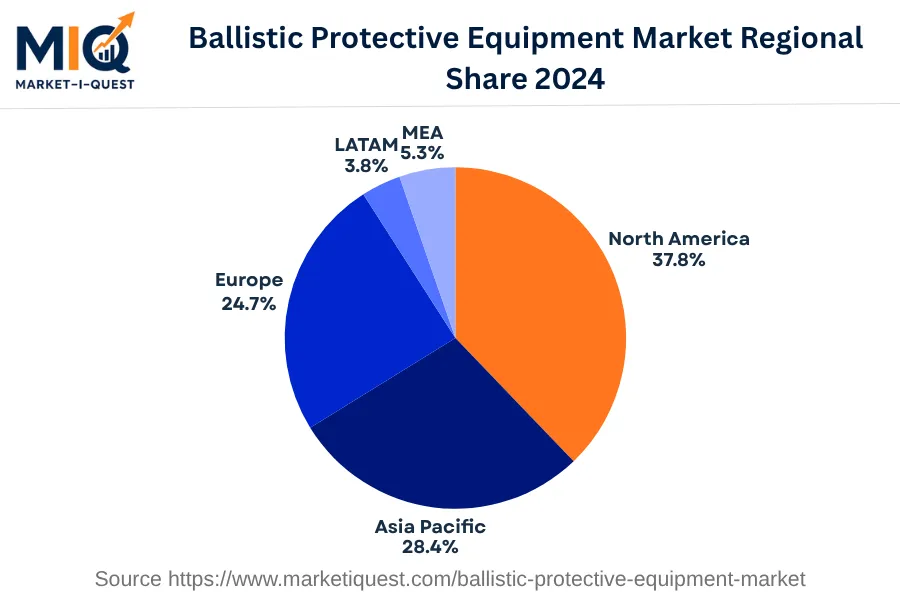
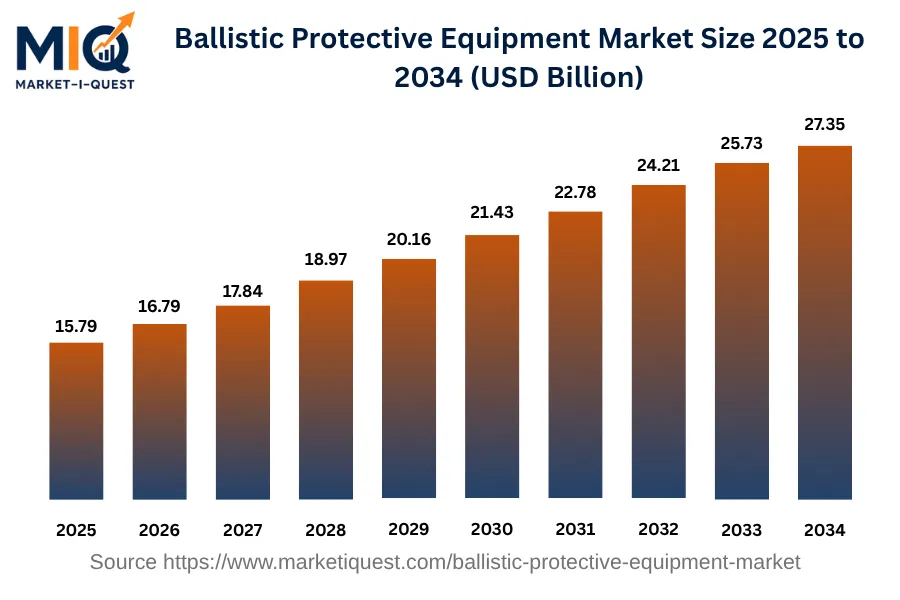
The Ballistic Protective Equipment Market size was 15.79 billion USD in 2025, and it grows to a size of 27.35 billion USD by 2034, with a CAGR of 6.3%. The growth is primarily linked to the rising demand for ballistic protection on account of accelerating global tension and military conflict. predominantly in areas with severe political instabilities and rising global terror threats. At the start of this period in 2024, the market value was at 14.86 billion USD, showing a significant increase to 15.79 billion USD the following year. As per regional share in 2024, North America dominated with 37.8%, followed by Asia Pacific at 28.4%. Europe held a share of 24.7%, while LATAM and MEA accounted for 3.8% and 5.3%, respectively.

Key Takeaways

  • By Material - Steel led the market accounting for a substantial share.
  • By Product - Head Protection grew fastest in the base year signifying high demand.
  • By End Use - Defense sector held a leadership position indicating a major market share.
ballistic-protective-equipment-market market size

Key Driving Factors

Increased adoption of stringent safety measures in law enforcement

In attempt to reduce the vulnerability of their workforce, law enforcement agencies worldwide are increasingly adopting stricter safety protocols that mandate the use of ballistic protective equipment. For instance, the Occupational Safety and Health Administration (OSHA) in the United States has set standards for protective clothing used by law enforcement officials which include the use of bullet-proof vests and helmet. In addition, growing awareness about the role of personal protective equipment (PPE) in injury prevention is also driving the demand.

Proliferation of asymmetric warfare and armed conflict

Asymmetric warfare and armed conflict are unfortunately on an upswing in several areas around the world. Such situations often involve non-state actors using modern tactics that emphasize the need for robust personal protection for both military and civilian personnel. This has led to a significant uptick in the demand for ballistic protective equipment by both military and non-military organizations. As the frequency and intensity of armed conflicts or security threats increase and strategies become more unpredictable, the importance of personal protective equipment including ballistic protection becomes more critical.

Market Evolution by Timeline

2019-2023
During this period, demand for ballistic protective equipment saw a significant rise from law enforcement segments and civilians. Mainly in North America and the Middle East. Prominent reasons behind this surge included escalating chaos and the need for personal security. Suppliers mainly focused on providing bulletproof vests and helmets that meets industry standards such as NIJ 0101.06. The initiation of National Defense Authorization Act (NDAA) contributed to adoption by enforcing higher safety measures. Privately-negotiated deals were common commercial model and pricing was primarily based on product type and level of protection.
2024
By 2024, the increased acquisition of protective gear by military forces in Asia-Pacific region significantly influenced the market. Innovations such as advanced ballistic materials like Dragon Skin are introduced that boasted more flexible, comprehensive protection. Compliance with safety norms like HOSDB became a critical supplier criterion. The shift from traditional direct-selling towards online sales platforms began to gain traction for wider market reach. Pricing are majorly determined by the advancement of technology and the handling cost.
2025-2029
In these years, ballistic protective equipment market will see an increasing demand from emerging economies due to political instability and rising defense budgets. Revolutionary technologies like liquid armor will start pilot programs, highlighting their potential for future domination. The EU's directive on Personal Protective Equipment (PPE) 2016/425 will heavily influence the market, promoting greater safety awareness. Collaborative partnerships between suppliers and governments will be typically establish for national defense projects. Cost of research and development will heavily influence the pricing.
2030-2034
This period will mark a significant shift towards the use of cutting-edge tech in the ballistic protective equipment market, namely nanotechnology. Countries in South America and Africa will be major buyers due to escalating regional conflicts. Regulations such as the U.S. Army's AEP-55 Vol 2 standard will be crucial in shaping the market. Subscription-based services will likely influence commercial models, shifting from a product-purchase to a service-lease model. Pricing will be largely dependent on the level of technology and required customization.

Future Market Outlook

Future Opportunities

The prospects for ballistic protection products in the near and distant future remain optimistic thanks to fast technological progress and the emerging security challenges in the region. The concentration of security risks is increasing in urban areas, including those born of the ongoing escalation of violent crime in places like Chicago and Los Angeles. In light of the escalating risks, many private security contractors will surely demand the most advanced protection equipment. The rise of geopolitical tensions globally, most visible since 2022 in Eastern Europe, will also have the effect of prompting many countries to rethink their defense strategies and as a result the demand for body armor will rise significantly on the part of armies around the world. Some companies, such as Revision Military, are actively working to satisfy this demand by creating intelligent, adapting solutions. At the same time, special regulations (for example, adopted by the European Union in 2021 to standardize the procurement of personal protection equipment) promote the use of advanced standards. Some U.S. Government organizations, like the Department of Homeland Security, finance research into the use of second-generation materials in ballistic protective equipment, including materials based on carbon nanotubes, that are characterized by a significant reduction in weight.
Many law enforcement organizations across the world also now use armored products. Developing countries in the Asian region such as India and Indonesia are beginning to take interest in reliable and powerful ballistic armor with growing security expenditures and defense collaborations with Western allies.

Segmentation Analysis

By Material

The market is segmented by material into Aramid, Composites, UHMWPE, Steel, and Others, with Steel accounting for the largest revenue share, while Composites is projected to grow at the fastest CAGR during the forecast period.

Largest Revenue Share

Steel

Market Share Leader

Steel held the highest market share for the material segment by revenue in 2024. Steel’s prevalence across various industrial sectors (construction, automobile, manufacturing, etc.), leading to heavy demand for steel as the basic constituent of the products, is contributing towards steel holding largest market share across material segment. The market revenue for steel is driven by the regions having strong industrial base, such as Asia Pacific, North America. The superior strength and durability of the material are also contributing towards its leading position in the market. End-users prefer highly reliable materials. Material regulations for quality and environmental standards, coupled with inherent traits such as high tensile strength and recyclable properties of steel, ensure its steady demand from the supply chain.

Fastest CAGR

Composites

Forecast Period Growth Leader

Composites are forecasted to exhibit the fastest growth rate. Emerging technologies play a crucial role in driving growth for this material segment. The growing interest in lightweight and high-performance materials, especially in the aerospace and automotive industries, is expected to act as a catalyst for increasing adoption. Strategic partnerships and joint ventures among key players in the composites industry are promoting innovation and reducing costs. A gradual increase in high expenditure towards research and development is also pushing the drive towards more accessible and affordable composite materials.

By Product

In the product segmentation, the market is divided into subsegments including Head Protection, Soft Armor, and Hard Armor. Of these, Soft Armor accounted for the largest revenue share in 2024, while Head Protection is expected to grow at the fastest CAGR during the forecast period.

Largest Revenue Share

Soft Armor

Market Share Leader

The Soft Armor subsegment leads the product market in terms of revenue primarily due to its extensive use in a variety of sectors like defense, law enforcement, and private security. Soft Armor is more comfortable and easier to move in, proving superior for protracted use scenarios which significantly drives its demand. Additionally, advancements in material technology have increased the effectiveness of Soft Armor, thus supporting higher price points and revenue. Geographically, higher revenue is likely drawn from regions with robust defense budgets and incidences of civil unrest. A noteworthy factor influencing purchasing decisions in this sector is the regulatory strictness, as not all types of armors are legally allowed in every region. We also assume that reliable supply chains and strong distribution partnerships have promoted market perception and revenue generation for Soft Armor in 2024.

Fastest CAGR

Head Protection

Forecast Period Growth Leader

Head Protection The Head Protection segment of the product market is forecast to record the highest CAGR growth with numerous drivers and catalysts contributing towards its growth. Technological advancements like the evolution of materials and design of Head Protection equipment has resulted in production of more advanced and lightweight equipment that improves wearer’s comfort and does not compromise their safety. Also, owing to mandated occupational health and safety regulations that are prevalent in industries, the sales of Head Protection gear is expected to increase, thereby becoming a major catalyst of growth for the segment. Several catalysts for segment growth are expected to drive innovation in product materials, extensive research and development investment, stringent safety standards and a broad acceptance of Head Protection equipment. Some of the challenges like, the high cost of producing these products and the higher switching costs, will likely play a deterrent role on the market, however the key manufacturers have come to a mutual understanding with the product distributors which will prove a growth enabler in this product segment.

By End Use

The market is divided into three subsegments by end use: Defense, Law Enforcement & Security, and Commercial, with Defense accounting for the largest revenue share and Commercial expected to grow at the fastest CAGR during the forecast period.

Largest Revenue Share

Defense

Market Share Leader

2024 - The defense segment dominates the revenue generation The defense subsegment generates a major part of the revenue as the demand for defense technologies are at all-time high, huge investments made, and national security plays an essential part. Also, most of the governments in the countries of the world always give priority to military spending to build new equipment and technologies which ensure consistent revenue. This is very prominent in regions like North America, Middle East, and Asia Pacific. Moreover, defensive technologies are subject to rigorous certification and testing procedures which prevents the entrance of any new players into the market and thus boosts up the revenues for existing players in the market. Reliability, durability, and the feature-richness of defense equipment are criteria taken into consideration when purchasing equipment which contributes to driving the Defense subsegment revenue generation. Switching costs related to change of any equipment, technologies and operations involved are also a factor for the defense sector revenue.

Fastest CAGR

Commercial

Forecast Period Growth Leader

The Commercial subsegment is expected to undergo the quickest growth, driven by a variety of factors. The ongoing technological innovation is catalyzing more feasible and cost-efficient applications of related tech in commercial industries, such as automation, telecommunication, and logistics. This coupled with expanding use-cases for commercial industries fuels rapid adoption rates among businesses keen to elegant operations and enhance efficiencies. As commercial industries increasingly rely on foregoing advanced applications, partnerships between technology providers and commercial entities are expected to become more common. The financial investments that these partnerships are driving further subsegment's growth.

Competitive Analysis

Key Market Players

Manufacturers / OEMs

3M Company
US
Honeywell International Inc
US
BAE Systems
UK

Key Suppliers & Raw Materials

DowDuPont
US
Teijin Aramid
Japan
Royal TenCate NV
Netherlands

Distributors, Integrators & Channel Partners

ADS Inc
US
Armor Express
US
Craig International Ballistics
Australia

Porter’s Five Forces Analysis

This analysis explores the competitive dynamics in the Ballistic Protective Equipment Market.

Supplier Bargaining Power

Medium

Raw material supply is diversified but specialized, resulting in medium supplier power.

Buyer Bargaining Power

Low

High switching costs and specificity of products restrict buyer bargaining power.

Threat of Substitutes

Low

Limited substitutes due to unique, tailored ballistic protection functionality.

Threat of New Entrants

High

Low entry barriers and increasing demand present high threat of new entrants.

Competitive Rivalry

High

Multiple established players and competitive prices lead to significant rivalry.

Regional Analysis

Geographic market dynamics and growth opportunities across key regions

Global Market Outlook

ballistic-protective-equipment-market market regional share

North America

In 2024, the North American Ballistic Protective Equipment Market was driven and shaped by several trends and forces. including elevated security concerns, increasing military expenditures, and a raised awareness of personnel protection in high-risk occupations. The passing of strict health and safety regulations in the U.S., Canada, and Mexico emphasized the critical importance of ballistic protective equipment, particularly in law enforcement sectors. The enhanced allocation of investment funds toward the development and acquisition of advanced protective equipment underscored this shift. Rapid technology adoption was also a key driver, countered by the challenge of expensive pricing structures.

Trends within this sector reflected the shifting consumer behaviors and technological advancements. Consumers, particularly in enterprise and government sectors, began prioritizing lightweight materials without compromising the protection levels. There was a notable shift towards the adoption of advanced materials and nanotechnology in the production of ballistic protective equipment. Furthermore, policy enforcement within the North American region was strict, safeguarding quality standards in manufacturing. Partnerships and merger & acquisition activities were widespread, as businesses aimed to strengthen their market position and expand their customer base within different sectors, including utilities and manufacturing. These movements collectively painted the landscape of the Ballistic Protective Equipment Market in North America for 2024.

Asia Pacific

In 2024, the Asia Pacific's ballistic protective equipment market evolved, predicated on several key factors. Elevated geopolitical tensions boosted demand as governments, particularly in India, China, and Japan, significantly invested in protective gear for their defense forces. Regulatory standards across this geographical belt brought about advancements in material technology, contributing to market strength. Specifically, China's updated GB/T standards challenged manufacturers, pushing innovation in lightweight, durable protection gear.

Evolving buyer behavior shaped several market trends. There was a surge in adoption among law enforcement agencies, especially in urban centers of South Korea and Australia, considering increased civil chaos incidents. Additionally, regional enterprises also contributed to the market traction due to elevated workplace safety awareness. Notably, the energy sector in key ASEAN countries added substantial demand, driven by regulatory enforcement to uplift safety standards. A major shift towards advanced materials for manufacturing ballistic vests, helmets, and shields, noted advancements in product technology. Amid this, partnerships planted, filled with cross-border expansion intents. Consequently, several factors tailored the 2024 landscape, they have further potential to transform this segment in the Asia Pacific region.

Europe

In 2024, Europe's Ballistic Protective Equipment Market was characterized by a distinct landscape of demand, driven largely by the security needs of different sectors. Key drivers included increased security concerns across military, law enforcement, and private security sectors, which drove increased investment in ballistic protective equipment. Regulatory advancements, particularly strict safety standards for law enforcement and military personnel, also triggered demand. Furthermore, advances in nanotechnology adopted in manufacturing ballistic equipment were crucial in the market's growth, offering superior protection capabilities. In terms of supply dynamics, the introduction of innovative materials with high durability and reduced weight drove the market.

Market trends in 2024 were centrally aligned to customer preferences and technological changes. Shifting dynamics towards the incorporation of smart technologies into protective equipment were also observed, providing critical intelligence data for enhanced security. The trend of mergers and acquisitions between leading industry players indicated combining strategies, driven by aims to expand product portfolios and customer reach. Enforcement of uniform safety standards across all European Union member states was integrated policy action meant to ensure the quality and performance of ballistic protective equipment in the region. In 2024, the European Ballistic Protective Equipment Market saw a strong interplay of demand drivers and evolving market trends, concentrated specifically in sectors such as military, law enforcement and retail.

Latin America

In 2024, the Ballistic Protective Equipment Market experienced significant growth in Latin America, largely driven by geopolitical instabilities and increasing defense budgets. The rise in public safety concerns and military modernization plans, particularly in Brazil, Mexico, and Argentina, have underscored the demand for enhanced defensive gears like bulletproof vests and helmets. Increasing investment in research and development by leading manufacturers meant the adoption of advanced technologies and materials was gaining momentum. Parallelly, strict enforcement of occupational safety regulations across sectors such as mining and construction, majorly in Peru and Chile, drove an uptick in the market. Although high product pricing still poses barriers, increased government acquisition, especially in Colombia, offered a robust counter.

Shifting trends highlighted a noticeable interest in lightweight, wearable protective gears with smart features. End-users—primarily military, federal and local law enforcement agencies, and private security firms— showed a preference for customized solutions that offer maximum mobility without compromising on protection levels. As the understanding of ballistic protection grew, corporations began implementing these solutions for executive personnel safety, adding a new customer dimension. The year also witnessed a surge in strategic partnerships between local manufacturers and global giants, looking to capitalize on LATAM's escalating market potential. Overall, LATAM’s Ballistic Protective Equipment Market in 2024 exhibited strong progressive signs, powered by a host of interplaying drivers and emerging trends.

Middle East & Africa

In 2024, the Ballistic Protective Equipment Market in the Middle East and Africa witnessed significant growth. Robust demand was primarily driven by geopolitical instability across the region, increasing military modernization programs, especially in Saudi Arabia, UAE, and Israel. Additionally, the growth of terrorist activities in the region placed emphasis on modernizing the defense sector, with significant investment focused on ballistic protective gear for military and police personnel. Key market trends were characterized by the adoption of advanced materials and technology in manufacturing safety equipment. There was a marked shift towards nano-materials and non-Newtonian fluids, which considerably enhance the protective capabilities of equipment. Channel dynamics also evolved, with online a platforms gaining rise, creating broader accessibility and competitive pricing.

In terms of sectors, the military and defense sector remained the primary customer base, given the elevated security concerns. Other sectors like oil and gas and utilities showcased a rising demand, particularly in Nigeria and Egypt due to increasing safety regulations. Additionally, significant demand was observed in the private security services sector, which accelerated in cities experiencing civil unrest. Strategic partnerships were observed among market players, particularly those based in Israel and UAE, aimed at technological advancements and sharing manufacturing best practices. Policies were focused more on meeting global and regional safety standards, ensuring high-quality, reliable products.

Recent Industry Developments

Latest market innovations, product launches, and strategic initiatives

January 2026

KIHOMAC Armor Systems officially expanded its production portfolio with the launch of its Ceridium body armor plates. The Level IV ceramic composite plates utilize an innovative thermoplastic polyurethane (TPU) spall cover and a multi-curve, SAPI-cut structural design engineered specifically to withstand multi-hit armor-piercing rifle threats while improving field weight distribution.

August 2025

Point Blank Enterprises introduced an updated line of modular plate carrier systems incorporating ultra-lightweight soft-armor backing. The protective equipment platform allows law enforcement and defense personnel to scale their loadout from baseline concealable configurations to heavy-duty tactical hard armor plates depending on active mission threats.

Frequently Asked Questions