X-Ray Systems Market Snapshot

Key Players

  • General Electric Company (United States)
  • Siemens AG (Germany)
  • Koninklijke Philips N.V. (Netherlands)
  • Canon Medical Systems Corporation (Japan)
  • Hitachi Ltd. (Japan)
  • Fujifilm Holdings Corporation (Japan)
  • Shimadzu Corporation (Japan)
  • Carestream Health Inc. (United States)
  • Hologic Inc. (United States)
  • Varian Medical Systems Inc. (United States)

Market Size

Base Year 2024
$14.28 Bn
CAGR
6.26%
Forecast 2034
$26.21 Bn

Market Segments

By Modality
Radiography, Fluoroscopy, Mammography
By Technology
Digital Radiography, Computed Radiography
By Mobility
Stationary, Mobile
By End Use
Hospitals, Diagnostic Imaging Centres, Other End Users

Market Dynamics

Drivers
  • Technological advancements
  • Increasing healthcare expenditure
Restraints
  • High equipment cost
  • Strict regulatory framework
Opportunities
  • Technological advancements in healthcare
  • Emerging markets growth potential

Market Size

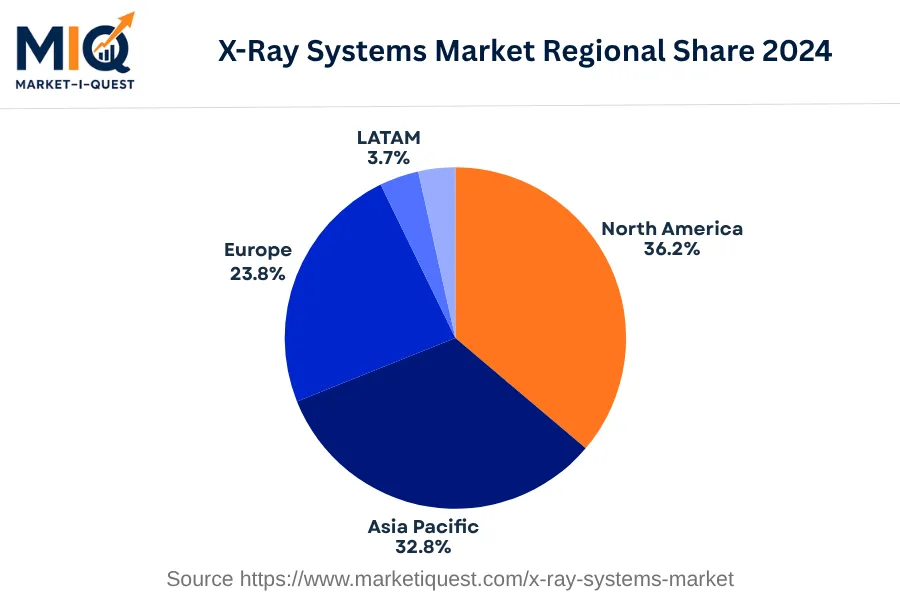
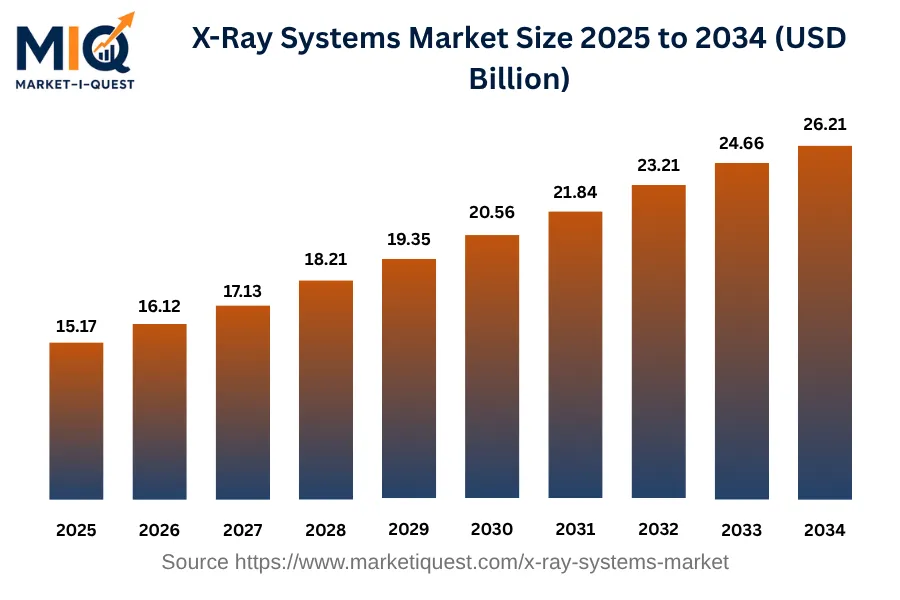
The X-Ray Systems Market size in 2025 is projected to be USD 15.17 Billion and is expected to grow over the next decade to reach USD 26.21 Billion by 2034. This represents a CAGR of 6.26%. From 2024 to 2025, the market size will increase from USD 14.28 Billion to USD 15.17 Billion, signifying the start of a stable growth phase. The upward trajectory of the market is maintained as it progresses towards the 2034 mark. As for the regional share in 2024, North America holds the largest portion with 36.18%. The Asia Pacific region follows closely with a 32.76% share, while Europe has a smaller, but still considerable, share of 23.84%. The LATAM and MEA regions trail with shares of 3.72% and 3.5% respectively.

Key Takeaways

  • By Modality - Radiography led the X-Ray Systems Market accounting for a notable market share.
  • By Technology - Digital Radiography held the dominant position in the base year.
  • By Mobility - Stationary subsegment were the top performers in the X-ray Systems Market.
  • By End Use - Hospitals accounted for a significant proportion of the market.
x-ray-systems-market market size

Key Driving Factors

Adoption of Portable X-ray Systems in Emergency Departments

In recent years, there's been an increased uptake of portable X-ray systems in hospital emergency departments. This accelerated adoption is primarily due to the system's ability to deliver faster diagnosis, which is crucial for patient treatment in emergency situations. These systems satisfy the need for quick, high-quality imaging in high-pressure environments. Hospital administrations are recognising this, and in turn, are increasingly investing in portable X-ray systems. Moreover, concerns regarding cross-contamination due to patient movement to radiology departments has also fuelled the demand for these systems. As the healthcare sector continues to emphasize speed, accuracy and patient safety, the market for portable X-ray systems is promising to rise.

Regulatory Compliance for Routine Device Safety Checks

Regulatory bodies across the globe, such as the FDA in the US and the European Medicines Agency (EMA) in Europe, mandate routine safety checks for medical imaging devices, including X-ray systems. These checks ensure the systems are operating within safety standards and delivering accurate results. Any deviations found demand corrective actions, which often necessitate either system enhancements or replacements. Such regulations obligate healthcare institutions to regularly upgrade their X-ray systems to remain compliant, driving purchases in the X-ray Systems Market. The continuation of these rigorous regulatory safety inspections propels demand for new and technologically improved X-ray systems.

Market Evolution by Timeline

2019-2023
During this period, hospitals and diagnostic centers were the primary buyers of X-ray systems. Increased incidences of injuries and diseases in North America and Asia-Pacific regions drove the demand. The supply side saw the introduction of digital radiography systems with superior imaging capabilities. However, the integration of these new systems with existing healthcare infrastructure remained challenging. No significant changes were observed in regulations except for the United States FDA's push for low-radiation imaging technologies. The market witnessed both outright purchase and leasing contracts. Notable partnerships included GE Healthcare's collaboration with Affidea. Risks included high costs of systems and interoperability issues.
2024
Demand in 2024 was majorly influenced by the COVID-19 pandemic that led to an increased need for lung imaging worldwide. Veterinary and chiropractic clinics emerged as new buyer segments. In terms of technology, compact and portable X-ray systems gained popularity. The major constraint was the scarcity of trained radiologists. With the HIPAA regulations favoring patient data privacy, makers of X-ray systems faced the challenge of data protection. The pricing leaned more towards a subscription model for software aspects. The supply chain was disrupted due to pandemic-related restrictions, causing availability issues.
2025-2029
Between 2025 and 2029, the demand for X-Ray systems was driven by growing orthopedic and dental sectors, particularly in emerging countries like India and China. AI-enhanced X-ray systems became prevalent, contributing to better diagnosis accuracy. Manufacturer-to-customer direct sales became prominent, alongside conventional channels. The EU Medical Device Regulation 2017/745 governed safety standards. Computed radiography dominated the commercial landscape due to its economic and environmental benefits. Issues related to radiation exposure and unsafe disposal of imaging chemicals persisted as challenges.
2030-2034
In this period, sectors such as sports medicine began considering X-Ray systems. Demand peaked from regions with ageing populations like Japan. The introduction of cloud-based imaging systems changed the technology scene by enabling remote healthcare services. The use of X-Ray systems for preventive healthcare gained traction, causing an increase in demand for regular health screenings. Pricing faced downward pressure due to competition. However, issues related to access in remote regions overshadowed technological advancements. The risk of breaches in patient data confidentiality escalated with the use of cloud technology.

Future Market Outlook

Future Opportunities

The evolving landscape of the X-ray systems market offers various growth prospects driven by current technological advancements. In 2023, healthcare institutions are increasingly investing in AI-driven diagnostic tools, with firms like IBM partnering with hospitals to enhance diagnostic workflows, reflecting an industry shift towards data analytics. The focus on telemedicine and remote diagnostics presents opportunities for companies to innovate portable and tele-friendly diagnostic solutions, as evidenced by initiatives launched during the COVID-19 pandemic that utilize mobile X-ray technologies in underserved areas. Additionally, the push for integrated healthcare solutions is encouraging collaboration among device manufacturers and software providers to create cohesive ecosystems, as demonstrated by the partnership between Siemens and Philips in developing comprehensive imaging solutions. Regulatory trends indicate a future necessity for compliance with strict data protection laws, like the GDPR in Europe, compelling manufacturers to invest in solutions that prioritize patient data security. Furthermore, the rising demand for preventive healthcare is prompting advances in screening technologies, where companies like Hologic are exploring novel X-ray applications in early disease detection. Opportunities are also emerging in the field of customized imaging solutions tailored for specific patient demographics, particularly the elderly population, where targeted solutions could address their unique health needs. These developments suggest that the X-ray systems market will evolve significantly by leveraging advanced technologies and addressing emerging healthcare trends, shaping its future landscape.

Segmentation Analysis

By Modality

The market is divided into subsegments including Radiography, Fluoroscopy, and Mammography, amongst which Radiography accounted for the largest revenue share while Mammography is expected to grow at the fastest CAGR during the forecast period.

Largest Revenue Share

Radiography

Market Share Leader

Assuming standard medical imaging frameworks where baseline diagnostics command the highest volume, Radiography leads the modality market today due to its foundational role across healthcare infrastructure. This subsegment serves hospitals and diagnostic clinics, establishing a ubiquitous presence across mature and developing geographies. The primary demand driver is the high volume of essential procedures required for fractures and chest screenings, making it an indispensable first line of assessment. Purchasing criteria emphasize system reliability, high patient throughput, and seamless interoperability with hospital networks. Switching costs remain high for organizations because of deep integration into enterprise workflows and the extensive staff retraining required to transition to competing systems. Distribution channels are mature, relying on direct contracts, multi year purchasing agreements, and established regional distributors securing hardware replacement cycles. Regulatory approval pathways are well established, minimizing supply chain disruption and maintaining a steady flow of updates. Consequently, this deep clinical integration and massive installed base ensure that it retains a higher revenue share versus more specialized diagnostic modalities.

Fastest CAGR

Mammography

Forecast Period Growth Leader

Mammography represents the fastest growing subsegment due to intensifying worldwide focus on preventive female oncology and proactive screening frameworks. The primary growth driver is the expansion of government sponsored breast health initiatives and public awareness campaigns incentivizing early detection procedures globally. These programs actively drive clinical technology upgrades across health centers. Technologically, the transition toward advanced three dimensional digital breast tomosynthesis acts as a significant catalyst, improving diagnostic accuracy and reducing false positive recalls. Strategic partnerships between software developers and hardware manufacturers accelerate adoption by embedding artificial intelligence tools directly into screening workflows to optimize interpretation speed. Capital expenditure allocations from healthcare systems increasingly prioritize specialized screening suites to capture growing outpatient demand and improve preventative metrics. However, adoption barriers persist in underfunded regions where equipment costs and a lack of dedicated technicians limit immediate deployment. Near term risks include shifts in national screening guidelines regarding target age cohorts and reimbursement adjustments by insurance providers. Assuming public health regulations continue to mandate routine screening compliance, these elements will sustain a rapid expansion trajectory.

By Technology

The market is divided into subsegments including Digital Radiography and Computed Radiography, of which Digital Radiography accounted for the largest revenue share, while Computed Radiography is expected to grow at the fastest CAGR during the forecast period.

Largest Revenue Share

Digital Radiography

Market Share Leader

Digital radiography holds the largest share in the market mainly due to its numerous advantages over computed radiography. Specifically, digital radiography provides clear and better image quality which reduces the need for image retakes, thereby saving time and radiation exposure. Furthermore, the advent and rapid adoption of high-definition digital radiological systems have pushed the demand in various fields including orthopedics, dentistry and mammography. In addition, digital radiography systems are compatible with modern telemedical technologies, which facilitates remote consultations and medical practice. Geographically, developed countries with well-established healthcare infrastructure, like the US and regions in Europe, have driven the demand for this market segment in 2024. Regulatory factors play a fundamental role as the technology adheres to the radiation safety protocols more strictly even as it improves diagnostic efficiency, thus encouraging its wider adoption.

Fastest CAGR

Computed Radiography

Forecast Period Growth Leader

Despite digital radiography's higher revenue, computed radiography is predicted to grow at the fastest CAGR. Primarily, this growth is driven by the technology's lower initial cost, allowing it to permeate developing regions where healthcare expenditures are more constrained. Another driving factor is the technology's flexibility. Unlike digital radiography, computed radiography doesn't require the user to adjust the X-ray machine's positioning for different angles—making it highly beneficial in instances where the patient's mobility is limited. However, adoption may be slowed due to perceived barriers including the system's slower processing speed compared to digital radiography. Partnerships with medical technology companies, continual advancement in capex-friendly technologies, along with favorable policy frameworks supporting digital transformation in healthcare are potential catalysts that could accelerate the adoption of computed radiography.

By Mobility

The market is divided into subsegments including Stationary and Mobile. In 2024, the Stationary subsegment accounted for the largest revenue share while the Mobile subsegment is expected to grow at the fastest CAGR during the forecast period.

Largest Revenue Share

Stationary

Market Share Leader

In the base year 2024, the Stationary subsegment emerged as the leader in terms of revenue. This prominence can be attributed to several factors. Stationary systems are often large-scale, catering to massive power needs for commercial or industrial settings. As such, the robust purchasing power of these sectors has greatly contributed to the dominance of the Stationary subsegment. The geographical spread of these entities, often in high-energy demand areas, is another driver. Favourable regulations have also played a part, as governments continue encouraging the adoption of energy-efficient solutions. High switching costs present another strategic advantage. Once implemented, stationary systems tend to remain in place for quite a long period due to their high installation and replacement costs, ensuring persistent revenues. The direct purchase from manufacturers or licensed vendors model often adopted in this subsegment further simplifies the purchasing process, giving an additional boost to its revenues.

Fastest CAGR

Mobile

Forecast Period Growth Leader

While it lags behind Stationary in terms of current revenues, the Mobile subsegment of the market shows the fastest predicted compound annual growth rate. Rapidly evolving technology is the major catalyst for this growth. As mobile systems are usually smaller, they need less capital investment, which is encouraging new entrants and driving competition. This in turn is leading to innovation and improvements in efficiency, making Mobile solutions increasingly appealing to customers. Partnerships between manufacturers and technology companies to develop more sophisticated mobile systems are also fuelling market growth. However, there are a few barriers to adoption in this market segment. The initial costs may be lower, but the recurring maintenance costs could act as a hindrance to widespread adoption. Furthermore, the lack of standardised regulations for Mobile energy systems across different geographical regions poses a near-term risk for this fastest-growing subsegment.

By End Use

The market is divided into subsegments including Hospitals, Diagnostic Imaging Centres, and Other End Users. In 2024, Hospitals accounted for the largest revenue share while Diagnostic Imaging Centres is expected to grow at the fastest CAGR during the forecast period.

Largest Revenue Share

Hospitals

Market Share Leader

Hospitals, as a subsegment, held the largest revenue share out of all end-use segments for 2024. A meticulous analysis of the trend reveals several influential factors driving this. One primary driver is the inherent need for medical services in hospitals, making them the leading segment by default. With the escalating incidences of chronic diseases that require continuous monitoring and treatment, hospitals are in persistent need of updated medical equipment. Furthermore, the growing influx of patients, due to population growth and aging, contributes to increased revenue. In addition, government policies provide substantial funding to hospitals, enabling them to better equip their facilities. Regulatory requirements mandate certain standards of equipment that hospitals need to align with, further increasing demand. Therefore, hospitals' purchasing power is strong, and considering the high costs associated with switching suppliers, they often form long-lasting partnerships with equipment providers. These key points illustrate why hospitals consistently generate the highest revenue amongst all sub-segments.

Fastest CAGR

Diagnostic Imaging Centres

Forecast Period Growth Leader

Despite Hospitals holding the largest revenue share, Diagnostic Imaging Centres has the fastest Compound Annual Growth Rate (CAGR). Technological advancements and innovation fuel the rapid growth in this subsegment. Increasing adoption of advanced imaging technologies such as Magnetic Resonance Imaging (MRI) and Computed Tomography (CT) offers substantial growth opportunities for diagnostic imaging centres. Moreover, as patients seek quicker and more accurate diagnoses, the demand for these centres increases. Partnerships are also a catalyst for expansion; strategic alliances with tech providers enable centres to stay updated with the latest equipment and practices. Moreover, increased healthcare expenditure and government initiatives to improve diagnostic services boost growth. However, the high cost of imaging devices and a dearth of trained professionals may act as barrier. To mitigate this, diagnostic centres might focus on attracting investment for staff training and machinery procurement. This outlook underscores the potential for significant growth in this subsegment in the near future.

Competitive Analysis

Key Market Players

Manufacturers / OEMs

Siemens Healthineers
Germany
GE Healthcare
US
Philips Healthcare
Netherlands

Key Suppliers & Raw Materials

Shanghai MaNan Crystals and Gemstones
China
PANalytical
Netherlands
Vytek
US

Distributors, Integrators & Channel Partners

Medtronic
US
Cardinal Health
US
McKesson Corporation
US

Porter’s Five Forces Analysis

This analysis provides a comprehensive understanding of influential factors within the X-Ray Systems Market.

Supplier Bargaining Power

Medium

Suppliers influence prices and quality, but there are multiple sources for components and materials.

Buyer Bargaining Power

High

Numerous system options and increasing price competition between manufacturers boost buyer's bargaining power.

Threat of Substitutes

Low

Substitutions like ultrasound and MRI are not always viable due to differing medical applications.

Threat of New Entrants

Medium

High technology costs and necessary certifications can deter new entrants, but innovation offers opportunities.

Competitive Rivalry

High

Dominant players and technological advancements create intense competition in the X-Ray Systems Market.

Regional Analysis

Geographic market dynamics and growth opportunities across key regions

Global Market Outlook

x-ray-systems-market market regional share

North America

In the base year 2024, the North American X-Ray Systems market was influenced by various factors across the sectors of healthcare, manufacturing, and government. Regulatory compliance played a significant role in driving demand; stipulating stringent safety standards in industries and healthcare facilities amplified the need for comprehensive X-Ray systems. Investment also surged, especially within the healthcare sector in the U.S., which witnessed advanced technology adoption. Additionally, supply dynamics exhibited notable changes, with manufacturers such as Canon, Fujifilm, and Philips, catering to the accelerated demand in the U.S and Canada.

Evolution in buyer behavior was a pertinent trend, with businesses and consumers seeking more efficient, user-friendly options. Government facilities in Mexico showed particular preference for high-resolution imaging technology, which consequently became a popular choice among major players. Furthermore, the channel dynamics were characterized by e-commerce growth, which expanded accessibility and drove high-volume sales. Several partnerships and M&A activities were observed; Philips' acquisition of BioTelemetry showed potential influence on future policy enforcement due to its scale and impact on telediagnostics technology. In sum, the X-Ray Systems market in North America for the year 2024 was a product of regulatory dynamics, investment and technology shifts, and strategic partnerships.

Asia Pacific

In the base year 2024, the X-Ray Systems Market exhibited robust expansion across the Asia Pacific region. Increased healthcare expenditure in countries like China, India, and South Korea fueled the demand for advanced diagnostic imaging equipment such as X-ray systems. The implementation of stricter regulations, aimed at ensuring patient safety and enhancing diagnostic accuracy, also catalyzed market expansion. Further, investment inflow into the healthcare sector of key ASEAN markets contributed to the improved availability and adoption of X-ray systems.

Simultaneously, the market experienced several transformative trends. Changes in buyer behavior, influenced by rising awareness regarding the benefits of early detection of diseases, underscored the salience of X-ray systems in healthcare. Technological shifts, including the gradual transition from analog to digital X-ray systems, redefined the product landscape. The increasing prevalence of strategic partnerships and M&A, primarily in China and Japan, heightened competition and innovation within the sector. The introduction of new healthcare standards and stricter policy enforcement, particularly in Australia and India, further framed market dynamics.

The primary sectors contributing to this X-ray systems demand were healthcare – including hospitals, clinics, diagnostic centers – and the government, especially in public health initiatives and healthcare infrastructure development. Precise applicability in sectors such as manufacturing for quality control processes also registered noticeable growth. Overall, the market was shaped by demand dynamics, regulatory actions, technological adoption, and changing buyer behavior.

Europe

In 2024, the European X-ray systems markett saw significant growth due to multiple factors. The healthcare sector's increasing demand, driven by the growing need for diagnostic imaging by ageing populations, particularly in the United Kingdom and Germany, played a key role. Simultaneously, emerging technological advancements in the X-ray systems, like AI integration, propelled the market's growth within enterprises across regions like Benelux and Central & Eastern Europe. Additionally, governmental policies such as the Medical Device Regulation (MDR) in the European Union encouraged compliance, leading to more investments and market expansion.

Conversely, market trends demonstrated variations in buyer behaviour in different regions. Healthcare providers in Italy and France have increasingly adopted portable X-ray devices for their practicality and efficiency. In Germany and the UK, there was a prevalent trend of digitisation in healthcare, leading to the increased demand for digital X-ray systems. M&A activities were dynamically observed in the Nordics, forging alliances between local enterprises and leading global firms. There was a strong emphasis on maintaining high quality standards, aided by regulatory bodies enforcing stricter policy measures across Europe. Consequently, it led to an increased demand for premium, high-quality X-ray systems chiefly in manufacturing and retail sectors.

Latin America

In 2024, the Latin America X-Ray Systems Market experienced dynamic growth shaped by various drivers and trends. Investment in healthcare from governments like Brazil and Mexico significantly propelled demand for X-ray systems, while pricing adjustments in Argentina and Colombia enhanced their market accessibility. Rapid technology adoption by healthcare providers in countries like Chile, coupled with regulations supporting equipment modernization in Peru, further fueled market expansion.

A noticeable trend was an increased preference for portable X-ray systems across major LATAM hospitals in response to rising imaging needs. With the rise of teleradiology in Brazil and Mexico, remote X-ray analysis became more prevalent, thereby changing the channel dynamics. Additionally, partnerships and M&A activity stimulated innovation, evident in Argentina’s nanotechnology-enhanced X-ray systems. Governments across nations have enforced strict standards for X-ray systems, primarily related to safety and image quality, further shaping the market.

Within the LATAM region, healthcare remains the primary sector leveraging these systems. However, an uptick in adoption was observed in manufacturing industries in Chile and utilities sector in Mexico using X-ray for non-destructive testing. Although each country exhibited unique growth patterns within the region, collectively, these factors illustrate the dynamic landscape of the X-ray systems market in Latin America for 2024.

Middle East & Africa

In 2024, the X-Ray Systems market in the Middle East and Africa saw substantial growth, driven by an elevated demand in the healthcare sector and technological advancements. Aging populations across various countries, including Saudi Arabia and South Africa, generated high demand for advanced diagnostic methods. Regulatory bodies, such as South Africa's National Department of Health, promoted large-scale investments in the healthcare sector, ultimately enhancing the procurement of X-ray systems. Technological adoption, especially in Israel’s robust medical device arena and the UAE's forward-leaning healthcare establishments, accelerated the market's growth dynamics.

Significant trends in the market included a predominance of digital X-ray systems, a direct response to increased health concerns such as cancer, cardiovascular diseases, and diabetes. The natural resources sector in nations like Nigeria and Qatar witnessed an uptake in industrial X-ray systems for quality control of their oil and gas installations. Enhanced policy enforcement of standardization practices was evidenced, for instance, by Egypt's Ministry of Health and Population. In Kenya, growth was driven by partnerships between government and international organizations for upgrading healthcare infrastructure. The main customers were healthcare institutions, manufacturing industries, and energy companies, prioritizing advanced and efficient imaging solutions in their operations.

Recent Industry Developments

Latest market innovations, product launches, and strategic initiatives

March 2025

Siemens Healthineers officially launched its AI Radiography Workflow Improvement Initiative, embedding next-generation automated workflow platforms directly into its commercial X-ray systems. The system integration relies on deep-learning algorithms to automate standard patient anatomical positioning and processing, reducing overall image interpretation times by up to 35%.

Frequently Asked Questions