Diagnostic Imaging Equipment Market Snapshot

Key Players

  • Siemens Healthineers (Germany)
  • Philips Healthcare (Netherlands)
  • GE Healthcare (United States)
  • Canon Medical Systems Corporation (Japan)
  • Hitachi Medical Corporation (Japan)
  • Koninklijke Philips N.V. (Netherlands)
  • Hologic Inc. (United States)
  • Fujifilm Holdings Corporation (Japan)

Market Size

Base Year 2024
$52.64 Bn
CAGR
6.4%
Forecast 2034
$97.89 Bn

Market Segments

By Imaging Modality
  • MRI
  • Computed Tomography
  • Ultrasound
  • X-Ray
  • Nuclear Imaging
  • Others
By Portability
  • Fixed Systems
  • Mobile and Hand-Held Systems
By End User
  • Hospitals
  • Diagnostic Imaging Centers

Market Dynamics

Drivers
  • Increased healthcare expenditure
  • Rising chronic disease prevalence
Restraints
  • High equipment costs
  • Regulatory compliance challenges
Opportunities
  • Emerging AI technology integration
  • Expansion in tele-radiology services

Market Size

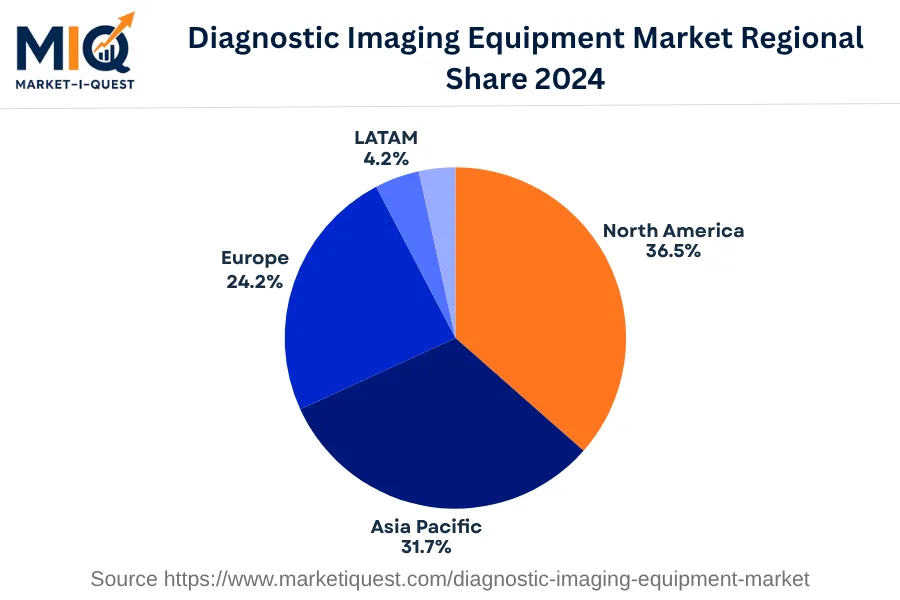
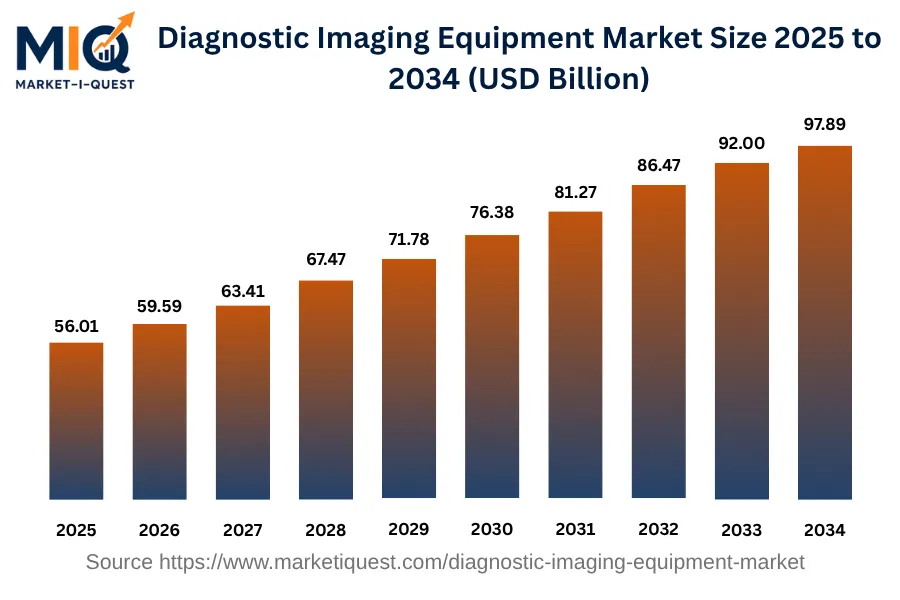
The Diagnostic Imaging Equipment Market size is projected to be USD 56.01 billion in 2025, escalating to USD 97.89 billion by 2034, marking a CAGR of 6.4%. The market witnessed growth from USD 52.64 billion in 2024 to USD 56.01 billion in 2025, showcasing an increase in demand for diagnostic imaging equipment in this period. This growth is likely attributable to advancements in equipment technology, increased availability and accessibility of diagnostic procedures, and rising requirement for timely and accurate diagnosis. The market is further projected to follow this growth trajectory till 2034, supported by an ageing population base and growing prevalence of chronic diseases requiring frequent imaging. In terms of regional market share in 2024, North America led with 36.48%, followed by Asia Pacific at 31.67%, and Europe at 24.17%. LATAM and MEA held a smaller part of the market, accounting for 4.23% and 3.45% respectively.

Key Takeaways

  • By Imaging Modality - MRI held the leading position in the Diagnostic Imaging Equipment Market in 2024.
  • By Portability - Fixed Systems led the market accounting for the largest market share in 2024.
  • By End User - Hospitals held a prominent share in the Diagnostic Imaging Equipment Market in 2024.
diagnostic-imaging-equipment-market market size

Key Driving Factors

Emergence of Portable & Hybrid Imaging Systems

The Diagnostic Imaging Equipment Market is being primarily driven by the introduction and uptake of portable and hybrid imaging systems. This is especially crucial in the current healthcare environment as the need for mobile, on-demand imaging increases. Providers are moving towards decentralized patient care, and these portable systems allow for imaging services to be easily transitioned to the point of care. Furthermore, hybrid imaging systems, like PET/MR or PET/CT, offer the advantage of comprehensive scans in a single sitting, improving diagnostic efficiency. These machines give a more accurate picture of patient health, improving treatment planning and promising better patient outcomes. The push from healthcare providers for greater efficiency and better patient care is stimulating the growth of this market.

Increasing Incidence of Chronic Diseases

Another driver for the Diagnostic Imaging Equipment Market is the increasing incidence of chronic diseases across the globe. These diseases, such as cardiovascular illness, cancer, neurodegenerative disease, and others, make heavy use of diagnostic imaging in their management, whether for the initial diagnosis, monitoring disease progress, or evaluating the effectiveness of treatment. This escalated usage is a direct result of the increasing chronic disease burden which makes diagnostic tools an indispensable part of patient care. As this trend is likely to continue given the aging population and the rise of lifestyle diseases, the demand for diagnostic imaging equipment is being propelled further.

Market Evolution by Timeline

2019-2023
During this period, Diagnostic Imaging Equipment demand was seen primarily from hospitals and diagnostic centers in mature markets such as North America, Europe, and Japan. Key reasons for demand were, age-associated deterioration of health, rise in chronic diseases, and increased awareness about early disease detection. On supply end, main source of technology were countries with strong medical equipment manufacturing capabilities, like USA and Germany. Equipment like CT, MRI, and ultrasound devices had common shipments. Challenges during integration were patient safety concerns relative to radiation exposure and high cost of diagnostic equipment. Funding patterns saw government and private sector participation. There were no significant changes to policy and regulations concerning the Diagnostic Imaging Equipment. Commercial model consisted of direct purchase, leasing, and device-as-a-service offerings.
2024
The Diagnostic Imaging Equipment market saw shifts in 2024. Demand from developing regions like Asia Pacific began to rise, with investments in healthcare infrastructure being a driving factor. Adoption of digital imaging saw acceleration, overcoming traditional barriers of high cost and integration concerns. Furthermore, supply of portable and mobile imaging devices became more common. Policies were introduced to encourage use of low-radiation and non-radiation devices, affecting market dynamics. New commercial models: shared equipment use and pay-as-you-go models were trialed. The market also faced risks from concerns regarding patient data privacy and protection, however, responses included beefing up cybersecurity measures and guidelines.
2025-2029
Throughout this period, demand from middle-income countries grew significantly due to increased government spending on healthcare, population growth, and the rise of non-communicable diseases. The key supply-side change was the introduction of AI and machine learning technologies, which further advanced diagnostic imaging capabilities, but faced challenges in terms of unbiased algorithms and clinician trust. Governments attempted to regulate use of machine learning in healthcare with named rules like the AI Regulation Act. On the commercial side, performance-based contracts gained traction. The key risk was the potential misuse of AI technology, hence, ethical AI research and guidelines development became an industry imperative.
2030-2034
Demand for Diagnostic Imaging Equipment continued to grow, especially in low-income countries with burgeoning population and improved healthcare spending. Advanced imaging technologies, incorporating AI and quantum computing, shipped from tech-leading nations, but faced issues in integration, cost, and ethics. Named initiatives like the Quantum Technology Act were introduced to regulate their use. Various commercial models thrived, with a key emergence of cooperative procurement and shared revenue contracts, while, decline was seen in the traditional direct sell model. The key risk emerged as global regulatory alignment on quantum technology use posing challenges and spurring intensive debates and dialogues for standardization.

Future Market Outlook

Future Opportunities

Potential future opportunities in the diagnostic imaging equipment market will likely arise from the growing emphasis on personalized medicine and early disease detection. The United Kingdom's National Health Service (NHS) has implemented initiatives aimed at enhancing early cancer detection through advanced imaging technologies, which may inspire similar programs globally. In Asia, particularly in countries like India, the increasing prevalence of chronic diseases such as diabetes offers an avenue for expanding imaging solutions tailored for early diagnosis. The demand for minimally invasive imaging modalities is anticipated to rise as advancements in technologies like interventional radiology are made, exemplified by Medtronic's acquisition of Mazor Robotics in 2018. Additionally, the push for enhanced patient safety and regulatory compliance is prompting manufacturers to innovate collaboratively. For example, adherence to the ISO 13485 standard for quality management systems in medical devices will lead to more reliable and effective equipment. Partnerships among technology providers and healthcare organizations, such as the collaboration between Canon Medical Systems and various academic institutions since 2020, are expected to drive research and development for novel imaging techniques. As healthcare systems mature and address emerging challenges, opportunities for growth in diagnostic imaging will emerge, particularly in developing regions where access to advanced healthcare technologies is increasingly prioritized.

Segmentation Analysis

By Imaging Modality

The market is divided into subsegments including MRI, Computed Tomography, Ultrasound, X-Ray, Nuclear Imaging, and Others. MRI accounted for the largest revenue share while Ultrasound is expected to grow at the fastest CAGR during the forecast period.

Largest Revenue Share

MRI

Market Share Leader

A magnetic resonance imaging (MRI) holds the largest share of the imaging modality segment. This can be attributed to the wide utility and effectiveness of MRIs in detecting and diagnosing several diseases and conditions early and accurately. MRI uses a strong magnetic field and radio waves to generate detailed images of the body's structure, which enables physicians to view parts of the body that cannot be observed through traditional X-rays. The increase in the prevalence of chronic diseases globally, which necessitates higher quality imaging for diagnosis, is another driving force behind the revenue of this subsegment. Geography wise, developed regions like North America and Europe contribute significantly owing to established healthcare infrastructure, regulatory mandates favoring advanced diagnostic tools, and higher healthcare spending. MRI also benefits from being a non-invasive, radiation-free modality, which is prioritized by health-conscious patients. The costs of maintaining and upgrading MRI machines, while significant, pose switching barriers, thus ensuring continued usage.

Fastest CAGR

Ultrasound

Forecast Period Growth Leader

Ultrasound is projected to exhibit the fastest CAGR growth in the imaging modality field. The key drivers of this include the wide utility of Ultrasound in prenatal care, and therapeutic and diagnostic applications among others. Adoption is catalyzed by advancements in technology and increased capital expenditure. New tech like 3D and 4D ultrasounds are increasing the accuracy of diagnosis and expanding possibilities for fetal health monitoring. Regulatory bodies worldwide, promoting usage of safer imaging modalities along with non-profit organizations offering financial help are working to expand accessible healthcare, accelerating ultrasound adoption. Market risk lies with potential policy changes regarding reimbursement criteria and increasing competition from alternative imaging technologies. There's an evident shift towards less invasive, safer, and cost-efficient diagnostic methods and ultrasound is aptly positioned to be the preferred choice among them.

By Portability

The market is divided into subsegments including Fixed Systems, Mobile, and Hand-Held Systems. Fix System accounted for the largest revenue share while Mobile Systems are expected to grow the fastest during the forecast period.

Largest Revenue Share

Fixed Systems

Market Share Leader

Fixed Systems holds the largest share in the market in terms of revenue. This dominance can be attributed to their broad-scale usage across several industries given their power, versatility, and durability. They are highly preferred in applications where mobility is not a critical factor, such as manufacturing plants, research institutions, and labs. They are used in complex tasks that require a higher degree of precision and control, which can be difficult to achieve with handheld or mobile systems. Their embedded nature enables easy integration in infrastructure, allowing seamless operations. Main factors driving their sales include the growing number of industrial applications, advancements in technology, and increase in automation. Furthermore, the substantial investments in research and development by market players continually enhance their precision and performance, solidifying their market position. However, the high initial cost can be a significant barrier in some developing regions.

Fastest CAGR

Mobile Systems

Forecast Period Growth Leader

Mobile Systems are projected to be the fastest-growing subsegment during the forecast period. They offer flexibility and versatility, which is propelling their demand. As technology continues to advance, these systems have become smaller and more powerful, expanding their range of possible applications. They are increasingly used in sectors like telecommunications, health and medical, and on-field operations where portability is required. The shift towards automation and digitization is further driving their growth. Numerous companies are investing in mobile system technologies, foreseeing their potential in improving workflow efficiency, reducing human error, and increasing productivity. However, potential obstacles include the high costs of implementation and necessary infrastructure adjustments. Also, security concerns related to data breaches could pose risks to their rapid adoption. Yet, the continuous improvements in technology and regulatory policies might mitigate these barriers leading to a higher growth rate.

By End User

The market is divided into subsegments including Hospitals and Diagnostic Imaging Centers. By the end of 2024, the Hospitals segment accounted for the largest revenue share, while the Diagnostic Imaging Centers segment is expected to grow at the fastest CAGR during the forecast period.

Largest Revenue Share

Hospitals

Market Share Leader

Hospitals being the largest revenue-generating segment hinges upon several factors. The primary driver is the high patient volume requiring diagnostic and therapeutic services. The in-hospital patient population benefits from direct access to comprehensive imaging modalities, creating a consistent demand. This, combined with the hospitals' inherent capability of large scale operations, allows for the maximization of revenue in the segment. Additionally, the growing adoption of advanced technologies in hospitals to enhance diagnosis accuracy exhibits a positive influence on revenue. Furthermore, hospitals often allocate significant portions of their budgets towards imaging technology, underlining the segment's contribution to driving revenue. Tight regulation ensures that only the highest quality, and thus often costlier, equipment is used, keeping average revenue per unit relatively high. From a geographical standpoint, market opportunity for hospitals seems notably high in urbanized areas where the population density and subsequent healthcare requirements are dense.

Fastest CAGR

Diagnostic Imaging Centers

Forecast Period Growth Leader

Diagnostic Imaging Centers hold the potential for fastest subsequent CAGR owing to specific factors. Rapid advancements in imaging technology are a potential catalyst for this growth, leading to wider adoption of services provided by these specialized centers. As an allied health institution, a diagnostic imaging center often benefits from partnerships with healthcare providers, which could facilitate steady customer inflow, thereby fostering revenue growth. Furthermore, diagnostic imaging centers' specialization allows them to overcome adoption barriers through advanced training and specialization, delivering highly accurate reports despite complex imaging modality outcomes, a factor that might not always be met in a common hospital setting. However, one must keep an eye on near-term risks such as heavy dependence on cutting-edge technology, unsustainable in an event of capital expenditure slash down, regulatory changes, or patent expiry.

Competitive Analysis

Key Market Players

Manufacturers / OEMs

GE Healthcare
US
Philips Healthcare
Netherlands
Siemens Healthineers
Germany

Key Suppliers & Raw Materials

Canon Medical Systems Corporation
Japan
Thermo Fisher Scientific
US
Bruker Corporation
US

Distributors, Integrators & Channel Partners

InHealth Group
UK
Alliance Medical
UK
DTP Group
France

Porter’s Five Forces Analysis

This analysis investigates the competitive forces within the Diagnostic Imaging Equipment Market.

Supplier Bargaining Power

Medium

OEM lock-ins and unique technology patents regulate supplier bargaining power.

Buyer Bargaining Power

Low

High switching costs and the critical nature of imaging equipment limit buyer power.

Threat of Substitutes

Low

Limited alternatives exist to advanced, innovative technology in this medical field.

Threat of New Entrants

Medium

Technological advancements and innovation can foster new entrant entry despite high capex costs.

Competitive Rivalry

High

Major players constantly compete on technology, warranty terms and customer service.

Regional Analysis

Geographic market dynamics and growth opportunities across key regions

Global Market Outlook

diagnostic-imaging-equipment-market market regional share

North America

In 2024, North America's diagnostic imaging equipment market revealed numerous dynamics driven by changes in demand factors, regulation amendments, technological adoption, and pricing fluctuations. Enhanced healthcare spending, aging population, and increased prevalence of chronic diseases escalated demand for advanced diagnostic imaging systems, particularly in the U.S. Shifts in regulatory policies towards public healthcare in Canada also stimulated market expansion, while the arrival of new reimbursement structures, such as Mexico's Seguro Popular, gave equipment providers a fresh incentive.

Significant trends such as the widespread adoption of Artificial Intelligence (AI) and IoT in imaging systems reshaped diagnostics, elevating precision, speed, and device connectivity. Transforming buying behaviors were noted, with enterprises and healthcare centers preferring comprehensive, multi-modality diagnostic solutions rather than standalone devices. Regional collaborations increased, witnessed by numerous partnerships between major market players with a focus on technological innovation, further fueling market competitiveness. Advances in tele-radiology services and a trend towards mobile diagnostic solutions also emerged, predominantly in the U.S, driven by patient convenience and a marked surge in home healthcare services. Government sectors, alongside healthcare and enterprise customers majorly influenced the market evolution in North America. This was particularly evident in the U.S, where the expansion of Medicare coverage for imaging procedures significantly boosted market growth, forming a central tenet of the regional landscape in 2024.

Asia Pacific

In 2024, the Diagnostic Imaging Equipment Market in the Asia Pacific region presented a robust scope of growth, fueled by a combination of key drivers and evolving trends. The surging demand for improved diagnostic imaging in countries like China, India, and ASEAN markets was fueled by the rising prevalence of chronic diseases and an aging population. Regulatory support, mainly in Japan and Australia, stimulated the market by fostering more investments and promoting the adoption of advanced imaging technologies. Additionally, competitive pricing strategies coupled with increasing healthcare expenditure amplified the equipment supply dynamics in this sector.

The market also experienced significant shifts in trends, including changing buyer behavior. As healthcare sectors in South Korea and China leaned towards automated and advanced diagnostic imaging equipment, manufacturers increasingly sought to cater to this demand. Additionally, strategic partnerships and M&A, particularly in India and ASEAN markets, reshaped the channel dynamics and expanded the accessibility of these equipments. Technology advancements furthermore led to the proliferation of compact and portable imaging equipment, largely driven by policy enforcement aimed at promoting home healthcare services. This swift adoption of efficiency-enhancing and cost-effective diagnostic imaging equipment primarily resonated with enterprise customers, healthcare facilities, and governmental entities. Overall, the Diagnostic Imaging Equipment Market in the Asia Pacific region reflected continuing growth and sophistication in 2024.

Europe

In 2024, the European diagnostic imaging equipment market showcased significant growth and development. High demand was predominantly driven by the aging population's healthcare needs, heightened investment in hospital modernization, and quick adoption of technologically advanced imaging systems, especially in Germany, the United Kingdom, and France. Regulatory changes such as the EU's Medical Device Regulation (MDR) also stimulated market dynamics, necessitating quality and safety improvements.

Trends revealed a shift towards portable and digital imaging equipment, reflective of the need for enhanced patient care. The healthcare sector's shift towards value-based care increased the reliance on superior imaging accuracy and reduced radiation dose, resulting in the growing popularity of AI-enhanced imaging platforms. Consolidation continued in the market, with prominent players like Siemens Healthineers and GE Healthcare anchoring partnerships and acquisitions, strengthening their product portfolios and delivery capabilities.

The largest customer for these devices was the healthcare sector, primarily in enterprise-level hospital networks and specialized diagnostic centers. Public health institutions in France, Italy, and Spain also made notable investments in upgrading their equipment. Additional purchases came from private sector growth in areas like Benelux and the Nordics, with increasing healthcare expenditure and greater accessibility to advanced medical imaging technologies in these regions. Meanwhile, Central & Eastern Europe observed slower, albeit consistent, growth driven by government healthcare initiatives.

Latin America

In 2024, Latin America's diagnostic imaging equipment market was characterized by increased demand due to improved healthcare infrastructure, reimbursement policies, and technological advancements. The market growth was primarily driven by mounting disease prevalence and aging populations, particularly in Brazil and Mexico, leading to higher demand for diagnostic technologies like MRI, CT scan, and X-ray equipment. Governments across the region enhanced policies encouraging investment in healthcare facilities, boosting the accessibility and affordability of imaging services. For instance, Argentina’s Universal Health Coverage law contributed to a surge in demand for diagnostic imaging equipment.

Simultaneously, increased technology adoption, influenced by growing partnerships between LATAM governments and global manufacturers, brought advanced diagnostic equipment, particularly from enterprises in the medical technology sector. The market was further propelled by the ability of manufacturers to offer competitive pricing due to lower operating costs in countries like Colombia and Chile.

Notable market trends included hospitals and diagnostic centers prioritizing digital imaging over traditional methods, fueling the demand for technologically advanced equipment. A proliferation of cross-border mergers and acquisitions, particularly in Peru, signaled the expanding market footprint of international manufacturers. Additionally, a push toward standardization in diagnostic imaging, led to increased conformance with global best practices, particularly in the private healthcare sector. This trend helped foster trust in diagnostic services, promoting their wider acceptance amongst patients.

Middle East & Africa

In 2024, the diagnostic imaging equipment market in the Middle East and Africa was characterized by increased demand, driven by numerous factors. Increased investment in healthcare, primarily in Saudi Arabia, UAE, Qatar, and South Africa, fostered a conducive environment for market expansion. Advances in technology and a greater adoption of these advancements, such as the proliferation of MRI, CT & ultrasound imaging equipment, stimulated demand and supply dynamics in the region. Additionally, favorable upgrades in health insurance regulations across these areas, coupled with competitive pricing of equipment, catalyzed the market growth.

Consumer behavior trends suggested a growing preference for non-invasive diagnostic imaging processes. This inclination was complemented by a technology shift towards AI-enhanced imaging and tele-radiology amid a global push for digitization, notably in Israel and Egypt. Government-led initiatives and partnerships stood out; for instance, in Saudi Arabia, public-private partnerships were initiated to procure advanced imaging technologies. Additionally, quality assurance programs led by regulatory bodies implemented minimum standards of operation, thereby ensuring that service providers adhered to quality and patient safety guidelines. Key customers in this market were mainly hospitals, diagnostic centers, and healthcare institutions driven by the budding healthcare, and more specifically, the medical tourism industry in regions like UAE and Qatar. Overall, a better understanding of imaging technology's benefits fueled the diagnostic imaging equipment market's growth in these regions during 2024.

Recent Industry Developments

Latest market innovations, product launches, and strategic initiatives

April 2025

Siemens Healthineers signed a 10-year contract to replace, upgrade, and manage the imaging equipment across Tower Health's hospital network. This represents a growing industry shift where hospitals prefer long-term subscription-style partnerships over buying individual machines outright.

Frequently Asked Questions