Waterborne Coating Additives Market Snapshot

Key Players

  • BASF SE (Germany)
  • Akzo Nobel N.V. (Netherlands)
  • The Lubrizol Corporation (United States)
  • Arkema Group (France)
  • Evonik Industries AG (Germany)
  • Clariant AG (Switzerland)
  • Elementis PLC (United Kingdom)
  • Allnex Netherlands B.V. (Belgium)
  • Ashland Global Holdings (United States)
  • Lonza Group Ltd. (Switzerland)

Market Size

Base Year 2024
$5.75 Bn
CAGR
6.72%
Forecast 2034
$11.02 Bn

Market Segments

By Type
  • Defoamers
  • Dispersants
  • Rheology Modifiers
  • Wetting Agents
By Formulation
  • Water-Based Acrylics
  • Water-Based Polyurethanes
  • Water-Based Epoxies
By Application
  • Architectural Coatings
  • Industrial Coatings
  • Protective Coatings
  • Automotive Coatings
  • Others

Market Dynamics

Drivers
  • Rising environmental regulations
  • Increasing demand in construction industry
Restraints
  • Regulatory compliance costs
  • Rapid technological advancements
Opportunities
  • Expanding infrastructure projects
  • Increased environmental standards

Market Size

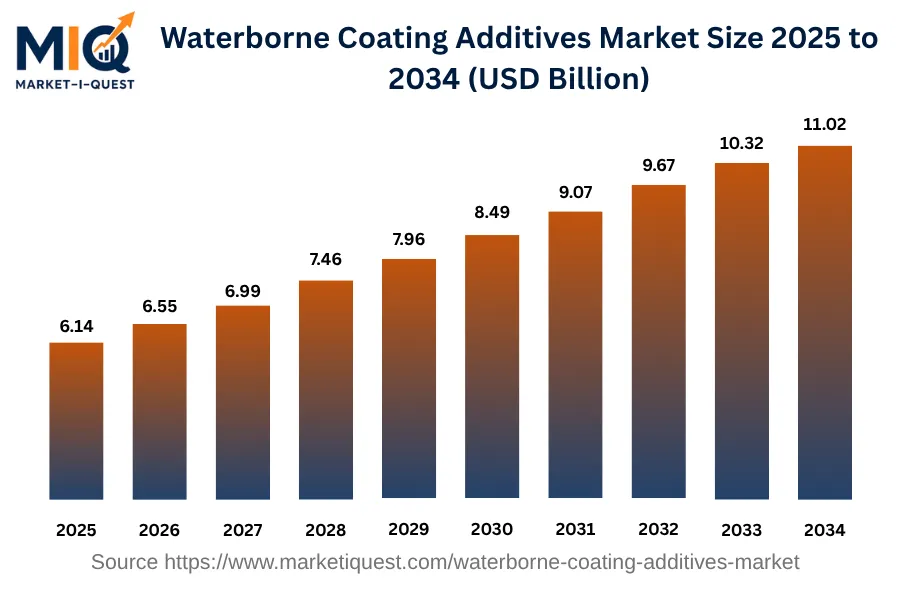
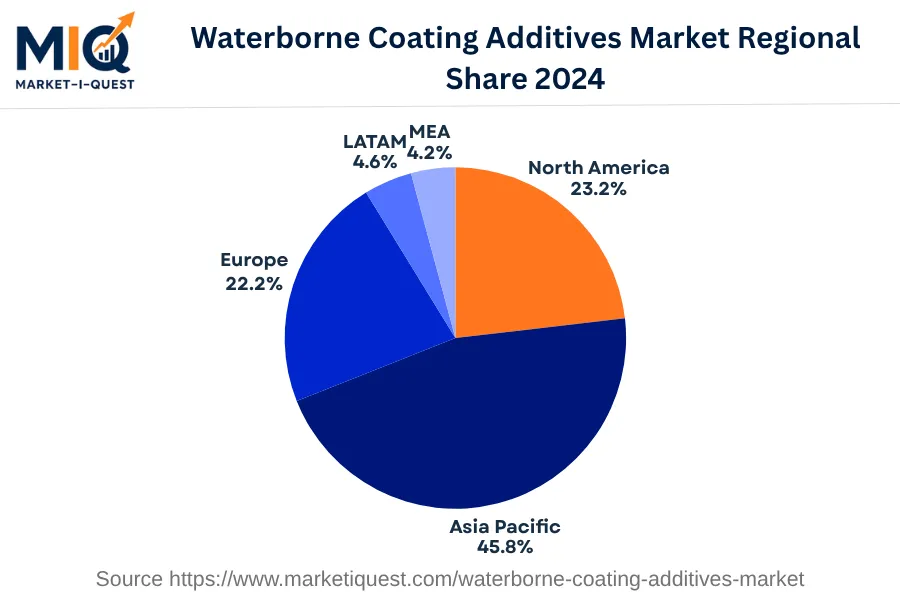
The Waterborne Coating Additives Market size was USD 6.14 Billion in 2025 and is expected to reach USD 11.02 Billion by 2034, with a CAGR of 6.72%. The market maintained a steady growth from its valuation of USD 5.75 Billion in 2024 until 2025. The next decade saw considerable growth as the market size nearly doubled, reaching its projected value of USD 11.02 Billion in 2034. The growth hullaballoo during this time period is primarily based on product innovation and development, and adoption of waterborne coating additives across various industries. As of the regional market share in 2024, the Asia Pacific held the dominant share of 45.83%, followed by North America with 23.16% and Europe at 22.24%. The remaining shares were occupied by LATAM and MEA, accounting for 4.58% and 4.19% respectively.

Key Takeaways

  • By Type - Defoamers led the Waterborne Coating Additives Market.
  • By Formulation - Water-Based Acrylics held the leading position.
  • By Application - Industrial Coatings dominated with a significant market share.
waterborne-coating-additives-market market size

Key Driving Factors

Stringent Environmental Regulations

In the recent years, the implementation of stricter environmental regulations concerning high Volatile Organic Compounds (VOC) emissions from solvent-based coatings has majorly influenced the Waterborne Coating Additives Market. Across regions like Europe and North America, regulatory bodies such as the U.S. Environmental Protection Agency (EPA) and the European Union (EU) have enacted stringent VOC content limits in paints and coatings. These regulations push manufacturers to favor waterborne coating additives, which have a significantly lower environmental impact due to their low VOC content. Manufacturers are shifting towards these environmentally friendly alternatives to not only avoid regulatory penalties but also to rise up to increasing customer expectations for eco-friendly products.
Industrial Expansion in Developing Regions

The Waterborne Coating Additives Market is buoyed by the industrial expansion happening in developing regions such as Asia Pacific and the Middle East. As these countries experience growth in industries such as construction, automotive, and marine, the demand for coating materials also increases. The industrial growth in these regions is amplifying the need for high-performing, durable coatings. Waterborne Coating Additives, with their advantages such as excellent finishing, heat resistance, and superior adhesion are witnessing high demand. Consequently, industrial expansion in these regions is anticipated to continue driving the Waterborne Coating Additives Market in the coming years.

Market Evolution by Timeline

2019-2023
During the period 2019-2023, the Waterborne Coating Additives Market witnessed an increased demand primarily from construction, automotive and furniture industries, especially in countries like China and India due to rapid industrialization.Manufacturers released waterborne coating additives like WETBYK-346 by BYK-Chemie and TEGO Suract 805 by Evonik Industries. However, the integration of these new formulations with existing coatings experienced difficulties, often leading to inconsistent results. There were no significant new policy or regulation changes affecting the market during this period. Nevertheless, sustainability standards such as ISO 14001 steadily influenced the market to move towards environmentally friendly additives. As competition intensified, manufacturers typically offered these additives at competitive prices, often based on long-term contracts, though the pricing spike in raw materials posed challenges. The biggest risk during this period was the inconsistent availability of raw materials, to which manufacturers responded through sprouting partnerships with local suppliers.
2024
In 2024, the demand for Waterborne Coating Additives from industrial maintenance, shipbuilding, and protective coating applications surged, led by Taiwan and Vietnam. Manufacturers continued launching innovative products like waterborne defoamers and wetting agents, but limited availability of testing facilities resulted in slow uptake. No significant policy changes occurred in 2024, but Responsible Care Initiative by the American Chemistry Council (ACC) played a major role in driving environmentally responsible practices across the value chain. A shift in commercial model occurred with manufacturers exploring value-based pricing and partnerships. As a result of abnormal weather patterns, constraints in raw material supply perpetuated causing price fluctuations. Companies typically tackled this by building increased capacity for raw material storage.
2025-2029
From 2025-2029, the Waterborne Coating Additives Market's major demand arose from the packaging and textiles industry, particularly in emerging markets like Brazil and Mexico. Advanced additives, particularly bio-based ones, entered the market but faced regularity issues in many geographies. The EU Bioeconomy Strategy reshaped the market by driving investment towards bio-based and sustainable products. Additionally, digital procurement models and online distribution channels proliferated, offering both front-end standardization and back-end customization options. Increased focus on sustainability saw contract clauses emphasizing recycling and minimal waste. However, rising energy costs introduced a new cost dynamic in manufacturing, pushing for efficient energy usage. This period also saw an increased dependence on strategic alliances for raw material security.
2030-2034
In 2030-2034, demand rose in the aerospace and electronics industry, predominantly in countries like UAE and Australia. High-performance waterborne coating additives emerged but faced technical compatibility issues. The environment-focused Green Coatings Initiative mandated tighter environmental rules around coatings, influencing a transition towards waterborne and bio-based additives. The market saw a rise in partnership agreements focused on technology sharing and pricing stability. However, increased digitalization elevated cybersecurity risks. Measures typically included stringent cybersecurity protocols and clear incident response plans in contracts. Moreover, the risk of supply disruptions due to political and environmental uncertainties became a significant challenge. Market participants responded by incorporating flexible sourcing strategies and enhancing inventory management systems.

Future Market Outlook

Future Opportunities

As consumer preferences shift towards sustainability, the waterborne coating additives market presents significant opportunities for growth. The increasing demand for low-VOC and environmentally-friendly products is already prompting companies like PPG Industries to expand their product lines in 2023. The construction industry, especially in regions such as North America and the European Union, is seeing a surge in green building certifications like LEED, which creates a growing demand for waterborne coatings that meet stringent environmental criteria. Additionally, ongoing innovations in additive manufacturing technologies are paving the way for unique applications of waterborne coatings in industries such as aerospace, where companies like Boeing are investigating chemical solutions that enhance performance while reducing environmental impact. Partnerships between coating manufacturers and technology firms further open avenues for developing new products tailored to meet specific industry needs, thereby enhancing market presence. Furthermore, the anticipated regulatory changes in emerging markets such as India aim to lower harmful pollution levels, which will likely drive the demand for waterborne solutions. As local manufacturers adopt these standards, global players have the chance to capture new market segments. Sustainability initiatives sponsored by governments worldwide are creating incentives for industries to transition to cleaner technologies, thus offering a promising landscape for future developments in waterborne coating additives.

Segmentation Analysis

By Type

The market is divided into subsegments including defoamers, dispersants, rheology modifiers, and wetting agents. In 2024, defoamers accounted for the largest revenue share while rheology modifiers are expected to grow at the fastest CAGR during the forecast period.

Largest Revenue Share

defoamers

Market Share Leader

Defoamers take the largest share of the market revenue in 2024, driven by their diverse application in many industries, particularly in the water treatment, paper & pulp, and coatings industry. The high manufacturing activity in such sectors directs the demand curve of defoamers upwards. In addition, the customers from these industries who highly use defoamers give precedence to the efficiency and the cost-effectiveness of these additives. Though international standards and regulations on environment protection and safety have imposed certain challenges, they have also championed for eco-friendly defoamers upgrading the overall market. Geographically, the demand in Asia Pacific regions has been significantly contributing to the revenues with concentration of industries and growing economies that enable extensive use of defoamers. When we move across the supply chain, it is worthy to note that the availability of raw materials and the ease of formulation also add to the revenue turnover of defoamers market in 2024.

Fastest CAGR

rheology modifiers

Forecast Period Growth Leader

Rheology modifiers are forecasted to register the fastest CAGR in the forecast period. These products alter the viscosity of formulations to provide optimal application properties and have growing demand in industries such as paints and coatings, and personal care products. Their increasing use is majorly driven by their ability to offer better pigment dispersion, improved levelling, and higher stability. Technological advancements are set to further contribute to their growth. The promotion of green chemistry has boosted the development of environmentally friendly rheology modifiers which is anticipated to be a significant growth catalyst. Yet, high raw material costs and strict environmental regulations pose a challenge. However, partnerships and collaborations between manufacturers and raw material suppliers could potentially act as a strategy to overcome these barriers.

By Formulation

The market is divided into subsegments including Water-Based Acrylics, Water-Based Polyurethanes, and Water-Based Epoxies. Water-Based Acrylics accounted for the largest revenue share while Water-Based Epoxies is expected to grow at the fastest CAGR during the forecast period.

Largest Revenue Share

Water-Based Acrylics

Market Share Leader

Water-Based Acrylics' segment has been leading the market in terms of revenue. This can be attributed to their widespread usage across various applications due to their versatility, affordability, and low toxicity. Acrylic polymers have established their dominance due to their superior qualities including high water resistance, great color quality, and quick drying time. In developing regions, the increase in infrastructure projects has led to a higher demand for acrylic emulsions used in architectural coatings. Additionally, rising environmental concerns are motivating end-users to opt for water-based acrylics instead of solvent-based counterparts due to their lower environmental impact. Furthermore, regulations and restrictions on volatile organic compound emissions have propelled the demand for this segment. However, the maturing markets in developed regions might impact the growth slightly. It's key to note that the global supply of raw materials such as propylene may influence this market segment's growth.

Fastest CAGR

Water-Based Epoxies

Forecast Period Growth Leader

Despite not being the leading subsegment in terms of revenue, Water-Based Epoxies are poised to grow at the fastest compound annual growth rate. This growth can be expected due to the increasing demand from various industrial applications. The primary driver for this growth is their superior adhesion, durability, and resistance to wear and tear, especially in harsh conditions. Growing industries such as electronics, automotive, and marine are increasingly using water-based epoxy coatings due to these properties. Furthermore, technological advancements and increased R&D initiatives are leading to the development of more environmentally friendly and efficient water-based epoxies, fostering market adoption. However, potential barriers to adoption could be the high cost of these coatings and the need for a highly skilled workforce for their application. The rising raw material costs might pose a near-term risk to this fast-growing segment.

By Application

The market is segmented into application-specific subsegments including Architectural Coatings, Industrial Coatings, Protective Coatings, Automotive Coatings and Others. In the base year 2024, the Industrial Coatings subsegment commands the largest revenue share, while the Automotive Coatings subsegment anticipates the fastest growth.

Largest Revenue Share

Industrial Coatings

Market Share Leader

The Industrial Coatings sector has held a significant market share due to the widespread usage in a range of industrial applications across sectors including construction, automotive, and manufacturing. The durability and protection offered by industrial coatings against corrosion, abrasion, and environmental impacts make it indispensable in these sectors. Geographically, emerging markets in Asia-Pacific, specifically China and India, have been significant contributors to the demand due to rapid industrial growth and development. The regulatory landscape has also pushed the demand for environmentally friendly and low VOC industrial coatings, furthering market growth. Customer purchasing criteria often hinge on the coating's performance and cost, where industrial coatings have a competitive edge. The robust distribution network encompassing manufacturers, distributors, and retailers has also supported its leading position in the market.

Fastest CAGR

Automotive Coatings

Forecast Period Growth Leader

Automotive Coatings subsegment is expected to witness the fastest growth. Key growth drivers for this market include the rising demand in the automotive industry driven by increasing vehicle production, particularly in emerging economies. Advances in technology have led to the development of environmentally sustainable coatings, which have been gaining traction, serving as a catalyst for this subsegment's growth. Government policies endorsing electric vehicles and high spending capacity of consumers on vehicle aesthetics are additional factors propelling demand. However, the automotive industry faces certain adoption barriers — such as the high cost of automotive coatings and regulatory challenges regarding VOC emissions — these may pose near-term risks to growth. Strategic partnerships within the industry players and capital investment in research and development are expected to overcome these barriers and drive future growth.

Competitive Analysis

Key Market Players

Manufacturers / OEMs

DowDupont
US
BASF SE
Germany
Akzo Nobel
Netherlands

Key Suppliers & Raw Materials

Evonik Industries
Germany
Ashland Inc.
US
Eastman Chemical Company
US

Distributors, Integrators & Channel Partners

Univar Inc.
US
Brenntag AG
Germany
Nexeo Solutions
US

Porter’s Five Forces Analysis

This analysis outlines the competitive forces affecting the Waterborne Coating Additives market.

Supplier Bargaining Power

Medium

Limited number of raw material suppliers might raise their bargaining power.

Buyer Bargaining Power

High

High competition and availability of substitutes enhance buyer bargaining power.

Threat of Substitutes

High

Substantial substitute products in the market present a high threat.

Threat of New Entrants

Low

High initial investment and technical expertise act as barriers for new entrants.

Competitive Rivalry

High

Presence of several key players leading to intense competition.

Regional Analysis

Geographic market dynamics and growth opportunities across key regions

Global Market Outlook

waterborne-coating-additives-market market regional share

North America

In 2024, the North American Waterborne Coating Additives Market demonstrated considerable dynamics. The key drivers of this market included escalating demand from end-user industries like manufacturing and utilities, strict environmental regulations regarding the use of solvent-based coatings, and significant investments in advanced waterborne technologies by industry giants. Additionally, advantageous pricing, stemming from the increased supply of raw materials, acted as a catalyst for market growth. The trends revealed a rise in buyer preference for eco-friendly solutions and increased adherence to governmental policies such as the U.S. Environmental Protection Agency's regulations on volatile organic compound (VOC) emissions. Technological shifts including the advent of multi-functional additives, and the strategic M&A activities, such as the acquisition of BASF Coating Services by AkzoNobel, further invigorated the market landscape. Moreover, a shift towards e-commerce channels for buying waterborne coating additives became evident.

Predominant customer sectors included automotive manufacturers requiring water-based coatings for vehicle exteriors, and public utilities that turned towards waterborne coatings for infrastructure maintenance due to environmental concerns. Also, the demand from the retail sector increased, stimulated by the growing popularity of DIY furniture renovation trends and green building standards; consumer behavior leaning towards sustainable products prompted such a surge. Hence, despite being a mature market, the North American Waterborne Coating Additives sector made notable strides in 2024.

Asia Pacific

In 2024, the Waterborne Coating Additives market in Asia Pacific was characterized by substantial dynamism due to various demand and supply-side factors. Increased environmental regulations in China and India compelled manufacturers to shift towards waterborne coating additives, reducing the emission of volatile organic compounds (VOCs). In Japan and South Korea, flourishing automotive and construction sectors heightened the demand for these additives, while technological advancements in production methods increased supply efficiency. Moreover, government-backed investments in Australia and key ASEAN markets supported the expansion of this industry. Trends in the market manifested through numerous shifts. Increasing consumer preference for eco-friendly and high-performance coatings fueled the demand, particularly in China and India's manufacturing sector. Technological advancements in coating additives led to a surge in product innovations, while strategic partnerships amongst manufacturers, especially in Australia and Japan, strengthened market presence. Additionally, the implementation of ISO 12944-5, a standard specifying protective paint systems, marked a significant regulatory impact in the Asia Pacific region.

Key consumers in this market spanned across diverse sectors. These included manufacturers from automotive and construction industries, retail enterprises selling home-improvement items, and government-backed sustainability initiatives. Demand was also observed in the healthcare sector for hygienic coatings and the utilities sector for protective and aesthetic hardware coatings. Overall, an intricate interplay of drivers and trends steered the Waterborne Coating Additives market in Asia Pacific during 2024.

Europe

In 2024, the Waterborne Coating Additives market in Europe maintained steady growth, shaped primarily by demand dynamics, regulatory factors, and technological advancements. Key demand drivers included growing environmental concerns pushing industries towards more sustainable practices, and the continued expansion of construction and automotive sectors particularly in Germany, the United Kingdom, France, and Italy, leading to increased demand for waterborne coating additives. Stringent European Union regulations promoting the use of eco-friendly coating solutions further stimulated the market. In addition, investments in technological innovations from enterprise sectors enhanced product performance and efficacy, spurting market growth.

Market trends were largely driven by buyer preference for low VOC-emitting coating solutions, with building and construction, and automotive sectors leading this trend. The shift towards green technology paved the way for the development of advanced waterborne coating additives. The distribution channel dynamics were also notable, with e-commerce platforms gaining traction for the sale of these products. Mergers and acquisitions were prevalent amongst key market players, enhancing their market footprint and product portfolio. Policy enforcement in line with the European Green Deal helped standardize industry practices and further promoted the adoption of these additives. Key customer sectors included enterprise, manufacturing, automotive, and government, pushing forward the sustainability narrative.

Latin America

In 2024, the waterborne coating additives market in Latin America demonstrated significant activity, driven by several factors and trends. Government regulations mandating reduced emissions and waste significantly enhanced the shift to waterborne coatings across industries such as automotive, textile, and construction sectors. The adoption of advanced technologies also played a vital role, as manufacturing companies in countries like Brazil and Argentina aimed to improve the durability and performance of their products. Increasing investment in the water-based paint industry, especially from countries such as Mexico, Chile, and Peru, also boosted market dynamics. With regards to supply, the abundant raw material supply in Brazil and Argentina positively affected the market, promoting lower prices that attracted large-scale buyers.

Consumer preference for eco-friendly, less toxic products was a significant trend in the LATAM market. Furthermore, major companies such as Sherwin-Williams and BASF sought strategic partnerships and pursued M&A activity to expand their market share. Notably, the increased enforcement of sustainability standards was a defining trend, driving the massive shift towards waterborne coatings. Lastly, in response to the emerging e-commerce trend in retail, the market saw an increasing number of digital platforms catering to the waterborne coatings additives market. This helped companies extend their reach beyond geographical constraints, especially reaching customers in remote areas of Colombia and Peru.

Middle East & Africa

In 2024, the Waterborne Coating Additives Market in the Middle East and Africa demonstrated significant growth through necessity and innovation. Disruptive industry regulations and environmental concerns motivated an industry-wide shift in Saudi Arabia, UAE, Egypt, and South Africa toward waterborne alternatives. Decreasing costs of raw materials due to the increase of local manufacturing plants in countries like Nigeria and Qatar drove supply dynamics positively. Investment in advanced additive technologies in Israel added to the demand.

Buyers in the automotive and industrial sectors, such as manufacturing plants in UAE and retail stores in Saudi Arabia, preferred eco-friendly coating additives, fueling a green trend. The adoption of digital tools in Kenya's retail sector altered channel dynamics, necessitating waterborne additives that matched emerging technologies. Government and policy enforcement in Egypt and Israel favored environmentally friendly standards, indirectly promoting the use of waterborne coating additives. Strategic partnerships within the region, like the M&A involving a leading UAE additive manufacturer and a South African paint company, further consolidated market standards while encouraging market growth. Overall, regulatory policies, local manufacturing, technology adoption, and strategic partnerships were the prime movers driving demand and shaping trends in the Middle East and Africa's Waterborne Coating Additives Market in 2024.

Recent Industry Developments

Latest market innovations, product launches, and strategic initiatives

June 2025

Evonik launched TEGO® Foamex 8051, a highly efficient, long-lasting siloxane defoamer specifically designed for use in waterborne decorative coatings.

April 2025

Evonik launched TEGO® Wet 288, a unique substrate wetting additive designed to address the challenges of waterborne and radiation-cured formulations.

Frequently Asked Questions