Water Soluble Polymers Market Snapshot

Key Players

  • Ashland Inc. (United States)
  • BASF SE (Germany)
  • Kemira OYJ (Finland)
  • SnF Group (France)
  • Gelmaxx (United States)
  • Nippon Shokubai (Japan)
  • Akzo Nobel N.V. (Netherlands)
  • Ecolab Inc. (United States)
  • CP Kelco (United States)
  • DowDuPont (United States)

Market Size

Base Year 2024
$40.85 Bn
CAGR
5.83%
Forecast 2034
$71.99 Bn

Market Segments

By Type
  • Polyacrylamide and Copolymers
  • Guar Gum & Derivatives
  • Casein
  • Polyvinyl Alcohol
  • Gelatin
  • Polyacrylic Acid
  • Others
By Raw Material
  • Synthetic
  • Semi-Synthetic
  • Natural
By Application
  • Wastewater Treatment
  • Cosmetics and Personal Care Products
  • Oil & Gas
  • Food
  • Pulp and Paper
  • Pharmaceuticals
  • Others

Market Dynamics

Drivers
  • Increasing wastewater treatment needs
  • Growing petroleum industry demand
Restraints
  • Fluctuating raw material costs
  • Stringent environmental regulations
Opportunities
  • Growing wastewater treatment industry
  • Increasing pharmaceutical applications

Market Size

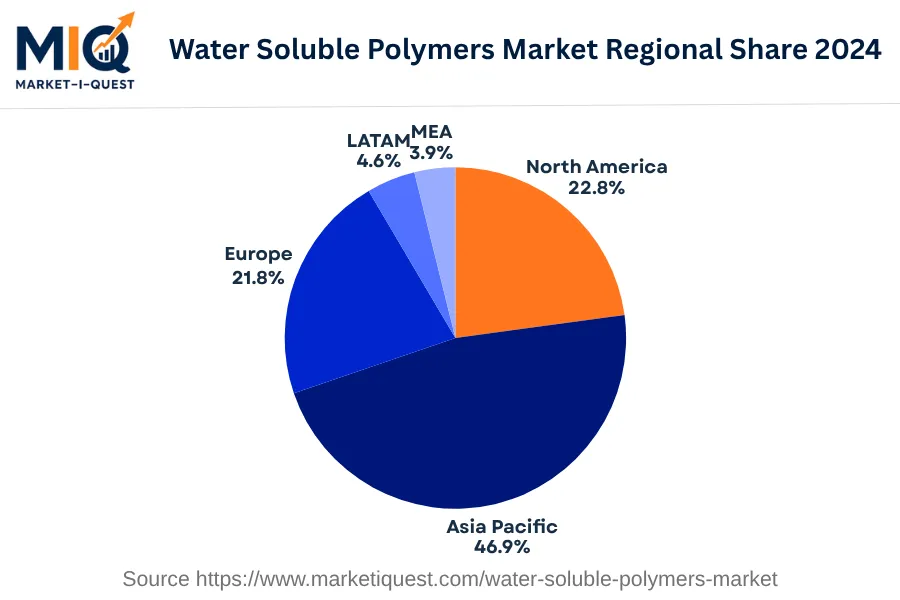
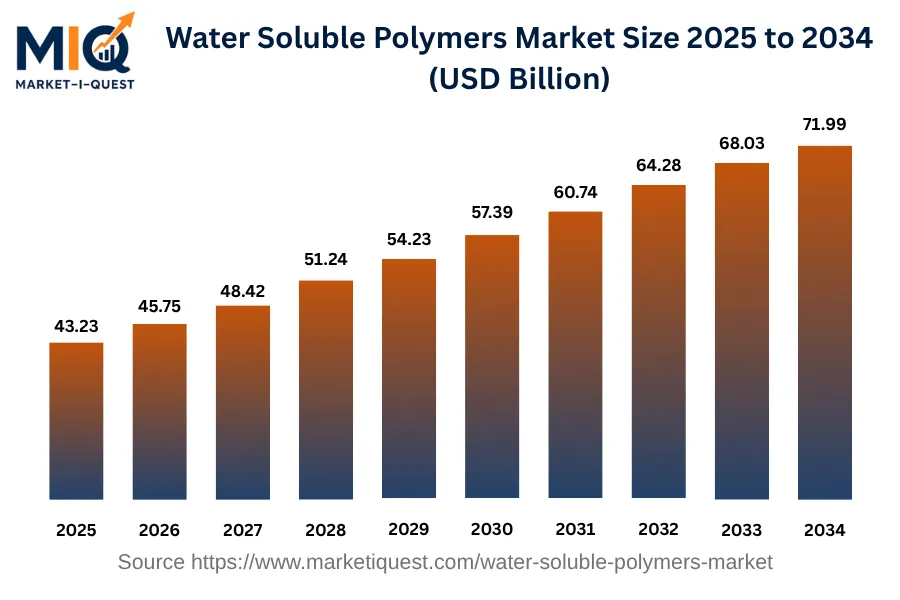
The Water Soluble Polymers Market size was valued at 43.23 USD Billion in 2025 and it is expected to reach 71.99 USD Billion by 2034, with a CAGR of 5.8% over the period. The market began to grow in 2025 and continued to progressively increase in value throughout the years under study. The multiple applications and preferences across diverse industries triggered a consistent rise. By 2034, it was substantially larger, reflecting a nearly 1.7-fold increase from the 2025 value. The market was geographically distributed in 2024 with Asia Pacific dominating at a 46.9% share, followed by North America and Europe accounting for 22.8% and 21.8% of the market, respectively. The remaining market share was distributed between Latin America at 4.6% and the Middle East & Africa at 3.9%.

Key Takeaways

  • By Type - Polyacrylamide and Copolymers held the major share in the Water Soluble Polymers Market in the base year.
  • By Raw Material - Synthetic subsegment was the top contributor to the market in the base year.
  • By Application - Oil & Gas stood as the leading subsegment in the Water Soluble Polymers Market in the base year.
water-soluble-polymers-market market size

Key Driving Factors

Stringent Environmental Regulations regarding Wastewater Treatment

Increasing concerns about environmental pollution have led to the enforcement of stringent government regulations worldwide. These regulations require industries to treat wastewater before its release into water bodies, in order to safeguard water ecosystems and reduce public health risks. Water soluble polymers are an essential component in wastewater treatment as they aid in the coagulation and flocculation process, ensuring dangerous contaminants are effectively removed. This higher regulatory scrutiny in wastewater management promotes the usage of water soluble polymers, consequently driving market growth.

Increasing Adoption in Enhanced Oil Recovery Techniques

The oil & gas sector is currently undergoing a significant shift towards the implementation of enhanced oil recovery (EOR) techniques. These methods involve the use of water soluble polymers to stabilize the viscosity of the injected water, enabling a more efficient extraction of oil reserves. The constant pursuit of operational excellence in the petroleum industry has led to an uptick in the use of such advanced recovery strategies. This targeted adoption in the petroleum sector is pushing the spend on water soluble polymers, driving the market growth in this segment.

Market Evolution by Timeline

2019-2023
In this period, the demand for water soluble polymers increased in the Asia-Pacific region, particularly China, due to its expansive water treatment sector. Predominantly, construction and personal care industries drove demand with extensive use in cement additives and cosmetics. Major suppliers included SNF Group and Kemira. However, production was most likely constrained by the availability and pricing volatility of raw materials like acrylamide. The EU's REACH regulation impacted polymer use, requiring safety data on large volume chemicals. Commercially, pricing was influenced by energy and feedstock costs. Contract types varied, often secured via long-term agreements. Partnerships were a common strategy for manufacturers to meet demand. Risks were centered around environmental regulations and the fluctuating costs of production.
2024
In 2024, North America led the demand for water soluble polymers due to a sharp increase in hydraulic fracturing activities. The pharmaceutical industry started using polymers for drug delivery systems. Suppliers faced challenges with production capacity while trying to adhere to stringent environmental standards. For instance, the Clean Water Act in the US impacted production and disposal methods. The commercial model saw a shift towards investments in technological upgrades to achieve efficiency and sustainability. Companies looked for flexible pricing models to mitigate rising energy and raw material costs. Regulatory compliance posed a significant risk to producers with heavy penalties.
2025-2029
From 2025 to 2029, Latin America and Africa started witnessing a surge in demand for water soluble polymers owing to extensive infrastructure development. The most notable use case was soil stabilization projects in the construction industry. Major contributions to supply came from newly established local companies to meet the regional demand. In terms of policy, more countries started implementing strict regulations on wastewater disposal affecting the market dynamics. The commercial model revolved around competitive pricing driven by the influx of local manufacturers. Risks included potential disruptions due to political instability and regulatory changes.
2030-2034
The period from 2030 to 2034 saw a higher global demand for bio-based, eco-friendly water soluble polymers. Widespread application in agriculture for water retention in soil influenced this demand. New profits came from countries with water scarcity issues. Supply was catered to by established chemical companies and start-ups with bio-based solutions. Regionally, the EU's Circular Economy Action Plan had a significant influence. Commercially, partnerships were common, specifically to achieve sustainability goals. Potential risks were patent infringement allegations and uncertainty over biodegradability impact on ecosystems. Competitive pricing remained a challenge due to high production costs.

Future Market Outlook

Future Opportunities

The present landscape for water-soluble polymers presents various opportunities driven by ongoing sustainability initiatives and regulatory compliance. With countries like Germany introducing stricter regulations on plastic waste management in 2023, manufacturers have an incentive to invest in biodegradable polymers. Moreover, a significant development in the agricultural sector has been the introduction of water-soluble fertilizers that enhance nutrient availability while minimizing water usage. In 2022, Syngenta launched a range of water-soluble fertilizers targeted at precision farming in China that supports more efficient resource utilization. The increasing demand for personal care products that utilize water-soluble ingredients is another area where growth can be anticipated, evidenced by Unilever's commitment in 2021 to replace conventional plastic in their products. Partnerships between research institutions and polymer manufacturers are also expected to drive innovation, as seen in the collaboration launched in 2023 between the University of California, Davis, and Dow on enhancing the characteristics of biodegradable polymers. Such collaborations may lead to improved formulations that cater to a broader range of applications, from food packaging to medical supplies. The expanding interest in sustainable building materials further suggests potential markets for developing water-soluble additives that enhance performance and reduce environmental impacts. As the demand for sustainable solutions escalates, so will the opportunities for water-soluble polymers to penetrate new applications and industries globally.

Segmentation Analysis

By Type

The market is divided into subsegments including polyacrylamide and copolymers, guar gum and derivatives, casein, polyvinyl alcohol, gelatin, polyacrylic acid, among others. Polyacrylamide and Copolymers accounted for the largest revenue share while Guar Gum & Derivatives is expected to grow at the fastest CAGR during the forecast period.

Largest Revenue Share

Polyacrylamide and Copolymers

Market Share Leader

Polyacrylamide and its copolymers are leading by revenue in this segment, influenced by several factors. Key drivers include the product's broad range of commercial applications, such as water treatment, oil recovery, and papermaking. Additionally, it is favored for its effective, sustainable properties in the manufacturing industry. Polyacrylamide’s superior properties like high water absorption, scalability, and adaptability are significant factors attracting industrial clients. The increasing demand from emerging economies and their expanding infrastructure is another contributing factor. The importance of water treatment in these rapidly developing economies has triggered major growth in the polyacrylamide segment, making it the region with the largest sales. Industrial regulations favoring environmentally friendly and cost-effective materials have also provided an impetus to polyacrylamide copolymers' growth run. These drivers collectively explain why the Polyacrylamide and Copolymers subsegment leads today's market.

Fastest CAGR

Guar Gum & Derivatives

Forecast Period Growth Leader

Guar Gum & Derivatives is anticipated to be the fastest-growing subsegment. This is can be attributed to the increasing demand in diverse industries, including food, pharmaceutical, and cosmetics. Companies are leveraging the versatility and affordability of guar gum for industrial applications. Technological advancements have further eased its procurement and application, fostering the growth. From a supply perspective, majority of guar gum is produced in India, allowing the country to significantly regulate pace and pricing in the international market, indirectly supporting the subsegment growth rate. On the demand side, higher consumer preference for natural and organic products in emerging markets is accelerating the usage of guar gum and its derivatives. Policy shifts towards more biodegradable and sustainable products open new avenues for growth and expansion. However, short-term volatility in raw material prices and availability due to environmental changes are potential risks. Despite these, the subsegment's growth drivers outweigh any temporary hurdles making it the fastest growing subsegment in the market.

By Raw Material

The market is divided into subsegments including Synthetic, Semi-Synthetic, and Natural Raw Materials. In the year 2024, the Synthetic subsegment accounted for the largest revenue share while the Natural subsegment is expected to grow at the fastest CAGR during the forecast period.

Largest Revenue Share

Synthetic

Market Share Leader

The Synthetic subsegment has become a substantial contributor in the raw material market, commanding the highest revenue valuation in 2024. The primary driver behind this precedence is the versatility and reliability of synthetic raw materials. Manufacturers prefer synthetic materials as they offer greater control over properties like durability, resilience, and resistance to heat and chemicals, which are crucial factors in many industries. Increased demand from industries such as automotive, construction, and electronics contributes to the booming revenue. In addition, synthetic materials often benefit from more stable and predictable supply chains, reducing the risks of raw materials' shortages. Furthermore, advances in technology have decreased the cost of synthetic raw material production, driving their increased adoption. Therefore, based on these reasons, synthetic raw materials could secure the largest revenue share in 2024.

Fastest CAGR

Natural

Forecast Period Growth Leader

Predictions stipulate that the Natural subsegment will register the fastest growth rate within the forecast period. The assumption leans heavily on the growing consumer and industrial preferences for eco-friendly and sustainable products. Continuous international regulations and policies promoting greener alternatives play a significant role in catalyzing this shift. The future holds an increasing capital expenditure in technologies aiming to improve the efficiency of natural raw material extraction and processing, further accelerating market growth. However, near-term risks involve potential supply chain disruptions caused by climate changes or natural disasters. Potential barriers to full adoption include the often higher costs of natural materials and the slow speed of legislative changes that would incentivize more sustainable business practices. Effective partnerships across the supply chain can help to alleviate these challenges and foster robust market growth.

By Application

The market is segmented into applications such as Wastewater Treatment, Cosmetics and Personal Care Products, Oil & Gas, Food, Pulp and Paper, Pharmaceuticals, and Others, with the Oil & Gas segment accounting for the largest revenue share while the Cosmetics and Personal Care Products segment is forecasted to grow at the fastest CAGR during the forecast period.

Largest Revenue Share

Oil & Gas

Market Share Leader

The Oil & Gas industry dominates the application segment in the base year of 2024. This domination in the contribution to revenue is attributed to the essential nature of oil and gas to almost all sectors of the global economy. New technologies and methods have significantly improved efficiency, making oil and gas extraction more affordable and pushing the limits of exploration further. Geographically, the Middle East, followed by North America, are the regions with the largest oil and gas reserves and are therefore leading contributors in the application segment. Regulatory and supply factors also significantly influence the revenue from this segment. The purchasing decision in this sector is highly influenced by its resilience to price volatility, the long-term contracts in place, and the high switching costs involved. The complex and capital-intensive nature of the Oil & Gas industry requires significant expertise and a variety of specialized channels for distribution and sales.

Fastest CAGR

Cosmetics and Personal Care Products

Forecast Period Growth Leader

The cosmetics and personal care products segment is anticipated to grow at the fastest CAGR. Drivers behind this growth include increasing demand for these products due to a globally rising middle-class population and changing consumer lifestyles. A rise in the purchasing power of individuals has made cosmetics and personal care products accessible to a larger part of the population, leading to an increase in its demand. Moreover, technological innovations, new product launches by key players, and strategic partnerships are acting as catalysts in boosting the growth of this subsegment. Potential barriers to its growth include rigid regulatory environments that scrutinize ingredient safety and the high capital cost needed for product advertising and manufacturing. Nonetheless, the growth trajectory of this sub-segment seems promising, albeit there are near-term risks, including raw material price fluctuations and potential threats from substitute products.

Competitive Analysis

Key Market Players

Manufacturers / OEMs

BASF SE
Germany
Ashland Inc.
US
Kemira Oyj
Finland

Key Suppliers & Raw Materials

The DOW Chemical Company
US
Nitta Gelatin Inc.
Japan
Snf Sas
France

Distributors, Integrators & Channel Partners

Akzo Nobel N.V.
Netherlands
Beijing Hengju Chemical Group Corporation
China
Gelita AG
Germany

Porter’s Five Forces Analysis

A detailed exploration of the competitive forces impacting the water soluble polymers market.

Supplier Bargaining Power

Medium

Controlled by few major suppliers, bargaining power is influenced by raw material availability.

Buyer Bargaining Power

High

High number of buyers with wide range of polymer application increases buyer's bargaining power.

Threat of Substitutes

Low

Specialized applications of water soluble polymers limits threat of substitute products.

Threat of New Entrants

Medium

High setup costs and advanced technology act as barriers yet market profitability attracts new entrants.

Competitive Rivalry

High

High demand and profitability leads to stiff competition among established players.

Regional Analysis

Geographic market dynamics and growth opportunities across key regions

Global Market Outlook

water-soluble-polymers-market market regional share

North America

In 2024, the North American market for water soluble polymers was predominantly driven by increasing demand from key sectors such as wastewater treatment, food processing, and oil & gas. Heightened environmental regulations imposed by governments in the U.S., Canada, and Mexico led to greater reliance on these polymers for efficient waste and water management. Additionally, the adoption of sophisticated technology and consistent investment in research and development amplified the supply dynamics of water soluble polymers. The competitive pricing dynamics further boosted the market appeal.

Concurrently, noticeable trends shaping the market involved significant shifts in buyer behavior, with a marked preference for bio-based and environmentally friendly products. The uptick in technological advancements prompted more efficient production methods, which in turn, streamlined supply channels. A rise in strategic partnerships and mergers & acquisitions was evident, aimed at expanding market share and boosting production capacity. The greater emphasis on stringent environmental standards made it mandatory for sectors like manufacturing and utilities to adopt these polymers consistently. Policy enforcement, especially regarding waste management and water treatment, further drove demand. In fact, retail sector too sought these polymers for enhanced packaging solutions. All these factors collectively dictated the market dynamics of water soluble polymers in North America in 2024.

Asia Pacific

In 2024, the market for water-soluble polymers in Asia Pacific showed significant dynamism, propelled by manifold drivers and trends. Demand for these polymers increased, specifically in China and India, driven by the growing wastewater treatment sector and escalating healthcare industry, respectively. Similarly, stringent environmental regulations, particularly in South Korea and Australia, accelerated the adoption of eco-friendly, water-soluble polymers. Notably, supportive policies in Japan fostered robust investment in polymer research and manufacturing, resulting in advanced product development and commercialization.

On the trends front, consumers in China and key ASEAN markets gravitated towards biodegradable and non-toxic polymer variants, contributing to shifts in product demand and manufacturing strategies. A pronounced trend was the rising incorporation of water-soluble polymers in personal care and pharmaceutical products, noticeably boosting demand from these sectors. In India and Australia, the transition to online sales channels opened new distribution avenues for manufacturers and suppliers. Furthermore, partnerships and M&A activities were prevalent, particularly in Japan and South Korea, influencing market structure and competition. Lastly, enforcement of international polymer standards was progressively adopted across the region to maintain product quality and safety. Thus, the Asia Pacific Water Soluble Polymers Market in 2024 was marked by coherent growth drivers and evolving market trends.

Europe

In 2024, the European market for water soluble polymers experienced noticeable growth, driven primarily by environment regulations, technological adoption, and diversified manufacturing sectors. Widespread regulations promoting water treatment processes in countries like Germany and the United Kingdom triggered amplified demand for these polymers. Furthermore, technological adoption in the region’s robust manufacturing industry, specifically Italy and Spain’s textile sector, facilitated expanding consumption of water soluble polymers.

Key trends shaping the market included a shift towards bio-based water soluble polymers, increased online sales, and strategic alignments. As the sustainability agenda grasped Europe, industries increasingly preferred bio-based polymers, particularly in France and the Nordic countries, often due to stricter environmental policies like the EU's Green Deal. Digitalization led to a transition in the distribution channel, with online sales of these polymers on the rise across the region. In parallel, intensified partnerships and M&A activities were witnessed, especially in Benelux and Central & Eastern Europe. This consolidation trend aimed at enhanced product portfolio and increased market presence. Evidently, the region's water soluble polymers market underwent substantial growth in 2024, influenced by both regulatory drive and a shift in industrial preference.

Latin America

In 2024, the Water Soluble Polymers market in Latin America (LATAM) exhibited a dynamic landscape shaped by various influencers. Key drivers included an uptick in demand from numerous industries such as wastewater treatment, healthcare, and consumer goods across Brazil, Mexico, and Argentina. Regulatory initiatives fostering environmental stewardship also boosted the market, particularly in Colombia and Chile, where new policies prioritized safe wastewater disposal and pollution reduction. Additionally, Peru and Mexico saw significant investment in innovative polymer technologies, enhancing not just supply capabilities but also product quality.

Market trends in 2024 reflected shifts in both technology and consumer behavior. A notable trend was the preference for bio-based polymers amongst key sectors, driven by compelling environmental benefits and potential regulatory incentives. Likewise, adoption of advanced technologies streamlined the polymer production process, ensuring better yield and quality. M&A activity was robust, particularly in Brazil and Chile, reflecting a concentrated effort by businesses to strengthen their positioning within the market. Lastly, stringent policy enforcement was observed across LATAM, with governments ensuring adherence to environmental and health safety standards. Despite challenges, LATAM's water soluble polymers market in 2024 demonstrated robustness, driven by demand diversification, regulatory frameworks, substantial tech investment, and consumer preferences, showcasing the region's determination to align commercial interests with environmental responsibility.

Middle East & Africa

In 2024, the Water Soluble Polymers Market experienced notable progression across the Middle East and Africa region. Notable drivers included increasing investment, particularly in Saudi Arabia and the United Arab Emirates, in oil and gas exploration and wastewater treatment, creating demand for water-soluble polymers. Developing technologies also encouraged adoption, as countries like Israel, Egypt, and South Africa aimed to enhance water conservation efforts through advanced polymer applications. Additionally, changes in regulatory policies, especially in Nigeria and Qatar, promoted increased utilization of these polymers in healthcare and manufacturing sectors.

Several trends shaped the market in 2024. In Saudi Arabia and Qatar's oil and gas industry, there was a significant shift towards using water-soluble polymers for drilling applications for the efficient extraction of shale gas. Egypt and South Africa's healthcare sector saw a rise in demand for these polymers due to their essential role in drug delivery systems. Moreover, partnerships between international polymer providers and local entities in Kenya and Israel were increasingly evident. Lastly, a growing emphasis on environmental regulations led to rigorous policy enforcement in wastewater treatment across the region, encouraging the use of water-soluble polymers for more sustainable practices.

Recent Industry Developments

Latest market innovations, product launches, and strategic initiatives

February 2026

Dober acquired Lygos' Agronomy and Water Treatment businesses, adding Soltellus™, a high-performance biodegradable water-soluble polymer, to its portfolio.

August 2025

SNF, the global leader in water-soluble polymers, acquired Obsidian Chemical Solutions LLC, a leading provider of specialty chemical solutions for completion operations in the oil and gas industry.

Frequently Asked Questions