
Water Based Pigments Market Snapshot

Key Players

  • BASF SE (Germany)
  • PPG Industries
  • Inc. (United States)
  • Akzo Nobel N.V. (Netherlands)
  • Axalta Coating Systems LLC (United States)
  • Pantone LLC (United States)
  • DIC Corporation (Japan)
  • Heubach GmbH (Germany)
  • Daniel Smith (United States)
  • Sun Chemical (United States)
  • Huber Group Holding SE (Germany)

Market Size

Base Year 2024
$17.85 Bn
CAGR
5.76%
Forecast 2034
$31.25 Bn

Market Segments

By Resin Type
Acrylics, Polyurethanes, Alkyds, Epoxies, Water-Soluble Resins
By Pigment Type
Inorganic Pigments, Organic Pigments, Special Effect Pigments
By Pigment Color
White, Black, Yellow, Red, Blue
By Application
Architectural Coatings, Industrial Coatings, Automotive Coatings, Wood Coatings, Textile Coatings, Others

Market Dynamics

Drivers
  • Growing environmental awareness
  • Shift towards non-toxic alternatives
Restraints
  • Regulatory compliance challenges
  • Unstable raw material prices
Opportunities
  • Rising environmental concerns
  • Increasing demand in textile industry

Market Size

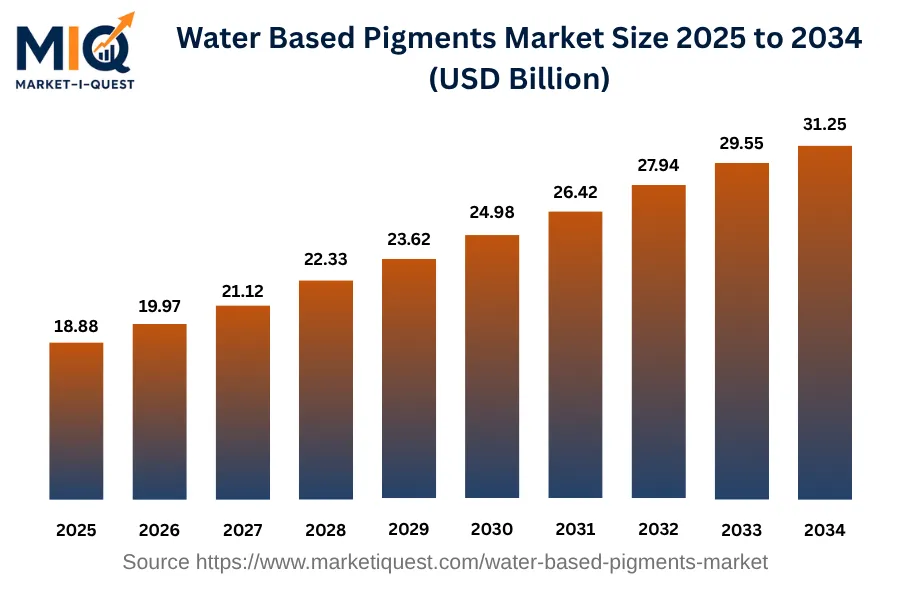
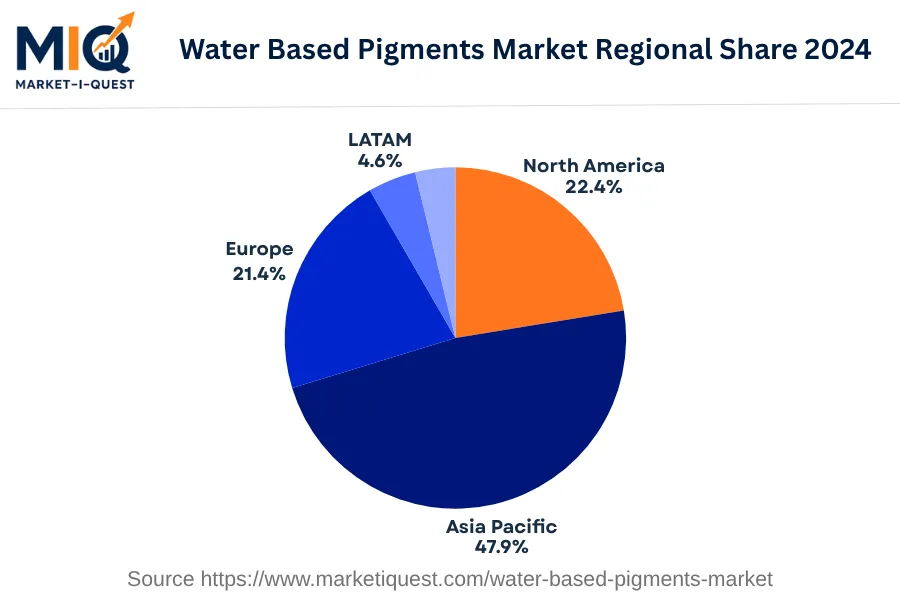
The Water Based Pigments Market had a size of 18.88 billion USD in 2025 and rose to 31.25 billion USD in 2034, marking a Compound Annual Growth Rate (CAGR) of 5.76%. The market growth observed over these years is sustained by an increase in demand for water-based pigments due to their environment-friendly nature. These pigments assure less toxicity and lower VOC emissions, leading to higher adoption across various industries, boosting the market size. Efforts in material research and technological advances in production have also contributed positively to this growth over the years. The market had a different share value across various regions in 2024: The Asia Pacific held a dominant share of 47.9%, followed by North America at 22.4%, Europe at 21.4%, Latin America at 4.6%, and the Middle East and Africa at 3.8%.

Key Takeaways

  • By Resin Type - Polyurethanes led accounting for a major share in the Water Based Pigments Market.
  • By Pigment Type - Inorganic Pigments held a significant position indicating a marked trend.
  • By Pigment Color - White segment was the primary leader in market share during the base period.
  • By Application - Industrial Coatings led accounting for great proportion of the Water Based Pigments Market usage.
water-based-pigments-market market size

Key Driving Factors

Government Regulations on VOC Emissions

The tightening of environmental regulations worldwide on Volatile Organic Compounds (VOCs) emissions is a compelling factor driving the water-based pigments market. Recent enactments by entities such as the European Union and the U.S. Environmental Protection Agency lay strict guidelines on the permissible limit of VOC emissions from pigments, encouraging companies to shift from solvent-based pigments. Water-based pigments possess significantly lower VOC content, aligning with these environmental standards. Therefore, paint and coating manufacturers, who are major users of pigments, are actively adopting water-based pigments in an effort to comply with these regulations, in turn, driving the industry forward.
Transition in Printing Industry

The printing industry's shift toward greener practices is a significant factor contributing to the growth of the water-based pigments market. Increasing environmental concerns have provoked this sector to transition away from solvent-based inks. Water-based pigment inks, which combine performance, safety, and environmental compatibility, are quickly becoming a preferred choice for printing applications, including packaging and textiles. Moreover, businesses are recognising the opportunity to appeal to eco-conscious consumers by adopting water-based pigments, thereby distinguishing themselves in the marketplace. This novel approach in the printing industry is fuelling demand within the water-based pigments market.

Market Evolution by Timeline

2019-2023
During this period, a shift was seen in the demand towards eco-friendly pigments, particularly in the textile and paint industries. Buyers in developed nations like USA sought water-based pigments due to their minimal environmental impact. Suppliers responded by offering pigments with enhanced durability and vibrancy. Barriers to entry were assessed as relatively high due to the need for large-scale pigment production capability and adherence to environmental regulations. Commercially, fixed-price contracts were dominant in this segment. Uncertainty in raw material prices posed a risk to suppliers. In response, suppliers typically hedged through multi-year supply contracts with raw material providers.
2024
A surge was noticed in the utilization of water-based pigments in automotive coatings in this year. This was primarily driven by stricter environmental regulations in Europe and Asia. Major auto manufacturers, such as Toyota, started preferring water-based pigments for metal coatings. While the technology was still maturing, companies started integrating the pigment production with other operations to streamline production. Despite an increase in costs, most companies held on to the fixed price model for contracts. Risk factors included inconsistent quality of the pigment and fluctuations in raw material costs.
2025-2029
In this phase, water-based pigments' demand rose in lesser-developed markets like Africa and Latin America, where textile industries expanded rapidly. More developed nations tightened environmental norms, promoting a shift in technology to nano-pigments with smaller particle size and improved color quality. The traditional supply and contract practices remained the same, and no new commercial models were introduced. However, a significant risk was seen in terms of maintaining the quality of the nano-pigments, demanding more rigorous quality control practices.
2030-2034
By 2030, water-based pigments became the standard in several industrial applications across the globe. The emphasis on sustainability made them a preferred choice in a majority of sectors. This demand was met by significant advancements in pigment production technology, with AI and other mature digital systems now integrated into production processes. Regulation-wise, the EU's CLP Regulation mandated labeling and classification of these pigments, influencing their adoption. While pricing tendencies remained consistent with previous years, partnership-based supply contracts became more common. The major risk was being unable to keep pace with rapidly evolving technology standards.

Future Market Outlook

Future Opportunities

The current regulatory landscape and consumer preferences for sustainable solutions hint at considerable future opportunities for the water-based pigments market. Recent trends show an increasing number of industries, including automotive and construction, demanding eco-friendly formulations. For example, in 2023, Ford Motor Company announced its commitment to using water-based paints in new vehicle models to decrease volatile organic compound emissions, reflecting a shift in industry standards. Concurrently, the rise in environmentally conscious practices among manufacturers ensures a growing societal focus on sustainability. Companies like Sherwin-Williams have committed to improving their product formulations to include a higher percentage of water-based pigments in their commercial offerings. Additionally, advancements in technology, such as the development of smart coatings that incorporate water-based pigments, promise to expand applications, resonating with the demands of industries looking to innovate. Furthermore, 2023 saw the establishment of partnerships, such as between BASF and local manufacturers in Asia, aimed at enhancing the supply chain for water-based pigments, thereby reinforcing market accessibility. This evolving demand signals an immense potential for growth in research and development activities, likely resulting in innovative products tailored to specific industries, with continuous advancements anticipated in product capabilities and customer offerings.

Segmentation Analysis

By Resin Type

The market is divided into subsegments including Acrylics, Polyurethanes, Alkyds, Epoxies, and Water-Soluble Resins. Polyurethanes accounted for the largest revenue share while Acrylics are expected to grow at the fastest CAGR during the forecast period.

Largest Revenue Share

Polyurethanes

Market Share Leader

Polyurethanes have seen the most significant market share in terms of revenue due to their broad applicability across various industries. They are notably used in furniture, construction, electronics, and automotive industries because of their unique and desirable properties like durability, flexibility, and resistance to abrasion and temperature. Furthermore, polyurethanes are being increasingly utilized in the production of thermal insulation materials, contributing to energy-saving initiatives globally. As concerns for energy efficiency and sustainable construction grow, the demand for polyurethane insulation is likely to rise, driving more revenue. The segment also benefits from the shift in consumer preferences toward high-performance products and regulatory standards pushing for more efficient energy use in building infrastructures. Lastly, the sales channel for polyurethanes, which includes direct and indirect sales through distributors, makes them more accessible to the end users, giving them a competitive edge in the market.

Fastest CAGR

Acrylics

Forecast Period Growth Leader

Acrylics are forecasted to grow at the fastest CAGR during the defined period. The demand for acrylics is driven by their compatibility with different substrates and their resistance properties against UV light and harsh weather conditions. This makes them hugely popular in the paints and coatings industry, especially for outdoor applications. Moreover, the booming construction industry, particularly in developing countries, serves as a significant catalyst for this growth. Adoption barriers are relatively low due to cost-effectiveness and easy application of acrylic-based coatings. However, volatile raw material prices could pose a near-term risk to the growth of this subsegment. Expect partnerships, research into alternative raw materials, and technological advancements in the production process as crucial drivers handling this risk and accelerating the growth rate of this subsegment.

By Pigment Type

The market is divided into subsegments including Inorganic Pigments, Organic Pigments, and Special Effect Pigments, with Inorganic Pigments accounting for the largest revenue share, while Special Effect Pigments are expected to grow at the fastest CAGR during the forecast period.

Largest Revenue Share

Inorganic Pigments

Market Share Leader

Inorganic pigments are leading the market owing to their comparatively lower cost, better color performance, and higher durability as compared to their alternatives. Their wide-range of application, spanning from paints and coatings, plastics, ink, construction materials, account for their majority market share. Favorable regulatory norms for the use of inorganic pigments in many sectors is also a driving force, especially in the developing regions where robust construction and industrial growth persist. The near-term risks relate to environmental concerns and fluctuations in raw material prices, but these factors are unlikely to significantly temper the demand. High switching costs associated with changing pigment technologies in established industries also secure inorganic pigments' place as the most revenue-generating subsegment.

Fastest CAGR

Special Effect Pigments

Forecast Period Growth Leader

While contributing a smaller revenue share, Special Effect Pigments are poised to grow at the fastest rate. The impetus for this growth comes from rising product demand in paints and coatings, plastics, and cosmetics industries. These pigments provide distinctive aesthetic value and superior functionality, which is increasingly appealing to producers seeking to distinguish their products in competitive markets. Technology advancements and growing partnerships amongst pigment producers and application industries are gradually overcoming the adoption barriers posed by the higher cost of these pigments. The near-term risks could include stringent regulations linked to environmental concerns, however, continued R&D in environmentally friendly production methods should mitigate this risk.

By Pigment Color

The market is divided into subsegments including White, Black, Yellow, Red, and Blue. White pigment commanded the largest revenue share in the base year of 2024 while Yellow pigment is projected to grow at the fastest compound annual growth rate in the market.

Largest Revenue Share

White

Market Share Leader

White pigment sub-segment registers the largest share of the market's revenue and this trend was particularly evident in 2024. This prominence is largely due to its extensive applicability across a variety of industries such as paints, coatings, plastics, printing inks, construction, and others. There is a consistent demand for white pigments particularly in the paint and coatings industry which makes use of white pigments for its covering ability and brightness. Additionally, white pigments are also integral in the paper and plastic industry where it is used in large quantities to provide opacity and reduce the transparency of these products. Besides, white pigments also offer excellent UV resistance making them suitable for outdoor applications, further driving their demand. Their ubiquity across industries and broad-spectrum functionality are major contributors to their leading revenue position.

Fastest CAGR

Yellow

Forecast Period Growth Leader

Although the yellow pigment sub-segment did not hold the largest market share in 2024, it is expected to experience the fastest CAGR over the forecast period. The increase in consumer preferences for eco-friendly and organic yellow pigments in the food, and textile industries, the rising demand from the agro and automotive sector for pigments, particularly of the high heat resistant variety, and the significant technological advancement seen in pigment production globally are key drivers for this growth. Barriers to adoption include limited pigment sources for certain shades of yellow, and regulatory concerns for pigment use. However, increasing collaborative strategies such as partnerships and agreements among key players represents encouraging catalysts for growth. Near-term risks to growth include potential supply chain disruption from geopolitical tensions and the continued impact of the Covid-19 pandemic.

By Application

The market is divided into subsegments including Architectural Coatings, Industrial Coatings, Automotive Coatings, Wood Coatings, Textile Coatings, and Others. Industrial Coatings accounted for the largest revenue share while Automotive Coatings is expected to grow at the fastest CAGR during the forecast period.

Largest Revenue Share

Industrial Coatings

Market Share Leader

Industrial Coatings command a significant share in revenue within this segment for a multitude of reasons. Industrial Coatings encompass a wide variety of applications in various industries like construction, marine, oil & gas, power, automotive and aerospace. Their use extends from corrosion control of steel structures to aesthetic aspects in finished products. They command a higher price point due to their superior performance in harsh conditions and specific requirements like fire retardancy, abrasion resistance, and chemical inertness. Geographically, Asia-Pacific region, with its rapid industrial growth, is a dominant market for these coatings. Regulations have also played a key role in driving the demand for green, eco-friendly industrial coatings. The significance of longevity and durability in industrial products, along with the need to meet regulatory standards, continue to drive investment in this area.

Fastest CAGR

Automotive Coatings

Forecast Period Growth Leader

Although a smaller segment when compared to Industrial Coatings, Automotive Coatings show a strong growth potential. As the global demand for automobiles continues to increase, so does the demand for Automotive Coatings. It's not just the high volume of vehicles produced that fuels this growth. Growing consumer expectations about vehicle appearance, durability, and quality are leading to advancements in this segment. Technology plays a vital role with innovations in coating materials that offer increased lifespan, enhanced aesthetics, and reduced environmental impact. The emerging trend of electric vehicles also impacts this segment with particular material requirements to cater to their unique architecture. The uptick in partnerships between coating manufacturers and automakers aiming for custom requirements signifies potential for revenue growth. However, regulatory constraints on VOC emissions and procurement of raw materials pose certain challenges on the near-term growth.

Competitive Analysis - Water Based Pigments Market

Key Market Players

Manufacturers / OEMs

BASF SE
Germany
DIC Corporation
Japan
Clariant
Switzerland

Key Suppliers & Raw Materials

Heubach GmbH
Germany
Sudarshan Chemical Industries Ltd.
India
Ferro Corporation
US

Distributors, Integrators & Channel Partners

Synthesia, a.s.
Czech Republic
Trust Chem Co. Ltd.
China
Color Corporation of America
US

Porter’s Five Forces Analysis

The analysis probes the competitive landscape and market dynamics within the Water Based Pigments industry.

Supplier Bargaining Power

Medium

Controlled by a few key players with potential for high raw material prices.

Buyer Bargaining Power

High

Numerous vendors, low switching costs, and standardized products empower buyers.

Threat of Substitutes

Low

Limited viable alternatives, owing to the eco-friendly nature of water based pigments.

Threat of New Entrants

Medium

High setup costs and regulatory compliance act as significant barriers.

Competitive Rivalry

High

Intense competition as established companies fight for market share in a high-growth industry.

Regional Analysis

Geographic market dynamics and growth opportunities across key regions

Global Market Outlook

water-based-pigments-market market regional share

North America

In 2024, the North American water-based pigments market experienced numerous developments driven by varying factors. Regulatory norms pushing towards environmentally friendly products increased the demand for water-based pigments in key sectors like manufacturing and retail. Changing customer preferences for sustainable and non-toxic alternatives further propelled this shift. Additionally, technological advancement in pigment manufacturing expanded the range and quality of water-based pigments, attracting a broader range of customers and industries.

The trend of digital manufacturing within the industrial sector saw a high demand for water-based pigments, owing to their compatibility with digital textile printing. Moreover, existing partnerships among key market players and new mergers and acquisitions broadened the supply chain, making water-based pigments more accessible. Enforcement of environmental policies like the Clean Air Act in the US also played a pivotal role in guiding industry trends towards water-based pigments. Healthcare, government, and utilities sectors, in particular, discovered innovative applications of water-based pigments in their processes. Healthcare companies used them for non-toxic alternatives in color marking, whilst some government projects utilized them in safe infrastructural paint. With technology enabling enhanced product quality and market forces driving towards sustainability, the North American water-based pigments market in 2024 was greatly influenced.

Asia Pacific

The Water-Based Pigments Market in the Asia Pacific witnessed significant traction in 2024. Key drivers included heightened demand in China and India's textile and packaging industries, catalyzed by regulatory emphasis on eco-friendly solutions and a shift to sustainable colorants. Japan’s stringent environmental laws stimulated domestic adoption of water-based pigments, while in South Korea, increased investment in manufacturing sectors like automotives and electronics facilitated market growth. Moreover, competitive pricing dynamics in Australia and ASEAN countries, led by local pigment producers, bolstered supply.

On the trends front, a shift was noted in consumer behavior, favoring brands utilizing greener manufacturing practices across sectors, particularly in retail and fashion. Technological advances led to the proliferation of water-based pigments in digital printing, especially in China and Japan. A wave of partnerships underscored the market, as entities sought to establish a pan-Asia presence. Policy enforcement in India and key ASEAN markets for eco-labeling pushed for water-based pigments in various industrial applications. Meanwhile, regulations towards the reduction of volatile organic compound emissions in Australia's manufacturing sector prompted a switch to cleaner pigment alternatives.

Europe

In the base year of 2024, the European Water Based Pigments Market experienced substantial evolution primarily in Germany, the United Kingdom, France, Italy, Spain, the Nordics, Benelux, and Central & Eastern Europe. Drivers included significant demand from sectors like manufacturing and retail, enhanced by extension of eco-oriented regulations promoting safer pigments usage. Investments in innovation have led to technology adoption across these nations enhancing the supply dynamics and helping stabilize prices.

Trends reflected a shift in buyer behavior, favoring sustainable and environmentally friendly natural pigments which contributed to the increased producer focus on green manufacturing processes. Digital transformation was noticed as emerging channels like e-commerce began playing a crucial role in the sales of water-based paints and coatings amid the ongoing technology shifts. A growing trend was also evident towards partnerships and Mergers and Acquisitions, particularly aiming to share technological expertise, leverage market reach, and enhance product portfolios to meet the rising demand for quality and sustainable water-based pigments. Enactment and stricter enforcement of health and environmental safety policies governed the trend of voluntary standards and certification across the European industries, influencing their choice for cleaner, water-based pigment options.

Latin America

In 2024, the Latin America (LATAM) water based pigments market saw a significant traffic in terms of market dynamics and trends. Driving this market were factors such as increased demand due to shifting toward environmentally friendly products, increased textile industry operations in countries like Brazil and Argentina, and government regulations encouraging the adoption of non-toxic pigments in the paint and coating sector. Moreover, significant investment in innovative pigment technologies and sustainable supply chains spurred the market growth.

Key trends shaping the market included shifting buyer behavior toward water based pigments over solvent based pigments owing to their low VOC emissions, primarily in industries such as textile, paint and coatings, and construction. There was also increased use of digital platforms for pigment distribution in response to the pandemic-hit traditional sales channels. The LATAM market witnessed a number of partnerships and M&A activities aimed at expanding companies' regional footprint. For instance, Brazil's manufacturing industry saw evolving partnerships aiming to incorporate green pigment technologies into their production lines. Upgraded regulatory standards were also enforced in countries such as Mexico and Colombia to ensure the production and consumption of sustainable water based pigments. Enterprises across sectors like manufacturing, retail, and utilities adopted these trends, creating a substantial market demand in the LATAM region.

Middle East & Africa

In the 2024 base year, the Water Based Pigments Market in the Middle East and Africa experienced notable adjustments. Drivers involve heightened demand in Saudi Arabia and UAE due to extensive use in industrial and domestic projects, fueled by robust economic growth and real estate expansion. Israel’s strict environmental regulations promoted Water Based Pigments' adoption over traditional solvent-based counterparts. Egyptian government's significant investments in domestic manufacturing supported local supply dynamics. Innovative pigment technology was embraced predominantly in South Africa and Kenya to increase efficiency and reduce environmental footprint.

Market trends widely observed were a shift towards eco-friendly products influenced by proactive governmental policies in Egypt and UAE. Technology adoption was prominent in Nigeria, where advanced pigment applications were favorably reviewed in the textile industry. The boom of online retail channels in South Africa and Qatar transformed distribution dynamics, facilitating accessibility and affordability of these pigments. Partnerships among pigment manufacturers and construction companies emerged strongly in Saudi Arabia and UAE, maximizing the utility of pigments in infrastructural development. Lastly, enforcement of policy standards representing environmental sustainability, particularly in Israel and UAE, steered the market towards more compliant practices. These trends and drivers were most prevalent among government projects, real estate, manufacturing and retail sectors.

Recent Industry Developments

Latest market innovations, product launches, and strategic initiatives

June 2025

Aquaspersions Group entered into a strategic licensing and distribution partnership with Haycolour, a subsidiary of Hayleys PLC, with Haycolour constructing an advanced chemical dispersion facility in Kalutara, Sri Lanka, expected to commence production in Q4 2025.

January 2025

Lorama Group announced the acquisition of the colorant dispersion businesses of Monteith (Canada) and Waterfoot (UK) from DCL Corporation.

Frequently Asked Questions