Vitamin D Testing Market Snapshot

Key Players

  • Abbott Laboratories (United States)
  • Roche Diagnostics (Switzerland)
  • Bio-Rad Laboratories (United States)
  • Siemens Healthineers (Germany)
  • Ortho Clinical Diagnostics (United States)
  • Quidel Corporation (United States)
  • Thermo Fisher Scientific (United States)
  • DiaSorin S.p.A (Italy)
  • Mindray Medical International (China)
  • Biomerieux SA (France)

Market Size

Base Year 2024
$0.857 Bn
CAGR
8.15%
Forecast 2034
$1.88 Bn

Market Segments

By Test Type
Serum Tests, Rapid Tests, Microneedle Tests, Urine Tests
By Technology
Enzyme-Linked Immunosorbent Assay (ELISA), Charge-Coupled Device (CCD) Technology, Mass Spectrometry
By Sample Type
Blood Samples, Saliva Samples, Urine Samples
By End User
Hospitals, Diagnostic Laboratories, Home Care Settings, Clinics

Market Dynamics

Drivers
  • Increasing health awareness
  • Growing prevalence of Vitamin D deficiency
Restraints
  • High Testing Costs
  • Limited Consumer Awareness
Opportunities
  • Rising health awareness
  • Advancement in testing technologies

Market Size

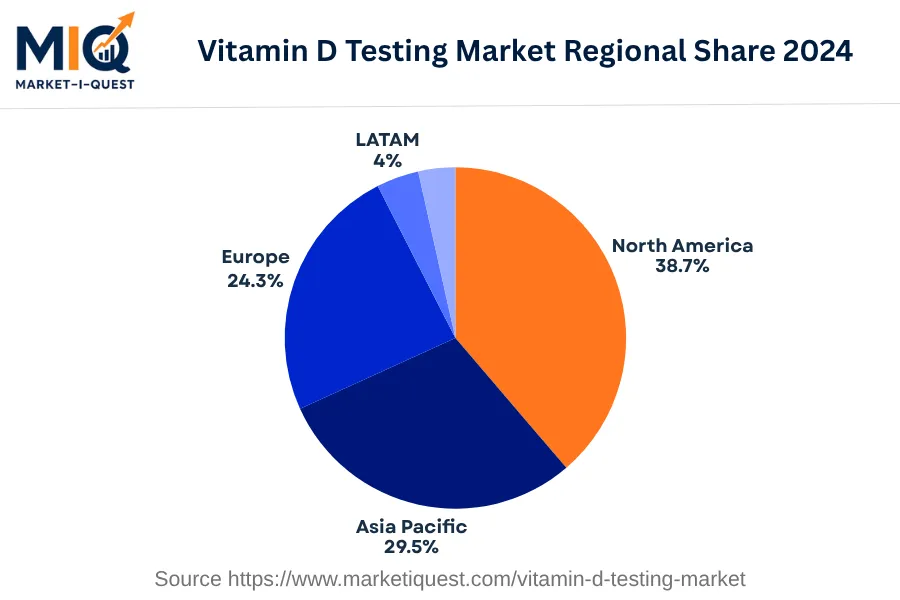
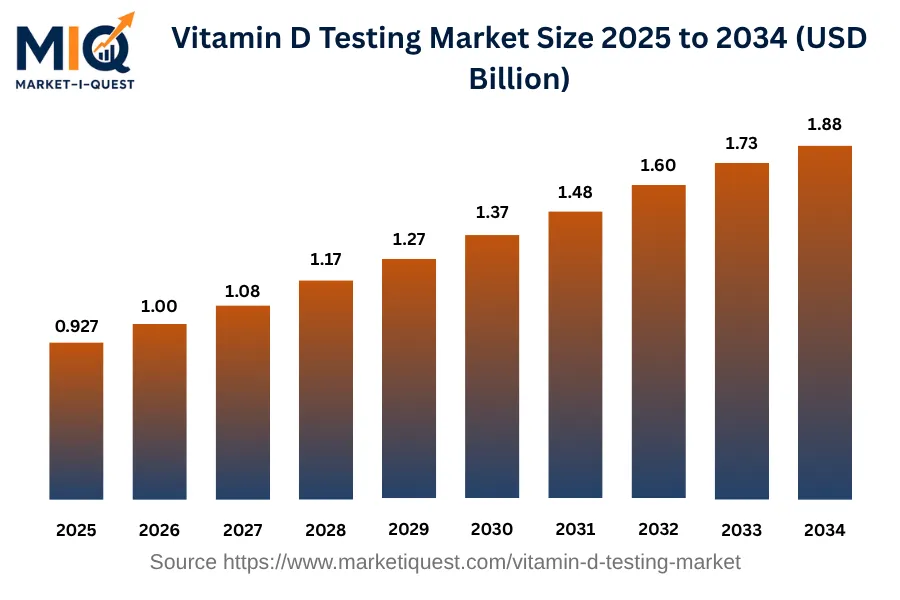
The Vitamin D Testing Market size stood at $0.93 billion in 2025 which, over the years, witnessed a substantial increase, reaching $1.88 billion in 2034 at a CAGR of 8.2%. This growth transpired due to varying incidence and prevalence rates of Vitamin D deficiencies across different regional populations. Increased awareness of the risks associated with low vitamin D levels and subsequent rise in testing and preventive measures also contributed. By 2024, the regional share distribution of the Vitamin D Testing Market was dominated by North America at 38.7%, followed by Asia Pacific at 29.5%, Europe at 24.3%, LATAM at 4.0%, and MEA at 3.5%.

Key Takeaways

  • By Test Type - Serum Tests held the primary position accounting for a substantial market share in the base year.
  • By Technology - Enzyme-Linked Immunosorbent Assay (ELISA) led the market making for a substantial share during the base year.
  • By Sample Type - Blood Samples were the leading segment accounting for a major market percentage in the base year.
  • By End User - Hospitals were at the helm contributing to a significant segment share in the base year.
vitamin-d-testing-market market size

Key Driving Factors

Implementation of Reimbursement Policies by Health Insurance Companies

Health insurance companies around the world are implementing policies to offer reimbursement for preventive check-ups, including Vitamin D tests. This new approach reflects a shift toward preventive care models and is encouraging individuals to undertake routine health assessments. The reimbursement policy has made Vitamin D testing more accessible and affordable for a large segment of the population. This policy, particularly in developed economies like USA, Canada, and several European countries, is a prominent factor driving the Vitamin D testing market as it stimulates more people to avail these tests regularly.

Increased Awareness about Vitamin D Deficiency Disorders

There is a growing global awareness about the impacts of Vitamin D deficiency, thanks to extensive health campaigns run by government and non-government organizations. These awareness initiatives highlight the negative consequences of Vitamin D deficiency like compromised immune system and increased risk of chronic illnesses. This knowledge sparks an interest in individuals to periodically check their vitamin D levels, thereby accelerating the Vitamin D testing market. Moreover, medical professionals are increasingly recommending Vitamin D tests as part of regular health check-ups, further propelling this specific market to expand. The high incidence of disorders related to Vitamin D deficiency also necessitates routine testing, sustaining the market growth.

Market Evolution by Timeline

2019-2023
During this period, prominent buyer segments for Vitamin D testing included Medical Laboratories and Hospitals located in developed regions, particularly North America and Europe, due to Vitamin D deficiency awareness. Technologically, the market saw the influx of automated Vitamin D testing systems, augmented by the existing ELISA and Liquid Chromatography-based testing solutions. However, interoperability was a sticking point, with multiple platforms lacking seamless integration. Legislation, such as the Affordable Care Act in the U.S., encouraged widespread adoption by incentivizing preventative care. The commercial model largely revolved around direct purchase contracts, and there was a gradual rise in leasing agreements. Key risks included supply disruptions on account of trade uncertainties and quality control issues.
2024
In 2024, Healthcare providers and diagnostics centers in densely populated regions like India, China emerged as substantial buyer segments, due to increased awareness and preventive initiatives. Technological advancement reflected in the development of rapid and point-of-care testing solutions. Information exchange and integration among these solutions were still limited. Regulation-wise, the EU's implementation of the In Vitro Diagnostic Regulation (IVDR) impacted the market to ensure high performance and safety standards. Typical commercial contracts remained as direct purchases, with the increasing appearance of partnership agreements between testing system manufacturers and service providers. Production and distribution logistics were the main risk factors due to the COVID-19 resurgence.
2025-2029
From 2025 to 2029, hospitals, diagnostic centers, and homecare buyers led the demand for Vitamin D testing due to prevalent osteoporosis and musculoskeletal disorders. The technology horizon expanded with the emergence of portable and easy-to-use testing kits. These solutions were partially integrated with familiar digital platforms via APIs for efficient data management. Medical Device Regulation (MDR) by the EU mandated strict performance and safety thresholds impacting the market. The commercial model tilted towards new forms, such as subscription-based or 'as a service' models, given the software-driven nature of emerging solutions. The risk of cyber-security breaches became pronounced due to increased connectivity and reliance on digital platforms.
2030-2034
In this period, demand for Vitamin D testing from geriatric patients and homecare services surged, especially from Japan, Italy, and Germany with high elderly population. Supplies saw further technological enhancements towards non-invasive, real-time monitoring solutions, although comprehensive integration with broader healthcare systems was still in progress. Policy-wise, the implementation of Electronic Health Records and Health Information Exchange initiatives by the U.S government significantly influenced adoption. Market practiced evolved into more collaborative models, with alliances enabling joint offerings, whereas the pricing was typically performance-based. This period also experienced potential market saturation and pricing pressures, risking profitability for certain segments.

Future Market Outlook

Future Opportunities

The global emphasis on preventive healthcare is opening new avenues for the Vitamin D testing market as health organizations push for enhanced screening recommendations. The rise in Vitamin D deficiency awareness, particularly noted in studies conducted in Europe and North America, provides a robust context for expanding testing services. In 2023, the Centers for Disease Control and Prevention released guidelines advocating for comprehensive Vitamin D screening, further legitimizing the need for widespread testing within healthcare frameworks. Additionally, partnerships between technology firms and health care providers, like the collaboration established in 2022 between Precision Medicine and the Mayo Clinic, are underlining the growing significance of personalized medicine in vitamin D assessment. Another key opportunity lies in the development of integrated health platforms that combine Vitamin D testing with other health assessments, as demonstrated by initiatives from startups in Southeast Asia targeting holistic health solutions. Moreover, the ongoing exploration of Vitamin D’s wider health implications, such as its relationships with chronic diseases, can spur interest and demand for testing. As insurance companies look to include preventive care in their coverage options, companies that offer streamlined testing solutions may benefit from these shifts. Increased public and private funding towards health innovation will also likely enhance accessibility to Vitamin D testing services, indicating a progressive landscape for future market participants.

Segmentation Analysis

By Test Type

The market is divided into subsegments including Serum Tests, Rapid Tests, Microneedle Tests, and Urine Tests. Serum Tests accounted for the largest revenue share while Rapid Tests are expected to grow at the fastest CAGR during the forecast period.

Largest Revenue Share

Serum Tests

Market Share Leader

Driven by significant diagnostic value and widespread application, the Serum Test segment has the distinction of accounting for the most substantial revenue within the market. The high revenue is largely attributed to the test's reliability and effectiveness in detecting various diseases, including infectious diseases, toxicology-related conditions, and metabolic disorders. It has a broad consumer base, ranging from hospitals to diagnostic laboratories, leading to further revenue augmentation. Additionally, widespread geographical presence and high demand, especially in developed regions like North America and Europe, significantly contribute to its revenue share. Regulatory compliance and supply are also less complicated compared to other testing types, making it more appealing to healthcare providers. The purchasing criteria are predominantly driven by accurate diagnostics, a factor that inherently favors Serum Tests due to their capacity to provide exact results, thus further solidifying this segment as the highest revenue-generating. Lastly, switching costs are relatively high, and distribution channels are well-established, which further promotes the Serum Tests' revenue dominance. Assumptions behind such market dynamics include consistent demand for reliable diagnostic tests and regular updates in testing technologies.

Fastest CAGR

Rapid Tests

Forecast Period Growth Leader

The Rapid Tests segment is forecasted to register the fastest growth rate, driven by several catalysts predominantly encompassing technological developments and public health policies. The need for immediate healthcare response and early diagnosis, particularly in community health centers and home settings, positions Rapid Tests as an essential resource hence the remarkable growth. Additionally, investments and policy guidance toward enhancing point-of-care testing facilities, both in terms of equipment and personnel training, aim to accelerate the segment's growth trajectory further. It is noted that partnerships between Rapid Test kit manufacturers and healthcare institutions, alongside the adoption of such testing by primary healthcare centers, provide a compelling growth narrative. However, there are near-term risks, such as regulatory hurdles and lower precision at times as compared to other conventional tests, that could potentially decelerate growth. Nonetheless, given the pressing demands for immediate, efficient, and user-friendly diagnostic tools, especially during emergencies, Rapid Tests are expected to grow significantly in the coming years. This statement is based on the assumption that the urgency for healthcare entities to adopt more time-efficient diagnostic methods will continue to heighten.

By Technology

In terms of technology, the market is segmented into Enzyme-Linked Immunosorbent Assay (ELISA), Charge-Coupled Device (CCD) Technology, and Mass Spectrometry. Of these, Enzyme-Linked Immunosorbent Assay (ELISA) garnered the largest revenue share in 2024, while Mass Spectrometry witnessed the fastest growth rate.

Largest Revenue Share

Enzyme-Linked Immunosorbent Assay (ELISA)

Market Share Leader

The Enzyme-Linked Immunosorbent Assay (ELISA) subsegment dominated the market in revenue terms due to several factors. Primarily, ELISA techniques offer high sensitivity and selectivity, which increases demand for a wide range of diagnostic applications. This growing demand is driven by increasing health awareness and the needs for prevention and early diagnosis of diseases. Moreover, the implementation of ELISA technology in the rapid detection of infectious diseases, cancer, and inflammatory disorders also significantly contributed to its revenue share. Besides, geographical regions with developed healthcare sectors like North America and Europe account for a significant proportion of the revenue generated. These regions have strict regulation for disease identification and prevalence, which create a robust demand for ELISA. The choice of ELISA over alternatives is also encouraged by its cost-efficient nature, ease of use, and flexibility to adapt to different formats, which reduce switching costs for the consumers.

Fastest CAGR

Mass Spectrometry

Forecast Period Growth Leader

Mass Spectrometry is predicted to experience the fastest growth rate. Key drivers include its superior performance in protein identification, biomarker discovery, and pharmaceutical analysis. Impulse in research and development activities in medicine and biotechnology serves as a catalyst, stimulating the adoption of mass spectrometry. A significant barrier to its wider acceptance had been the high initial capital expenditure, which is gradually surmounting with increasing partnerships and collaborations amongst key players leading to cost reductions. On the technology front, the introduction of high-resolution mass spectrometry, and advancements in ionization techniques have broadened possibilities and applications, causing a surge in demand. However, the near-term risks involve the need for skilled personnel for operation and the complexity of data interpretation. Overcoming these barriers would expedite the growth of mass spectrometry subsegment.

By Sample Type

The market is divided into subsegments including blood samples, saliva samples, and urine samples. In base year 2024, blood samples accounted for the largest revenue share while saliva samples is expected to grow at the fastest CAGR during the forecast period.

Largest Revenue Share

Blood Samples

Market Share Leader

Blood samples hold the majority revenue share within segment 3 in 2024. Their dominance can be attributed to the widespread use of blood tests in medical settings as they provide a broad spectrum of information and are crucial for diagnosing a range of conditions. Blood samples are often the first choice for diagnostic testing due to their high reliability, regulatory norms, and the ability to provide deep insights into a patient's health status. These samples are extensively used in clinical laboratories, hospitals, and research settings, resulting in consistent demand. Furthermore, advancements in blood sampling techniques and equipment contribute to higher revenues for this subsegment. The ease of sample collection and storage, coupled with its clinical significance across various diseases, tend to position blood samples as a preferred choice over saliva and urine samples. This continued demand underscores the dominant revenue position of blood samples in this market segment.

Fastest CAGR

Saliva Samples

Forecast Period Growth Leader

Despite the current dominance of blood samples, it's the saliva samples subsegment that demonstrates the fastest growth rate. Saliva based testing is forecasted to grow at a rapid pace due to numerous advantages such as ease of collection, non-invasive nature, and lower cost. Emerging technologies are enhancing the diagnostic accuracy of saliva samples, leading to increased adoption. Additionally, the rising trend of in-home diagnostic and wellness tests leveraging saliva samples further propels its growth. Social acceptability of these tests is also higher, particularly in pediatric and geriatric populations, due to their non-invasive nature. However, it's important to consider potential growth barriers such as regulatory challenges around saliva based testing for certain diseases and less established protocols compared to blood tests. Despite these factors, strategic partnerships and increasing research investments are expected to facilitate the wide adoption of saliva samples, driving its faster CAGR outlook.

By End User

The market is divided into subsegments including Hospitals, Diagnostic Laboratories, Home Care Settings, and Clinics. In 2024, hospitals accounted for the largest revenue share while home care settings are expected to grow at the fastest CAGR during the forecast period.

Largest Revenue Share

Hospitals

Market Share Leader

Hospitals are tapping the benefits of the latest high-value medical devices and technological advancements, offering an extensive range of healthcare services, thus generating the largest share of revenue in the sector. The complex level of care and numerous medical procedures offered in hospitals, compared to other healthcare settings, result in a higher per-capita cost, thus contributing to the massive revenue share in this subsegment. Hospitals are also typically the primary preference for severe or critical conditions needing superior and specialised care, surgeries, and medical procedures, further cementing the substantial revenue share. Additionally, public hospitals supported by government funds, combined with private hospitals' market-based approach, provide large-scale service coverage in disparate geographical areas, driving substantial revenue from diverse societal strata. Additionally, the linking of hospitals with diagnostic labs further expands the revenue potential, due to an increase in patient referrals.

Fastest CAGR

Home Care Settings

Forecast Period Growth Leader

Home care settings, despite contributing a lesser revenue percentage compared to hospitals, are expected to grow at the fastest CAGR during the forecast period. This growth is driven by the increasing adoption of telehealth and remote patient monitoring due to continual technological improvements and an advancing digital infrastructure. Home care settings are not only economically viable for patients, but they also offer comfortable surroundings and personalised care, thus leading to increasing patient preference. In addition to telehealth, the growth of this sector can also be attributed to the implementation of Artificial Intelligence and machine learning technologies in home care settings. However, factors like the lack of high-skilled healthcare professionals and less exposure to advanced healthcare technologies can pose potential challenges. The growing partnerships between healthcare technology companies with home care providers can potentially overcome these barriers and further bolster growth in this sector.

Competitive Analysis

Key Market Players

Manufacturers / OEMs

Roche Diagnostics
Switzerland
Abbott Laboratories
US
Siemens Healthineers
Germany

Key Suppliers & Raw Materials

Koninklijke DSM N.V.
Netherlands
BASF SE
Germany
Zhejiang Garden Biochemical High-tech Co., Ltd.
China

Distributors, Integrators & Channel Partners

Thermo Fisher Scientific
US
Cardinal Health
US
Danaher Corporation
US

Porter’s Five Forces Analysis

This analysis provides insights into the competitive intensity and attractiveness of the Vitamin D Testing Market.

Supplier Bargaining Power

Medium

Suppliers have moderate power due to the specialized nature of the test kits and reagents.

Buyer Bargaining Power

High

Buyers are empowered by multiple product options, and the gradual shift towards personalized healthcare.

Threat of Substitutes

Low

Few available alternatives for Vitamin D testing, reducing threat of substitutes.

Threat of New Entrants

Medium

Regulatory requirements and high R&D costs pose barriers, while growing healthcare sector attracts new entrants.

Competitive Rivalry

High

Numerous established players and high competition due to extensive product portfolios and technological advancements.

Regional Analysis

Geographic market dynamics and growth opportunities across key regions

Global Market Outlook

vitamin-d-testing-market market regional share

North America

In the base year of 2024, the Vitamin D Testing Market in North America encompassed testing services provided by healthcare facilities, laboratories, and other providers to assess Vitamin D levels in individuals. Key drivers for this market included increased awareness of the importance of Vitamin D for optimal health, reinforced by public health campaigns in countries such as the U.S. Implementation of federal regulations for regular Vitamin D testing in susceptible population groups, including the elderly and people with chronic diseases, also boosted demand. In addition, technological advancements, such as the adoption of high-throughput immunoassays, enhanced the efficiency of Vitamin D testing, reducing costs and increasing supply.

As for trends, behavior shifts exhibited by consumers towards preventive healthcare significantly increased requests for Vitamin D testing. The evolution of telemedicine also transformed operational dynamics, enabling consumers to order at-home test kits via digital channels, fostering convenience and privacy. Further, notable tactical alliances were observed among healthcare providers, diagnostic labs, and technological companies aiming at capitalizing on the growing market. Policymakers rigorously pursued standardization of Vitamin D testing procedures, curbing discrepancies between test results from different providers. In conclusion, various sectors — notably healthcare, retail, and technology — are deeply intertwined in North America's Vitamin D Testing Market, influenced by demographic needs, regulatory measures, technology, and changing consumer preferences in the base year of 2024.

Asia Pacific

In 2024, the Vitamin D Testing Market in the Asia Pacific region saw a sharp rise in activities due to increased health awareness, regulatory norms, technological advancements, and accessibility. Drivers include the escalating awareness of Vitamin D deficiency among the public in India and China, which fuels the demand for testing services. Moreover, governments in these countries have stepped up regulations, implementing robust healthcare norms to combat health issues related to Vitamin D deficiency. In Japan and South Korea, investment in advanced diagnostic technologies and better accessibility to healthcare have increased the uptake for these tests. Simultaneously, the declining cost of these tests due to market competition contributes to their increased adoption across the region.

Trends witnessed indicate a shift in consumer behavior toward preventive healthcare measures, reflected in higher demand for tests from the retail sector. The evolution of at-home rapid testing technologies has also gained traction among consumers in Australia, making it a popular choice for Vitamin D testing. Partnerships between diagnostic companies and healthcare providers have increased across the key markets of ASEAN, aiming to improve service accessibility. Lastly, rigorous policy enforcement regarding test standards has been seen across all the mentioned countries, ensuring quality and accuracy in testing services. The clients for the Vitamin D Testing Market are primarily healthcare providers, retail sector, and government health departments, reflecting across enterprises of various sizes.

Europe

In 2024, the Vitamin D Testing market in Europe demonstrated considerable growth emphasized by increased consumer awareness of the health implications of Vitamin D deficiency. Driving forces behind this growth included higher demand owing to a surge in prevalence of Vitamin D deficiency disorders across the region and an upswing in the aging population in countries like Italy and Germany. Technological advancements in Italy and the UK led to increased adoption of automated Vitamin D tests, making the testing process quicker and easier. Stringent government regulations in France and Spain for public healthcare screening programs also propelled the market.

Regarding trends, increasing consumer awareness about preventive healthcare in countries such as the UK and Germany resulted in a shift towards regular, self-administered Vitamin D tests. Channel dynamics showed a preference for online purchases across Europe, resulting from the convenience of at-home test kits. In Nordic countries like Denmark and Sweden, partnerships between public healthcare systems and diagnostics manufacturers helped provide accessibility to Vitamin D tests. Implementation of European Union (EU) policies enforcing regular checkups led to higher testing rates, notably in Benelux countries and Central & Eastern Europe. Prominent customer sectors included healthcare, with a significant increase seen in both government-led public health programs and retail purchases for self-administered tests.

Latin America

In 2024, the Vitamin D testing market in Latin America has empowered key public health initiatives amidst rising concerns about micronutrient deficiencies. Regulatory bodies across LATAM- especially in Brazil, Mexico, and Argentina- have endorsed extensive Vitamin D testing, stimulating demand for accurate, cost-effective testing solutions. In countries like Colombia, Chile, and Peru, government investment in healthcare infrastructure has spurred this market's expansion, with efforts to integrate Vitamin D testing into routine health check-ups. Technological advances in non-invasive testing methodologies are another crucial driver, differentiating market offerings and broadening supply potential.

Consumer behavior patterns underscore interest in preventive health measures, positioning Vitamin D testing as a cornerstone of individual wellness strategies. Consequently, manufacturers have sought innovative collaborations with healthcare institutions, often via public-private partnerships, to address this rising demand. A shift towards digital health technologies is evident across LATAM, with telehealth platforms incorporating Vitamin D testing into their service packages as a core offering. The adoption of international health regulations and standards in the region has also normalized Vitamin D testing. While this market predominantly services the healthcare sector, it also caters to enterprises promoting employee wellness, thus underscoring its relevance across multiple sectors in the LATAM region.

Middle East & Africa

In the base year of 2024, the Vitamin D Testing Market exhibited significant growth across the Middle East and Africa. The principal drivers of this trend were increased health awareness and high prevalence of Vitamin D deficiency in countries such as Saudi Arabia, UAE, and Egypt. Rigorous efforts by governments to address health concerns led to an influx of investment in the healthcare sector which subsequently aided market expansion. Moreover, the adoption of advanced diagnostic technology in urban hospitals and clinics bolstered the testing capabilities, hence driving up demand.

Trends in the market were primarily influenced by shifts in buyer behavior. Saudi and UAE consumers increasingly opted for regular health check-ups that included Vitamin D testing, thanks to effective health promotion campaigns. Furthermore, developments in the field of medical research and technology enabled faster, more efficient testing methods, creating a shift towards these new products. The market also saw several partnerships between local and international medical firms, with the intent to drive improvement in Vitamin D testing. The healthcare sector, particularly hospitals and diagnostic centers, constituted the main customer base, as they underwent capacity expansion in response to the increasing demand for Vitamin D screening among the general populace in 2024.

Recent Industry Developments

Latest market innovations, product launches, and strategic initiatives

March 2026

The Birmingham and Solihull Integrated Care System in the UK implemented an updated Vitamin D testing policy, aligning with national guidelines and regional best practices to standardize testing protocols across primary and secondary care.

September 2025

Roche's Ionify® 25‑Hydroxy Vitamin D Total Assay received CLIA "Moderate Complexity" categorization from the U.S. FDA, becoming the first mass spectrometry‑based vitamin D testing system to receive this designation, expanding reimbursement and laboratory adoption pathways.

Frequently Asked Questions