Thermal Spray Coatings Market Snapshot

Key Players

  • Praxair Surface Technologies Inc. (United States)
  • H.C. Starck GmbH (Germany)
  • Oerlikon Metco (Switzerland)
  • Bodycote (United Kingdom)
  • A&A Coatings (United States)
  • Flame Spray Technologies B.V. (Netherlands)
  • Saint-Gobain SA (France)
  • ASB Industries Inc. (United States)
  • Plasma-Tec Inc. (United States)
  • General Magnaplate Corporation (United States)

Market Size

Base Year 2024
$12.75 Bn
CAGR
7.24%
Forecast 2034
$25.65 Bn

Market Segments

By Process
  • Electrical
  • Combustion Flame
By Material
  • Metals & Alloys
  • Polymers
  • Ceramics
By End User
  • Automotive
  • Aerospace
  • Electrical & Electronics
  • Healthcare
  • Energy & Power
  • Agriculture
  • Machinery
  • Others

Market Dynamics

Drivers
  • Rising automotive industry demand
  • Increasing need for corrosion-resistant coatings
Restraints
  • High equipment costs
  • Limited substrate suitability
Opportunities
  • Rising industrialization globally
  • Surge in aerospace activities

Market Size

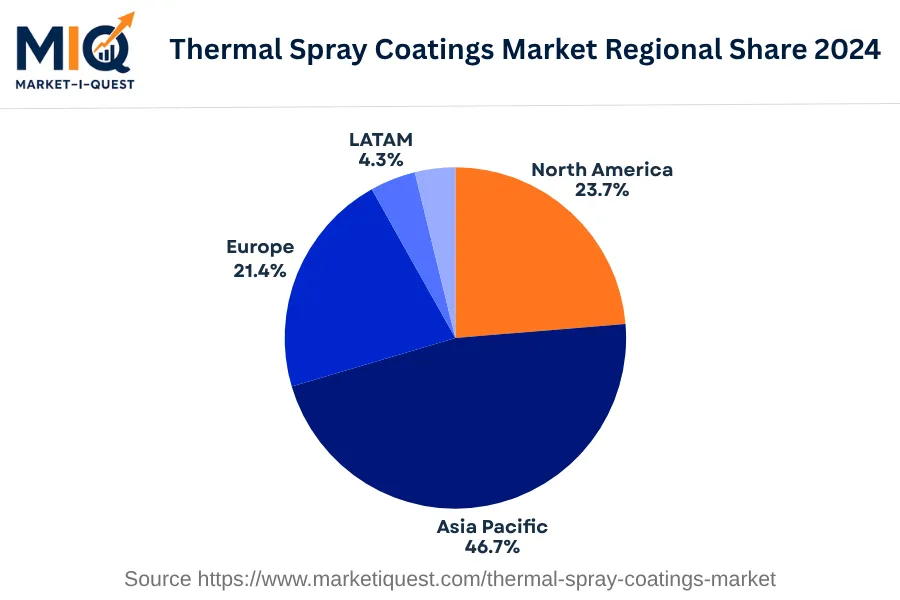
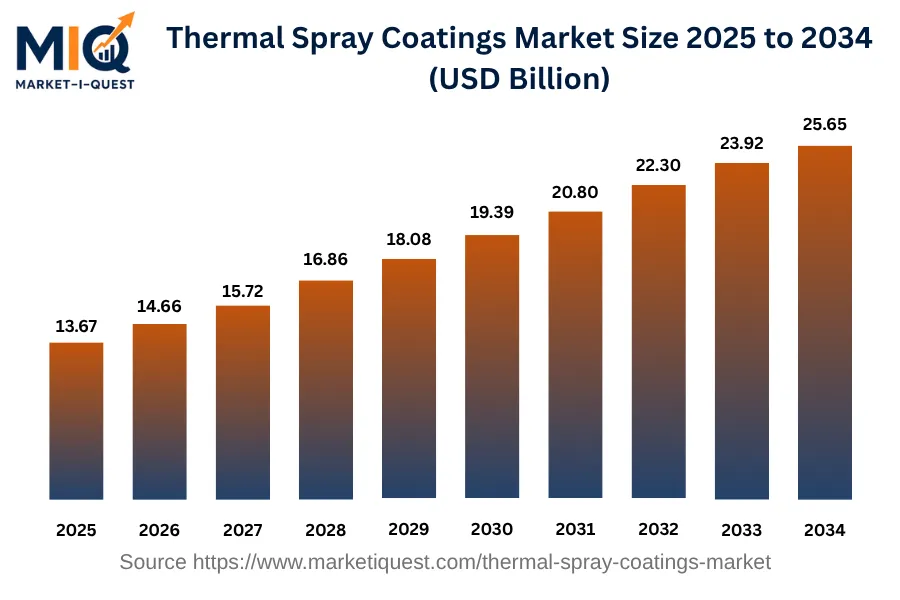
The Thermal Spray Coatings Market was valued at $13.67 billion in 2025 and underwent significant growth to reach a value of $25.65 billion in 2034, exhibiting a Compound Annual Growth Rate (CAGR) of 7.24% over the period. The market saw growth from 2024’s value of $12.75 billion to $25.65 billion within a span of a decade which is attributable to the increased utilization of thermal spray coatings in various industries. Growth path was marked with continuous expansion over these years brought on by technological advancement and the advantages offered by thermal spray coatings such as increased lifespan of parts and enhancement in performance. As per regional share distribution in 2024, the Asia Pacific region held the highest share of 46.7%, followed by North America and Europe at 23.7% and 21.4% respectively. Meanwhile, Latin America and Middle East and Africa (MEA) held a lower share of 4.3% and 3.8% respectively.

Key Takeaways

  • By Process - Electrical process led the Thermal Spray Coatings Market in the base year.
  • By Material - Metals & Alloys held the majority share in the Thermal Spray Coatings Market during the last reporting period.
  • By End User segment - Automotive industry had a notably high usage of thermal spray coatings.
thermal-spray-coatings-market market size

Key Driving Factors

Shift towards Superior Corrosion Protection Solutions in Oil & Gas Industry

In the oil & gas sector, there has been a distinct transition from traditional anti-corrosion solutions to advanced techniques, favoring thermal spray coatings. Thermal spray coatings offer extensive resilience to heat, wear, and corrosion—a trio of threats frequently damaging pipelines, thereby shortening their lifespan and escalating maintenance cost. With the thermal spray coating, companies can significantly diminish material wear, thereby extending the service life of equipment and pipelines. As a result, there is a heightened demand in the oil & gas industry for these coatings to offset potential economic losses associated with shutdowns and maintenance.

Compulsory Compliance to Environmental Regulations in the Automotive Industry

Stringent environmental regulations enforced by governments globally, particularly for the automotive sector, play a substantial role in driving the thermal spray coatings market. The coatings are eco-friendly, with their application releasing significantly fewer volatile organic compounds (VOCs) compared to traditional alternatives. They also minimize metal waste due to their high material utilization ratio. Because adherence to such regulations is legally enforced, automotive companies are incited to integrate these coatings into their manufacturing processes. Consequently, the stipulation to comply with environmental regulations and legislation is promoting the utilization of thermal spray coatings, thereby strengthening the market.

Market Evolution by Timeline

2019-2023
During this period, Thermal Spray Coatings (TSC) primarily catered to the aerospace and automotive industries due to their capability to provide protection against wear and erosion. Specifically in North America, these industries demonstrated a high demand for TSC due to strict regulatory standards by FAA in the United States. However, the TSC technology faced constraints due to its expensive and complex installation process. Nations that initiated the usage of TSC policies include the United States and European Union under their aerospace standard AS9100 and REACH regulations respectively. A typical commercial model was direct selling from manufacturer to the industries, with substantial price competition between major companies. Challenges included high installation costs and need for skilled labor.
2024
In 2024, TSC found application in the healthcare industry, especially in the manufacturing of orthopedic and dental implants. Demand increased in the Asian region due to an ageing population and growing healthcare infrastructure. This period saw the technology evolve to reduce the installation complexity, but high costs still remained a barrier. There were no major policy regulations for TSC application in healthcare except general medical device manufacturing standards. A new business model emerged with partnerships happening between TSC manufacturers and healthcare device companies. The risk of contamination during application continued to be a major concern.
2025-2029
In this timeframe, TSC witnessed expansion into the energy sector, specifically for protective coatings in wind turbines and solar panels. The global markets, predominantly Europe and North America, experienced increased demand for TSC due to increased focus on renewable energy sources. Technology gained further refinement but, regulatory certification for TSC in energy sector was initial and fragmented. Different price models were tested to encourage wider adoption, which included bundling with other energy equipment. Supply chain complexities due to unique energy sector needs presented a new challenge for manufacturers.
2030-2034
This phase saw burgeoning application of TSC in marine and chemical industries. Australia and oceanic regions emerged as primary markets due to their substantial shipping industry. Supply side saw major players working on increased process automation to handle rising global demand and to reduce labor cost. Despite international maritime regulations, specific policies regarding TSC usage were still nascent. As a commercial model, long term contracts became popular as these industries sought to establish reliable protective coating sources. However, longer application times and possible environmental risks posed potential problems in wider adoption.

Future Market Outlook

Future Opportunities

Future opportunities within the thermal spray coatings market appear robust, particularly as industries seek to enhance efficiency and longevity in their applications. In 2024, the aerospace industry is expected to increase its dependence on advanced thermal barrier coatings, driven by ongoing regulations from the International Air Transport Association aimed at reducing emissions. This will likely lead to heightened collaboration between companies such as General Electric and smaller coatings firms. Additionally, the oil and gas sector is observing a renewed interest in protective coatings that withstand extreme conditions, including high levels of corrosion and wear. In 2023, major oil producers began partnerships with thermal spray providers to develop bespoke solutions tailored to specific operational challenges, reflecting a proactive stance on maintenance and operational efficiency. Furthermore, as industries globally pursue sustainability goals, companies are likely to pivot towards eco-friendly thermal spray materials. In 2023, organizations including the American Coatings Association have initiated dialogues on sustainable practices in coatings. The automation and digitalization trends, particularly in the Asia-Pacific region, signify that there will be increased investments in advanced robotics and machine learning to optimize coating processes. As these developments unfold, businesses that remain agile and prioritize innovation are poised to seize market share, shaping the future landscape of thermal spray coatings globally.

Segmentation Analysis

By Process

The market is divided into subsegments including Electrical and Combustion Flame. Electrical accounted for the largest revenue share while Combustion Flame is expected to grow at the fastest CAGR during the forecast period.

Largest Revenue Share

Electrical

Market Share Leader

The Electrical subsegment is currently leading in revenue, mainly due to its widespread applicability and adoption across various sectors. Industries ranging from manufacturing to construction heavily rely on electrical processes, bolstering this subsegment's market position. The development of sophisticated, energy-efficient, and diverse electric appliances has also been a significant driver, with industries and consumers opting for these due to their high efficiency and lower environmental impact. Geographically, regions with developed and emerging economies showing high industrial activity contribute significantly to the Electrical subsegment's revenues. Regulatory frameworks promoting energy efficiency and environmentally-friendly practices favor the adoption of electric appliances, adding to the segment's growth. Moreover, customers tend to prioritize items with low running costs and high efficiency - characteristics inherent to electrical appliances. This trend, combined with the relatively low switching costs, has led to an increase in reliance on electrical tools, further driving the Electrical subsegment's revenue.

Fastest CAGR

Combustion Flame

Forecast Period Growth Leader

Although trailing in terms of revenue, the Combustion Flame subsegment is expected to grow at a faster rate in the coming years. This growth is fueled by several factors including technological advancements, operational efficiencies, and strategic partnerships. Despite barriers such as high initial costs and environmental concerns, an improved understanding of combustion processes and groundbreaking developments in flame controlling technologies are expected to boost the growth of this subsegment. Policy interventions promoting the reduction of harmful emissions by incentivizing clean combustion processes will also act as catalysts for growth. However, the considerable investment required for upgrading or replacing existing equipment with cleaner, more efficient models presents a near-term risk. Future prospects for the Combustion Flame subsegment look promising, given the ongoing technological and operational efficiencies enabling more sustainable combustion processes and partnerships that allow for shared risks and rewards.

By Material

The material market is divided into subsegments including Metals & Alloys, Polymers, and Ceramics with Metals & Alloys accounting for the largest revenue share while Polymers are expected to grow at the fastest CAGR during the forecast period.

Largest Revenue Share

Metals & Alloys

Market Share Leader

The Metals & Alloys segment dominates the market based on revenue in the base year 2024. This can be attributed to the diverse application base and the innate characteristics of metals and alloys, such as high strength, durability, and resistance to wear and tear, which make them indispensable in various industries. They are widely used in industries like automotive, aerospace, construction, and electronics. The robust growth in these industries, especially in emerging economies, fuels the demand for metals and alloys. Additionally, innovations in alloy development, improving the properties of materials, have provided a further boost to its demand. Strict regulations regarding the use of certain materials, particularly in the food and beverage and healthcare sectors, also favor metals and alloys, thereby contributing to their significant revenue share.

Fastest CAGR

Polymers

Forecast Period Growth Leader

Despite Metals & Alloys leading in terms of revenue, the Polymers segment is expected to grow at the fastest CAGR. Polymers' growth rate can be attributed to their versatile properties like lightweight, high resistance, and durability. Continued innovation in the polymers sector is resulting in the development of superior quality and high-performance polymers that are finding applications in a variety of sectors, particularly in packaging, automotive, and the medical field. Moreover, increasing regulatory constraints and sustainability issues related to metals and alloys utilization are shifting consumer preference toward polymers. However, fluctuations in raw material prices and environmental concerns related to polymer disposal may impede the growth rate to some extent, necessitating breakthroughs in bio-based and recyclable polymer technologies.

By End User

The market is divided into subsegments including Automotive, Aerospace, Electrical & Electronics, Healthcare, Energy & Power, Agriculture, Machinery, and Others. Automotive accounted for the largest revenue share while Healthcare is expected to grow at the fastest CAGR during the forecast period.

Largest Revenue Share

Automotive

Market Share Leader

The automotive industry has a central role in the economy with a large number of vehicles produced annually. It is a driver of technological advancement and a significant consumer of various other industries' inputs. The extensive customer base for automotive parts and services sets the groundwork for high revenue realization, with the demand extending across both the consumer and commercial sectors. A combination of safety legislation and changing consumer preferences create a strong market for new and sophisticated car components, leading to increased sales. High consumption areas include developed and emerging regions alike, largely due to the growing vehicle ownership trends. Also, the presence of global automotive giants who make enormous capital expenditures helps to keep revenue growth steady in this segment. Their investment in research and development, manufacturing facilities, and marketing supports a highly competitive and dynamic market. Key purchasing criteria include quality, durability, and cost-effectiveness, but unique selling propositions like product differentiation and innovation can command premium pricing which adds to the revenues.

Fastest CAGR

Healthcare

Forecast Period Growth Leader

The Healthcare industry subsegment is expected to observe the fastest growth rate in terms of CAGR during the forecast period. This is predominantly due to the ever-increasing global demand for healthcare services and technological advancements in medical equipment and procedures. Factors such as an aging global population, rising rates of chronic diseases, and increased emphasis on preventative care are driving the expansion of this subsegment amid significant opportunities for growth and innovation. Innovation in healthcare technology, including telemedicine and predictive analytics, is boosting the sector’s growth. One significant barrier standing in the way is regulatory approval processes, which can be time-consuming and unpredictable. However, greater public-private partnerships, mergers, and acquisitions present new opportunities for growth in the healthcare industry, allowing for easier navigation of these barriers. At the same time, potential risks to this growth include possible regulatory changes and the uncertain economic impact of global events.

Competitive Analysis

Key Market Players

Manufacturers / OEMs

Praxair S.T. Technology, Inc.
US
Bodycote Plc
UK
Oerlikon Metco
Switzerland

Key Suppliers & Raw Materials

Air Products and Chemicals, Inc.
US
Saint-Gobain
France
BASF SE
Germany

Distributors, Integrators & Channel Partners

Linde AG
Germany
Messer Group GmbH
Germany
Airgas, Inc.
US

Porter’s Five Forces Analysis

This analysis evaluates the competitive forces impacting the thermal spray coatings market.

Supplier Bargaining Power

Medium

Limited suppliers and high raw material costs moderately empower providers.

Buyer Bargaining Power

Low

Lack of alternatives and high switching costs reduce buyer’s bargaining power.

Threat of Substitutes

Low

Specialized nature and performance of thermal spray coatings limit viable substitutes.

Threat of New Entrants

Medium

Entry barriers with high investment requirements and technological expertise constrain new entrants.

Competitive Rivalry

High

Intense competition with companies striving for technological advancement and product differentiation.

Regional Analysis

Geographic market dynamics and growth opportunities across key regions

Global Market Outlook

thermal-spray-coatings-market market regional share

North America

In 2024, the North American market for thermal spray coatings revealed a significant growth trajectory, largely driven by industries like automotive, aerospace, healthcare and energy. Demand in the automotive and aerospace sectors surged, fueled by stringent regulations for durable and corrosion-resistant coatings. This was bolstered by advancements in coating technologies promising efficiency and longevity. Investments in renewable energy, specifically wind turbines, also contributed to the rising demand, with thermal sprays crucial in extending equipment lifespan.

The year witnessed a shift towards high-velocity oxygen fuel (HVOF) in the US, largely attributable to its superior coating characteristics compared to plasma spray technology. Partnerships and M&A activity grew, as providers aimed to consolidate their market presence and broaden their product portfolio. Canada exhibited a notable increase in demand within the oil and gas sector as the industry adopted thermal spray coatings to combat the challenges of erosion and corrosion. On the other hand, Mexico saw a spike in the use of thermal spray coatings within its growing electronics manufacturing sector due to its proven track record in enhancing product durability. Policy implementation across the region promoted the use of thermal spray coatings that met environmental and safety standards, shaping the market trajectory in these geographies during the base year.

Asia Pacific

In 2024, the Thermal Spray Coatings Market in Asia Pacific exhibited dynamic growth driven by various elements. Leap in industrial manufacturing and the surge in demand for these coatings in sectors like aerospace, automotive, healthcare, and energy spearheaded the growth. Additionally, government regulations like China’s “Made in China 2025” policy bolstered domestic production, thus promoting market expansion. Technological innovation, specifically in India and South Korea, also played a pivotal role where enhancement in coating quality as well as process efficiency significantly influenced the supply chain dynamics.

Buyer behavior, particularly in Japan and Australia, saw a notable shift towards environmentally-friendly coatings, with a notable rise in demand for Plasma Sprayed Ceramic Coatings. Noticing this trend, numerous manufacturers are striving to diversify their product portfolios or forming strategic partnerships, reflected by the emergence of various M&As in the Chinese and ASEAN markets. Strict enforcement of industry standards and policies were also prominent, inspiring manufacturers to produce high-quality products and innovate. For instance, the healthcare sector, especially in India, required stringent quality and standards for medical implant coatings. Thus, the Thermal Spray Coatings Market flourished in the Asia Pacific region during 2024, backed by both robust drive factors and intriguing market trends.

Europe

In 2024, the European thermal spray coatings market showcased notable growth, primarily driven by demand for improved automotive forms and the continued industrial expansion. Regulatory advancements, including EU directives on greenhouse gas emissions and fuel efficiency, spurred demand for high-performance coatings in the region. Investment flowed particularly towards high-velocity Oxy Fuel (HVOF) and plasma spraying technologies, reflecting the market's rapid adoption of these modern processes. Meanwhile, increased raw material prices, especially of metals, critically affected the supply dynamics and overall cost of the coatings.

In terms of trends, buyer behavior across the manufacturing, aerospace, and automotive sectors gravitated towards environmentally-friendly and durable coatings, prompting a shift towards green and nanotechnology coatings innovations. Distribution channels evolved, with an increased emphasis on direct-to-customer and online channels leveraging digital technologies for real-time inventory and delivery management. Partnerships flourished specifically among coating material manufacturers and spray equipment producers to optimize product offerings. Notably, enforcement of REACH's Annex XVII and the "Green Deal" policy led to a renewed focus on the development and adoption of compliant, less-toxic thermal spray coatings. Germany, United Kingdom, France and Italy – leading industrial nations – remained the primary contributors and consumers within this market context.

Latin America

In 2024, the Latin America (LATAM) thermal spray coatings market showcased significant value across various industries. Drivers include increased demand from the automotive sector, particularly in Brazil and Mexico, where manufacturers elevated their usage of thermal spray coatings to enhance the longevity and performance of auto components. Additionally, in countries like Argentina and Colombia, regulations advocating for more sustainable manufacturing practices urged companies to adopt thermal spray technologies, contributing to market growth. An increase in infrastructure investment in Chile and Peru also stimulated demand for these coatings in the construction industry.

Trends in 2024 underscored a shift in buyer behavior, with cost-effective, durable products gaining preference. A prominent trend was rapid technology adoption aimed at reducing operational costs and increasing productivity, particularly in the manufacturing sector. In the oil and gas industry, technology shifts to anti-corrosive coatings to increase equipment lifespan were notable. Partnerships among LATAM nations became more frequent, allowing technology transfer and leveraging market opportunities. Lastly, reinforcement of environmental policies affected the market, evidenced by the increasing preference for eco-friendly thermal spray coatings in healthcare, utilities, and retail sectors. Despite potential challenges, these drivers and trends pointed to a robust thermal spray coatings market in LATAM for 2024.

Middle East & Africa

In 2024, the Thermal Spray Coatings Market in the Middle East and Africa demonstrated substantial growth. The increased demand for thermal spray coatings was primarily driven by significant investment in sectors like oil and gas, utilities, and manufacturing, particularly in countries like Saudi Arabia, UAE, and Nigeria, which demanded corrosion and wear-resistant products. The adoption of more advanced technologies and new application methods also boosted market growth. In addition, increased emphasis on energy efficiency regulations, particularly in South Africa and Israel, indirectly stimulated market growth by driving demand for thermal barrier coatings.

Market trends in 2024 showcased a strong shift towards High-Velocity Oxygen Fuel (HVOF) coating technology, mainly due to its superior performance characteristics. Adoption of newer materials like Ceramics and Intermetallics was also noticeable, primarily in the oil and gas sector in Qatar and Egypt. In terms of partnerships and M&A, several multinational corporations established strategic collaborations with local players, especially in Kenya, to expand their foothold in the African market. Lastly, stricter enforcement of quality and environmental standards, prominently in the government sector in Saudi Arabia and the UAE, influenced the market by promoting higher-quality coatings and more environmentally friendly techniques.

Recent Industry Developments

Latest market innovations, product launches, and strategic initiatives

April 2026

Integrated Global Services (IGS) announced the acquisition of Flamsprutarna AB, a global provider of turbine maintenance and thermal spray services, strengthening IGS's ability to support power plant operators worldwide across gas turbines, steam turbines, and nuclear assets.

January 2025

Integrated Global Services (IGS) acquired the engineered coatings and materials business of Liquidmetal Industrial Solutions. Based in Chattanooga, Tennessee, the acquired business specializes in high-performance thermal spray application services and materials. The acquisition expands IGS's asset integrity technology portfolio.

Frequently Asked Questions